
Puck, 1877-05 · page 7 of 16
Puck — May 1877 — page 7: what you’re looking at
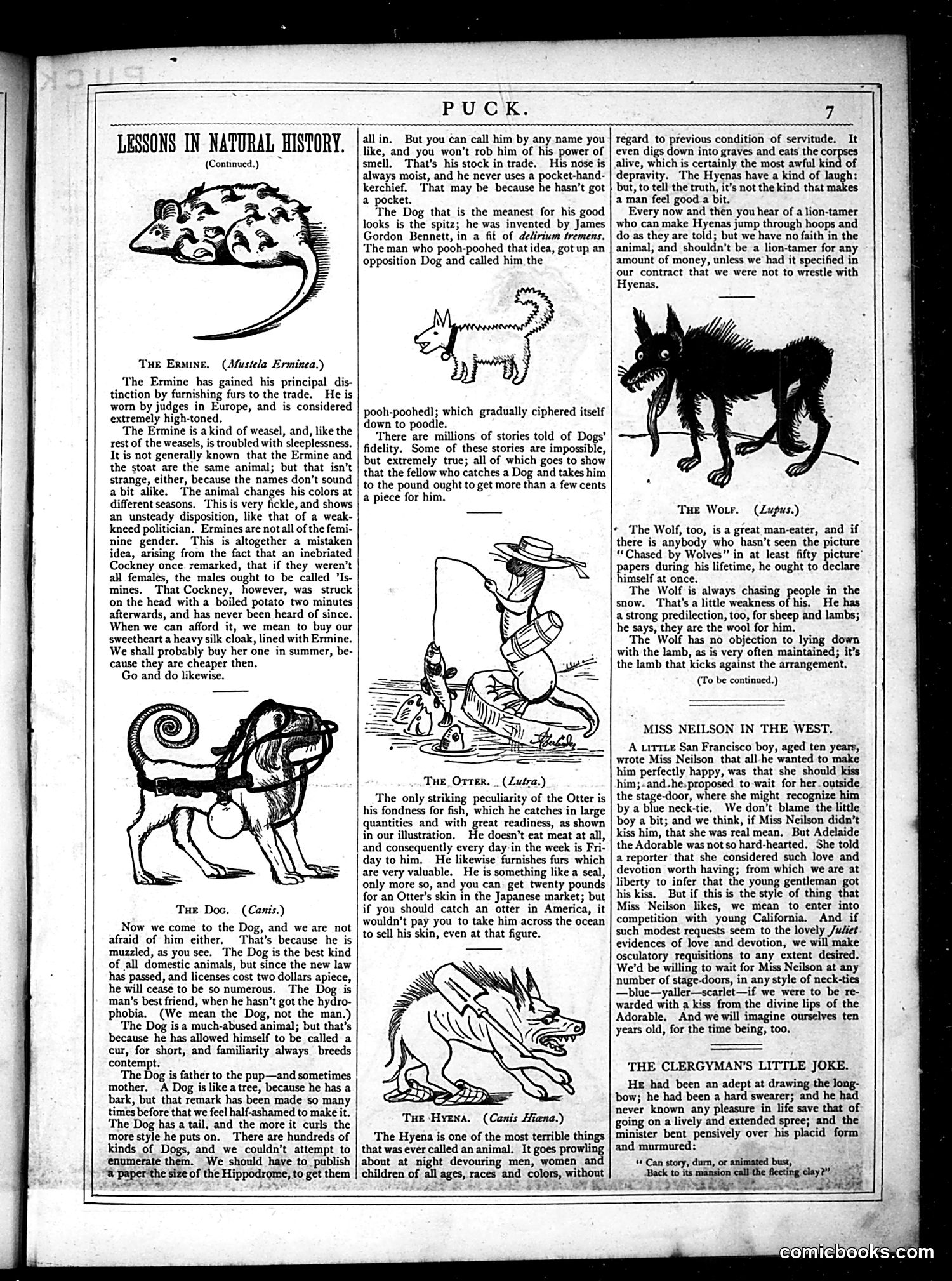
What you’re looking at
This page from *Puck* contains "Lessons in Natural History," a humorous educational feature illustrated with animal drawings and descriptions. Rather than political satire, it's comedic natural history writing about various animals: the Ermine, Dog, Otter, Wolf, and Hyena. The humor comes from anthropomorphizing these creatures with human characteristics and social commentary. For instance, the Dog section jokes about dogs being "man's best friend" and notes their popularity, while the Wolf section plays on folklore about wolves chasing people in snow. The Hyena description mentions their frightening reputation and laugh. This appears to be lighthearted educational content meant to entertain readers through witty animal descriptions rather than biting political commentary typical of *Puck*'s satirical tradition.
📄 Transcribed text from this page (OCR, searchable)
Machine-transcribed from the original scan — historical spelling and the odd misread are preserved.
LESSONS IN NATURAL HISTORY. (Continued.) Tue Ermine. (Afustela Erminea.) ‘The Ermine has gained his principal dis- tinction by furnishing furs to the trade. He is worn by judges in Europe, and is considered extremely high-toned. The Ermine is akind of weasel, and, like the rest of the weasels, is troubled with sleeplessness. It is not generally known that the Ermine and the stoat are the same animal; but that isn’t strange, either, because the names don’t sound a bit alike. The animal changes his colors at different seasons, This is very fickle, and shows an unsteady disposition, like that of a weak- kneed politician. Ermines are not all of the femi- nine gender. This is altogether a mistaken idea, arising from the fact that an inebriated Cockney once. remarked, that if they weren’t all females, the males ought to be called 'Is- mines. That Cockney, however, was struck on the head with a boiled potato two minutes afterwards, and has never been heard of since. When we can afford it, we mean to buy our sweetheart a heavy silk cloak, lined with Ermine. We shall probably buy her one in summer, be- cause they are cheaper then, Go and do likewise. Tue Doc. (Canis.) Now we come to the Dog, and we are not afraid of him either. That’s because he is muzzled, as you see. The Dog is the best kind of all domestic animals, but since the new law has passed, and licenses cost two dollars apiece, he will cease to be so numerous. The Dog is man’s best friend, when he hasn't got the hydro- phobia. (We mean the Dog, not the man.) The Dog is a much-abused animal; but that’s because he has allowed himself to be called a cur, for short, and familiarity always breeds contempt. The Dog is father to the pup—and sometimes mother. A Dog is like atree, because he has a bark, but that remark has been made so many times before that we feel half-ashamed to make it. The Dog has a tail, and the more it curls the more style he puts on. There are hundreds of kinds of Dogs, and we couldn’t attempt to enumerate them. We should have to publish “® paper'the size of the Hippodrome, to get them PUCK. all in. But you can call him by any name you like, and you won't rob him of his power of smell. That’s his stock in trade. His nose is always moist, and he never uses a pocket-hand- kerchief. That may be because he hasn't got a pocket. The Dog that is the meanest for his good looks is the spitz; he was invented by James Gordon Bennett, in a fit of delirium tremens. The man who pooh-poohed that idea, got up an opposition Dog and called him the pooh-poohedl; which gradually ciphered itself down to poodle. There are millions of stories told of Dogs’ fidelity. Some of these stories are impossible, but extremely true; all of which goes to show that the fellow who catches a Dog and takes him to the pound ought to get more than a few cents a piece for him. Tue Otter. . (Lutra.) The only striking peculiarity of the Otter is his fondness for fish, which he catches in large quantities and with great readiness, as shown in our illustration. He doesn’t eat meat at all, and consequently every day in the week is Fri- day to him. He likewise furnishes furs which are very valuable. He is something like a seal, only more so, and you can get twenty pounds for an Otter’s skin in the Japanese market; but if you should catch an otter in America, it wouldn’t pay you to take him across the ocean to sell his skin, even at that figure. Tue Hyena. (Canis Hiena.) The Hyena is one of the most terrible things that was ever called an animal. It goes prowlin; about at night devouring men, women an children of all ages, races and color without regard to previous condition of servitude. It even digs down into graves and eats the co! alive, which is certainly the most awful kind of depravity. ‘The Hyenas have a kind of laugh: but, to tell the truth, it’s not the kind that makes a man feel good a bit. Every now and then you hear of a lion-tamer who can make Hyenas jump through hoops and do as they are told; but we have no faith in the animal, and shouldn't be a lion-tamer for any amount of money, unless we had it specified in our contract that we were not to wrestle with Hyenas. Tue Wor. (Lupus.) + ‘The Wolf, too, is a great man-eater, and if there is anybody who hasn’t seen the picture “Chased by Wolves” in at least fifty picture’ pers during his lifetime, he ought to declare imself at once. The Wolf is always chasing people in the snow. That's a little weakness of his. He has a strong predilection, too, for sheep and lambs; he says, they are the wool for him. The Wolf has no objection to lying down with the lamb, as is very often maintained; it’s the lamb that kicks against the arrangement, (To be continued.) MISS NEILSON IN THE WEST, A LitTLe San Francisco boy, aged ten years, wrote Miss Neilson that all-he wanted to make him perfectly happy, was that she should kiss him;.and.he.proposed to wait for her_outside the stage-door, where she might recognize him by a blue neck-tie. We don’t blame the little boy a bit; and we think, if Miss Neilson didn’t kiss him, that she was real mean, But Adelaide the Adorable was not so hard-hearted, She told a reporter that she considered such love and devotion worth having; from which we are at liberty to infer that the young gentleman got his kiss. But if this is the style of thing that Miss Neilson likes, we mean to enter into competition with young California. And if such modest requests seem to the lovely Judiet evidences of love and devotion, we will make osculatory requisitions to any extent desired. We'd be willing to wait for Miss Neilson at any number of stage-doors, in any style of neck-ties —blue—yaller—scarlet—if we were to be re- warded with a kiss from the divine lips of the Adorable, And we will imagine ourselves ten years old, for the time being, too. THE CLERGYMAN’S LITTLE JOKE. He had been an adept at drawing the long- bow; he had been a hard swearer; and he had never known any pleasure in life save that of going on a lively and extended spree; and the minister bent pensively over his placid form and murmured: “ Can story, durn, or animated bust, Back to its mansion call the fleeting clay?” aODED BRR SN