
Puck, 1877-05 · page 5 of 16
Puck — May 1877 — page 5: what you’re looking at
What you’re looking at
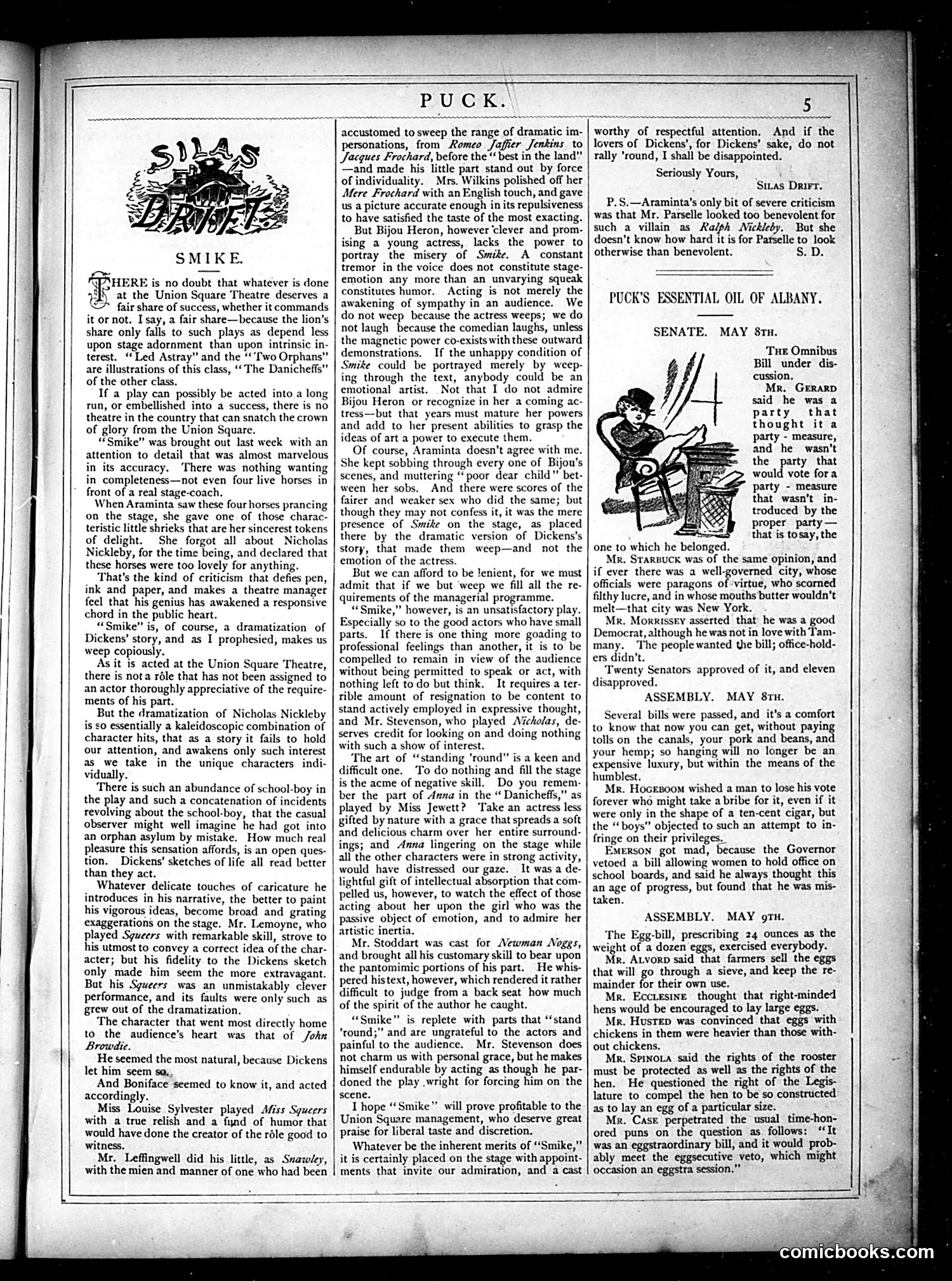
This page primarily contains **theater reviews** rather than political cartoons. The main content discusses dramatizations of Dickens' works, particularly criticizing actress Bijou Heron's performance in "Smike" for lacking emotional depth and power. The text praises other actors' performances while critiquing Heron's "constant terror in the voice" and inability to convey genuine feeling. There's debate about whether stage adaptations of Dickens adequately capture the source material's emotional impact. The small illustration shows a figure in period costume, likely related to one of the theatrical productions being reviewed. The page also contains legislative notes from the Senate and Assembly, suggesting this is a typical Puck issue mixing entertainment criticism with political/social commentary.
📄 Transcribed text from this page (OCR, searchable)
Machine-transcribed from the original scan — historical spelling and the odd misread are preserved.
SMIKE. Apeere is no doubt that whatever is done v f) at the Union Square Theatre deserves a <" fair share of success, whether it commands it or not. I say, a fair share—Dbecause the lion's share only falls to such plays as depend less upon stage adornment than upon intrinsic in- terest. “Led Astray” and the “ ‘Iwo Orphans” are illustrations of this class, ‘The Danicheffs” of the other class. If a play can possibly be acted into a long run, or embellished into a success, there is no theatre in the country that can snatch the crown of glory from the Union Square. “Smike” was brought out last week with an attention to detail that was almost marvelous in its accuracy. ‘There was nothing wanting in completeness—not even four live horses in front of a real stage-coach. When Araminta saw these four horses prancing on the stage, she gave one of those charac- teristic little shrieks that are her sincerest tokens of delight. She forgot all about Nicholas Nickleby, for the time being, and declared that these horses were too lovely for anything. That's the kind of criticism that defies pen, ink and paper, and makes a theatre manager feel that his genius has awakened a responsive chord in the public heart. “Smike” is, of course, a dramatization of Dickens’ story, and as I prophesied, makes us weep copiously. As it is acted at the Union Square Theatre, there is nota réle that has not been assigned to an actor thoroughly appreciative of the require- ments of his part. But the dramatization of Nicholas Nickleby is so essentially a kaleidoscopic combination of character hits, that as a story it fails to hold our attention, and awakens only such interest as we take in the unique characters indi- vidually, ‘There is such an abundance of school-boy in the play and such a concatenation of incidents revolving about the school-boy, that the casual observer might well imagine he had got into an orphan asylum by mistake. How much real pleasure this sensation affords, is an open ques- tion. Dickens’ sketches of life all read better than they act. Whatever delicate touches of caricature he introduces in his narrative, the better to paint his vigorous ideas, become broad and grating exaggerations on the stage. Mr. Lemoyne, who played Sgueers with remarkable skill, strove to his utmost to convey a correct idea of the char- acter; but his fidelity to the Dickens sketch only made him seem the more extravagant. But his Sgueers was an unmistakably clever performance, and its faults were only such as grew out of the dramatization. The character that went most directly home to the audience’s heart was that of /ohn Browdie. f He seemed the most natural, because Dickens let him seem sa, And Boniface seemed to know it, and acted accordingly. Miss Louise Sylvester played Miss Sgueers with a true relish and a fynd of humor that would have done the creator of the réle good to witness. _Mr. Leffingwell did his little, as Snawéy, with the mien and manner of one who had been | would have distressed our gaze. accustomed to sweep the range of dramatic personations, from Romeo Jaffier Jenkins to Jacques Frochard, before the ‘ best in the land” —and made his little part stand out by force of individuality. Mrs. Wilkins polished off her Mere Frochard with an English touch, and gave us a picture accurate enough in its repulsiveness to have satisfied the taste of the most exacting. But Bijou Heron, however ‘clever and prom- ising a young actress, lacks the power to portray the misery of Smike. A constant tremor in the voice does not constitute stage- emotion any more than an unvarying squ constitutes humor. Acting is not merely the awakening of sympathy in an audience. We do not weep because the actress weeps; we do not laugh because the comedian laughs, unless the magnetic power co-exists with these outward demonstrations, If the unhappy condition of Smike could be portrayed merely by weep- ing through the text, anybody could be an emotional artist. Not that I do not admire Bijou Heron or recognize in her a coming ac- tress—but that years must mature her powers and add to her present abilities to grasp the ideas of art a power to execute them. Of course, Araminta doesn’t agree with me. She kept sobbing through every one of Bijou’s scenes, and muttering “poor dear child” bet- ween her sobs. And there were scores of the fairer and weaker sex who did the same; but though they may not confess it, it was the mere presence of Smike on the stage, as placed there by the dramatic version of Dickens's story, that made them weep—and not the emotion of the actress, But we can afford to be lenient, for we must admit that if we but ‘weep we fill all the re- quirements of the managerial programme. “Smike,” however, is an unsatisfactory play. Especially so to the good actors who have small parts. If there is one thing more goading to professional feelings than another, it is to be compelled to remain in view of the audience without being permitted to speak or act, with nothing left to do but think. It requires a ter- rible amount of resignation to be content to stand actively employed in expressive thought, and Mr. Stevenson, who played Nicholas, de- serves credit for looking on and doing nothing with such a show of interest. The art of ‘standing 'round” is a keen and difficult one. To do nothing and fill the stage is the acme of negative skill. Do you remem- ber the part of Anna in the “ Danicheffs,” as played by Miss Jewett? ‘Take an actress less gifted by nature with a grace that spreads a soft and delicious charm over her entire surround- ings; and Anna lingering on the stage while all the other characters were in strong activity, Tt was a de- lightful gift of intellectual absorption that com- pelled us, however, to watch the effect of those acting about her upon the girl who was the ive object of emotion, and to admire her inertia. Mr. Stoddart was cast for Mewman Noggs, and brought all his customary skill to bear upon the pantomimic portions of his part. He whis- pered histext, however, which rendered it rather difficult to judge from a back seat how much of the spirit of the author he caught. “Smike” is replete with parts that “stand ’round;” and are ungrateful to the actors and painful to the audience. Mr. Stevenson does not charm us with personal grace, but he makes himself endurable by acting as though he par- doned the play .wright for forcing him on the scene. I hope “Smike”’ will prove profitable to the Union Square management, who deserve great praise for liberal taste and discretion. Whatever be the inherent merits of ‘‘Smike, it is certainly placed on the stage with appoint- ments that invite our admiration, and a cast worthy of respectful attention, And if the lovers of Dickens’, for Dickens’ sake, do not rally ’round, I shall be disappointed. Seriously Yours, Stas Drirt. P.S.—Araminta’s only bit of severe criticism was that Mr. Parselle looked too benevolent for such a villain as Ralph Nickleby. But she doesn’t know how hard it is for Parselle to look otherwise than benevolent. Ss. D. PUCK’S ESSENTIAL OIL OF ALBANY. SENATE. MAY 8rtn. Tue Omnibus Bill under dis- said he was a party that thought it a party - measure, and he wasn't the party that would vote fora party - measure that wasn’t in- troduced by the proper party — eS that is tosay, the one to which he belonged. Mr. Starpuck was of the same opinion, and if ever there was a well-governed city, whose officials were paragons of virtue, who scorned filthy lucre, and in whose mouths butter wouldn’t melt—that city was New York. Mr. Morrissey asserted that he was a good Democrat, although he was not in love with Tam- many. The people wanted the bill; office-hold- ers didn’t. ‘Twenty Senators approved of it, and eleven disapproved. ASSEMBLY. MAY 8ru. Several bills were passed, and it’s a comfort to know that now you can get, without payin, tolls on the canals, your pork and beans, an your hemp; so hanging will no longer be an expensive luxury, but within the means of the humblest. Mr. Hocesoom wished a man to lose his vote forever who might take a bribe for it, even if it were only in the shape of a ten-cent cigar, but the “boys” objected to such an attempt to in- fringe on their privileges. Emerson got mad, because the Governor vetoed a bill allowing women to hold office on school boards, and said he always thought this an age of progress, but found that he was mis- taken. ASSEMBLY. MAY gti. The Egg-bill, prescribing 24 ounces as the weight of a dozen eggs, exercised everybody. Mr. Atvorp said that farmers sell the eggs that will go through a sieve, and keep the re- mainder for their own use. Mr. Eccuesine thought that right-minded hens would be encouraged to lay large eggs. Mr. Hustep was convinced that eggs with chickens in them were heavier than those with- out chickens. Mr. SpINoLa said the rights of the rooster must be protected as well as the rights of the hen. He questioned the right of the Legis- lature to compel the hen to be so constructed as to lay an egg of a particular size. Mr. Case perpetrated the usual time-hon- ored puns on the question as follows: ‘It was an eggstraordinary bill, and it would prob- ably meet the eggsecutive veto, which might occasion an eggstra session.”