
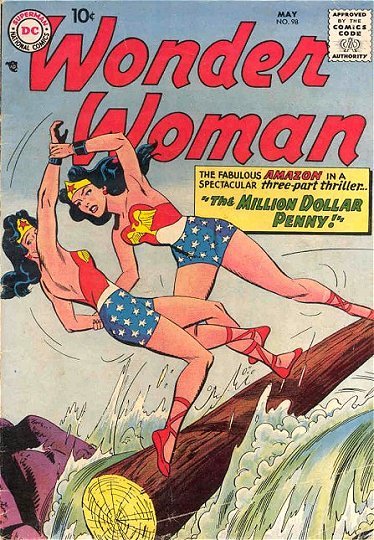
Wonder Woman #98
☆ Be the first to review + Add to your collection — Join freeWonder Woman #98 marks the unambiguous dividing line between the Golden Age and Silver Age versions of the character: writer-editor Robert Kanigher and incoming artist Ross Andru swept aside the William Moulton Marston continuity and rebuilt Diana's origin from the ground up, producing what DC's own publication history designates the first appearance of the Earth-One Wonder Woman. Beyond the origin retelling, the issue introduced several character attributes that would define the Amazon for decades — among them the rule that a man setting foot on Paradise Island would cost the Amazons their powers, Hippolyta's newly blonde hair, and Diana's ability to ride air currents (a power the Golden Age version never possessed), which planted the seed for what later writers and adaptations would develop into full flight. Because Kanigher simultaneously served as the book's actual hands-on editor while Whitney Ellsworth held the credited masthead role, this single issue effectively handed one man complete creative control over the franchise's Silver Age direction.
In "The Million Dollar Penny! Part I: The Secret Amazon Trials!", Wonder Woman faces a pivotal moment as Athena tasks Hippolyta with selecting an Amazon champion to represent Themyscira in Man's World, where justice and crime collide. Written by Charles Moulton and brought to life by Ross Andru’s dynamic art and Mike Esposito’s sharp inks, this 1958 issue sets the stage for a trial of strength, courage, and purpose—on a cover by Andru and Esposito.
In "The Million Dollar Penny! Part I: The Secret Amazon Trials!", Diana must prove her worth by turning a single penny into a million dollars in just 24 hours—no easy task, especially when she’s still adjusting to life in man’s world. With Pallas-Athena watching from afar and Orana offering guidance, Diana sets out on a mission that tests her wit, courage, and belief in the power of kindness.
In "The Million Dollar Penny, Part II: The Undersea Menace!", Wonder Woman faces her most bizarre challenge yet: turning a single penny into a million dollars in just 24 hours to build a playground for underprivileged children. With the clock ticking and a mysterious undersea threat looming, Diana must balance her mission with the dangers of the modern world—and the secrets hidden beneath the waves.
In "The Million Dollar Penny, Part III: The Impossible Bridge!", Wonder Woman faces her greatest challenge yet: turning a single penny into a million dollars within 24 hours to build a playground for underprivileged children. With the fate of the project hanging in the balance, she must navigate the complexities of man’s world while staying true to her Amazonian principles.
ComicBooks.com Value
Show all 21 grades ▾
Find on ebay
Read it digitally
Sell my copy
Have this issue — or a whole collection? Get a fair offer from us, skip the marketplace fees and the hassle.
We Buy Collections ▸History
Harry G. Peter, the artist who had drawn Wonder Woman since her debut, produced the interior art through issue #97, at which point he was replaced; he died shortly afterward. Kanigher, who had been scripting the title since taking over from Marston's collaborators after Marston's 1947 death, seized the transition as an opportunity for a wholesale reinvention, bringing in Ross Andru and inker Mike Esposito — a creative partnership already well-practiced on DC's war titles under Kanigher's editorial supervision. The Grand Comics Database records the on-sale date as March 20, 1958, with a May 1958 cover date, and notes that Kanigher functioned as the actual editor despite Ellsworth receiving the official credit in the indicia.
Trivia · 8 facts
- Cover-dated May 1958 (on-sale March 20, 1958); published by National Comics Publications (DC Comics) at a cover price of ten cents.
- First appearance of the Silver Age / Earth-One Wonder Woman — a complete narrative and visual break from the Golden Age Marston/Peter continuity.
- Writer Robert Kanigher scripted and served as the actual hands-on editor; Whitney Ellsworth held the credited editorial title in the indicia.
- Ross Andru (pencils) and Mike Esposito (inks) debuted as the new interior art team, replacing Golden Age mainstay Harry G. Peter, beginning what would become a roughly nine-year run for Andru on the title.
- First instance of Wonder Woman riding/gliding on air currents — a power the Golden Age version never had — established here when Diana saves a falling Steve Trevor, whose nickname for her ('Angel') takes on new resonance.
- Key Silver Age retcons introduced: Hippolyta's hair color changed to blonde, World War II references stripped from the origin, and the new rule that Paradise Island would be destroyed (or the Amazons lose their powers) if a man ever set foot on it.
- The issue introduces an Amazon challenger named Orana, a red-haired rival who contests Diana for the title of Wonder Woman in the Amazon tournament staged at Athena's request — Diana wins and departs for Man's World.
- Reprinted multiple times in DC collections, including Showcase Presents: Wonder Woman Vol. 1 (2007), Wonder Woman: The Amazon Princess Archives Vol. 1 (2013), Wonder Woman in the Fifties (2021), Wonder Woman: 80 Years of the Amazon Warrior — The Deluxe Edition (2021), and Wonder Woman: The Silver Age Omnibus Vol. 1 (2022).
Cast · 3 characters
Full credits
Reprints
↩ Reprints World's Finest Comics #56 (1952)
Reprinted in Marvila, la Mujer Maravilla #286 (1982), Showcase Presents: Wonder Woman #1 (2007), Wonder Woman: The Amazon Princess Archives #1 (2013), DC Comics Graphic Novel Collection #7 (2015), Wonder Woman in the Fifties #[nn] (2021), Wonder Woman: 80 Years of the Amazon Warrior The Deluxe Edition #[nn] (2021), Wonder Woman: The Silver Age Omnibus #1 (2022)
Key issues in Wonder Woman
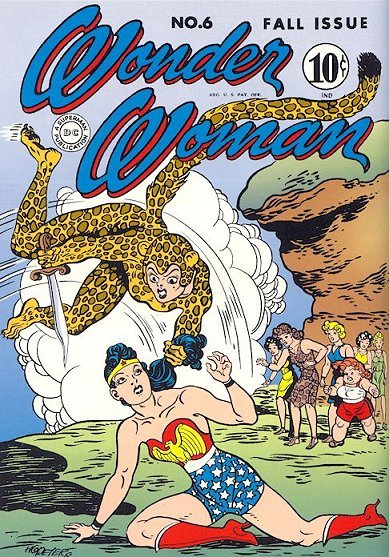
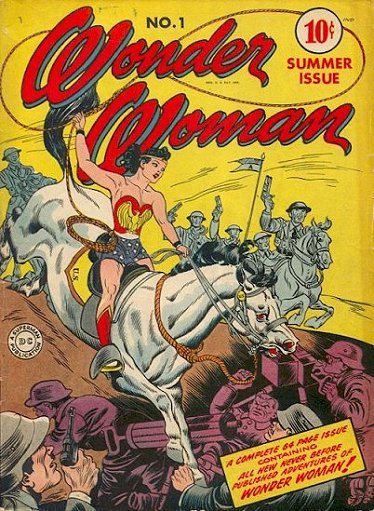
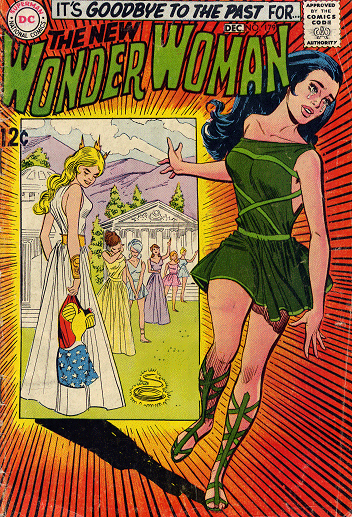
Reviews
Reader reviews
No reader reviews yet.