
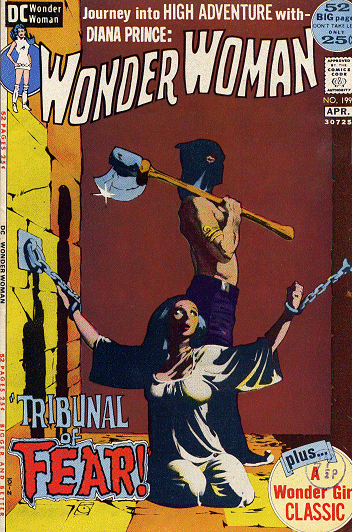
Wonder Woman #199
Wonder Woman #199 represents one of the final entries in the controversial 'Diana Prince' era, when Denny O'Neil and collaborators stripped the Amazon Princess of her powers and recast her as a street-level martial-arts adventurer. As the issue in which O'Neil returned to scripting duties after a gap — accompanied by a Denny O'Neil-penned editorial that openly wrestled with what Wonder Woman meant as a character — it crystallizes the creative tension at the heart of a run that provoked genuine cultural debate, including the vocal opposition of Gloria Steinem and the feminist press. The cover by Jeffrey Catherine Jones, rendered in an atmospheric grey-tone with restrained, illustrative mastery, is among the most artistically distinguished of the entire Bronze Age Wonder Woman run and stands apart from the series' more typical covers. With only two issues of the 'Diana Prince' era remaining after this one, #199 also marks the beginning of the end of an experiment DC would soon reverse entirely.
ComicBooks.com Value
Show all 22 grades ▾
Find on ebay
Read it digitally
Sell my copy
Have this issue — or a whole collection? Get a fair offer from us, skip the marketplace fees and the hassle.
We Buy Collections ▸History
By 1972, Denny O'Neil had taken back the editorial and scripting reins on Wonder Woman after Mike Sekowsky's departure, returning to the depowered Diana Prince concept O'Neil had helped launch in 1968. For the interior of #199, O'Neil paired with penciller Don Heck and inker Dick Giordano; the cover assignment went to Jeffrey Catherine Jones, a celebrated fantasy and science-fiction illustrator then at the height of her early career, who also provided the cover for the immediately following issue #200. O'Neil used the issue's text page for a rare editorial statement directly addressing the character's identity — a notable act of editorial self-reflection during a run that was already drawing outside scrutiny.
Trivia · 7 facts
- Cover date: March–April 1972 (on sale date cited as January 4, 1972, per DCU Guide); published by National Periodical Publications under the DC imprint.
- First appearances of both the villainous cult The Tribunal and nightclub magnate Fellows Dill, who serves as the story's MacGuffin-like figure in need of protection.
- Cover art — pencils and inks — by Jeffrey Catherine Jones, rendered in a distinctive grey-tone palette; this is one of only two Wonder Woman covers Jones produced, with the companion being issue #200.
- Jeffrey Catherine Jones (1944–2011) was a Hugo Award–nominated and World Fantasy Award–winning illustrator best known for fantasy and science-fiction cover work; the Wonder Woman covers represent a rare foray into superhero comics.
- The issue includes a back-up reprint of 'Battle of the Mermen!' from Wonder Woman #111 (January 1960), with script by Robert Kanigher and art by Ross Andru and Mike Esposito.
- A one-page editorial by Denny O'Neil — not a letters column — discusses the character of Wonder Woman directly, an unusual editorial introspection for a DC superhero comic of the period.
- The main story was later collected in Diana Prince: Wonder Woman Vol. 4 (DC, 2009) and the Wonder Woman: Diana Prince – Celebrating the '60s Omnibus (DC, 2018/2019).
Full credits
Reprints
↩ Reprints Wonder Woman #111 (1960)
Reprinted in Superman Presents World's Finest Comic Monthly #89 (1972), Marvila, la Mujer Maravilla #199 (1972), Superman Presents World's Finest Comic Monthly #90 (1972), Diana Prince: Wonder Woman #4 (2009), Wonder Woman: Diana Prince: Celebrating the '60s Omnibus #[nn] (2019)
Key issues in Wonder Woman
Reviews
Reader reviews
No reader reviews yet.