
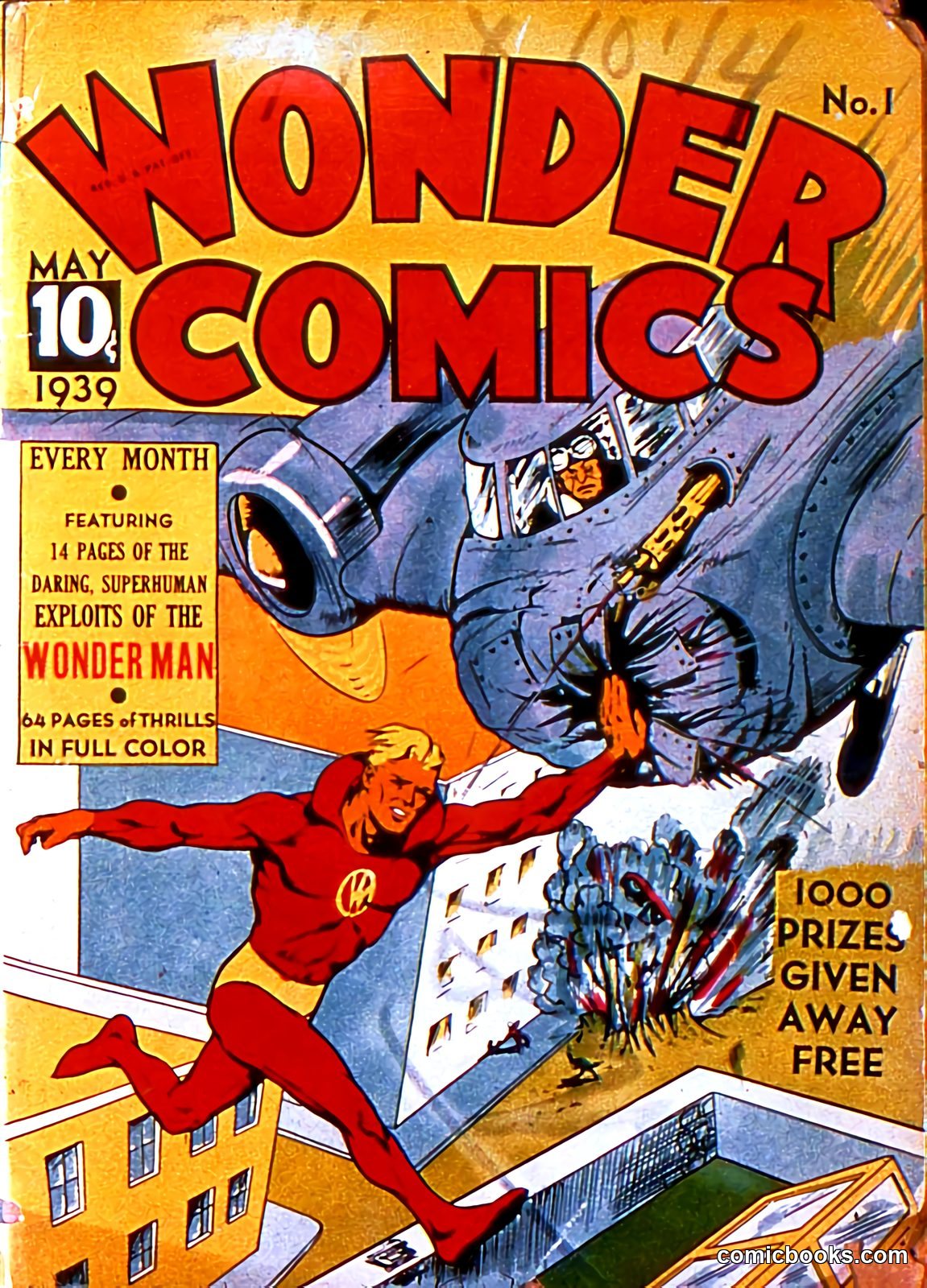
Wonder Comics #1
☆ Be the first to review + Add to your collection — Join freeWonder Comics #1 (May 1939) stands as a singular artifact of the Golden Age's most consequential legal battle: the debut and instant erasure of Wonder Man triggered Detective Comics, Inc. v. Bruns Publications, Inc. — the first copyright infringement lawsuit in comic book history — which established foundational precedents for how intellectual property in the superhero genre would be protected and contested for decades to come. The Second Circuit's 1940 ruling affirmed that while the archetype of a super-powered hero could not itself be monopolized, the specific expression, visual details, and arrangement of story incidents could be protected, a distinction that shaped every subsequent character-infringement case in the industry. Beyond the courtroom, the issue is the only published adventure of Will Eisner's Wonder Man, making it both the debut and the finale of a character whose very existence accelerated DC Comics' aggressive defense of Superman and implicitly pushed competing publishers toward greater creative differentiation. As the first title launched by Fox Feature Syndicate — one of 1939's boom-year entrants into comics publishing — it also documents the chaotic, commercially opportunistic origins of the Golden Age anthology format, packed with a wide range of genres and featuring early work by artists who would become central figures in the medium.
Wonder Comics #1 is an anthology featuring the primary story of Wonder Man, a superhuman hero in a red costume. In the opening story, Mr. Hastings offers Carson a "transmitter" device, and Carson later uses it to pilot a low-winged monoplane. The narrative follows Carson as he flies to meet his fiancée Brenda at a Red Cross base, where enemy planes attack and the hospital base must be evacuated, leaving three persons behind. Wonder Man subsequently battles armed guards at Attila's office, disarms soldiers with superhuman strength, and rescues people from a collapsing building by carrying a massive structure. The issue concludes with Wonder Man distributing food to hungry crowds and aiding exhausted citizens, earning their gratitude as he is called "a wonder man."
In this 1939 origin tale from *Wonder Comics #1*, timid radio engineer Fred Carson is transformed when a mysterious Tibetan gift grants him superhuman strength and invulnerability. Sent to join the Red Cross with his boss’s daughter—Brenda or Nora, depending on the version—the pair arrives just as a foreign war base comes under siege. With his new powers, Fred steps forward as Wonder Man, defending the outpost and stepping into a role far beyond his quiet past.
In a breezy 1939 adventure from Wonder Comics #1, Shorty finds himself in trouble after being captured by smugglers near the Rio Grande. Meanwhile, his friends Suzy and her dog Skippy, along with the ever-resourceful Tiny, enlist the help of Mr. De Welth—the richest man in the world—and his sharp-witted butler Weems to track him down before it’s too late.
In "Fire At Sea," reporter and camerawoman Patty O'Day leaps into danger by parachuting onto a cruise ship to capture footage of a raging fire. Though the crew resists her presence, a mysterious figure known only as Lord Farnsworth quietly aids her escape—then entrusts her with a letter to deliver from the sea.
In "The Oasis of Li-Wang," Dr. Fung and his assistant Dan stumble upon the hidden lair of the enigmatic mad scientist Li-Wang, where Dan is taken prisoner. Escaping into the desert, Dan discovers that Dr. Fung has already found Li-Wang’s secret laboratory and is preparing a daring plan to stop the scientist’s ambitions before they come to fruition.
In "The Hijacked Pocket Battleship," Navy sailors Spark Stevens and Chuck Lawton—bickering friends with a knack for trouble—find themselves in the middle of a high-seas crisis when their ship is seized by criminals. With quick thinking and stubborn teamwork, they take on the challenge of reclaiming their vessel, proving that even the smallest crew can make a big difference.
ComicBooks.com Value
Show all 20 grades ▾
Find on ebay
Read it digitally
Sell my copy
Have this issue — or a whole collection? Get a fair offer from us, skip the marketplace fees and the hassle.
We Buy Collections ▸History
Victor S. Fox, who had access to DC Comics' extraordinary Superman sales data through his work as an accountant or through industry contacts, launched Bruns Publications (trading as Fox Feature Syndicate) in early 1939 and immediately contracted the Eisner & Iger studio to produce his debut title. Working under the pen name 'Willis,' Will Eisner wrote and drew the Wonder Man lead feature, and the completed issue reached newsstands in under six weeks from the initial commission — a remarkable production pace even by the standards of the era's assembly-line studios. DC Comics filed suit on March 15, 1939, essentially the same day the issue appeared on stands, and District Judge Woolsey ruled for DC on April 7, 1939; Fox appealed and lost before the Second Circuit in April 1940, ending Wonder Man's publication life after a single issue. Eisner's own account of events — that he testified against Fox at trial — was complicated when comics historian Ken Quattro unearthed the actual trial transcript in 2010, which showed Eisner had in fact argued for Wonder Man's originality on the stand, a discrepancy with the version Eisner told in interviews and depicted (under changed names) in his 1985–86 semi-autobiographical graphic novel The Dreamer.
Trivia · 8 facts
- First and only appearance of Wonder Man (secret identity: Fred Carson, radio engineer), created by Will Eisner for Fox Feature Syndicate / Bruns Publications; published May 1939, cover-dated Volume 1, No. 1.
- Wonder Man's 14-page origin story — in which a Tibetan monk bestows Carson a magic ring granting Superman-like powers — was written and drawn by Eisner under the pen name 'Willis'; the issue was a 64-page, full-color anthology priced at 10 cents.
- First appearances of supporting and backup characters who continued into the Wonderworld Comics run: reporter Patty O'Day (newsreel reporter), Navy sailor 'Spark' Stevens (and his partner Chuck), comedy strip character Shorty Shortcake, and mystery-detective feature Dr. Fung.
- The issue also featured 'Men Who Made the West,' a historical text feature referencing figures such as Buffalo Bill Cody, and 'Movie Memos,' a humor strip spoofing contemporary celebrities including Stan Laurel and Oliver Hardy.
- Additional story and art credits in the issue include S.M. Iger, Adolphe Barreaux, Bob Powell, Bob Kane, Chuck Wilson, and Glenda Carol, making it an early showcase for the Eisner & Iger studio's stable of talent.
- DC Comics (then National Periodical Publications / Detective Comics, Inc.) filed suit on March 15, 1939, alleging Wonder Man infringed the Superman copyright; the resulting case — Detective Comics, Inc. v. Bruns Publications, Inc., 111 F.2d 432 (2d Cir. 1940) — is recognized as the first copyright lawsuit in comic book history.
- The Second Circuit's ruling held that while a general 'Superman' archetype could not be monopolized by copyright, the specific pictorial and literary expression — costume, feats, sequential arrangement of incidents — could be protected; this distinction became a foundational precedent for subsequent superhero IP litigation.
- Wonder Man's story was reprinted in black and white in the fanzine Alter Ego #48 (May 2005); the issue's cover has also been reproduced in published comic book history reference works including The Comic Book in America: An Illustrated History (Taylor Publishing, 1989) and Action! Mystery! Thrills! Comic Book Covers of the Golden Age 1933–45 (Fantagraphics, 2011).
Cast · 9 characters
Full credits
Reprints
Reprinted in Rex Dexter of Mars #1 (1940), The Green Mask #3 (1940), The Flame #2 (1940), Blue Beetle #5 (1940), The Flame #3 (1940), The Golden Age of Comic Books #[nn] (1977), The Comic Book in America: An Illustrated History #[nn] (1989), Action! Mystery! Thrills! Comic Book Covers of the Golden Age: 1933-45 #[nn] (2011), Take That, Adolf!: The Fighting Comic Books of the Second World War #[nn] (2017)
Reviews
Reader reviews
No reader reviews yet.