
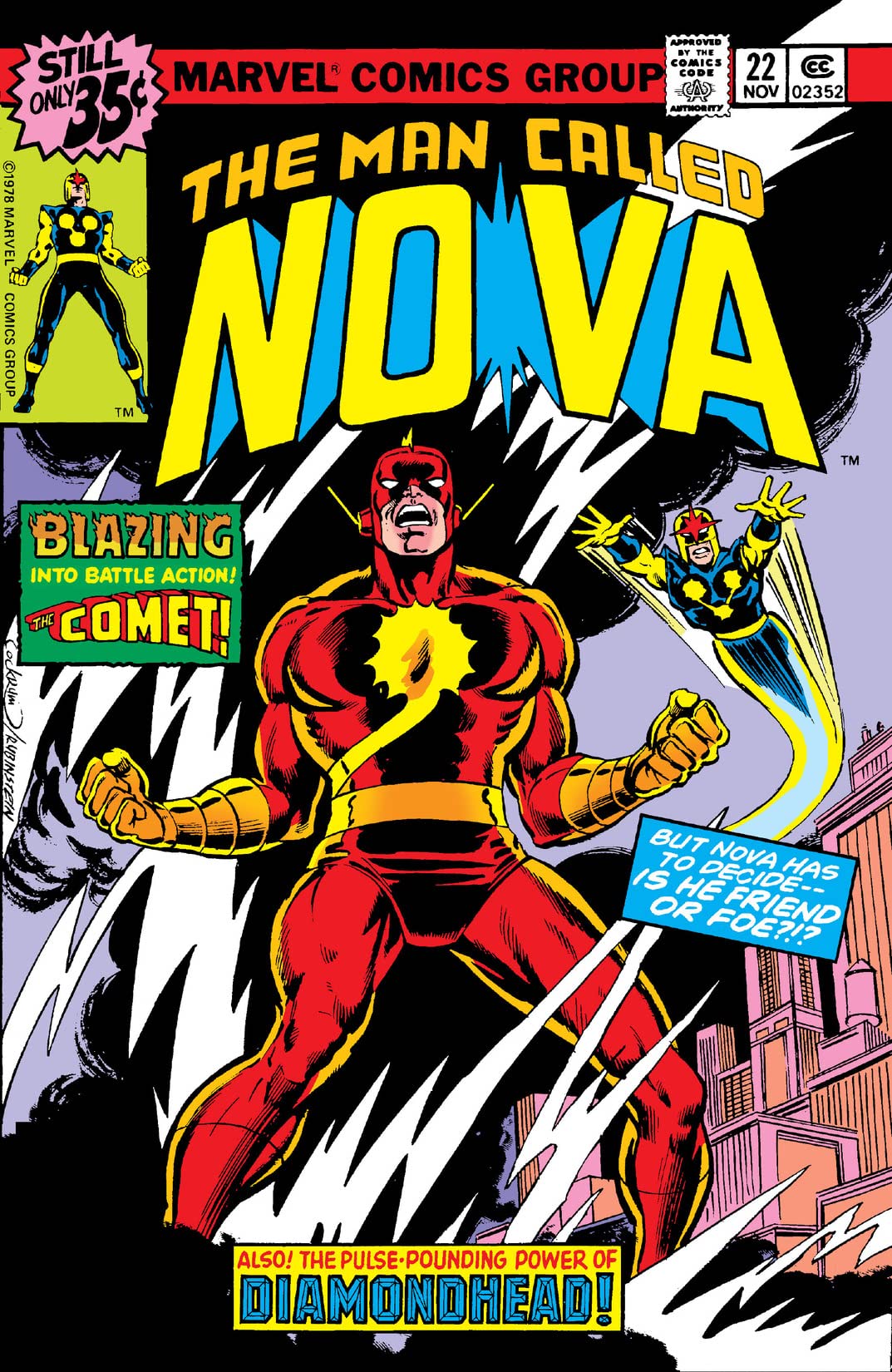
The Man Called Nova #22
☆ Be the first to review + Add to your collection — Join freeNova (Vol. 1) #22 holds its place in Bronze Age history primarily as the first full costumed appearance and origin issue of the Comet (Harris Moore), a character Marv Wolfman deliberately designed as a throwback to the earnest, radiation-powered heroes of the 1950s — a nostalgic counterpoint to the angst-driven protagonists Marvel was producing in the late 1970s. The issue deepens the narrative architecture of the Nova series by threading a multi-generational superhero legacy into what had been a fairly self-contained teenage-hero book, setting up the Champions of Xandar storyline that would carry the title to its conclusion and spill into Fantastic Four and ROM the Spaceknight. It also represents a notable creative pairing: Marv Wolfman writing and editing his own book under Jim Shooter's editorial-in-chief watch, with veteran industry artist Carmine Infantino — who had recently crossed from DC to Marvel — handling the interior pencils. The issue belongs to a tight four-issue run (#22–25) that transformed Nova's supporting cast from a high-school ensemble into a loose cosmic team, a structural shift that distinguished the series' finale from its earlier Spider-Man-homage origins.
ComicBooks.com Value
This exact issue on ebay
Raw — FINE ▾ $2.99–$6.95 3 listings
Raw / ungraded ▾ $3.5–$195 24 listings
Read it digitally
Sell my copy
Have this issue — or a whole collection? Get a fair offer from us, skip the marketplace fees and the hassle.
We Buy Collections ▸History
The series was the brainchild of Marv Wolfman, who had originally sketched out the Nova concept with Len Wein in a 1966 fan-zine, a full decade before the character debuted in his own ongoing in 1976. By issue #22, Wolfman was serving double duty as both writer and editor on the title, with Jim Shooter occupying the Editor-in-Chief role at Marvel. The interior art was provided by Carmine Infantino — a Silver Age DC legend who had served as that company's publisher before moving to Marvel in the late 1970s — inked by Steve Leialoha, while Dave Cockrum and Joe Rubinstein supplied the cover. The Comet himself was introduced one issue earlier (#21) as the unnamed derelict Harris Moore, making #22 the issue that delivers his costumed identity, his 1956 radiation-origin flashback, and his first direct team-up with Nova.
Trivia · 8 facts
- Story title: 'The Coming of the Comet'; cover-dated November 1978, released August 15, 1978 (Marvel Vol. 1, issue #22 of the 1976 series).
- First full costumed appearance and origin of the Comet (Harris Moore): a 1950s-style hero whose powers — electrical projection and flight — stem from exposure to a mysterious gaseous comet in 1956.
- Harris Moore first appeared without his costume (as a derelict) one issue earlier in Nova #21; #22 is universally cited as his first appearance as the Comet in costume.
- Written and edited by Marv Wolfman; interior art by Carmine Infantino (pencils) and Steve Leialoha (inks); cover by Dave Cockrum and Joe Rubinstein; colored by Carl Gafford; lettered by Gaspar Saladino; Editor-in-Chief Jim Shooter.
- The issue also features Diamondhead as the primary antagonist, with Doctor Sun appearing in cameo and the Sphinx referenced in flashback — villains central to the series' concluding cosmic arc.
- The Comet went on to appear in Fantastic Four #206, #208–209, and ROM #24, and was later codified in the Official Handbook of the Marvel Universe Deluxe Edition #16 as a member of the Champions of Xandar.
- This issue is part of the run (#22–25) that transitioned Nova's supporting cast toward the Champions of Xandar concept, a storyline whose conclusion carried over into Fantastic Four #204–205 after Nova's own series ended.
- The Comet's in-universe origin is presented as a retro 1950s hero — deliberately evoking an earlier era of Marvel/Atlas superhero storytelling within a 1978 Bronze Age context.
Full credits
Reprints
Reprinted in Spider-Man Comic #321 (1979), Spider-Man Comic #322 (1979), Spider-Man Comic #323 (1979), Spider-Man Comic #324 (1979), Nova #23 (1979), Essential Nova #1 (2006), Nova Classic #3 (2014), Nova: Richard Rider Omnibus #[nn] (2022)
Variants (1)
Reviews
Reader reviews
No reader reviews yet.