
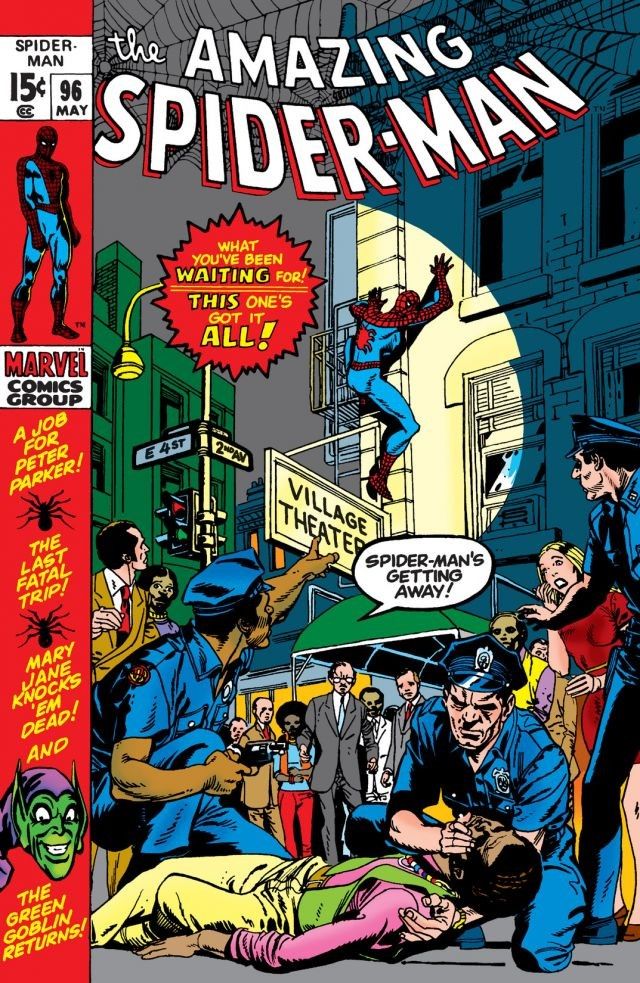
The Amazing Spider-Man #96
☆ Be the first to review + Add to your collection — Join freeThe Amazing Spider-Man #96 (May 1971) stands as one of the most consequential single issues in the history of American comics — not for a first appearance, but for a deliberate act of editorial defiance that rewired the entire industry. It was the first issue of a major mainstream comic series sold without the Comics Code Authority seal since the CCA's founding in 1954, a distinction it earned because writer-editor Stan Lee refused to bury an anti-drug storyline the Code had rejected outright. By hitting newsstands anyway, and finding that retailers distributed it without incident, Lee and Marvel proved that the CCA's approval was not the commercial lifeline publishers had long assumed it to be. The direct result was that the CCA convened a formal review and loosened its rules — opening the door not only to anti-drug narratives but also to horror content that would fuel the entire Bronze Age monster-comics boom.
In "And Now, the Goblin!", Peter Parker returns from England to find himself unexpectedly working for Norman Osborn—only to witness the man’s sudden, terrifying descent back into the Green Goblin. Written by Stan Lee and brought to life with dynamic art by Gil Kane and John Romita, this pivotal issue sees the return of one of Spider-Man’s most dangerous foes, with the cover by Gil Kane and Marie Severin capturing the moment’s chilling intensity.
ComicBooks.com Value
Show all 19 grades ▾
This exact issue on ebay
CGC 8 ▾ $205–$318 2 listings
CGC 7.5 ▾ $210–$274 2 listings
CGC 7 ▾ $150–$399 2 listings
Raw — VF ▾ $99.97–$210 5 listings
Raw — FN/VF ▾ $95.04–$110 2 listings
Raw / ungraded ▾ $35–$142 23 listings
Read it digitally
Sell my copy
Have this issue — or a whole collection? Get a fair offer from us, skip the marketplace fees and the hassle.
We Buy Collections ▸History
The story's genesis traces to a formal request from the Nixon administration's Department of Health, Education and Welfare, which approached Stan Lee around 1970 asking Marvel to publish an anti-drug message through one of its top titles; Lee selected The Amazing Spider-Man because its college-age readership made it the ideal vehicle. Lee scripted the three-part arc titled 'Green Goblin Reborn!', with issue #96 penciled by Gil Kane and inked by John Romita Sr. — though Romita later admitted he struggled to render drug imagery convincingly because he had no personal experience with it. When the completed issue was submitted to the CCA for routine approval, regular administrator Leonard Darvin was reportedly out sick, and acting administrator John L. Goldwater — the Archie Comics publisher who was also president of the Comics Magazine Association of America — made the call to reject the story on the grounds that depicting drugs in any context violated the Code's spirit. Lee, backed by publisher Martin Goodman, elected to strip the CCA seal from all three issues and publish without it, a decision that generated immediate coverage in the New York Times and confirmed, once sales came in, that distributors and retailers would carry Code-less material from a trusted publisher.
Trivia · 8 facts
- First issue of a major mainstream comic series published and sold without Comics Code Authority approval since the CCA's inception in 1954.
- Written by Stan Lee; penciled by Gil Kane; inked by John Romita Sr.; cover by Gil Kane (with an inset Green Goblin face credited to John Romita Sr.; Marie Severin provided the cover layout).
- Part 1 of the 3-issue 'Green Goblin Reborn!' arc (ASM #96–98), which introduced Harry Osborn's drug addiction as a key plot thread — the unnamed pills he takes are never identified in the story.
- The issue opens with Spider-Man saving a drug-addled teenager who believes he can fly; the story also marks the return of Norman Osborn to his Green Goblin persona after a period of amnesia.
- The CCA's rejection — made by acting administrator John L. Goldwater rather than regular administrator Leonard Darvin, who was reportedly ill — was based on a general 'spirit and intent' clause; the original Code contained no specific prohibition on drug depictions.
- The arc's commercial success prompted the CCA to formally revise its rules: under the new standards, drug use could be depicted as long as it was portrayed negatively, and restrictions on horror content were also loosened, enabling titles like Tomb of Dracula.
- Future Marvel Editor-in-Chief Joe Quesada — who later ended Marvel's participation in the CCA entirely — has said his father bought him these issues specifically because of their anti-drug message, making ASM #96–98 his entry point into comics.
- The story was first reprinted in Marvel Tales #77 (March 1977); when reprinted, the issues carried the CCA stamp they had originally lacked.
Full credits
Reprints
Reprinted in Hit Comics Die Spinne #233 (1971), O Homem-Aranha #45 (1972), L'Uomo Ragno [Collana Super-Eroi] #97 (1974), Spindelmannen #4/1974 (1974), Spider-Man Comics Weekly #129 (1975), Spider-Man Comics Weekly #130 (1975), Marvel Tales #77 (1977), Strange #93 (1977), The Amazing Spider-Man #[nn] (1979), El Hombre Araña / El Asombroso Hombre Araña #90 (1982), Marvel Tales #191 (1986), Marvel #8/1989 (1989), Spiderman Klassiek #2 (1989), Edderkoppen klassikere #2/1989 (1989), L'Uomo Ragno Classic #28 (1993), Spider-Man vs. Green Goblin #[nn] (1995), Spider-Man: The Death of Gwen Stacy #[nn] (1999), Great American Comic Books #[nn] (2001), Spiderman de John Romita #41 (2002), Spider-Man [pocket] #1 (2004), Marvel Visionaries: Stan Lee #[nn] (2005), Spider-Man kjempepocket #[nn] (2005), Marvel Masterworks: The Amazing Spider-Man #10 (2008), Amazing Spider-Man Family #4 (2009) + 13 more
Key issues in The Amazing Spider-Man
 ★
★ ★
★ ★
★ ★
★ ★
★ ★
★ ★
★ ★
★Variants (1)
Reviews
Reader reviews
No reader reviews yet.