
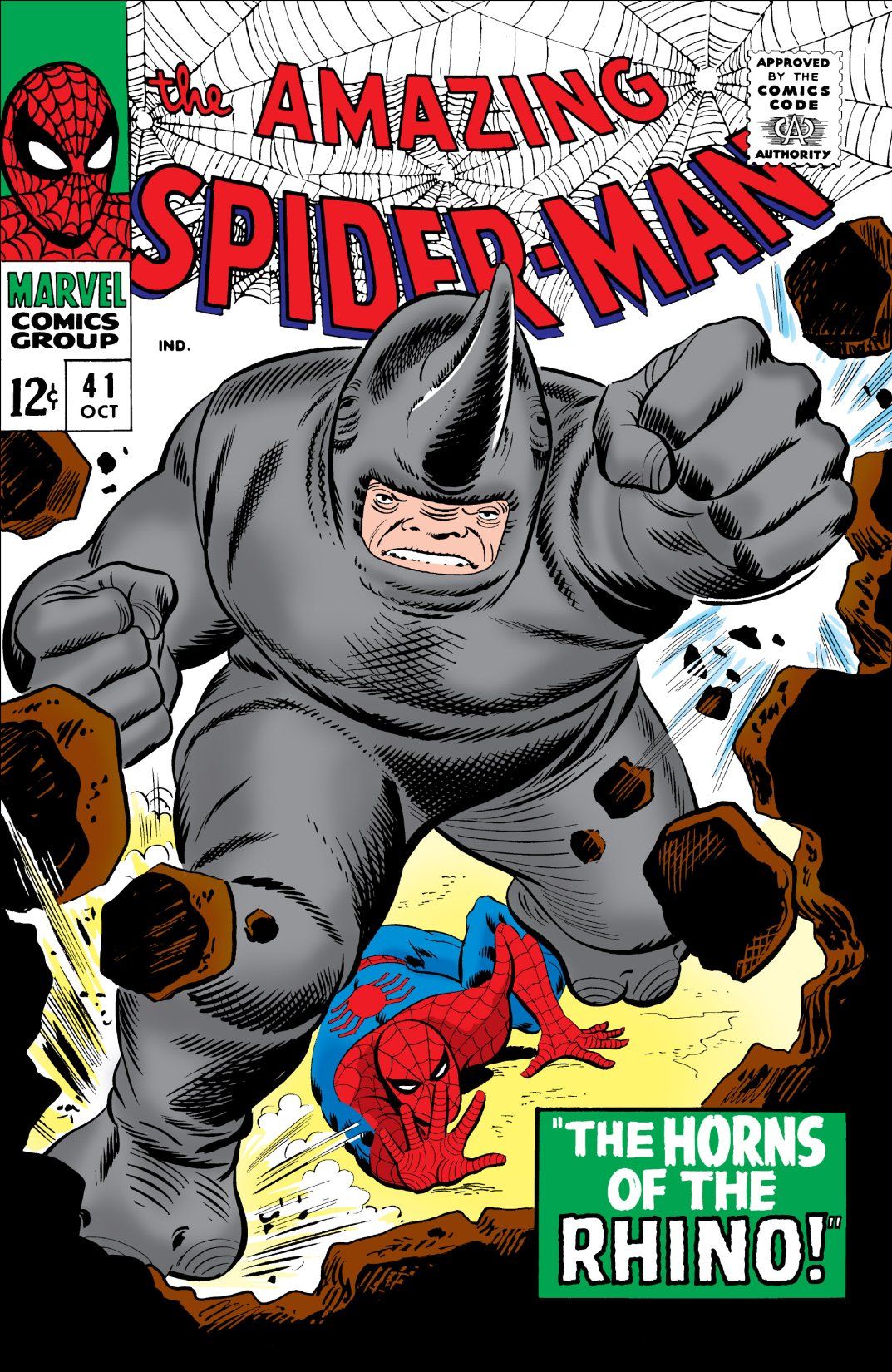
The Amazing Spider-Man #41
☆ Be the first to review + Add to your collection — Join freeThe Amazing Spider-Man #41 is the debut issue of Aleksei Sytsevich, the Rhino — a Soviet-backed super-powered bruiser whose polymer-bonded hide made him one of the few villains in Spider-Man's rogues' gallery capable of physically overwhelming the wall-crawler in a straight fight. Beyond the villain introduction, the issue functions as a pivotal bridge in the early Lee–Romita era: it plants the first seeds of Peter Parker's romantic awareness of Gwen Stacy and closes the door on his long-running feelings for Betty Brant, deftly shifting the title's emotional center just one issue before Mary Jane Watson's face-revealed debut in #42. Arriving only three issues into John Romita Sr.'s tenure as penciler — itself one of the most transformative creative handoffs in Marvel history — the issue showcases the new team's ability to pack a debut villain, Cold War intrigue, and genuine soap opera into a single 20-page story, establishing the rhythms that would define the Lee–Romita run for the next five years.
In "The Horns of the Rhino!", Spider-Man faces off against the rampaging Rhino, who's on a mission to kidnap John Jameson and deliver him to foreign agents seeking secrets from the U.S. space program. With sharp storytelling by Stan Lee and dynamic art by John Romita and Bill Ward, this 1966 classic delivers a tense showdown that highlights the web-slinger’s quick thinking and courage. The cover by John Romita and Mike Esposito captures the menace of the Rhino in bold, striking detail.
ComicBooks.com Value
Show all 22 grades ▾
This exact issue on ebay
CGC 9 ▾ $2,995–$3,100 2 listings
CGC 8 ▾ $2,225–$2,384 2 listings
CGC 7 ▾ $425–$1,800 7 listings
CGC 6.5 ▾ $629–$699 5 listings
CGC 6 ▾ $500–$2,200 4 listings
CGC 5 ▾ $450–$545 9 listings
CGC 4.5 ▾ $300–$480 6 listings
CGC 4 ▾ $325–$425 4 listings
CGC 3.5 ▾ $325–$450 7 listings
CGC 3 ▾ $300–$1,275 4 listings
CGC 2.5 ▾ $260–$300 2 listings
Raw — FN ▾ $300–$500 4 listings
Raw — VG+ ▾ $333–$350 2 listings
Raw — VG ▾ $280–$1,500 10 listings
Raw — GD ▾ $171–$400 13 listings
Raw / ungraded ▾ $2.5–$1,850 54 listings
More listings for this title
Read it digitally
Sell my copy
Have this issue — or a whole collection? Get a fair offer from us, skip the marketplace fees and the hassle.
We Buy Collections ▸History
The issue landed at a moment of considerable backstage pressure: Steve Ditko had abruptly departed after completing issue #38, and Stan Lee had tapped John Romita Sr. — fresh off a brief Daredevil run that served as a deliberate tryout — to take over a title already Marvel's highest-profile book. Romita has acknowledged that, under deadline strain for this third issue of his run, he enlisted uncredited ghost artist Bill Ward to pencil a portion of the story, most likely the five-page Rhino fight sequence (pages 13–17), with Romita then making touch-up alterations and Mike Esposito providing inks throughout under the pseudonym 'M. Demeo' (Esposito was moonlighting from DC Comics). The Marvel Method plotting process — with Lee and Romita developing storylines verbally before Romita committed them to panel breakdowns — was already in full operation, meaning the Rhino's design and the issue's dense character-work were collaborative achievements from the outset of the new partnership.
Trivia · 8 facts
- First appearance of the Rhino (Aleksei Sytsevich), created by Stan Lee (writer) and John Romita Sr. (artist), published October 1966 — the character's third issue of Romita's run on the title.
- Story title: 'The Horns of the Rhino!' — The Rhino is deployed by Eastern Bloc foreign powers to kidnap astronaut John Jameson and extract secrets about the U.S. space program; Spider-Man defeats him by using leverage and speed rather than brute force.
- The Rhino's origin as a Russian thug (Aleksei Sytsevich) who voluntarily underwent an experiment bonding a super-strong polymer to his skin is presented in this issue, giving him superhuman strength and near-invulnerability.
- The issue marks a decisive turning point in Peter Parker's romantic arc: his rekindled encounter with Betty Brant clarifies that their feelings for each other have faded, while the closing pages show Peter and Gwen Stacy genuinely noticing each other for the first time — directly setting up the central romance of the Romita era.
- Anna Watson reminds Peter about the upcoming dinner where he will finally meet her niece Mary Jane — a direct narrative hand-off to Amazing Spider-Man #42's landmark full-face debut of Mary Jane Watson.
- Ghost penciling by Bill Ward (uncredited) covers a portion of the issue's action pages; Romita disclosed this in a 1966 fanzine interview (The Web-Spinner) and confirmed inking details at San Diego Comic-Con in 2006. Researcher Nick Caputo suspects Ward's contribution spans pages 13–17.
- Mike Esposito inked the issue under the pseudonym 'M. Demeo,' concealing his Marvel moonlighting from his regular employer DC Comics — a practice he continued on the title for several more issues.
- The story has been reprinted in Marvel Tales #30 (April 1971) and Marvel Tales #180 (October 1985), as well as collected in the Essential Spider-Man Vol. 2, the Spider-Man Visionaries: John Romita trade paperback (2001), and multiple Marvel Masterworks volumes; a special reprint was also packaged with a Toy Biz Spider-Man Classics Rhino action figure (2001).
Cast · 10 characters
Full credits
Reprints
Reprinted in Edderkoppen #3 (1967), HIP Comics #1917 (1967), Marvelserien #7 (1967), Hit Comics #17 (1967), Marvel Tales #30 (1971), Strange #39 (1973), Spider-Man Comics Weekly #35 (1973), Spindelmannen #2/1974 (1974), Die Spinne #42 (1975), El Hombre Araña / El Asombroso Hombre Araña #35 (1980), Une Aventure de l'Araignée #19 (1983), O Espectacular Homem-Aranha #9 (1983), Marvel-pocket #1/1984; 1 (1984), Marvel-pocket #1/1985 (1985), Marvel Tales #180 (1985), Marvel Masterworks #22 (1992), The Essential Spider-Man #2 (1997), Spiderman de John Romita #3 (1999), Spider-Man Komplett #41 [4] (2000), Amazing Spider-Man Vol. 1 No. 41 [Spider-Man Classics Reprint] #[nn] (2001), Spider-Man Visionaries: John Romita #[nn] (2001), Os Maiores Clássicos do Homem-Aranha #1 (2002), Marvel Masterworks: The Amazing Spider-Man #5 (2004), Marvel Masterworks: The Amazing Spider-Man #5 (2010) + 9 more
Key issues in The Amazing Spider-Man
 ★
★ ★
★ ★
★ ★
★ ★
★ ★
★ ★
★ ★
★Variants (1)
Reviews
Reader reviews
No reader reviews yet.