
The Amazing Spider-Man #1
The Amazing Spider-Man #1 marks the moment Marvel formally committed to its most groundbreaking character — a guilt-ridden, financially struggling teenager who had no mentor, no team, and no public support, fundamentally rewriting what a solo superhero series could be. By placing Peter Parker's mundane anxieties — paying rent, cashing a paycheck made out to a fictional alias, being smeared in the press — at the center of every adventure, Stan Lee and Steve Ditko proved that superhero storytelling could sustain novelistic characterization across an ongoing title. The issue introduced J. Jonah Jameson, whose crusading hostility toward Spider-Man created one of comics' richest antagonist dynamics without the villain ever throwing a punch, and staged the first crossover between Spider-Man and the Fantastic Four, a narrative technique that became the architectural cornerstone of the Marvel shared universe. The series that launched here ran, in various forms, to more than 900 issues and produced nearly every member of Spider-Man's rogue's gallery and supporting cast, making this single issue the tap root of one of the most expansive continuous story worlds in popular culture.
ComicBooks.com Value
Show all 22 grades ▾
Find on ebay
Read it digitally
Sell my copy
Have this issue — or a whole collection? Get a fair offer from us, skip the marketplace fees and the hassle.
We Buy Collections ▸History
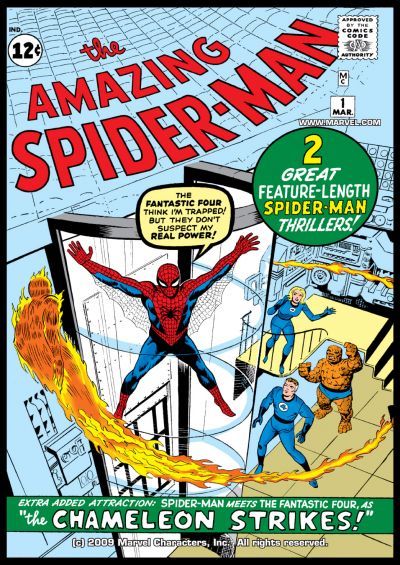
Spider-Man debuted in Amazing Fantasy #15 (August 1962), a title that publisher Martin Goodman had already slated for cancellation — a circumstance that ironically freed Stan Lee to experiment with an unconventional hero. When the issue's sales figures came back surprisingly strong, Goodman moved quickly to give the character his own ongoing series, and research by comics historian Will Murray suggests the stories that appeared in Amazing Spider-Man #1 and #2 were likely already being prepared as follow-up material for Amazing Fantasy before the series was cancelled. The cover of issue #1 was pencilled by Jack Kirby and inked by Steve Ditko — a division of labor that reflected Marvel's early house practice of using Kirby's dynamic layouts for commercial hook while Ditko's idiosyncratic line defined the character's look in the interior pages; the logo was designed by Sol Brodsky with lettering by Artie Simek. Lee had originally brought Kirby aboard to design the character entirely, but Kirby's version of Peter Parker read as too conventionally heroic, so Lee turned to Ditko — already his collaborator on Amazing Adult Fantasy — who created the skinny, bespectacled everyman that readers embraced.
Trivia · 8 facts
- Cover date: March 1963; on-sale date: December 10, 1962 (per U.S. Copyright Office filings). Cover price: 12 cents.
- Written by Stan Lee (script); interior art pencilled and inked by Steve Ditko; cover pencilled by Jack Kirby and inked by Steve Ditko; colors by Stan Goldberg; logo design by Sol Brodsky.
- First appearances of J. Jonah Jameson (publisher of the Daily Bugle and Spider-Man's most persistent media antagonist) and his astronaut son John Jameson.
- First appearance of the Chameleon (Dmitri Smerdyakov), Spider-Man's first named supervillain in his own title, a Soviet-connected master of disguise.
- First encounter between Spider-Man and the Fantastic Four — Spider-Man invades the Baxter Building hoping to join the team for a salary, discovers they are non-profit, and leaves broke. This is the first inter-title superhero crossover within the nascent Marvel shared universe.
- The issue contains two stories: 'Spider-Man' (origin recap / John Jameson rescue) and 'Spider-Man vs. the Chameleon!' The second story was later reprinted in Marvel Tales #138 (April 1982) and The Amazing Spider-Man Annual #7 (December 1970).
- Peter Parker's surname is misprinted as 'Palmer' in the second story — a well-documented production error confirmed by the Marvel Database.
- The series launched as a bimonthly title and was promoted to monthly frequency after its first four issues, going on to publish more than 900 issues across multiple volumes and spawning major film, television, and animation adaptations — including the Sam Raimi trilogy (2002–2007), the Marc Webb duology (2012–2014), and Tom Holland's appearances in the Marvel Cinematic Universe.
Key issues in The Amazing Spider-Man
 ★
★ ★
★ ★
★ ★
★ ★
★ ★
★ ★
★ ★
★Reviews
Reader reviews
No reader reviews yet.