
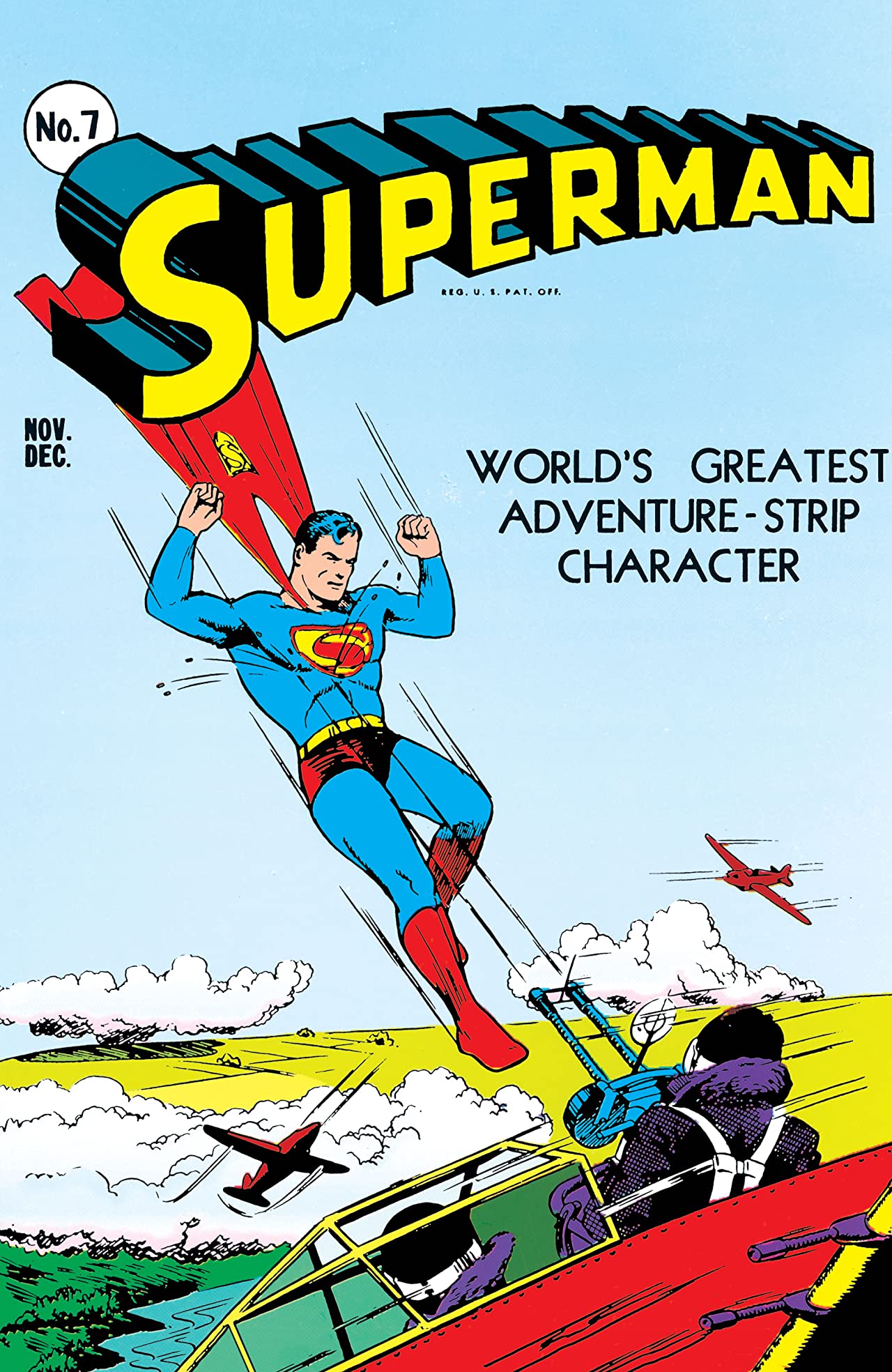
Superman #7
Superman #7 (cover-dated November–December 1940) holds a permanent place in DC history as the first comic-book appearance of Perry White, the gruff, dedicated editor who would anchor the Daily Planet's supporting cast for more than eight decades. His arrival also quietly retired the newspaper's previous editor, George Taylor, and cemented the Daily Planet name as the definitive home of Clark Kent and Lois Lane — a transition that had begun in the newspaper strips and radio serial but was now fixed in the comics themselves. By this issue the cover was already promoting Superman as the 'World's Greatest Adventure Strip Character,' a reflection of how rapidly the character had gone from debut to cultural institution in just over two years.
In "Metropolis's Most Savage Racketeers," Superman takes on the Black Band, a brutal gang preying on nightclub patrons, including Clark Kent and Lois Lane, who go undercover to expose them. Written by Jerry Siegel and illustrated by Joe Shuster, this 1940 classic showcases the Man of Steel’s early days in Metropolis, with dynamic art and a gripping crime-fighting mission. The cover, by Joe Shuster and Wayne Boring, captures the tension of the city’s underworld.
In a 1940 tale of cunning crime and courtroom deception, a ruthless gang led by Nick Norton, Mike Moran, and Billings orchestrates a deadly scheme that pins a murder on the wife of a prosecuting attorney—only to use her death as a weapon to silence justice. With Sgt. Casey and Police Chief Watson racing to untangle the web, the true menace lies not in the violence, but in the way it’s framed to protect the very criminals who pulled the strings.
In "The Exploding Citizens," Clark Kent is sent to Gay City to investigate a bizarre epidemic where mere contact with locals causes them to disintegrate — a mystery that draws the attention of two new villains, Commissioner Jim Stanley and Kotzoff, whose motives remain shrouded in the chaos.
In a whimsical 1940s slice of comic charm, Shorty—ever the eager participant in canine antics—knocked out by a fellow dog, drifts into a surreal dream sequence: first soaring with birds, then chasing a tantalizing package of dog biscuits, and finally encountering a girl dog in a moment of pure cartoon whimsy. Waking up with a grin, he immediately seeks out his friend, eager for another knock-out—just to dream again.
In a 1940 tale of civic duty and justice, Superman steps into the political fray when Clark Kent, guided by his journalistic instincts, rallies the Daily Planet to oppose corrupt candidate Red Tyler. With the public prosecutor Ralph Dale and other powerful figures entangled in a web of deceit, Kent pushes for reform by backing the honest campaign of Bert Runyan—only to find that even the most noble intentions can stir up dangerous forces.
In "The Black Gang," Superman takes on a brutal crime syndicate known as the Black Band, targeting nightclubs across Metropolis. Disguised as a wealthy patron, Clark Kent teams up with Lois Lane to infiltrate the gang’s operations, while facing off against the gang’s ruthless leaders—Jane Day, Peter Peeker, Frank Jordan, and Sgt. Casey, who may not be who he seems.
ComicBooks.com Value
Show all 19 grades ▾
More listings for this title
Read it digitally
Sell my copy
Have this issue — or a whole collection? Get a fair offer from us, skip the marketplace fees and the hassle.
We Buy Collections ▸History
The issue was written by Jerry Siegel with pencils and cover art by Joe Shuster and Wayne Boring — Boring had joined Shuster's Cleveland studio in 1940 and was becoming an increasingly important presence on the art. Whitney Ellsworth served as executive editor and Murray Boltinoff as in-house editor, with Ellsworth's tenure at DC coinciding with a broader push to standardize and soften the Superman franchise. Perry White himself was not invented for the comic page: he had debuted in the very second episode of the Adventures of Superman radio serial in February 1940, voiced by Julian Noa, and his migration to the printed page in this issue was part of a deliberate cross-media synchronization — notably, the issue even contained an advertisement for the radio show alongside White's print debut.
Trivia · 7 facts
- First comic-book appearance of Perry White, editor of the Daily Planet, who had originated on the Adventures of Superman radio serial in February 1940 (episode: 'Clark Kent, Reporter').
- Perry White appears in all four of the issue's Superman stories, debuting in the lead story 'The Three Kingpins of Crime,' where he dispatches Clark Kent and Lois Lane to interview star prosecutor George Lash.
- The issue effectively replaces previous Daily Planet editor George Taylor with Perry White, without any in-story explanation — a quiet but permanent retcon that reshaped the Superman supporting cast.
- Written by Jerry Siegel; pencils and cover art by Joe Shuster and Wayne Boring; executive editor Whitney Ellsworth; in-house editor Murray Boltinoff.
- By this issue, Superman's own title was billing him on the cover as the 'World's Greatest Adventure Strip Character,' a marketing superlative that reflected the character's extraordinary early commercial momentum.
- The issue contains four Superman stories: 'The Three Kingpins of Crime,' 'The Gay City Plague,' 'Bert Runyan's Campaign,' and 'The Black Gang' — all featuring the newly introduced Perry White alongside Clark Kent and Lois Lane.
- The issue is included in DC's Archive Editions reprint program; Superman Vol. 1 Archives Vol. 4 (covering Superman #6–7) was published in February 2008.
Cast · 21 characters
Full credits
Reprints
Reprinted in Action Comics #29 (1940), Detective Comics #44 (1940), Action Comics #30 (1940), Detective Comics #45 (1940), Superman from the Thirties to the Eighties #[nn] (1983), The Superman Archives #2 (1990), DC Archiv Edition #7 (2000), The Superman Chronicles #4 (2008), Superman: The Golden Age Omnibus #1 (2013), Superman: The War Years 1938-1945 #[nn] (2015), Superman: The Golden Age #2 (2017)
Key issues in Superman
Variants (1)
Reviews
Reader reviews
No reader reviews yet.