
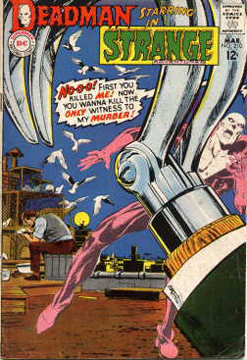
Strange Adventures #210
☆ Be the first to review + Add to your collection — Join freeStrange Adventures #210 is a pivotal chapter in one of the Silver Age's most forward-looking series runs, carrying the distinction of being the first full appearance of the Hook — the assassin at the center of Deadman's entire revenge quest — in a story where he is given a name, a face, and an active role in the plot rather than remaining a shadowy unknown. The issue sits squarely within Neal Adams's celebrated stretch on the title, a run widely recognized as his professional breakout and one of the earliest DC works to push against the era's clean-cut storytelling norms toward something grittier and more emotionally grounded. Because Deadman's search for the Hook drives every installment from Strange Adventures #205 onward, this is the issue where that hunt becomes concrete and personal, transforming the premise from a wandering ghost story into a genuine noir chase. The Deadman series as a whole — and this issue as a key link in its chain — helped lay groundwork for the darker, more mature superhero storytelling that would define the early Bronze Age.
In "Hide and Seek," set designer Dane Foote stumbles upon an ancient candle that ignites not just his creativity, but something far more dangerous. As he dreams up a cinematic effect under its glow, the line between illusion and reality begins to blur—until the nightmare he imagined comes to life in the real world. Penciled and inked by Nick Cardy, this eerie tale from Strange Adventures #210 (1968) features a haunting cover by Neal Adams.
In "Hide and Seek," Deadman investigates the strange circumstances surrounding his own murder, uncovering a trail that leads to a disgraced detective and a witness whose life is in danger—only to find the witness silenced before the truth can be spoken.
In "Designs for Disaster," set designer Dane Foote stumbles upon an ancient candle that ignites his imagination—leading him to dream up a cinematic set and effect so vivid, they seem to spill into reality. When the scene is built and filmed, the nightmare he envisioned begins to unfold in the real world, with terrifying consequences for an unsuspecting town.
ComicBooks.com Value
Show all 17 grades ▾
This exact issue on ebay
Raw — FINE ▾ $19.99–$40 3 listings
Raw — VG ▾ $8.88–$25 19 listings
Raw — GOOD ▾ $8.95–$9.99 2 listings
Raw / ungraded ▾ $5–$138 24 listings
More listings for this title
Read it digitally
Sell my copy
Have this issue — or a whole collection? Get a fair offer from us, skip the marketplace fees and the hassle.
We Buy Collections ▸History
Deadman was created by writer Arnold Drake and artist Carmine Infantino in Strange Adventures #205 (October 1967), with Infantino subsequently handing interior art duties to Neal Adams beginning with #206 — Adams's first sustained superhero assignment at DC Comics after being hired as a freelancer in 1967. By issue #210, editor and scripter Jack Miller was shaping the monthly stories while Adams handled all covers and interiors, working under an editorial environment that Carmine Infantino — then elevated to DC's editorial director — had consciously opened to younger, more illustratively ambitious artists. The on-sale date recorded by copyright registration is January 30, 1968, with a March 1968 cover date. The issue also carried two backup reprint stories: one reprinted from Real Fact Comics #4 (1946) and one from House of Secrets #19 (1959), a common anthology-filler practice of the period.
Trivia · 8 facts
- First appearance of the Hook (real name Matson), the hook-handed assassin who murdered Boston Brand / Deadman — the character was co-created by Jack Miller and Neal Adams and goes on to become a member of the League of Assassins.
- Story title: 'Hide and Seek' — written by Jack Miller, penciled and inked by Neal Adams, lettered by Milt Snapinn; cover also by Neal Adams.
- Cover date: March 1968; on-sale date per copyright registration: January 30, 1968; published by National Periodical Publications (DC Comics).
- The Hook appears here under the alias 'Roy Martin,' a name that according to comics historians is a sly reference to Roy Huggins and Quinn Martin, producer and executive producer of the TV series The Fugitive — a show whose premise of a man hunting his framer directly inspired the Deadman series.
- Issue #210 is part of Neal Adams's breakout run on the title (Strange Adventures #206–#216), widely cited as his first major superhero interior work, predating his celebrated Batman and Green Lantern/Green Arrow runs with Dennis O'Neil.
- The Deadman feature in Strange Adventures received a 1967 Alley Award for Best New Strip (awarded to Arnold Drake and Carmine Infantino) and the series' run with Adams was inducted into the Alley Award Hall of Fame; Adams himself received a special award for bringing 'new perspective and dynamic vibrance' to the field.
- The lead story from this issue has been reprinted multiple times: in Deadman #3 (DC, July 1985, recolored), The Deadman Collection (DC, 2001), Deadman #1 (DC, 2011), and the Deadman Omnibus (DC, 2020).
- The issue also contains two filler backup stories reprinted from earlier DC titles: one from Real Fact Comics #4 (1946) with art by Virgil Finlay, and one from House of Secrets #19 (1959) with art by Nick Cardy.
Full credits
Reprints
↩ Reprints Real Fact Comics #4 (1946), House of Secrets #19 (1959)
Reprinted in Titanes Planetarios #297 (1969), Eclipso #6 (1969), The Brave and the Bold #100 (1972), All Star Adventure Comic #77 (1972), Deadman #[nn] (1978), Démon #10 (1979), Serietidningen #2/1985 (1985), Deadman #3 (1985), The Deadman Collection #[nn] (2002), Deadman #1 (2011), Deadman Omnibus #[nn] (2021)
Key issues in Strange Adventures
Reviews
Reader reviews
No reader reviews yet.