
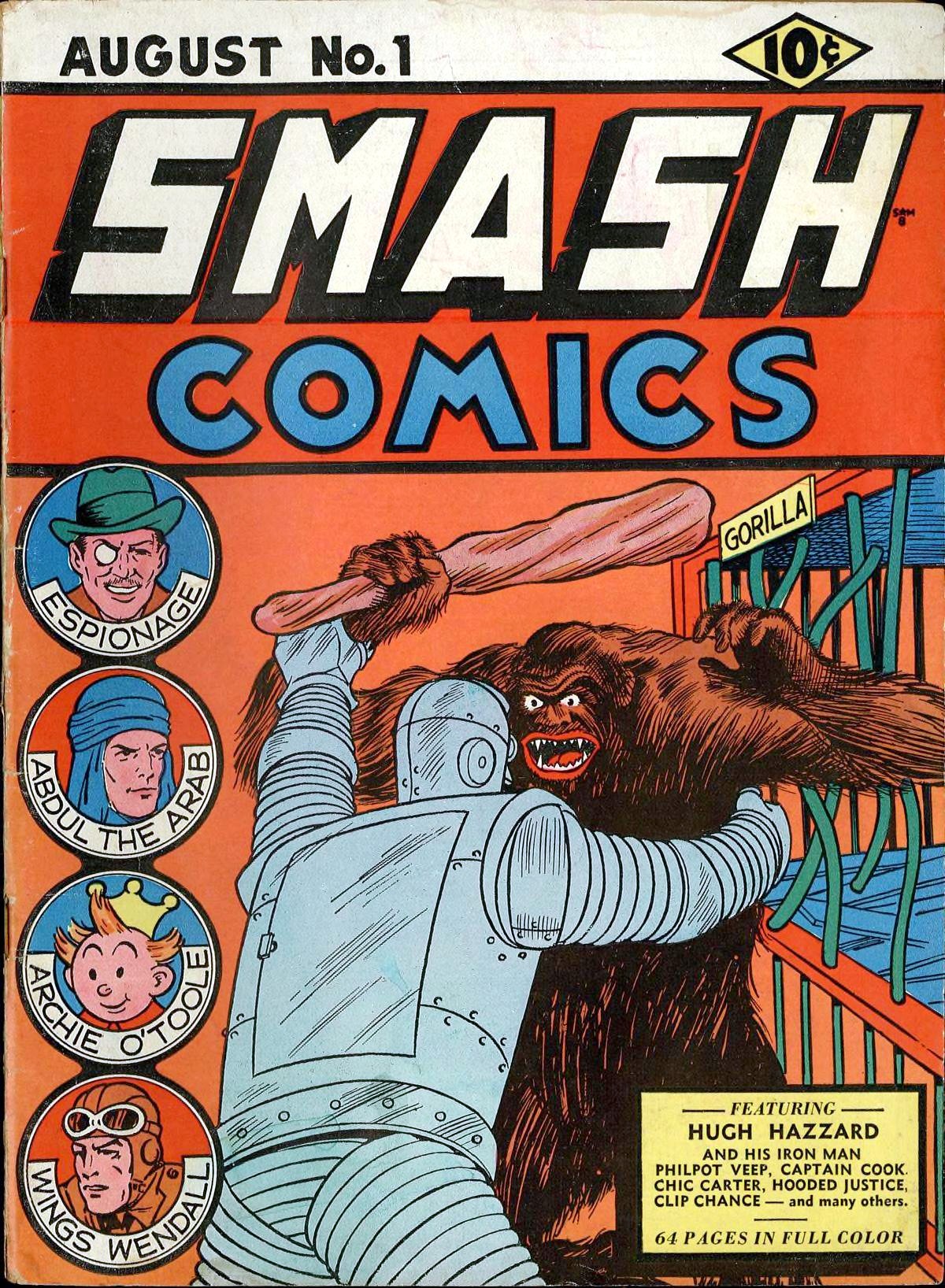
Smash Comics #1
☆ Be the first to review + Add to your collection — Join freeSmash Comics #1 holds a specific, verifiable place in comics history as the first comic book to feature a robot on its cover — Bozo the Iron Man, introduced here alongside his partner Hugh Hazzard in a debut that preceded the concept of a man piloting a mechanical suit by roughly a quarter century. The issue also launched one of Quality Comics' most expansive anthology titles, running ten years and ultimately seeding characters who were absorbed into DC's Earth-X mythology as the Freedom Fighters and the All-Star Squadron. Beyond its cover distinction, the issue gathered an unusually ambitious slate of new characters for a single debut, including the Invisible Hood and Chic Carter (later the Sword), establishing Quality's anthology model of rotating pulp-genre features that distinguished the publisher from its superhero-focused peers. As Quality's first comic book to consist entirely of original material rather than newspaper-strip reprints, it marks the moment Everett Arnold's line fully committed to the new medium on its own creative terms.
An anthology featuring multiple adventure heroes, including the Invisible Hood attempting to stop a murderer named Max Gorman and retrieve stolen sapphires from Randolph while battling the villain's invisible abilities and henchmen. Chic Carter investigates a case involving a woman trapped in a burning building, working to rescue her before the door is locked permanently. Abdul the Arab pursues thieves across desert terrain on horseback, ultimately confronting them in a violent confrontation where he recovers stolen goods and deals with a treacherous adversary.
When the power-mad dictator Vlamir Koran seizes control of South America and sets his sights on the United States, American spy Black Ace is dispatched into the jungles to deliver a crucial message of support to a resistance leader—but the enemy has their own operative in play, the cunning spy Mara Hani, who'll stop at nothing to intercept him. It's a high-stakes race through hostile territory as Black Ace navigates sabotage, ambushes, and deception to complete his mission.
When Waldo brings home a bargain radio for their apartment, detective Philpot Veep quickly discovers the set is completely hollow—a con that's victimized dozens of people across the street. Philpot and Waldo track down the schemer to a room above the closed shop, uncovering a clever ventriloquist using voice-throwing tricks to simulate working radios and a darker secret waiting to be revealed.
When reporter Chic Carter stumbles onto the kidnapping of Gloria Gorman, he finds himself trapped between a murderer seeking revenge and a criminal mastermind who won't hesitate to silence them both. Racing against time and fire, Carter must navigate the dangerous schemes of Van Drenn and his associates to uncover the truth behind Max Gorman's death. It's a tense 1939 mystery where quick thinking and guts are the only tools that might get him—and the boss's daughter—out alive.
In "Apple of Invisibility," young Archie finds himself trapped in the clutches of the mischievous Gil O'Teen, who’s taken over the whimsical realm of Pyromania. With hunger gnawing and tantalizing food scents taunting him, Archie stumbles upon a mysterious apple in a lab—only to vanish when he takes a bite.
In "The Baseball Fixers," Jo and his friend Bob head to a rural farm, unaware that two crooks at the local hotel are plotting to fix the next day’s big baseball game. When the star player Bob vanishes, Clip springs into action, following clues to rescue him just in time for the game to go on.
In "The Ghost Express," detectives Cook and Kelly race to uncover the truth behind a phantom train haunting the Continental Railway—appearing without warning, its headlight and whistle echoing through the night. When Cook pieces together the impossible, he tracks the eerie phenomenon to a low-flying airplane, leading to a tense showdown with a pilot working for a rival railroad.
In "Iron Monster at Large Again," a mad scientist's metal robot runs amok through the city, baffling the police until Hugh Hazzard steps in—stowing away inside the machine to track it back to its creator. Once the robot is captured, Hazzard intervenes when authorities plan to destroy it, instead giving it a name and a new purpose as his crime-fighting ally.
ComicBooks.com Value
Show all 16 grades ▾
Find on ebay
Read it digitally
Sell my copy
Have this issue — or a whole collection? Get a fair offer from us, skip the marketplace fees and the hassle.
We Buy Collections ▸History
Publisher Everett M. 'Busy' Arnold formally restructured his publishing entity as Comic Magazines, Inc. in 1939, and Smash Comics #1 — put on sale June 16, 1939, with an August 1939 cover date — was the direct product of that reorganization, becoming Quality's first all-original-material comic book. Content was assembled from a mix of in-house contributors and the Eisner & Iger studio, with Arnold later recalling that he began purchasing material from Eisner & Iger specifically for Smash Comics in 1939; Will Eisner contributed the 'Espionage Starring Black Ace' strip (under the pen name 'Will Erwin') while George Brenner — working as 'Wayne Reid' — both wrote and drew the Hugh Hazzard and Bozo feature that anchored the book. Editor Ed Cronin coordinated the issue, and the cover artist has not been definitively identified, though Cronin himself is the leading candidate according to the Grand Comics Database.
Trivia · 8 facts
- On-sale date was June 16, 1939; cover-dated August 1939 — Quality Comics' first anthology composed entirely of original (non-reprint) material.
- First appearance and origin of Hugh Hazzard and his robot Bozo the Iron Man, created and drawn by George Brenner under the pseudonym 'Wayne Reid'; Bozo was featured on the cover, marking the first time a robot appeared on the cover of a comic book.
- The design of Bozo is widely believed to have been inspired by Westinghouse's Elektro robot, a 7-foot mechanical marvel exhibited at the 1939 New York World's Fair — a connection noted by the Grand Comics Database.
- Hugh Hazzard's crime-fighting method — climbing inside Bozo's hollow chest to pilot him — anticipated the armored-suit concept later associated with Marvel's Iron Man by approximately 24 years; the feature ran through Smash Comics #41 (March 1943).
- First appearance of Chic Carter, Ace Reporter, who would later evolve into the superhero The Sword; the feature is confirmed as a debut for Carter in DC's own wiki annotations.
- The 'Espionage Starring Black X' spy feature, written and drawn by Will Eisner (as 'Will Erwin'), was renamed 'Black Ace' for the first six issues of Smash Comics before quietly reverting to 'Black X' in issue #6 — Eisner also drew the 'Archie O'Toole' humor strip under the pseudonym 'Bud Thomas.'
- The Invisible Hood feature was titled 'Hooded Justice' in this debut installment, with the hero wearing only a red monk's cloak and domino mask and not yet possessing the power of invisibility that the strip's later title implied.
- The issue has been reprinted in two Gwandanaland Comics collections: 'The Complete Smash Comics: Volume 1' (May 2017) and 'The Golden Age Firsts of Quality Comics: Volume 1' (May 2018), and a story was also reprinted in a 2013 issue of the French anthology Futura.
Full credits
Reprints
Reprinted in Futura #2 (2013), Gwandanaland Comics #951 (2017), Gwandanaland Comics #2005 (2018)
Key issues in Smash Comics
Reviews
Reader reviews
No reader reviews yet.