
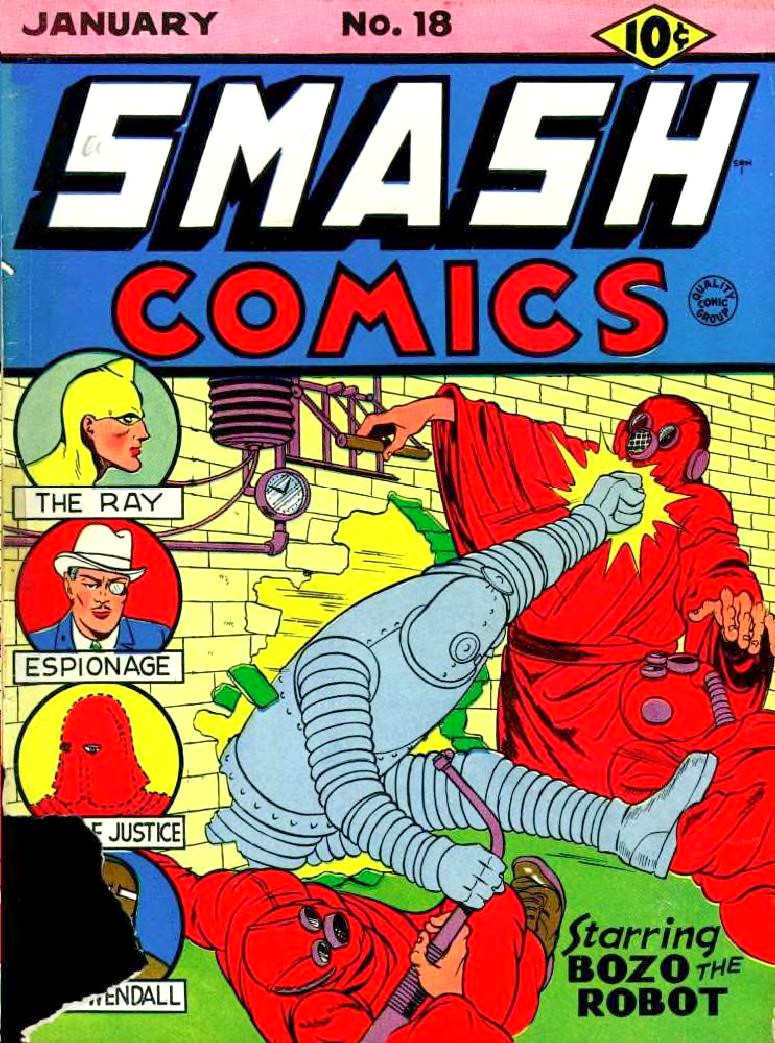
Smash Comics #18
☆ Be the first to review + Add to your collection — Join freeSmash Comics #18 (cover-dated January 1941) marks the debut of Midnight, a masked crimefighter created by Jack Cole — the same artist who would go on to create Plastic Man just months later — making this issue a genuine two-for-one landmark in the career of one of the Golden Age's most inventive talents. The character's genesis is inseparable from the business anxieties of wartime publishing: Quality Comics publisher Everett 'Busy' Arnold needed a house-owned contingency in case creator-owned Spirit artist Will Eisner was killed on military service, and the resulting character, while visually indebted to Eisner's creation, eventually grew into something distinct enough to carry Smash Comics as its sole cover feature from issue #28 all the way through the title's final issue (#85) in 1949. Beyond its key-issue status, the issue is a dense anthology snapshot of Quality's full Golden Age roster — The Ray (drawn by Lou Fine), Magno, Invisible Hood, Bozo the Robot, Black X, and more — making it one of the richest single issues Quality ever published. Midnight's long run and subsequent absorption into the DC Universe ensure that this debut sits at the root of a character lineage still occasionally revisited in modern comics.
In "The Midget Train Robbers," a 1941 Smash Comics classic, the inventive George Brenner crafts a high-stakes showdown between the cunning scientist von Thorp and the resourceful robot Hazzard. When von Thorp escapes prison and hijacks his own creation with a new control device, Hazzard must outwit his creator in a desperate game of survival—hiding inside the robot, evading capture, and enduring a flooded chamber with nothing but a pipe to breathe. The story, written, drawn, and inked by Brenner, features a striking cover by Gill Fox, capturing the tension and scale of the conflict in a single, dynamic image.
In "The Midget Train Robbers," newly transformed Ray—still grappling with the weight of his old identity—returns to his life as a newspaper reporter, chasing a story that leads him into the shadowy world of a traveling vaudeville troupe allied with the enigmatic Miss White. The case takes a bizarre turn as he investigates a string of train robberies, uncovering secrets that blur the line between circus spectacle and criminal enterprise.
In "The Return of Dr. Von Thorp," the mad scientist returns to reclaim his creation, the robot Bozo, using a device that overpowers Hazzard’s control. Trapped and outmaneuvered, Hazzard must survive a flooded chamber by improvising a breath tube—then strike back before the doctor’s reign of terror ends in gunfire.
In "null," the Scarlet Seal navigates a tense standoff between rival Chinese tongs, using diplomacy to avert a violent war fueled by a hidden fifth columnist. Though the traitor is ultimately eliminated by the tongs themselves, the Seal quietly accepts responsibility, stepping into the shadows to protect the fragile peace.
When King Archie O'Toole is evacuated from his war-torn country to escape a ruthless dictator's bombing campaign, he finds refuge on the serene Lover's Island—only to discover that tropical paradise comes with its own chaotic complications. This 1941 humor tale finds the king caught between danger and unexpected entanglements, longing for the relative safety of home and the sound of battle.
In "null," Midnight takes on a dangerous mystery when a series of faulty buildings linked to contractor Carleton begin to collapse. After being captured and tied to a crumbling dam, Midnight uses his wits and courage to escape just as the structure gives way, racing to warn the town below and bring Carleton to justice—securing $10 million in relief for the community.
In "null," Magno plunges into a murky swamp in pursuit of a criminal, only to uncover a hidden labyrinth beneath the mire—filled with prisoners altered by a deranged scientist. With his magnetic abilities, Magno confronts the madman behind the prison and dismantles the sinister complex before it can claim more victims.
ComicBooks.com Value
Show all 20 grades ▾
Find on ebay
Read it digitally
Sell my copy
Have this issue — or a whole collection? Get a fair offer from us, skip the marketplace fees and the hassle.
We Buy Collections ▸History
Quality publisher Everett 'Busy' Arnold directed Jack Cole to create a Spirit-adjacent character that Quality would own outright, a hedge against the uncertainty of Will Eisner's wartime military service. Cole, uncomfortable with the assignment, actually visited Eisner beforehand to discuss it; Eisner, as he later recalled in Alter Ego #48, was not thrilled but understood the commercial reality. Cole then consciously worked to push Midnight away from pure imitation, lending it a more satirical, cartoonist's energy that critic and historian commentary consistently identifies as a rehearsal for the humor and kinetic invention he would pour into Plastic Man (debuting in Police Comics #1 just seven months later, in August 1941). The issue was edited by Ed Cronin and featured cover art by Gill Fox alongside contributions from Lou Fine, Alex Blum, Vernon Henkel, Bob Powell, George Brenner, Dan Zolnerowich, Art Pinajian, George Tuska, and Paul Gustavson — a remarkably deep bench of Golden Age talent for a single 68-page issue.
Trivia · 8 facts
- First appearance of Midnight (Dave Clark), the masked radio-announcer crimefighter created by writer-artist Jack Cole; published cover-dated January 1941 by Quality Comics.
- Midnight's alter ego is Dave Clark, a radio spot announcer who voices a fictional masked hero called 'The Man Called Midnight' on air — he adopts the identity for real after witnessing a building collapse caused by criminal negligence by builder Morris Carleton.
- The character was deliberately commissioned by Quality publisher Everett 'Busy' Arnold as a Spirit analogue that Quality would own outright, in case Will Eisner — who retained rights to The Spirit — was killed during World War II military service.
- Jack Cole consulted Will Eisner directly before creating Midnight; Eisner's own account (published in Alter Ego #48) confirms he was unenthusiastic but accepted the situation, and that Cole worked to differentiate the feature from The Spirit.
- Despite his Spirit-inspired appearance (blue suit, fedora, domino mask), Midnight has no superpowers; the GCD and DC Database both note that, contrary to GoCollect's listing, the issue does not actually provide Midnight's origin — partygoers recognize him immediately, indicating this first published story is not his first in-universe adventure.
- The issue is a 68-page anthology also featuring The Ray (art by Lou Fine), Magno, Invisible Hood (Kent Thurston), Bozo the Robot, Espionage Starring Black X (a Will Eisner-originated feature, by then written by Lane French), the Purple Trio, the Scarlet Seal, Abdul the Arab, Wings Wendall, and others — with many artists working under pen names (Lou Fine as 'E. Lectron,' Bob Powell as 'Powell Roberts,' George Brenner as 'Wayne Reid,' Alex Blum as 'S.M. Regi,' Art Pinajian as 'Art Gordon').
- Midnight became Smash Comics' cover feature starting with issue #28 (November 1941) and held that position until the title was cancelled with issue #85 (October 1949), outlasting nearly every other Quality superhero.
- After Quality Comics folded in 1956, DC Comics acquired the character; Midnight was later integrated into DC's Earth-Two continuity via Roy Thomas's All-Star Squadron, received a revised post-Crisis origin in Secret Origins #28 (1988, written by Thomas, drawn by Gil Kane), and most recently appeared in the Young Animal backup 'Midnight in the Phantom Zone' in Bug! The Adventures of Forager #3–6 (2017–2018). A female version named Midnight also appeared as a villain in Season 5 of the Supergirl television series, portrayed by Jennifer Cheon Garcia.
Full credits
Reprints
Reprinted in Special Edition Series #2 (1974)
Key issues in Smash Comics
Reviews
Reader reviews
No reader reviews yet.