
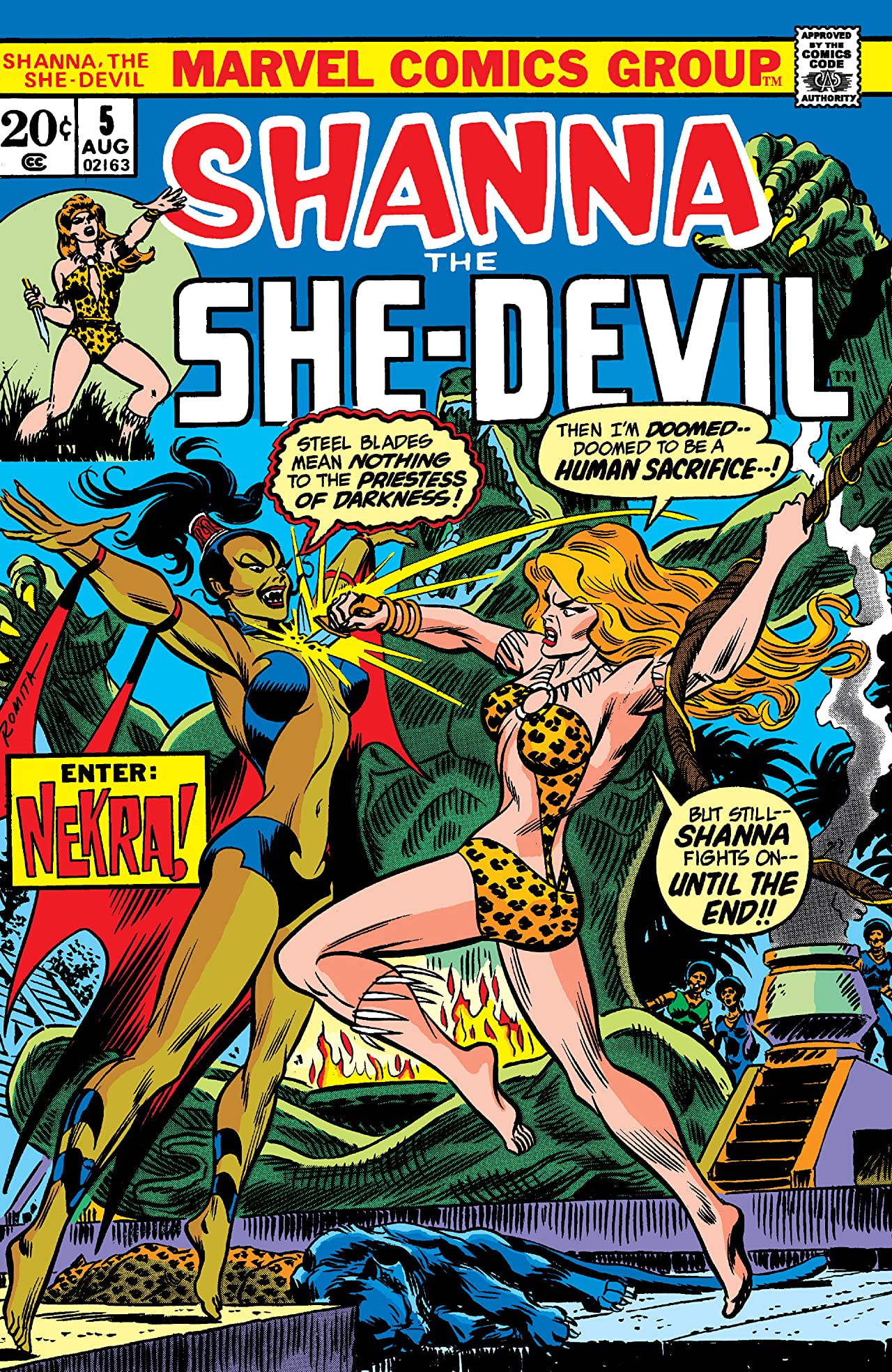
Shanna, the She-Devil #5
Shanna the She-Devil #5 is the first appearance of Nekra (Nekra Sinclair), a mutant villain whose emotion-powered abilities and racially inverted origin made her one of the more conceptually unusual antagonists introduced during Marvel's Bronze Age. As the final issue of the short-lived series — the last of Marvel's early-1970s experiment in female-led, female-written superhero comics — it also closes a chapter that helped lay groundwork for Shanna's decades-long career as a supporting figure across the wider Marvel Universe. Nekra's debut here directly fed into Steve Gerber's subsequent Daredevil run, where her story was expanded alongside Mandrill's, ensuring that a cancelled five-issue series left a surprisingly durable villain legacy. The issue also marks an early in-continuity appearance of Professor X in a non-X-Men title, used here as an off-panel mutant-detection authority.
ComicBooks.com Value
Show all 15 grades ▾
This exact issue on ebay
CGC 9.2 ▾ $160–$165 2 listings
CGC 7.5 ▾ $77–$82 2 listings
Raw / ungraded ▾ $12.77–$108 7 listings
More listings for this title
Read it digitally
Sell my copy
Have this issue — or a whole collection? Get a fair offer from us, skip the marketplace fees and the hassle.
We Buy Collections ▸History
The Shanna the She-Devil series was conceived by editor-in-chief Stan Lee as one of three Marvel titles aimed at broadening the publisher's female readership, alongside Night Nurse and Claws of the Cat, with Roy Thomas recruiting women writers to helm them. Carole Seuling wrote the first three issues and plotted the fourth — introducing the Mandrill — before departing, at which point Steve Gerber took sole scripting duties for the final issue. Gerber created Nekra for this closing chapter, pairing her with Seuling's Mandrill in a two-villain team whose shared radiation-mutated origin he would continue developing in Daredevil the following year. The series was cancelled after five issues due to low sales, leaving its final cliffhanger unresolved within the title itself.
Trivia · 8 facts
- First full appearance of Nekra (Nekra Sinclair), a mutant villain with hate-powered superhuman strength and invulnerability, created by writer Steve Gerber and penciler Ross Andru.
- Titled 'Where Nekra Walks, Death Must Follow!' — the fifth and final issue of the 1972–1973 Shanna the She-Devil series (cover date: August 1973).
- Interior art by Ross Andru with inks by Vince Colletta; cover painted by John Romita Sr., who also drew the cover of issue #4.
- Edited by Roy Thomas, who served as both editor and editor-in-chief on the entire series; the series was part of Marvel's early-1970s initiative to publish female-led superhero titles.
- Professor X (Charles Xavier) and FBI Agent Fred Duncan appear in the story only via video screen, as Xavier announces he has detected two mutants in Africa — an early cross-title use of Professor X as a mutant-detection resource outside the X-Men books.
- Mandrill (Jerome Beechman), who made his first appearance in issue #4 per Carole Seuling's plot, appears here only in a photograph, while Nekra takes center stage as his ally and de facto field commander.
- Nekra and Mandrill share an origin rooted in prenatal radiation exposure at Los Alamos, giving them a mirrored racial appearance — Nekra born pale to Black parents, Mandrill born dark-skinned to white parents — a heavy-handed racial allegory that later commentators and the characters' own subsequent stories addressed critically.
- This issue was later reprinted in the Women of Marvel: Celebrating Seven Decades Omnibus, cementing its place in Marvel's collected retrospective on female characters.
Cast · 9 characters
Full credits
Reprints
Reprinted in L'Inattendu #6 (1976), Women of Marvel: Celebrating Seven Decades Omnibus #[nn] (2010), Marvel Masterworks: Ka-Zar #2 (2018)
Key issues in Shanna, the She-Devil
Reviews
Reader reviews
No reader reviews yet.