
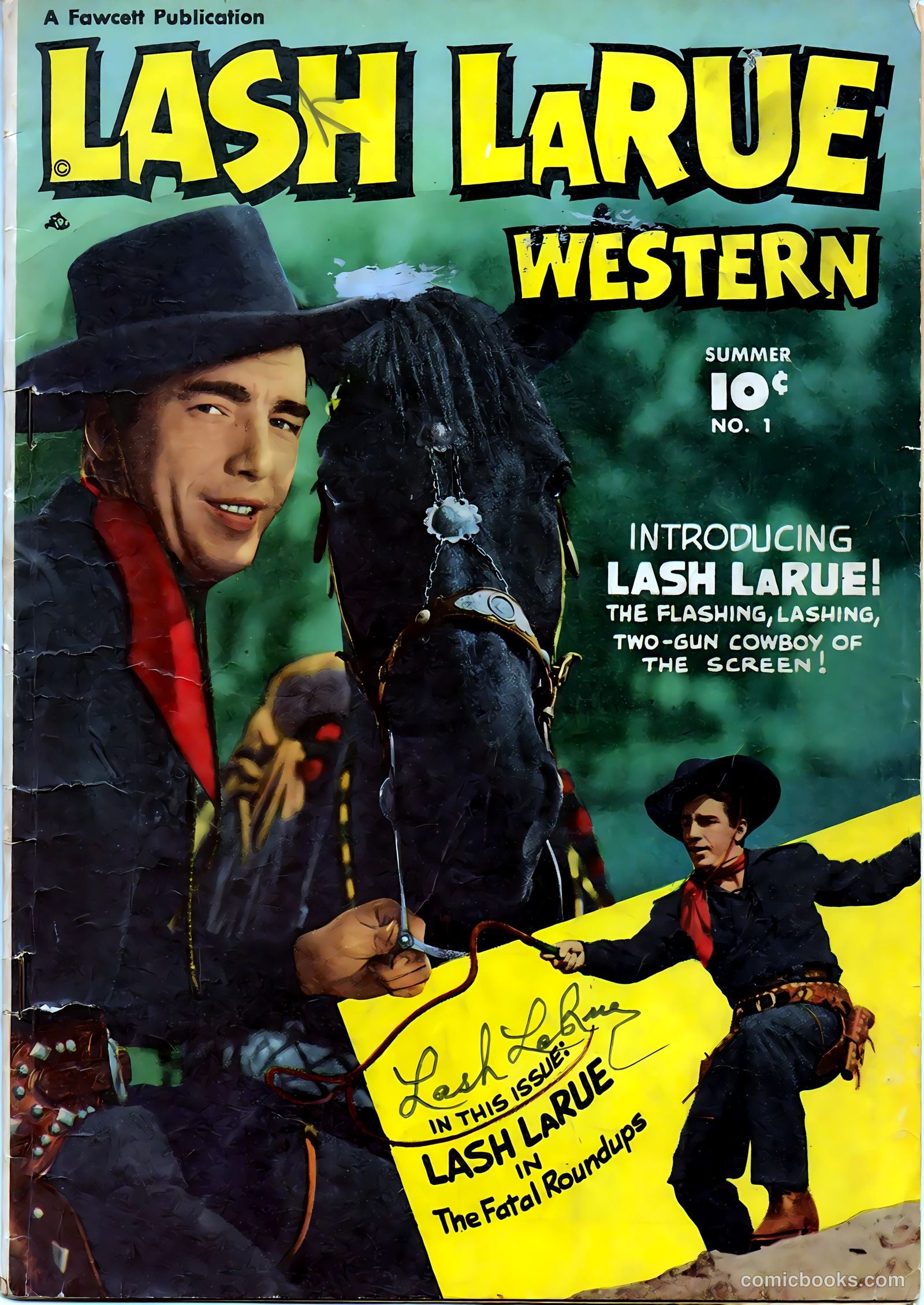
Lash LaRue Western #1
☆ Be the first to review + Add to your collection — Join freeLash LaRue Western #1 (Summer 1949) marks the debut of one of Golden Age comics' most distinctive movie-tie-in titles, translating a genuinely unconventional screen hero — a black-clad, whip-wielding roving marshal who looked more like a Humphrey Bogart antihero than a singing cowboy — directly onto the four-color page at the height of the B-Western craze. The series it launched proved to be among the most commercially successful Western comics of its era, eventually running 84 issues across two publishers over twelve years and reportedly moving 12 million copies in 1952 alone. It also stands as an early example of a comic book's cross-media cultural reach feeding back into Hollywood mythology: LaRue's real-life bullwhip mastery, first popularized through his films and then reinforced issue after issue on the stands, contributed to an enduring cultural archetype that would later inspire Indiana Jones.
In "The Fatal Roundups," Lash LaRue confronts the villainous Red Frisby and his gang, who are stealing cattle and committing murders across the territory. Using his signature whip, Lash defeats Frisby's men in a series of battles. The story reveals a plot involving a disputed ranch inheritance, with Lash ultimately working to protect young Lamont and recover the stolen cattle while bringing the criminals to justice.
Chief Gray Matter greets a dude ranch visitor fresh off his first day in the saddle, and the injured tenderfoot gets a good-natured ribbing about what he won't be able to do by sunset. It's a quick joke that plays on the exhaustion of a long day of riding, delivered with Chief Gray Matter's distinctive frontier humor.
Wagonwheels arrives in a state of dramatic distress, insisting he's witnessed something so terrible he'll never recover from it—but when his friends press him for details, the gabby character reveals his "awful" experience was nothing more than a clever setup for a well-timed punchline. A quick-witted bit of frontier humor that proves even the best intentions to keep a secret can fall victim to a good gag.
When a notorious rustler named Red Frisby devises a deadly scheme to steal cattle from the ranchers of Peaceful Corners, Marshal Lash LaRue arrives to put a stop to the gang's murderous spree. What begins as a clever ploy to lure unsuspecting cattlemen into a trap becomes a test of wits and nerve when LaRue's quick thinking and legendary whip work turn the tables on Frisby and his ruthless henchmen.
When a sharpshooter reveals his unorthodox method for hitting perfect bull's-eyes—shoot first, draw the targets afterward—the humor lands in "Some Shooting," a quick comic bit from *Lash LaRue Western* #1 (1949) featuring Loco Lew and a visiting marksman. It's the kind of frontier tall-tale logic that makes westerns fun, delivered with a punchline that flips the whole premise on its head.
Big Bow and Little Arrow seek shelter in a carnival stable for the night, but the carnival owner agrees to let them stay only if they work—sweeping, hauling hay, and feeding the horses. When the owner then serves them horse feed as payment for their labor, the duo plots revenge by washing away the decorative paint and powder that makes the carnival horses look pristine, working through the night to teach the owner a lesson. Come morning, their prank backfires in the most ironic way possible.
When Bill Lamont Jr. returns home to claim his late father's ranch, he finds himself in danger from an unexpected source—the trusted foreman Sledge, who stands to inherit the property if anything happens to the young heir before his twenty-first birthday. With each "accident" Sledge arranges growing more elaborate and deadly, Bill discovers he can count on Marshal Lash LaRue to see through the schemes and stand by his side. As Sledge's desperation mounts and his final trap is sprung, it becomes a race against time to stop a man willing to commit murder to claim what he believes is rightfully his.
ComicBooks.com Value
Show all 18 grades ▾
This exact issue on ebay
Raw — VF ▾ $111–$132 2 listings
Raw / ungraded ▾ $20.29–$450 9 listings
Read it digitally
Sell my copy
Have this issue — or a whole collection? Get a fair offer from us, skip the marketplace fees and the hassle.
We Buy Collections ▸History
Fawcett Publications launched the series in the summer of 1949 as part of a robust slate of Western comics tied to then-popular B-movie cowboys, a strategy that also yielded titles for Tom Mix and Monte Hale. The arrangement between Fawcett and LaRue involved no royalty payments to the actor; like other Western stars of the era, LaRue accepted the deal purely for the promotional value it offered his film career. When Fawcett shuttered its comics division in 1953–54, the title transferred seamlessly to Charlton Comics, which continued the numbering from issue #47 through #84, keeping the character on newsstands until 1961. AC Comics published two reprint editions drawing on the Fawcett run in 1990, extending the title's archival life.
Trivia · 8 facts
- First issue published Summer 1949 by Fawcett Publications; cover price 10 cents, 32 pages, full color.
- Fawcett published issues #1–46 (Summer 1949–January 1954); Charlton Comics continued the run with issues #47–84, ending in 1961 — a combined span of twelve years.
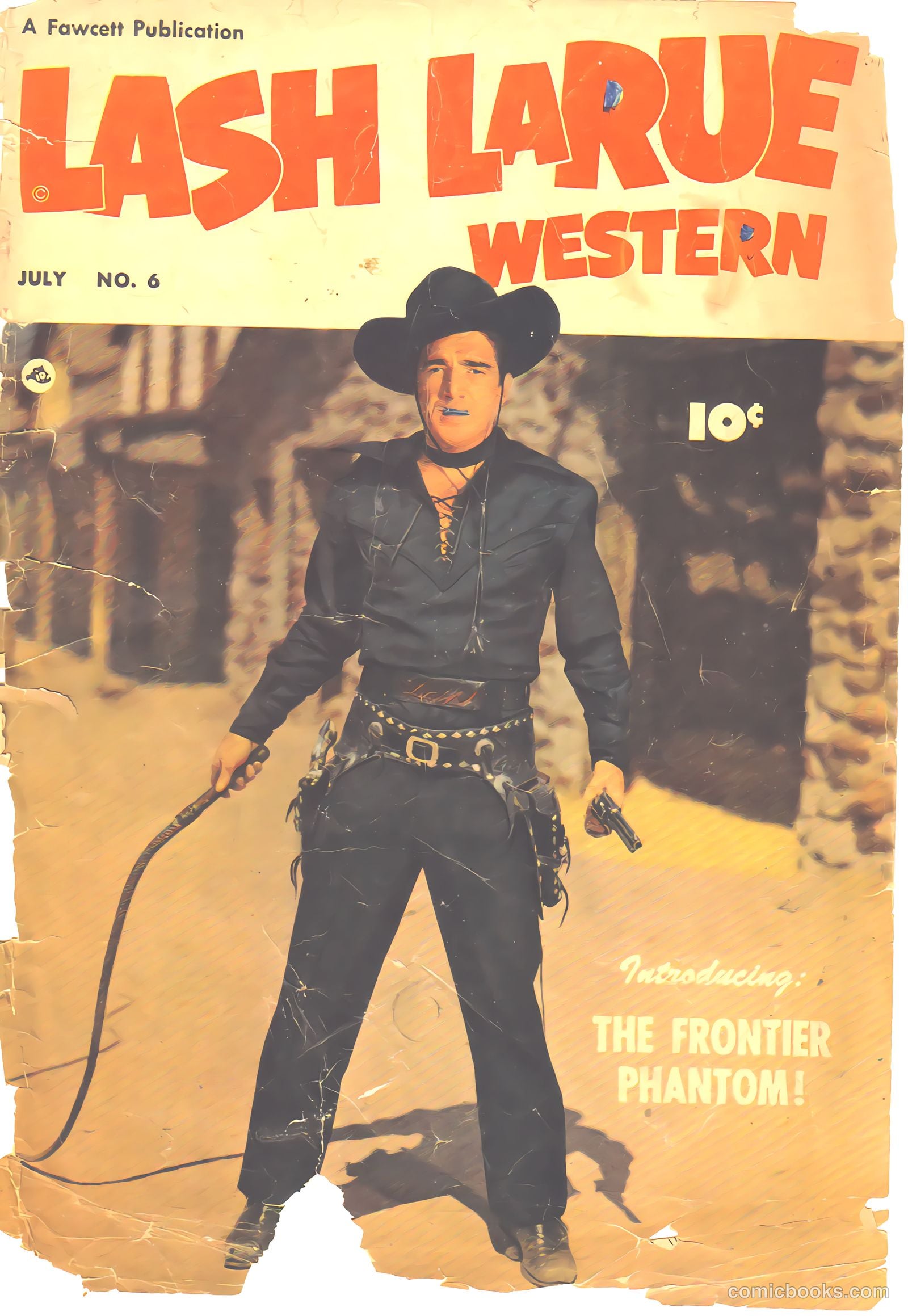
- All 46 Fawcett issues are reported to have featured photo covers of Alfred 'Lash' LaRue rather than illustrated cover art.
- The in-comic version of Lash is depicted as a 'roving U.S. Marshal' dressed entirely in black, whose signature weapon is an 18-foot bullwhip — mirroring the actor's screen persona.
- LaRue received no royalties from Fawcett for the use of his name and likeness; the promotional exposure was considered sufficient compensation.
- The series was a major commercial success: the comic sold 12 million copies in 1952 alone across its various issues.
- Many stories in the run featured LaRue's real-life godson, child actor J.P. Sloane, as a recurring character.
- AC Comics issued two reprint editions from the Fawcett run in 1990; individual issues from the series have also been reprinted in the modern era under public-domain reprint imprints.
Reprints
Reprinted in Lash LaRue Western #1 (1950), Tex Ritter Western #32 (1956), Jim Bowie #18 (1957), Black Fury #10 (1957)
Key issues in Lash LaRue Western
Reviews
Reader reviews
No reader reviews yet.