
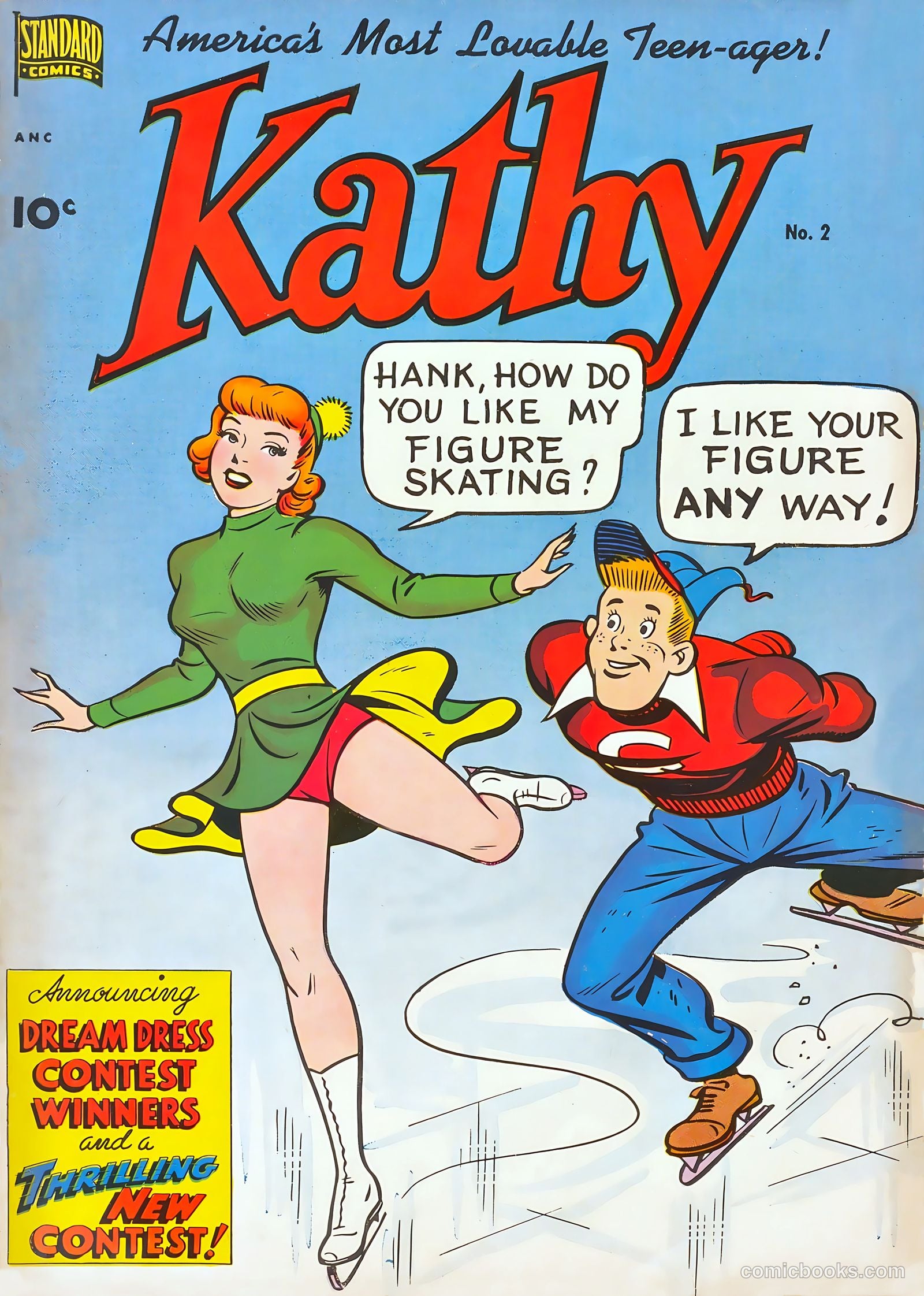
Kathy #2
☆ Be the first to review + Add to your collection — Join freeKathy #2 is an early entry in Standard Comics' answer to the postwar teen-humor boom — a genre wave that Archie had pioneered and that every major publisher rushed to join by decade's end. The issue is distinguished by its cover, credited to Alex Schomburg, one of the most versatile cover artists of the Golden Age, here demonstrating his late-1940s pivot from wartime superhero splash pages to breezy, good-girl cheesecake work. As the second issue of a series that would run a healthy seventeen issues through 1955, it helped establish the formula — rotating ensemble cast, school-and-dating comedy, reader-participation contests — that kept the Kathy franchise alive well into the early Silver Age. The book is also a quiet early-career document for Clark Haas, the cartoonist who drew virtually every interior story in the series before going on to found Cambria Studios and create the animated television series Clutch Cargo.
"Big Splash," by Betty Cummings, follows Janey as she competes in a Diving Club contest at Hollywood High for the prize of appearing in a movie short. Competing against her friend Dotty, who has a crush on Don Winters (the best boy diver), Janey struggles with nervousness and Dotty's increased practice efforts, ultimately discovering her white satin bathing suit missing just before the contest. Additionally, the issue contains a comedic story about Ginger's father unexpectedly bringing a Scottish visitor to a party, leading to confusion and chaos when the guest mistakes casual party antics for serious misbehavior and enlists the host's help to discipline the unruly "American children."
Kathy agrees to watch her nature study class's baby alligator, Oswald, over the weekend—but when her father accidentally sends the gift-wrapped cage to his boss as an anniversary present, she and her friend Mickey spring into action to pull off a frantic switch before the truth comes out. What should be a simple swap turns into a slapstick scramble across town, complete with fake fainting spells and close calls, all while Kathy tries to keep her dad from discovering what really went into that fancy box.
When Kathy's well-meaning bid at a military auction turns out to cost four hundred and fifty dollars instead of four dollars and fifty cents, the runaway steam shovel she brings home wreaks havoc all over town—and lands her father in hot water with the judge. Now it's up to Kathy to think fast and turn the chaos into an opportunity that might just save the day for everyone involved.
When Speedy Hopper criticizes the girls at Hilltop High for wearing casual clothes, Ginger and her friends double down on their sloppy style just to spite him. Determined to prove his point, Speedy rounds up the boys and rents Scottish kilts and bagpipes for an outrageous parade right outside Ginger's house—only to have his scheme backfire in the most unexpected way. It's a clash of teenage fashion stubbornness that spirals into hilarious chaos nobody saw coming.
When Kathy lands a part in the school play, her constant weeping and dramatics turn her household upside down—no amount of parental concern or intervention seems to snap her out of her emotional spiral. It turns out her tearful performance isn't a problem at all, just perfect preparation for the role, and the director has an entirely different challenge in mind for her next appearance.
ComicBooks.com Value
Show all 22 grades ▾
Find on ebay
Read it digitally
Sell my copy
Have this issue — or a whole collection? Get a fair offer from us, skip the marketplace fees and the hassle.
We Buy Collections ▸History
The Kathy series launched in September 1949 under Ned Pines's publishing empire, which operated its comic-book output through the Standard Comics brand while the indicia listed the legal entity as Visual Editions Inc. Pines, a prolific pulp and comic-book publisher active from the late 1920s onward, had built his stable around genre variety — superheroes, romance, science fiction — and the teen-humor line was a deliberate commercial response to Archie's growing dominance of that readership. Clark Haas, who had previously worked on Sunday-supplement strips including Buz Sawyer and Tim Tyler's Luck, was the primary artistic engine of the series from the outset, handling both pencils and inks on the Kathy features throughout the run's early years.
Trivia · 8 facts
- Published December 1949 by Pines (Standard Comics), with the legal indicia listing Visual Editions Inc. as publisher — the second issue of a series that debuted in September 1949.
- Cover art by Alex Schomburg, one of the Golden Age's most prolific cover artists, known for his earlier work on Timely/Marvel superhero covers and his long association with Ned Pines's Standard Comics line.
- All interior Kathy strip art in the issue is by Clark Haas, who signed his work and served as the series' consistent artistic backbone across its early years.
- The issue is a 36-page, full-color anthology in the teen-humor genre, priced at ten cents — standard for the format and era.
- The series marketed its title character as 'America's Most Lovable Teen-ager,' a branding phrase used in house advertisements within the comic itself.
- The ensemble cast established across the series includes Kathy Crane, her family members (Mickey, Mr. Crane, Martha Crane), her dog Gyp, and supporting characters Fanny Farnswortle and Hank — all of whom appear in issues surrounding #2.
- Later issues of the same series (around #9–#10) featured work by Dan DeCarlo, identified by comics historian Jerry Bails, giving the Kathy run a footnote in the pre-Archie career of one of teen-humor comics' most consequential artists.
- The series ran for 17 issues in total, from September 1949 through September 1955, making it one of Standard Comics' more durable humor titles of the period.
Full credits
Reviews
Reader reviews
No reader reviews yet.