
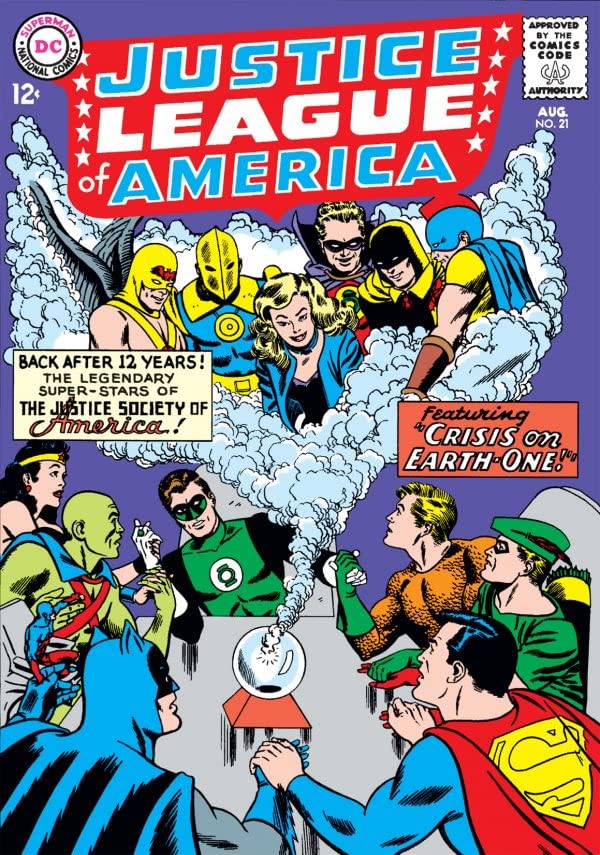
Justice League of America #21
Justice League of America #21 marks the first time the Silver Age Justice League of America and the Golden Age Justice Society of America shared a story, an event so well-received that it inaugurated an annual summer crossover tradition lasting from 1963 all the way to 1985. Equally significant, this is the issue in which both parallel universes were given their formal designations — Earth-One for the JLA's reality and Earth-Two for the JSA's — cementing the structural foundation of the DC Multiverse that The Flash #123 had only sketched two years earlier. The story also introduced the word 'Crisis' as a label for a DC crossover event, a term that would echo through the publisher's entire line for decades and ultimately give its name to the 1985 universe-reshaping Crisis on Infinite Earths. In one 36-page package, writer Gardner Fox and editor Julius Schwartz handed collectors the first JLA/JSA meeting, the first official naming of Earth-One and Earth-Two, and the origin of DC's most durable crossover vocabulary.
In "Crisis on Earth-One!", the Justice League of America faces a cunning scheme as three Earth-1 villains team up with three Earth-2 counterparts to commit crimes and vanish across dimensions. With the League trapped in their own headquarters, they call upon the older heroes of the Justice Society of America—switching places to battle the threat. Written by Gardner Fox and illustrated by Mike Sekowsky, with inks by Bernard Sachs and lettering by Gaspar Saladino, this 1963 classic features cover art by Mike Sekowsky and Murphy Anderson.
ComicBooks.com Value
Show all 22 grades ▾
Find on ebay
Read it digitally
Sell my copy
Have this issue — or a whole collection? Get a fair offer from us, skip the marketplace fees and the hassle.
We Buy Collections ▸History
Gardner Fox was uniquely positioned to engineer this collision: he had created the Justice Society for All-Star Comics in 1940 and then conceived the Justice League for editor Julius Schwartz in 1960, making him the sole architect of both teams. The story built directly on reader enthusiasm generated by The Flash #123 (1961) and two subsequent Flash issues that had teased Golden Age characters returning, with fan-letter pages reportedly overflowing with enthusiasm for Jay Garrick's revival. Schwartz later acknowledged that the sequel crossover was not planned in advance — it was triggered by strong sales on this two-parter, confirming audience demand and turning what might have been a one-off into a cornerstone annual event. Interior art was penciled by series regular Mike Sekowsky with inks by Bernard Sachs, while Murphy Anderson inked Sekowsky's cover.
Trivia · 8 facts
- Cover date August 1963; story title 'Crisis on Earth-One!'; continued in Justice League of America #22 ('Crisis on Earth-Two!').
- First team-up of the Justice League of America and the Justice Society of America — the event that launched an annual JLA/JSA crossover tradition running continuously until Justice League of America #245 (1985).
- First in-story use of the designations 'Earth-One' and 'Earth-Two,' formally naming the parallel universes that The Flash #123 (1961) had introduced conceptually.
- First use of the word 'Crisis' to describe a DC crossover event — a term later applied to Identity Crisis, Infinite Crisis, Final Crisis, and the landmark 1985 maxi-series Crisis on Infinite Earths.
- First Silver Age appearances of Doctor Fate (Kent Nelson) and Hourman (Rex Tyler); also marks the first in-continuity meeting of Green Arrow and Black Canary, and the first meeting of the two Green Lanterns — Hal Jordan (Earth-One) and Alan Scott (Earth-Two).
- Written by Gardner Fox (creator of both teams); penciled by Mike Sekowsky; inked by Bernard Sachs (interiors) and Murphy Anderson (cover); edited by Julius Schwartz.
- The two-part 'Crisis on Earth-One / Crisis on Earth-Two' arc won the 1963 Alley Award for Favorite Novel, voted by comics readers.
- The issue has been reprinted extensively, including Justice League of America Archives Vol. 3 (1994), Crisis on Multiple Earths Vol. 1 (2002), Showcase Presents: Justice League of America Vol. 2 (2007), the Justice League of America Omnibus Vol. 1 (2014), and a DC Facsimile Edition (2025/2026). Alan Moore's Image series Supreme also paid homage to this issue's cover.
Full credits
Reprints
Reprinted in Batman #204 (1964), Quadrinhos (1ª Série) [Os Justiceiros] #1 (1967), DC 100-Page Super Spectacular #6 (1971), The Greatest Team-Up Stories Ever Told #[nn] (1989), The Greatest Team-Up Stories Ever Told #[nn] (1990), Justice League of America Archives #3 (1994), Crisis on Multiple Earths #[1] (2002), DC 100-Page Super Spectacular No. 6 Replica Edition #[nn] (2004), Showcase Presents: Justice League of America #2 (2007), DC Comics Anthologie #[nn] (2012), The Justice League of America Omnibus #1 (2014), Justice Society of America: A Celebration of 75 Years #[nn] (2015), DC Comics Graphic Novel Collection #66 (2016), Justice League of America: The Silver Age #3 (2017), Justice League of America: The Silver Age Omnibus #1 (2020), Crisis on Multiple Earths #1 (2021), Justice League of America 21 (Facsimile Edition) #[nn] (2026)
Key issues in Justice League of America
Reviews
Reader reviews
No reader reviews yet.