
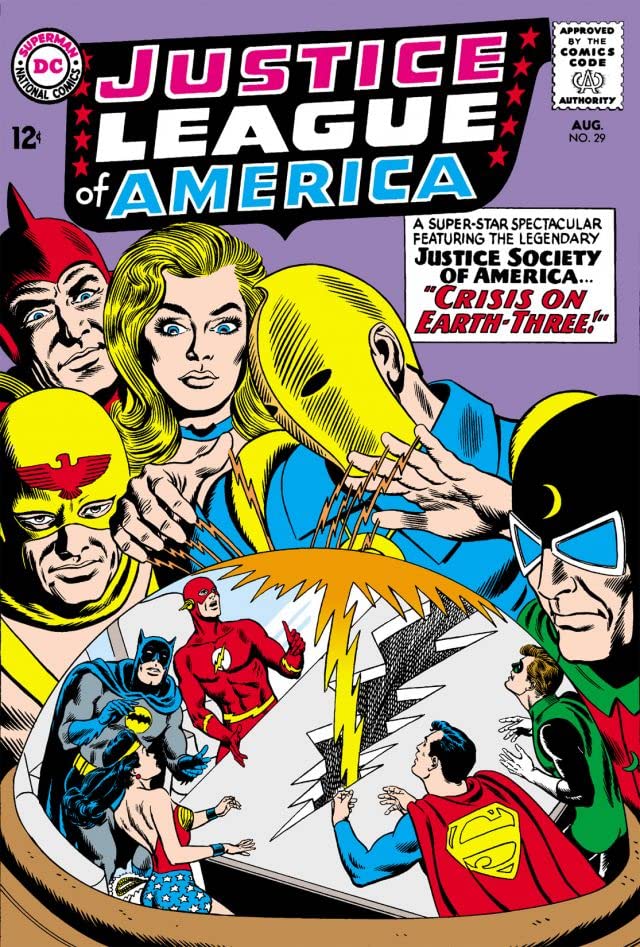
Justice League of America #29
Justice League of America #29 is the founding document of DC's Earth-Three concept and the debut of the Crime Syndicate of America — five evil mirror-image counterparts to the Justice League's core members — making it one of the most consequential single issues in the development of DC's multiverse mythology. Writer Gardner Fox used the issue to push the annual JLA/JSA crossover format a step further, adding a third parallel Earth to the cosmology he had begun building in issues #21–22, and the idea of a world where history runs in reverse proved durable enough to anchor stories across six decades. The first Silver Age appearance of Starman (Ted Knight) gives the issue a second major debut, bringing a key Golden Age hero back to comics after years of absence. The Crime Syndicate concept — villains who are structurally identical to the heroes but morally inverted — became one of the genre's most-recycled ideas, directly inspiring the 2010 animated film Justice League: Crisis on Two Earths, the New 52's Forever Evil crossover, and countless alternate-universe storylines.
In "Crisis on Earth-Three!", the Crime Syndicate—bored with their role as Earth-3’s supreme villains—break through to the Justice League’s world after Ultraman gains a strange new power from repeated exposure to Green Kryptonite. With the JLA momentarily on the defensive, the Syndicate teleport them to their home Earth, where they hold the upper hand. Now, with the JSA on their target list, the League must find a way to even the odds before it’s too late. Written by Gardner Fox and illustrated by Mike Sekowsky, with inks by Bernard Sachs and letters by Gaspar Saladino, this 1964 classic features cover art by Mike Sekowsky and Murphy Anderson.
ComicBooks.com Value
Show all 20 grades ▾
This exact issue on ebay
CGC 4.5 ▾ $138–$250 2 listings
Raw — VF ▾ $1–$250 2 listings
Raw — FN+ ▾ $110–$375 2 listings
Raw — FN ▾ $120–$225 2 listings
Raw — VG ▾ $60.79–$130 5 listings
Raw / ungraded ▾ $2.99–$125 12 listings
Read it digitally
Sell my copy
Have this issue — or a whole collection? Get a fair offer from us, skip the marketplace fees and the hassle.
We Buy Collections ▸History
The issue was produced by the core Silver Age JLA creative team of writer Gardner Fox, penciler Mike Sekowsky, and inker Bernard Sachs, under editor Julius Schwartz, who had been orchestrating annual JLA/JSA team-ups since 1963. Fox expanded the multiverse framework he and Schwartz had established with Earth-One and Earth-Two by introducing Earth-Three as a world where history literally ran in reverse — Christopher Columbus was an American who discovered England, John Wilkes Booth served as U.S. President, and the only super-powered individuals were criminals. The story ran across 23 pages divided into three chapters and continued into issue #30, following the two-part structure Fox had used for every prior JLA/JSA crossover. The cover was penciled by Sekowsky with inks by Murphy Anderson, a slightly different inking combination than the interior.
Trivia · 8 facts
- First team appearance of the Crime Syndicate of America: Ultraman (evil Superman), Owlman (evil Batman), Superwoman (evil Wonder Woman), Johnny Quick (evil Flash), and Power Ring (evil Green Lantern), all from Earth-Three.
- First appearance of Earth-Three itself as a named, fully realized parallel universe within DC's multiverse.
- First Silver Age appearance of Starman (Ted Knight, Earth-Two), returning the Golden Age hero to comics pages.
- Story title: 'Crisis on Earth-Three!' — written by Gardner Fox, penciled by Mike Sekowsky, inked by Bernard Sachs, lettered by Gaspar Saladino; cover pencils by Sekowsky, inked by Murphy Anderson; edited by Julius Schwartz.
- The issue also features a JSA contingent from Earth-Two: Hawkman (Carter Hall), Black Canary (Dinah Drake), Dr. Fate (Kent Nelson), Dr. Mid-Nite (Charles McNider), Jay Garrick's Flash, Atom (Al Pratt), and Alan Scott's Green Lantern.
- Earth-Three's inverted history is sketched in this issue: Columbus (an American) discovers England; the English win independence from America; Abraham Lincoln assassinates President John Wilkes Booth.
- The magic word 'Volthoom' — the name of the monk who gave Power Ring his ring — serves as the CSA's dimensional transport mechanism and is first mentioned here; the name was later repurposed in the New 52 as 'the first Lantern.'
- Known reprints include Justice League of America #114 (1974) and the 'Crisis on Multiple Earths' Vol. 1 trade paperback (collecting JLA #21–22, 29–30, 37–38, 46–47); the story also appears in Justice League of America Archives Vol. 4 and Justice League of America: The Silver Age Vol. 3.
Cast · 23 characters
Full credits
Reprints
↩ Reprints Showcase #19 (1959)
Reprinted in From Beyond the Unknown #10 (1971), Justice League of America #114 (1974), Justice League of America Archives #4 (1998), Crisis on Multiple Earths #[1] (2002), Showcase Presents: Justice League of America #2 (2007), Comix #9/2013 (2013), The Justice League of America Omnibus #1 (2014), Justice League of America: The Silver Age #3 (2017), Justice League of America: A Celebration of 60 Years #[nn] (2020), Justice League of America: The Silver Age Omnibus #1 (2020), Crisis on Multiple Earths #1 (2021)
Key issues in Justice League of America
Reviews
Reader reviews
No reader reviews yet.