
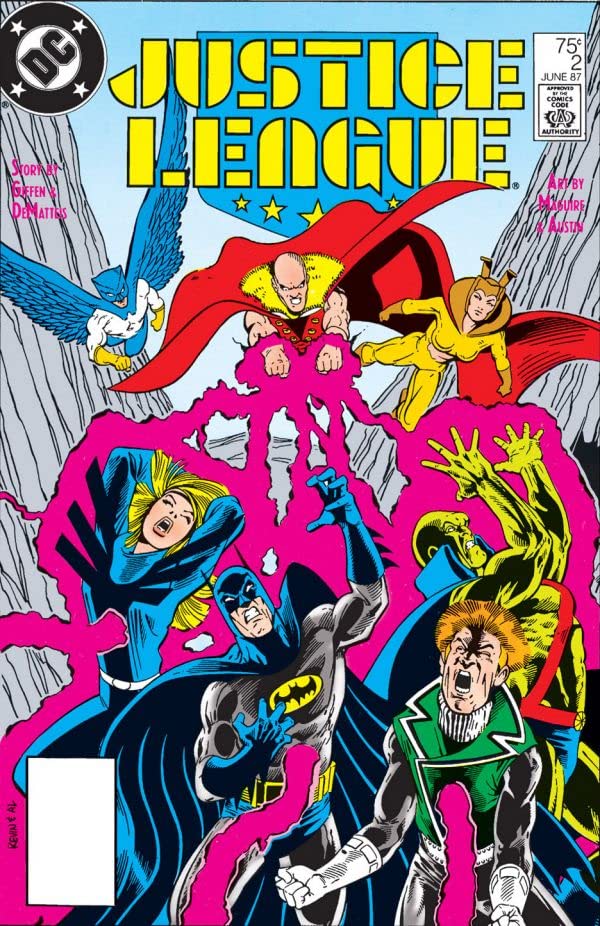
Justice League #2
Justice League #2 is the first appearance of the Gray Man — a rogue servant of the Lords of Order whose storyline threads through the entire inaugural arc of the Giffen/DeMatteis run — and delivers the post-Crisis debut of Rumaan Harjavti, the fictional Bialyan dictator who would remain a recurring political antagonist in the series. The issue also reintroduces the Champions of Angor (Blue Jay, Silver Sorceress, and Wandjina) in their post-Crisis form, recasting them as traumatized survivors of a nuclear holocaust rather than alien adventurers, a thematic pivot that grounded the series in the real-world nuclear anxieties of the late Cold War era. That willingness to engage geopolitical tension — with the fictional nation of Bialya standing in for Libya and the plot drawing on contemporary headlines about Israel's nuclear capabilities — distinguished the Giffen/DeMatteis Justice League from contemporaries content with pure escapism, and it set the moral and comedic tone that would define the book through its renaming as Justice League International.
In "Make War No More!", the Justice League faces a mysterious trio of super-powered beings who appear without warning and begin dismantling the world’s nuclear stockpiles—leaving the League torn between stopping a potential catastrophe and respecting the sanctuary granted by Bialya. Written by Keith Giffen and J. M. DeMatteis, with art by Keith Giffen and Kevin Maguire, this 1987 issue delivers a tense, morally complex clash of ideals, all rendered in dynamic pencils and bold colors by Maguire and Al Gordon, with lettering by Bob Lappan and coloring by Gene D'Angelo. The cover by Kevin Maguire and Al Gordon captures the moment of confrontation with striking intensity.
ComicBooks.com Value
Find on ebay
Read it digitally
Sell my copy
Have this issue — or a whole collection? Get a fair offer from us, skip the marketplace fees and the hassle.
We Buy Collections ▸History
The series emerged directly from the 1986–1987 DC crossover event Legends as a post-Crisis relaunch of the Justice League franchise, with Keith Giffen handling plot and breakdowns while J.M. DeMatteis wrote dialogue — a division of labor born partly from Giffen's self-described uncertainty about scripting. Editor Andrew Helfer assembled the team, notably insisting on Guy Gardner as Green Lantern over the more prominent Hal Jordan, and the comedy-inflected tone evolved organically rather than by design, as Giffen himself later acknowledged. The creative team's working method — Giffen plotting in thumbnail form and DeMatteis scripting from those pages — gave the series its unusually precise character voice, with Kevin Maguire's expressive, acting-driven pencils and Al Gordon's inks completing the distinctive look. Issue #2's nuclear disarmament storyline drew on then-current events, most notably Mordechai Vanunu's revelations about Israel's nuclear program and the international profile of Muammar Gaddafi's Libya.
Trivia · 8 facts
- First appearance of the Gray Man, a rogue agent of the Lords of Order, who serves as the primary supernatural antagonist of the book's opening six-issue arc before dying in Justice League International #7.
- First appearance of Rumaan Harjavti, dictator of the fictional nation of Bialya, who manipulates the Champions of Angor and becomes a recurring political villain in the series.
- Post-Crisis reintroduction of the Champions of Angor — Blue Jay (Jay Abrams), Silver Sorceress (Laura Neilsen), and Wandjina — now portrayed as sole survivors of a nuclear holocaust that destroyed their world, Angor; their pre-Crisis debut was Justice League of America #87 (February 1971), created by Mike Friedrich and Dick Dillin.
- The Champions of Angor are explicit DC analogues of Marvel characters: Wandjina corresponds to Thor, Silver Sorceress to the Scarlet Witch, and Blue Jay to Yellowjacket/Hank Pym.
- The issue's fictional politics mirror real-world events: the Bialyan dictator Harjavti parallels Muammar Gaddafi, and the Israeli nuclear subplot draws on Mordechai Vanunu's 1986 whistleblowing disclosures.
- Captain Speed (Harry Christos), the Champions' fourth member and a Quick Silver/Flash analogue, appears only in flashback — already dead of radiation poisoning sustained in Angor's nuclear disaster.
- Written by Keith Giffen (plot/breakdowns) and J.M. DeMatteis (script), with pencils by Kevin Maguire, inks by Al Gordon, colors by Gene D'Angelo, letters by Bob Lappan, and edited by Andrew Helfer; cover date June 1987.
- The issue has been reprinted at least twelve times across multiple languages and formats, including Justice League: A New Beginning (1989), Justice League International Omnibus Vol. 1 (2017), and Justice League International: Born Again (2020).
Cast · 22 characters
Full credits
Reprints
Reprinted in Lovens Vogtere #1 (1988), DC presenterer #1/1988 (1988), Batman #26 (1988), Liga da Justiça #2 (1989), Justice League: A New Beginning #[nn] (1989), Justice League [Lega della Giustizia] #5 (1990), Justice League International #1 (2008), Justice League International #1 (2009), DC Comics Graphic Novel Collection #73 (2016), Justice League International Omnibus #1 (2017), Liga da Justiça: Lendas do Universo DC #1 (2019), Justice League International #1 (2020)
Key issues in Justice League
Variants (2)
Reviews
Reader reviews
No reader reviews yet.