
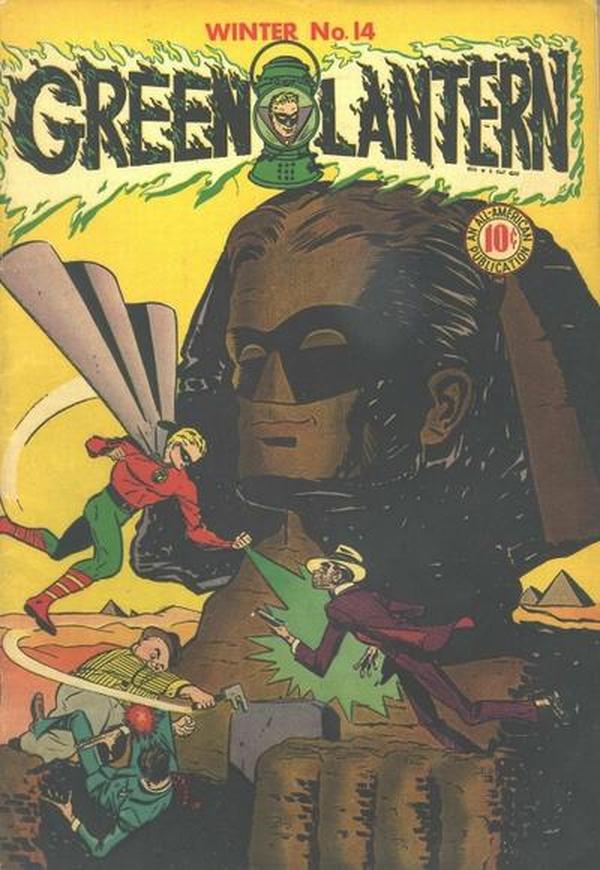
Green Lantern #14
Green Lantern Vol. 1 #14 (December 1944) is a quiet but notable waypoint in the Golden Age run of Alan Scott's solo series, marking what the DC Database identifies as the apparent shift of Alan Scott's base of operations from Capitol City to Gotham City — a geographical anchor that would define the character for decades. The issue also contains a striking anachronism: Alan Scott recites the famous Green Lantern oath most readers associate with Silver Age successor Hal Jordan, demonstrating how the oath's wording was still in flux during this wartime period before it was formalized. As a midpoint entry in the 38-issue run, the issue captures the tonal duality that defined the Golden Age series — a mix of gangster-busting action and broad comedy built around Doiby Dickles — reflecting the lighter entertainment priorities of home-front America in late 1944.
In "The Case of the Crooked Cook!", Green Lantern Alan Scott visits a doctor for a stomach ache, only to be told the pain is psychosomatic—his cure, simply to smile. But when he does, something strange happens: his smile triggers confessions from those around him, revealing hidden crimes. Written by Alfred Bester and illustrated by Martin Nodell, with a cover by Irwin Hasen, this 1944 issue delivers a quirky, unexpected twist on the hero’s usual adventures.
In "The Smile That Wins!" from Green Lantern #14 (1944), Alan visits a doctor for a persistent stomach ache only to be told the pain is all in his mind—his cure, simply to smile. But when he does, something extraordinary happens: his smile triggers confessions of hidden crimes from everyone around him.
ComicBooks.com Value
Show all 22 grades ▾
Find on ebay
Read it digitally
Sell my copy
Have this issue — or a whole collection? Get a fair offer from us, skip the marketplace fees and the hassle.
We Buy Collections ▸History
The issue was produced during Martin Nodell's primary artistic tenure on the title; Nodell penciled and self-inked the Green Lantern series through issue #25 (May 1947), making this squarely within his run as the character's definitive visual architect. Like most of the mid-run Golden Age issues, the specific writer of each story in this issue is not individually documented in major reference sources — the series drew on a rotating pool of writers including Alfred Bester, Joseph Greene, Henry Kuttner, and others. Published by National Periodical Publications (the forerunner to DC Comics), the issue appeared in December 1944 as the war in Europe was reaching its final months, though the stories themselves focus on domestic crime rather than wartime themes.
Trivia · 8 facts
- Published by National Periodical Publications (DC Comics predecessor) with a cover date of December 1944; it is issue #14 of the Green Lantern solo series, Volume 1, which ran for 38 issues from 1941 to 1949.
- This issue marks the apparent first time Gotham City is established as Alan Scott / Green Lantern's home base; in prior stories his base was Capitol City, and briefly Manhattan.
- Alan Scott recites the Green Lantern oath (in the form later closely associated with Silver Age GL Hal Jordan) to recharge his power ring — one of several instances in the Golden Age run where the oath's exact wording shifted.
- The issue contains three separate short stories: 'The Case of the Crooked Cook' (featuring villain the Lisper, who exploits an employment agency to plant gang members as servants across the city), an untitled comedy story involving Alan Scott's doctor-prescribed smile accidentally frightening criminals into confessing, and 'The Cave Kid Goes to Town,' in which Alan and Doiby befriend a feral boy on vacation in the western mesas.
- The power ring's weakness is described inconsistently within this single issue: one story implies any nonmetallic object can harm Green Lantern, while a second story insists wood alone is the weakness — a continuity point the DC Database explicitly flags.
- Sidekick Doiby Dickles appears prominently throughout all three stories, consistent with his role as Alan Scott's comic-relief partner across the mid-run of the Golden Age series.
- Martin Nodell, creator and primary artist of the Golden Age Green Lantern, was still the penciler at the time of this issue, having continued on the title through issue #25 (1947).
- Green Lantern Vol. 1 #14 has not been reprinted in any known collected edition; DC's two Golden Age Green Lantern Archive hardcovers (1999, 2002) only cover issues #1–3 of the solo title and the All-American Comics stories, leaving this issue — like most of Green Lantern Vol. 1 #4–38 — accessible only in original form or via digital archives.
Full credits
Key issues in Green Lantern
Reviews
Reader reviews
No reader reviews yet.