
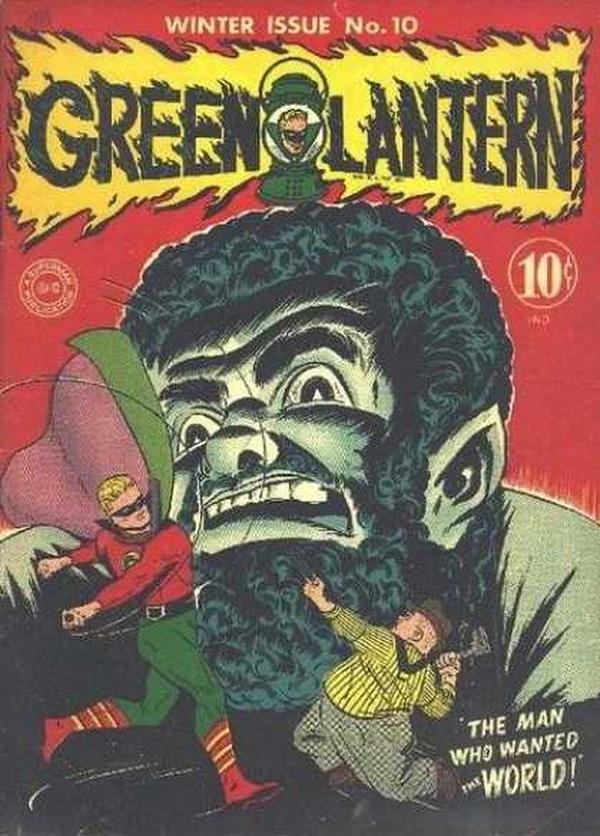
Green Lantern #10
Green Lantern #10 (December 1943) earns its place among the most consequential Golden Age issues because it introduces Vandal Savage — a prehistoric immortal who would grow into one of DC's most enduring and versatile villains, crossing every era of the publisher's history from the Justice Society through the Justice League. The debut story, 'The Man Who Wanted the World,' also establishes the core template for the character: a Cro-Magnon granted immortality by a meteorite who has inserted himself into the corridors of human power across millennia. Separately, the issue carries one of the earliest known appearances of the Captain Tootsie promotional strip — a C.C. Beck–produced candy advertisement that, as a one-page superhero narrative embedded in mainstream comics, stands as a direct ancestor of the product-placement comic form that later became ubiquitous. Together, the two debuts make this a single issue that touched both villainy mythology and the commercialization of the superhero form in the same package.
In "The Man Who Wanted the World! [Part 1]," Alan Scott faces a surprising challenge when Apex Studios' executives try to convince his assistant, Doiby, that he’s the more natural radio talent—putting Alan’s career and confidence on the line. Written by Alfred Bester and illustrated by Marty Nodell, this 1943 Green Lantern issue blends workplace tension with the hero’s signature mystique, all rendered with the crisp energy of Irwin Hasen’s cover art.
In "The Man Who Wanted the World! [Part 2]," Green Lantern confronts the chilling truth behind Vandal Savage’s uncanny knowledge of his past—revealing the villain’s age stretches back over a million years, turning the battle for Earth into something far more ancient and personal.
When Alan Scott’s radio contract at Apex Studios comes up for renewal, the studio’s scheming executives try to convince Doiby Dickles he’s better suited to be the station’s voice than the Green Lantern himself—turning the usually laid-back announcer into an unlikely contender in a battle of charisma and credibility.
ComicBooks.com Value
Show all 20 grades ▾
This exact issue on ebay
Raw / ungraded ▾ $1.49–$100 18 listings
More listings for this title
- Arcane Comics · Shoreline, WA1 on eBay ↗
- CollegeComix.com · Athens, GA1 on eBay ↗
- JAF Comics · Bethlehem, PA1 on eBay ↗
- Titan Comics · Dallas, TX1 on eBay ↗
Read it digitally
Sell my copy
Have this issue — or a whole collection? Get a fair offer from us, skip the marketplace fees and the hassle.
We Buy Collections ▸History
Writer Alfred Bester, best known outside comics as a Hugo Award–winning science fiction novelist, had been recruited to DC in the early 1940s after two of his science fiction editors moved there; he took over Green Lantern scripting from Bill Finger and quickly elevated the rogues gallery, creating both Solomon Grundy and Vandal Savage during his tenure on the title. The lead story in this issue, drawn by series co-creator Martin Nodell under editor Julius Schwartz, was Bester's vehicle for introducing an immortal villain whose scheming touched on wartime anxieties about subversives infiltrating U.S. industry and government — a timely backdrop for a 1943 readership. The Captain Tootsie advertisement appearing in the issue was produced by the C.C. Beck studio — the same shop behind Fawcett's Captain Marvel — and written in collaboration with Rod Reed, constituting an early instance of a fully illustrated superhero narrative used purely as commercial advertising copy.
Trivia · 8 facts
- First appearance of Vandal Savage, created by writer Alfred Bester and artist Martin Nodell; the character is a prehistoric Cro-Magnon who gained immortality after exposure to a meteorite's radiation.
- The lead story is titled 'The Man Who Wanted the World' and depicts Savage's attempt to infiltrate wartime U.S. government and industry by stealing Doiby Dickles's identity to manufacture birth records he cannot legitimately possess as a prehistoric being.
- In his debut, Savage claims prior identities as Cheops, Julius Caesar, and Genghis Khan — historical boasts that later DC continuity largely walked back or retconned.
- The issue establishes (or reinforces) wood as Green Lantern's explicit vulnerability, with a collapsing wooden ceiling incapacitating Alan Scott during a bank-robbery sequence.
- Cover art is credited to Irwin Hasen; interior Green Lantern art is by Martin Nodell; the issue also contains a Hop Harrigan story by Jon L. Blummer and Mutt and Jeff strips by Al Smith.
- The issue contains an early appearance of the Captain Tootsie promotional strip — a one-page adventure advertisement for Tootsie Roll candy produced by the C.C. Beck studio, featuring the hero and his kid-gang the Secret Legion, which included the boy sidekick Rollo.
- Vandal Savage's second appearance did not come until All-Star Comics #37 (1947), where he joined the original Injustice Society; the long gap underscores how the character was not immediately recognized as a recurring villain.
- The lead story 'The Man Who Wanted the World' was later reprinted in Green Lantern: 80 Years of the Emerald Knight: The Deluxe Edition, marking its retrospective recognition as a landmark Golden Age tale.
Cast · 2 characters
Full credits
Reprints
Reprinted in Green Lantern: 80 Years of the Emerald Knight The Deluxe Edition #[nn] (2020)
Key issues in Green Lantern
Reviews
Reader reviews
No reader reviews yet.