
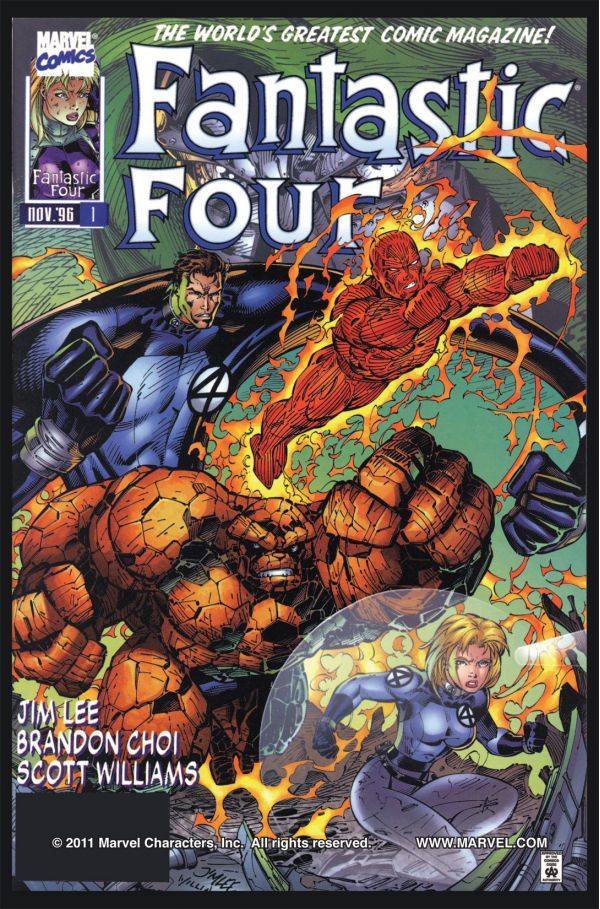
Fantastic Four #1
Fantastic Four (Vol. 2) #1 is the opening chapter of Marvel's audacious 'Heroes Reborn' experiment — the first time the publisher handed one of its founding titles to an outside studio, Jim Lee's WildStorm Productions, allowing a former Marvel superstar to completely reimagine the team's origin for a contemporary audience in a self-contained pocket universe. The issue matters not because it introduced new characters into the main Marvel canon, but because it represents a pivotal inflection point in 1990s comics publishing: a major company conceding, at least temporarily, that its own in-house talent could not revive flagging reader interest, and outsourcing the creative identity of its first superhero team to former employees who had left to co-found Image Comics. Critically, the experiment was divisive, provoking sustained fan debate about character authenticity, and its ultimate failure to sustain momentum helped clarify for Marvel what its heroes should and should not be — a lesson that shaped the editorial philosophy of the Heroes Return era and, arguably, the later Marvel Knights initiative.
ComicBooks.com Value
This exact issue on ebay
Raw — NM ▾ $2.99–$59 3 listings
Raw / ungraded ▾ $4.99–$130 4 listings
More listings for this title
Read it digitally
Sell my copy
Have this issue — or a whole collection? Get a fair offer from us, skip the marketplace fees and the hassle.
We Buy Collections ▸History
The direct editorial context for this issue is the Onslaught crossover of summer 1996, in which the Avengers and the Fantastic Four apparently sacrificed themselves to destroy a psionic threat; in-story, Franklin Richards — the nearly omnipotent son of Reed and Susan — subconsciously shunted them into a pocket universe (Counter-Earth) where they were reborn without memories of their prior lives. Marvel's motivation was commercial: the Fantastic Four title had suffered comparatively weak sales while Spider-Man and X-Men books thrived, and editor-in-chief Bob Harras oversaw a deal in which Jim Lee's WildStorm studio took full creative responsibility for Fantastic Four and Iron Man. Lee plotted all twelve of his issues while co-writer Brandon Choi scripted the dialogue, with pencils and layouts by Lee himself inked by Scott Williams; the issue shipped with two variant covers at a 1:1 ratio, and also included a six-page 'Time Slip' promotional feature imagining how classic characters like Doctor Doom and Nick Fury might look if created in the 1990s.
Trivia · 8 facts
- Fantastic Four (Vol. 2) #1 launched as part of the 'Heroes Reborn' crossover event (1996–97), directly following Fantastic Four Vol. 1 #416, which had ended the original series' 35-year run.
- The title was produced entirely by Jim Lee's WildStorm Productions studio — one of the first times Marvel outsourced a core ongoing series to an outside, formerly competing company.
- Written (plot) by Jim Lee and (script) by Brandon Choi, with pencils by Jim Lee and inks by Scott Williams; editor-in-chief was Bob Harras, with Mike Heisler and Jonathan Peterson as editors.
- The story functions as a deliberate retelling of the original Fantastic Four #1 (1961): the team gains their powers via cosmic-ray exposure on the Excelsior spacecraft, with updated details — Ben Grimm is now a Gulf War veteran pilot rather than a WWII figure, and Susan and Johnny Storm are financial backers of Reed's project rather than crew.
- In-universe, the entire Counter-Earth setting — including all supporting characters not native to Earth-616 — are constructs of Franklin Richards' subconscious imagination, a detail only revealed retrospectively in Heroes Reborn: The Return (1997).
- The Heroes Reborn version of Kl'rt (Super-Skrull) makes his first appearance in this issue, disguised as S.H.I.E.L.D. agent Wyatt Wingfoot; his true identity as a Skrull is not revealed until Fantastic Four (Vol. 2) #5.
- The Heroes Reborn incarnations of Harvey Elder (Mole Man) and Matthew Storm both debut in this issue; a behind-the-scenes, off-panel appearance of the Heroes Reborn Silver Surfer is also embedded in the issue's closing sequence, though he is not fully revealed until a later issue.
- The series ran for 13 issues (the planned 12 plus a 'World War III' crossover finale written by James Robinson); the full run was collected in the Heroes Reborn: Fantastic Four trade paperback (first published 2000, with a revised edition in 2018).
Cast · 9 characters
Full credits
Reprints
Reprinted in The Sensational Spider-Man #9 (1996), Venom: The Hunger #3 (1996), Mega Marvel #18 (1/1998) (1998), Fantastic Four #1 (1998), Die Fantastischen Vier #1 (1999), Heroes Reborn: Fantastic Four #[nn] (2006), Heroes Reborn Omnibus #[nn] (2019), The Ultimate Graphic Novels Collection #180 (2019), Marvel Comics - La collection #208 (2022), Marvel Superhelden #72, Mega Marvel #3/1998
Key issues in Fantastic Four
Variants (4)
Reviews
Reader reviews
No reader reviews yet.