
Doctor Fate #1
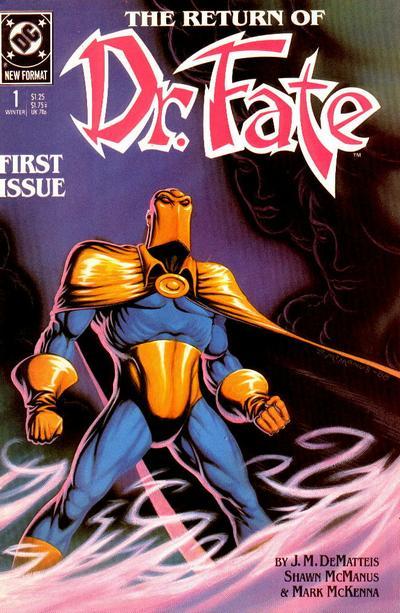
Doctor Fate #1 (1988) launched the first ongoing solo series for one of DC's oldest Golden Age characters, picking up directly from the 1987 miniseries that had replaced Kent Nelson with Eric and Linda Strauss — a dual-soul, man-and-woman composite Doctor Fate unprecedented in the character's nearly fifty-year history. Writer J.M. DeMatteis used the series as a platform for deeply personal spiritual ideas drawn from comparative religion, Eastern cosmology, and his own Meher Baba-influenced worldview, making it one of the rare mainstream superhero monthlies of the era to function simultaneously as metaphysical treatise and action comic. Edited by Karen Berger — who would go on to found Vertigo two years after the series concluded — the book is widely recognized as a proto-Vertigo title in the same breath as Grant Morrison's Doom Patrol and Peter Milligan's Shade the Changing Man, demonstrating that DC's mainstream line could sustain creator-driven, philosophically ambitious work long before that imprint existed. The series also marked the Post-Crisis resurrection of Andrew Bennett (I, Vampire) after years of absence from DC continuity, linking two corners of DC's supernatural universe in ways that would resonate through that character's later appearances.
ComicBooks.com Value
Show all 14 grades ▾
This exact issue on ebay
CGC 9.8 ▾ $40.24–$500 4 listings
CGC 9.6 ▾ $60–$212 4 listings
Raw / ungraded ▾ $5–$11.99 7 listings
Read it digitally
Sell my copy
Have this issue — or a whole collection? Get a fair offer from us, skip the marketplace fees and the hassle.
We Buy Collections ▸History
The ongoing series grew directly out of the success of DeMatteis and Keith Giffen's four-issue miniseries (Doctor Fate Vol. 1, 1987), which had introduced Eric and Linda Strauss as the new dual incarnation of Doctor Fate and killed off Kent Nelson. With the character appearing concurrently in the Giffen/DeMatteis Justice League International, interest in Doctor Fate was at a late-1980s high, and DeMatteis pitched Karen Berger on an ongoing. His original concept was to give the book a JLI sensibility — light, character-driven, with a knowing comedic edge — but as he later described in his own introduction to the 2025 collected edition, the story quickly outgrew that framework and became a sustained meditation on reincarnation, chaos and order, and divine love. Berger and assistant editor Art Young gave DeMatteis what he called essentially creator-owned freedom on an existing DC property, and he partnered with artist Shawn McManus, who brought a heavily stylized, emotionally expressive visual language to the book that distinguished it sharply from the house style of the period.
Trivia · 8 facts
- Issue #1 went on sale October 13, 1988, under the title 'The Return of Dr. Fate,' written by J.M. DeMatteis with pencils by Shawn McManus and inks by Mark McKenna.
- The series is the direct continuation of the 1987 four-issue Doctor Fate miniseries (penciled by Keith Giffen), which had introduced Eric and Linda Strauss as a new composite Doctor Fate and marked the final appearance of Kent Nelson in that role.
- Doctor Fate in this series is portrayed as a merged being: stepson Eric Strauss and his stepmother Linda Strauss physically combine to form a single hero, with Nabu — inhabiting the reanimated corpse of Kent Nelson — serving as their mentor.
- Issue #1 contains the first appearance of Andrew Bennett (I, Vampire) since House of Mystery #321, reintegrating a long-dormant DC supernatural character into Post-Crisis continuity; Bennett becomes a major supporting character through the first story arc.
- The series was edited by Karen Berger (with Dick Giordano as Executive Editor and Art Young as Assistant Editor) — the same editorial voice that would later launch DC's Vertigo imprint, and the book is frequently cited as a stylistic and thematic forerunner of that line.
- The series ran 24 issues (Winter 1988 – January 1991), all written by DeMatteis; Shawn McManus provided art for the majority of the run, with fill-ins by Val Semeiks, Jim Fern, and Joe Staton.
- The series introduced and developed the concept of the Kali Yuga — a cosmological age of chaos borrowed from Hindu tradition — as the governing metaphysical framework for the Lords of Order and Chaos conflict, and established that successive incarnations of Doctor Fate are bound by reincarnation cycles across thousands of lifetimes.
- The complete DeMatteis run — the 1987 miniseries and all 24 issues of the ongoing plus Annual #1 — was collected for the first time in a single trade paperback published by DC in May 2025, featuring an introduction written by DeMatteis.
Full credits
Reviews
Reader reviews
No reader reviews yet.