
Detective Comics #73
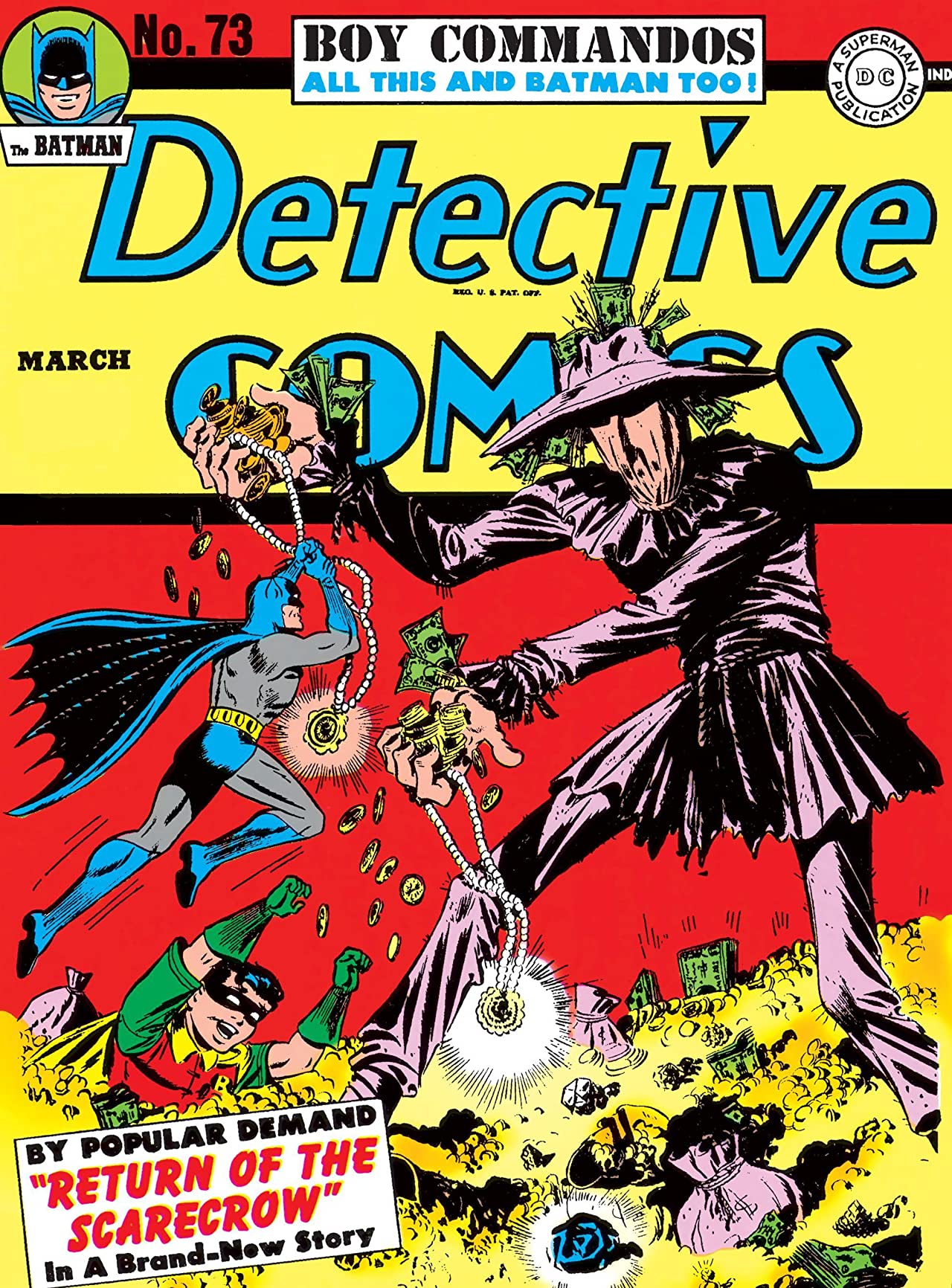
☆ Be the first to review + Add to your collection — Join freeDetective Comics #73 holds a specific and verifiable place in Batman's Golden Age history as the first — and only — cover appearance of the Scarecrow during the entire 1940s. Jonathan Crane had debuted in World's Finest Comics #3 (Fall 1941), but this issue marked the first time the villain's striking, skeletal silhouette commanded the cover of DC's flagship detective title, cementing a visual template for the character that artists still reference decades later. Despite being only the Scarecrow's second comic appearance ever, it would also prove to be his last of the Golden Age: the character then vanished from print for over twenty years until Gardner Fox revived him in Batman #189 (1967). That long absence makes this issue the closing chapter of Scarecrow's entire original run, giving it a narrative finality that his creators could not have anticipated.
In "The Scarecrow Returns," the enigmatic Professor Jonathan Crane returns to Gotham with a chilling new game—using simple words as cryptic clues to mark his crimes. Batman and Robin must unravel his wordplay before he strikes again, turning the city into a puzzle only they can solve. Written by Don C. Cameron and brought to life by Bob Kane’s iconic art, with inks by Jerry Robinson and George Roussos, and lettering by Roussos, this 1943 classic features a cover by Kane and Robinson, capturing the eerie tension of a mind game played in shadows.
In "The Scarecrow Returns," former teacher Professor Jonathan Crane unleashes a chilling game of wordplay, marking his crimes with simple, ominous phrases. Batman and Robin must unravel his cryptic clues after school—literally and figuratively—before the Man of Straw strikes again.
ComicBooks.com Value
Show all 21 grades ▾
More listings for this title
Read it digitally
Sell my copy
Have this issue — or a whole collection? Get a fair offer from us, skip the marketplace fees and the hassle.
We Buy Collections ▸History
The issue went on sale January 16, 1943, with a cover date of March 1943, published by Detective Comics, Inc. Whitney Ellsworth received the credited editorial byline, but the Grand Comics Database documents that the actual day-to-day editing was handled by Jack Schiff and Bernard Breslauer — a division of labor common at DC during the wartime era. Rather than returning the character to his co-creator Bill Finger, who had been less active on the title in those months, DC assigned the script to Don Cameron, a journeyman Batman writer of the period. The cover and interior art for the lead story were produced by Bob Kane, with inks by Jerry Robinson and background work attributed to George Roussos — the same core studio team responsible for much of the Batman output of the era.
Trivia · 8 facts
- Cover date: March 1943; on-sale date: January 16, 1943; published by Detective Comics, Inc. (DC).
- This is the first cover appearance of the Scarecrow (Jonathan Crane) in any comic book, and his second interior story appearance overall — his debut having been in World's Finest Comics #3 (Fall 1941).
- The lead story, 'The Scarecrow Returns' (also titled 'Return of the Scarecrow' in some indexes), was written by Don Cameron with pencils by Bob Kane and inks by Jerry Robinson and George Roussos.
- The Scarecrow would not appear again in comics after this issue until Batman #189 (February 1967) — a gap of more than two decades — making this the final Golden Age appearance of the character.
- The issue features a prominent backup story, 'The Saga of the Little Tin Box,' starring the Boy Commandos, with script and pencils by Jack Kirby and inks by Joe Simon — putting two of comics' most important creative partnerships in the same issue.
- Additional backup features include stories headlining the Crimson Avenger, Air Wave, Slam Bradley, and Spy — a typical wartime-era DC anthology format with six or more features per issue.
- The story's lead plot has Crane, escaping from prison, commit a themed series of robberies telegraphed by three-letter word clues left on school slates — an early example of the 'gimmick villain' structure that would define Batman's rogues gallery through the Silver Age.
- The issue has been reprinted at least seven times, including in Batman Archives Vol. 3 (1994), Batman Chronicles Vol. 8 (2009), Batman: The War Years 1939–1945 (2015), Batman Arkham: Scarecrow (DC, 2016), and Batman: The Golden Age Omnibus Vol. 2 (2016).
Full credits
Reprints
Reprinted in Batman Archives #3 (1994), The Batman Chronicles #8 (2009), The Boy Commandos by Joe Simon & Jack Kirby #1 (2011), Batman: The War Years 1939-1945 #[nn] (2015), Batman Arkham: Scarecrow #[nn] (2016), Batman: The Golden Age Omnibus #2 (2016), Batman: The Golden Age #4 (2018), O Lobinho (2ª Série) #60
Key issues in Detective Comics
Reviews
Reader reviews
No reader reviews yet.