
Detective Comics #38
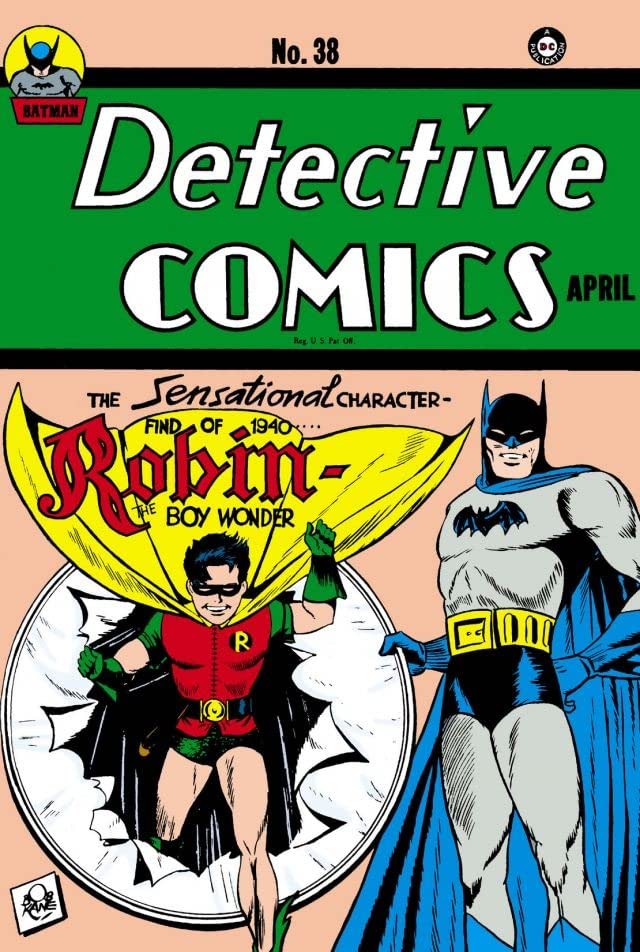
Detective Comics #38 stands as one of the most consequential single issues in superhero comics history: it introduces Dick Grayson as Robin, the Boy Wonder — the first teenage sidekick in the medium and the template for virtually every junior hero that followed. The gamble of placing a child alongside a brooding vigilante paid off spectacularly, doubling Batman's sales and cementing the 'Dynamic Duo' partnership that would define the character for decades. Robin's origin — parents murdered by a crime boss, ward taken in by a sympathetic billionaire — deliberately echoed Batman's own trauma, giving the story an emotional resonance unusual for Golden Age fare. The issue's cover blurb billing him as 'the sensational character find of 1940' proved prophetic: Robin's success triggered a generation of superhero sidekicks across the entire industry and launched what historians recognize as a defining stylistic trend of the Golden Age of Comic Books.
In this classic 1940 tale from Detective Comics #38, young Dick Grayson witnesses the tragic death of his parents and, after overhearing the killers’ confession, tries to alert the police—only to be rescued by the Batman. Recognizing a kindred spirit, the Dark Knight takes the boy under his wing, training him to become Robin the Boy Wonder. Together, the dynamic duo set out to gather the evidence needed to bring the criminals to justice.
In "The Electrical Assassin," Bart ventures into a dangerous mystery after uncovering a scientist’s lightning-generating invention—capable of striking any target on command. With the device poised to be used as a weapon of mass control, Bart must race against time to stop the man behind the storm before it strikes again.
In "Dr. Hydkil," Red stumbles into a chilling murder mystery that reeks of vampire lore—until he uncovers a far more terrifying truth. Behind the cloak of superstition lies a deranged medical genius with a monstrous ambition, bent on playing god in the shadows.
In "Phoney Jewel Robbery," the Crimson takes on a clever criminal scheme where the wealthy stage their own jewel thefts to collect insurance—only to have their stolen treasures returned, not by the police, but by a mysterious figure who seems to know more than he should. Written by an unknown author and illustrated by an unknown artist, the story unfolds with sharp intrigue and a touch of irony, as the hero uncovers the truth behind the staged heists.
In the frozen reaches of the Arctic Circle, pilot Cliff and scientist Dr. Broussard make a desperate crash landing, only to stumble upon a hidden tribe of African natives thriving in the ice with no clothing—protected by a mysterious serum that defies the extreme cold.
ComicBooks.com Value
Show all 20 grades ▾
More listings for this title
Read it digitally
Sell my copy
Have this issue — or a whole collection? Get a fair offer from us, skip the marketplace fees and the hassle.
We Buy Collections ▸History
By early 1940, roughly a year after Batman's debut in Detective Comics #27, writer Bill Finger and artist Bob Kane had begun discussing how to give their increasingly popular hero a companion — partly to open the character up to younger readers, and partly, as Finger later noted, because Batman had no one to talk to and the constant internal monologues were becoming a narrative limitation. Jerry Robinson, then inking and lettering the Batman strip while still a journalism student at Columbia University, proposed the name 'Robin' drawn from his boyhood love of Robin Hood, and quickly sketched a medieval-influenced costume from memory, inspired by N. C. Wyeth's illustrations for a Robin Hood book he had owned as a child. The resulting character — orphaned circus acrobat Dick Grayson, whose parents are murdered by extortionist Boss Zucco — was written by Finger, pencilled by Kane, and inked and lettered by Robinson, with the issue going on sale March 6, 1940 under a cover date of April 1940.
Trivia · 8 facts
- First appearance and complete origin story of Robin (Dick Grayson), Batman's crime-fighting partner, published April 1940 (on-sale March 6, 1940).
- Created by writer Bill Finger, penciller Bob Kane, and inker/letterer Jerry Robinson — the same trio responsible for Batman's earliest stories.
- Dick Grayson's name was coined by Bill Finger, drawn partly from a character in pulp fiction and partly from a book editor named Charles Grayson, Jr.
- The Robin costume's medieval design was conceived by Jerry Robinson from memory, inspired by N. C. Wyeth's illustrations for a Robin Hood novel Robinson had owned as a boy.
- The issue also introduces Boss Zucco (Anthony Zucco), the circus extortionist who orders the murder of the Flying Graysons, as well as John and Mary Grayson (Dick's parents) and C. C. Haly (Haly Circus owner) — all in their first appearances.
- Robin's debut doubled the sales of DC's Batman titles, directly fueling the Golden Age trend of superhero-and-sidekick pairings (Captain America and Bucky, the Human Torch and Toro, and many others).
- Robin's origin story from this issue was adapted as the two-part 'Robin's Reckoning' episode of Batman: The Animated Series and served as a loose basis for Robin's backstory in the 1995 film Batman Forever.
- The issue has been reprinted numerous times, including a 1997 Blockbuster/Toys 'R' Us Special Replica Edition tied to the Batman Forever home video release, a DC Millennium Edition (2000), inclusion in The Batman Chronicles Vol. 1 (2005), and a full Facsimile Edition released by DC in May 2020 to mark Robin's 80th anniversary — DC's first Golden Age entry in its Facsimile Edition line.
Full credits
Reprints
Reprinted in Batman from the 30s to the 70s #[nn] (1972), Secret Origins #7 (1974), Batman Classics #61 (1975), Läderlappen #4/1975 (1975), Lynvingen #4/1975 (1975), Läderlappen #12/1975 (1975), Batman Album #37 (1979), The Untold Legend of the Batman [Batman Cereal Edition] #3 (1989), The Untold Legend of the Batman [MPI Audio Edition] #3 (1989), Batman Especial - As Várias Faces de Batman #[nn] (1989), Batman-klassikot #2 (1990), Batman Archives #1 (1990), The Batman Gallery #1 (1992), Detective Comics Special Reprint #38 (1995), Detective Comics Special Reprint [Toys 'R' Us Special Replica Edition] #38 (1997), DC Archiv Edition #3 (1999), Millennium Edition: Detective Comics 38 #[nn] (2000), Batman in the Forties #[nn] (2004), The Batman Chronicles #1 (2005), Batman: Cover to Cover #[nn] (2005), Batman Anthologie #[nn] (2014), Batman: The War Years 1939-1945 #[nn] (2015), DC Comics Graphic Novel Collection #22 (2015), Robin, The Boy Wonder: A Celebration of 75 Years #[nn] (2015) + 10 more
Key issues in Detective Comics
Reviews
Reader reviews
No reader reviews yet.