
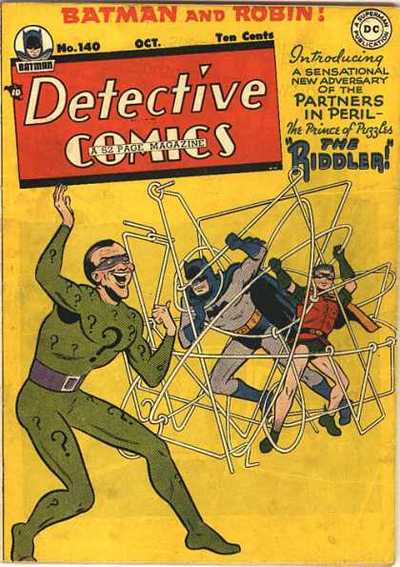
Detective Comics #140
☆ Be the first to review + Add to your collection — Join freeDetective Comics #140 introduced one of the most enduring figures in Batman's rogues gallery: the Riddler, Edward Nigma, a criminal mastermind defined by an obsessive compulsion to challenge the Dark Knight through elaborate puzzles and clues rather than mere brute force. That concept — a villain whose gimmick is intellectual rather than physical, and whose crimes are structured as interactive challenges for both detective and reader — gave the Batman mythos a genuinely new storytelling mode. Though the character made only two appearances in the Golden Age before vanishing for seventeen years, the seed planted here eventually grew into one of DC's most widely adapted villains, appearing in live-action television, major motion pictures, animated series, and video games. The issue's narrative DNA — the origin sequence tracing Nigma's childhood cheating, his carnival-huckster years, and his decision to pit his mind against Gotham's greatest detective — has been revisited and retold across decades of comics continuity.
In "The Riddler," a 1948 issue of Detective Comics, Edward Nigma—brilliant and cunning, with a penchant for puzzles—transforms his talents into a game of wits against the Gotham Police and Batman. Written by Bill Finger and illustrated by Dick Sprang, with inks by Charles Paris, this story introduces one of Batman’s most enduring foes, all brought to life with the sharp, expressive art of Win Mortimer on the cover.
In this classic 1948 tale from Detective Comics #140, Edward Nigma—long known for his brilliance with puzzles and his knack for cheating his way through challenges—turns his talents to a darker purpose, becoming the enigmatic Riddler and challenging Batman and the Gotham Police with a series of mind-bending riddles.
ComicBooks.com Value
Show all 21 grades ▾
More listings for this title
Read it digitally
Sell my copy
Have this issue — or a whole collection? Get a fair offer from us, skip the marketplace fees and the hassle.
We Buy Collections ▸History
The issue carries a cover date of October 1948 and was placed on sale August 23, 1948, by National Comics Publications. The lead Batman story was written by Bill Finger — the unheralded co-creator of Batman himself — and drawn by Dick Sprang with inks by Charles Paris; the cover was painted by Win Mortimer. Whitney Ellsworth held the credited editorial role, though the Grand Comics Database notes that Jack Schiff was the actual hands-on editor for the issue. The Riddler was originally conceived as a one-off antagonist, and the character's near-total absence from print for the following seventeen years supports the idea that initial reader response was not overwhelming enough to prompt an immediate return; it was not until editor Julius Schwartz revived the character in Batman #171 (1965), partly to capitalize on the approaching ABC television series, that the Riddler became a recurring presence.
Trivia · 9 facts
- First appearance and origin of the Riddler (Edward Nigma), created by writer Bill Finger and artist Dick Sprang — the lead Batman story is titled simply 'The Riddler.'
- Published on-sale date: August 23, 1948; cover date: October 1948; 52 pages; cover price 10 cents; published by National Comics Publications.
- The cover was penciled by Win Mortimer; interior Batman story pencils by Dick Sprang, inks by Charles Paris; credited editor Whitney Ellsworth, with Jack Schiff noted by the GCD as the actual editor.
- The issue gives Nigma a complete origin in its opening pages: he begins as a schoolboy who cheats his way to victory in a classroom puzzle contest, later becomes a carnival 'puzzle king' swindling customers, and finally adopts the Riddler persona to match wits with Batman.
- Nigma's name is itself a pun — 'Edward Nigma' is a phonetic play on 'enigma,' a detail built into the character's foundation from his very first appearance.
- The Riddler returned just two issues later in Detective Comics #142 (December 1948), then disappeared from print entirely for seventeen years until Batman #171 (May 1965), when editor Julius Schwartz and writer Gardner Fox revived him ahead of his television debut.
- Frank Gorshin's performance as the Riddler in the first episode of the 1966 ABC Batman television series — itself adapted from Batman #171 — transformed the character from a forgotten Golden Age curiosity into a pop-culture fixture; Gorshin's casting reportedly originated with someone at 20th Century Fox selecting the Riddler as the debut villain for the show.
- The entire issue was reprinted as a DC Facsimile Edition in December 2023, and the Batman story has been collected in Batman Archives Vol. 7, Batman: The Golden Age Omnibus Vol. 6, and Batman: The TV Stories (2013), among other editions; Detective Comics Annual #8 (1995) serves as a modern retelling of the original story's plot beats.
- The DC Database notes that the events of 'The Riddler' were later considered canonical to both the Earth-Two and Earth-One realities, and the issue number itself was worked into the animated film Scooby-Doo! & Batman: The Brave and the Bold, where the Riddler's Arkham cell number is listed as DC 140.
Full credits
Reprints
Reprinted in Detective Comics #140 (1948), Batman from the 30s to the 70s #[nn] (1972), Batman Especial - As Várias Faces de Batman #[nn] (1989), Batman: Featuring Two-Face and the Riddler #[nn] (1995), Batman Archives #7 (2008), Batman: The TV Stories #[nn] (2013), Batman Arkham: The Riddler #[nn] (2015), DC Comics Graphic Novel Collection #19 (2016), Batman: The Golden Age Omnibus #6 (2019), Detective Comics: 80 Years of Batman #[nn] (2019), Detective Comics 140 (Facsimile Edition) #[nn] (2023)
Key issues in Detective Comics
Reviews
Reader reviews
No reader reviews yet.