
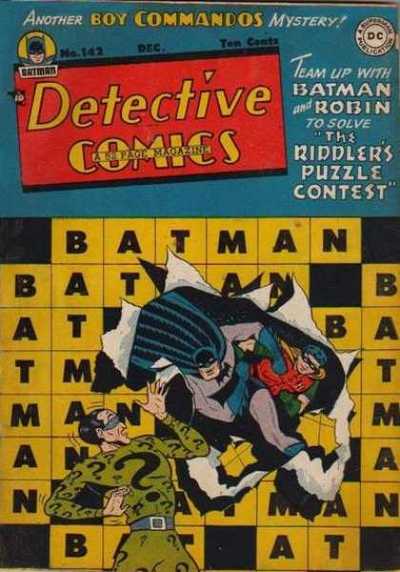
Detective Comics #142
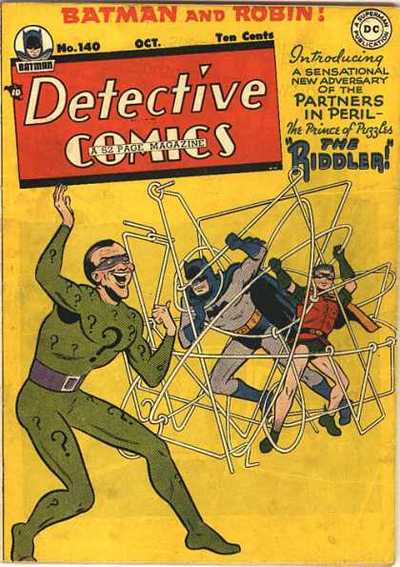
☆ Be the first to review + Add to your collection — Join freeDetective Comics #142 (cover-dated December 1948) is the Riddler's second-ever comic book appearance, arriving just two issues after his debut in Detective Comics #140, and it closed out Edward Nigma's entire Golden Age run — he would not return to print for another seventeen years, until Batman #171 in 1965. Together, these two issues locked in every defining trait of the character: the question-mark-covered green jumpsuit, the compulsive need to challenge Batman's intellect with puzzles, and the modus operandi of announcing crimes through elaborate riddles rather than simply committing them. The story titled 'Crime's Puzzle Contest' demonstrated that the Riddler concept had legs beyond a single outing, even as DC's editorial drift toward science-fiction storytelling in the early 1950s ultimately sidelined most of its costumed Gotham villains. Without this issue existing as a companion piece, and later being rediscovered by producer William Dozier while developing the 1966 Batman television series, the Riddler's ascent to A-list status might never have happened.
In "Crime's Puzzle Contest!", the mysterious "Secret X" remains locked away with Professor Vanners in prison—until Killer Arnie Benet hatches a daring plan to free him, promising a share of the secret in return. Once on the outside, the duo's criminal spree begins, with meticulously planned robberies that suggest inside knowledge no outsider should possess. Curt Swan’s art and Steve Brodie’s inks bring the tense cat-and-mouse game to life, while Dick Sprang and Charles Paris deliver a striking cover that captures the mystery at the heart of the case.
In "The Robot Bandit!", millionaire Joshua Lloyd—confined to a wheelchair—finds his home invaded by one of his nine robotic servants, prompting him to call on Robotman to go undercover as "robot servant number 10" to uncover the thief among them. With the line between man and machine blurring, the mystery unfolds in a world where loyalty is as much a question of circuitry as it is of heart.
In "The Mystery of Secret X," Professor Vanners, imprisoned with a secret he took to the grave, becomes the key to a dangerous plan when Killer Arnie Benet orchestrates a daring escape. With Vanners now on the run, a string of high-stakes robberies begins—each one eerily precise, hinting at inside knowledge only the professor could possess.
ComicBooks.com Value
Show all 20 grades ▾
More listings for this title
Read it digitally
Sell my copy
Have this issue — or a whole collection? Get a fair offer from us, skip the marketplace fees and the hassle.
We Buy Collections ▸History
The lead story, 'Crime's Puzzle Contest,' was written by Bill Finger and drawn by Dick Sprang with inks by Charles Paris — the same creative team responsible for the Riddler's debut in issue #140. The issue's on-sale date was October 20, 1948, with a December 1948 cover date, and it was published under the National Comics Publications imprint with Whitney Ellsworth credited as editor and Jack Schiff serving as the actual hands-on editor. Comics historian Les Daniels singled out Sprang's visual storytelling on the surrounding Riddler stories as 'a superb example of story breakdown and page design,' a reflection of Sprang's deliberate practice of studying how children read comics to maximize suspense and narrative flow — though some later critics have noted that the plot of #142 itself is looser and more gimmick-driven than the tighter debut story.
Trivia · 8 facts
- Cover date: December 1948; on-sale date: October 20, 1948. Published by National Comics Publications (DC Comics).
- The lead Batman story is titled 'Crime's Puzzle Contest' and is the Riddler's second comic book appearance, following his debut in Detective Comics #140 (October 1948).
- The creative team on the lead story is writer Bill Finger, penciler Dick Sprang, and inker Charles Paris — the same trio that created the Riddler two issues prior.
- The issue's editor of record was Whitney Ellsworth; Jack Schiff was the actual working editor on Batman-related titles at the time.
- The story continues directly from #140: the Riddler is revealed to have survived his apparent drowning by escaping through a storm-drain pipe, and he resumes his puzzle-based crime spree against Batman and Robin.
- After this issue, the Riddler disappeared from comics for approximately seventeen years, returning only in Batman #171 (May 1965) — an absence attributed in part to DC's editorial pivot toward science-fiction stories in the early 1950s.
- The issue also contains backup features including Slam Bradley ('The Farmer in the Till'), Robotman ('The Robot Bandit'), and Boy Commandos ('The Mystery of Secret X'), plus a Captain Tootsie promotional advertisement.
- The Batman story from this issue has been reprinted in Batman Archives Vol. 7 (2007/2008), Batman Arkham: The Riddler (2015), and Batman: The Golden Age Omnibus Vol. 6 (2018/2019), with art credits verified by Sprang himself per the Grand Comics Database.
Cast · 5 characters
Full credits
Reprints
Reprinted in Detective Comics #142 (1949), The Batman Gallery #1 (1992), Hero Illustrated Special Edition #1 (1993), Batman Archives #7 (2008), Batman Arkham: The Riddler #[nn] (2015), Batman: The Golden Age Omnibus #6 (2019)
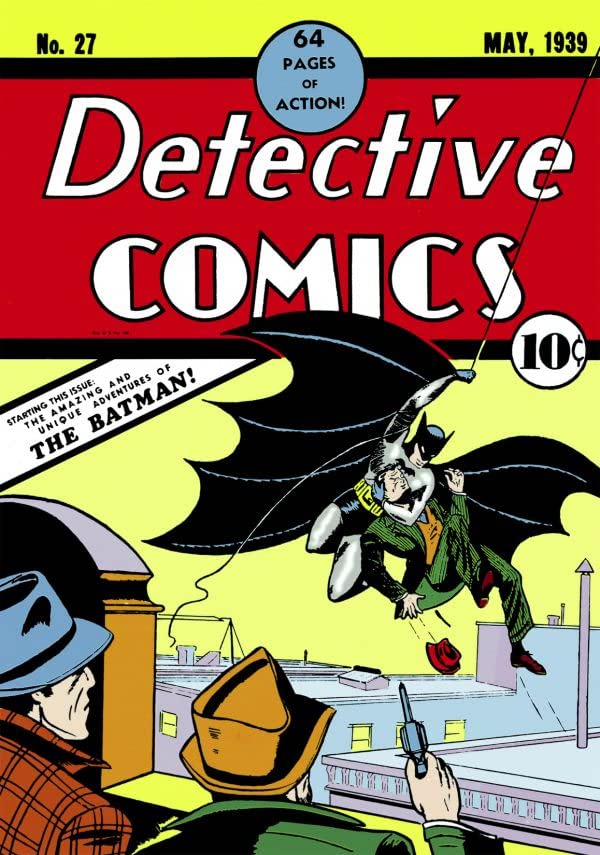
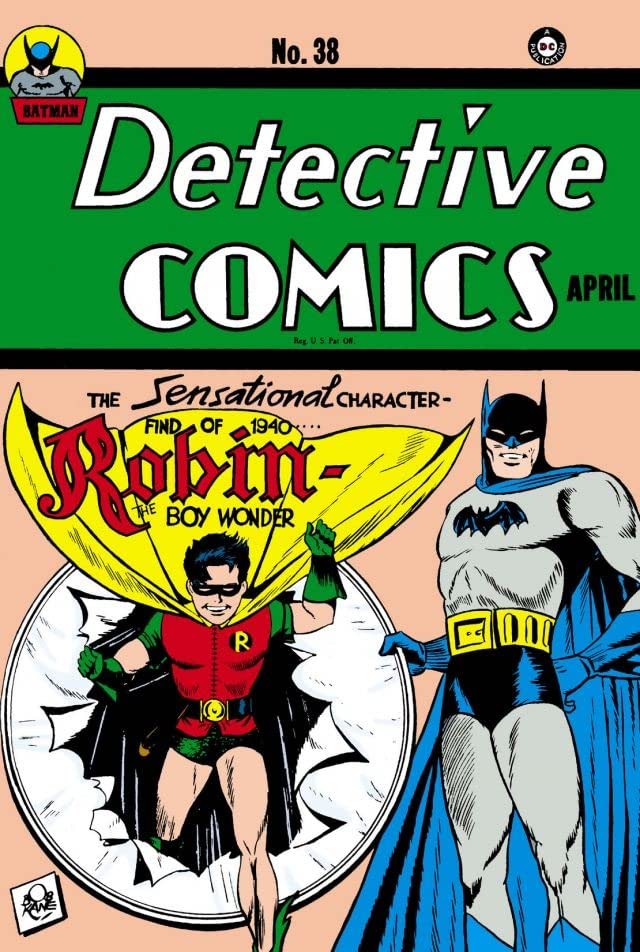
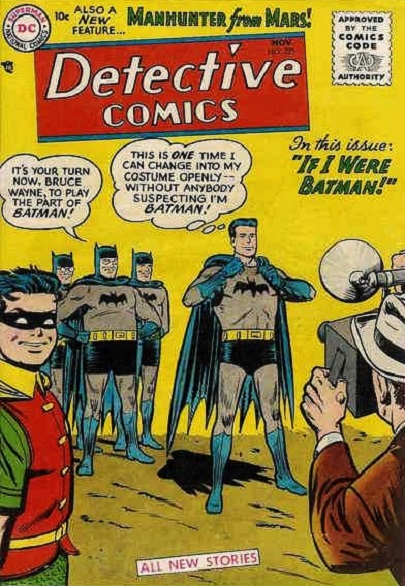
Key issues in Detective Comics
Reviews
Reader reviews
No reader reviews yet.