
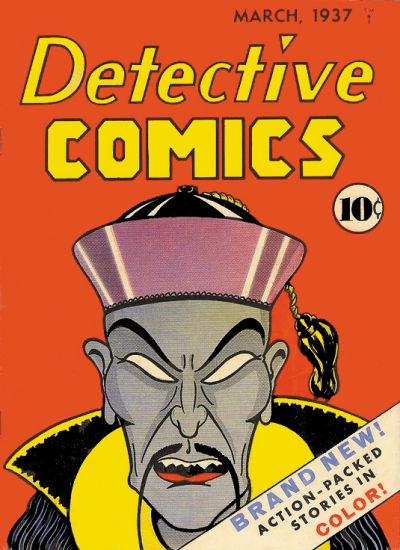
Detective Comics #1
Detective Comics #1 (March 1937) marks the birth of the series that would literally give DC Comics its name — the company's initialism derives directly from this title, making it the corporate and creative cornerstone of one of the world's two largest comic book publishers. It was a genuine structural innovation: the first American comic book built entirely around a single genre theme, with every strip — adventure, western, and comedy alike — oriented toward mystery and detection, departing from the grab-bag anthology format that had defined the medium to that point. The issue introduced Slam Bradley, created by Jerry Siegel and Joe Shuster roughly a year before those same two Clevelanders would launch Superman in Action Comics #1, making this the first sustained outlet for the duo who would define superhero comics. By grounding Batman's future home in hard-boiled pulp conventions two years before the Dark Knight's debut in issue #27, Detective Comics #1 quietly constructed the atmospheric and narrative template that would make Batman possible.
Detective Comics #1 (1937) kicks off with "The River Patrol," a gripping tale written by Major Malcolm Wheeler-Nicholson and illustrated by Tom Hickey, whose bold artwork brings the mystery to life. Set in a quietly unsettling downtown San Francisco, the story follows Bruce as he stumbles upon a strange Chinese restaurant where the staff seem to vanish—leaving him and another couple alone, only to be seized without warning. The cover, by Vin Sullivan, captures the tension perfectly, setting the tone for one of DC’s earliest adventures.
In "The Peruvian Mine Murders, Part 1," detective Bret ventures into the dense Peruvian jungles, drawn into a chilling mystery where each victim bears a strange, unexplained wound—a hole in the throat with no sign of a weapon. With no clear motive and no trace of a killer, Bret must unravel the truth behind these gruesome deaths before the next victim falls.
In "The Claws of the Red Dragon [Part 1]," Bruce ventures into downtown San Francisco and stumbles upon a curious Chinese restaurant—empty, yet humming with unseen energy. When a mysterious couple is lavishly served while he’s ignored, curiosity turns to dread as both are suddenly seized and blindfolded.
In "The Gotlotz Jewels," Gus is assigned to guard a wealthy woman’s pearls at a party—only to catch the chief in the act of stealing them. The twist? The man he’s apprehended is no ordinary thief, but the very officer in charge.
In "The Balinoff Case, Part 1," Bart faces a difficult choice when he’s recruited for a covert mission that demands he put duty over love—forcing him to confront the cost of his commitment to justice, even as his engagement to fiancée Sally hangs in the balance.
In "The Bar S Rustlers," Buck is drawn into a tense standoff between two cattle ranchers whose long-standing feud erupts over stolen livestock, forcing him to untangle a web of suspicion on the dusty frontier. With rivalries rooted in a broken land deal and trust as scarce as water, the truth lies buried beneath dust and deception.
ComicBooks.com Value
Show all 17 grades ▾
More listings for this title
- JAF Comics · Bethlehem, PA3 on eBay ↗
- Diverted Comics · Bakersfield, CA2 on eBay ↗
- A AND A Comics · Buffalo, NY1 on eBay ↗
- The 616 Comics LLC · Mantua Township, NJ1 on eBay ↗
- World's Best Comics and Toys · Sacramento, CA1 on eBay ↗
Read it digitally
Sell my copy
Have this issue — or a whole collection? Get a fair offer from us, skip the marketplace fees and the hassle.
We Buy Collections ▸History
Detective Comics was the third and final title launched by Major Malcolm Wheeler-Nicholson's National Allied Publications, and financial crisis shaped its very existence: deep in debt to printer and distributor Harry Donenfeld, Wheeler-Nicholson was compelled to take Donenfeld and his accountant Jack S. Liebowitz on as co-owners, resulting in a newly formed entity called Detective Comics, Inc. The cover had originally been solicited with a December 1936 date but the book did not reach newsstands until February 1937, with a March cover date. Associate editor Vin Sullivan, who also served as the issue's first editor, drew the cover himself — a caricatured Fu Manchu-style villain named Ching Lung drawn from the Bruce Nelson story, an image now recognized as emblematic of the racial stereotyping that permeated the era's pulp-influenced storytelling. Wheeler-Nicholson was pushed out of his own company within a year of the launch, before the book that bore his creative vision had even introduced Batman.
Trivia · 8 facts
- First appearance of Slam Bradley and his sidekick Shorty Morgan, created by Malcolm Wheeler-Nicholson and developed by Jerry Siegel and Joe Shuster — the same team that would introduce Superman approximately one year later in Action Comics #1 (1938).
- First appearance of Speed Saunders (Cyril 'Speed' Saunders), whose debut story 'The River Patrol: The Murders of Cap'n Scum' follows a harbor investigator uncovering a human-smuggling ring; the art credit for this strip has been disputed — long attributed to E.C. Stoner, but historian Ken Quattro's 2020 book Invisible Men re-attributes it to Creig Flessel.
- First appearances of Cosmo the Phantom of Disguise, Bret Lawton, Bruce Nelson, Buck Marshall, Bart Regan (Spy) and his fiancée Sally Norris, and the comedy detectives Gumshoe Gus and Eagle-Eye Jake — every named character in the issue makes their debut here.
- The issue was the first American comic book constructed entirely around a single subject theme — all strips, including the comedic ones (Gumshoe Gus, Eagle-Eye Jake), were detective stories, breaking from the era's mixed-genre anthology format.
- Published by the newly formed Detective Comics, Inc., whose initials would eventually become the company name DC Comics; Wheeler-Nicholson co-owned the imprint with Harry Donenfeld and Jack S. Liebowitz, though he was forced out within a year.
- The cover — a caricatured depiction of the villain Ching Lung (Fui Onyui in the Slam Bradley story's interior) from the Bruce Nelson serial — was drawn by associate editor Vin Sullivan and is now widely cited as an example of the 'Yellow Peril' racial stereotyping prevalent in 1930s pulp media; Gene Luen Yang later engaged with this cover directly in the 2016–2017 DC series New Super-Man.
- Slam Bradley's debut story sets him in Cleveland, Ohio — Siegel and Shuster's hometown — which the DC Database notes was also the real-world analog for the fictional Metropolis; Bradley relocated to New York City by Detective Comics #4.
- The entire issue was officially reprinted in DC's Millennium Edition: Detective Comics #1 (January 2001), and select stories have appeared in The Golden Age of Comic Books (Random House, 1977), The Comic Book in America: An Illustrated History (Taylor Publishing, 1989), and DC Comics Before Superman: Major Malcolm Wheeler-Nicholson's Pulp Comics (Hermes Press, 2018).
Cast · 10 characters
Full credits
Reprints
Reprinted in Mirim #1 (1937), Mirim #2 (1937), Mirim #3 (1937), Mirim #14 (1937), Mirim #15 (1937), Mirim #16 (1937), Action Comics [ashcan] #1 (1937), The Golden Age of Comic Books #[nn] (1977), The Comic Book in America: An Illustrated History #[nn] (1989), The Greatest Golden Age Stories Ever Told #[nn] (1990), Millennium Edition: Detective Comics 1 #[nn] (2001), DC Comics Before Superman: Major Malcolm Wheeler-Nicholson's Pulp Comics #[nn] (2018), Mirim #4
Key issues in Detective Comics
Reviews
Reader reviews
No reader reviews yet.