
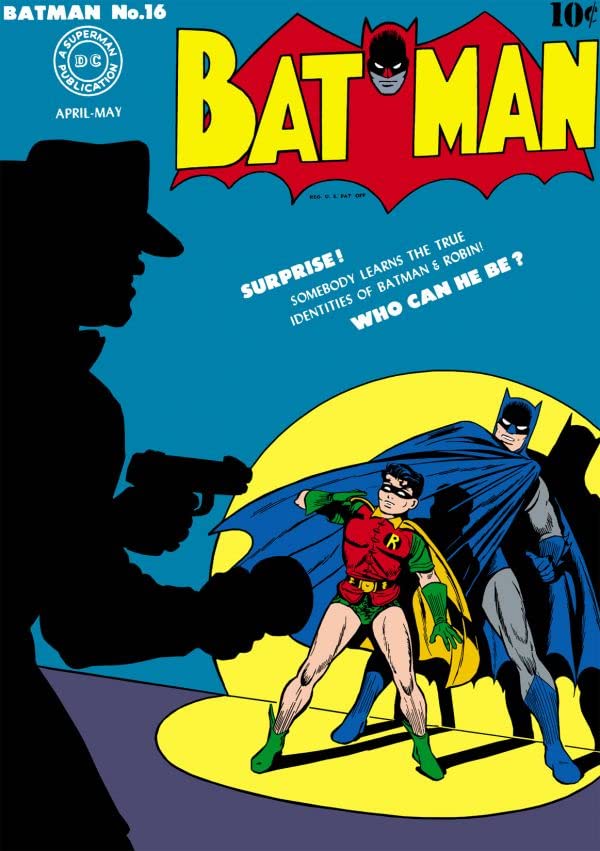
Batman #16
Batman #16 is one of the most consequential single issues of the Golden Age because it introduces Alfred Beagle — the man who would eventually become Alfred Pennyworth — as Bruce Wayne and Dick Grayson's butler, completing the domestic architecture of Wayne Manor that has defined the Batman mythos ever since. The issue's final story, 'Here Comes Alfred,' establishes the character's origin in a single 13-page sequence: Alfred arrives on Wayne Manor's doorstep to honor his dying father's wish, is reluctantly accepted by a hero who fears a live-in servant will expose his secret, and then accidentally stumbles into the Batcave on his very first night. That accidental discovery — Alfred knowing, and choosing loyalty over exposure — set the moral and emotional tone for every iteration of the character across eight decades of comics, films, and television. The issue also features a notably inventive Joker story in which the villain loses his memory in a plane crash and briefly becomes a small-town hero, an early example of writers playing against a rogue's established personality rather than simply repeating their formula.
In "The Joker Reforms!", a mysterious English butler named Alfred arrives at Wayne Manor with a solemn promise to uphold his late predecessor’s duty—only to stumble upon the shocking truth that his new employers are the Dynamic Duo themselves. Written by Don C. Cameron and brought to life by Bob Kane’s bold art and Jerry Robinson’s sharp inks, this 1943 classic blends domestic intrigue with superhero secrets, all wrapped in a cover by Fred Ray and Jerry Robinson that captures the moment Alfred’s world tilts.
In this 1943 tale from Batman #16, the Joker—after a botched jewelry heist and a crash landing—wakes with no memory, only to find himself in a small town where he begins helping others, a surprising turn for the notorious prankster. But his new life is threatened when his old gang tracks him down for the stolen jewels, and the Caped Crusader himself closes in, drawn by the chaos he left behind.
In "The Grade A Crimes!", Batman zeroes in on a peculiar pattern: a milkman and his horse-drawn wagon show up at each of a string of early-morning robberies. With the city baffled, the Dark Knight follows the trail of milk and hoofprints, uncovering a scheme that’s as unexpected as it is suspicious.
In the quiet halls of Wayne Manor, a new butler named Alfred arrives with a mysterious promise to honor the memory of the late family servant. His arrival stirs unexpected tension when he unwittingly uncovers the secret identities of his employers—Batman and Robin—leaving both him and the Dynamic Duo navigating a delicate new reality.
ComicBooks.com Value
Show all 19 grades ▾
This exact issue on ebay
CGC 8.5 ▾ $25,500 2 listings
CGC 2.5 ▾ $1,749–$2,950 4 listings
CGC 2 ▾ $2,800–$2,850 2 listings
CGC 0.5 ▾ $978–$1,810 4 listings
Raw / ungraded ▾ $390–$695 3 listings
More listings for this title
Read it digitally
Sell my copy
Have this issue — or a whole collection? Get a fair offer from us, skip the marketplace fees and the hassle.
We Buy Collections ▸History
The issue went on sale February 6, 1943, with a May 1943 cover date, under editor Whitney Ellsworth (credited in the indicia as F. W. Ellsworth). All four main Batman stories were scripted by Don Cameron, with 'The Joker Reforms' and 'Here Comes Alfred' penciled by Bob Kane and inked by Jerry Robinson and George Roussos; the two middle stories were drawn by Jack Burnley (with inking by his brother Ray Burnley). Multiple sources indicate that Alfred was originally conceived by the writers of the concurrent 1943 Columbia Batman serial — Victor McLeod, Leslie Swabacker, and Harry Fraser — and that DC asked Cameron to create a comic introduction timed to publish before the serial reached theaters, making the issue a deliberate cross-media tie-in from the start. Because the serial's Alfred (played by William Austin) was lean and mustachioed rather than portly and clean-shaven, DC quietly updated the comic-book version in Detective Comics #83 later that same year, having Alfred vacation at a health resort — a continuity patch that cemented the familiar silhouette the character carries to this day.
Trivia · 7 facts
- First appearance and origin of Alfred Beagle (later Alfred Pennyworth), Bruce Wayne's butler, in the 13-page story 'Here Comes Alfred' — confirmed as his debut by DC's official character page, Wikipedia, and the Grand Comics Database.
- The issue contains four stories: 'The Joker Reforms!', 'The Grade A Crimes!', 'The Adventures of the Branded Tree!', and 'Here Comes Alfred!' — all scripted by Don Cameron, with 'The Grade A Crimes!' scripted by Ruth Lyons Kaufman.
- Cover art is by Jerry Robinson; the composition deliberately mirrors (and flips) Jack Burnley's earlier cover for Batman #9, making it the series' first known cover homage/swipe — the GCD notes it as 'a reverse scene from the cover to Batman #9.'
- Alfred's introductory design — a portly, clean-shaven man with a Cockney accent — was revised within months; Detective Comics #83 (January 1944) showed him slimming down at a health resort to match actor William Austin's appearance in the 1943 Batman serial.
- In his debut, Alfred accidentally presses a hidden switch and discovers the Batcave, immediately deducing that Bruce Wayne is Batman and Dick Grayson is Robin — the character's foundational secret-identity moment.
- The 'Here Comes Alfred' story was reprinted in Batman #213 (July–August 1969) and later collected in Batman: From the 30's to the 70's and Batman Allies: Alfred Pennyworth; the full issue was collected in Batman: The Dark Knight Archives Vol. 4.
- The Joker appears in the lead story 'The Joker Reforms!', in which amnesia following a plane crash leads him to pose as a virtuous citizen named 'Ed Smith' — one of the earliest stories to explore the character outside his standard criminal-mastermind role.
Cast · 7 characters
Full credits
Reprints
Reprinted in O Guri Comico #125 (1945), Batman #213 (1969), Batman from the 30s to the 70s #[nn] (1972), Batman #260 (1975), Batman: The Dark Knight Archives #4 (2003), The Batman Chronicles #9 (2010), Batman: The Golden Age Omnibus #3 (2017), Batman: The Golden Age #5 (2018), Batman Allies: Alfred Pennyworth #[nn] (2020)
Key issues in Batman
 ★
★ ★
★ ★
★ ★
★ ★
★ ★
★ ★
★ ★
★Reviews
Reader reviews
No reader reviews yet.