
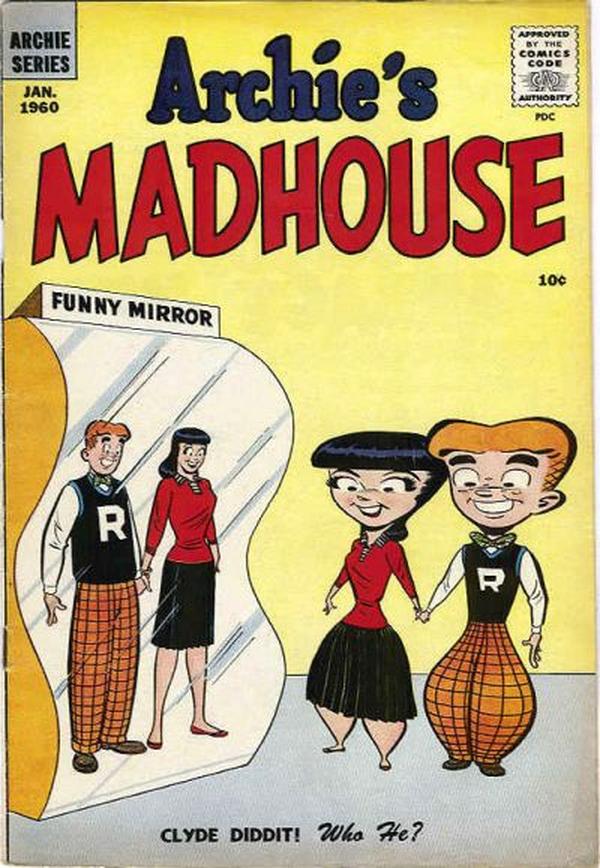
Archie's Madhouse #3
☆ Be the first to review + Add to your collection — Join freeArchie's Madhouse #3 (January 1960) belongs to the foundational first 18-issue stretch of a series that Archie deliberately designed as a response to the cultural dominance of MAD Magazine — spelling the title as two words ('Mad House') to imply a kinship with Harvey Kurtzman's satirical juggernaut. In that context, issue #3 is a working example of Archie's early experiment in absurdist teen humor, deploying the entire Riverdale cast in loosely structured sketch-comedy vignettes rather than conventional narrative strips. While the issue itself introduces no major recurring character, it demonstrates the creative latitude the title enjoyed in its early years — latitude that would eventually clear the path for landmark debuts like Sabrina the Teenage Witch in issue #22. Material from this issue was later selected for inclusion in IDW's retrospective 'Best of Archie's Madhouse' collection, signaling its place as a representative artifact of the series' original satirical voice.
In "Fancy Garbage Kit," Archie finds himself at the center of a surreal, satirical take on 1960s television, where even the news and prime-time shows are reimagined to target a teenage audience—complete with a hip-talking John Cameron Swayback and a teen-focused "Playhouse Under 20." The story takes a playful dive into pop culture parody, culminating in Archie’s unexpected appearance on "This is Your Life," all drawn with sharp, expressive flair by Bob White. The cover, by Harry Lucey and Terry Szenics, captures the zany energy of the issue in full color.
In this playful 1960 satire from *Archie's Madhouse #3*, teenage life takes over TV in a series of wacky, tongue-in-cheek updates: John Cameron Swayze gets a hip rename to Swayback, *Playhouse 90* becomes *Playhouse Under 20*, and Archie finds himself the surprise guest on *This is Your Life*. The story gleefully imagines a world where every broadcast is tuned to teen vibes—no spoilers, just pure, lighthearted fun.
In "Hair Styles of the Future," Monsieur Sheldon De La Broadbeam showcases his outrageous visions for the decades to come, from the sleek "Atomic Bob" to the dramatic "Tailfin" Wave—each more delightfully absurd than the last. A playful satire of mid-century futurism, the story imagines hair as high fashion, blending whimsy and satire in two pages of pure 1960s comic charm.
In a delightfully absurd twist, Archie finds himself in a Shakespearean realm where even a sabotaged box of tarts becomes a royal comedy of errors. With Reggie's mischief turning the moment into a scene of faux-Elizabethan flair, the story unfolds in playful, archaic dialogue that turns a simple romance attempt into a theatrical farce.
In "Laff It Up," Archie faces a pop quiz in class, while Jughead delivers his signature take on Reggie’s antics. Betty tries to engage Moose with a question, only to be interrupted by Veronica’s sharp reprimand of her butler—just as Moose reveals some surprising news.
ComicBooks.com Value
Find on ebay
Read it digitally
Sell my copy
Have this issue — or a whole collection? Get a fair offer from us, skip the marketplace fees and the hassle.
We Buy Collections ▸History
The series launched in September 1959 as part of Archie's conscious attempt to capitalize on the teen-satire market pioneered by MAD Magazine, with the two-word 'Mad House' branding intended to suggest a commercial connection that did not actually exist. Issue #3 appeared in January 1960, the third entry in that founding run, and features cover art penciled by Harry Lucey — one of Archie's most prolific house artists of the era — with inks by Terry Szenics. Interior stories were shared among key studio contributors Bob White, Dan DeCarlo, Samm Schwartz, and writer George Gladir, reflecting Archie's typical bullpen-style production model of the period.
Trivia · 8 facts
- Published January 1960 by Archie Publications; cover dated accordingly and confirmed by multiple indexing sources.
- Cover penciled by Harry Lucey with inks by Terry Szenics — Lucey was one of Archie's defining house artists throughout the Silver Age.
- Interior art contributed by Dan DeCarlo ('A Place in the Sun,' a Jughead gag strip), Samm Schwartz ('Madhouse Collection of Auto Fashions'), and prolific workhorse Bob White ('If Teen Agers Ran the Airlines!,' 'Madhouse Gadgets for Teen-Agers!').
- Writer George Gladir is credited on at least one story ('Realistic Dolls,' with art by Bob White) — Gladir would later create Sabrina the Teenage Witch for this same series in issue #22.
- Falls within the series' first 18-issue era, when the 'Archie gang' (Archie, Jughead, Betty, Veronica, Reggie, et al.) anchored all stories in a deliberately nonsensical, sketch-comedy format.
- The title 'Mad House' was deliberately rendered as two words to imply kinship with MAD Magazine and tap into the satirical humor market MAD had pioneered — a calculated editorial strategy that shaped the entire early run.
- At least one page from this issue was reprinted at reduced size in IDW Publishing's 'Best of Archie's Madhouse' retrospective collection, confirming the issue's status as a reference point for the series' original satirical style.
- No first appearances of major characters occur in this issue; the series' most significant debut (Sabrina the Teenage Witch) would not come until issue #22 (1962).
Full credits
Reprints
Reprinted in Archie's Madhouse #5 (1960), Archie's Madhouse Annual #1 (1962), The Best of Archie's Madhouse #[nn] (2011)
Key issues in Archie's Madhouse
Reviews
Reader reviews
No reader reviews yet.