comicbooks.com Join Free

A complete, restored issue of Pulp Fiction from 1942 — all 116 pages of painted-cover fiction magazines that launched science fiction, horror, and hardboiled crime, free to page through at comicbooks.com.

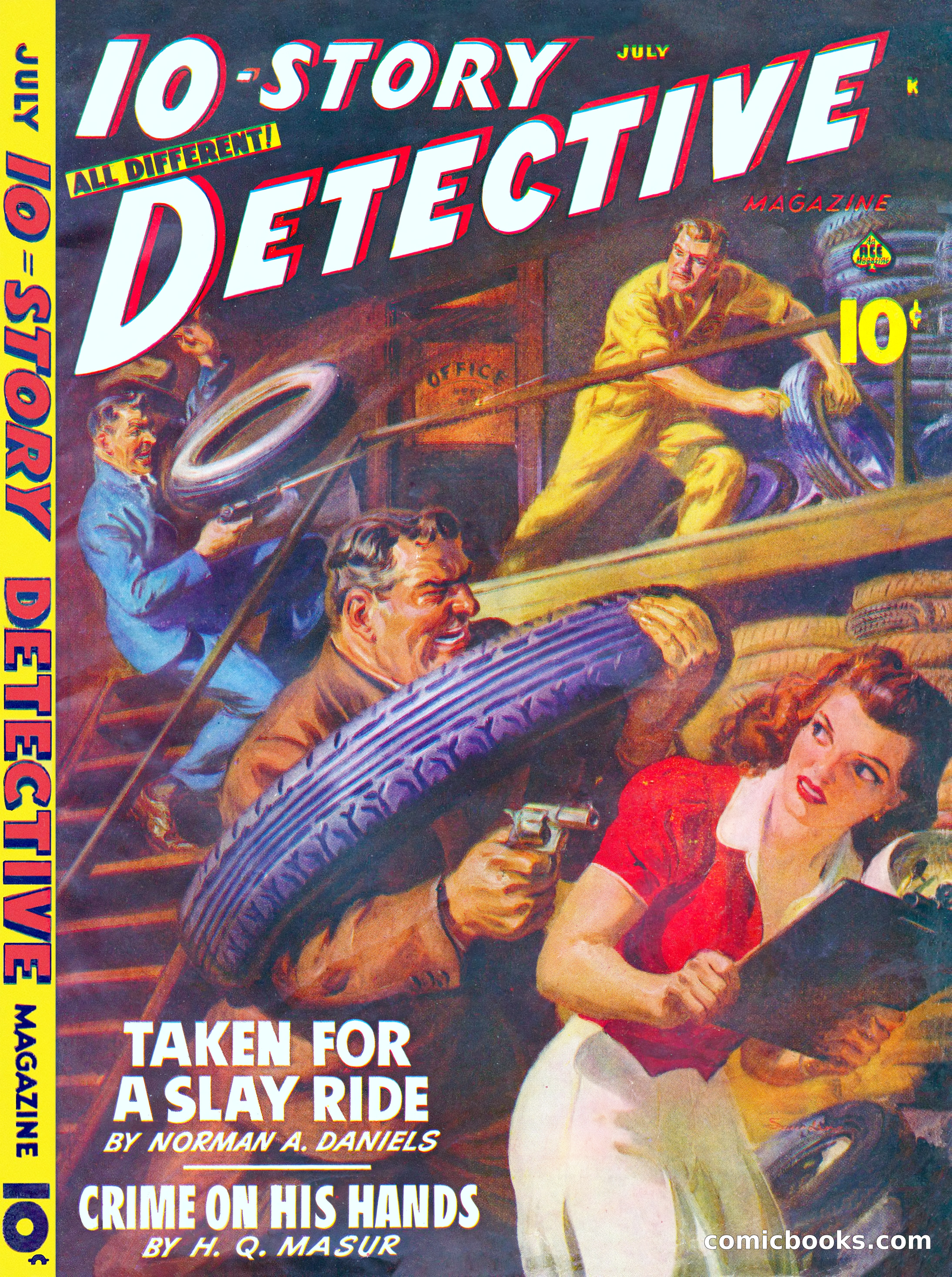
On the cover: # 10-Story Detective Magazine Cover - July Issue This is a magazine cover from *10-Story Detective*, a pulp fiction publication priced at 10 cents. The cover features dramatic illustration art depicting what appears to be a violent confrontation—multiple men struggling, one wielding what looks like a circular object or weapon, and a woman in a red dress appearing threatened or in distress. The main story advertised is "Taken for a Slay Ride" by Norman A. Daniels. A secondary story, "Crime on His Hands" by H. Q. Masur, is also listed. The cover emphasizes action and danger typical of crime and detective pulp magazines from this era.

🖼️ Every page has a plain-English note on what you’re looking at — the figures, the references, the point of the satire.

← Back to Pulp Fiction All exhibitions

HomeExhibitionPulp FictionRead

A complete issue · 116 pages · 1942

10 Story Detective, July 1942
1942 · Free to read

10 Story Detective, July 1942 — page 1 of 116
1 / 116
What you’re looking at · open this page on its own ↗

# 10-Story Detective Magazine Cover - July Issue This is a magazine cover from *10-Story Detective*, a pulp fiction publication priced at 10 cents. The cover features dramatic illustration art depicting what appears to be a violent confrontation—multiple men struggling, one wielding what looks like a circular object or weapon, and a woman in a red dress appearing threatened or in distress. The main story advertised is "Taken for a Slay Ride" by Norman A. Daniels. A secondary story, "Crime on His Hands" by H. Q. Masur, is also listed. The cover emphasizes action and danger typical of crime and detective pulp magazines from this era.

10 Story Detective, July 1942 — page 2 of 116
2 / 116
What you’re looking at · open this page on its own ↗

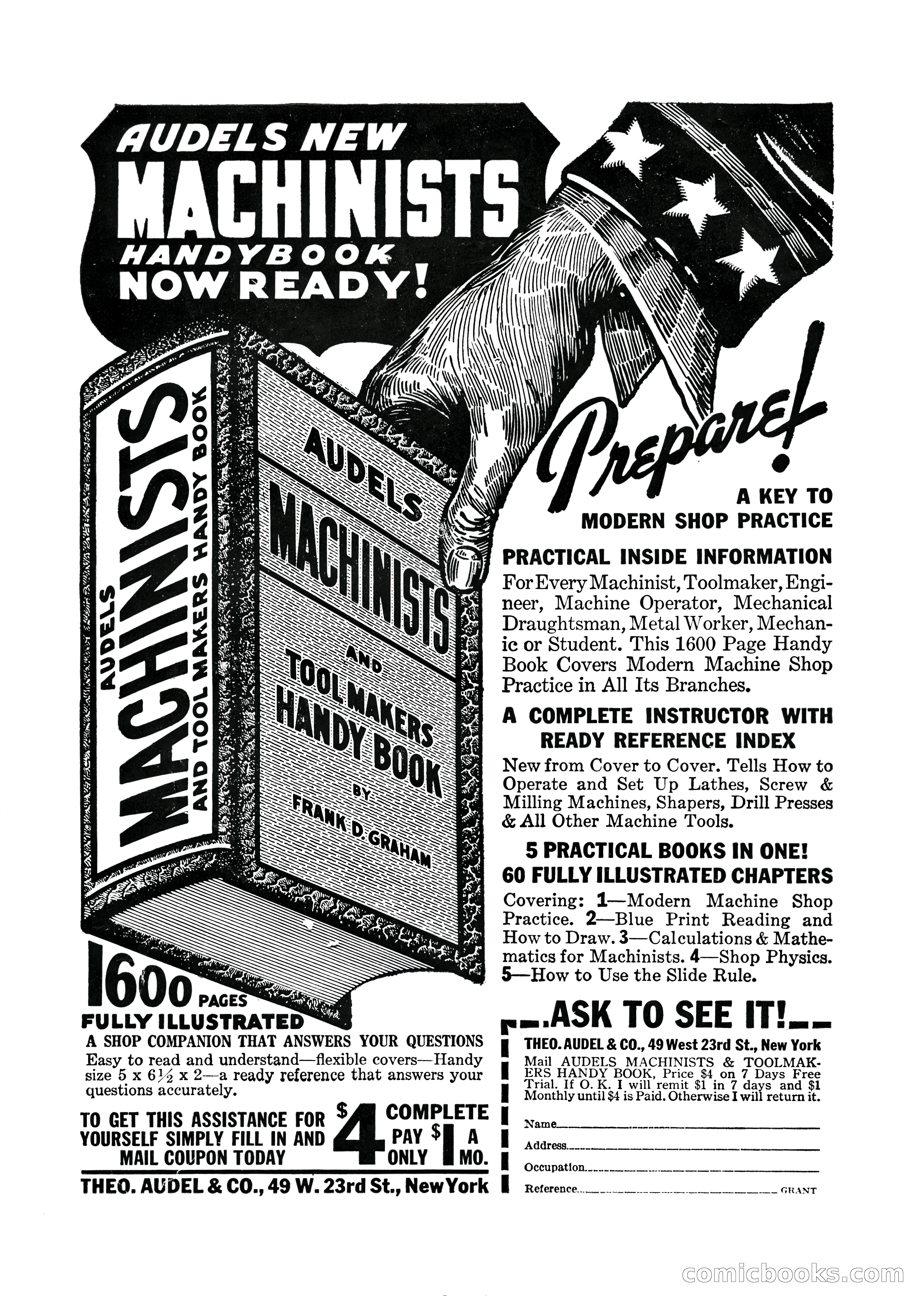
This is an advertisement page from a pulp magazine promoting "Audels Machinists and Tool Makers Handy Book" by Frank D. Graham, published by Theo. Audel & Co. in New York. The ad features a large illustration of a hand holding the book and describes it as a 1,600-page reference guide covering modern machine shop practice, lathe operation, tool use, and mathematical calculations for machinists, engineers, operators, and students. The advertisement emphasizes the book's 60 illustrated chapters and offers it for $4 complete, or $1 monthly on a payment plan. A mail coupon is included for ordering.

10 Story Detective, July 1942 — page 3 of 116
3 / 116
What you’re looking at · open this page on its own ↗

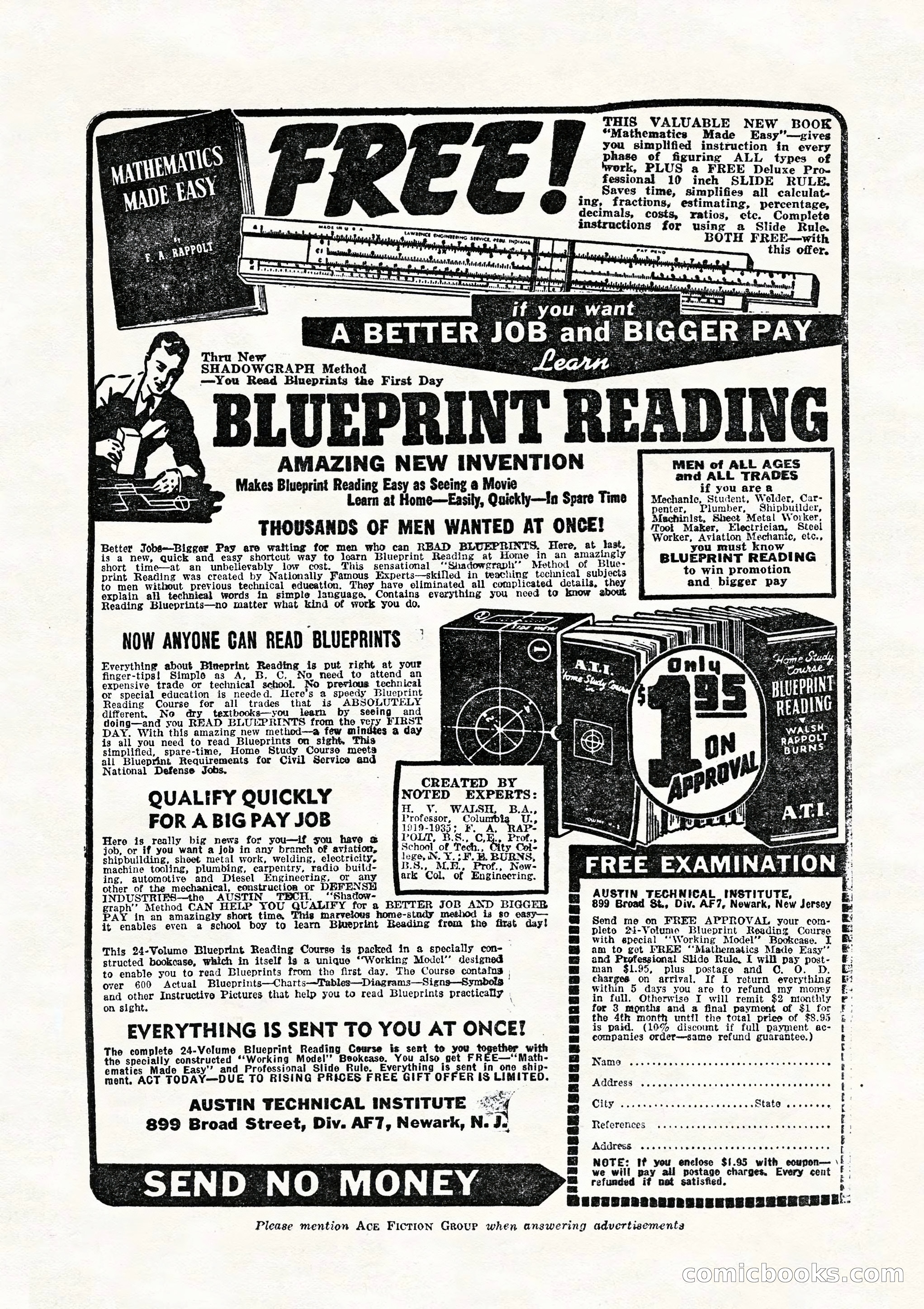
# Advertisement Page This is an advertisement page from a pulp magazine, not story content. It promotes a correspondence course in "Blueprint Reading" offered by the Austin Technical Institute in Newark, New Jersey. The ad promises job advancement and higher pay for those who learn to read blueprints, targeting men in various trades including aviation, carpentry, and engineering. It claims the course can be completed quickly and offers a free examination. The page also advertises a companion book, "Mathematics Made Easy," available free with the course. A slide rule is pictured as an included bonus item. The advertisement uses typical pulp-era marketing language emphasizing rapid self-improvement and economic opportunity.

10 Story Detective, July 1942 — page 4 of 116
4 / 116
What you’re looking at · open this page on its own ↗

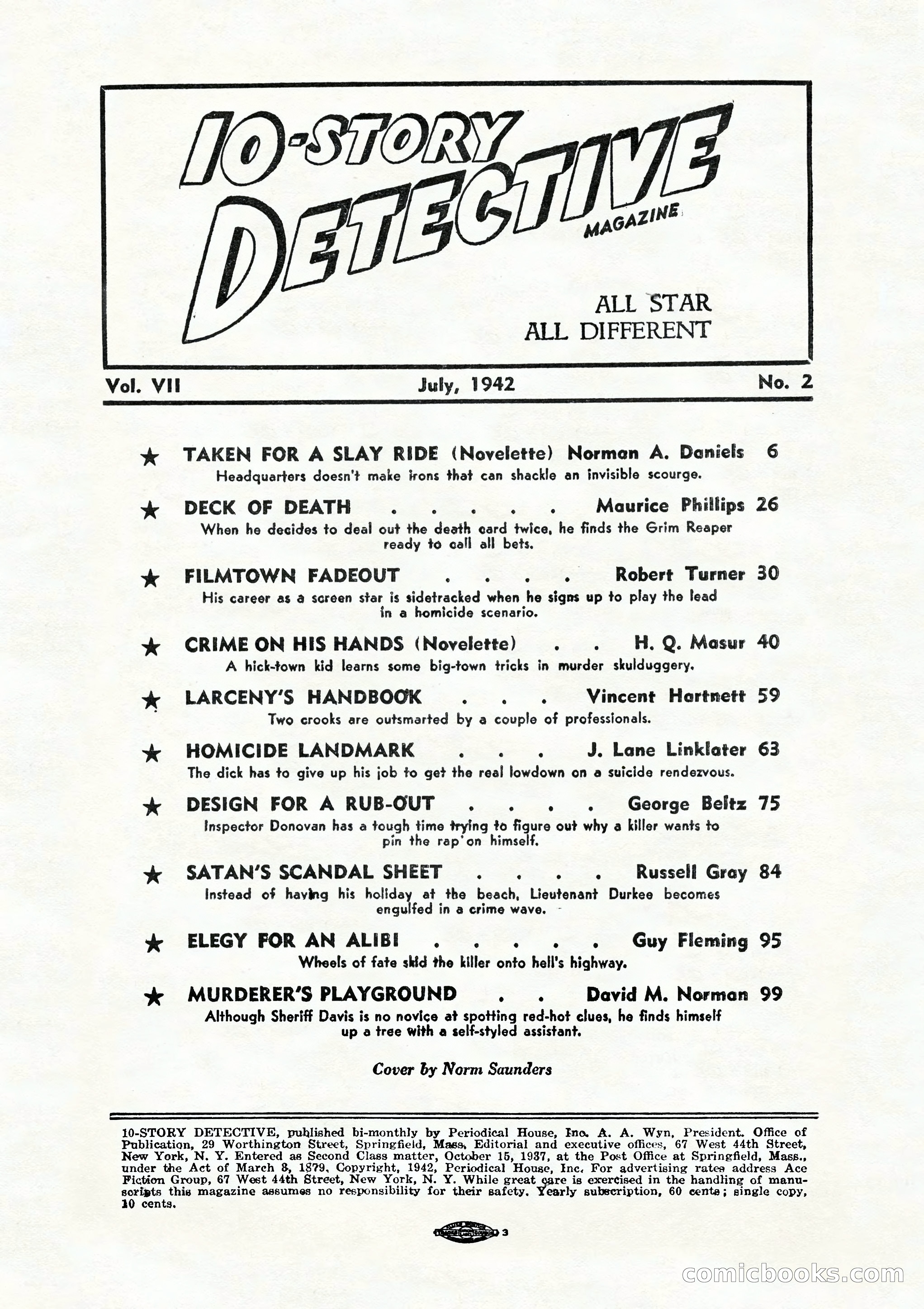
# 10-Story Detective Magazine Table of Contents This is a table of contents page from the July 1942 issue of *10-Story Detective Magazine* (Vol. VII, No. 2). It lists eleven short stories and novelettes, each with author names and page numbers. The stories include titles like "Taken for a Slay Ride" by Norman A. Daniels, "Deck of Death" by Maurice Phillips, and "Murderer's Playground" by David M. Norman, among others. Each entry includes a brief one-line description of the story's plot. The page notes the cover was illustrated by Norm Saunders and includes publication information indicating the magazine sold for 10 cents.

10 Story Detective, July 1942 — page 5 of 116
5 / 116
What you’re looking at · open this page on its own ↗

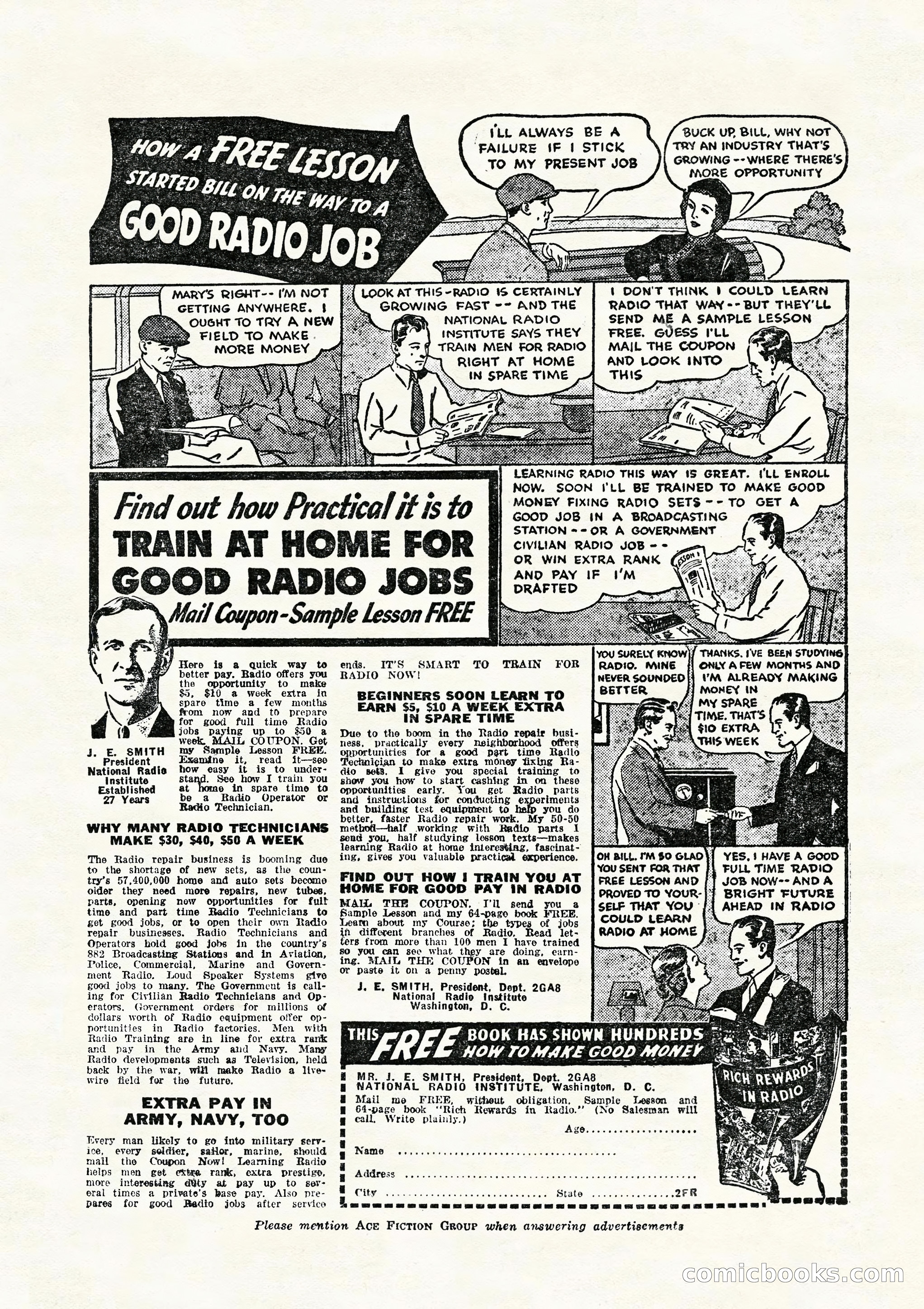
# Page Description This is an advertisement page featuring a comic-strip narrative about how one man obtained a radio job through home training. The page promotes the National Radio Institute's correspondence course for radio technicians, claiming students can earn $5-10 weekly in spare time while learning. The comic panels show a conversation between characters named Bill and Mary, where Bill decides to pursue radio training rather than seek a new job field. Text blocks describe radio industry opportunities, technician salaries ($30-$50 weekly), and military service benefits. A coupon at the bottom invites readers to request a free sample lesson and 64-page book about radio careers. The overall message emphasizes practical home-based training for lucrative employment in the growing radio repair business.

10 Story Detective, July 1942 — page 6 of 116
6 / 116
What you’re looking at · open this page on its own ↗

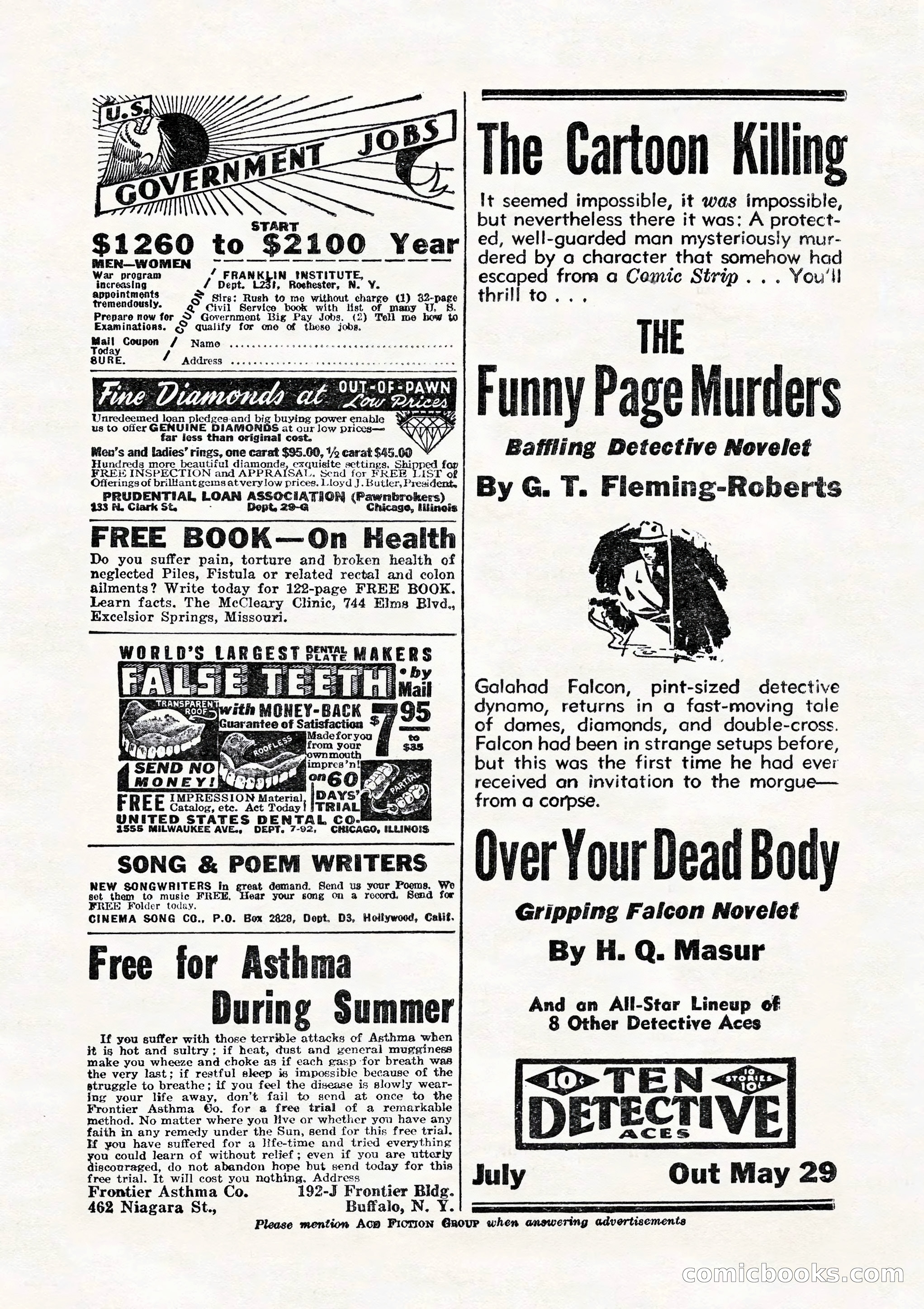
# Content Analysis This is an **advertising and promotional page** from a pulp magazine. The page is dominated by vintage advertisements for various products and services (government jobs, diamonds, false teeth, asthma remedies, songwriting opportunities) positioned on the left side. The right side features promotional material for pulp fiction detective stories, specifically highlighting two novelettes: "The Cartoon Killing" by G. T. Fleming-Roberts and "Over Your Dead Body" by H. Q. Masur, both apparently featuring a detective character named Galahad Falcon. The page advertises an upcoming issue of *Ten Detective Aces* magazine, scheduled to come out May 29, with an illustration of what appears to be a detective figure. This is primarily a promotional/advertising page rather than story content.

10 Story Detective, July 1942 — page 7 of 116
7 / 116
What you’re looking at · open this page on its own ↗

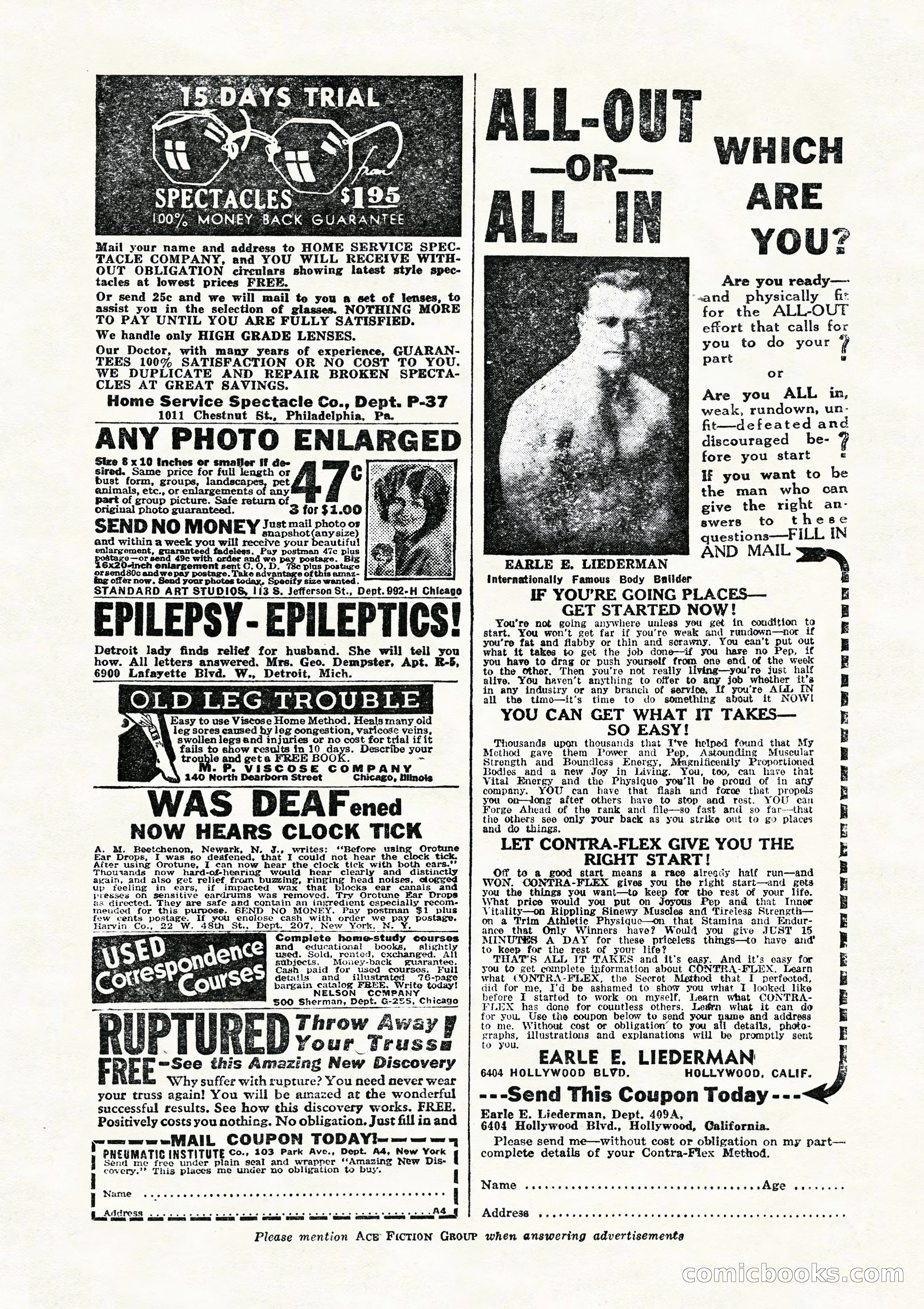
# Analysis of Page Content This is an **advertisement page** from a pulp magazine, containing multiple classified ads and promotional materials typical of early-20th-century publications. The page features various mail-order advertisements including: spectacles for $1.25, photo enlargement services for 47¢, treatments for epilepsy and leg troubles, a correspondence course offer, a "ruptured truss" discovery, and a hearing aid device. The dominant advertisement promotes "Contra-Flex," a physical fitness/body-building method by Earle E. Liederman of Hollywood, California, featuring a muscular man's photograph and promising strength development. All ads include coupons or contact information encouraging reader response via mail.

10 Story Detective, July 1942 — page 8 of 116
8 / 116
What you’re looking at · open this page on its own ↗

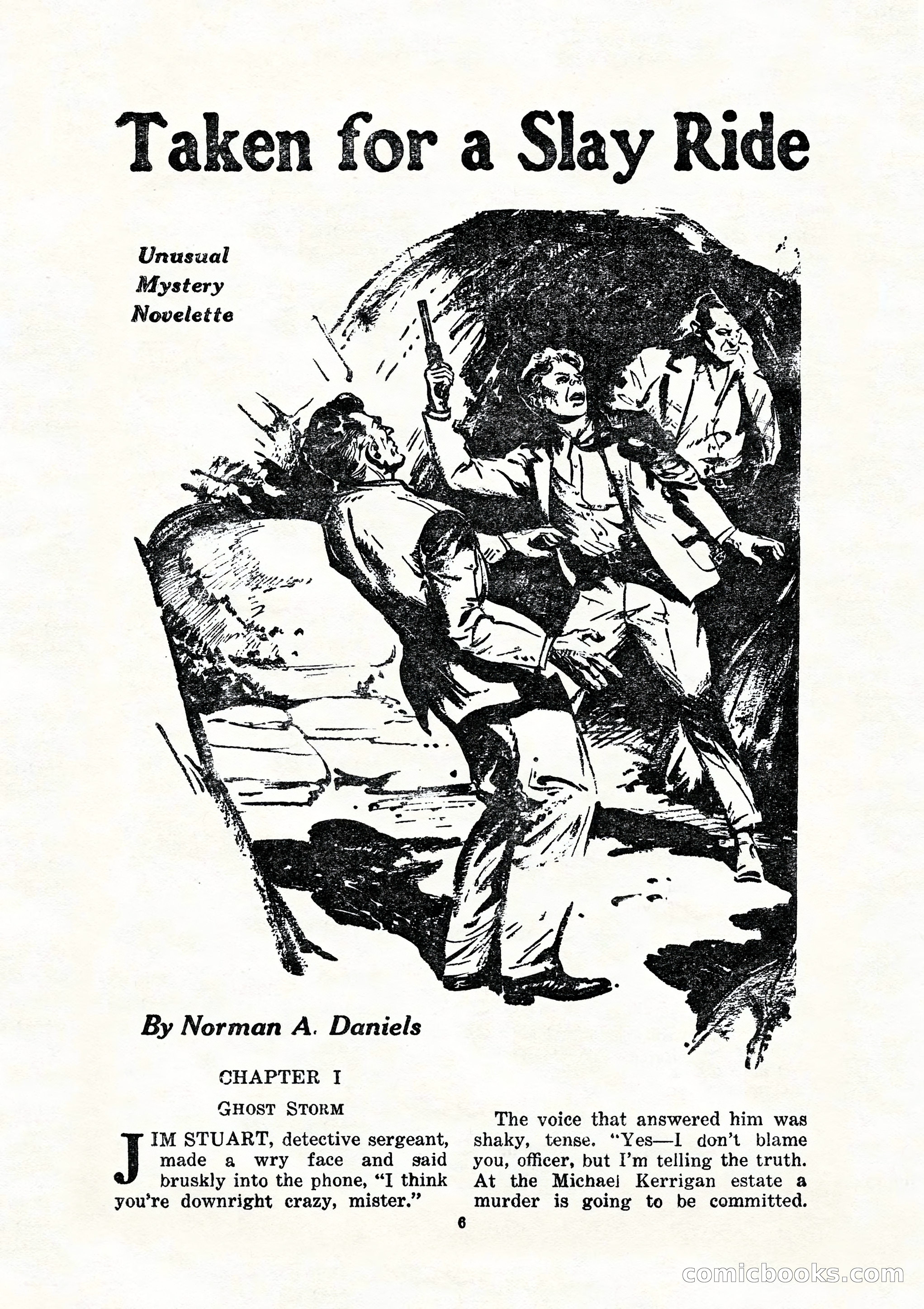
# Page Analysis This is the opening page of a story titled "Taken for a Slay Ride," described as an "Unusual Mystery Novelette" by Norman A. Daniels. The page includes a dramatic black-and-white illustration depicting several men in what appears to be a tense or violent confrontation scene. Chapter I is titled "Ghost Storm" and begins with Detective Sergeant Jim Stuart responding to a phone call from someone claiming a murder will be committed at the Michael Kerrigan estate. Stuart appears skeptical, telling the caller he thinks they're "downright crazy," though the caller insists they're telling the truth. The page is numbered 6.

10 Story Detective, July 1942 — page 9 of 116
9 / 116
What you’re looking at · open this page on its own ↗

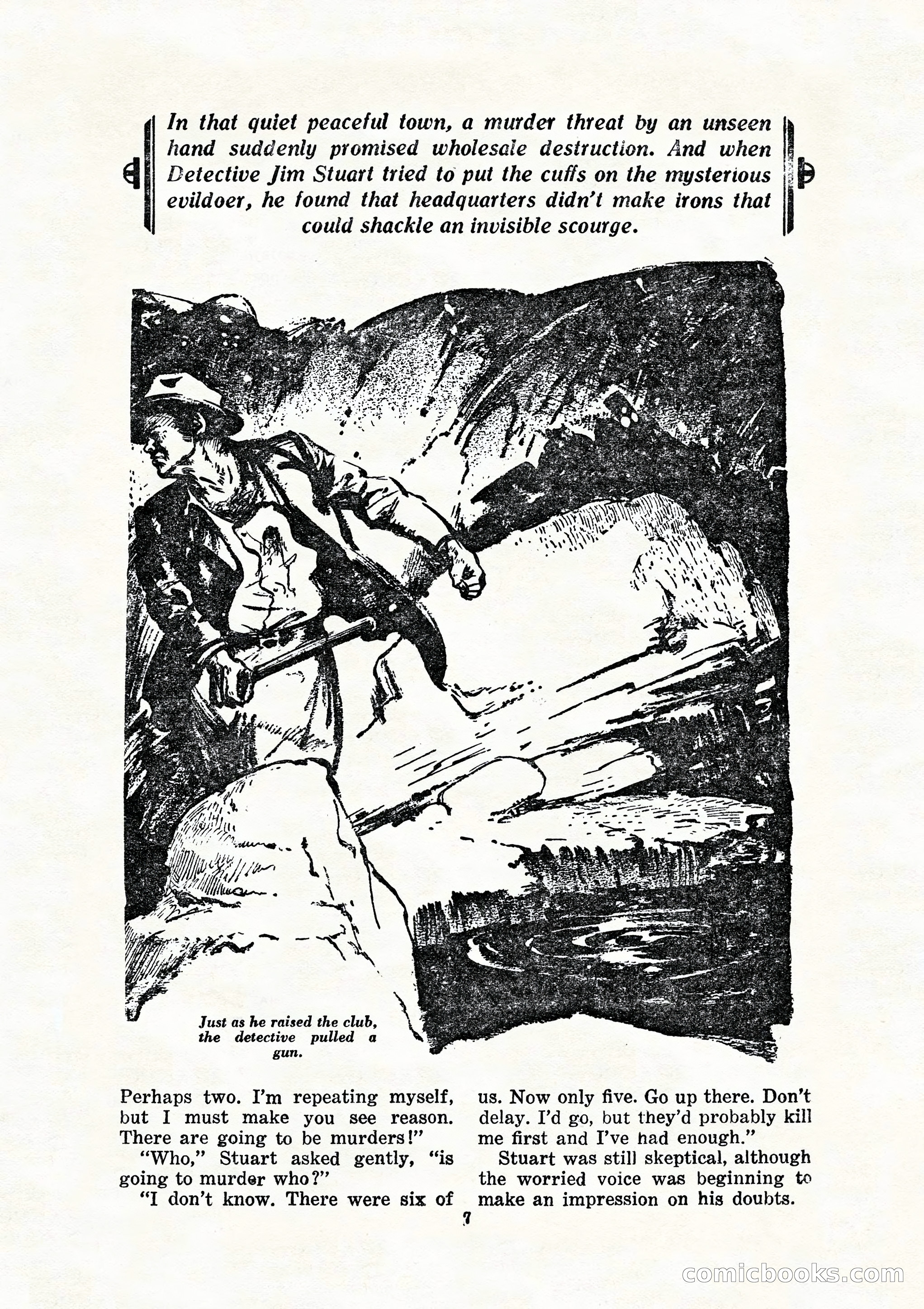
This is an interior story page featuring a dramatic black-and-white illustration above prose text. The illustration depicts Detective Jim Stuart in a confrontation with an armed assailant near water, with Stuart drawing a gun as the other figure raises a club. The page header establishes the plot: a quiet town faces murder threats from an unseen killer, and Stuart encounters difficulty apprehending this mysterious criminal. The prose below the illustration continues the story, with dialogue between Stuart and another character discussing the impending murders and the danger involved. The page number appears to be 9, indicating this is mid-story content from a hardboiled crime pulp magazine.

10 Story Detective, July 1942 — page 10 of 116
10 / 116
What you’re looking at · open this page on its own ↗

# Page Analysis This is a page of story prose from a pulp detective magazine titled "10-STORY DETECTIVE" (visible in the header). The page contains two columns of text presenting a hardboiled crime narrative. Detective Sergeant Jim Stuart responds to a call about a man named John Alexander registered at the Fairview Hotel, then investigates a shooting incident where a bullet pierces a car windshield on a hillside. Stuart discovers an enormous, mysterious figure encased in heavy clothing and boots on the hillside, which he pursues after it vanishes. The narrative establishes an apparent connection between Alexander's earlier warning of murder and this strange encounter near the wealthy Michael Kerrigan estate.

10 Story Detective, July 1942 — page 11 of 116
11 / 116
What you’re looking at · open this page on its own ↗

# Page Analysis This is a text-only story page (page 9) from a pulp magazine titled "Taken for a Slay Ride." The visible prose depicts a hardboiled crime narrative in which Sergeant Stuart, a local policeman, arrives at an estate after receiving reports of trouble. He encounters Michael Kerrigan, a tall hollow-cheeked man, who is entertaining three other men (Meredith, Gordon, and Terry). Kerrigan explains that he and his associates were mining partners in Alaska fourteen months ago, when two of their group—Leonard and Alexander—were swept away in a mountain storm and presumed dead. Stuart grows suspicious that Alexander may not actually be deceased, suspecting the men may be planning something.

10 Story Detective, July 1942 — page 12 of 116
12 / 116
What you’re looking at · open this page on its own ↗

# Page Analysis This is a **story prose page** from a pulp detective magazine titled "10-Story Detective." It shows **Chapter II: "Dead Man Walks,"** depicting a dramatic scene where detective Stuart and his companions discover that their associate Albert Meredith has died during a violent storm. The text describes Meredith's collapse, the group's shock and confusion about the circumstances, and their attempts to understand whether he died from a heart attack or some other cause. Stuart and another character named Kerrigan discuss the suspicious nature of the death, while a frightened character named Doug Terry remains reluctant to examine the body. The passage emphasizes the eerie atmosphere created by the suddenly-stopped storm.

10 Story Detective, July 1942 — page 13 of 116
13 / 116
What you’re looking at · open this page on its own ↗

# Page Analysis This is a story prose page (page 11) titled "Taken for a Slay Ride." The text describes a mystery unfolding in a house where characters named Stuart, Gordon, Kerrigan, and Terry discover that a corpse—apparently belonging to someone named Meredith or Alexander—has vanished. The narrative involves discussion of a tall, supernatural figure dressed in heavy winter clothing that appeared at windows and melted like snow. Stuart investigates the house's interior while the others debate whether they witnessed an illusion or genuine supernatural phenomenon, with references to Eskimo beliefs about a "storm god." The plot suggests a crime or mystery with potentially supernatural elements.

10 Story Detective, July 1942 — page 14 of 116
14 / 116
What you’re looking at · open this page on its own ↗

# Page Analysis This page contains story prose from a pulp detective fiction magazine. The visible text depicts an intense interrogation scene in which Detective Stuart questions a terrified man named Terry about the death of John Alexander. As a violent storm rages outside, Terry becomes increasingly hysterical, insisting he is innocent and claiming Alexander is a ghost. The narrative focuses on Terry's psychological breakdown—he faints after ranting about the wind taking his breath—while Stuart and other detectives observe. The page emphasizes Gothic atmosphere and psychological suspense rather than action, with detailed descriptions of the storm's effects on the frightened suspect.

10 Story Detective, July 1942 — page 15 of 116
15 / 116
What you’re looking at · open this page on its own ↗

# Page 19 of "Taken for a Slay Ride" This page contains story prose from what appears to be a mystery or crime story. The narrative describes Stuart discovering that his companion Terry is dead, then discusses whether Terry's body mysteriously vanished. Stuart, Kerrigan, and Gordon debate theories about the disappearance—one suggests a ghost took the body, while another proposes someone else on the property removed it. The conversation shifts to discussing a murdered man named Alexander and a missing carved stone artifact. Gordon mentions finding worthless rock samples during an Alaskan expedition. The text suggests a plot involving murder, missing objects, and possible deception about analysis results.

10 Story Detective, July 1942 — page 16 of 116
16 / 116
What you’re looking at · open this page on its own ↗

# Page Analysis This is a prose story page from a pulp detective magazine titled "10-STORY DETECTIVE" (visible in the header). The page contains two columns of text with no illustrations. The story follows a detective named Stuart investigating a theft and a missing persons case at a clifftside estate. Stuart discovers a toolhouse near the cliff and finds evidence of stolen cement. He then investigates a large cave behind the cliff, discovering it could hide bodies. After being attacked inside the cave, Stuart continues exploring deeper passages, discovering additional cavern openings. The narrative emphasizes suspense and danger as Stuart proceeds with his investigation despite the hazardous conditions.

10 Story Detective, July 1942 — page 17 of 116
17 / 116
What you’re looking at · open this page on its own ↗

This page contains story prose from what appears to be a pulp adventure or science fiction tale titled "Taken for a Slay Ride." The narrative describes a protagonist named Stuart who has been attacked and rendered unconscious in a cave system. Upon awakening, bound and injured, Stuart realizes he's trapped in darkness with a mysterious glittering humanoid figure. He manages to locate a gun and broken flashlight, then uses his wits to escape his bonds by cutting rope with broken glass. The text emphasizes Stuart's gradual physical and mental recovery as he assesses his dire situation within the cavern system.

10 Story Detective, July 1942 — page 18 of 116
18 / 116
What you’re looking at · open this page on its own ↗

# Page Analysis This page contains story prose from a pulp magazine titled "10-Story Detective" (visible in the header). The text describes a character named Stuart who has escaped from a cave by jumping into the ocean during high tide, then swimming to shore to retrieve his wet clothes. The narrative then shifts to Chapter IV, titled "Alaskan Killer," which begins with Stuart entering a house where he finds no one present, though he suspects Kerrigan and Gordon may be searching for him. The page is entirely text with no illustrations or advertisements visible.

10 Story Detective, July 1942 — page 19 of 116
19 / 116
What you’re looking at · open this page on its own ↗

This page contains story prose from what appears to be a pulp fiction adventure tale titled "Taken for a Slay Ride." The narrative follows characters named Stuart, Gordon, and Kerrigan as they discuss mysterious disappearances and thefts on an estate. A granite god has been stolen, and there are references to a vanished rowboat and missing people, including someone named Bates and Meredith. Stuart decides to investigate by exploring a cave accessible by rope over a cliff, while Gordon reports a break-in at his house. The dialogue suggests a mystery plot involving theft and disappearance during or after a violent storm in Alaska.

10 Story Detective, July 1942 — page 20 of 116
20 / 116
What you’re looking at · open this page on its own ↗

# 10-Story Detective - Page 18 This page contains story prose from what appears to be a detective or crime fiction narrative. The text describes Stuart sneaking around a house at night, positioning himself by a window to observe the interior while waiting for a criminal named Bates to appear. When Bates arrives, a tense confrontation develops involving a knife and revolver. Stuart's allies Kerrigan and Gordon eventually emerge, disarm Bates, and prepare to move him downstairs. The passage emphasizes suspense and danger, with detailed descriptions of the characters' movements and the weapons involved in this apparent stakeout or trap scenario.

10 Story Detective, July 1942 — page 21 of 116
21 / 116
What you’re looking at · open this page on its own ↗

This is a page of story prose (page 19) from a pulp magazine titled "Taken for a Slay Ride." The text depicts an interrogation scene where Gordon has captured a man named Bates and tied him to a chair. Stuart and Gordon question Bates about murders and stolen idols, while Bates claims protection from a supernatural entity called the "Storm God" that rules a mountain in Alaska. Bates insists the Storm God is real, describing it as a giant, ice-like being that controls violent weather and has killed men. Gordon remains skeptical of Bates's claims about this deity, dismissing them as superstitious folklore while Bates maintains his account with apparent conviction.

10 Story Detective, July 1942 — page 22 of 116
22 / 116
What you’re looking at · open this page on its own ↗

This page contains story prose from a pulp fiction narrative titled "10-Story Detective." The text describes an intense physical confrontation between characters named Bates, Stuart, Gordon, and Kerrigan during a violent storm. Bates, apparently the antagonist, strangles Kerrigan while Stuart attempts to stop him. The passage details the struggle, the failing lights during the storm, Bates's escape, and Stuart's pursuit with a gun. The scene involves multiple characters fighting, gunshots being fired, and dramatic action typical of hardboiled crime or detective fiction. The page contains no illustrations, only dense columns of printed text formatted as a continuous narrative.

10 Story Detective, July 1942 — page 23 of 116
23 / 116
What you’re looking at · open this page on its own ↗

This is a text page from a pulp fiction story titled "Taken for a Slay Ride," continuing from Chapter V ("Tunnel to Danger"). The page contains prose narrative depicting characters named Stuart, Gordon, Kerrigan, and Bates in what appears to be a suspenseful scene. After a confrontation where Bates escapes, the men discover their cars have been stolen and their telephone line cut. Kerrigan expresses fear about Bates, attributing supernatural powers to him and referencing something called "the Storm God." The dialogue suggests this is likely a horror or supernatural story, though the exact plot and context remain unclear from this single page alone.

10 Story Detective, July 1942 — page 24 of 116
24 / 116
What you’re looking at · open this page on its own ↗

# Page Analysis: "10-Story Detective" This is a **prose story page** from what appears to be a detective pulp magazine titled "10-Story Detective." The page contains two columns of text continuing a mystery narrative. The visible story follows a detective named Stuart investigating disappearances and a mysterious intruder. Stuart discovers a hidden sub-cellar beneath the house—accessed through a trap door concealed in the dirt floor—which appears to be the method by which an intruder (named Bates) enters and exits the property undetected. Stuart finds blood evidence and realizes Kerrigan and Gordon, who were outside attempting car repairs, are now returning inside. The passage suggests Stuart has solved how the mysterious "ghost" enters the house.

10 Story Detective, July 1942 — page 25 of 116
25 / 116
What you’re looking at · open this page on its own ↗

# Page Analysis This is a **text-only story page** (page 23) from a pulp magazine titled "Taken for a Slay Ride." The visible prose depicts an action sequence in which characters named Stuart, Gordon, and Kerrigan pursue a man named Bates through a tunnel system beneath a cliff overlooking the sea. After a violent confrontation in a cave, Bates—apparently wounded—threatens the men with a gun and makes accusations about their involvement in pushing people off a cliff in Alaska. The passage is dense dialogue and narrative describing gunplay, pursuit, and moral conflict among the characters.

10 Story Detective, July 1942 — page 26 of 116
26 / 116
What you’re looking at · open this page on its own ↗

This page contains story prose from what appears to be "10-Story Detective," a pulp crime fiction magazine. The text shows a confrontation scene where the detective Stuart accuses a man named Gordon of orchestrating murders disguised as supernatural "Storm God" manifestations. Stuart reveals that Gordon hired a man named Bates to kill business rivals by poisoning them with aconite, then staging fake storms with compressed air and chemical rain to cover the crimes. The passage details Stuart's deduction of the murder method and a tense standoff with guns, ending with discussion of whether Bates will leave the cave location.

10 Story Detective, July 1942 — page 27 of 116
27 / 116
What you’re looking at · open this page on its own ↗

This is a page of story prose from a pulp fiction magazine, numbered 25. The text depicts an intense confrontation between characters named Stuart, Bates, and Gordon in what appears to be a crime or mystery story. Stuart has apparently poisoned brandy and orchestrated a murder plot involving Kerrigan, while Bates has discovered the scheme. The passage describes physical struggle, gunfire, and Stuart's subsequent disposal of bodies by boat to cover his crime. The narrative is written in hardboiled detective fiction style, with dialogue and action-heavy descriptions typical of early-20th-century pulp crime magazines. A small revolver illustration appears at the page's bottom.

10 Story Detective, July 1942 — page 28 of 116
28 / 116
What you’re looking at · open this page on its own ↗

# "Deck of Death" by Maurice Phillips This is a page of story prose from a pulp magazine (page 26, as marked). The visible text depicts a hardboiled crime story involving a character named Marco Sewell, who appears to be a gambling operation owner, and George Pendegrast, who seems to be pressuring Marco for money—apparently four thousand dollars owed within five weeks. The narrative establishes Marco's world of casinos, roulette wheels, and urban vice, while suggesting some form of criminal debt or extortion plot. A small illustration showing playing cards and what appears to be a gun accompanies the text, reinforcing the story's noir crime themes.

10 Story Detective, July 1942 — page 29 of 116
29 / 116
What you’re looking at · open this page on its own ↗

This is a page of story prose from a hardboiled crime pulp magazine titled "Deck of Death." The text describes a character named Marco, who works in accounting, planning to eliminate his business rivals George Pendegrast and Henry Frazer after discovering they've been embezzling. The narrative shifts to a dance floor scene where Marco observes Iris Stanton performing and then receives a phone call from Pendegrast. The prose employs typical pulp-fiction conventions: dramatic tension, internal monologue revealing criminal intent, and noir-style descriptions of characters and situations. No illustrations are visible on this text-heavy page.

10 Story Detective, July 1942 — page 30 of 116
30 / 116
What you’re looking at · open this page on its own ↗

# Page Analysis This is a **story prose page** from a hardboiled crime detective pulp magazine titled "10-Story Detective." The page contains two columns of text narrating a mystery involving a character named Marco who becomes entangled in a case after meeting with a man named Pendegrast. The visible text describes how Marco must establish an alibi when detectives Reeves and Gissing of Homicide arrive to question him about a murder. According to the detectives' explanation, George Pendegrast (Marco's associate) was found dead from a gunshot wound, with the shooting occurring between four and six o'clock. The narrative focuses on Marco's predicament as suspicion falls on him and his connection to the case.

10 Story Detective, July 1942 — page 31 of 116
31 / 116
What you’re looking at · open this page on its own ↗

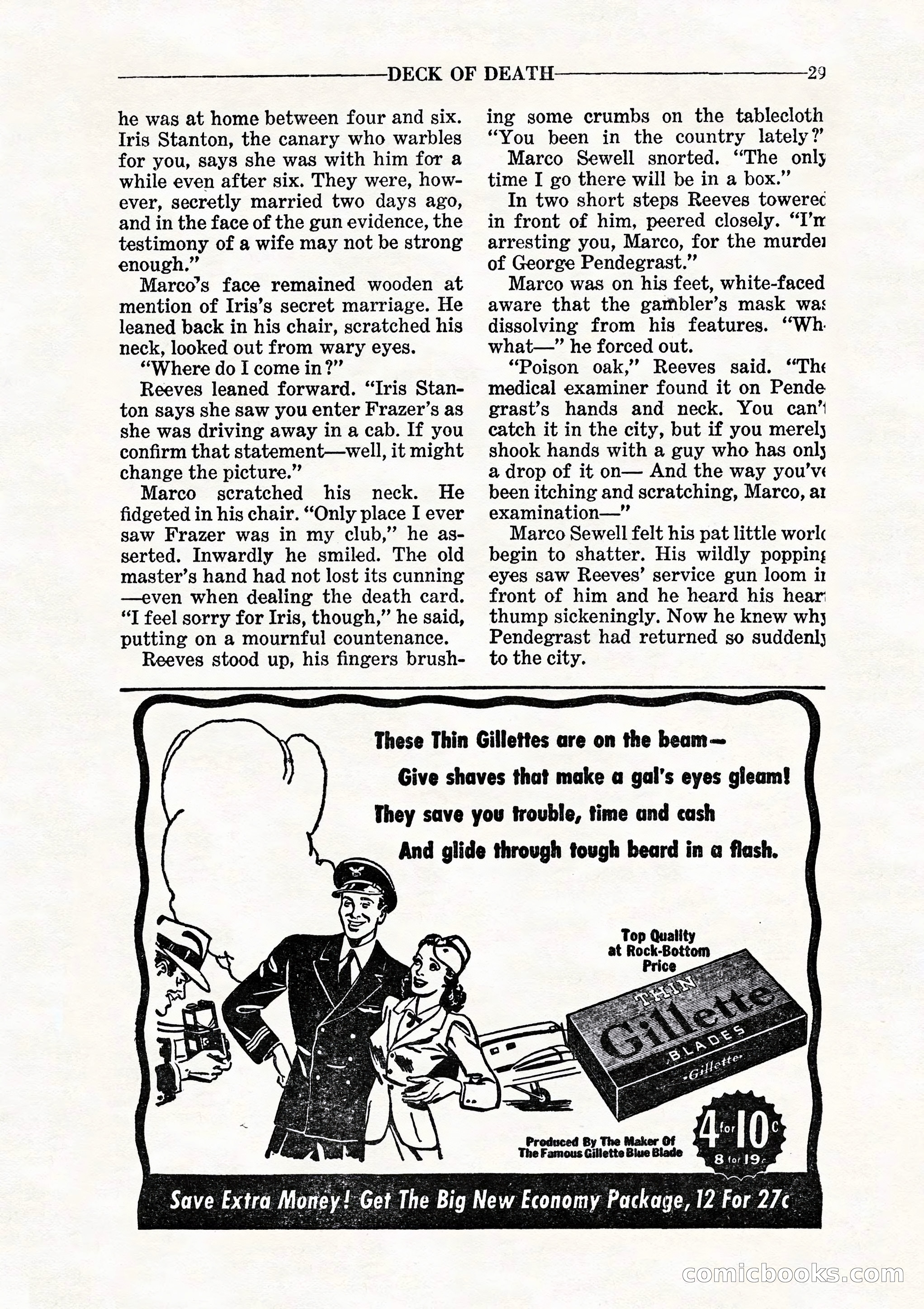
This page contains the continuation of a hardboiled crime story titled "Deck of Death" (visible at page header 29). The prose describes a tense confrontation between characters named Marco and Reeves, involving accusations of murder related to someone named George Pendergrast and mention of poison oak. The narrative focuses on Marco's mounting fear as Reeves reveals evidence against him. Below the story text is a full-page advertisement for Gillette razor blades, featuring illustrated figures and promotional copy emphasizing the blades' quality and value. The ad promises savings and quick, smooth shaving performance, with pricing information ("4 for 10¢") visible at the bottom.

10 Story Detective, July 1942 — page 32 of 116
32 / 116
What you’re looking at · open this page on its own ↗

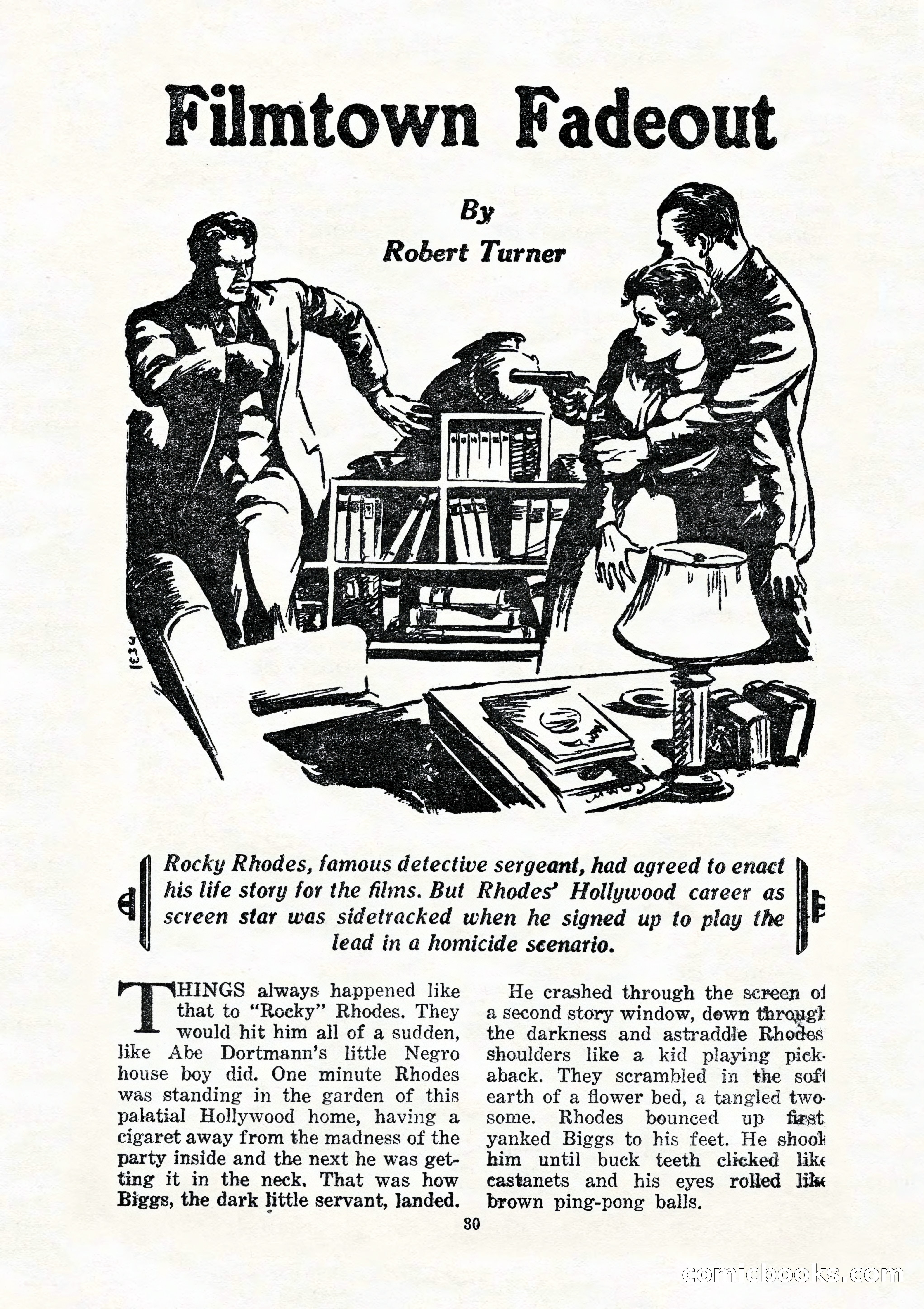
# Filmtown Fadeout This is an interior story page from a pulp magazine, featuring a black-and-white illustration at the top and prose text below. The story, by Robert Turner, concerns Rocky Rhodes, a famous detective sergeant whose Hollywood career derails when he's cast in a homicide scenario instead of his own life story. The visible text describes an incident where Rhodes is suddenly attacked—thrown through a window by someone named Biggs, a servant. The prose uses vivid, colloquial language typical of pulp crime fiction, describing the physical altercation in exaggerated detail with imagery like "buck teeth clicked like castanets."

10 Story Detective, July 1942 — page 33 of 116
33 / 116
What you’re looking at · open this page on its own ↗

This page contains story prose from a pulp magazine titled "Filmtown Fadeout" (visible in the header). The text describes a murder investigation in Hollywood: detective Rocky Rhodes discovers a dead body—newspaper columnist Jack Rance—sprawled on a polar bear rug with a knife wound to the chest. Rhodes questions witnesses at what appears to be a party scene, including a character named Biggs. The narrative details the discovery of the murder weapon (a knife with an African savage handle) and the shocked reactions of various Hollywood figures present at the scene, including actors, producers, and industry figures. The prose is typical hardboiled crime fiction style.

10 Story Detective, July 1942 — page 34 of 116
34 / 116
What you’re looking at · open this page on its own ↗

# Page 32 of "10-Story Detective" This is a **story prose page** from a hardboiled crime/detective pulp magazine. The text continues a murder mystery narrative involving characters named Rocky Rhodes, Greg Rhodes, and others investigating a death. The plot concerns a corpse, a stolen knife, and questions about who committed a murder—apparently someone named Rance. A dentist named Rawlins provides a clue about false teeth found at the scene. The dialogue and narrative suggest this is a classic pulp detective story with multiple suspects and dramatic confrontations between brothers and romantic rivals.

10 Story Detective, July 1942 — page 35 of 116
35 / 116
What you’re looking at · open this page on its own ↗

This page contains story prose from a hardboiled crime fiction narrative titled "Filmtown Fadeout" (page 33). The text depicts a tense scene where detective Rocky Rhodes is questioned by police about a knife used in what appears to be a murder investigation. Rocky insists he couldn't have loaned the weapon to anyone else. The narrative then shifts to Rocky meeting with a woman named Donna Mario in a moonlit summerhouse, where she flirts with him while discussing the murder. The prose is typical pulp fiction style—direct dialogue mixed with descriptive narrative focusing on character interactions and plot development. No illustrations appear on this page.

10 Story Detective, July 1942 — page 36 of 116
36 / 116
What you’re looking at · open this page on its own ↗

# Page Analysis This is a text-only story page from a pulp magazine titled "10-Story Detective." The page contains two columns of prose narrative depicting a violent confrontation between characters named Rocky, Donna, and an unnamed antagonist. The story involves Rocky defending Donna during a physical altercation; Rocky is struck repeatedly but manages to fend off attacks. The narrative then shifts to Rocky visiting an office building in Hollywood, where he encounters a business card belonging to Hugh Rawlins (a dentist in the Albon Building). The passage concludes with Rocky having a tense conversation with a character named Dortmann before driving toward town. The prose style and subject matter are consistent with hardboiled crime fiction.

10 Story Detective, July 1942 — page 37 of 116
37 / 116
What you’re looking at · open this page on its own ↗

This page contains story prose from what appears to be a hardboiled crime pulp magazine titled "Filmtown Fadeout" (visible at the page header as page 35). The text describes detective Rocky Rhodes breaking into dentist Hugh Rawlins' office and discovering compromising photographs of Hollywood women, apparently used for blackmail. The narrative then depicts Rhodes being shot at in the office, with the bullet hitting his shoulder. The prose is dense and action-oriented, typical of early pulp crime fiction, focusing on the detective's investigation into what may be connected to a murder involving a columnist. No illustrations are visible on this page—it is entirely text.

10 Story Detective, July 1942 — page 38 of 116
38 / 116
What you’re looking at · open this page on its own ↗

# Page 36: "10-Story Detective" — Story Prose This page contains two columns of prose narrative from what appears to be a hardboiled crime story. The visible text depicts an interrogation scene where Detective Jensen questions a suspect named Rocky Rhodes about guns found at a crime scene. Rhodes claims he hasn't carried a gun in years and suggests that he and another person named Rawlins fired simultaneously at the same time during some unspecified incident. The narrative then shifts to Rocky's escape: he flees through a building, jumps to a roof and alley, and eventually makes his way to a drug store on Sunset Boulevard, where he changes a ten-dollar bill. The text suggests Rocky realizes he may have been wrongly implicated in whatever crime occurred.

10 Story Detective, July 1942 — page 39 of 116
39 / 116
What you’re looking at · open this page on its own ↗

# Filmtown Fadeout - Page 37 This is a text-only page from a hardboiled crime story containing no illustrations. The prose describes a scene where Rocky, a newspaper columnist, calls his editor Les Lee requesting unpublished columns about Hollywood figures including singer Donna Marlo and actor Harry Hunt. After the call, Rocky visits Donna's home in Laurel Canyon, arriving intoxicated. There he encounters Harry Hunt, who is armed with a pistol and confronts Rocky about knowing details of murders connected to Jack Rance. Hunt threatens Rocky and Donna, insisting they leave town and keep quiet about the crimes, or face further violence.

10 Story Detective, July 1942 — page 40 of 116
40 / 116
What you’re looking at · open this page on its own ↗

# Page Analysis This is a **story prose page** from a hardboiled crime pulp magazine titled "10-Story Detective" (visible in the header). The page contains dialogue and narrative describing what appears to be a murder investigation. A character named Rocky is being interrogated by Harry Hunt about the killing of Jack Rance. Rocky explains his theory of the crime: Rance was murdered out of revenge related to a secret marriage between two characters, and the killer placed false teeth on a polar bear rug as evidence. The conversation reveals details about blackmail, a hidden camera, and a safe—all elements typical of hardboiled detective fiction from the early twentieth century.

10 Story Detective, July 1942 — page 41 of 116
41 / 116
What you’re looking at · open this page on its own ↗

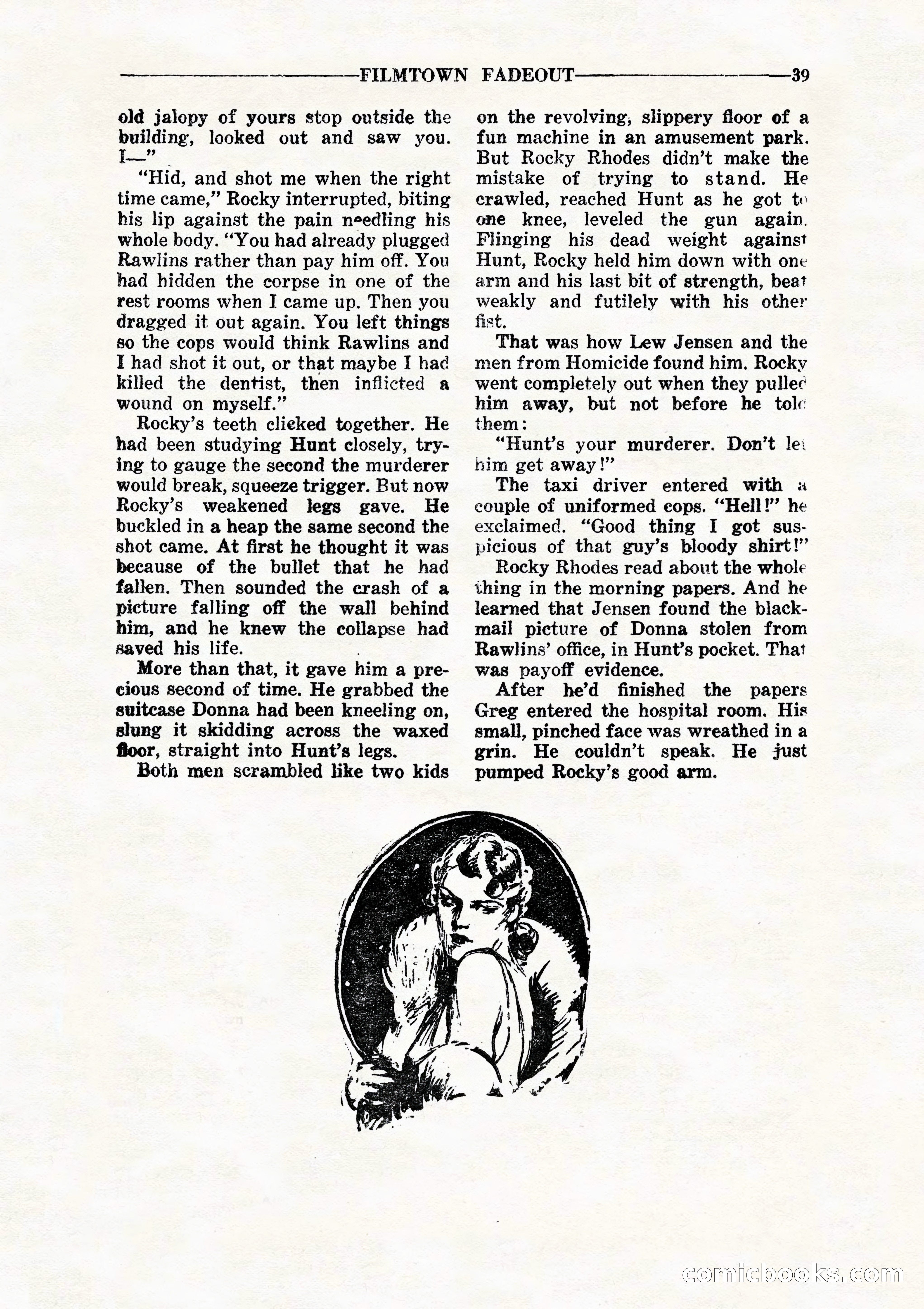
This is a text page from a pulp crime or detective fiction story titled "Filmtown Fadeout" (page 39). The prose describes a violent confrontation between characters named Rocky, Hunt, and Rawlins, involving gunfire and physical combat in what appears to be an amusement park setting. The narrative then shifts to police discovering the scene, with a detective named Lew Jensen and a character named Greg arriving at a hospital. A small illustration at the bottom shows a woman's portrait in profile. The text focuses on action, mystery, and crime-solving elements typical of hardboiled detective pulp fiction.

10 Story Detective, July 1942 — page 42 of 116
42 / 116
What you’re looking at · open this page on its own ↗

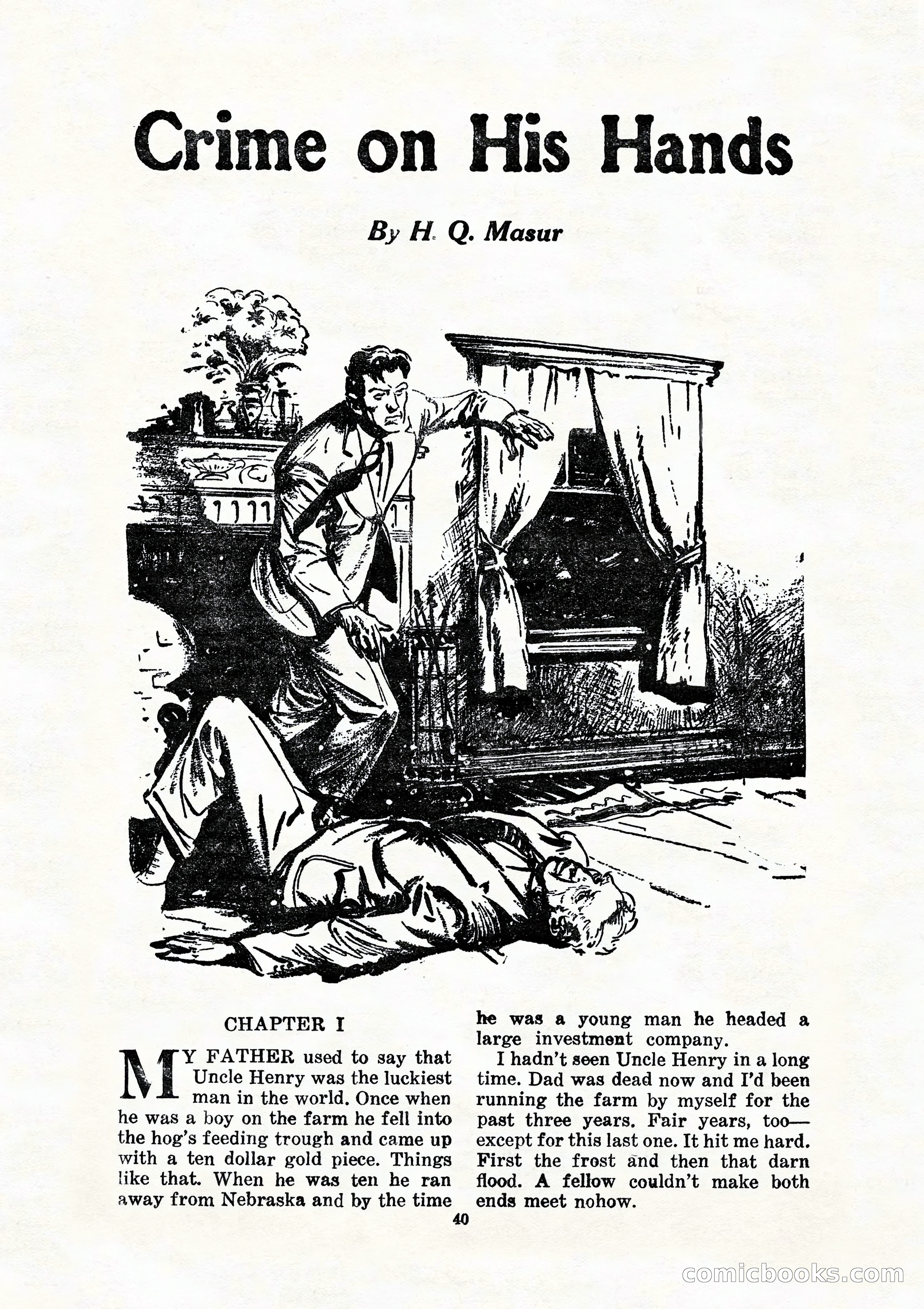
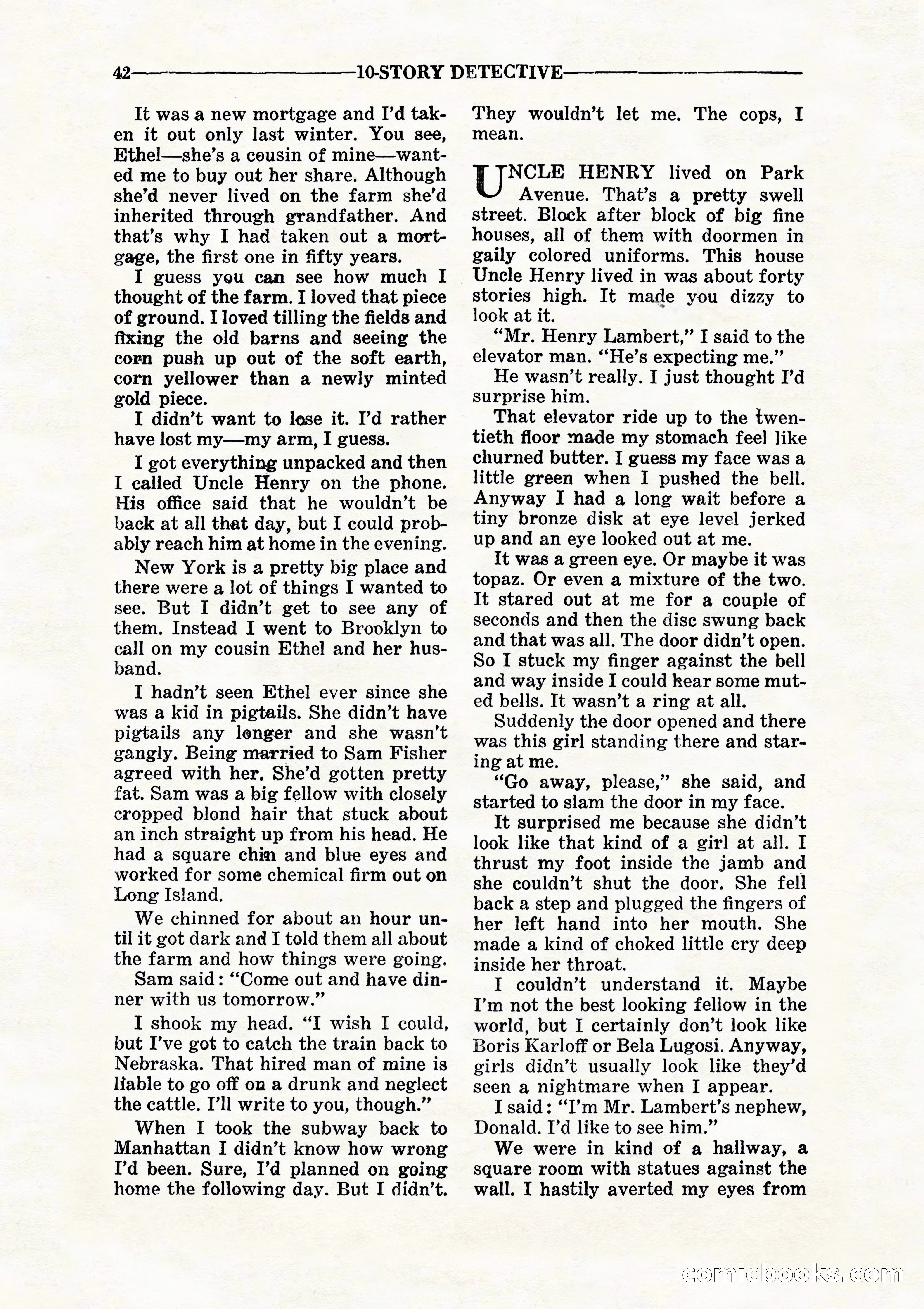
# Crime on His Hands - Page Analysis This is an interior story page from a pulp magazine, featuring Chapter 1 of "Crime on His Hands" by H.Q. Masur. The page includes a dramatic black-and-white illustration showing a man discovering what appears to be a dead body on the ground near a building entrance, with a woman visible in a doorway above. The prose text begins the narrator's story, explaining that his father claimed Uncle Henry was "the luckiest man in the world," recounting an anecdote about Henry finding a ten-dollar gold piece as a boy in Nebraska. The narrator mentions his own recent hardships—managing the family farm for three years through difficult weather—before the visible text cuts off at page 40.

10 Story Detective, July 1942 — page 43 of 116
43 / 116
What you’re looking at · open this page on its own ↗

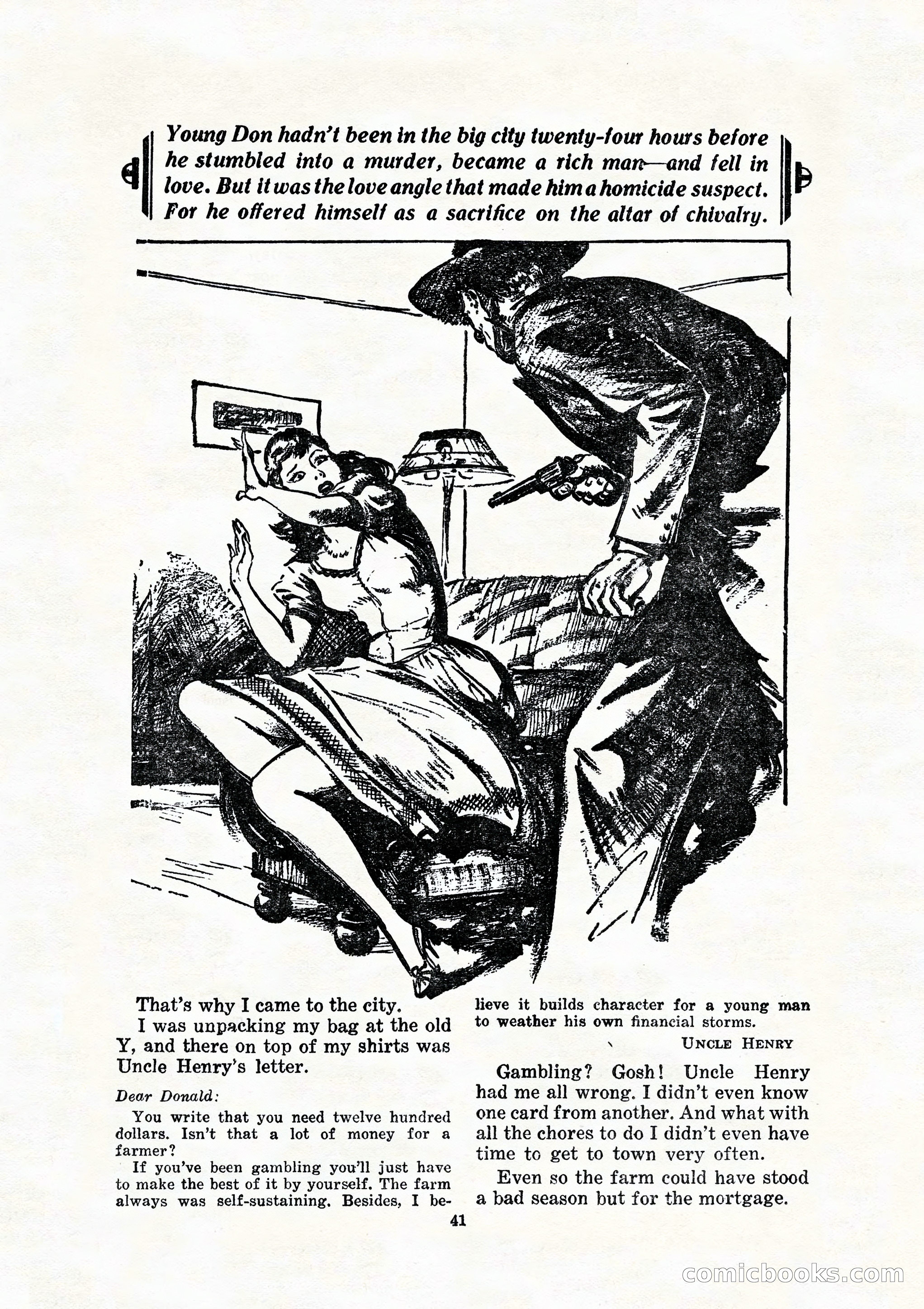
# Page Analysis This is a **story page with illustration** from an early-20th-century pulp magazine. The page contains an ink illustration showing a young man leaning over a woman reclining on a bed in what appears to be a hotel room, with dramatic noir-style shading. The visible text describes a character named Donald who came to the city and became involved in a murder, apparently motivated by love. Below the illustration is a letter from "Uncle Henry" advising Donald against gambling and suggesting the farm could have survived financial difficulties without a mortgage. The narrative concerns themes of ambition, temptation, and moral consequences in an urban setting.

10 Story Detective, July 1942 — page 44 of 116
44 / 116
What you’re looking at · open this page on its own ↗

# Page 42 of "10-Story Detective" This page contains story prose from what appears to be a hardboiled detective or crime narrative. The text describes a narrator's visit to New York City and Brooklyn to see relatives, including Uncle Henry who lives on Park Avenue in a forty-story building. The narrator encounters a girl at Uncle Henry's apartment who mysteriously prevents entry and appears distressed, making strange sounds. The passage maintains the first-person voice of a rural Midwesterner reflecting on farm life and family relationships while navigating an urban setting. The page is entirely text with no illustrations or advertisements visible.

10 Story Detective, July 1942 — page 45 of 116
45 / 116
What you’re looking at · open this page on its own ↗

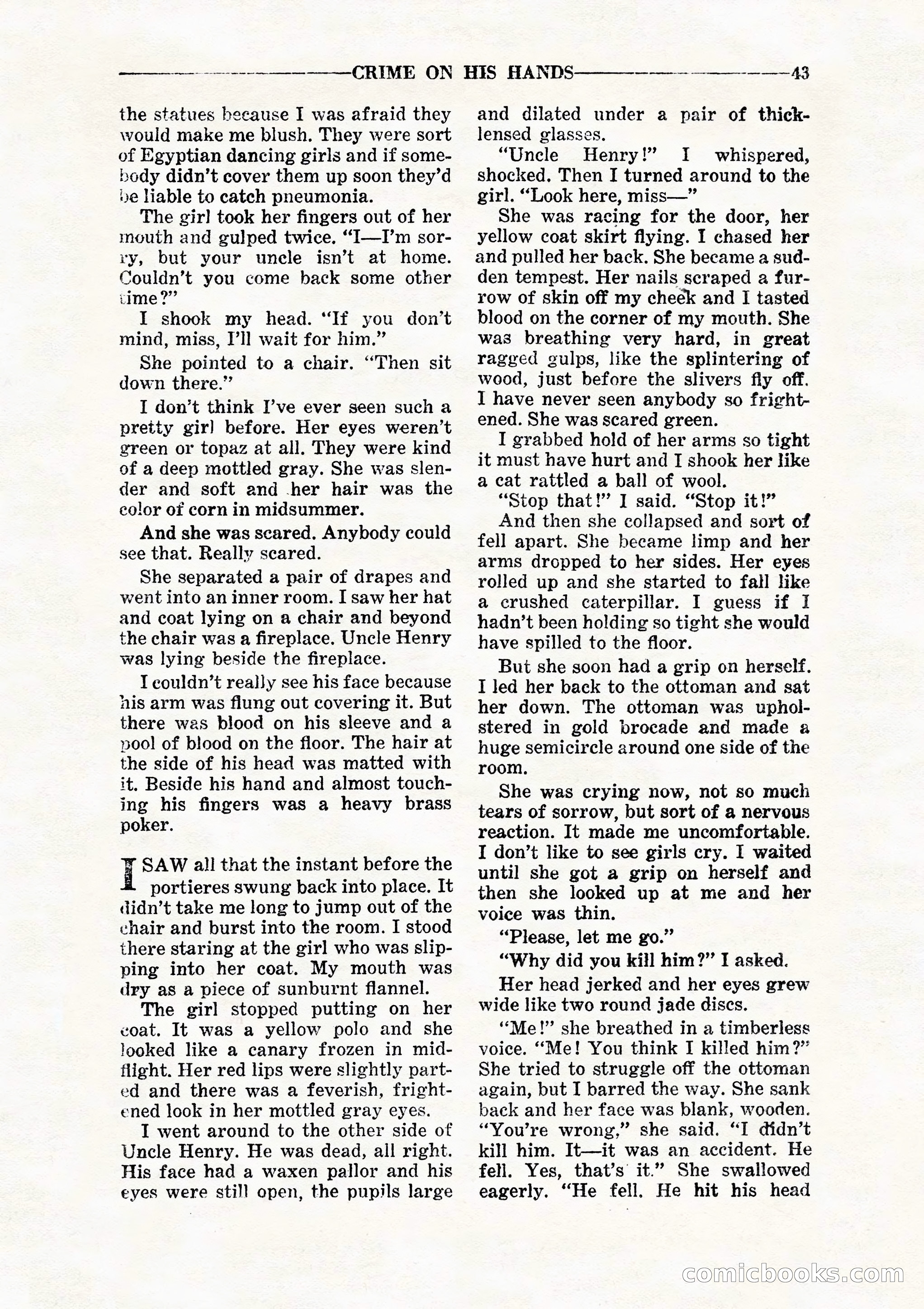
# Page 43: Story Prose from "Crime on His Hands" This is a text-only story page from a pulp crime fiction magazine. The narrative describes the narrator discovering his Uncle Henry dead by a fireplace, with blood visible on his head and hand. A frightened young woman in a yellow coat is also present; she becomes hysterical when questioned about the death, claiming it was an accident—that Uncle Henry fell and hit his head. The scene is tense and dramatic, focusing on the narrator's shock at finding the body and his interrogation of the distressed girl, who denies responsibility for the death.

10 Story Detective, July 1942 — page 46 of 116
46 / 116
What you’re looking at · open this page on its own ↗

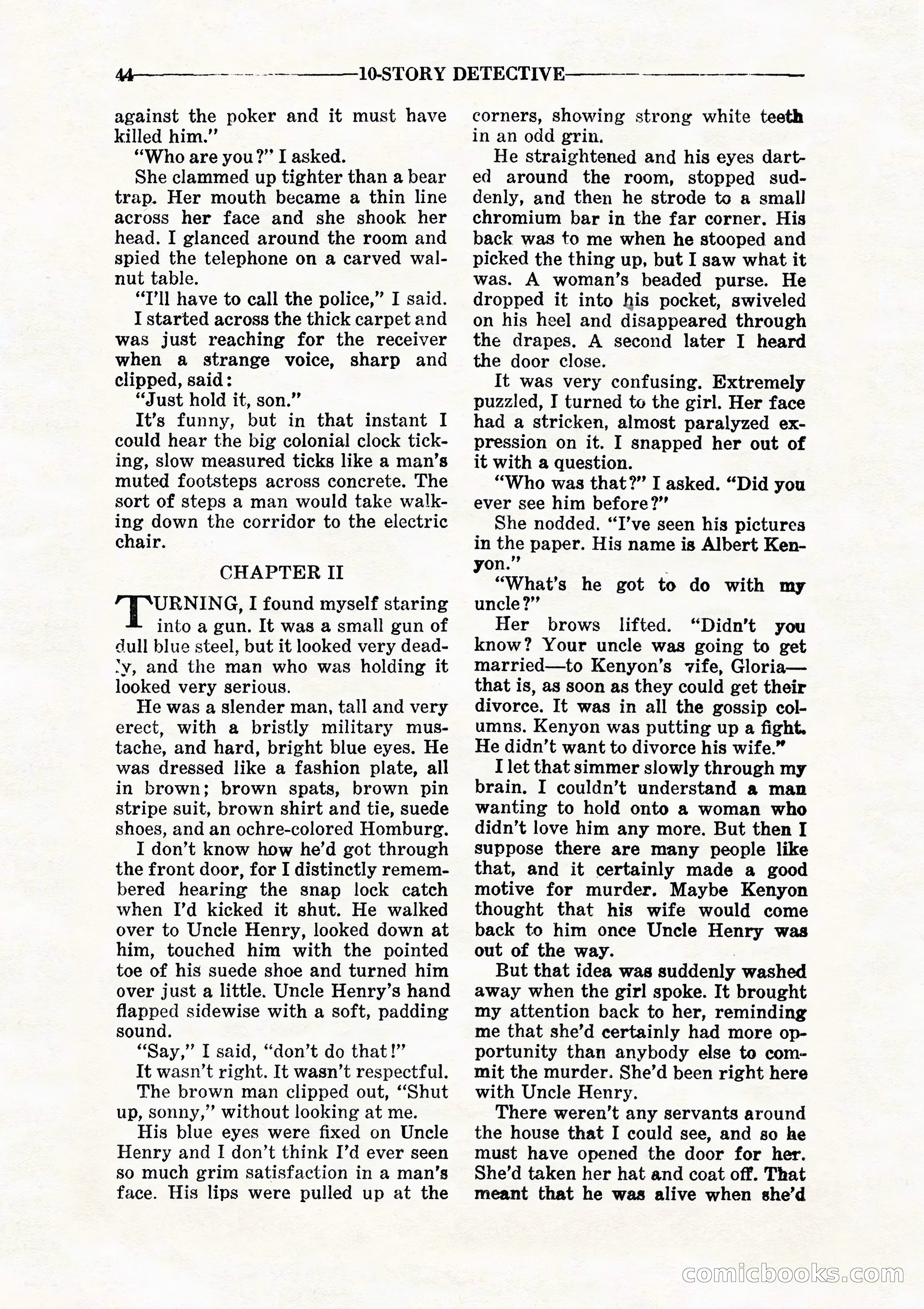
# Page 44 of "10-Story Detective" This page contains story prose from Chapter II of what appears to be a hardboiled crime narrative. The narrator describes confronting a man with a gun who has just taken a woman's beaded purse and disappeared through drapes. The narrator then questions a girl about the man's identity—she identifies him as Albert Kenyon, whose pictures she's seen in newspaper gossip columns. The girl reveals that Kenyon is the narrator's uncle, involved in divorce proceedings with his wife Gloria. The narrator reflects on Kenyon as a potential murder suspect, considering whether his wife might return to him now that "Uncle Henry was out of the way," before noting that the girl's presence at the house suggests she'd let Kenyon in—meaning he was still alive when she arrived.

10 Story Detective, July 1942 — page 47 of 116
47 / 116
What you’re looking at · open this page on its own ↗

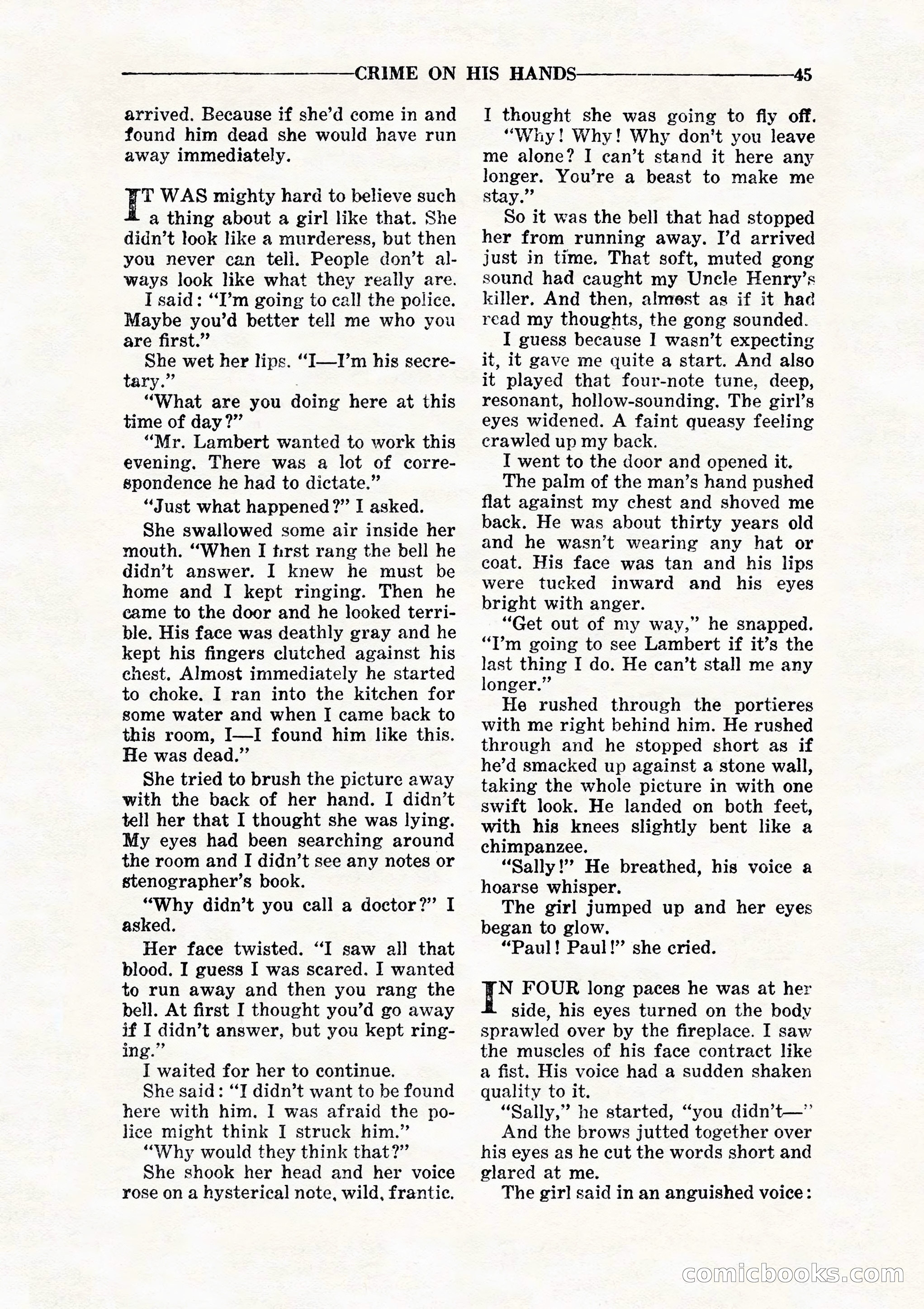
This page contains story prose from a pulp fiction magazine titled "Crime on His Hands." The narrative describes a tense domestic scene where a narrator discovers a dead body and becomes involved in a confrontation. A woman tries to conceal what happened, claiming she feared being blamed, while a man named Paul arrives and becomes angry upon learning details about the death. The dialogue and action focus on the characters' reactions to the body and their conflicting accounts of events. The text emphasizes emotional tension, physical descriptions, and dramatic dialogue typical of early-20th-century hardboiled crime fiction, though specific plot details about how the death occurred remain unclear from this excerpt alone.

10 Story Detective, July 1942 — page 48 of 116
48 / 116
What you’re looking at · open this page on its own ↗

# 10-Story Detective - Page 46 This page contains story prose from what appears to be a hardboiled crime narrative. The narrator, apparently a detective or investigator, describes being struck unconscious during a confrontation, then awakening to find police present at the scene. A fat detective questions him about finding a body (someone named Master Lambert) and the involvement of other characters named Sally and Paul. The narrator mentions discovering an envelope addressed to "Paul Benson, Parkview Apartments" from "Lambert Investmenta." The passage emphasizes physical violence, with the narrator recounting being hit hard enough to lose consciousness, and contains noir-style internal monologue and dialogue typical of pulp crime fiction.

10 Story Detective, July 1942 — page 49 of 116
49 / 116
What you’re looking at · open this page on its own ↗

# Page Analysis This is a text-only story page (page 47) from a pulp magazine titled "Crime on His Hands." The page contains prose narrative from Chapter III, featuring dialogue between a narrator and a detective named Hallock investigating the death of Uncle Henry. The narrator explains he came to New York after receiving a letter from his uncle requesting to borrow twelve hundred dollars, and reveals that Uncle Henry has been found dead. Hallock questions the narrator about his arrival and movements, while observing his reaction to learning of the inheritance. The passage emphasizes the narrator's shock and the tense interrogation scene developing between them.

10 Story Detective, July 1942 — page 50 of 116
50 / 116
What you’re looking at · open this page on its own ↗

# Page 48 from "10-Story Detective" This page contains story prose from what appears to be a hardboiled crime narrative. The narrator, Donald, is being interrogated by someone named Hallock about his involvement in a case involving Uncle Henry's death and a young woman. Hallock is threatening Donald with graphic descriptions of the death penalty—electrocution and burial—while Donald struggles to maintain his story about finding Kenyon in an apartment. The passage emphasizes Donald's fear and confusion as he tries to protect two people he barely knows while being accused of murder. The prose captures the psychological pressure of interrogation in classic pulp-fiction style.

10 Story Detective, July 1942 — page 51 of 116
51 / 116
What you’re looking at · open this page on its own ↗

# Page Analysis This is a text page (page 49) from a hardboiled crime pulp fiction story titled "Crime on His Hands." The page contains two distinct scenes of dialogue and narrative prose. In the first section, a character named Hallock interrogates Donald about a murder, pressuring him to confess and reveal the identity of a woman who left with "the blonde man." Donald insists he didn't kill his uncle and claims he found Uncle Henry already dead. The second section depicts a plainclothes detective physically attacking Donald, yanking him by the necktie and threatening violence to extract a confession. The passage emphasizes the detective's brutality and Donald's resistance, describing his physical responses to the assault. The narrative style is typical of hard-boiled crime fiction from the early-to-mid 20th century.

10 Story Detective, July 1942 — page 52 of 116
52 / 116
What you’re looking at · open this page on its own ↗

# Page 50: "10-Story Detective" This is a text-only page of prose fiction from what appears to be a hardboiled crime or detective pulp magazine. The narrative concerns a murder investigation involving a character named Sally Benson, who was present when a man named Lambert died. A detective (identified as Hallock) interrogates Sally about the death, asking whether she killed Lambert and what happened. Sally explains she found Lambert already dead on the floor, struck by a poker. The passage reveals tension between Sally and the narrator regarding her brother Paul's involvement in the incident, with Hallock pressing for truthful answers about Lambert's death.

10 Story Detective, July 1942 — page 53 of 116
53 / 116
What you’re looking at · open this page on its own ↗

# Page Description This is story prose from a pulp crime magazine, specifically page 51 of a work titled "Crime on His Hands." The visible text consists of two chapters: the conclusion of a previous chapter discussing a character's death and financial troubles, and the beginning of Chapter IV introducing a character named Ecija, described as a small brown man. The narrator recounts conversations with Uncle Henry's Filipino servant and follows him through the streets, eventually discovering that the Hotel Alverne is positioned against the back of Uncle Henry's house. The prose depicts a mystery narrative with apparent suspicion of foul play.

10 Story Detective, July 1942 — page 54 of 116
54 / 116
What you’re looking at · open this page on its own ↗

# "10-Story Detective" - Story Prose Page This is a text-only page from what appears to be a hardboiled crime detective pulp magazine. The page contains prose narrative from a story in which the narrator, Donald, visits a woman named Mrs. Kenyon to inform her of her uncle Henry's death. The narrator explains that Henry was killed by being hit over the head with a poker, and the police initially suspected the narrator but later cleared him. Mrs. Kenyon reacts with surprising coldness to the news, and the narrator confronts her about her purse and her husband's visit to the uncle's apartment, suspecting her involvement in the murder.

10 Story Detective, July 1942 — page 55 of 116
55 / 116
What you’re looking at · open this page on its own ↗

# Page Analysis This is a text-only page (page 53) from a hardboiled crime pulp story titled "Crime on His Hands." The page contains two columns of prose narrative describing a dramatic domestic and criminal situation. The narrator recounts a confrontation involving his involvement in retrieving a purse from an uncle's apartment, complications with a man named Albert Kenyon and his wife, and the narrator's growing realization that he has become entangled in a murder plot. The text discusses the narrator's emotional turmoil and his subsequent attempts to process the events by walking and attempting to sleep.

10 Story Detective, July 1942 — page 56 of 116
56 / 116
What you’re looking at · open this page on its own ↗

# Page Analysis: 10-Story Detective This is a text page from a pulp magazine containing story prose (no illustrations visible). The page shows a dramatic hardboiled crime narrative in which the narrator, lying in bed at night, witnesses an intruder enter their darkened room with a knife. After a violent struggle where the narrator barely escapes the attacker, a visitor named Sam Fisher arrives, disheveled and bruised from apparently being attacked himself on the stairs. Fisher recounts his own violent encounter with "some lunatic" who knocked him down multiple flights and continued attacking without explanation. The passage emphasizes suspenseful tension and physical danger throughout.

10 Story Detective, July 1942 — page 57 of 116
57 / 116
What you’re looking at · open this page on its own ↗

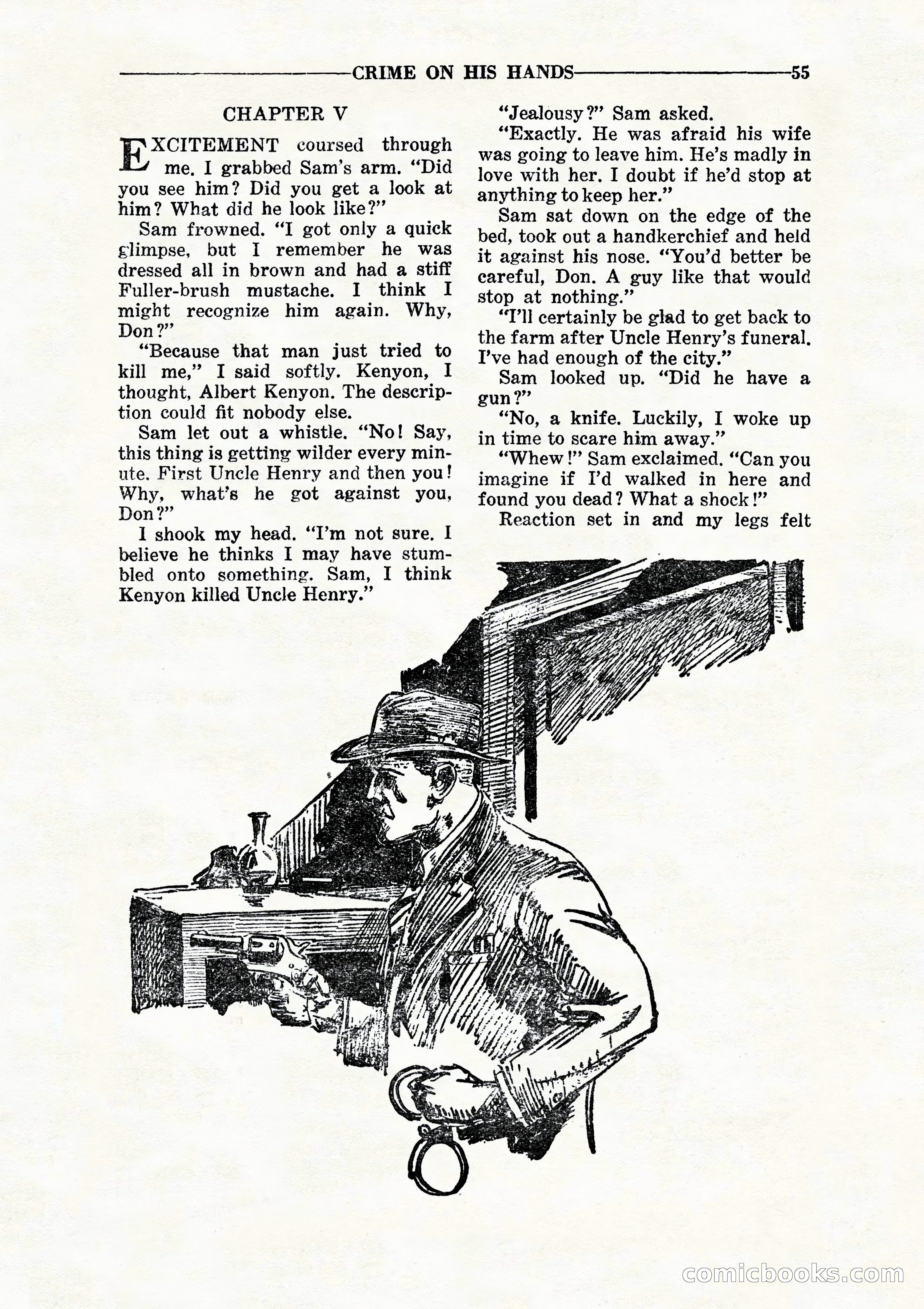
# Page 55 from "Crime on His Hands" This is a story page featuring prose narrative with an accompanying illustration. The text shows a dialogue between characters named Don and Sam, discussing a man with a "Fuller-brush mustache" who apparently tried to kill Don. The narrator suspects this man is Albert Kenyon and believes Kenyon may have killed Uncle Henry. Sam responds with alarm at the escalating danger and expresses relief at the prospect of leaving the city after a funeral. The illustration depicts a man in a hat and coat sitting at a desk or table, appearing to be in a tense or contemplative moment, consistent with the crime-drama narrative visible in the text.

10 Story Detective, July 1942 — page 58 of 116
58 / 116
What you’re looking at · open this page on its own ↗

# Page 56: Story Prose from "10-Story Detective" This page contains prose narrative from a detective story. The text depicts a narrator dealing with the aftermath of a murder investigation involving Uncle Henry's estate. The narrator discusses keeping the situation secret from Ethel (Uncle Henry's widow) for about a week before the estate is probated, then transitions to the arrival of Uncle Henry's lawyer and the reading of the will. The passage shows the narrator's interaction with various characters including Sam, Mr. Hallock, and a lawyer, with discussion of how the estate will be divided between Ethel and the narrator. The tone is characteristic of hardboiled crime fiction from the pulp era.

10 Story Detective, July 1942 — page 59 of 116
59 / 116
What you’re looking at · open this page on its own ↗

# Page Analysis This is story prose from a pulp crime fiction magazine, page 57 titled "Crime on His Hands." The narrative depicts a dramatic scene where Uncle Henry has collapsed, apparently poisoned. The narrator describes Henry's physical distress in vivid detail—convulsions, discoloration, difficulty breathing. Detective Hallock investigates while Mrs. Kenyon reveals Henry had been using saccharin instead of sugar. The narrator theorizes Henry was poisoned, possibly by thallium or digitalis, with the poison administered through the saccharin tablets. The passage concludes with dialogue suggesting Mrs. Kenyon may have committed the murder to prevent Henry from inheriting money and marrying her, thereby securing the family's financial future.

10 Story Detective, July 1942 — page 60 of 116
60 / 116
What you’re looking at · open this page on its own ↗

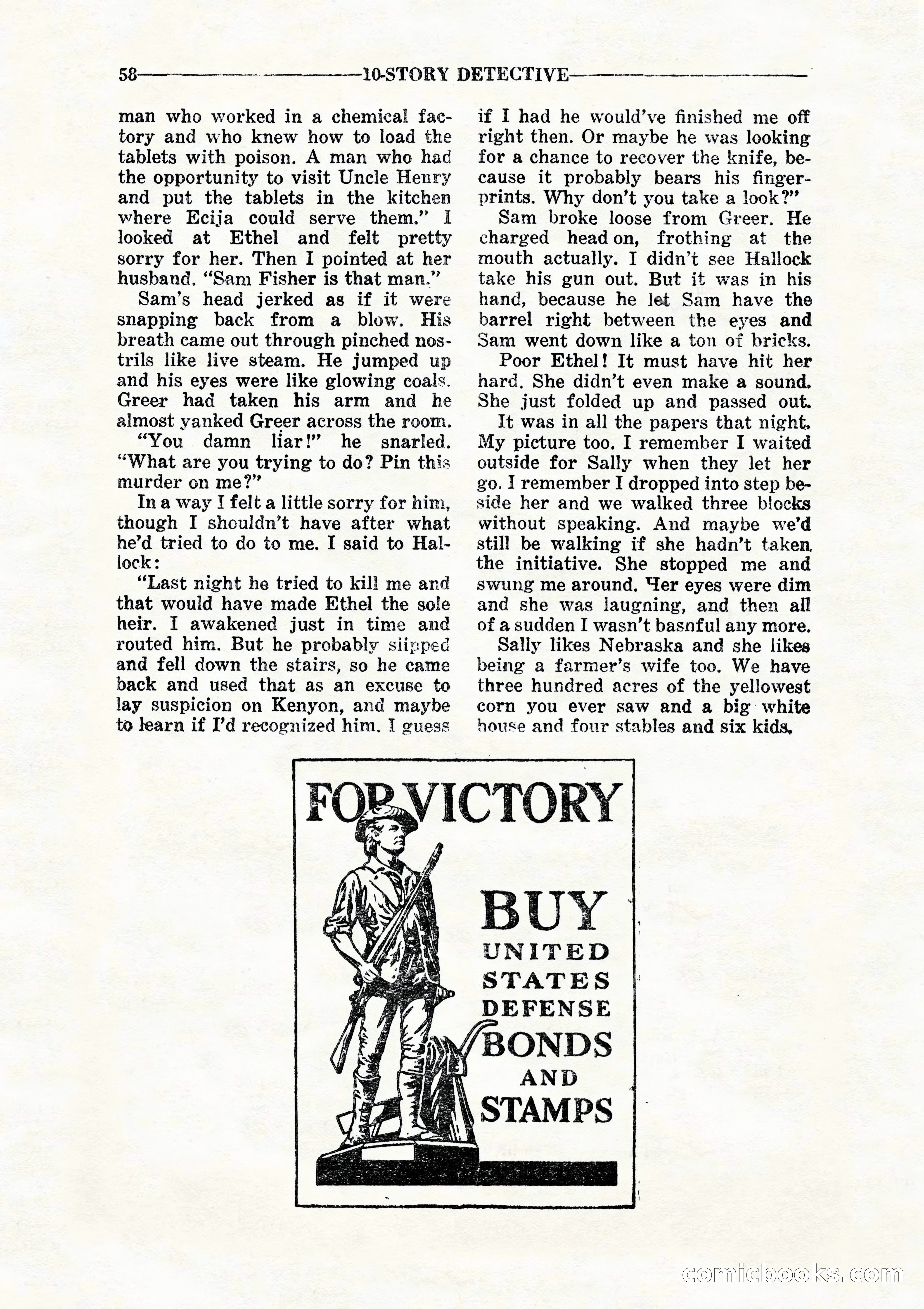
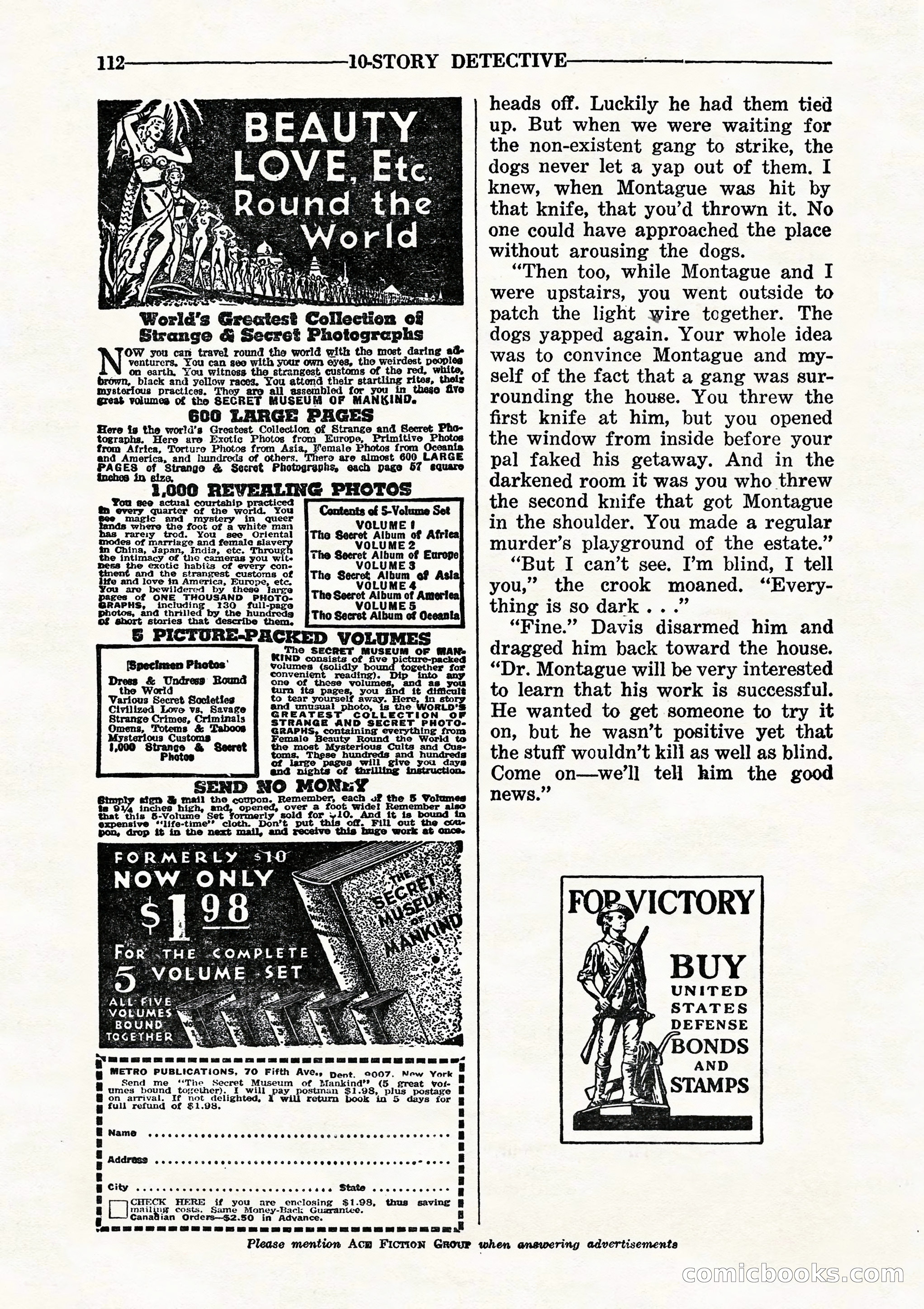
# Page Description This is a **story page** (interior text) from a hardboiled detective pulp magazine. The visible text recounts a violent confrontation where the narrator describes how someone named Sam Fisher attempted to murder them with poison tablets, and how Hallock shot and killed Sam in self-defense. The passage details the aftermath—Ethel (presumably Sam's wife) fainting upon witnessing the shooting, and the narrator later walking with a character named Sally, who is described as a farmer's wife in Nebraska. At the bottom of the page is a **vintage war-bond advertisement** featuring a soldier and encouraging readers to "Buy United States Defense Bonds and Stamps."

10 Story Detective, July 1942 — page 61 of 116
61 / 116
What you’re looking at · open this page on its own ↗

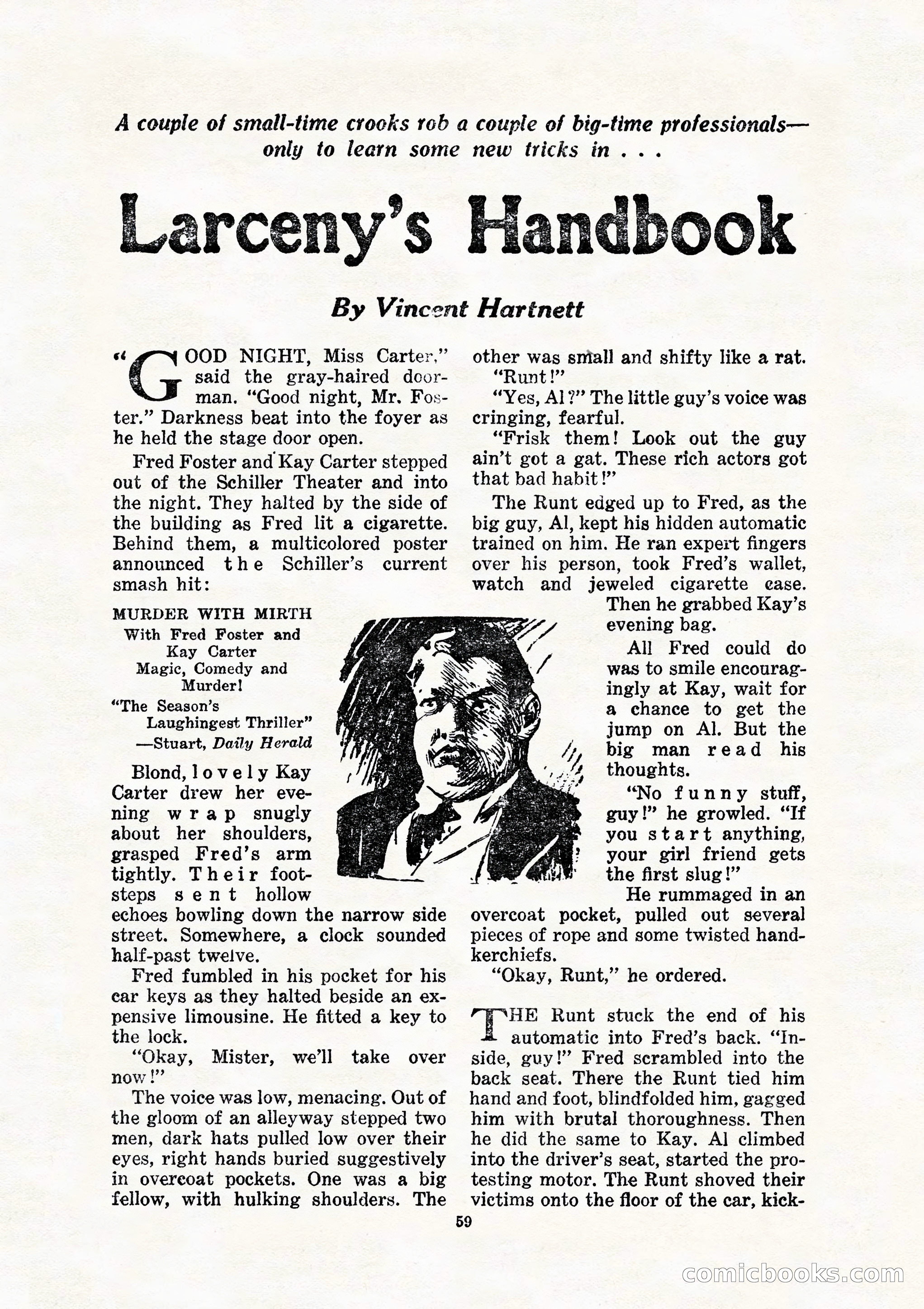
# Page 59: Story Text with Illustration This is an interior story page from a pulp magazine featuring "Larceny's Handbook" by Vincent Hartnett. The page contains prose narrative accompanied by a black-and-white illustration of a man's face in the upper right. The story depicts a crime scenario: two small-time crooks rob Fred Foster and Kay Carter, wealthy theater patrons leaving the Schiller Theater. One criminal, called "the Runt," is small and rat-like; his partner is larger. The Runt uses an automatic pistol to force Fred and Kay into a limousine, where he ties and gags them before driving away. The narrative suggests this is part of a larger scheme these criminals have devised.

10 Story Detective, July 1942 — page 62 of 116
62 / 116
What you’re looking at · open this page on its own ↗

This page contains story prose from "10-Story Detective," a pulp magazine. The text describes a kidnapping scene in which Fred and Kay have been forced from a car by criminals called "the Runt" and his associates. They are taken to what appears to be an abandoned house—apparently the former residence of someone named Charlie Grimm. The Runt threatens them with violence, and Fred learns the house is notoriously haunted, with local legend claiming Charlie Grimm's ghost haunts it nightly, wielding a bloody knife and chasing an apparition. The narrative builds suspense through descriptions of the eerie location and ominous supernatural claims surrounding the property.

10 Story Detective, July 1942 — page 63 of 116
63 / 116
What you’re looking at · open this page on its own ↗

# Page 61 of Larceny's Handbook This page contains story prose with no illustrations. It depicts a tense scene in which criminals—Al, Fred, Kay, and Charlie—are hiding in a room with stolen goods when they hear mysterious, threatening noises from above (described as "scraping" and "shuffling"). An elderly woman's voice appears to be present in the room as well, and the situation escalates when a man screams in "awful agony." Fred insists they cannot shoot at what appears to be a supernatural entity, and the group attempts to escape before the threatening presence reaches them. The narrative builds suspense through dialogue and atmospheric description.

10 Story Detective, July 1942 — page 64 of 116
64 / 116
What you’re looking at · open this page on its own ↗

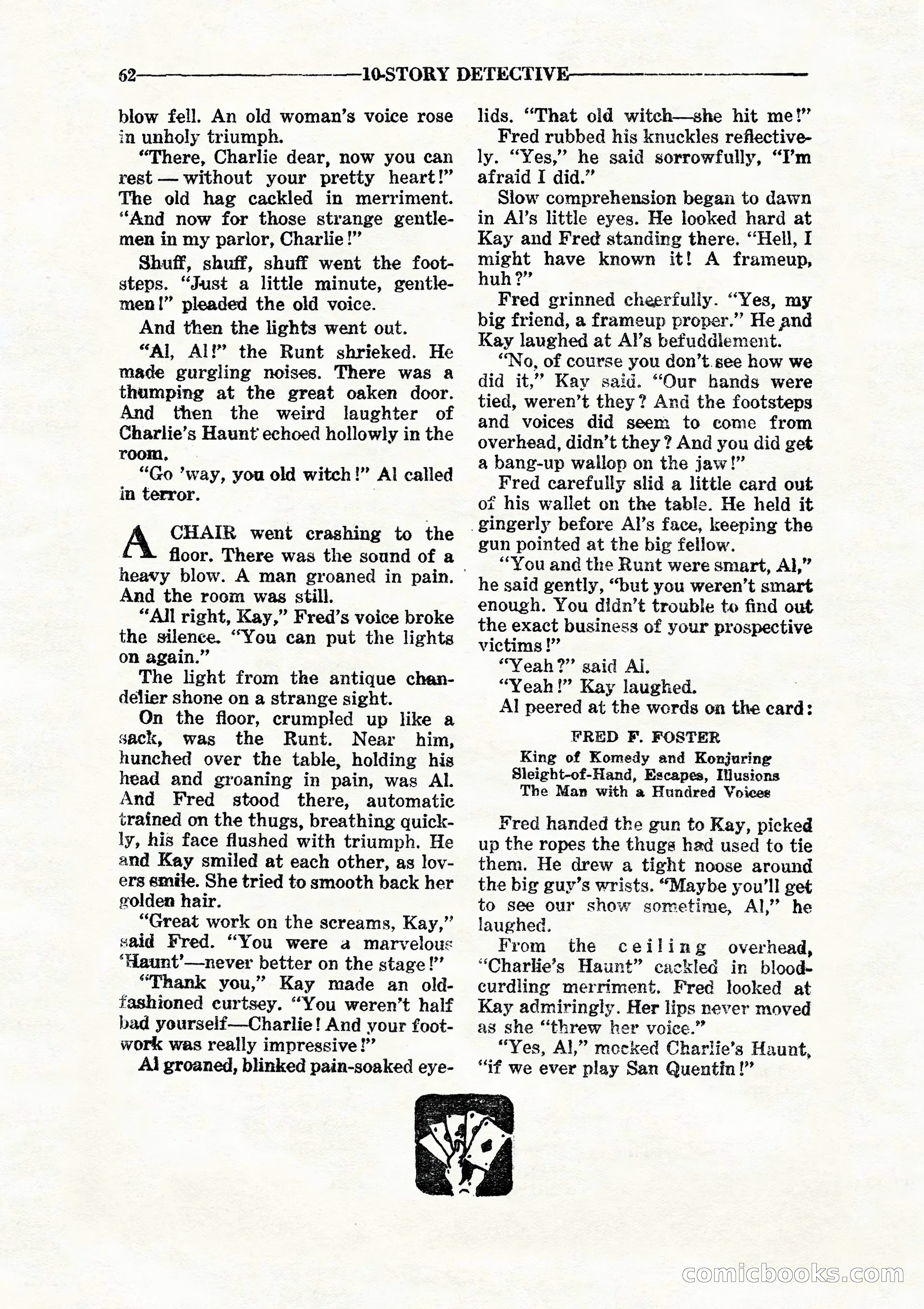
# Page 62: "10-Story Detective" — Story Prose This page contains story prose from what appears to be a mystery or crime story. The narrative describes a dramatic scene where characters named Fred, Kay, and Al have seemingly orchestrated an elaborate scheme involving screams, footsteps, and voices to trick someone. Fred reveals a business card identifying "Fred F. Foster" as "King of Komedy and Konjuring" with various theatrical acts listed. The passage culminates with Fred handing Kay a gun and a noose, joking about seeing "our show sometime, Al," while "Charlie's Haunt" cackles overhead. The tone suggests a suspenseful or darkly comedic climax involving deception and potential danger.

10 Story Detective, July 1942 — page 65 of 116
65 / 116
What you’re looking at · open this page on its own ↗

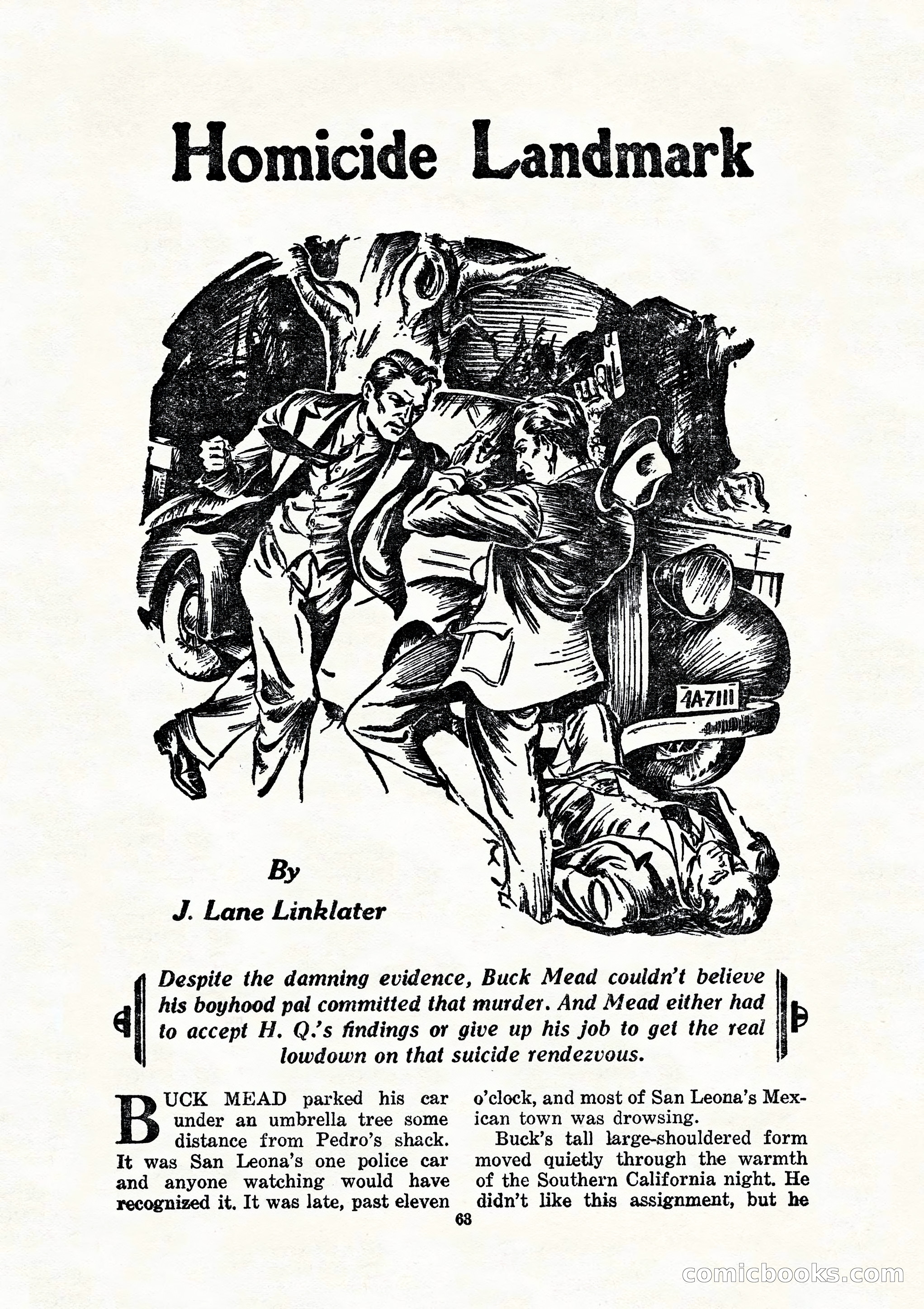
This is an interior story page from a pulp magazine featuring a hardboiled crime story titled "Homicide Landmark" by J. Lane Linklater. The page includes a dramatic black-and-white illustration showing what appears to be a violent confrontation between men near automobiles. The visible prose describes Buck Mead, a police officer, who parks his car near Pedro's shack in San Leona late at night. The text indicates Mead struggles to believe his childhood friend committed murder and faces pressure regarding an H.Q. investigation and a suspicious suicide. This appears to be page 63 of the magazine.

10 Story Detective, July 1942 — page 66 of 116
66 / 116
What you’re looking at · open this page on its own ↗

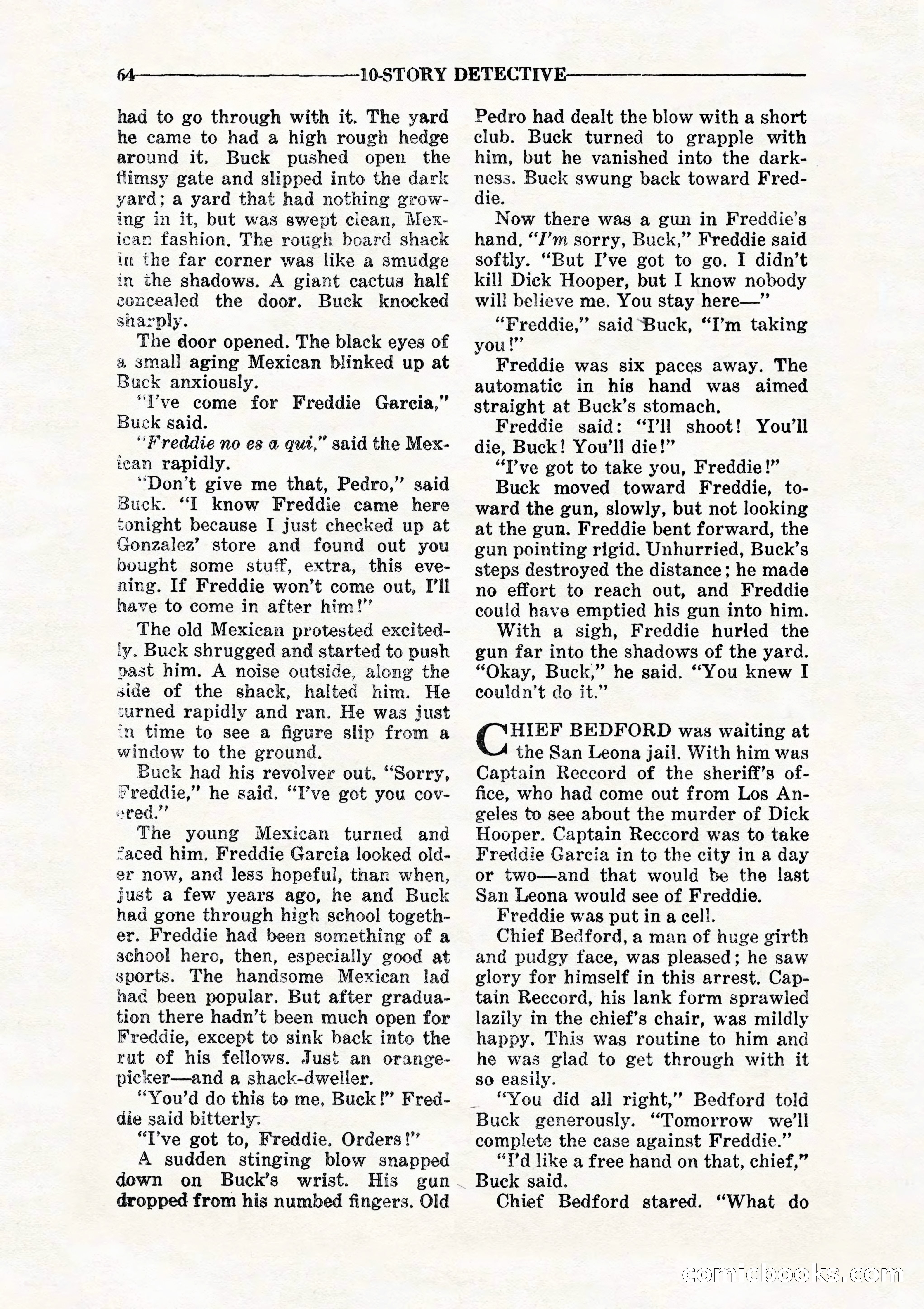
# Page Analysis This is a text-only page from a pulp detective story titled "10-STORY DETECTIVE." The narrative follows a confrontation between two characters named Buck and Freddie Garcia in what appears to be a Mexican setting. Buck has come to arrest Freddie for a murder, but during their tense encounter, Freddie disarms Buck and throws his gun into the shadows. The scene then shifts to Chief Bedford at the San Leona jail, who is pleased about Freddie's arrest and expects to easily close the case against him. The text describes their dialogue and the detective work surrounding what appears to be a murder investigation.

10 Story Detective, July 1942 — page 67 of 116
67 / 116
What you’re looking at · open this page on its own ↗

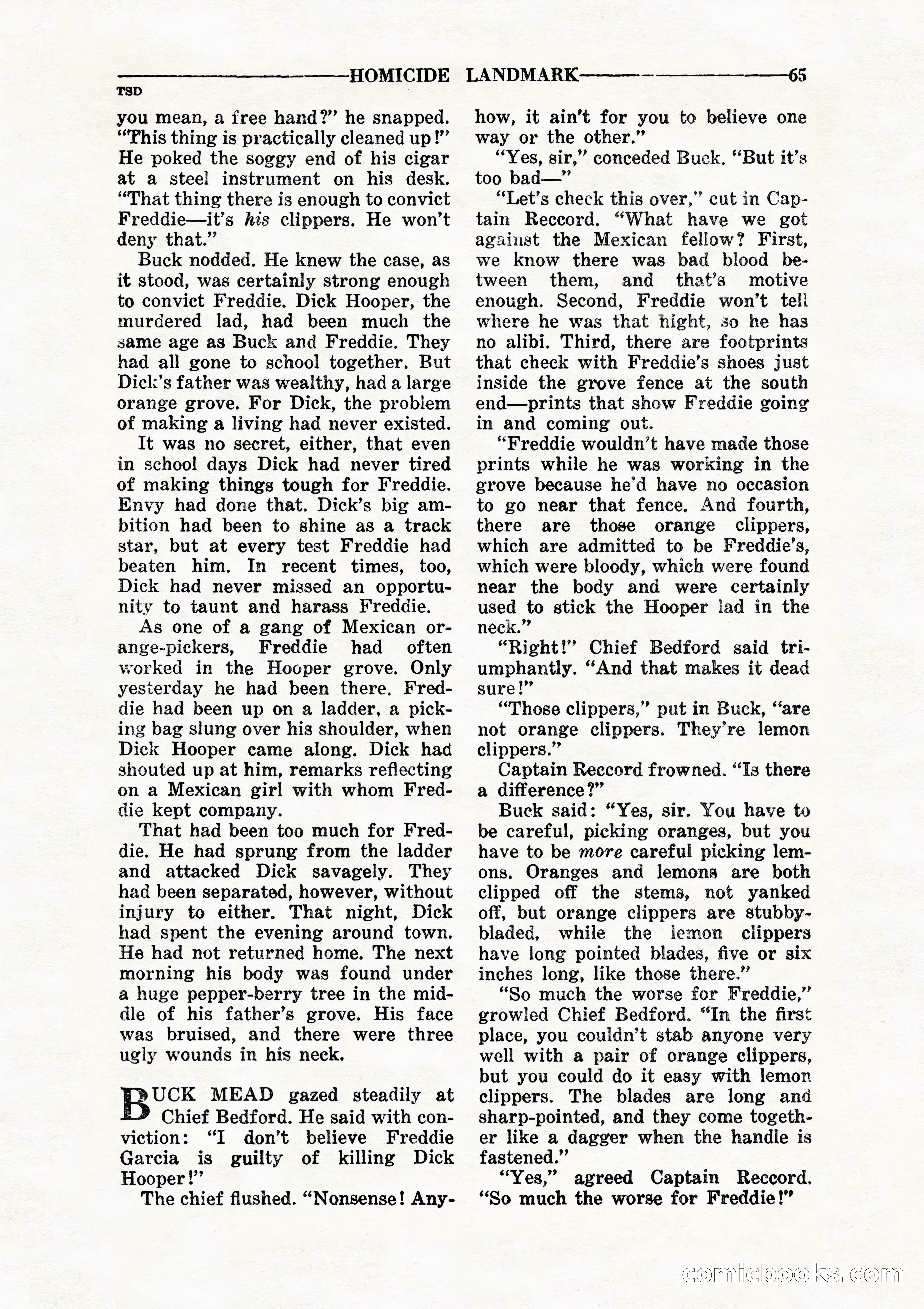
# Page Analysis This is a page of story prose from a pulp magazine titled "HOMICIDE LANDMARK" (page 65). The text describes a murder investigation into the death of Dick Hooper, a young man found dead in a grove with neck wounds. Buck Mead, apparently a law enforcement officer, declares that Freddie Garcia is guilty of the killing. Captain Record and Chief Bedford discuss evidence including footprints, bloody clippers, and the weapon's characteristics—specifically debating whether orange or lemon clippers were used in the crime. The dialogue suggests the investigators are building a case against Freddie based on circumstantial evidence and the weapon's distinctive nature.

10 Story Detective, July 1942 — page 68 of 116
68 / 116
What you’re looking at · open this page on its own ↗

# Page Analysis This is a text-only page of prose fiction from a pulp magazine titled "10-STORY DETECTIVE" (visible in the header). The page contains dialogue and narrative describing a detective investigation into a murder case involving characters named Buck, Freddie, Dick Hooper, and Mary Heath. Buck has apparently resigned from the police force following suspicion that Freddie Garcia killed Dick Hooper. The narrative follows Buck as he visits a pool hall to interview the proprietor, Stokey Heaton, about Dick's movements the night before his death. The page advances the mystery plot through conversation and Buck's investigative efforts.

10 Story Detective, July 1942 — page 69 of 116
69 / 116
What you’re looking at · open this page on its own ↗

# Page Analysis This page contains story prose from what appears to be a hardboiled crime or detective fiction story titled "Homicide Landmark" (visible in the header). The text depicts a scene where a detective named Buck questions Joe about conversations with Dick Hooper regarding a death. Buck then drives to the Hooper orange grove, where he encounters Sam Hooper and learns that Dick Hooper's body was found beneath a distinctive pepper-berry tree. Hooper dismisses Buck's investigation, insisting a man named Garcia is guilty. The narrative focuses on dialogue and character interactions within a murder investigation plot, with no visible illustrations on this text-only page.

10 Story Detective, July 1942 — page 70 of 116
70 / 116
What you’re looking at · open this page on its own ↗

# Page Analysis This is **story prose** from a pulp fiction magazine titled "10-STORY DETECTIVE" (visible in the header). The page contains dialogue-heavy narrative about a crime investigation. A character named Buck is questioning Freddie about the death of someone named Dick, who was found dead with injuries to his neck. Freddie admits to beating Dick in a grove but claims he left him alive. Buck presses Freddie for details about why Dick intended to meet someone at that location and who he expected to encounter there. The conversation suggests this is a hardboiled crime story involving violence and murder investigation.

10 Story Detective, July 1942 — page 71 of 116
71 / 116
What you’re looking at · open this page on its own ↗

# Page 69 of "Homicide Landmark" This page contains story prose from what appears to be a hardboiled crime story. Buck confronts old man Sam Hooper at his property, discovering a hidden wall safe containing currency that is short three thousand dollars. Hooper reveals the safe was opened only once in three weeks—the night before the murder. Buck theorizes that money might be a motive for the killing, though Hooper insists only he knew the combination and never wrote it down. When Hooper mentions an unexpected late-night visit from someone named Dobbs, Buck's suspicions intensify, suspecting this timing may connect to the crime.

10 Story Detective, July 1942 — page 72 of 116
72 / 116
What you’re looking at · open this page on its own ↗

This page contains story prose from "10-Story Detective," a pulp crime magazine. The text depicts a confrontation between Detective Buck and a man named Hooper, whom Buck suspects of involvement in a robbery. Buck has entered Hooper's home and discovered an open safe, leading to accusations that Hooper broke in through a window and stole money. Hooper denies the charge, claiming he came through the front door. The narrative continues with Buck calling a pool hall to verify Hooper's alibi, and includes dialogue revealing tensions between the two men regarding a woman named Garcia and apparent involvement in illegal gambling activities.

10 Story Detective, July 1942 — page 73 of 116
73 / 116
What you’re looking at · open this page on its own ↗

# Page Analysis This is story prose from a pulp fiction magazine, specifically page 71 titled "HOMICIDE LANDMARK." The text depicts a criminal scheme involving characters named Buck, Mary, and Joe Cowper. Buck instructs Mary to befriend Joe when he arrives that evening, claiming he wants to take her away. Buck's actual plan involves meeting Chief Bedford and Captain Record at a nearby orange grove after midnight to discuss something related to Joe. The passage shows Buck manipulating Mary into helping him, though she expresses reluctance about the deceptive scheme. The narrative appears to be a hardboiled crime story.

10 Story Detective, July 1942 — page 74 of 116
74 / 116
What you’re looking at · open this page on its own ↗

This is a page of story prose from a hardboiled crime pulp magazine titled "10-Story Detective." The text describes a tense nighttime confrontation in a grove where detectives Buck and Captain Record are conducting a stakeout. They observe suspicious figures, including a man on his knees, and witness a brief gunfight. Buck reveals that the individuals involved are Will Dobbs, Stokey Heaton, and Joe Cowper, and explains a theory connecting them to a murder—suggesting Joe Cowper killed Dick Hooper over a gambling debt that Hooper owed Heaton. The narrative emphasizes the detectives' careful surveillance and tactical approach to the situation.

10 Story Detective, July 1942 — page 75 of 116
75 / 116
What you’re looking at · open this page on its own ↗

# Page Description This is a story prose page from a hardboiled crime pulp magazine titled "Homicide Landmark" (page 73). The text describes a criminal scheme involving characters named Dick, Joe, Dobbs, and Heaton, centering on stolen money hidden near a pepper-berry tree. Captain Record and Bedford discuss Joe's involvement in the crime and the likelihood he'll retrieve the hidden cash. The page includes a black-and-white illustration of a man's face in profile wearing what appears to be a hat or head covering. The narrative focuses on detective work and criminal planning typical of early pulp crime fiction.

10 Story Detective, July 1942 — page 76 of 116
76 / 116
What you’re looking at · open this page on its own ↗

# Page Analysis This is a text-only page (page 74) from a hardboiled crime pulp fiction story titled "10-Story Detective." The page contains dialogue-heavy prose depicting an interrogation scene where characters Buck, Joe Cowper, Chief Bedford, and Captain Reccord discuss the murder of someone named Dick. Joe appears to be a suspect, and Buck is challenging his account of events—specifically, whether Joe was present when Dick was killed. The tension escalates when Mary arrives, and Buck escorts her away. The page ends with Buck and Mary having a casual conversation about orange blossoms while walking together, suggesting the immediate crisis has passed.

10 Story Detective, July 1942 — page 77 of 116
77 / 116
What you’re looking at · open this page on its own ↗

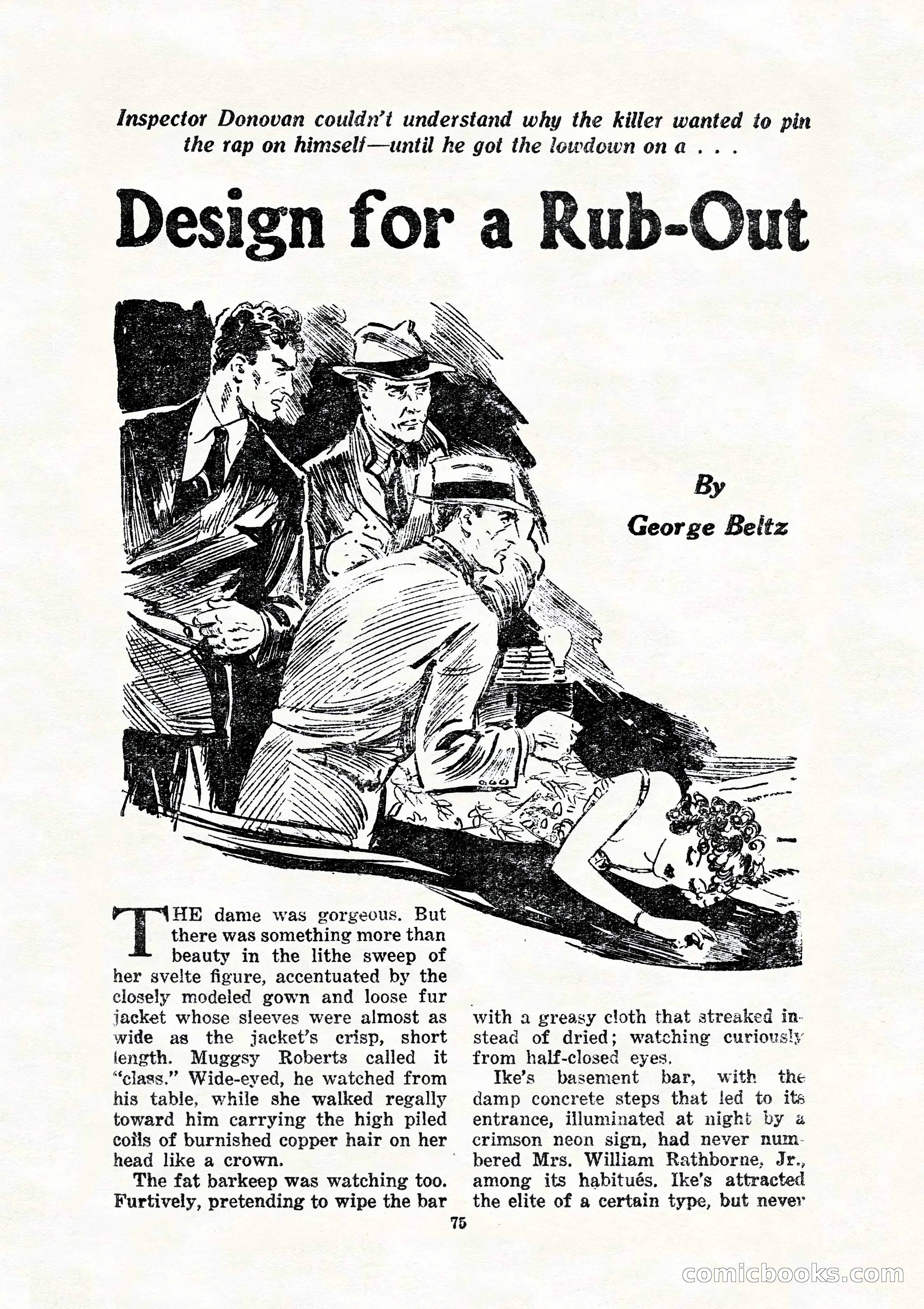
# Page Analysis This is a story page from a pulp magazine featuring a black-and-white illustration and prose text. The story is titled "Design for a Rub-Out" by George Beltz. The illustration shows what appears to be Inspector Donovan with other figures in what looks like a crime scene or basement setting. The visible prose describes a woman of striking appearance entering what is identified as Ike's basement bar, with details about her elegant clothing and the barkeeper's observations of her. The narrative suggests a hardboiled crime fiction story, likely involving murder or criminal activity, as indicated by the title's reference to a "rub-out."

10 Story Detective, July 1942 — page 78 of 116
78 / 116
What you’re looking at · open this page on its own ↗

# Page 76: "10-Story Detective" Story Prose This page contains two columns of text-only story prose (no illustrations). The narrative depicts a scene in a bar where a woman named Vivian Rathborne meets with a man called Muggsy Roberts. Vivian proposes that Muggsy commit a murder in exchange for money, offering him $1,000. She provides detailed instructions for the crime: he must drive to a specific address at 9 PM, retrieve a gun from inside the house, and shoot a woman silhouetted in a second-floor window. The text emphasizes the transactional, morally murky nature of their arrangement.

10 Story Detective, July 1942 — page 79 of 116
79 / 116
What you’re looking at · open this page on its own ↗

# Page Content Description This page contains story prose from a pulp fiction narrative titled "Design for a Rub-Out" (page 77). The text describes a scene in which a character named Muggsy Roberts receives threatening instructions from a woman about breaking into the Rathborne home. The passage details Muggsy's reconnaissance of the mansion—walking across the lawn, entering through an unlocked rear door, and moving cautiously through the darkened interior while listening for sounds. The prose suggests this is a crime or noir story involving burglary or a similar criminal act. No illustrations are visible on this page—it is entirely text-based narrative prose.

10 Story Detective, July 1942 — page 80 of 116
80 / 116
What you’re looking at · open this page on its own ↗

# Page Content Analysis This page contains story prose from a pulp detective fiction magazine titled "10-STORY DETECTIVE" (visible in the header). The text describes a murder investigation following the shooting death of Vivian Rathborne. Inspector Donovan of the homicide division interrogates William Rathborne, the victim's young husband, about a kidnapping of the couple's son Ronnie that occurred a week prior. The narrative establishes that the kidnapping followed specific instructions and resulted in a ransom payment, with police involvement deliberately avoided due to threats against the child's life. The page contains no illustrations, only typeset fiction prose in a two-column format.

10 Story Detective, July 1942 — page 81 of 116
81 / 116
What you’re looking at · open this page on its own ↗

# Page 79: "Design for a Rub-Out" This is a text-only story page from a hardboiled crime pulp magazine. The narrative concerns a kidnapping scheme involving a $50,000 ransom paid through the mail. The protagonist, William Rathborne, describes how instructions were burned after reading and how he retrieved the kidnapped boy. The story then shifts to Inspector Donovan receiving a call revealing the boy's killer has been caught—a man named Muggsy Roberts who apparently turned himself in. The page details the investigators' suspicions about Muggsy's involvement and the ballistic evidence linking his gun to the victim. The narrative explores whether Muggsy's surrender was genuine or strategically motivated.

10 Story Detective, July 1942 — page 82 of 116
82 / 116
What you’re looking at · open this page on its own ↗

# 10-Story Detective This page contains story prose from what appears to be a detective fiction narrative. Inspector Donovan investigates the death of a woman named Mrs. Rathborne, examining a gun found in the house and reviewing her will. The text describes Donovan's subsequent activities: checking the victim's bank account (which contains no personal account for Mr. Rathborne), visiting the Rathborne home, and questioning household staff about a boy named Ronnie. The narrative focuses on Donovan's investigative methods and the clues he uncovers regarding the circumstances surrounding Mrs. Rathborne's death and the family's financial situation.

10 Story Detective, July 1942 — page 83 of 116
83 / 116
What you’re looking at · open this page on its own ↗

This is a page of story prose from a pulp fiction magazine, numbered 81 and titled "Design for a Rub-Out." The narrative depicts a conversation between William Rathborne and a character named Donovan, who appears to be explaining a criminal scheme. Donovan discusses a man called Muggsy Roberts, described as a murderer hired by Rathborne's wife to commit a killing. The plot involves a kidnapped boy and a ransom situation, with Donovan outlining how police involvement might help recover the child while avoiding direct criminal involvement. The text is dense dialogue and exposition typical of hardboiled crime fiction from early pulp magazines.

10 Story Detective, July 1942 — page 84 of 116
84 / 116
What you’re looking at · open this page on its own ↗

# Page 82 of "10-Story Detective" This is a text-only story page from the pulp magazine *10-Story Detective*. The page contains prose dialogue and narration from what appears to be a hardboiled crime story. The visible text depicts an interrogation scene in which Detective Inspector Rathborne confronts a man named Donovan about a kidnapping case involving a boy and ransom money. Donovan attempts to explain his involvement, while Rathborne systematically refutes his claims, suggesting Donovan orchestrated the crime to gain access to his wife's wealth. The dialogue explores conflicting accounts of events and Rathborne's deductions about Donovan's motives and guilt.

10 Story Detective, July 1942 — page 85 of 116
85 / 116
What you’re looking at · open this page on its own ↗

# Page Analysis: "Design for a Rub-Out" This is a **story prose page** (page 83) from a hardboiled crime pulp magazine. The text depicts a confrontation between two men—apparently Donovan and Rathborne—discussing criminal activity related to a kidnapping and extortion scheme. Rathborne threatens to expose Donovan's involvement to authorities and demands a confession before a stenographer and police official. The illustration below shows several men in formal attire gathered around a table with a large spider web backdrop, suggesting intrigue or entrapment. The page depicts classic pulp crime fiction themes: blackmail, corruption, and threats of legal exposure.

10 Story Detective, July 1942 — page 86 of 116
86 / 116
What you’re looking at · open this page on its own ↗

# Satan's Scandal Sheet This is an interior story page from a pulp magazine, featuring a black-and-white illustration at the top and prose text below. The story is titled "Satan's Scandal Sheet" by Russell Gray. The illustration depicts what appears to be a dramatic scene with multiple figures in an interior setting. The visible text describes Lieutenant Durkee arriving in Miami for a holiday, only to become caught up in criminal activity involving gamblers' guns. The opening paragraph establishes the scene with the narrator sitting against a coconut palm when a fur-bearing animal approaches, addressing the narrator as "Lieutenant Durkee." The page number shown is 84.

10 Story Detective, July 1942 — page 87 of 116
87 / 116
What you’re looking at · open this page on its own ↗

This page contains story prose from what appears to be a hardboiled crime or adventure pulp magazine titled "Satan's Scandal Sheet" (visible in the header). The text depicts a conversation between the narrator and a man named Mark Gregg, whom the narrator encounters at a beach near horse-racing tracks in Miami. Their discussion centers on dog-track betting and a gambling system involving "quiniellas" and "Daily Doubles"—wagers that apparently offer poor odds. The narrator expresses skepticism about the scheme's profitability. Later, a woman named Betty Boyer appears, described as a singer and dancer from New York. The page contains no illustrations, only dense columns of printed text typical of pulp fiction magazines.

10 Story Detective, July 1942 — page 88 of 116
88 / 116
What you’re looking at · open this page on its own ↗

# Page Analysis: 10-Story Detective This is a text page from a pulp detective magazine containing story prose. The narrative describes a detective's investigation of a drowning death at a beach. The protagonist has discovered the body of Mark Gregg, a man with a distinctive hairy torso, who appears to have been murdered—his right side ripped open from armpit to hipbone. The detective searches for a woman named Betty Boyer, who was swimming with Gregg before his death, but she has disappeared. A lifeguard and bystanders discuss theories about the death, with one mentioning a possible stingray attack. The passage emphasizes the detective's careful observation and growing suspicion that this drowning may not be accidental.

10 Story Detective, July 1942 — page 89 of 116
89 / 116
What you’re looking at · open this page on its own ↗

# Page 87: "Satan's Scandal Sheet" This page contains story prose from what appears to be a hardboiled crime narrative. The text describes a drowning investigation in Miami, following the discovery of a body in the water. A detective-narrator identifies the deceased as Mark Gregg, a small-time gambler from New York, and interviews witnesses including Lieutenant Claude Durkee of the New York Police and Sergeant Swanson. The passage reveals that Gregg had been seen with a girl named Betty Boyer at Augie Shore's Club before his death, though her whereabouts remain unclear. The narrative focuses on establishing details about the victim and the circumstances surrounding his death.

10 Story Detective, July 1942 — page 90 of 116
90 / 116
What you’re looking at · open this page on its own ↗

# Page Analysis This is **story prose** from a pulp detective magazine (page 88, titled "10-STORY DETECTIVE" at the top). The visible text shows a hardboiled crime story in progress. A detective or lieutenant is investigating a murder case involving a victim named Gregg who was killed on a beach, apparently stabbed with a hidden knife. The narrative discusses suspect interviews—including Augie Shor and Betty Boyer—and debate among investigators about whether the murder weapon was carried away or left in the water. The prose focuses on police procedure, alibi-checking, and the difficulty of narrowing suspects in a public beach setting. The tone is typical of 1930s-40s crime fiction.

10 Story Detective, July 1942 — page 91 of 116
91 / 116
What you’re looking at · open this page on its own ↗

# Page 89: Story Prose from "Satan's Scandal Sheet" This page contains story prose from what appears to be a hardboiled crime or detective pulp magazine. The text describes a narrator's suspicious encounter with a detective named Raft regarding a murder case, followed by the narrator's visit to a dog-racing track (Bayshore Kennel Club). The narrator places a bet on a dog race and wins money when the favored dogs perform well, then encounters a character named Augie Shor near the betting windows. The passage suggests the narrator has become a suspect in a murder investigation, likely involving someone named Mark Gregg.

10 Story Detective, July 1942 — page 92 of 116
92 / 116
What you’re looking at · open this page on its own ↗

# Page Analysis This is story prose from a pulp detective magazine (the header reads "10-STORY DETECTIVE"). The page contains two columns of text describing a hardboiled crime narrative. The narrator, apparently a detective, describes cashing a gambling-related ticket, an encounter with Detective Bill Raft, and surveillance of a woman named Betty Boyer at a nightclub called Augie Shor's Club. The narrator observes Betty with middle-aged couples and later follows her into a corridor where she meets with a man in a "dazzling slack suit." The prose is typical noir detective fiction, focusing on observation, suspicion, and underworld elements like gambling and nightclub scenes.

10 Story Detective, July 1942 — page 93 of 116
93 / 116
What you’re looking at · open this page on its own ↗

# Page 91: Story Prose from "Satan's Scandal Sheet" This page contains story prose from a hardboiled crime narrative. The text depicts a confrontation between the narrator and a woman named Betty in a dressing room. The narrator is questioned about their involvement with a murder victim named Mark Gregg and accused of taking betting tips related to dog racing from someone named Augie Shor. The dialogue reveals the narrator received a tip about a race, passed it to Gregg, took a flyer on a bet themselves, and is now being interrogated about their knowledge of Gregg's death. The scene appears to involve blackmail, gambling, and investigation into suspicious circumstances surrounding the victim.

10 Story Detective, July 1942 — page 94 of 116
94 / 116
What you’re looking at · open this page on its own ↗

# Page Analysis This is a text-only page (page 92) from a hardboiled crime pulp magazine titled "10-STORY DETECTIVE." The page contains story prose continuing a narrative about a detective named Durkee investigating a murder case involving a character named Mark Gregg. Durkee is being questioned by Detective Raft at what appears to be a nightclub (Augie Shor's Club). The passage describes Durkee's movements, conversations with various characters including Betty Boyer and Bill Raft, and Raft's accusatory line: "This is the second time in ten hours that you've been at the spot where murder was committed. This time we have you dead to rights."

10 Story Detective, July 1942 — page 95 of 116
95 / 116
What you’re looking at · open this page on its own ↗

This page contains story prose from a hardboiled crime narrative titled "Satan's Scandal Sheet" (visible in the header). The text describes a violent confrontation in an office where the narrator has killed a man named Augie Shor with a paper-knife. A detective named Raft arrives and accuses the narrator of murder. The narrator claims self-defense, stating that Shor attacked first and that Raft himself is implicated in criminal activity at a racetrack. The passage details the physical struggle, the chair being used as a weapon, and the narrator's attempt to frame Raft by planting Shor's gun with Raft's fingerprints. The prose is typical pulp-magazine crime fiction with fast-paced dialogue and violent action.

10 Story Detective, July 1942 — page 96 of 116
96 / 116
What you’re looking at · open this page on its own ↗

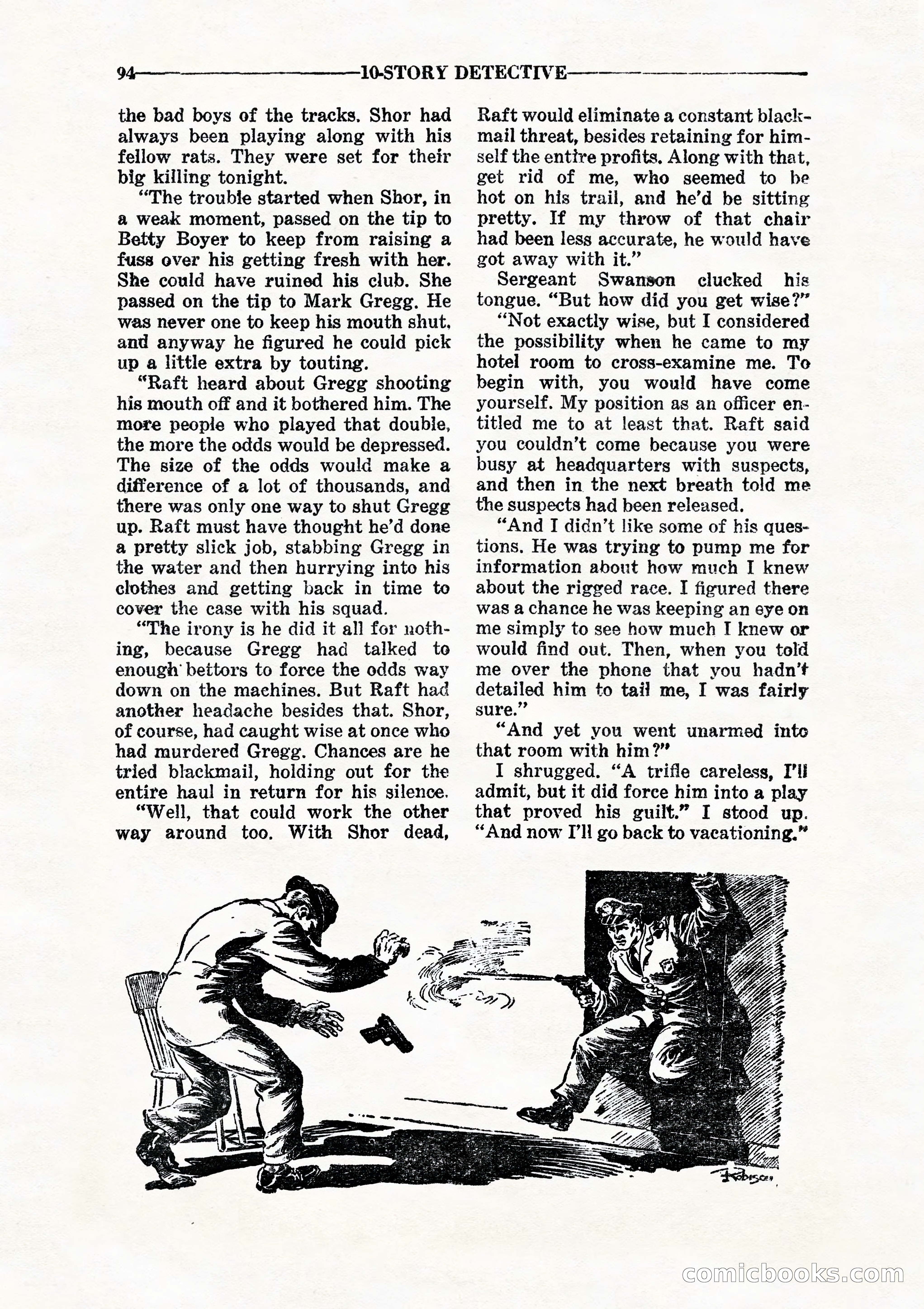
# Page 94 from "10-Story Detective" This is a story prose page with an accompanying illustration. The text discusses a murder investigation involving characters named Raft, Gregg, Shor, and others connected to what appears to be a fixed horse race. The narrative reveals that Raft murdered Gregg by stabbing him in water, then changed clothes to cover his tracks. Sergeant Swanson and the narrator (apparently a police officer) discuss how Raft's scheme involved blackmail and manipulation of betting odds. The page concludes with the narrator announcing he's returning to vacation. The illustration shows a dramatic scene of confrontation between two figures, with one appearing to threaten the other near a doorway.

10 Story Detective, July 1942 — page 97 of 116
97 / 116
What you’re looking at · open this page on its own ↗

# "Elegy for an Alibi" by Guy Fleming This is a story prose page from a pulp magazine featuring the beginning of a crime fiction tale. The page shows the opening chapters of a narrative about Albert Wahl, who appears to be contemplating or planning a crime, and his subsequent interaction with Dan Curtin, a jewelry store owner who visits Wahl requesting a loan of five thousand dollars. The story involves what appears to be a criminal scheme, with Wahl calculating financial details and Curtin producing some form of security or collateral. The page includes decorative drop caps and is formatted in a two-column layout typical of pulp magazines from this era.

10 Story Detective, July 1942 — page 98 of 116
98 / 116
What you’re looking at · open this page on its own ↗

This is a page of story prose from a pulp detective magazine titled "10-STORY DETECTIVE" (visible in the header). The text describes Albert Wahl, apparently a loan broker, examining a valuable diamond brooch worth around $100,000 that belongs to an elderly widow named Mrs. Prentice. Wahl agrees to lend money against it as security. The narrative reveals Wahl's scheme: he plans to appropriate the brooch for himself, reasoning that Mrs. Prentice—a financially irresponsible widow—had approached him offering to sell it at half price, making theft seem justified. The page contains no illustrations, only dense columns of black text on a cream background.

10 Story Detective, July 1942 — page 99 of 116
99 / 116
What you’re looking at · open this page on its own ↗

This page contains story prose from what appears to be a hardboiled crime fiction titled "Elegy for an Alibi" (visible in the header). The text describes a jeweler named Wahl who, after a store robbery involving a man named Curtin, retrieves a .32 caliber automatic from his safe and pursues the suspect through darkened streets. Wahl shoots Curtin in an alley, then takes the victim's wallet containing five thousand dollars and flees to hide the gun at a nearby house. The narrative focuses on Wahl's criminal actions and the consequences of his shooting. No illustrations are visible—this is purely text prose from the middle of the story.

10 Story Detective, July 1942 — page 100 of 116
100 / 116
What you’re looking at · open this page on its own ↗

# Page Analysis This is **story prose** from a hardboiled crime detective pulp magazine titled "10-STORY DETECTIVE" (visible at the page header). The visible text depicts a pivotal interrogation scene in which Chief Garson questions Albert Wahl about selling a firearm to Fred Avery. Wahl initially appears triumphant about framing Avery for Dan Curtin's murder, but Garson reveals a crucial detail: Avery suffered a fatal heart attack yesterday afternoon at 2 p.m. and died an hour later at the hospital—making it impossible for Avery to have committed the murder. Wahl's confidence crumbles as he realizes his carefully constructed plan has unraveled. The page ends with a small decorative illustration at the bottom.

10 Story Detective, July 1942 — page 101 of 116
101 / 116
What you’re looking at · open this page on its own ↗

# "Murderer's Playground" by David M. Norman This page shows the opening of a hardboiled crime story featuring an illustration of a uniformed state trooper in action. The story introduces Sheriff Ted Davis, described as experienced at solving murders. The visible text explains the setup: a murder occurred on a dark night without moon or stars, involving a "rich old eccentric" victim. Sheriff Davis apparently discovers important clues at a crime scene. A state trooper has brought in a prisoner, whom he dismissively describes as a "little rat snooping around that big estate." The page is primarily story prose with an accompanying action illustration at the top.

10 Story Detective, July 1942 — page 102 of 116
102 / 116
What you’re looking at · open this page on its own ↗

# Page Description This is a story prose page from a pulp magazine titled "10-STORY DETECTIVE" (visible at the top). The page contains no illustrations—only text in two columns. The story depicts a hardboiled crime narrative: Sheriff Davis and Trooper Patrick have captured a suspicious character and suspect him of involvement with a reclusive inventor named Dr. Montague, who apparently keeps money hidden on his estate. The prisoner initially denies any involvement in a murder, claiming he doesn't "travel heeled" (carry a gun). The officers decide to take the prisoner to Dr. Montague's property to investigate further, suggesting the doctor may be able to identify him. The narrative follows typical pulp detective convention with criminal investigation, interrogation, and mystery elements.

10 Story Detective, July 1942 — page 103 of 116
103 / 116
What you’re looking at · open this page on its own ↗

# Page 101: Story Prose from "Murderer's Playground" This page contains story prose (no illustrations) from what appears to be a hardboiled crime narrative. The text follows two characters—Davis and Trooper Patrick—as they pursue a suspect in a forest setting. They discover a dead body and find evidence suggesting the criminal "Spats" Stafford may be involved. The story involves gunfire, a chase through woodland terrain, and mentions Dr. Montague's estate with an electrically charged gate. The narrative focuses on their investigation and pursuit strategy as they attempt to apprehend a killer loose in the woods near Montague's property.

10 Story Detective, July 1942 — page 104 of 116
104 / 116
What you’re looking at · open this page on its own ↗

# Page Analysis This page contains story prose from a pulp detective magazine titled "10-STORY DETECTIVE" (visible in the header). The text describes Sheriff Davis arriving at the estate of Dr. Montague, a tall, white-haired scientist wearing nose glasses who appears nervous. Davis has brought a prisoner to identify, possibly connected to a prowler seen on Montague's property. Trooper Patrick accompanies them and warns of dangerous guard dogs and security measures. The conversation suggests someone dangerous—possibly a criminal named Spats Stafford—may be threatening Montague's life. The passage establishes tension around protecting Montague and his valuable hidden assets.

10 Story Detective, July 1942 — page 105 of 116
105 / 116
What you’re looking at · open this page on its own ↗

# Analysis This page is primarily an **advertisement**, not story content. It promotes the "Quiky Gym," a mail-order strength-building device marketed to men seeking muscular development. The ad features photographs of muscular men and illustrations of exercise equipment, alongside testimonial text claiming the device can build a "mighty body" in "15 minutes a day." The bottom portion contains an order form for "Triple Strength Progressive Cables" from the Muscle Power Co. in New York, offering a five-day free trial. The text emphasizes the product's effectiveness and appeals to male readers interested in physical fitness and body building.

10 Story Detective, July 1942 — page 106 of 116
106 / 116
What you’re looking at · open this page on its own ↗

# Page Analysis This is a story prose page from a pulp detective magazine titled "10-STORY DETECTIVE" (visible in the header). The page contains two columns of text depicting an action sequence in which the protagonist Davis investigates disturbances at a house during nighttime. The narrative describes Davis and a character named Patrick responding to shots fired, discovering a dead man (described as "the little crook"), and Davis himself becoming wounded in a subsequent gunfight with an attacker in the darkness. The prose is typical hardboiled detective fiction, emphasizing action, danger, and the chaos of nighttime conflict. No illustrations accompany this text.

10 Story Detective, July 1942 — page 107 of 116
107 / 116
What you’re looking at · open this page on its own ↗

# Page Description This is a full-page advertisement, not story content. The ad promotes the "Guarantee Reserve Life Insurance Company's Family Group Policy," offering life insurance coverage for 2-6 family members for $1.00 per month. The advertisement emphasizes "no medical examination" required and highlights death benefits ranging from $1,500 to $4,500 depending on the cause of death. A photograph shows a family group, and the ad includes a mail-in coupon for free policy information. The copy claims this represents "over 14 million dollars in force" protecting families across America, positioning it as superior protection compared to other family group policies available at the time.

10 Story Detective, July 1942 — page 108 of 116
108 / 116
What you’re looking at · open this page on its own ↗

# Page Analysis This is a prose story page from a pulp detective magazine, numbered 106. The text shows a scene where Sheriff Davis and Trooper Patrick discuss their dangerous situation while pursued by armed criminals on an estate. Davis has retrieved a gun from a dead body and considers their options for escape, while Patrick argues they should abandon their investigation and flee with the evidence they've gathered. Montague, apparently a nervous official, urges them to leave immediately, warning that local mobsters control the property and that daylight is coming. The passage depicts rising tension as the characters debate whether to escape or continue their work.

10 Story Detective, July 1942 — page 109 of 116
109 / 116
What you’re looking at · open this page on its own ↗

# Page 107: Story Text and Advertisement This page contains story prose (left side) continuing a narrative about characters named Montague, Davis, and Patrick who are preparing to defend themselves against potential intruders on a property. The dialogue shows them deciding to stay and fortify their position with guns rather than flee. The right side features a large advertisement for the "Institute of Applied Science" promoting fingerprint expert training. The ad claims that graduates of the institute now head identification bureaus across multiple U.S. states and cities, and encourages readers to pursue training in scientific crime detection. It includes a coupon for a free "Blue Book of Crime" offering case histories and information on crime detection techniques.

10 Story Detective, July 1942 — page 110 of 116
110 / 116
What you’re looking at · open this page on its own ↗

# Page Analysis This page contains story prose from a pulp fiction magazine titled "10-STORY DETECTIVE" (visible in the header). The text describes an action sequence in which Davis and others are investigating a dangerous situation in a house. Dr. Montague is stabbed in the back with a knife and must be moved to safety, though he's weakened by blood loss. The group then discovers a mysterious wooden box weighing about fifty pounds hidden in the house, which they attempt to carry toward a staircase. The passage ends as lights suddenly flood the house, suggesting an unexpected development. No illustrations appear on this page—it is entirely text.

10 Story Detective, July 1942 — page 111 of 116
111 / 116
What you’re looking at · open this page on its own ↗

# Page 109 of "Murderer's Playground" This page contains the continuation of a crime story featuring dialogue between characters named Davis, Patrick, and Montague. The text shows Davis confessing to crimes including murder and theft, explaining how he killed a state trooper and stole money. The narrative appears to be a hardboiled crime story climax where criminal motivations and methods are revealed. The right side features vintage advertisements, including promotions for a book on "Short Men," false teeth by mail order, a request for poems, and remedies for weakness in older adults—typical pulp magazine advertising of the era.

10 Story Detective, July 1942 — page 112 of 116
112 / 116
What you’re looking at · open this page on its own ↗

# Page Analysis: 10-Story Detective Magazine This page contains **story prose with interspersed vintage advertisements**. The main narrative appears to be a hardboiled crime story in which a sheriff confronts a criminal who has locked him and another character (Davis) in a closet. The crook threatens them, claiming he will burn down the house and steal valuables. Davis negotiates for their lives, and the criminal agrees to leave, though Davis suspects the man has hidden most of his stolen money and jewels elsewhere. The page also features period advertisements for beauty products, mail-order glasses, a "Blue Book" guide, and other products typical of early pulp magazine era publications.

10 Story Detective, July 1942 — page 113 of 116
113 / 116
What you’re looking at · open this page on its own ↗

# Page Description This is a text page from a pulp fiction magazine containing story prose and advertisements. The upper portion continues a narrative about a criminal confrontation involving poison gas—a crook threatens a protagonist with a loaded gun after the protagonist has apparently exposed him to gas from a box, causing the crook to suspect a trap. The crook reveals he's working on developing a liquid weapon that can be dispersed as gas for warfare purposes. The lower two-thirds of the page consists entirely of period advertisements for various products and services: music lessons, tobacco cessation, detective work, drug sundries, song publishing, picture rings, and stomach ulcer treatment. These ads are typical of early-20th-century pulp magazine content.

10 Story Detective, July 1942 — page 114 of 116
114 / 116
What you’re looking at · open this page on its own ↗

# Page Content Analysis This is a text page from a pulp detective story, containing the conclusion of a narrative scene. The visible prose describes a detective named Davis confronting a blind criminal (apparently named Montague) about his role in murders on an estate. Davis disarms the crook and indicates they'll report back to "Dr. Montague" about the case's success. The page is primarily story text, but also features period advertisements: a "Beauty Love, Etc. Round the World" photo collection offer, a "Secret Museum of Mankind" book promotion (reduced from $10 to $1.98), and a U.S. Defense Bonds and Stamps patriotic advertisement.

10 Story Detective, July 1942 — page 115 of 116
115 / 116
What you’re looking at · open this page on its own ↗

# This Page: Advertisement This is a full-page advertisement for Charles Atlas's bodybuilding course, featuring the famous "Dynamic Tension" exercise method. The ad includes photographs of Atlas displaying his physique and testimonials from apparent customers claiming dramatic physical transformations. The advertisement promises that readers can develop a muscular "he-man body" in just 15 minutes daily, regardless of their current condition. It emphasizes appeal to both men (for beach confidence and attraction) and women (for admiration). A coupon at the bottom allows readers to request a free book titled "Everlasting Health and Strength." This represents typical mid-20th-century fitness advertising found in pulp magazines.

10 Story Detective, July 1942 — page 116 of 116
116 / 116
What you’re looking at · open this page on its own ↗

This is an advertisement page for the U.S. School of Music's home music instruction course. The ad features testimonial photos and claims that over 700,000 people have learned music "this easy way" for less than 7 cents per day. It includes a visual diagram showing how to read music notes (labeled "Easy as ABC"), photographs of satisfied students, and quoted success stories from learners in places like Clarksburg, West Virginia and Altoona, Pennsylvania. The bottom half contains a coupon for interested readers to request a free illustrated booklet about music instruction. The school, established in 1898, is located in New York City.

Browse this issue page by page

Each page has its own page — the cartoon, who’s in it, and what the satire means.

  1. Page 1 # 10-Story Detective Magazine Cover - July Issue This is a magazine cover from *10-Story Detective*, a pulp fiction publication priced at 10 cents. The cover fe…
  2. Page 2 This is an advertisement page from a pulp magazine promoting "Audels Machinists and Tool Makers Handy Book" by Frank D. Graham, published by Theo. Audel & Co. i…
  3. Page 3 # Advertisement Page This is an advertisement page from a pulp magazine, not story content. It promotes a correspondence course in "Blueprint Reading" offered b…
  4. Page 4 # 10-Story Detective Magazine Table of Contents This is a table of contents page from the July 1942 issue of *10-Story Detective Magazine* (Vol. VII, No. 2). It…
  5. Page 5 # Page Description This is an advertisement page featuring a comic-strip narrative about how one man obtained a radio job through home training. The page promot…
  6. Page 6 # Content Analysis This is an **advertising and promotional page** from a pulp magazine. The page is dominated by vintage advertisements for various products an…
  7. Page 7 # Analysis of Page Content This is an **advertisement page** from a pulp magazine, containing multiple classified ads and promotional materials typical of early…
  8. Page 8 # Page Analysis This is the opening page of a story titled "Taken for a Slay Ride," described as an "Unusual Mystery Novelette" by Norman A. Daniels. The page i…
  9. Page 9 This is an interior story page featuring a dramatic black-and-white illustration above prose text. The illustration depicts Detective Jim Stuart in a confrontat…
  10. Page 10 # Page Analysis This is a page of story prose from a pulp detective magazine titled "10-STORY DETECTIVE" (visible in the header). The page contains two columns …
  11. Page 11 # Page Analysis This is a text-only story page (page 9) from a pulp magazine titled "Taken for a Slay Ride." The visible prose depicts a hardboiled crime narrat…
  12. Page 12 # Page Analysis This is a **story prose page** from a pulp detective magazine titled "10-Story Detective." It shows **Chapter II: "Dead Man Walks,"** depicting …
  13. Page 13 # Page Analysis This is a story prose page (page 11) titled "Taken for a Slay Ride." The text describes a mystery unfolding in a house where characters named St…
  14. Page 14 # Page Analysis This page contains story prose from a pulp detective fiction magazine. The visible text depicts an intense interrogation scene in which Detectiv…
  15. Page 15 # Page 19 of "Taken for a Slay Ride" This page contains story prose from what appears to be a mystery or crime story. The narrative describes Stuart discovering…
  16. Page 16 # Page Analysis This is a prose story page from a pulp detective magazine titled "10-STORY DETECTIVE" (visible in the header). The page contains two columns of …
  17. Page 17 This page contains story prose from what appears to be a pulp adventure or science fiction tale titled "Taken for a Slay Ride." The narrative describes a protag…
  18. Page 18 # Page Analysis This page contains story prose from a pulp magazine titled "10-Story Detective" (visible in the header). The text describes a character named St…
  19. Page 19 This page contains story prose from what appears to be a pulp fiction adventure tale titled "Taken for a Slay Ride." The narrative follows characters named Stua…
  20. Page 20 # 10-Story Detective - Page 18 This page contains story prose from what appears to be a detective or crime fiction narrative. The text describes Stuart sneaking…
  21. Page 21 This is a page of story prose (page 19) from a pulp magazine titled "Taken for a Slay Ride." The text depicts an interrogation scene where Gordon has captured a…
  22. Page 22 This page contains story prose from a pulp fiction narrative titled "10-Story Detective." The text describes an intense physical confrontation between character…
  23. Page 23 This is a text page from a pulp fiction story titled "Taken for a Slay Ride," continuing from Chapter V ("Tunnel to Danger"). The page contains prose narrative …
  24. Page 24 # Page Analysis: "10-Story Detective" This is a **prose story page** from what appears to be a detective pulp magazine titled "10-Story Detective." The page con…
  25. Page 25 # Page Analysis This is a **text-only story page** (page 23) from a pulp magazine titled "Taken for a Slay Ride." The visible prose depicts an action sequence i…
  26. Page 26 This page contains story prose from what appears to be "10-Story Detective," a pulp crime fiction magazine. The text shows a confrontation scene where the detec…
  27. Page 27 This is a page of story prose from a pulp fiction magazine, numbered 25. The text depicts an intense confrontation between characters named Stuart, Bates, and G…
  28. Page 28 # "Deck of Death" by Maurice Phillips This is a page of story prose from a pulp magazine (page 26, as marked). The visible text depicts a hardboiled crime story…
  29. Page 29 This is a page of story prose from a hardboiled crime pulp magazine titled "Deck of Death." The text describes a character named Marco, who works in accounting,…
  30. Page 30 # Page Analysis This is a **story prose page** from a hardboiled crime detective pulp magazine titled "10-Story Detective." The page contains two columns of tex…
  31. Page 31 This page contains the continuation of a hardboiled crime story titled "Deck of Death" (visible at page header 29). The prose describes a tense confrontation be…
  32. Page 32 # Filmtown Fadeout This is an interior story page from a pulp magazine, featuring a black-and-white illustration at the top and prose text below. The story, by …
  33. Page 33 This page contains story prose from a pulp magazine titled "Filmtown Fadeout" (visible in the header). The text describes a murder investigation in Hollywood: d…
  34. Page 34 # Page 32 of "10-Story Detective" This is a **story prose page** from a hardboiled crime/detective pulp magazine. The text continues a murder mystery narrative …
  35. Page 35 This page contains story prose from a hardboiled crime fiction narrative titled "Filmtown Fadeout" (page 33). The text depicts a tense scene where detective Roc…
  36. Page 36 # Page Analysis This is a text-only story page from a pulp magazine titled "10-Story Detective." The page contains two columns of prose narrative depicting a vi…
  37. Page 37 This page contains story prose from what appears to be a hardboiled crime pulp magazine titled "Filmtown Fadeout" (visible at the page header as page 35). The t…
  38. Page 38 # Page 36: "10-Story Detective" — Story Prose This page contains two columns of prose narrative from what appears to be a hardboiled crime story. The visible te…
  39. Page 39 # Filmtown Fadeout - Page 37 This is a text-only page from a hardboiled crime story containing no illustrations. The prose describes a scene where Rocky, a news…
  40. Page 40 # Page Analysis This is a **story prose page** from a hardboiled crime pulp magazine titled "10-Story Detective" (visible in the header). The page contains dial…
  41. Page 41 This is a text page from a pulp crime or detective fiction story titled "Filmtown Fadeout" (page 39). The prose describes a violent confrontation between charac…
  42. Page 42 # Crime on His Hands - Page Analysis This is an interior story page from a pulp magazine, featuring Chapter 1 of "Crime on His Hands" by H.Q. Masur. The page in…
  43. Page 43 # Page Analysis This is a **story page with illustration** from an early-20th-century pulp magazine. The page contains an ink illustration showing a young man l…
  44. Page 44 # Page 42 of "10-Story Detective" This page contains story prose from what appears to be a hardboiled detective or crime narrative. The text describes a narrato…
  45. Page 45 # Page 43: Story Prose from "Crime on His Hands" This is a text-only story page from a pulp crime fiction magazine. The narrative describes the narrator discove…
  46. Page 46 # Page 44 of "10-Story Detective" This page contains story prose from Chapter II of what appears to be a hardboiled crime narrative. The narrator describes conf…
  47. Page 47 This page contains story prose from a pulp fiction magazine titled "Crime on His Hands." The narrative describes a tense domestic scene where a narrator discove…
  48. Page 48 # 10-Story Detective - Page 46 This page contains story prose from what appears to be a hardboiled crime narrative. The narrator, apparently a detective or inve…
  49. Page 49 # Page Analysis This is a text-only story page (page 47) from a pulp magazine titled "Crime on His Hands." The page contains prose narrative from Chapter III, f…
  50. Page 50 # Page 48 from "10-Story Detective" This page contains story prose from what appears to be a hardboiled crime narrative. The narrator, Donald, is being interrog…
  51. Page 51 # Page Analysis This is a text page (page 49) from a hardboiled crime pulp fiction story titled "Crime on His Hands." The page contains two distinct scenes of d…
  52. Page 52 # Page 50: "10-Story Detective" This is a text-only page of prose fiction from what appears to be a hardboiled crime or detective pulp magazine. The narrative c…
  53. Page 53 # Page Description This is story prose from a pulp crime magazine, specifically page 51 of a work titled "Crime on His Hands." The visible text consists of two …
  54. Page 54 # "10-Story Detective" - Story Prose Page This is a text-only page from what appears to be a hardboiled crime detective pulp magazine. The page contains prose n…
  55. Page 55 # Page Analysis This is a text-only page (page 53) from a hardboiled crime pulp story titled "Crime on His Hands." The page contains two columns of prose narrat…
  56. Page 56 # Page Analysis: 10-Story Detective This is a text page from a pulp magazine containing story prose (no illustrations visible). The page shows a dramatic hardbo…
  57. Page 57 # Page 55 from "Crime on His Hands" This is a story page featuring prose narrative with an accompanying illustration. The text shows a dialogue between characte…
  58. Page 58 # Page 56: Story Prose from "10-Story Detective" This page contains prose narrative from a detective story. The text depicts a narrator dealing with the afterma…
  59. Page 59 # Page Analysis This is story prose from a pulp crime fiction magazine, page 57 titled "Crime on His Hands." The narrative depicts a dramatic scene where Uncle …
  60. Page 60 # Page Description This is a **story page** (interior text) from a hardboiled detective pulp magazine. The visible text recounts a violent confrontation where t…
  61. Page 61 # Page 59: Story Text with Illustration This is an interior story page from a pulp magazine featuring "Larceny's Handbook" by Vincent Hartnett. The page contain…
  62. Page 62 This page contains story prose from "10-Story Detective," a pulp magazine. The text describes a kidnapping scene in which Fred and Kay have been forced from a c…
  63. Page 63 # Page 61 of Larceny's Handbook This page contains story prose with no illustrations. It depicts a tense scene in which criminals—Al, Fred, Kay, and Charlie—are…
  64. Page 64 # Page 62: "10-Story Detective" — Story Prose This page contains story prose from what appears to be a mystery or crime story. The narrative describes a dramati…
  65. Page 65 This is an interior story page from a pulp magazine featuring a hardboiled crime story titled "Homicide Landmark" by J. Lane Linklater. The page includes a dram…
  66. Page 66 # Page Analysis This is a text-only page from a pulp detective story titled "10-STORY DETECTIVE." The narrative follows a confrontation between two characters n…
  67. Page 67 # Page Analysis This is a page of story prose from a pulp magazine titled "HOMICIDE LANDMARK" (page 65). The text describes a murder investigation into the deat…
  68. Page 68 # Page Analysis This is a text-only page of prose fiction from a pulp magazine titled "10-STORY DETECTIVE" (visible in the header). The page contains dialogue a…
  69. Page 69 # Page Analysis This page contains story prose from what appears to be a hardboiled crime or detective fiction story titled "Homicide Landmark" (visible in the …
  70. Page 70 # Page Analysis This is **story prose** from a pulp fiction magazine titled "10-STORY DETECTIVE" (visible in the header). The page contains dialogue-heavy narra…
  71. Page 71 # Page 69 of "Homicide Landmark" This page contains story prose from what appears to be a hardboiled crime story. Buck confronts old man Sam Hooper at his prope…
  72. Page 72 This page contains story prose from "10-Story Detective," a pulp crime magazine. The text depicts a confrontation between Detective Buck and a man named Hooper,…
  73. Page 73 # Page Analysis This is story prose from a pulp fiction magazine, specifically page 71 titled "HOMICIDE LANDMARK." The text depicts a criminal scheme involving …
  74. Page 74 This is a page of story prose from a hardboiled crime pulp magazine titled "10-Story Detective." The text describes a tense nighttime confrontation in a grove w…
  75. Page 75 # Page Description This is a story prose page from a hardboiled crime pulp magazine titled "Homicide Landmark" (page 73). The text describes a criminal scheme i…
  76. Page 76 # Page Analysis This is a text-only page (page 74) from a hardboiled crime pulp fiction story titled "10-Story Detective." The page contains dialogue-heavy pros…
  77. Page 77 # Page Analysis This is a story page from a pulp magazine featuring a black-and-white illustration and prose text. The story is titled "Design for a Rub-Out" by…
  78. Page 78 # Page 76: "10-Story Detective" Story Prose This page contains two columns of text-only story prose (no illustrations). The narrative depicts a scene in a bar w…
  79. Page 79 # Page Content Description This page contains story prose from a pulp fiction narrative titled "Design for a Rub-Out" (page 77). The text describes a scene in w…
  80. Page 80 # Page Content Analysis This page contains story prose from a pulp detective fiction magazine titled "10-STORY DETECTIVE" (visible in the header). The text desc…
  81. Page 81 # Page 79: "Design for a Rub-Out" This is a text-only story page from a hardboiled crime pulp magazine. The narrative concerns a kidnapping scheme involving a $…
  82. Page 82 # 10-Story Detective This page contains story prose from what appears to be a detective fiction narrative. Inspector Donovan investigates the death of a woman n…
  83. Page 83 This is a page of story prose from a pulp fiction magazine, numbered 81 and titled "Design for a Rub-Out." The narrative depicts a conversation between William …
  84. Page 84 # Page 82 of "10-Story Detective" This is a text-only story page from the pulp magazine *10-Story Detective*. The page contains prose dialogue and narration fro…
  85. Page 85 # Page Analysis: "Design for a Rub-Out" This is a **story prose page** (page 83) from a hardboiled crime pulp magazine. The text depicts a confrontation between…
  86. Page 86 # Satan's Scandal Sheet This is an interior story page from a pulp magazine, featuring a black-and-white illustration at the top and prose text below. The story…
  87. Page 87 This page contains story prose from what appears to be a hardboiled crime or adventure pulp magazine titled "Satan's Scandal Sheet" (visible in the header). The…
  88. Page 88 # Page Analysis: 10-Story Detective This is a text page from a pulp detective magazine containing story prose. The narrative describes a detective's investigati…
  89. Page 89 # Page 87: "Satan's Scandal Sheet" This page contains story prose from what appears to be a hardboiled crime narrative. The text describes a drowning investigat…
  90. Page 90 # Page Analysis This is **story prose** from a pulp detective magazine (page 88, titled "10-STORY DETECTIVE" at the top). The visible text shows a hardboiled cr…
  91. Page 91 # Page 89: Story Prose from "Satan's Scandal Sheet" This page contains story prose from what appears to be a hardboiled crime or detective pulp magazine. The te…
  92. Page 92 # Page Analysis This is story prose from a pulp detective magazine (the header reads "10-STORY DETECTIVE"). The page contains two columns of text describing a h…
  93. Page 93 # Page 91: Story Prose from "Satan's Scandal Sheet" This page contains story prose from a hardboiled crime narrative. The text depicts a confrontation between t…
  94. Page 94 # Page Analysis This is a text-only page (page 92) from a hardboiled crime pulp magazine titled "10-STORY DETECTIVE." The page contains story prose continuing a…
  95. Page 95 This page contains story prose from a hardboiled crime narrative titled "Satan's Scandal Sheet" (visible in the header). The text describes a violent confrontat…
  96. Page 96 # Page 94 from "10-Story Detective" This is a story prose page with an accompanying illustration. The text discusses a murder investigation involving characters…
  97. Page 97 # "Elegy for an Alibi" by Guy Fleming This is a story prose page from a pulp magazine featuring the beginning of a crime fiction tale. The page shows the openin…
  98. Page 98 This is a page of story prose from a pulp detective magazine titled "10-STORY DETECTIVE" (visible in the header). The text describes Albert Wahl, apparently a l…
  99. Page 99 This page contains story prose from what appears to be a hardboiled crime fiction titled "Elegy for an Alibi" (visible in the header). The text describes a jewe…
  100. Page 100 # Page Analysis This is **story prose** from a hardboiled crime detective pulp magazine titled "10-STORY DETECTIVE" (visible at the page header). The visible te…
  101. Page 101 # "Murderer's Playground" by David M. Norman This page shows the opening of a hardboiled crime story featuring an illustration of a uniformed state trooper in a…
  102. Page 102 # Page Description This is a story prose page from a pulp magazine titled "10-STORY DETECTIVE" (visible at the top). The page contains no illustrations—only tex…
  103. Page 103 # Page 101: Story Prose from "Murderer's Playground" This page contains story prose (no illustrations) from what appears to be a hardboiled crime narrative. The…
  104. Page 104 # Page Analysis This page contains story prose from a pulp detective magazine titled "10-STORY DETECTIVE" (visible in the header). The text describes Sheriff Da…
  105. Page 105 # Analysis This page is primarily an **advertisement**, not story content. It promotes the "Quiky Gym," a mail-order strength-building device marketed to men se…
  106. Page 106 # Page Analysis This is a story prose page from a pulp detective magazine titled "10-STORY DETECTIVE" (visible in the header). The page contains two columns of …
  107. Page 107 # Page Description This is a full-page advertisement, not story content. The ad promotes the "Guarantee Reserve Life Insurance Company's Family Group Policy," o…
  108. Page 108 # Page Analysis This is a prose story page from a pulp detective magazine, numbered 106. The text shows a scene where Sheriff Davis and Trooper Patrick discuss …
  109. Page 109 # Page 107: Story Text and Advertisement This page contains story prose (left side) continuing a narrative about characters named Montague, Davis, and Patrick w…
  110. Page 110 # Page Analysis This page contains story prose from a pulp fiction magazine titled "10-STORY DETECTIVE" (visible in the header). The text describes an action se…
  111. Page 111 # Page 109 of "Murderer's Playground" This page contains the continuation of a crime story featuring dialogue between characters named Davis, Patrick, and Monta…
  112. Page 112 # Page Analysis: 10-Story Detective Magazine This page contains **story prose with interspersed vintage advertisements**. The main narrative appears to be a har…
  113. Page 113 # Page Description This is a text page from a pulp fiction magazine containing story prose and advertisements. The upper portion continues a narrative about a c…
  114. Page 114 # Page Content Analysis This is a text page from a pulp detective story, containing the conclusion of a narrative scene. The visible prose describes a detective…
  115. Page 115 # This Page: Advertisement This is a full-page advertisement for Charles Atlas's bodybuilding course, featuring the famous "Dynamic Tension" exercise method. Th…
  116. Page 116 This is an advertisement page for the U.S. School of Music's home music instruction course. The ad features testimonial photos and claims that over 700,000 peop…