
Pulp Fiction, 1942 · page 47 of 116
10 Story Detective, July 1942 — page 47: what you’re looking at
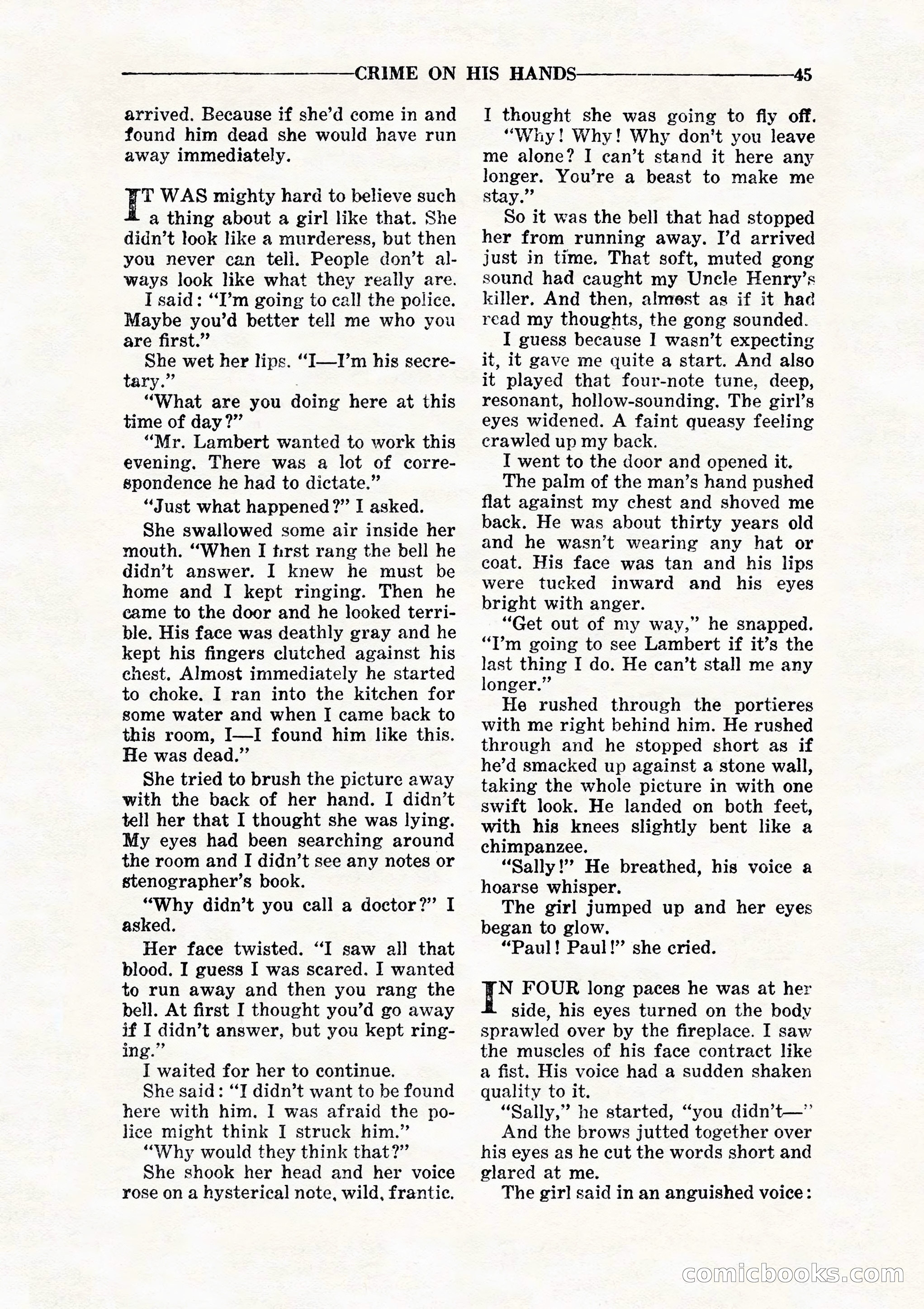
A restored page from Pulp Fiction, 1942. Page through the whole issue in the reader above.
📄 Transcribed text from this page (OCR, searchable)
Machine-transcribed from the original scan — historical spelling and the odd misread are preserved.
arrived. Because if she’d come in and found him dead she would have run away immediately. T WAS mighty hard to believe such a thing about a girl like that. She didn’t look like a murderegs, but then you never can tell. People don’t al- ways look like what they really are. I said: “I’m going to call the police. Maybe you’d better tell me who you are first.” She wet her lips. “I—I’m his secre- tary.” 7 “What are you doing here at this time of day?” “Mr. Lambert wanted to work this evening. There was a lot of corre- spondence he had to dictate.” “Just what happened?” I asked. She swallowed some air inside her mouth. “‘When I first rang the bell he didn’t answer. I knew he must be home and I kept ringing. Then he came to the door and he looked terri- ble. His face was deathly gray and he kept his fingers clutched against his chest. Almost immediately he started to choke. I ran into the kitchen for some water and when IJ came back to this room, I—I found him like this. He was dead.”’ She tried to brush the picture away with the back of her hand. I didn’t tell her that I thought she was lying. My eyes had been searching around the room and I didn’t see any notes or stenographer’s book. “Why didn’t you call a doctor?” I asked. Her face twisted. “I saw all that blood. I guess I was scared. J wanted to run away and then you rang the bell. At first I thought you’d go away if I didn’t answer, but you kept ring- ing.” I waited for her to continue. She said: “I didn’t want to be found here with him. I was afraid the po- lice might think I struck him.” “Why would they think that?” She shook her head and her voice rose on a hysterical note, wild, frantic. CRIME ON HIS HANDS 45 I thought she was going to fly off. “Why! Why! Why don’t you leave me alone? I can’t stand it here any longer. You’re a beast to make me stay.” So it was the bell that had stopped her from running away. I’d arrived just in time, That soft, muted gong sound had caught my Uncle Henry’s killer. And then, almest as if it hae read my thoughts, the gong sounded. I guess because I wasn’t expecting it, it gave me quite a start. And also it played that four-note tune, deep, resonant, hollow-sounding. The girl’s eyes widened. A faint queasy feeling crawled up my back. I went to the door and opened it. The palm of the man’s hand pushed flat against my chest and shoved me back. He was about thirty years old and he wasn’t wearing any hat or coat. His face was tan and his lips were tucked inward and his eyes bright with anger. “Get out of my way,” he snapped. “I’m going to see Lambert if it’s the last thing I do. He can’t stall me any longer.” He rushed through the portieres with me right behind him. He rushed through and he stopped short as if he’d smacked up against a stone wall, taking the whole picture in with one swift look. He landed on both feet, with his knees slightly bent like a chimpanzee. “Sally!” He breathed, his voice a hoarse whisper. The girl jumped up and her eyes began to glow. “Paul! Paul!” she cried. N FOUR long paces he was at her side, his eyes turned on the body sprawled over by the fireplace. I saw the muscles of his face contract like a fist. His voice had a sudden shaken quality to it. “Sally,” he started, “you didn’t—”’ And the brows jutted together over his eyes as he cut the words short and glared at me. The girl said in an anguished voice: O\O)O) () COMI S ( Gi O)