
Pulp Fiction, 1942 · page 46 of 116
10 Story Detective, July 1942 — page 46: what you’re looking at
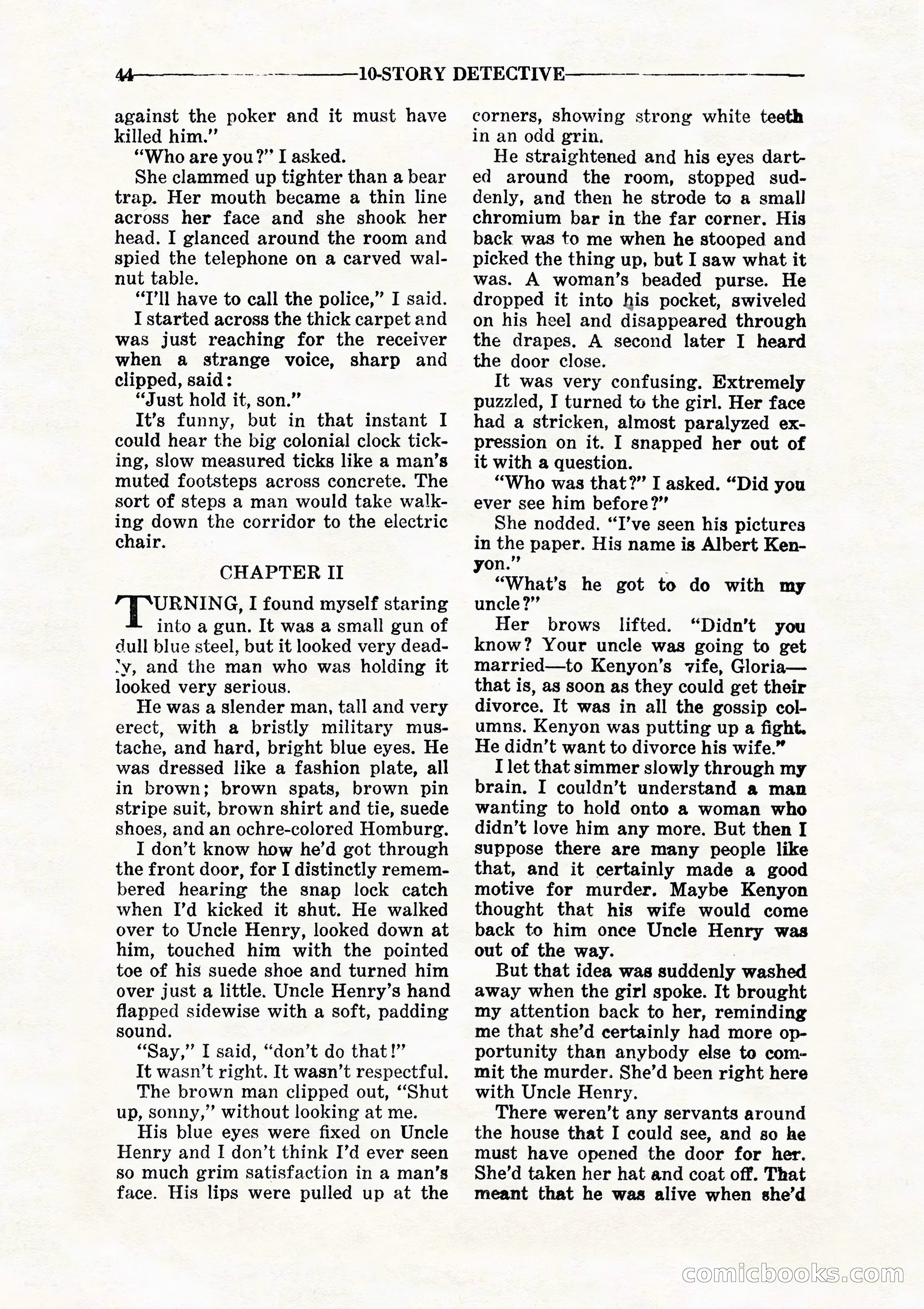
A restored page from Pulp Fiction, 1942. Page through the whole issue in the reader above.
📄 Transcribed text from this page (OCR, searchable)
Machine-transcribed from the original scan — historical spelling and the odd misread are preserved.
44———-- ~~~ against the poker and it must have killed him.” “Who are you?” I asked. She clammed up tighter than a bear trap. Her mouth became a thin line across her face and she shook her head. I glanced around the room and spied the telephone on a carved wal- nut table. “T’ll have to call the police,” I said. I started across the thick carpet and was just reaching for the receiver when a strange voice, sharp and clipped, said: “Just hold it, son.” It’s funny, but in that instant I could hear the big colonial clock tick- ing, slow measured ticks like a man’s muted footsteps across concrete. The sort of steps a man would take walk- ing down the corridor to the electric chair. CHAPTER II URNING, I found myself staring into a gun. It was a small gun of dull blue steel, but it looked very dead- ‘y, and the man who was holding it looked very serious. He was a slender man, tall and very erect, with a bristly military mus- tache, and hard, bright blue eyes. He was dressed like a fashion plate, all in brown; brown spats, brown pin stripe suit, brown shirt and tie, suede shoes, and an ochre-colored Homburg. I don’t know how he’d got through the front door, for I distinctly remem- bered hearing the snap lock catch when I’d kicked it shut. He walked over to Uncle Henry, looked down at him, touched him with the pointed toe of his suede shoe and turned him over just a little. Uncle Henry’s hand flapped sidewise with a soft, padding sound. “Say,” I said, “don’t do that!” It wasn’t right. It wasn’t respectful. The brown man clipped out, “Shut up, sonny,” without looking at me. His blue eyes were fixed on Uncle Henry and I don’t think I’d ever seen so much grim satisfaction in a man’s face. His lips were pulled up at the 10-STORY DETECTIVE ee ee +e ee ee corners, showing strong white teeth in an odd grin. He straightened and his eyes dart- ed around the room, stopped sud- denly, and then he strode to a small chromium bar in the far corner. His back was to me when he stooped and picked the thing up, but I saw what it was. A woman’s beaded purse. He dropped it into his pocket, swiveled on his heel and disappeared through the drapes. A second later I heard the door close. It was very confusing. Extremely puzzled, I turned to the girl. Her face had a stricken, almost paralyzed ex- pression on it. I snapped her out of it with a question. “Who was that?” I asked. “Did you ever see him before?” She nodded. “I’ve seen his pictures in the paper. His name is Albert Ken- yon.” “What’s he got to do with my uncle?” Her brows lifted. “Didn’t you know? Your uncle was going to get married—to Kenyon’s vife, Gloria— that is, as soon as they could get their divorce. It was in all the gossip col- umns. Kenyon was putting up a fight. He didn’t want to divorce his wife.” I let that simmer slowly through my brain. I couldn’t understand a man wanting to hold onto a woman who didn’t love him any more. But then I suppose there are many people like that, and it certainly made a good motive for murder. Maybe Kenyon thought that his wife would come back to him once Uncle Henry was out of the way. 3 But that idea was suddenly washed away when the girl spoke. It brought my attention back to her, reminding me that she’d certainly had more op- portunity than anybody else to com- mit the murder. She’d been right here with Uncle Henry. There weren’t any servants around the house that I could see, and so he must have opened the door for her. She’d taken her hat and coat off. That meant that he was alive when she’d MIGoOo (C(O) S (C(O) nn