
Pulp Fiction, 1942 · page 99 of 116
10 Story Detective, July 1942 — page 99: what you’re looking at
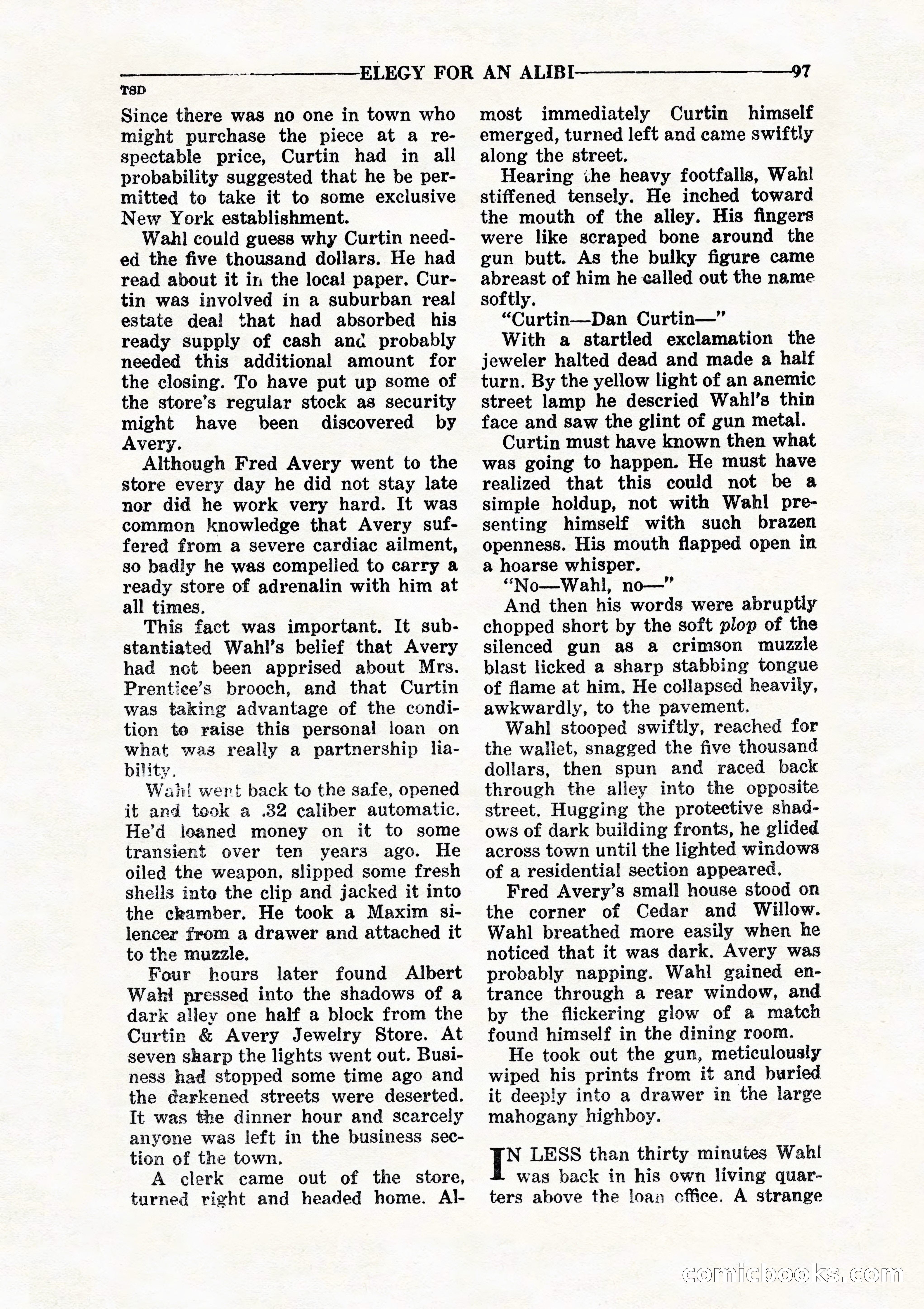
A restored page from Pulp Fiction, 1942. Page through the whole issue in the reader above.
📄 Transcribed text from this page (OCR, searchable)
Machine-transcribed from the original scan — historical spelling and the odd misread are preserved.
a ELEGY FOR AN ALIBI———— TSD Since there was no one in town who might purchase the piece at a re- spectable price, Curtin had in all probability suggested that he be per- mitted to take it to some exclusive New York establishment. Wahl could guess why Curtin need- ed the five thousand dollars. He had read about it in the local paper. Cur- tin was involved in a suburban real estate deal that had absorbed his ready supply of cash and probably needed this additional amount for the closing. To have put up some of the store’s regular stock as security might have been discovered by Avery. Although Fred Avery went to the store every day he did not stay late nor did he work very hard. It was common knowledge that Avery suf- fered from a severe cardiac ailment, so badly he was compelled to carry a ready store of adrenalin with him at all times. This fact was important. It sub- stantiated Wahl’s belief that Avery had not been apprised about Mrs. Prentice’s brooch, and that Curtin was taking advantage of the condi- tion to raise this personal loan on what was really a partnership lia- bility, Wahl wert back to the safe, opened it and took a .32 caliber automatic. He’d leaned money on it to some transient over ten years ago. He oiled the weapon, slipped some fresh shells into the clip and jacked it into the ckamber. He took a Maxim si- lencer from a drawer and attached it to the muzzle. Four hours later found Albert Wahi pressed into the shadows of a dark alley one half a block from the Curtin & Avery Jewelry Store. At seven sharp the lights went out. Busi- ness had stopped some time ago and the darkened streets were deserted. It was the dinner hour and scarcely anyone was left in the business sec- tion of the town. A clerk came out of the store, turned right and headed home. AIl- SS most immediately Curtin himself emerged, turned left and came swiftly along the street. Hearing the heavy footfalls, Wahl stiffened tensely. He inched toward the mouth of the alley. His fingers were like scraped bone around the gun butt. As the bulky figure came abreast of him he called out the name softly. “Curtin—Dan Curtin—” With a startled exclamation the jeweler halted dead and made a half turn. By the yellow light of an anemic street lamp he descried Wahl’s thin face and saw the glint of gun metal. Curtin must have known then what was going to happen. He must have realized that this could not be a simple holdup, not with Wahl pre- senting himself with such brazen openness. His mouth flapped open in a hoarse whisper. ‘“No—Wahl, no—” And then his words were abruptly chopped short by the soft plop of the silenced gun as a crimson muzzle blast licked a sharp stabbing tongue of flame at him. He collapsed heavily, awkwardly, to the pavement. Wahl stooped swiftly, reached for the wallet, snagged the five thousand dollars, then spun and raced back through the alley into the opposite street. Hugging the protective shad- ows of dark building fronts, he glided across town until the lighted windows of a residential section appeared. Fred Avery’s small house stood on the corner of Cedar and Willow. Wahl breathed more easily when he noticed that it was dark. Avery was probably napping. Wahl gained en- trance through a rear window, and by the flickering glow of a match found himself in the dining room. He took out the gun, meticulously wiped his prints from it and buried it deeply into a drawer in the large mahogany highboy. | LESS than thirty minutes Wahl was back in his own living quar- ters above the loan office. A strange OOO) O COLL S (C(O) im