
Pulp Fiction, 1942 · page 106 of 116
10 Story Detective, July 1942 — page 106: what you’re looking at
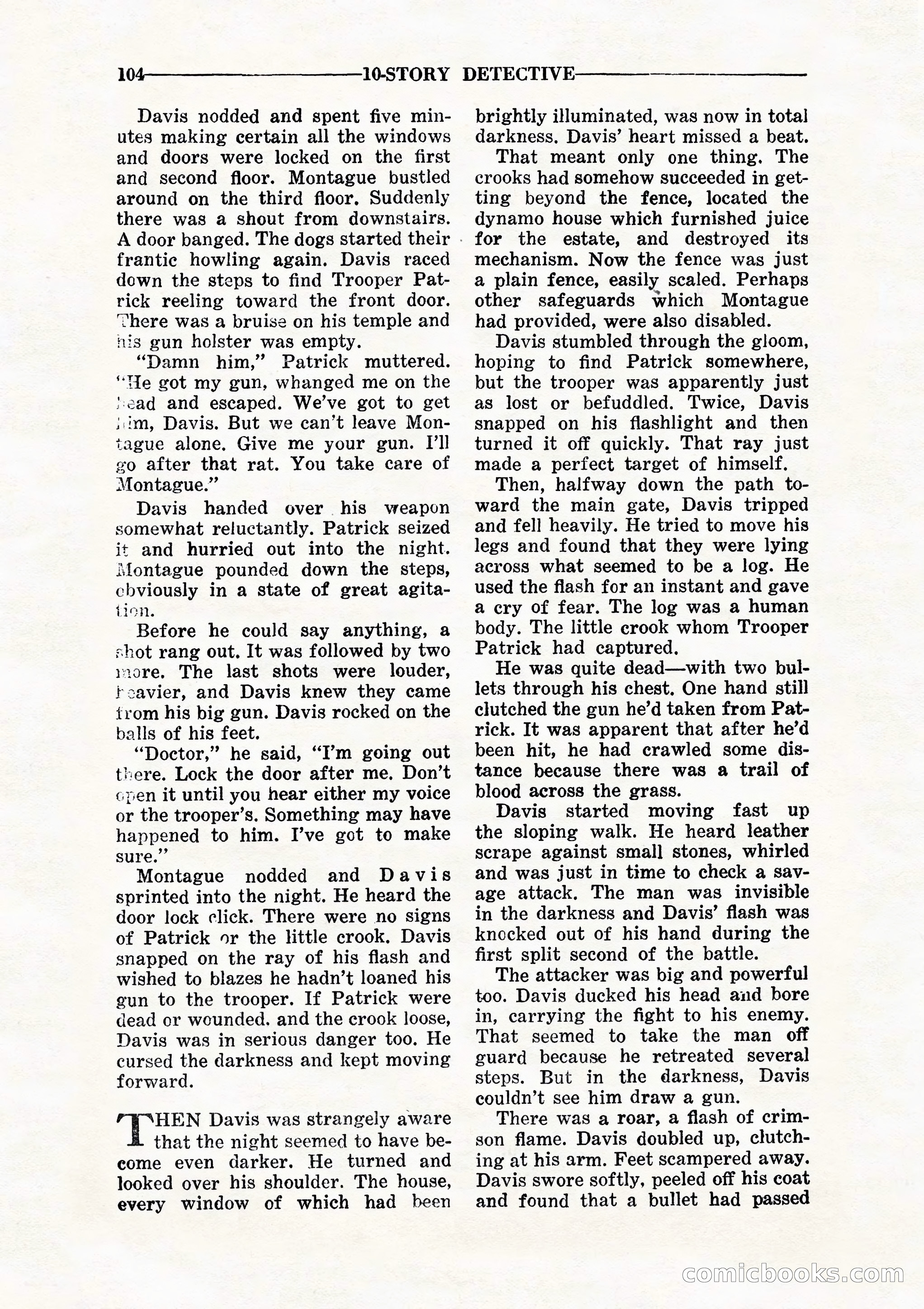
A restored page from Pulp Fiction, 1942. Page through the whole issue in the reader above.
📄 Transcribed text from this page (OCR, searchable)
Machine-transcribed from the original scan — historical spelling and the odd misread are preserved.
1 eee ORY Davis nodded and spent five min- utes making certain all the windows and doors were locked on the first and second floor. Montague bustled around on the third floor. Suddenly there was a shout from downstairs. A door banged. The dogs started their - frantic howling again. Davis raced down the steps to find Trooper Pat- rick reeling toward the front door. “here was a bruise on his temple and his gun holster was empty. “Damn him,” Patrick muttered. “We got my gun, whanged me on the :ead and escaped. We’ve got to get ;im, Davis. But we can’t leave Mon- tague alone. Give me your gun. [’]l so after that rat. You take care of Montague.” Davis handed over his weapon somewhat reluctantly. Patrick seized it and hurried out into the night. Montague pounded down the steps, cbviously in a state of great agita- {20n. Before he could say anything, a shot rang out. It was followed by two more, The last shots were louder, Feavier, and Davis knew they came trom his big gun. Davis rocked on the balls of his feet. “Doctor,” he said, “I’m going out there. Lock the door after me. Don’t cpen it until you hear either my voice or the trooper’s. Something may have happened to him. I’ve got to make sure.” Montague nodded and Davis sprinted into the night. He heard the door lock click. There were no signs of Patrick or the little crook. Davis snapped on the ray of his flash and wished to blazes he hadn’t loaned his gun to the trooper. If Patrick were dead or wounded. and the crook loose, Davis was in serious danger too. He cursed the darkness and kept moving forward. HEN Davis was strangely aware that the night seemed to have be- come even darker. He turned and looked over his shoulder. The house, every window of which had been DETECTIVE———— brightly illuminated, was now in total darkness, Davis’ heart missed a beat. That meant only one thing. The crooks had somehow succeeded in get- ting beyond the fence, located the dynamo house which furnished juice for the estate, and destroyed its mechanism. Now the fence was just a plain fence, easily scaled. Perhaps other safeguards which Montague had provided, were also disabled. Davis stumbled through the gloom, hoping to find Patrick somewhere, but the trooper was apparently just as lost or befuddled. Twice, Davis snapped on his flashlight and then turned it off quickly. That ray just made a perfect target of himself. Then, halfway down the path to- ward the main gate, Davis tripped and fell heavily. He tried to move his legs and found that they were lying across what seemed to be a log. He used the flash for an instant and gave a cry of fear. The log was a human body. The little crook whom Trooper Patrick had captured. He was quite dead—with two bul- lets through his chest, One hand still clutched the gun he’d taken from Pat- rick. It was apparent that after he’d been hit, he had crawled some dis- tance because there was a trail of blood across the grass. Davis started moving fast up the sloping walk. He heard leather scrape against small stones, whirled and was just in time to check a sav- age attack. The man was invisible in the darkness and Davis’ flash was knocked out of his hand during the first split second of the battle. The attacker was big and powerful too. Davis ducked his head and bore in, carrying the fight to his enemy. That seemed to take the man off guard because he retreated several steps. But in the darkness, Davis couldn’t see him draw a gun. There was a roar, a flash of crim- son flame. Davis doubled up, clutch- ing at his arm. Feet scampered away. Davis swore softly, peeled off his coat and found that a bullet had passed MIGoOo (C(O) S (C(O) nn