
Pulp Fiction, 1942 · page 58 of 116
10 Story Detective, July 1942 — page 58: what you’re looking at
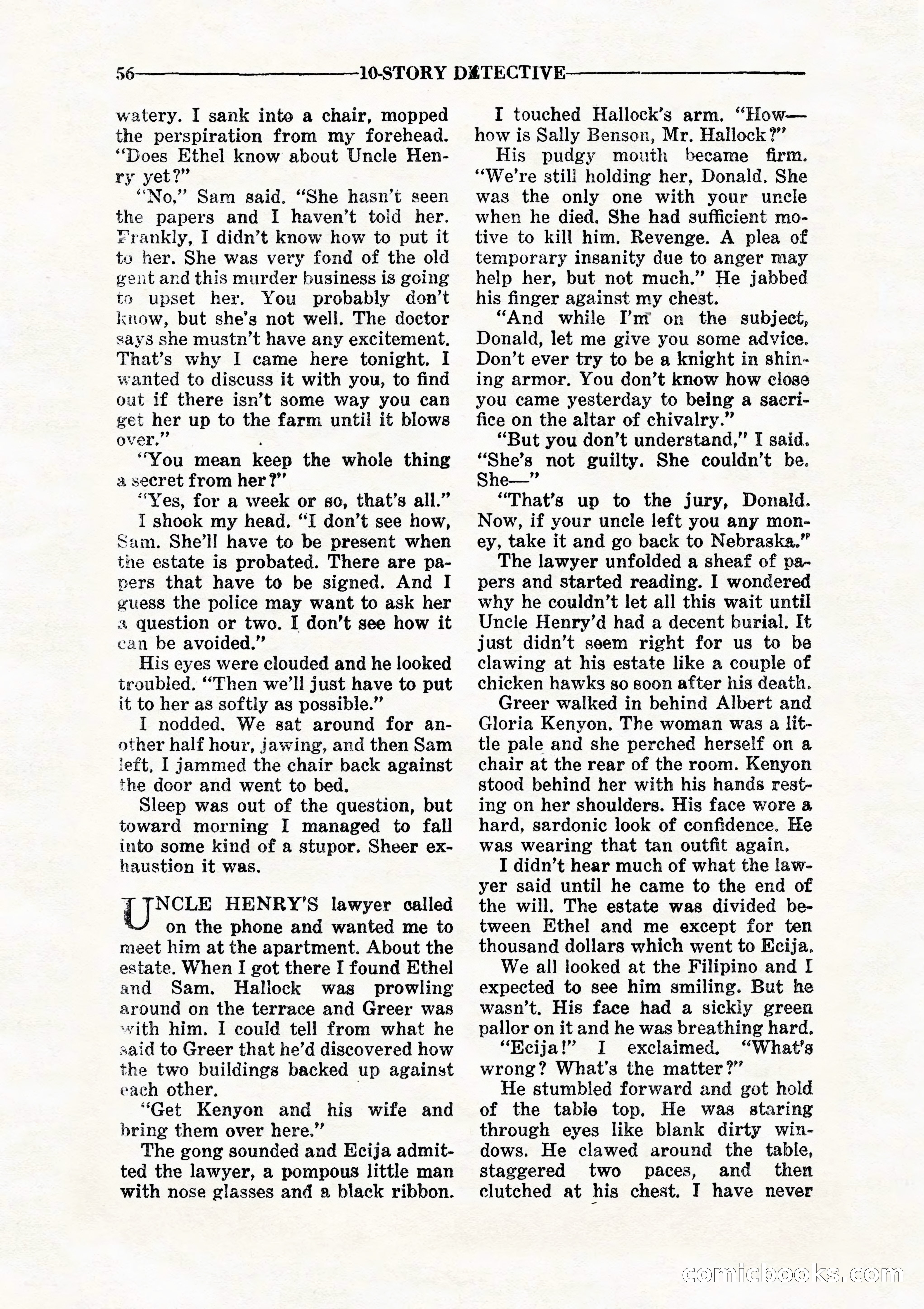
A restored page from Pulp Fiction, 1942. Page through the whole issue in the reader above.
📄 Transcribed text from this page (OCR, searchable)
Machine-transcribed from the original scan — historical spelling and the odd misread are preserved.
56—_—___———_10-STORY D&TECTIVE watery. I sank inte a chair, mopped the perspiration from my forehead. “Does Ethel know about Uncle Hen- ry yet?” “No,” Sam said. “She hasn't seen the papers and I haven’t toid her. vrankly, I didn’t know how to put it to her. She was very fond of the old geut and this murder business is going to upset her. You probably don’t know, but she’s not well. The doetor says she mustn’t have any excitement, That’s why 1 came here tonight. I wanted to discuss it with you, to find out if there isn’t some way you can get her up to the farm until it blows over.” “You mean keep the whole thing a secret from her ?”’ “Yes, for a week or s0, that’s all.” { shook my head. “I don’t see how, Sam. She’ll have to be present when the estate is probated. There are pa- pers that have to be signed. And I guess the police may want to ask her a question or two. I don’t see how it can be avoided.” His eyes were clouded and he looked troubled. “Then we'll just have to put it to her as softly as possible.” I nodded. We sat around for an- other half hour, jJawing, and then Sam left, I jammed the chair back against the door and went to bed. Sleep was out of the question, but toward morning I managed to fall into some kind of a stupor. Sheer ex- haustion it was. 7 TNCLE HENRY’S lawyer called on the phone and wanted me to meet him at the apartment. About the estate. When I got there I found Ethel and Sam. Hallock was prowling around on the terrace and Greer was ‘vith him. I could tell from what he said to Greer that he’d discovered how the two buildings backed up against each other. . “Get Kenyon and his wife and bring them over here.” The gong sounded and Ecija admit- ted the lawyer, a pompous little man with nose glasses and a black ribbon. I touched Hallock’s arm. “How— how is Sally Benson, Mr. Hallock ?” His pudgy mouth became firm. “We're still holding her, Donald. She was the only one with your uncle when he died. She had sufficient mo- tive to kill him. Revenge. A plea of temporary insanity due to anger may help her, but not much.” He jabbed his finger against my chest. “And while I’m on the subject, Donald, let me give you some advice. Don’t ever try to be a knight in shin- ing armor. You don’t know how close you came yesterday to being a sacri- fice on the altar of chivalry.” “But you don’t understand,’ I said. “She’s not guilty. She couldn’t be. She—” “That’s up to the jury, Donald. Now, if your uncle left you any mon- ey, take it and go back to Nebraska.” The lawyer unfolded a sheaf of pa- pers and started reading. I wondered why he couldn’t let all this wait until Uncle Henry’d had a decent burial. It just didn’t seem right for us to be clawing at his estate like a couple of chicken hawks so soon after his death. Greer walked in behind Albert and Gloria Kenyon. The woman was a lit- tle pale and she perched herself on a chair at the rear of the room. Kenyon stood behind her with his hands rest- ing on her shoulders. His face wore a hard, sardonic look of confidence. He was wearing that tan outfit again. I didn’t hear much of what the law- yer said until he came to the end of the will. The estate was divided be- tween Ethel and me except for ten thousand dollars which went to Ecija. We all looked at the Filipino and I expected to see him smiling. But he wasn’t. His face had a sickly green pallor on it and he was breathing hard, “Ecija!” I exclaimed. “What's wrong? What’s the matter?’ He stumbled forward and got hold. of the table top. He was staring through eyes like blank dirty win- dows. He clawed around the table, staggered two paces, and then clutched at his chest. I have never MIGOOo (C(O) S (C(O) nn