
A complete issue · 116 pages · 1923
The Taking of Helen by John Masefield

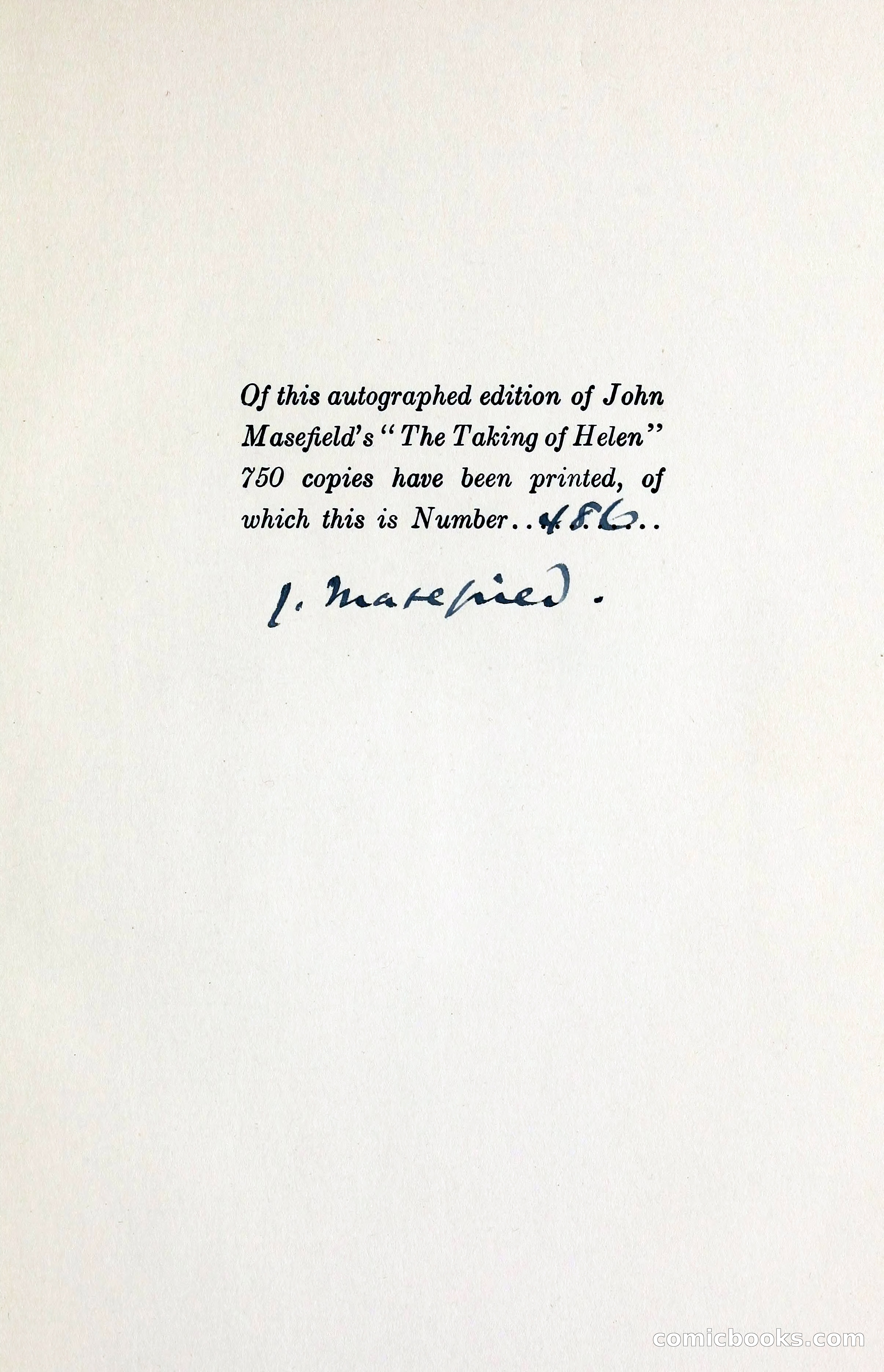
This is a colophon page (a publisher's note) from a limited edition. It states that 750 copies of John Masefield's "The Taking of Helen" have been printed in an autographed edition, and identifies this copy as Number 462. The page is signed by what appears to be "J. Masefield" in handwriting below the printed text. The OCR has garbled some elements, but the essential information about this being a numbered copy of a limited autographed edition is clear from the legible printed portion.
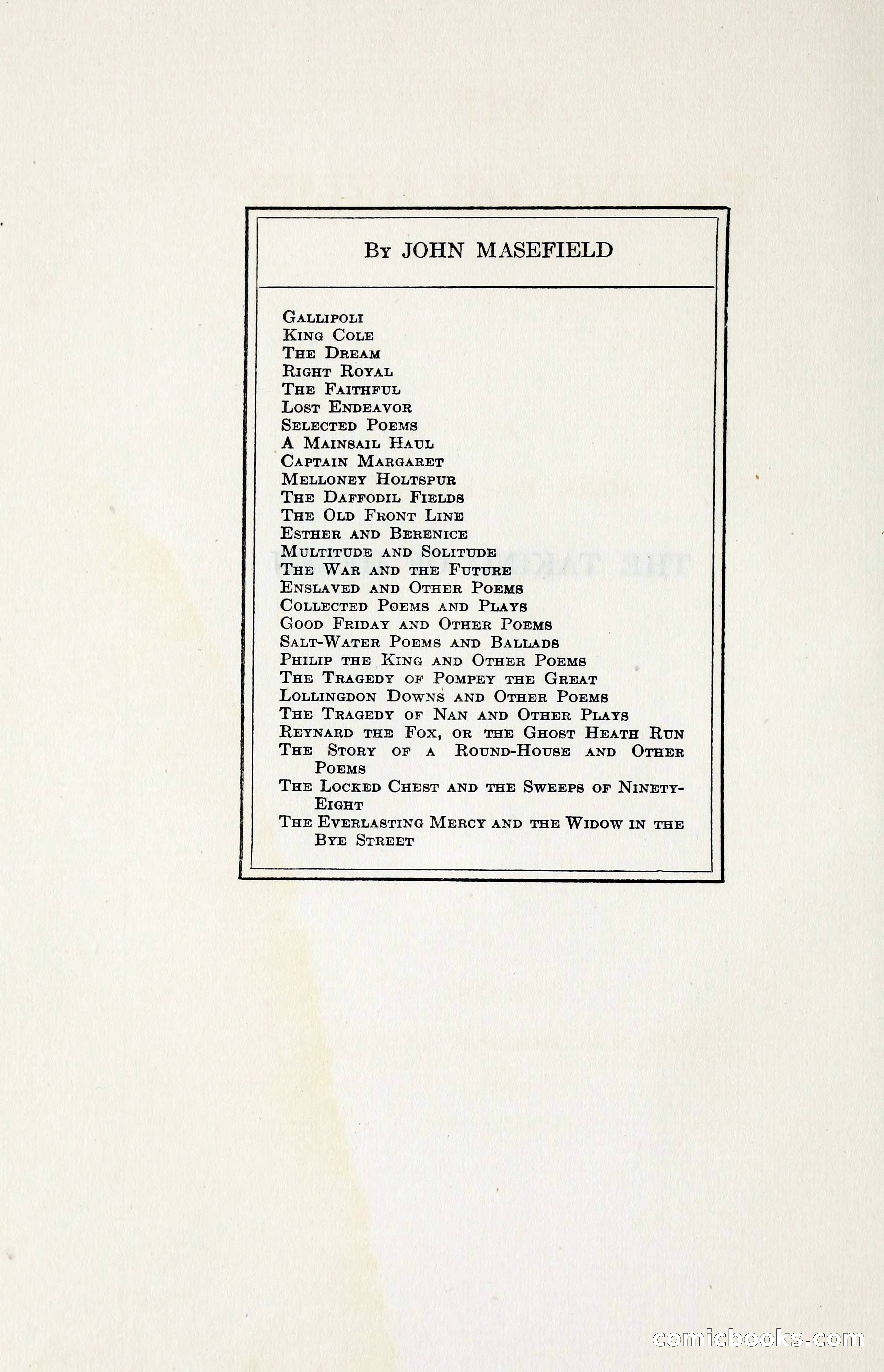
# Analysis This is a **title/advertisement page** listing works by author John Masefield. The page presents a catalog of approximately 27 titles by Masefield, including poetry collections, plays, and narrative works such as *Gallipoli*, *King Cole*, *The Dream*, *Salt-Water Poems and Ballads*, and *The Everlasting Mercy and the Widow in the Bye Street*. The works span poetry, drama, and what appear to be longer narrative pieces, presented in a simple typographic format within a double-ruled border. This type of page typically appeared in Victorian publications to advertise an author's backlist to readers.
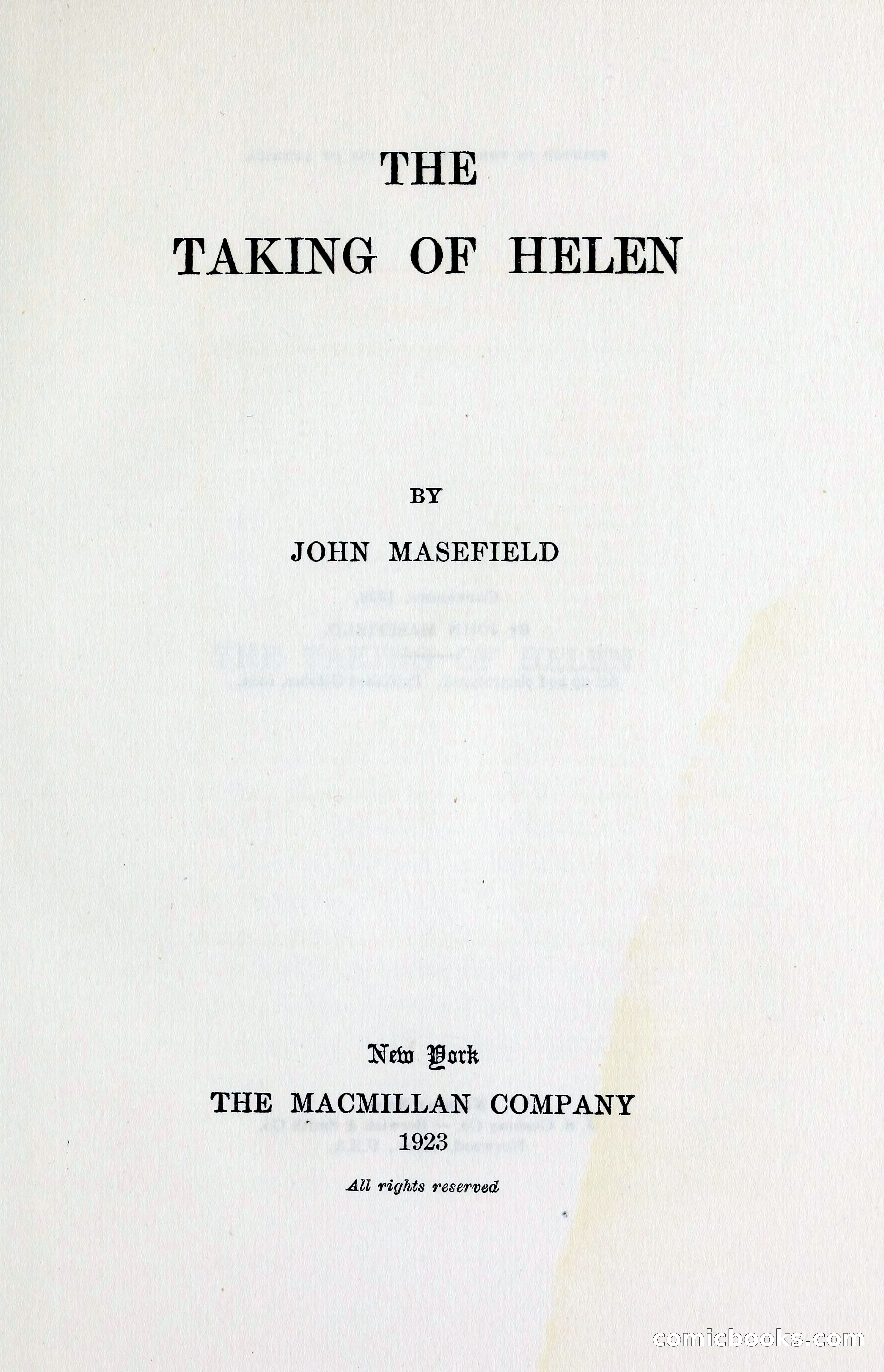
This is a title page from a 1923 American edition published by The Macmillan Company in New York. The work is *The Taking of Helen* by John Masefield, with all rights reserved noted at the bottom. Despite your framing, this appears to be a legitimate literary work rather than a Victorian penny dreadful—Masefield was an established poet and writer (later Poet Laureate), and The Macmillan Company was a prestigious publisher. The page shows typical early twentieth-century title page formatting with centered text in various sizes.
This is a copyright and publication page from a 1923 American book by John Masefield, printed in Norwood, Massachusetts. The page states the work was set up and electrotyped, with publication in October 1923. Despite the prompt's reference to Victorian penny dreadfuls, this document is from the 1920s and represents standard American book production practices of that era, listing printer and publisher information rather than containing narrative content or illustrations.
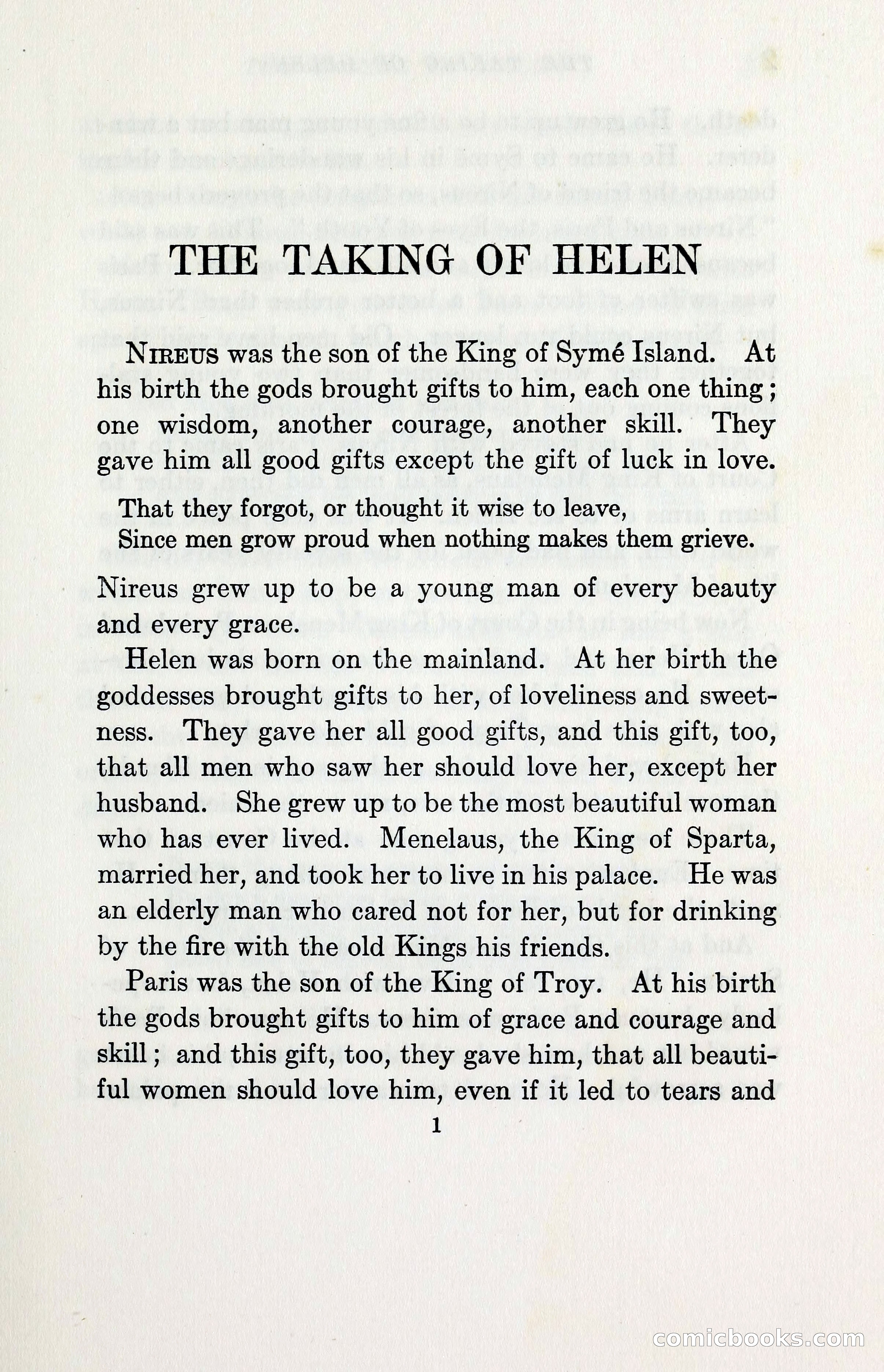
# Page Description This is the opening page of a prose story titled "The Taking of Helen." The text presents a mythological narrative introducing three male characters—Nireus, Paris, and Helen—and their divine gifts. It explains that Nireus lacks luck in love, Helen possesses beauty that makes all men love her (except her husband Menelaus, an indifferent elderly king), and Paris receives the gift of being loved by all beautiful women. The page establishes a romantic conflict rooted in supernatural destiny, typical of penny dreadful sensational fiction adapted from classical mythology.
# Page Description This is a page of running prose (page 2) from a work titled *The Taking of Helen*. The text narrates the classical myth: Paris, a wanderer who befriended Prince Nireus, arrives at King Menelaus's court and falls in love with Queen Helen, who reciprocates his affection. The passage describes Paris courting Helen with youth, grace, and Trojan gifts, while also introducing Prince Nireus, who arrives at court, falls hopelessly in love with Helen upon witnessing her devotion to Paris, and wanders sorrowfully near the palace. A painter named Euphorion is mentioned as having created wax heads of Paris and Helen.
This is page 3 of running prose from a Victorian penny dreadful titled "The Taking of Helen." The text recounts a mythological narrative: multiple young men love Helen and grow jealous of Paris; her husband Menelaus learns of the jealousy. Paris asks Nireus to lend him a ship to escape the country within three days, which Nireus agrees to do in secret. The passage then shifts to poetic language describing summer moonlight before depicting Nireus wandering the castle gardens at night, lovesick and hearing someone call his name in the darkness.
# Page Description This is a page of running prose dialogue from a Victorian penny dreadful titled "The Taking of Helen" (page 4). The text depicts a conversation between Queen Helen and a man named Nireus, in which Helen requests that Nireus secretly provide a ship at Green Havens so she and Paris can escape together. Nireus agrees to help, though he expresses concern about the wisdom of her plan, and offers assistance with horses for their journey to the coast.
This is a page of running prose from a Victorian penny dreadful titled "The Taking of Helen" (page 5). The text depicts a dramatic scene in which a character named Nireus conceals Helen with his cloak when guards approach, then later observes the suspicious behavior of Menelaus at a feast. Menelaus, described as elderly and cunning, approaches someone called "cousin Paris" with knowing remarks about "what lovely lady is the lucky one," suggesting he has discovered or suspects an illicit romance. The narrative also mentions Nireus preparing a second ship for escape.
# Page Analysis This is a page of running prose text (page 6) from a Victorian penny dreadful titled *The Taking of Helen*. The narrative describes Nireus overhearing Queen's attendants gossip about their mistress, then visiting the court-armourer ostensibly for a sword-chain repair. The armourer cryptically warns Nireus about Prince Paris and "King's wives" being dangerous, then delivers a suggestive message: telling Paris not to leave gloves behind and to draw curtains in "the little third room in the tower"—implications of an illicit affair. The passage builds melodramatic tension through veiled innuendo and palace intrigue.
# Page Analysis: "The Taking of Helen" This is a page of running prose from what appears to be a Victorian penny dreadful retelling of classical mythology. The text describes Prince Nireus visiting the guard quarters, where a soldier sings a satirical song about Trojan princes and kings. A courtier named Brighteyes then summons Nireus to meet King Menelaus in the secret "Rooms of Report"—a three-chambered space where the King conducts spy activities. The passage emphasizes intrigue and mystery as Nireus proceeds toward an audience with the monarch.
# Page 8: Running Prose from "The Taking of Helen" This is a page of running prose text from what appears to be a serialized Victorian narrative. A character named Nireus eavesdrops on King Menelaus questioning Paris's servant about secretly obtained information. The servant whispers a report involving a woman who picked a distinctive deep yellow rose (that grows near a postern) and placed it on someone's table. The conversation suggests intrigue and possible infidelity, with Menelaus attempting to extract details about the rose's presence as apparent evidence of clandestine activity.
# Page Analysis This is a page of running prose from page 9 of *The Taking of Helen*, a Victorian penny dreadful. The text depicts a clandestine meeting where a spy reports to Menelaus about two horses from the Two Brothers Inn. After the spy's dismissal, Menelaus discusses with another man (described as heavy-set and labored in breathing) an apparent planned abduction scheduled for "the night after to-morrow." The heavy man cryptically references owing someone named Priam "a trouble," suggesting a revenge plot underlying the kidnapping scheme.
This is a page of running prose from a Victorian penny dreadful titled "The Taking of Helen" (page 10). The dialogue depicts characters—apparently Menelaus and others—discussing plans to capture or punish Paris and prevent his escape by ship. Menelaus declares that Paris will be stopped, tried, and hanged, and predicts this action will provoke war with Priam within three weeks. A heavy-set character also expresses concern about men from elsewhere who harbor ideas of independence and may require forceful control. The text blends classical mythology (Helen, Paris, Priam) with Victorian sensationalist plotting.
# Page Description This is page 11 of running prose from a Victorian penny dreadful titled *The Taking of Helen*. The page contains a dialogue between characters named Menelaus and a "heavy man," overheard by Nireus, discussing plans involving the promise of booty to recruit men and some kind of secret, morally questionable scheme involving "one of our own men" whose son is a child. Menelaus appears reluctant about the proposal but considers whether the target "can be tempted." The scene ends with Nireus withdrawing as both men stand and an officer returns from supper.
This is a page of running prose from the middle of a narrative, numbered page 12. The text depicts a dialogue between a King and a runner named Nireus, wherein the King proposes a wager: Nireus will race against "the Stag-footed, the grandson of Aktor" over twelve furlongs at Port-of-Maidens the following morning. The King, described as a heavy man wearing the Blood Axe symbol, mentions having bet considerably on Nireus because he allegedly outran Prince Paris. The passage concludes with the King inviting Nireus to prepare for their midnight departure.
# Page Description This is a page of running prose from the novel *The Taking of Helen* (page 13). The text depicts a dialogue between King Menelaus and a heavy man (later identified as Nireus) discussing running races and athletic prowess. Menelaus recalls beating the athlete Aktor at the Holy Games in his youth, while the heavy man disputes this claim, attributing Aktor's poor performance to illness and age. The conversation then shifts to hospitality, with Menelaus offering food and wine to his guest and discussing grapes, wines, and foreign ports before transitioning to mention Paris of Troy and forest goddesses.
# Analysis This is a page of running prose from *The Taking of Helen*, a Victorian penny dreadful (page 14). The King questions his companion Nireus about a man who claims to possess a lock of a goddess's golden hair that glimmers in darkness. The King then asks Nireus if he has lost a pair of scarlet gloves decorated with gold roses made from fine golden hair—the same miraculous material. Nireus denies losing them, and the King begins to share wisdom from his late father about "leaving things about," suggesting Nireus may be lying or hiding something. The passage builds suspense through indirect accusation and mythological intrigue.
# Page Description This is a page of running prose narrative (page 15) from "The Taking of Helen," a Victorian penny dreadful retelling of classical mythology. The text describes Nireus boarding a ship with Menelaus, competing in athletic games, and then attempting to send a secret message to Queen Helen via fishermen on a beach, offering payment in goats and a jeweled silver cup if they will deliver a rayed shell to her.
This is a page of running prose from a Victorian penny dreadful titled *The Taking of Helen* (page 16). The text depicts a scene in which a character named Nireus instructs fishermen to deliver a rare twisted shell to Queen Helen as a gift. Nireus marks the shell with a "danger-mark of the Beggars" to authenticate the message, and promises the fishermen meat and wine if they deliver it faithfully. The passage emphasizes the shell's rarity and frames the transaction as an act of devotion to the Queen.
# Page Analysis: "The Taking of Helen," Page 17 This is a page of running prose from what appears to be a Victorian penny dreadful retelling of classical mythology. King Menelaus arranges a footrace between Nireus and a character called Brighteyes, but Nireus's real interest is learning news of Helen. Brighteyes reports that the Queen (Helen) has departed the palace with the royal party to stay at Lord Halys' estate in the hills for at least two nights, and that Prince Paris is also there—"constant as a wasp to the peach." The dialogue suggests an ominous situation developing around Helen's absence from court.
This is a page of running prose from the serial "The Taking of Helen," page 18. The text depicts a scene at a royal feast where a King questions a man named Nireus about an escort, congratulates him on winning a race, and then presents a mysterious left-handed rayed shell brought by fishermen. When Nireus claims the shell bears his own mark as a gift to the Queen, the King breaks it open to disprove the claim, finding no fish inside. The passage concludes with entertainment—young men dancing and a poet beginning to sing—following the meal.
# Page Analysis: Running Prose from "The Taking of Helen" This is page 19 of a prose narrative titled "The Taking of Helen." The page contains running text describing a character named Nireus who slips away from King Menelaus's gathering, steals a brown mare from a field, and rides toward the Curlews. The passage includes a brief poetic section describing the moonlit landscape and the horse's movement, then depicts Nireus encountering a dismounted man at a crossroads, where they exchange directions regarding Port-of-Maidens, the King, and Lord Halys's location. The text appears to be classical or mythological in subject matter, given references to King Menelaus and the classical name Nireus.
# Page Analysis This is a page of running prose narrative (page 20) from "The Taking of Helen," a Victorian penny dreadful. The text depicts a character named Nireus arriving at Lord Halys' house seeking the Queen, only to learn she has mysteriously disappeared after supper while heading toward "the Great Stones" three hours prior. The passage reveals that Prince Paris has also vanished, leaving those at the house bewildered and the escort searching the hills. The narrative concerns itself with this apparent abduction or elopement, creating melodramatic suspense typical of the genre.
# Page Analysis This is a page of running prose from *The Taking of Helen*, a Victorian penny dreadful (page 21). The text depicts a dramatic scene: a character named Nireus learns that the Queen has disappeared during supper. A messenger reports that a farmer's wife witnessed a dark chariot with two horses waiting nearby for an hour, with one horse identifiable by an unusual gait. Nireus theorizes the disappearance is a kidnapping for ransom, but locals insist no thieves or pirates have operated in the region for years. The passage ends with Nireus questioning whether a message summoned the Queen away from the gathering.
This is a page of running prose from a Victorian penny dreadful titled "The Taking of Helen." The text depicts a conversation between soldiers and a character named Nireus concerning the disappearance of two people—apparently a young man and woman who have fled. Soldiers are searching various routes to Green Havens and the coast. Nireus learns of multiple mountain passes leading to the sea and decides to pursue them, suspecting the fugitives have already been warned and escaped by one of these remote byways. The dialogue establishes the dramatic setup of a chase narrative.
This is page 23 of running prose from a Victorian penny dreadful titled "The Taking of Helen." The text describes a character named Nireus riding through misty mountains on horseback, attempting to intercept some destination. After his mare refuses to proceed further—apparently frightened by a fox or other unseen threat—Nireus continues on foot into increasingly dense woodland, where he encounters an injured animal whimpering in a thicket. The passage emphasizes atmospheric suspense and Gothic wilderness imagery.
# Page Analysis: "The Taking of Helen" This is a page of **running prose narrative** from what appears to be the middle of a serialized story titled "The Taking of Helen" (shown as page 24). The text describes a character moving through dark woodland, hearing an injured animal's cries, then discovering harnessed horses near a chariot. He finds a cloak bearing Queen Helen's scent and royal device (The Swan in gold), suggesting she has recently fled this location. The passage ends with him calling out for someone named Paris, receiving no response. The narrative is tense and atmospheric, mixing Gothic elements (bogs, darkness, danger) with classical allusion.
# Page Analysis This is a page of running prose from what appears to be a serialized Victorian adventure narrative titled "The Taking of Helen" (page 25). The text describes a character named Nireus searching for someone called Paris in the darkness. Finding abandoned horses, Nireus drives a chariot along a track and is stopped by soldiers emerging from trees, who challenge him and question his identity and purpose. The narrative involves apparent classical or mythological names (Nireus, Paris, Helen, Symé) in a sensational adventure context typical of penny dreadfuls.
# Page Analysis: Running Prose from "The Taking of Helen" This is a page of running prose dialogue from the Victorian penny dreadful *The Taking of Helen* (page 26). An officer named Nireus questions a soldier about a young man and woman with fair hair who have gone missing from the hills. The soldier reveals he was born near the Curlews farm, owned by Lord Halys, where his father worked as a shepherd. When Nireus asks if the soldier has seen the pair since being in the hills, he says no. Nireus then reveals they are actively searching for this man and woman and "we've got to have them"—suggesting an urgent pursuit, though the specific reason remains unclear from this excerpt alone.
# Page Analysis This is a page of running prose from the story "The Taking of Helen" (page 27). A military officer stops a traveler named Nireus at a checkpoint, citing orders to detain all passers while waiting for another troop. Nireus grows impatient about losing favorable wind conditions for his journey to Green Havens. After the officer requests Nireus's rug to cover the horses against cold, Nireus complies and tends to his animals. A soldier then approaches nervously to ask whether Lord Halys intends to sell something called the Curlews, apparently a matter decided only the previous month.
# Page Description This is a page of running prose dialogue from the penny dreadful *The Taking of Helen* (page 28). Soldiers interrogate a man named Nireus about Lord Halys, testing whether Nireus actually knows him by asking details about which guard troop Halys commands and what colored scarf he wears. When Nireus gives conflicting answers, one soldier moves away in suspicion. The page concludes with casual banter about horses and their peculiar natures.
# Page Description This is page 29 of running prose from *The Taking of Helen*, a Victorian penny dreadful. The text depicts a conversation among soldiers and a lad about horses, love, and relationships. A soldier shares crude advice about treating women harshly, while another character asks Nireus about "Madame Fantasy," a housekeeper at the Curlews who has caused trouble. The page ends with the arrival of another troop of horsemen. The dialogue reveals period attitudes toward courtship and domestic life through crude soldier's banter.
# Page Description This is a page of running prose from a Victorian penny dreadful titled *The Taking of Helen* (visible at page head as "30"). The text depicts a dialogue scene in which a military officer interrogates a man named Nireus about disappeared persons and a ship impounded at Green Havens. The officer questions whether Nireus has seen anything of "the people" or "runaways," and Nireus repeatedly denies knowledge. A commandant of troops arrives and also questions Nireus about the missing persons. The passage appears to be part of a criminal investigation or pursuit narrative within the serialized melodrama.
# Page Description This is a page of running prose from a Victorian penny dreadful titled "The Taking of Helen" (page 31). The text depicts a dialogue between two characters, Nireus and an unnamed rider, discussing the pursuit of a fugitive couple—a Queen and Prince Paris—who have apparently eloped. The rider reports they've searched the woods and coast, and will capture them at dawn. He mentions the couple will face severe punishment: the woman will be immured and the man hanged, with no trial. The passage includes a notably sensual moment where the rider touches Helen's cloak, fascinated by its softness, suggesting the story deals in melodramatic sentiment and physical detail typical of the genre.
# Analysis of Page 32 from *The Taking of Helen* This is a page of running prose from what appears to be the middle of a narrative. The text depicts a dramatic interrogation scene: a commandant questions Prince Nireus about the whereabouts of a fugitive couple, with an officer named Short suggesting suspiciously that Nireus may have hidden them. Nireus repeatedly swears he knows nothing of their location or departure. When another officer notes that three people couldn't fit in a cart, Short counters that one could have ridden separately and concealed them. The scene ends with unexplained noise among the troops, prompting Short to investigate and return leading a horse. The passage emphasizes tension and evasion through dialogue.
This is a page of running prose from the middle of a narrative (page 33), titled "The Taking of Helen." The text depicts a confrontation between military officers and a man traveling with a cart, concerning a found horse marked with the "Blood Axe"—apparently cavalry property. A rider accuses the man of having been at a place called the Curlews the previous night asking about routes to the sea, shortly after "the people were missed." The man claims employment as a studman (stable worker) at the Curlews, and the commandant demands proof of his identity and whereabouts.
# Page from "The Taking of Helen" This is a page of running prose text (page 34) from a Victorian sensation novel titled "The Taking of Helen." The dialogue depicts a tense but ultimately cordial exchange between a commandant named Lord Nireus and a man called Short, who has apparently been suspicious of Nireus regarding a horse. After Short's suspicions are resolved through a young man's testimony about knowing Nireus from the Curlews, the two men part amicably. A stud-groom then reveals to the departing Nireus that everyone had mistakenly believed *someone else* possessed "the horse that wove"—implying a mystery or misunderstanding about the animal's ownership.
# Page Description This is page 35 of running prose from a Victorian penny dreadful titled *The Taking of Helen*. A young lad from the Curlews approaches a man named Nireus to ask a favor: if Nireus travels to Lord Halys' estate, would he mention seeing the lad to a girl who lives nearby? The lad reveals he left the area because the girl married the grieve (estate manager), and he asks Nireus if he saw the grieve's wife—described as having short brown hair and meeting eyebrows. Nireus denies seeing her, and the lad departs to rejoin his comrades waiting for daylight.
This is a page of running prose from "The Taking of Helen," a narrative poem or verse novel. The page shows Nireus, a character who appears to be a rival suitor, soliloquizing at dawn about his unrequited love and his refusal to help his rival Paris. After this emotional monologue, Nireus travels by chariot through woodland, eventually abandoning his horses and concealing his vehicle in brambles. The text combines poetic verse with prose narrative description of his actions.
# Page Analysis This is a page of running prose from a Victorian penny dreadful titled *The Taking of Helen* (page 37). The narrative follows a character named Nireus who emerges from woodland onto a hillside overlooking the sea near Green Havens. Searching for two missing lovers, Nireus initially despairs of finding them among the scattered population and soldiers he observes in the landscape. His fortune changes when he discovers fresh footprints of a man and woman in the dew-wet grass below a stone wall, causing him to celebrate what he believes is evidence of their location.
This is a page of running prose from a Victorian penny dreadful titled "The Taking of Helen" (page 38). The text describes a man pursuing Helen and another person to an ancient ruined shrine in a lane. He discovers them standing together near the shrine's altar, where Helen has gathered wild strawberries as offerings and filled a clay jug at a nearby spring, preparing to pour a libation. The passage emphasizes the atmospheric setting—the overgrown temple, aspen grove, and spring—as the moment of dramatic confrontation approaches.
# Analysis This is a page of running prose from "The Taking of Helen," page 39 of what appears to be a Victorian serialized work. The text depicts a scene at a shrine where Helen stands praying at an altar while Paris watches her intently. A character named Nireus observes both of them, experiencing conflicting emotions—admiration for Helen's beauty and murderous jealousy toward Paris. When the religious rite concludes, Nireus urgently warns them they may be seen, but Helen reveals they stopped at "the Lovers' shrine" to sacrifice. The passage ends with Nireus ordering Helen not to speak further after she answers that love brought them there.
# Page Content Description This is running prose from page 40 of *The Taking of Helen*, a Victorian penny dreadful. The text depicts a dramatic dialogue between characters named Paris and Nireus as they flee into a coastal woodland copse to hide and plan their escape. Nireus reveals that Paris is being pursued by the King, that Paris's ship is impounded by soldiers at Green Havens, and that their only hope lies in a second ship hidden among rocks three miles away on the coast. The passage emphasizes danger, pursuit, and urgent conversation in a melodramatic tone typical of the genre.
This is a page of running prose from "The Taking of Helen," a narrative poem or dramatic text presented in verse form. The passage depicts characters Paris, Nireus, and Helen hiding on a hillside after being spotted by a boy. They debate whether to flee or hide as horses approach from a nearby shrine, with Paris declaring he will openly wear Helen "like my crown" and Nireus urging them toward an evergreen thicket for concealment. The text treats the classical abduction narrative as sensational drama with tension and dialogue-driven action typical of Victorian penny dreadful serialization.
# Page 42 of "The Taking of Helen" This is a page of running prose from a Victorian penny dreadful serial. The text describes characters (including Paris and Nireus) fleeing pursuit through ruined buildings and courtyards. They encounter a young woman beating mats outside a house, who sings a cynical verse about men's infidelity. When she turns and sees them, Nireus decides to trust her. The narrative focuses on evasion, danger, and a chance encounter that may prove significant to the plot.
# Page Description This is a page of running prose narrative text from a Victorian penny dreadful titled "The Taking of Helen" (page 43). The passage depicts a scene in which Nireus asks an unnamed girl for shelter for two fugitive lovers, Paris and Helen. The girl becomes emotionally attached to Helen upon meeting her, while dismissing Paris as merely handsome. The text shows dialogue and internal narration as the group enters a stone passage and discusses their immediate danger of being searched for, with the girl offering to hide them despite the risks involved.
# Page Analysis This is a page of running prose from *The Taking of Helen*, a Victorian penny dreadful (page 44). The text depicts a dramatic scene in which Helen is hidden in a cupboard by a servant girl while two princes—Paris and Nireus—conceal themselves from an approaching soldier in the courtyard. The soldier attempts to summon the girl (named Myrtle) by singing a crude song comparing her unfavorably to "Queen Helen," then calls into the house seeking her. The passage emphasizes suspense and danger as the characters evade detection.
# Page Description This is a page of running prose narrative (page 45) from a Victorian penny dreadful titled *The Taking of Helen*. The text depicts a dramatic scene in which a girl helps conceal a man named Paris from approaching soldiers, while another man named Nireus hides his princely coat in an oil jar and prepares to dig in a gully. A soldier arrives at the house demanding entry. The narrative focuses on frantic dialogue and evasive action as the characters attempt to avoid discovery.
# Page Analysis This is a page of running prose from "The Taking of Helen," a penny dreadful (page 46). The text depicts soldiers searching a house and gully for a fugitive man and woman accused of "reasons of state." A character named Nireus, who is digging a catchment for a brook, encounters the soldiers. When they compliment a girl as "a nice piece," Nireus reveals she is his sister, prompting the trooper's approval. A sergeant then reports finding no trace of the fugitives indoors. The passage is dialogue-heavy melodrama depicting manhunt and family loyalty in what appears to be a classical or mythological setting.
# Page Description This is a page of running prose from the novel *The Taking of Helen* (page 47). The text depicts a scene where soldiers search a gully while a sergeant interrogates a young man (Nireus) about a girl and her brother. After the soldiers depart, Nireus speaks with the girl, who asks what "the worst they have done" is. He replies that the couple "love each other." The girl expresses concern that they were seen by a sharp-featured boy who will likely report them, leading to the soldiers' return with an officer. The dialogue suggests a narrative of concealment and impending danger.
# Page Analysis: Running Prose from "The Taking of Helen" This is a page of running prose—dialogue and narrative from what appears to be a Victorian penny dreadful serialized story titled "The Taking of Helen" (visible at page top, page 48). The text depicts a fugitive (apparently named Nireus) hiding in an old ruin while soldiers search the countryside. A local girl has sheltered him, claiming he is her sister to the soldiers. The passage shows soldiers returning hours later with an officer and a boy witness who can identify the fugitives, suggesting imminent danger and discovery.
# Page Analysis This is a page of running prose from page 49 of *The Taking of Helen*, a Victorian penny dreadful. The text depicts soldiers searching a house for something (unstated on this page). A character named Nireus appears to be doing manual labor while a sergeant harangues him with contemptuous remarks about his "woman's hands" and work ethic. An officer directs the search operations, but the soldiers find nothing and eventually depart on horseback, frustrated by their lack of success.
# Page Description This is a page of running prose from "The Taking of Helen," a Victorian penny dreadful (page 50). The text depicts an officer interrogating someone about a man digging, then departing. After he leaves, a girl speaks with a man named Nireus about having "changed them" to avoid discovery, and mentions rewards being offered. The scene then shifts to girls arriving at a house and one girl bringing urgent news about identifying mysterious people—specifically identifying a woman as the wife of "old Lord Halys" from the hills. The passage concerns what appears to be a kidnapping or abduction plot with concealment and investigation elements typical of sensation fiction.
# Page from "The Taking of Helen" This is a page of running prose dialogue from a Victorian penny dreadful. The text depicts a conversation in which one character reports, secondhand, an account of a murder: a young lord and his lover (the wife of old Lord Halys) murdered the elderly lord by bleeding him slowly to death, then hid his body in a woollen store. The narrative includes a supernatural element—the discovery of the body when a servant woman (the soldier's mother) opens the store door causes the corpse to groan, which the character attributes to the murdered body sensing its murderers passing by.
# Analysis of Page 52 from "The Taking of Helen" This page contains running prose dialogue from a Victorian penny dreadful. The conversation depicts women discussing a manhunt for two fugitives—apparently murderers who are to be burned if caught. The dialogue reveals the reward structure (two hundred silver for capture, one hundred for information) and severe punishments for those who help them (whipping and blinding). The speakers express mixed sentiments: moral condemnation of the fugitives, desire to see them caught, but also complaints about the soldiers conducting the search, whom they find rude and intrusive despite finding them pleasant "at a distance." The text emphasizes sensational drama and class-conscious social commentary typical of the genre.
# Page Analysis This is a page of running prose (page 53) from the penny dreadful *The Taking of Helen*. The scene depicts a conversation between a character named Myrtle and a young man named Nireus, who reveals himself to be Prince of Symé harboring the Queen and Prince Paris of Troy. Myrtle, apparently a servant or household member, dismisses concerns about danger and advises Nireus to sleep, while maintaining a practical, somewhat sardonic tone. The text contains dialogue establishing that these fugitives are hiding at a location where Myrtle works, and that their presence poses potential risk to her.
# Page from "The Taking of Helen" This is a page of running prose from a Victorian penny dreadful serial. The text depicts a sleep-deprived man who lies down among tamarisk trees intending to rest briefly, only to sleep for four hours. He awakens to discover soldiers dismounting at a doorway, suggesting imminent danger or conflict. The passage emphasizes his exhaustion through vivid sensory details—grasshoppers, crickets, heat—before the abrupt shift to alarm as he discovers armed horsemen have arrived.
This is a page of running prose from the novel *The Taking of Helen*, page 55. A skeptical military officer interrogates soldiers about their search of some ruins, challenging whether they could have thoroughly searched the area given the unbeaten grass. He then questions a man named Nireus, apparently the girl's brother, who has been digging in a gully since daybreak. The dialogue suggests tension between the officer's suspicions and the soldiers' explanations.
This is a page of running prose dialogue from the Victorian penny dreadful *The Taking of Helen*. An officer questions a young man named Nireus about his work digging and attempts to recruit him into military service, arguing he should seek fortune and adventure rather than remain bound by family obligations. Nireus resists, citing his duty to support his relatives as an only son, while the officer insists the King requires capable lads like him. The exchange reflects period concerns about duty, social advancement, and patriotic service.
# Page Analysis This is a page of running prose from *The Taking of Helen*, a Victorian penny dreadful (page 57). The text depicts an interrogation scene in which a man questions a boy named Nireus about his family's whereabouts—they are harvesters gone north—and then turns to question a girl named Myrtle about a dovecot in an upper floor of a house. Nireus observes the girl's face harden when answering, suggesting someone is hiding in the dovecot. The man (apparently an authority figure, possibly military given the reference to "sergeant") grows suspicious and demands to know why the dovecot was not searched, though the sergeant claims he saw no way to access it.
# Page Content Description This is a page of running prose from *The Taking of Helen*, a Victorian penny dreadful (page 58). The text depicts an officer searching a house with his men, accompanied by a servant named Myrtle and a boy named Nireus who claims to be protecting his sister. They move through the house toward a locked dovecot door on leather hinges, behind which pigeons can be heard. The scene appears to involve some kind of official search or investigation, though the specific context remains unclear from this excerpt alone.
# Page Analysis This is a page of running prose from "The Taking of Helen," page 59 of what appears to be a Victorian serialized fiction. An officer named Nireus and a woman named Myrtle inspect a bird cote (dovecote). The officer finds no birds present but notes the structure has been recently opened. While examining the crude larch-pole ceiling, Nireus spots gold cloth dangling between two poles—which he recognizes as the fringe of someone named Paris' mantle. The passage suggests a mystery or crime involving missing birds and concealed evidence.
# Page 60 of "The Taking of Helen" This is a page of running prose from a Victorian sensation novel. An officer interrogates a young underling named Myrtle about a failed search of a dovecot for political prisoners. The officer suspects negligence—the man was ordered to search but claims the cote was full of doves. A servant named Myrtle offers to fetch a sponge after the officer soils himself in the muck. The officer then notices an unusual scent in what was once a spinning-room, now used occasionally as storage, suggesting hidden prisoners may actually be concealed there.
This is a page of running prose from Chapter 61 of "The Taking of Helen," a Victorian penny dreadful. An officer investigates a suspicious scent in a room, which a woman named Myrtle attributes to spice bark from a foreign shipwreck three years prior. The officer remains unconvinced, noting the smell seems stronger in another area, and concludes that the people he's searching for were last seen near this location. The text suggests a mystery or crime investigation is unfolding.
# Page Analysis This is a page of running prose from the penny dreadful *The Taking of Helen* (page 62). A military commander inspects a house and grounds with his sergeant, discussing a failed search. The commander critiques the sergeant's earlier efforts to catch fugitives—apparently someone named Nireus worked in a gully that leads to the beach. The commander expresses frustration that dogs weren't used initially, orders the sergeant to await his command before searching the house further, and blames the sergeant for inadequate duty performance. The page ends with the commander examining a gap in a wall from multiple angles, remarking that something about the fugitives' whereabouts seems odd.
# A Page from a Victorian Penny Dreadful This is a page of running prose (page 63) from "The Taking of Helen," a serialized sensation story. The dialogue shows an authority figure (apparently named Nireus) interrogating a woman named Myrtle about missing items. Suspecting they are hidden in the building, he orders a search of a woolens store that has already been thoroughly examined. When Myrtle asserts her innocence, he suddenly has an idea and walks toward the door, where he pauses to examine the structure above—noting there should be a space between the poles and roof, suggesting the items may be concealed in the ceiling or roof cavity.
This is a page of running prose from a Victorian penny dreadful titled "The Taking of Helen" (page 64). An officer inspects a deteriorating building with rotted poles and cobwebs, searching for someone. He interrogates a character named Nireus, studying his face for signs of guilt, but Nireus maintains composure. After the soldiers leave, Nireus resumes digging. Shortly after, sounds of a hunt move toward Green Havens, and a character named Paris arrives looking disheveled and distressed.
# Analysis of Page 65 from "The Taking of Helen" This is a page of running prose dialogue from a Victorian penny dreadful serial. Characters named Paris, Nireus, and Helen are in hiding from soldiers. Paris explains he is digging a water-trap as a defensive measure and has refused further concealment, stating that fate cannot be altered. Nireus asks about Helen's whereabouts; she is indoors with a girl. Paris then recounts how he escaped searchers by hiding in a pitch-black cellar behind casks—the soldiers came close but could not see him without moving the casks, and lacked an officer with authority to do so. The dialogue emphasizes danger, resignation to fate, and narrow escapes.
# Page Description This is a page of running prose (page 66) from *The Taking of Helen*, a Victorian penny dreadful. The text describes a first-person account of soldiers searching a building for a fugitive. A sergeant leads idle soldiers who search casks looking for drink, find nothing, and leave. The narrator is then moved by a girl to hide in a dovecot, where a guard named Lusty questions whether the dovecot has been searched—unaware the narrator is locked inside. The passage emphasizes Lusty's obstinate but potentially sharp character.
# Page Analysis This is a page of running prose (page 67) from the serialized story *The Taking of Helen*. The text consists of dialogue and first-person narrative in which a character describes hiding in a confined space among larch-poles (wooden supports), enduring discomfort from spiders and dust, and nearly being discovered by someone named Lusty. The passage ends with one speaker confronting the other about leaving earlier than planned and hints at betrayal. The page contains no illustrations or advertisements—only justified text in standard Victorian print format.
# Page Description This is a page of running prose dialogue from *The Taking of Helen*, a Victorian penny dreadful retelling of the classical abduction narrative. The page shows an intense conversation between two male characters, Nireus and Paris, in which Nireus confesses his long-suppressed desire to kill Paris out of love for Helen, while warning Paris that taking Helen to Troy will bring catastrophe. The dialogue explores themes of jealousy, doomed love, and fate, with Nireus suggesting Paris flee to other lands instead.
# Page 69 from "The Taking of Helen" This page contains running prose—dialogue between two characters, Nireus and Paris. Nireus warns Paris that his pursuit of Helen will bring war to Troy and calamity to them both, urging him to stay away. Paris dismisses these warnings, declaring himself happy as "youth and beauty against the world." The text appears to reference the classical legend of the Trojan War, though presented here in what seems a Victorian narrative adaptation rather than classical source material.
# Page Description This is running prose from page 70 of *The Taking of Helen*, a Victorian penny dreadful retelling of classical mythology. The text shows a dramatic dialogue between Paris and Nireus concerning Helen and the impending Trojan War. Nireus warns Paris that Helen will suffer—cursed and spat upon—and threatens to kill Paris if he makes her unhappy, invoking shared memories from Symé. Paris dismisses such talk as inappropriate for his wedding day, while Nireus counters with dark premonitions about their uncertain futures. The exchange explores themes of love, sacrifice, and mortality through heated argument between the two characters.
# Page Analysis This is running prose text from page 71 of a Victorian penny dreadful titled *The Taking of Helen*. The passage depicts characters Nireus and Myrtle making urgent plans as sunset approaches—Nireus will attempt to sail his ship that night to escape danger. After Myrtle sends them indoors to hide their tools, Nireus encounters an old man on a sea-beach who philosophically discusses planets and fate, reflecting on how celestial bodies influence human passion and violence. The text blends melodramatic urgency with mystical, poetic observation about love, death, and destiny.
# Page Analysis This is a page of running prose and poetry from what appears to be a narrative work titled "The Taking of Helen" (shown at page 72). The text consists of dialogue between an old man and someone named Nireus, discussing the nature of human fate—whether it involves love, conquest, or contemplation. Their conversation shifts into philosophical territory, touching on the relationship between fate, folly, and love. The page concludes with a poetic passage describing celestial and maritime imagery: planets, sea creatures, and flames reflecting on water. The tone is literary and allegorical rather than sensational.
# Page Description This is running prose from page 73 of a Victorian penny dreadful titled *The Taking of Helen*. The text depicts a dialogue between a character named Nireus and a dark man cooking shellfish at a seaside cave. The man warns Nireus that soldiers are searching for him within a mile, and delivers a bitter monologue condemning men who abandon their lives for women, declaring he himself has renounced such attachments and will one day witness Nireus hanged. The passage concludes with Nireus departing toward the beach where his ship is moored.
This is a page of running prose from a Victorian penny dreadful titled "The Taking of Helen." The text depicts a scene where a character named Nireus arrives at a ship that is under military guard. Soldiers are searching for a man and woman, and a general has been asking for Nireus. The dialogue between Nireus, the ship-master, and a guard from the Curlews establishes that military forces are preventing the ship from sailing, and that the general wishes to meet with Nireus, who prepares to go speak with him.
# Running Prose Page from Victorian Penny Dreadful This is a page of running prose from *The Taking of Helen*, page 75. A general interrogates a weary officer named Nireus about his whereabouts that morning. Nireus claims he lost his way in the woods traveling to Green Havens, found shelter at a remote farm, and walked back over rocks rather than ride his lame horses. When questioned about troops searching the farm, he states they said he was "not the man they wanted"—a sergeant delivered this assessment. The page ends as another officer approaches the general and speaks privately, suggesting a narrative development ahead.
This is a page of running prose from the novel *The Taking of Helen*, page 76. A general confronts a character named Nireus about sailing restrictions imposed by King Menelaus. When a ship's master points out they are actually in King Mekisteus' territory, the general withdraws his order. The general then questions Nireus about "runaways," but Nireus refuses to answer further questions, citing his word of honour as a prince, though he offers refreshment to the general.
# Page Description This is a page of running prose from a Victorian penny dreadful titled "The Taking of Helen" (page 77). The text depicts a dialogue between a character named Nireus and a general arriving by ship, who discusses searching a warehouse in Green Havens for wool. After the general departs, Nireus learns from a guard that soldiers plan to search an old ruined house by torchlight, then hurries across the fields toward where his friends are hiding, pausing to leave a rag as an offering at a holy tree.
This is a page of running prose from a Victorian penny dreadful titled *The Taking of Helen*. The text describes a character named Nireus following a group of men hurrying down a hill (who discuss soldiers and wool), then discovering a boy watching him in the bushes before proceeding to a house. He signals at a shuttered window, and someone named Paris lets him into a dimly lit, tomb-like room illuminated by a burning rush in sheep-fat. The narrative appears to involve secrecy, evasion, and possibly abduction—typical elements of sensational Victorian fiction.
# Page Description This is a page of running prose from the novel *The Taking of Helen* (page 79). The text depicts a dialogue scene in which a character named Nireus questions Helen about her day while hiding from soldiers. Helen describes being concealed in a woollen store and then in a hidden recess (apparently made historically to shelter women from pirates). The conversation then shifts as Paris and Nireus discuss whether they should flee to Nireus's ship, fearing discovery when Paris hears what may be a footstep outside their location. The passage emphasizes danger and the need for immediate escape.
# Page Description This is a page of running prose from what appears to be the middle of a serialized narrative titled "The Taking of Helen" (visible as page 80). The text depicts a tense scene in which three characters—Helen, Paris, and Nireus—hide indoors while debating whether to flee. A neighbor arrives at the door calling for someone named Myrtle, and they listen anxiously as he circles the house with his walking stick. The dialogue suggests escape and concealment are the narrative's immediate concerns.
This is a page of running prose from a Victorian penny dreadful titled "The Taking of Helen." The text depicts a dramatic scene where an angry man pounds on a house door demanding entry, while Helen, Paris, and Nireus—apparently inside—debate who will answer. As the man shouts threats and insults, an elderly woman slowly makes her way toward the door from within the house, audibly struggling with age and infirmity. The passage emphasizes tension through sound (the knocking's echo, the old woman's wheezing) and dialogue revealing the characters' anxious reactions to this unwanted visitor.
# Page Description This is a page of running prose (page 82) from the Victorian penny dreadful *The Taking of Helen*. The text depicts a nighttime scene in which an old woman unlocks a door for a visitor she calls "The Sightless." A character named Paris observes from within as the mysterious man enters, and the old woman follows him, muttering about reflection and age. The passage emphasizes atmosphere—wind, rushlight, shadows—and suggests the visitor is a figure of some significance or notoriety from the woman's past.
# Page Description This is page 83 of running prose from a Victorian penny dreadful titled "The Taking of Helen." The text depicts a blind man called "the Sightless" encountering characters named Paris, Nireus, and Helen in what appears to be a house. The Sightless recites lines of classical poetry about arriving from Leros with ships, then comments ominously that "Princes are here again. Misfortune follows princes." Helen welcomes him, calling his arrival "lovely fortune," while looking at Paris "with the eyes of a lover." The passage ends with the Sightless observing that one of the three present has not yet spoken.
# Page 84: Running Prose from "The Taking of Helen" This page contains running prose narrative from what appears to be a serialized story titled "The Taking of Helen." The text depicts a scene in which characters named Helen and Paris, along with someone called "the Sightless," have sought shelter in an old woman's house. The passage shows dialogue between Helen and the elderly woman who granted them refuge, with Paris interjecting poetically. The Sightless man grows irritable about being left alone in darkness, prompting discussion about male temperament versus female acceptance of hardship. The narrative voice provides character description, particularly of the old woman's frail, possibly confused state.
# Page Description This is page 85 of running prose from "The Taking of Helen," a Victorian penny dreadful. The text depicts a domestic scene where Helen, a princess, and companions attempt to persuade a blind poet (called "The Sightless") to join them for a meal with an old woman. The blind man initially refuses, claiming bitterness taints all things except his thoughts, but the characters—identified as a princess and two princes—appeal to him to reconsider, fearing his isolation might endanger their secret presence. The passage ends mid-dialogue as the blind man begins to speak.
# Page Analysis: Running Prose from "The Taking of Helen" This is a page of running prose narrative (page 86) from what appears to be a Victorian novel titled *The Taking of Helen*. The text depicts a dialogue-heavy scene in which a blind poet-host, a character named Paris, and a woman named Helen (who has followed her lover) interact in a ruined dwelling. The blind man initially refuses to welcome guests, insisting "all is ruin and desolation," but ultimately agrees to join them for a meal of burnt broth. After eating and drinking wine, the blind poet begins to reflect on his literary output, noting he has never written a poem about himself before posing a question about the visitor's character. The passage emphasizes themes of ruin, new beginnings, and self-reflection.
# The Taking of Helen, Page 87 This is a page of running prose from what appears to be a narrative poem or dramatic work titled "The Taking of Helen." A blind man recounts his past glory as a prince of Leros, describing his beauty and travels, before narrating an encounter at a king's castle where the monarch had married a beautiful young woman. The blind man emphasizes the king's unattractive appearance—comparing him to a weasel and mocking his fondness for ornate red boots over his wife. The page includes both dialogue and poetic verse describing the aging blind man's worn face, "milky with despair." The text is densely printed in a small typeface typical of penny dreadful publications.
# Page Description This is a page of running prose (page 88) from a Victorian penny dreadful titled *The Taking of Helen*. The text consists of dialogue between characters named Paris, a blind man, and Nireus, debating human wisdom and folly. The blind man describes a King as a man with a fish-like face who held power, characterizing him as merely an "outside" with red boots and nothing of substance beneath the surface. The passage concerns itself with philosophical commentary on mankind's tendency to accept fools as leaders.
# Page Description This is a page of running prose from page 89 of a Victorian penny dreadful titled *The Taking of Helen*. The text presents a first-person monologue in which a speaker recounts seizing a king's wife during a hunting expedition. The narrator describes his contempt for the weak king (comparing him to an empty eggshell), his bold public declaration before the royal court that the king's wife is now his, and the king's pathetic failure to respond—he merely giggled. The speaker boasts that when he and the woman rode through the court defying the king and his armed courtiers, they simply looked away rather than resist.
# Page Analysis This is running prose from page 90 of *The Taking of Helen*, a Victorian narrative work (likely a penny dreadful given the designation). The page consists entirely of dialogue between characters identified as the blind man, Helen, Nireus, and Paris, discussing a past moment of youthful defiance and love. The blind man reflects bitterly on how others' indifference—their silence and inaction—wounded him more deeply than active opposition would have, describing that silence as "the first wound, the first touch of death" and a lasting judgment that has haunted him since. The passage explores themes of passion, social rejection, and the crushing power of indifference.
# Page Analysis: Running Prose from "The Taking of Helen" This is page 91 of running narrative prose from a work titled *The Taking of Helen*. The text presents a first-person monologue by an aging, blind male character reflecting bitterly on his life. He recalls a time when he and a woman (apparently a queen) were lovers at court, hunted stag together, and were envied. Now diminished and powerless, he has become merely a tool for the twenty courtiers who once looked away from their scandal. He claims to have "done all and dared all and spent all" and now possesses only old-style verses nobody wants, concluding with existential doubt about whether he is human or some supernatural force. The passage emphasizes betrayal, lost youth, and powerlessness.
# Page Analysis: Running Prose from *The Taking of Helen* This is a page of running prose (page 92) from a work titled *The Taking of Helen*. The text presents a philosophical dialogue among several characters—Nireus, Paris, Helen, and an unnamed old woman—debating the nature of life choice and human nature. Nireus compares people to stars, some fixed and some wandering like comets; Paris argues life offers only the choice to be oneself or conform; Helen appeals to the old woman's wisdom about how men and women differ in perceiving life; the old woman begins to express her view that life is like a shepherd constraining sheep, and that women's role is limited. The passage concerns itself with destiny, individual will, and gender philosophy rather than sensational plot developments.
This is a page of running prose from the penny dreadful *The Taking of Helen*, page 96. The text depicts a tense scene at a ship where Nireus and Paris are attempting to escape with Helen. A blind man called "The Sightless" warns them that soldiers are approaching—apparently alerted by a boy who witnessed their passage—and horse-hoofs are audible on the beach, drawing nearer. Nireus orders the ship to shove off immediately. The passage combines melodramatic dialogue with mounting urgency as the characters face imminent capture.
# Page Analysis This is a page of running prose from a Victorian penny dreadful titled "The Taking of Helen" (page 97). The text depicts a dramatic scene at a boat departure: a blind man and a woman named Myrtle say farewell to a young man named Nireus, who is boarding a vessel with characters identified as Helen and Paris. The master of the ship orders the crew to cast off and row away from the rocks. The passage emphasizes emotional farewells and the tension of escape, with sensory details like an oar-blade scraping rock and splashing into water.
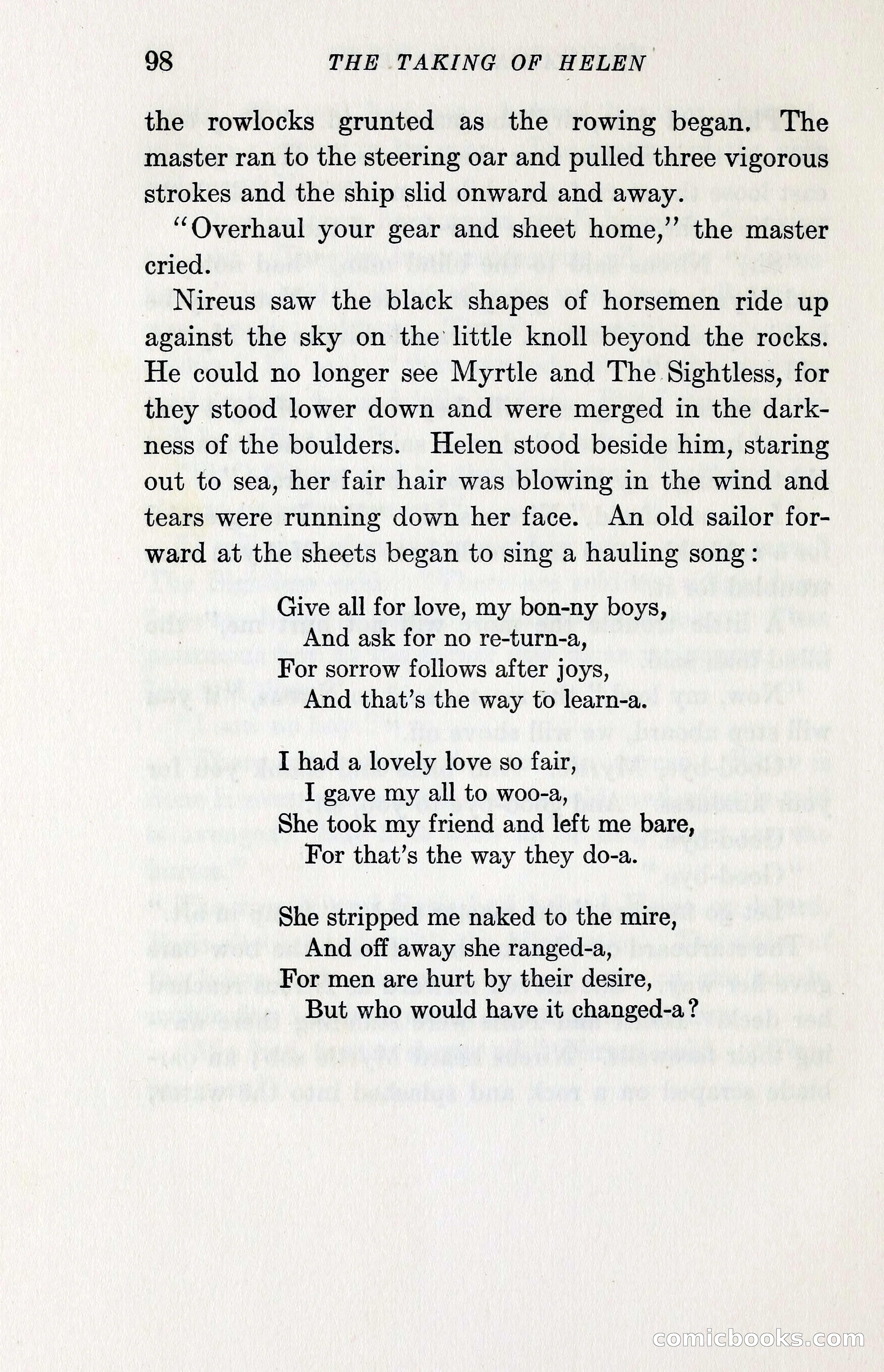
# Page Analysis: "The Taking of Helen" This is a page of running prose (page 98) from what appears to be a Victorian serialized narrative. The text describes a ship departing by rowboat, with a character named Nireus watching horsemen on shore while Helen stands beside him weeping. An old sailor sings a melancholic ballad about romantic betrayal and loss—a woman who took the singer's friend and stripped him of everything. The song's refrain questions whether anyone would change such painful desire. The narrative combines maritime adventure with themes of love, loss, and resignation to fate characteristic of penny dreadful melodrama.

# Analysis This is **not a page from a Victorian penny dreadful**. The image shows a **color reference card** (a "24ColorCard" by CameraTrax.com, visible at bottom center) placed on a textured black surface alongside Oregon Rule Co. measuring rulers. This appears to be a **photographic documentation setup**—likely used for calibrating color and scale in archival or scientific photography. The OCR'd text is largely corrupted and unreadable, which is unsurprising given the image depicts measurement tools rather than printed literature. This is modern archival equipment, not historical popular fiction.
# Assessment This is **not a page from a Victorian penny dreadful**. The image shows a **modern photograph of a color reference card** (a "24ColorCard" by CameraTrax.com) placed against a textured dark surface, with Oregon Rule Co. measurement scales positioned for photographic documentation purposes. The OCR'd text is largely corrupted noise from attempting to read the measurement rulers and card labels. This appears to be a reference photograph used in archival or documentary work, not a historical text page.