
Penny Dreadfuls, 1923 · page 20 of 116
The Taking of Helen by John Masefield — page 20: what you’re looking at
What you’re looking at
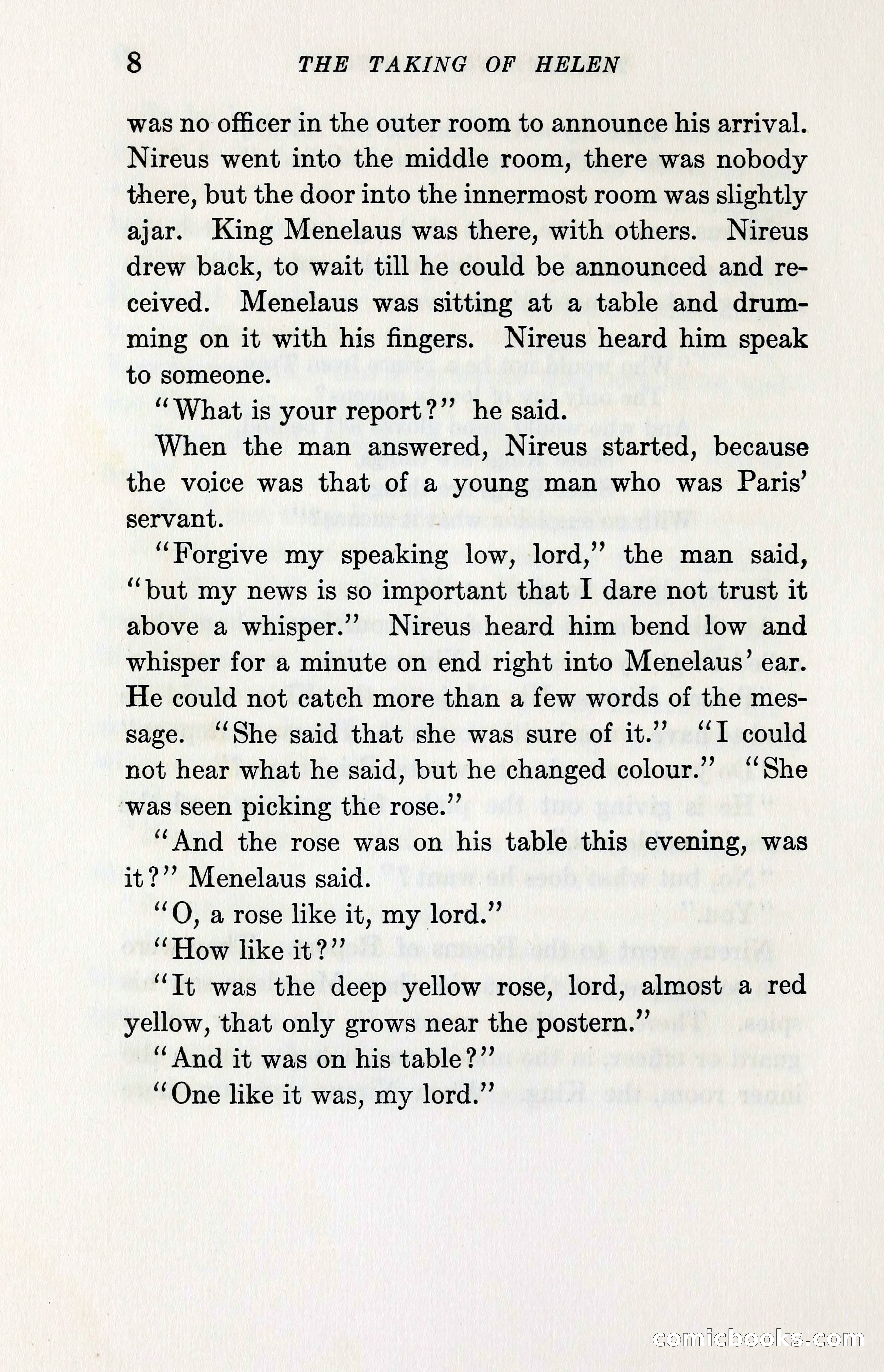
# Page 8: Running Prose from "The Taking of Helen" This is a page of running prose text from what appears to be a serialized Victorian narrative. A character named Nireus eavesdrops on King Menelaus questioning Paris's servant about secretly obtained information. The servant whispers a report involving a woman who picked a distinctive deep yellow rose (that grows near a postern) and placed it on someone's table. The conversation suggests intrigue and possible infidelity, with Menelaus attempting to extract details about the rose's presence as apparent evidence of clandestine activity.
📄 Transcribed text from this page (OCR, searchable)
Machine-transcribed from the original scan — historical spelling and the odd misread are preserved.
8 THE TAKING OF HELEN was no officer in the outer room to announce his arrival. Nireus went into the middle room, there was nobody there, but the door into the innermost room was slightly ajar. King Menelaus was there, with others. Nireus drew back, to wait till he could be announced and re- ceived. Menelaus was sitting at a table and drum- ming on it with his fingers. Nireus heard him speak to someone. “What is your report?” he said. When the man answered, Nireus started, because the voice was that of a young man who was Paris’ servant. “Forgive my speaking low, lord,’ the man said, “but my news is so important that I dare not trust it above a whisper.’”’ Nireus heard him bend low and whisper for a minute on end right into Menelaus’ ear. He could not catch more than a few words of the mes- sage. ‘‘She said that she was sure of it.” “I could not hear what he said, but he changed colour.”’ “She “was seen picking the rose.’’ ‘‘And the rose was on his table this evening, was it?’’ Menelaus said. ‘‘Q, a rose like it, my lord.” “How like it?” ‘Tt was the deep yellow rose, lord, almost a red yellow, that only grows near the postern.”’ ‘And it was on his table?”’ “One like it was, my lord.” CONnNIEDOOKS (EO)