
Penny Dreadfuls, 1923 · page 109 of 116
The Taking of Helen by John Masefield — page 109: what you’re looking at
What you’re looking at
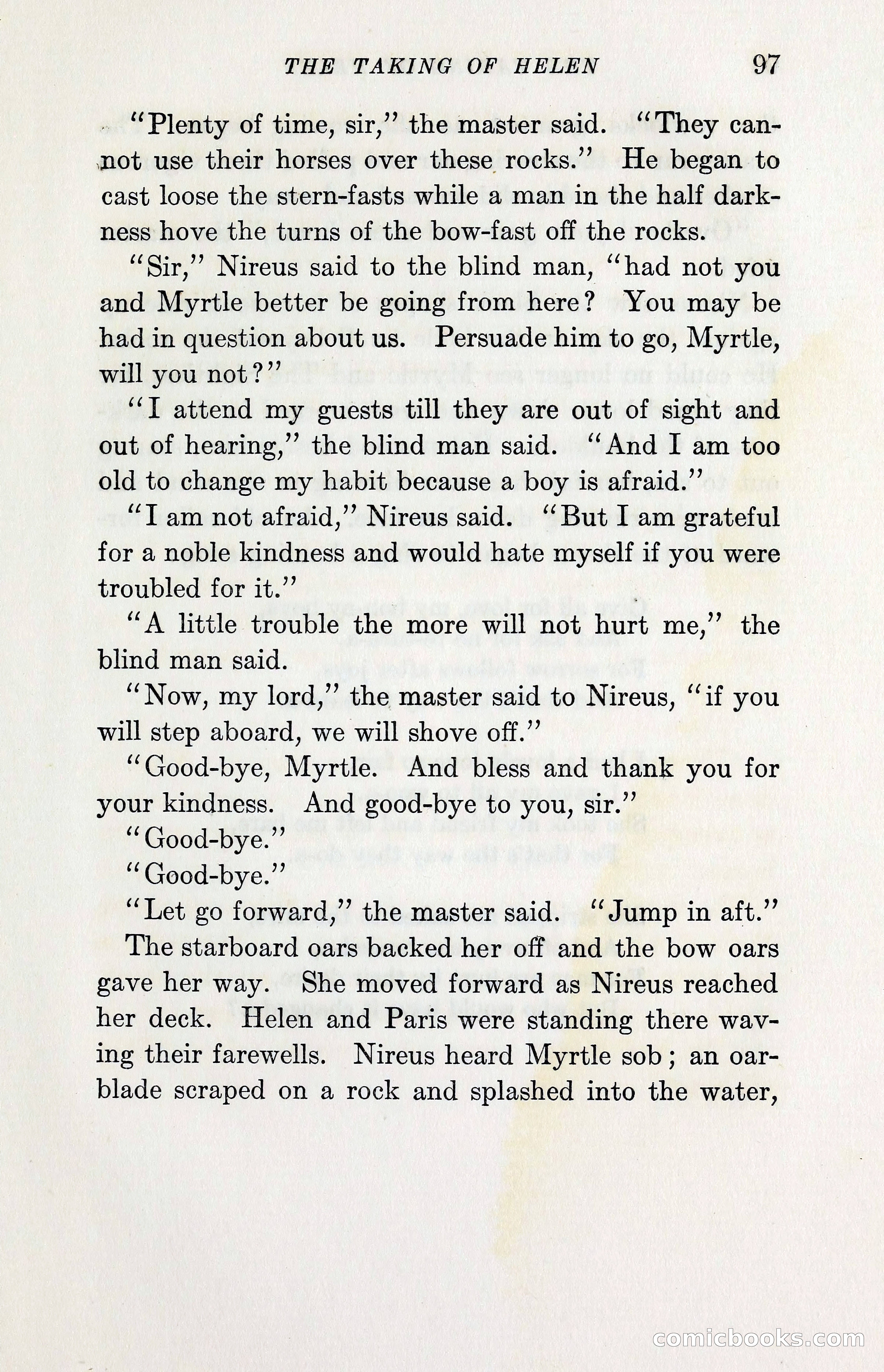
# Page Analysis This is a page of running prose from a Victorian penny dreadful titled "The Taking of Helen" (page 97). The text depicts a dramatic scene at a boat departure: a blind man and a woman named Myrtle say farewell to a young man named Nireus, who is boarding a vessel with characters identified as Helen and Paris. The master of the ship orders the crew to cast off and row away from the rocks. The passage emphasizes emotional farewells and the tension of escape, with sensory details like an oar-blade scraping rock and splashing into water.
📄 Transcribed text from this page (OCR, searchable)
Machine-transcribed from the original scan — historical spelling and the odd misread are preserved.
THE TAKING OF HELEN G7 . “Plenty of time, sir,’ the master said. ‘‘They can- not use their horses over these rocks.”” He began to cast loose the stern-fasts while a man in the half dark- ness hove the turns of the bow-fast off the rocks. “Sir,” Nireus said to the blind man, “had not you and Myrtle better be going from here? You may be had in question about us. Persuade him to go, Myrtle, will you not?”’ ‘““T attend my guests till they are out of sight and out of hearing,” the blind man said. ‘And I am too old to change my habit because a boy is afraid.”’ “Tam not afraid,’ Nireus said. “But I am grateful for a noble kindness and would hate myself if you were troubled for it.’’ | “A little trouble the more will not hurt me,” the blind man said. “Now, my lord,” the master said to Nireus, ‘if you will step aboard, we will shove off.” ‘Good-bye, Myrtle. And bless and thank you for your kindness. And good-bye to you, sir.”’ “Good-bye.” ‘“Good-bye.”’ “Let go forward,” the master said. ‘Jump in aft.” The starboard oars backed her off and the bow oars gave her way. She moved forward as Nireus reached her deck. Helen and Paris were standing there wav- ing their farewells. Nireus heard Myrtle sob; an oar- blade scraped on a rock and splashed into the water, CORIICLO@ SS) (C(O)