
Penny Dreadfuls, 1923 · page 98 of 116
The Taking of Helen by John Masefield — page 98: what you’re looking at
What you’re looking at
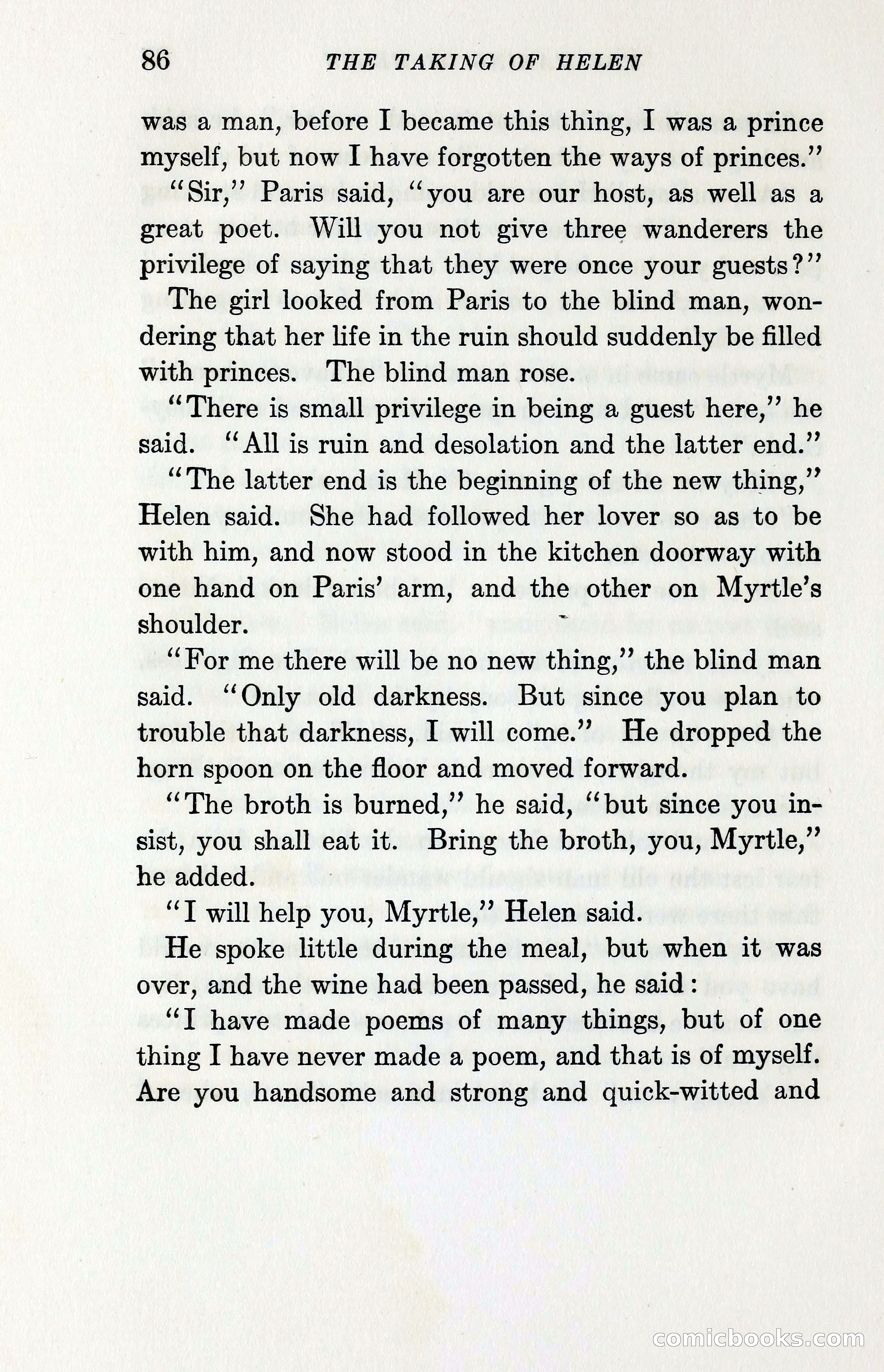
# Page Analysis: Running Prose from "The Taking of Helen" This is a page of running prose narrative (page 86) from what appears to be a Victorian novel titled *The Taking of Helen*. The text depicts a dialogue-heavy scene in which a blind poet-host, a character named Paris, and a woman named Helen (who has followed her lover) interact in a ruined dwelling. The blind man initially refuses to welcome guests, insisting "all is ruin and desolation," but ultimately agrees to join them for a meal of burnt broth. After eating and drinking wine, the blind poet begins to reflect on his literary output, noting he has never written a poem about himself before posing a question about the visitor's character. The passage emphasizes themes of ruin, new beginnings, and self-reflection.
📄 Transcribed text from this page (OCR, searchable)
Machine-transcribed from the original scan — historical spelling and the odd misread are preserved.
86 THE TAKING OF HELEN was a man, before I became this thing, I was a prince myself, but now I have forgotten the ways of princes.” “Sir,’’ Paris said, ‘you are our host, as well as a great poet. Will you not give three wanderers the privilege of saying that they were once your guests?”’ The girl looked from Paris to the blind man, won- dering that her life in the ruin should suddenly be filled with princes. The blind man rose. “There is small privilege in being a guest here,’’ he said. “All is ruin and desolation and the latter end.”’ “The latter end is the beginning of the new thing,” Helen said. She had followed her lover so as to be with him, and now stood in the kitchen doorway with one hand on Paris’ arm, and the other on Myrtle’s shoulder. ‘ “For me there will be no new thing,” the blind man said. ‘Only old darkness. But since you plan to trouble that darkness, I will come.’”’ He dropped the horn spoon on the floor and moved forward. “The broth is burned,” he said, ‘‘ but since you in- sist, you shall eat it. Bring the broth, you, Myrtle,” he added. “T will help you, Myrtle,’’ Helen said. He spoke little during the meal, but when it was over, and the wine had been passed, he said: “T have made poems of many things, but of one thing I have never made a poem, and that is of myself. Are you handsome and strong and quick-witted and CORnNICLOOKS».EO