
Penny Dreadfuls, 1923 · page 46 of 116
The Taking of Helen by John Masefield — page 46: what you’re looking at
What you’re looking at
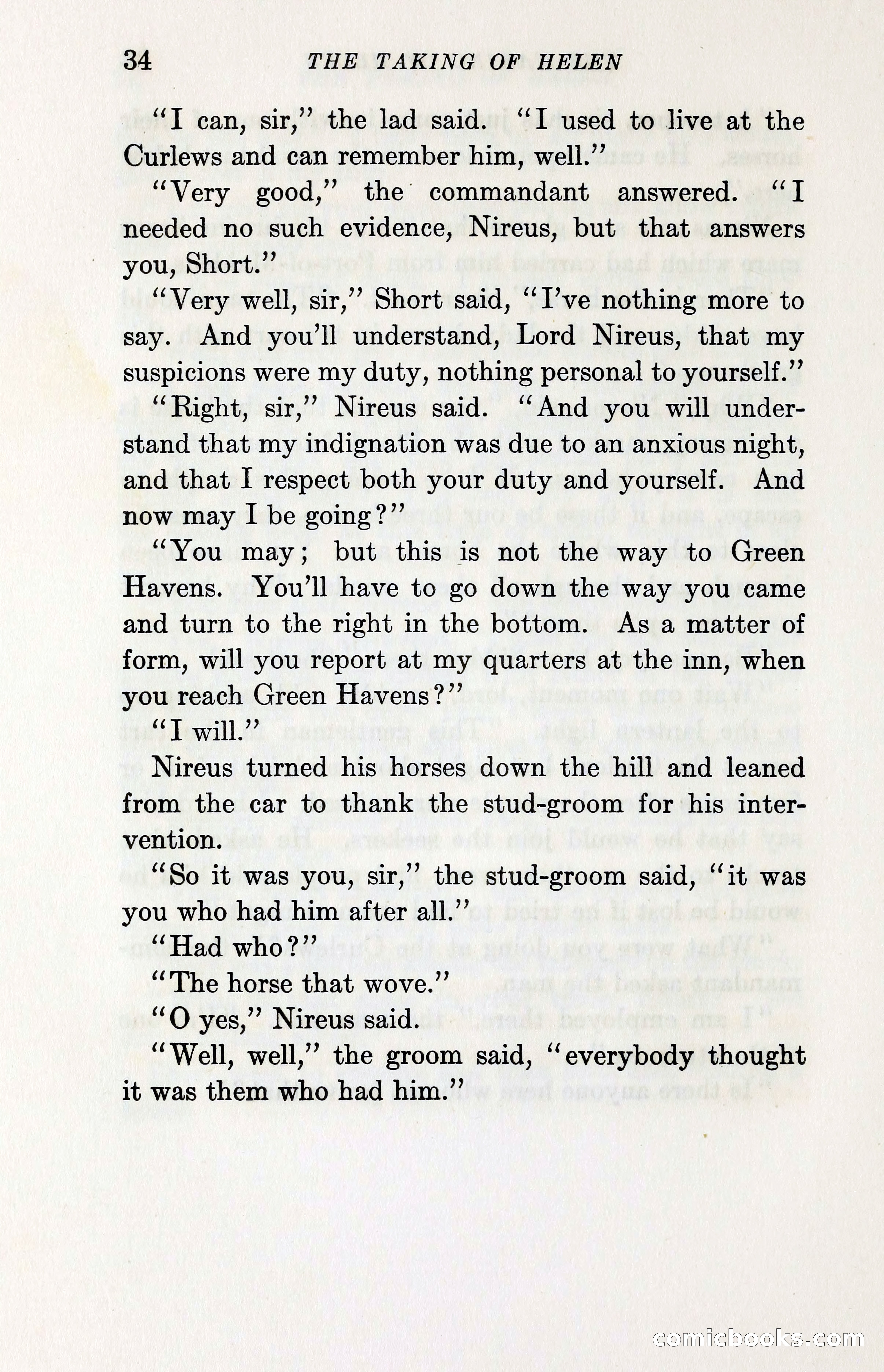
# Page from "The Taking of Helen" This is a page of running prose text (page 34) from a Victorian sensation novel titled "The Taking of Helen." The dialogue depicts a tense but ultimately cordial exchange between a commandant named Lord Nireus and a man called Short, who has apparently been suspicious of Nireus regarding a horse. After Short's suspicions are resolved through a young man's testimony about knowing Nireus from the Curlews, the two men part amicably. A stud-groom then reveals to the departing Nireus that everyone had mistakenly believed *someone else* possessed "the horse that wove"—implying a mystery or misunderstanding about the animal's ownership.
📄 Transcribed text from this page (OCR, searchable)
Machine-transcribed from the original scan — historical spelling and the odd misread are preserved.
34 THE TAKING OF HELEN “T ean, sir,” the lad said. “I used to live at the Curlews and can remember him, well.”’ “Very good,’ the commandant answered. ‘I needed no such evidence, Nireus, but that answers you, Short.” “Very well, sir,” Short said, “I’ve nothing more to say. And you'll understand, Lord Nireus, that my suspicions were my duty, nothing personal to yourself.”’ “Right, sir,’ Nireus said. “‘And you will under- stand that my indignation was due to an anxious night, and that I respect both your duty and yourself. And now may I be going?”’ “You may; but this is not the way to Green Havens. You'll have to go down the way you came and turn to the right in the bottom. As a matter of form, will you report at my quarters at the inn, when you reach Green Havens?’ “T will.” Nireus turned his horses down the hill and leaned from the car to thank the stud-groom for his inter- vention. ‘So it was you, sir,’ the stud-groom said, “it was you who had him after all.” “Had who?” “The horse that wove.”’ “QO yes,’”’ Nireus said. “Well, well,” the groom said, “everybody thought it was them who had him.’’ COnnIENOOKS (C(O)