A complete issue · 258 pages · 1812
Psyche, and other poems
This page is a text page from a Victorian penny dreadful, though the OCR rendering is heavily corrupted and largely illegible. The image shows dense printed text in multiple columns, appearing dark and degraded, making accurate transcription impossible. The watermark "comicbooks.com" is visible at the bottom right. Without clearer source material or successful OCR, the actual narrative content—whether sensational crime, horror, or melodrama—cannot be reliably determined from this particular page.
This is a library classification page from a Victorian-era publication. The page features the Library of Congress seal dated 1800, with an eagle emblem at the top. Below the seal are handwritten catalog entries: "Class PR5671" and "Book .T2 A7," with what appears to be "1812" written below. The page itself is largely blank cream-colored paper, typical of endpapers or title pages in period publications. This appears to be a cataloging or ownership page rather than content-bearing text, marking the book's classification within a library system.
# Analysis This is a heavily degraded page from a penny dreadful, likely showing running prose text rather than an illustration or title page. The image quality is extremely poor—the page appears water-damaged or heavily aged, with significant discoloration in purple, pink, and gray tones that obscures most content. The OCR text is largely illegible, yielding only "icbhooks" (likely a watermark or footer), "Si.* 5" (possibly a page or issue number), and "see" (a single word fragment). Due to the severe deterioration and minimal legible text, the specific plot details or subject matter of this particular page cannot be reliably determined from the visible evidence.

This page appears to be heavily degraded and largely illegible, making definitive analysis difficult. The image shows what seems to be a printed page with text, but the scan quality is extremely poor—characterized by significant discoloration, pixelation, and color distortion (predominantly purple, green, and brown tones) that obscures most readable content. Small dark marks and specks are scattered across the surface, suggesting age and deterioration. While the OCR text field is empty, this appears to be either running prose or possibly an illustration page from a penny dreadful publication, but the actual textual or visual content cannot be reliably determined from this degraded image. The page's original subject matter remains unclear.

# Assessment This page is largely illegible due to severe degradation, discoloration, and image quality issues. The visible content appears to be textured or illustrated rather than clearly printed prose. While a small watermark reading "comicbooks.com" is visible at the bottom, and what may be page numbering or reference markers appear in the image, the actual text content of the Victorian penny dreadful page cannot be reliably read or transcribed from this photograph. The purple and blue tonal variations suggest either an illustration or heavily stained/aged print, but specific content remains indecipherable. A higher-quality scan would be necessary to identify whether this is prose, an illustration, or advertisement, and what its subject matter actually is.

# Assessment This page is **heavily degraded and largely illegible**. The image shows what appears to be a scanned Victorian-era publication page with significant color distortion—patches of orange, pink, blue, green, and cream tones distributed across a textured surface. There are a few dark marks or lines visible, but no readable text is discernible in the image itself. The OCR text provided is nearly useless, containing only fragments ("ho.'", "'a sd", "*%") and a watermark ("comicbooks.com"). **Conclusion**: The page's content cannot be reliably determined from either the image or the OCR text. It may be an illustration, prose page, or title matter, but deterioration and scanning artifacts prevent confident identification of what this penny dreadful page actually contains.

# Analysis This page is largely illegible in the image provided. The photograph shows what appears to be aged paper with significant staining, discoloration, and deterioration—brown and rust-colored marks scattered across a light background. There are a few small dark marks or spots visible, but no clearly readable text is discernible from the image itself. The OCR text at the bottom appears to be a watermark or source attribution ("comicbooks.com") rather than content from the page. Without legible text or illustrations visible in the image, I cannot determine whether this is a title page, illustration, or running prose, nor can I describe what the page's content actually addresses. The document's condition has rendered it essentially unreadable in this reproduction.
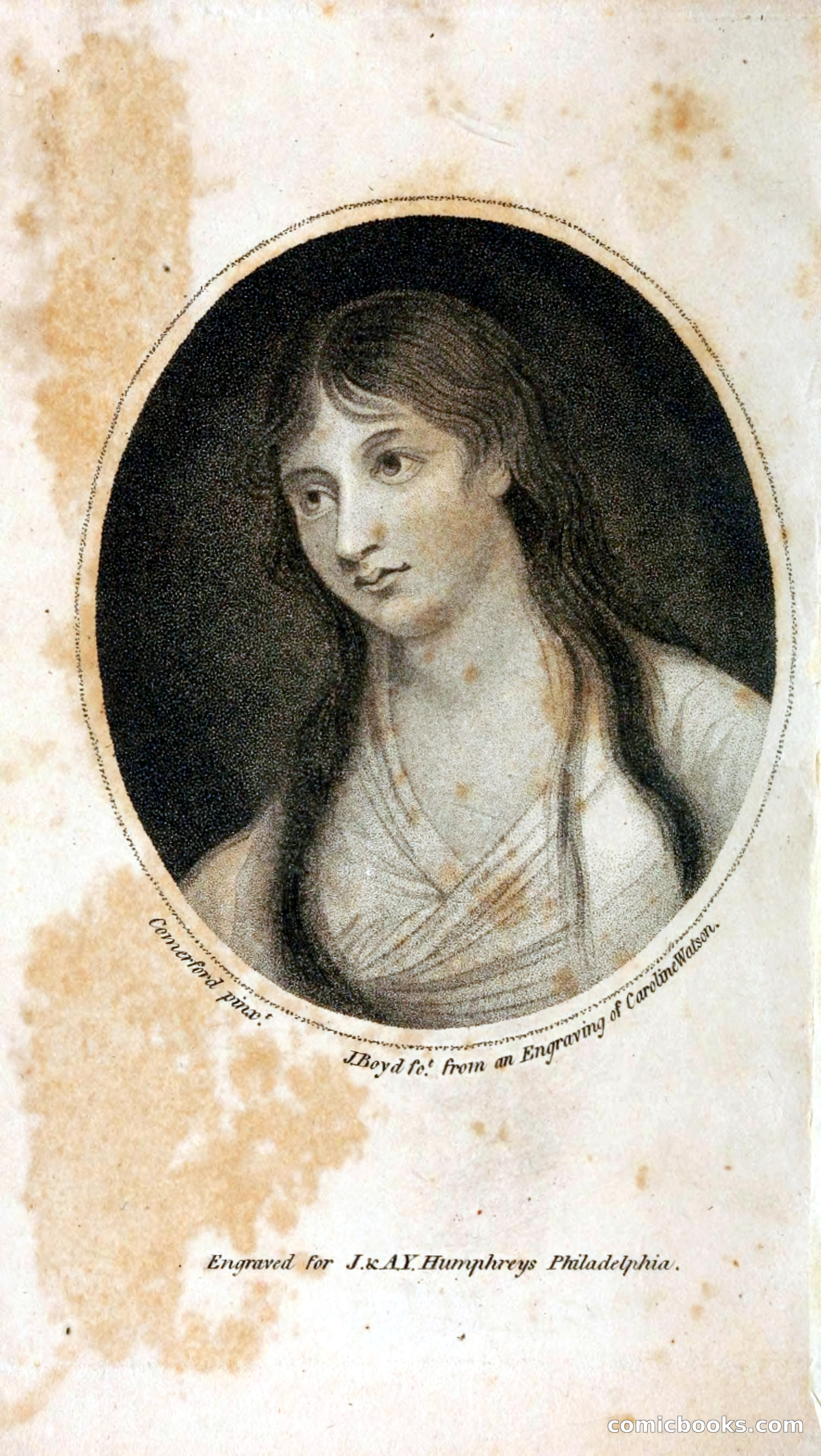
This page features a portrait engraving of a woman in classical style, set within an oval frame. The subject has long dark hair and wears a draped white garment against a dark background. The caption beneath reads "Boyd Esq! from an Engraving of Carolina Matilda" and credits the engraving to "J. & A.Y. Humphreys Philadelphia." The image appears to be a frontispiece or illustrative plate rather than running text, typical of early American publication practices. The worn, aged appearance of the paper and the OCR errors suggest this is from an old printed source, though the specific penny dreadful context remains unclear from the visible text alone.
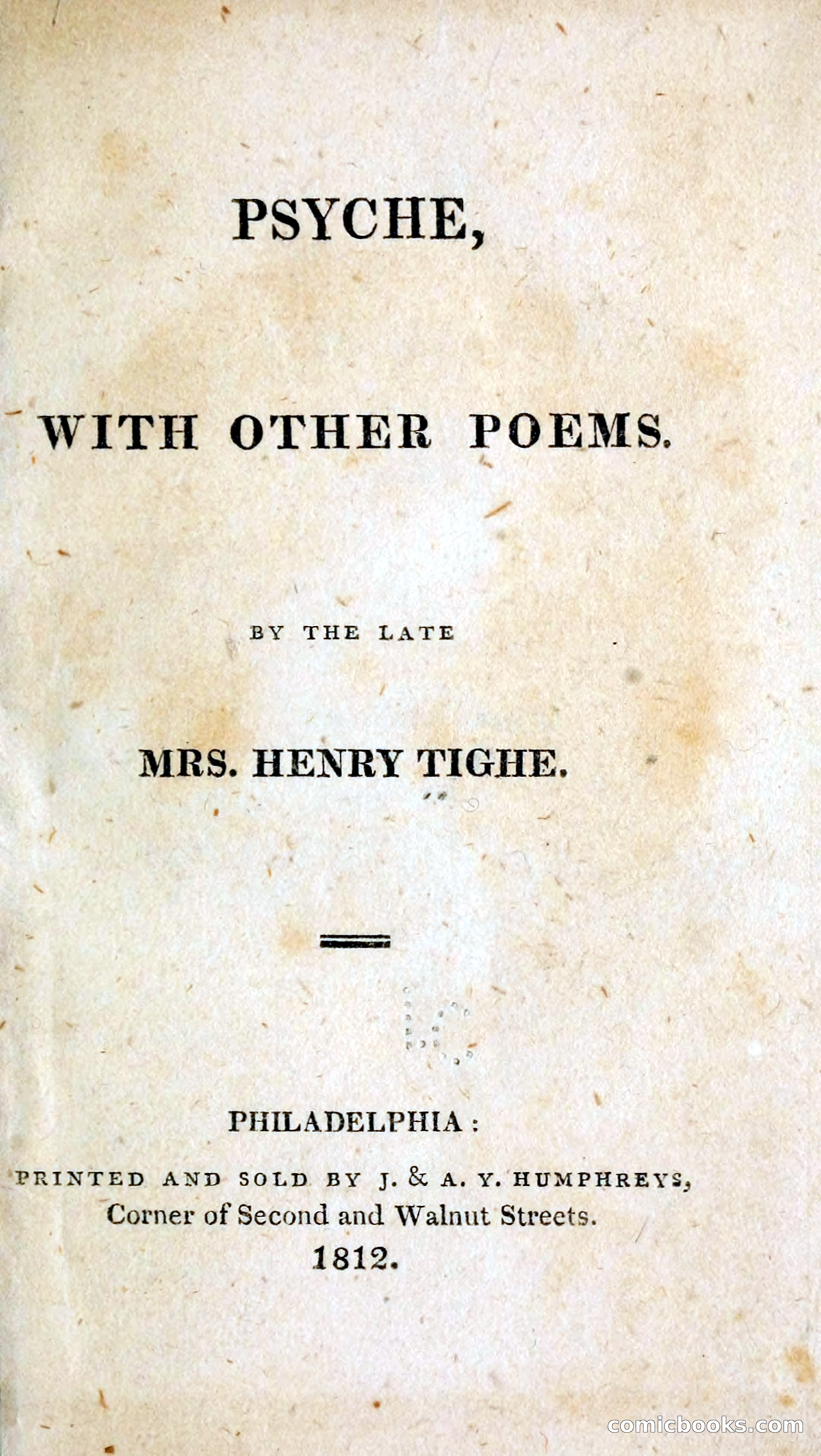
This is a title page from an 1812 Philadelphia edition of poetry. The page announces "Psyche, With Other Poems" by the late Mrs. Henry Tighe, printed and sold by J. & A. Y. Humphreys at the corner of Second and Walnut Streets. The aged, cream-colored paper and formal typography are characteristic of early nineteenth-century book production. However, this is not a Victorian penny dreadful—it predates the Victorian era and appears to be a standard poetry collection, not serialized sensation fiction.
# Victorian Penny Dreadful Page Analysis This appears to be a **back cover or endpaper** of a Victorian penny dreadful publication. The page is largely blank aged paper with visible staining and deterioration. The only meaningful text visible is a cataloging stamp reading "Source unknown" with what appears to be a date of "FEB 18 1911," suggesting this is a library or archive copy. At the top of the page are handwritten notations including what reads "PR5671," "T2 A7," and "1812"—likely call numbers or acquisition information. The bottom contains a website reference "comicbooks.com." The page contains no narrative text, illustrations, or advertisements visible.
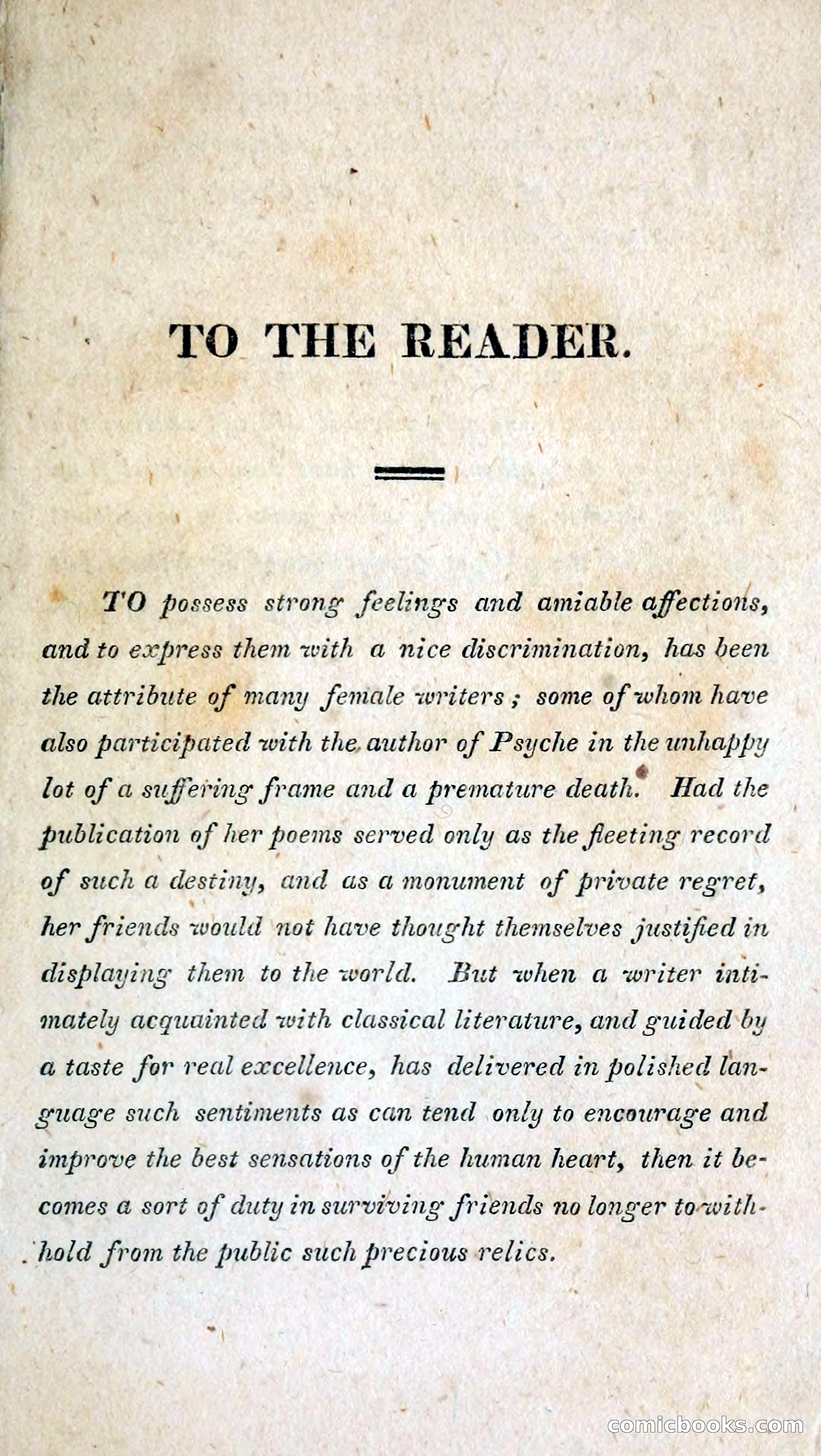
# Page Description This is a prefatory address "TO THE READER" in italicized prose. The text justifies publishing the poems of a deceased female writer (referred to as the author of *Psyche*), arguing that while private grief alone would not warrant public display, the literary merit and moral sentiment of her work—expressed in polished language and rooted in classical learning—creates a duty for surviving friends to share these "precious relics" with the world. The passage emphasizes that excellent writing capable of improving human sentiment transcends private sorrow and merits public circulation.
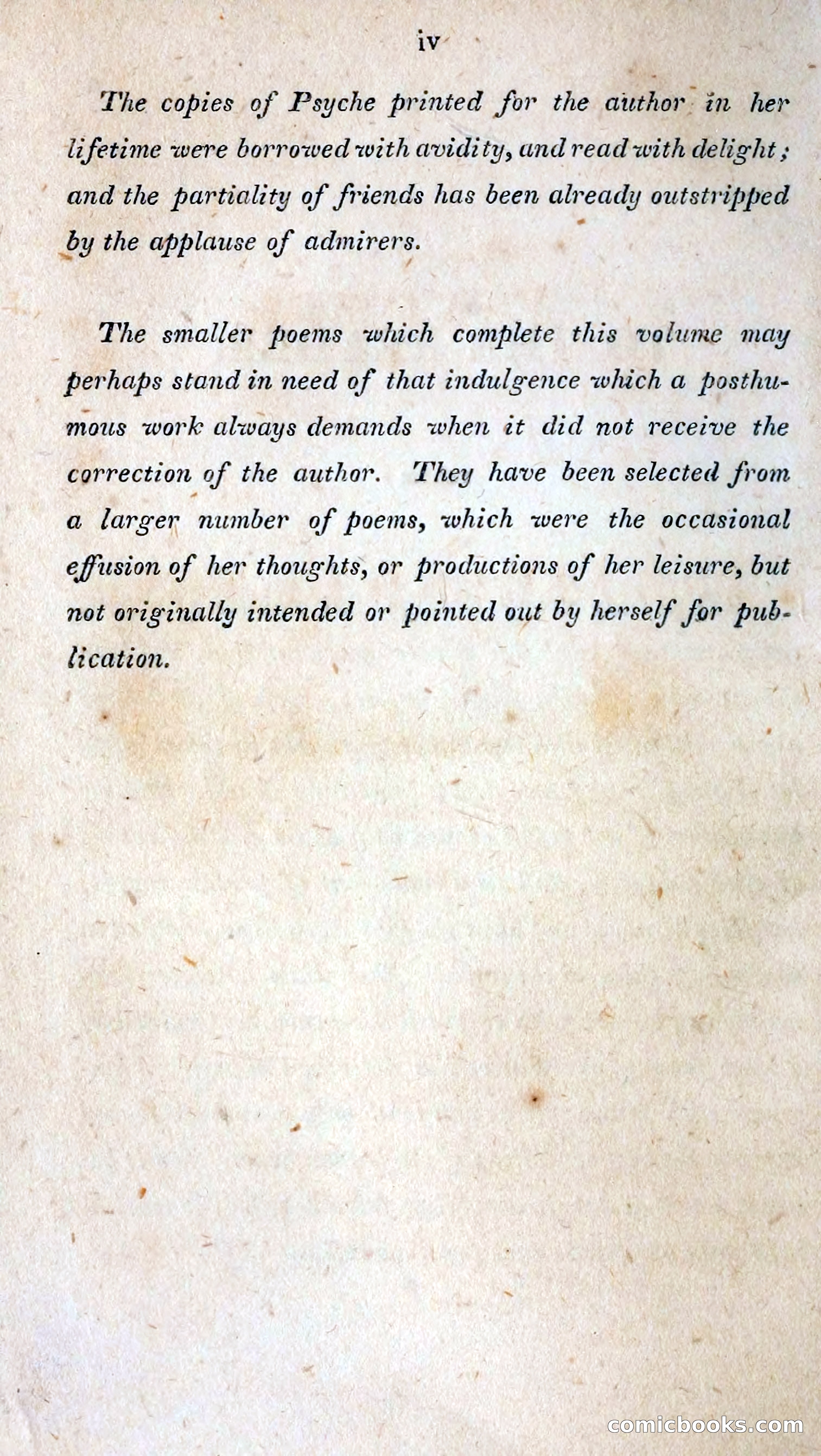
This is a prefatory page (likely page iv of front matter) from what appears to be a posthumous poetry collection. The text explains that copies of a work called "Psyche" circulated widely during the author's lifetime and gained admiration. It then introduces smaller poems completing the volume, asking readers' indulgence since they are posthumous work lacking the author's final corrections. These poems were selected from a larger body of occasional verses the author wrote for private reflection or leisure, rather than for publication. The page is entirely prose—no illustrations or advertisements.
This is a title page from a Victorian penny dreadful. The main title reads "PSYCHE; OR, THE LEGEND OF LOVE," presented in large decorative typography on aged, cream-colored paper with visible foxing and stains. Below the title appears a Latin epigraph attributed to Martial: "Castos docet et pios amores" (roughly, "teaches chaste and devoted loves"). The page bears a signature mark "A 2" at the bottom, indicating this is the second leaf of the preliminary matter. The typography and paper quality are consistent with nineteenth-century cheap serialized fiction.

# Analysis This page appears to be heavily degraded or damaged, making definitive interpretation difficult. The image shows a textured, worn surface with scattered discoloration in browns, grays, and muted colors—consistent with aged paper from a Victorian-era publication. The OCR text is largely corrupted and illegible, yielding only fragmentary characters and what appears to be a watermark or website reference ("comicbooks.com") at the bottom. **Verdict:** I cannot reliably determine whether this is a title page, illustration, or prose page, nor can I accurately describe textual content. The page quality is too compromised to meet the accuracy standard required. It may be a cover, text page, or illustration, but visible evidence is insufficient for confident identification.
# Analysis This is a preface page from a reprinted edition of a work titled *Psyche*, originally printed in 1805. The author addresses readers with self-deprecating modesty, acknowledging that while professional authors must accept indifferent public reception, those writing for friends' appreciation naturally hope for favorable judgment. The author requests forgiveness for recommending their own tale enthusiastically, while excusing various literary shortcomings—except, they ruefully note, the one deficiency they cannot excuse: insufficient genius. The tone is genteel and reflective rather than sensational, though the document's appearance and OCR source suggest it may be part of a later penny dreadful reprint or related popular edition.
# Page viii: Prefatory Justification This is a prefatory page (marked "viii") containing the author's defense of their work. The text explains the author's choice to write an allegory about "Love and the Soul," anticipating criticism from strict moralists while insisting they have depicted only "innocent love." The author quotes La Rochefoucault in French, defends allegory as a legitimate poetic tradition by citing classical precedent, and acknowledges their inability to resist the subject's appeal. The page mixes italic prose with roman-type quoted verse, typical of Victorian prefaces justifying the moral propriety of their narratives.
# Analysis of Page ix This is a prefatory page (numbered ix in Roman numerals) containing authorial prose—likely from an introduction or preface rather than the narrative itself. The author discusses compositional choices: explaining the deliberate simplicity of their verse to ensure clarity, avoidance of obsolete Spenserian language, and justification for adopting a particular stanza form despite its disadvantages (recurring rhymes ill-suited to English). The author also acknowledges drawing the outline of their tale about Cupid and Psyche from Apuleius for the first two cantos, while claiming originality beyond that source and independence from French and Italian treatments of the same material.
# Page Analysis This is a prefatory page of prose text (not a cover, title page, or illustration). The author, signing as "M.T.," offers a defensive preface acknowledging potential charges of plagiarism. The writer claims that any unattributed expressions or ideas were adopted unconsciously from memory rather than deliberately copied, and appeals to a Latin quotation from Terentius excusing poetic carelessness over intentional theft. The author further requests forgiveness for not rigorously documenting sources, attributing this laxity to an indulged taste for a particular reading style. The page functions as a disclaimer common to Victorian serialized fiction.
This is a text page containing a sonnet titled "Sonnet Addressed to My Mother." The poem is a sentimental dedication expressing the speaker's gratitude to his mother, crediting her tender smile, love, and affectionate voice for inspiring his literary work and shaping his grateful heart. The verse follows a traditional sonnet structure and celebrates maternal affection as a formative influence on the speaker's soul and creative endeavors.
This appears to be a decorative epigraph or quotation page from a book, printed on aged cream paper with visible foxing and stains. The text is an Italian verse passage, likely from Ludovico Ariosto's Elegy XII, addressing themes of love and desire—specifically how a pilgrim spirit is elevated by beautiful love, and how sweet it is to believe oneself cherished by one's beloved alone. The attribution to "Ariosto, Eleg. XII" appears at the bottom. This type of classical literary epigraph was common as a frontispiece or introductory element in Victorian-era fiction. The watermark visible indicates this is from comicbooks.com's digitization.
This is a heavily degraded page from a Victorian penny dreadful showing the word "PSYCHE" in bold black type as what appears to be a chapter or section heading. The surrounding text is largely illegible due to age, staining, and poor OCR quality, making it impossible to determine specific plot details or narrative content. The page shows significant foxing and discoloration typical of aged Victorian-era printed materials. Based on the visible heading alone, this page appears to introduce a section or chapter concerning a character or concept named Psyche, but the actual narrative content remains unclear from the legible text.
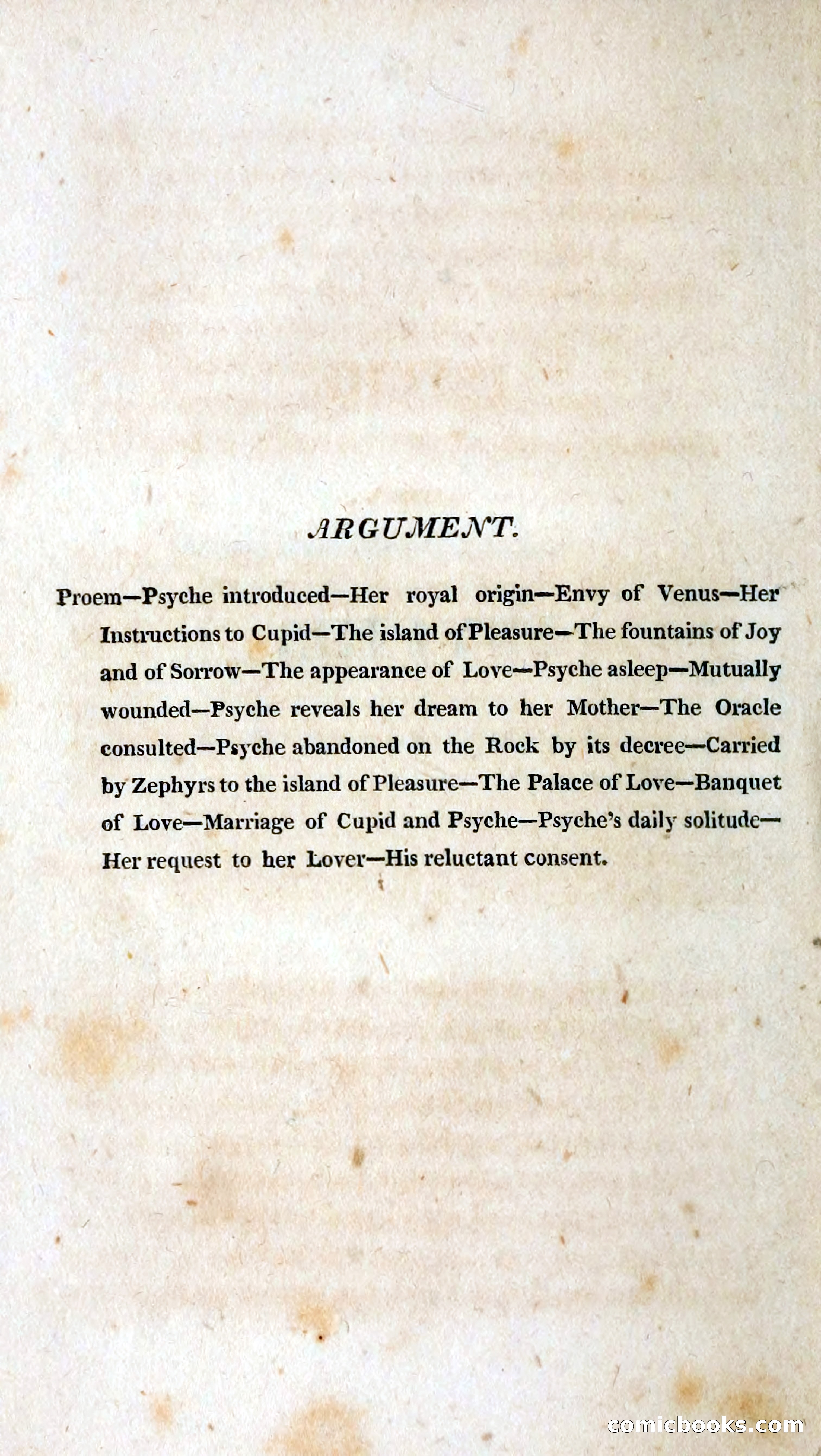
# Analysis of Page This is an **argument page** (plot summary/contents listing) from what appears to be a Victorian poetic or narrative work retelling the classical myth of Psyche and Cupid. The page lists the sequential events of the story: Psyche's introduction and royal origins, Venus's envy, Cupid's instructions, the magical island setting, their meeting and mutual attraction, Psyche's consultation of an oracle, her abandonment and rescue by Zephyrs, her marriage to Cupid, and her subsequent loneliness and request to see her family. The aged paper and typography suggest this is indeed from a Victorian-era publication, though whether it qualifies as a "penny dreadful" (typically sensational crime or horror) is unclear—this reads more like serialized romantic or mythological poetry.
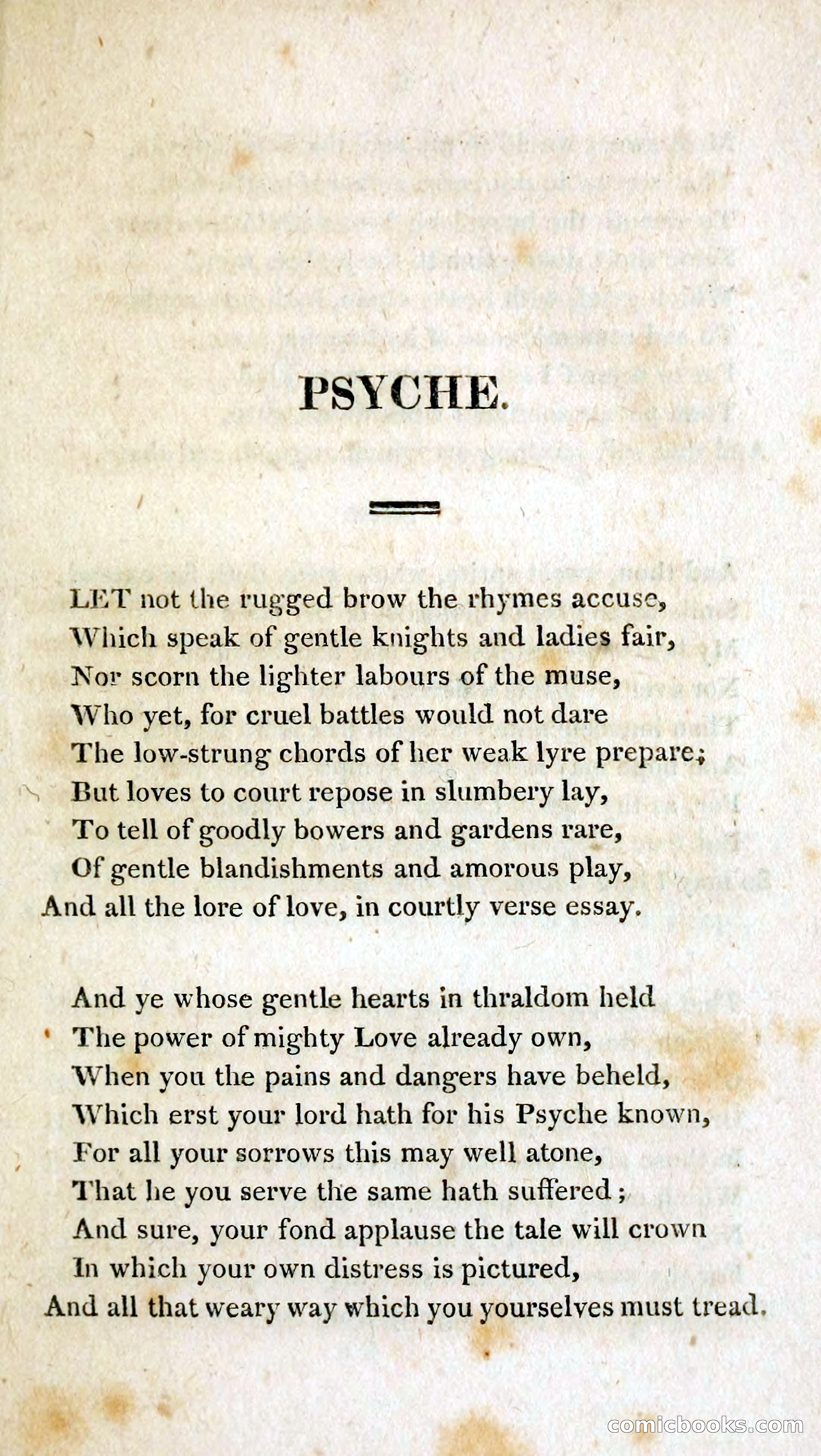
# Page Analysis This is a title page or prefatory poem for a work titled "PSYCHE." The page presents verse in a classical style rather than the sensational prose typical of penny dreadfuls. The poem addresses readers, asking them not to scorn lighter romantic verse, and dedicates the tale to those who have experienced love's "pains and dangers." It promises that the story of Psyche—apparently suffering trials for her lord—will resonate with readers who recognize their own "distress" and hardships in the narrative. The text appears to be an introduction or dedication rather than the main story itself.
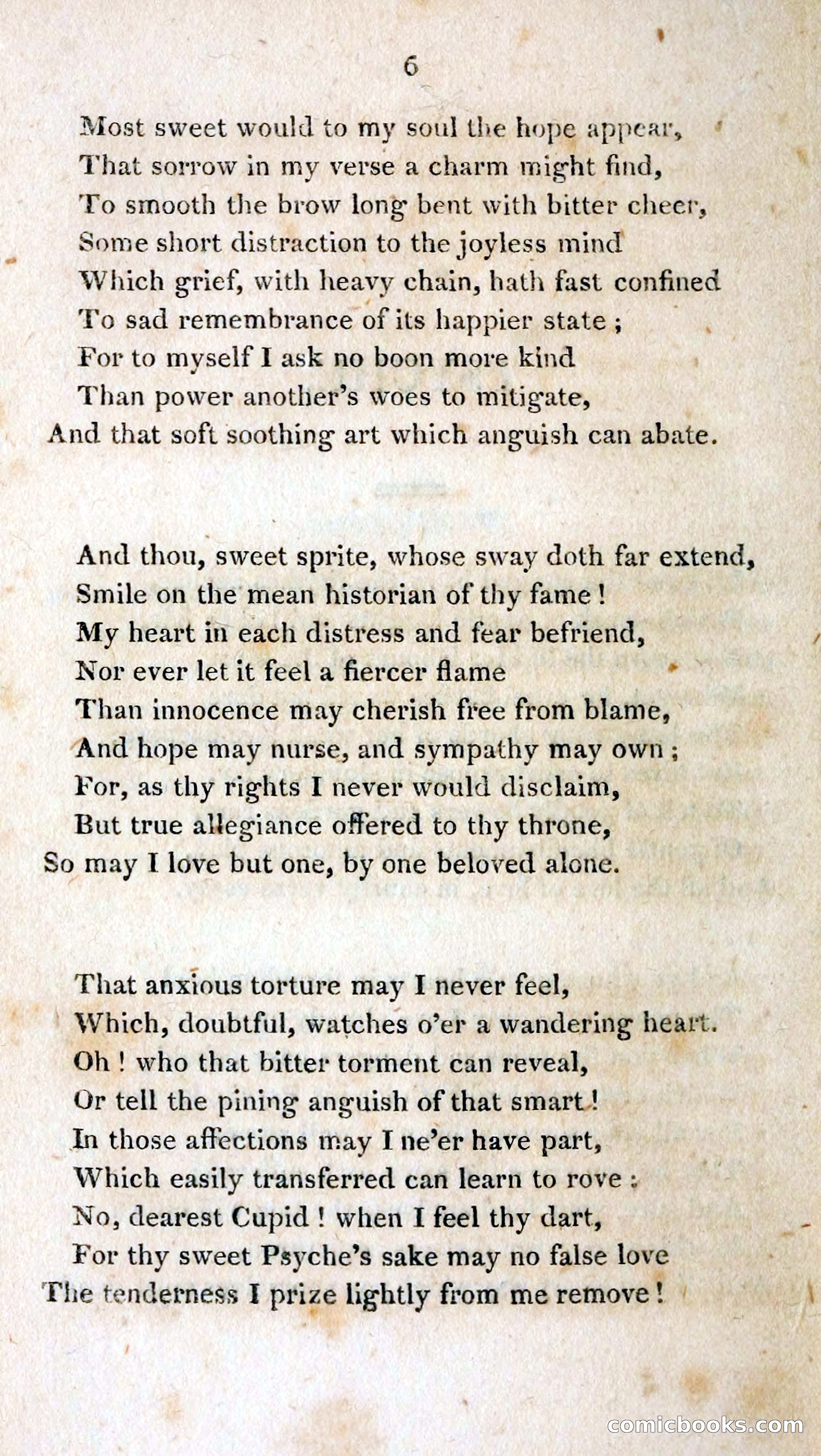
# Page 6 of a Victorian Penny Dreadful This is a text page containing verse—specifically, a lengthy poetic passage numbered "6." The poem addresses themes of emotional suffering and romantic devotion, appealing to a "sweet sprite" (apparently Cupid) for protection from inconstancy and false love. The speaker requests the power to ease others' sorrows and asks for constancy in devotion to a single beloved, invoking Psyche. The verse employs formal rhyming couplets and elevated diction typical of sentimental Victorian poetry. No illustration or advertisement is visible; this appears to be running narrative or lyrical content from the serialized work.
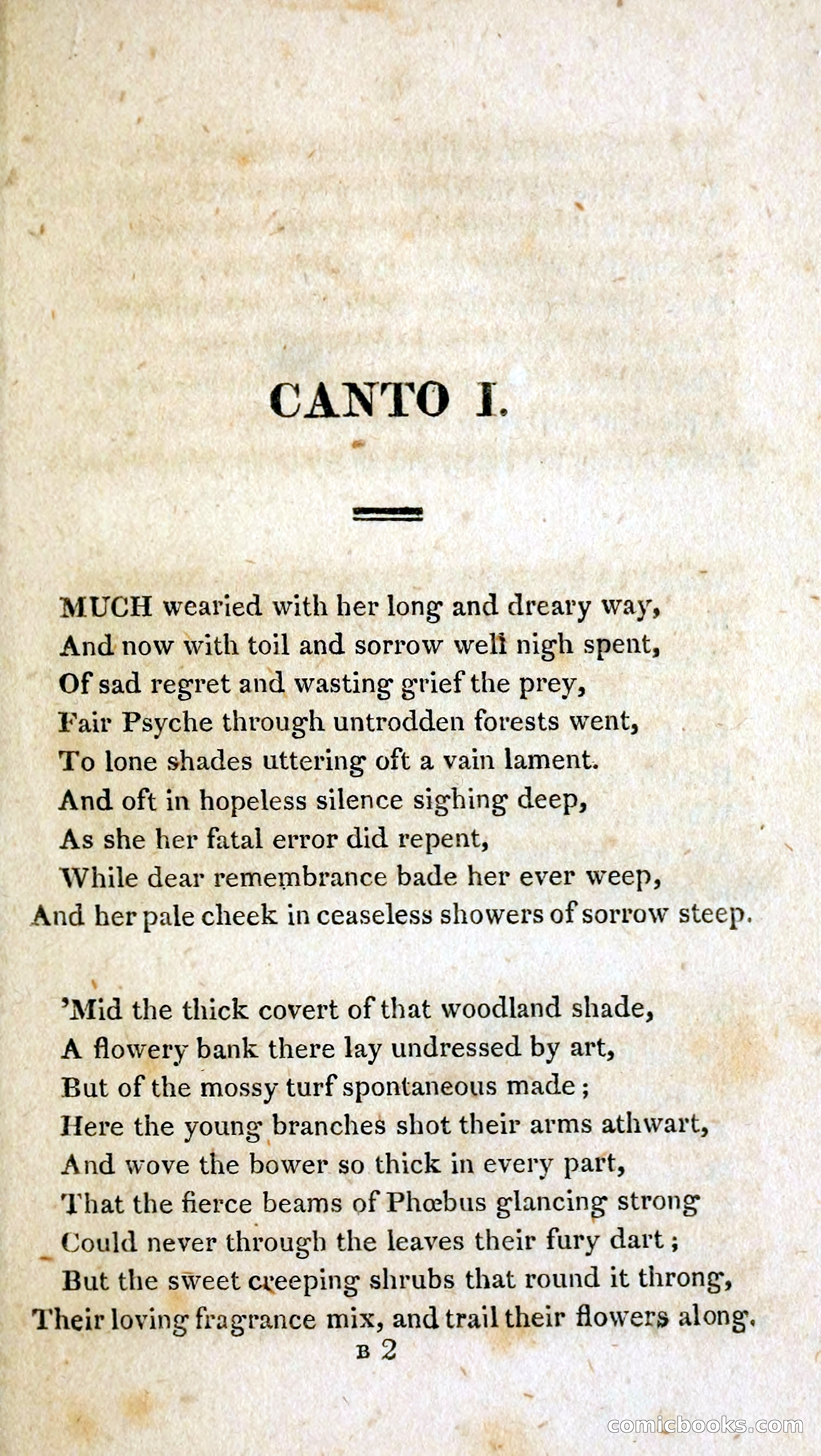
# Page Analysis This is a running prose page from what appears to be a narrative poem. It presents "Canto I" of a work featuring a character named "Fair Psyche" wandering through forests in a state of emotional distress—wearied, sorrowful, and repenting a "fatal error." The verse describes her lonely lamentation and then shifts to depict a sheltered woodland bower with dense vegetation and fragrant shrubs that block out the sun's rays. The page is printed in double-column format typical of Victorian serialized fiction, with a signature mark "B 2" at the bottom indicating this is sheet B, leaf 2 of the printing.
# Page Analysis This is a page of running verse poetry (section 8) from what appears to be a narrative poem. The text describes a character named Psyche discovering a peaceful bower with a fountain and resting there. She reflects on her sudden reversals of fortune—raised to "high estate" then "plunged...low in sorrow desolate"—while the narrator elaborates on her physical beauty, describing her golden hair, graceful form, and angelic appearance. The passage emphasizes her distress amid idealized aesthetic description, typical of sensational Victorian verse narrative.
This is a page of running verse poetry (page 9) from what appears to be a narrative poem. The text describes a royal maiden of extraordinary beauty who travels alone through the forest. Though many princes have courted her, she remains unmoved by their advances. The passage notes that her beauty is so remarkable that people have abandoned worship of Cytherea (Venus) to revere her instead as "fair Psyche," invoking divine rites. The final stanza reveals that her envious sisters, poisoning their father's mind with false piety, have convinced him to forbid the crowds of worshippers who gather at the royal hall to honor her. The verse employs classical mythology and romantic melodrama typical of Victorian popular literature.
# Page 10 of a Victorian Penny Dreadful This is a page of running prose—specifically narrative poetry in rhyming couplets and stanzas. The text describes a female character (compared to a timid winter flower) who has been rejected or wronged and retreats to isolation. The passage appears to reference "Cytherea" (likely a classical or mythological allusion) withdrawing to an island, abandoning her usual charm and social power. The final stanza shows her calling her son with unaccustomed anger and rage rather than her typical delightful voice, commanding him to obey her vengeful will. The overall mood is one of wounded pride transforming into malevolent scheming.
# Page 11 of a Victorian Penny Dreadful This is a page of running verse prose, numbered 11, containing poetic dialogue. The visible text presents a goddess (apparently Venus, based on references to "beauty's queen") pleading with her son for vengeful intervention against a rival—identified as Psyche. The goddess demands that her rival be made to suffer through love's arrows and humiliation, stripped of honor and fame. The passage draws on classical mythology, depicting Venus's rage at a mortal woman who has challenged her supremacy in beauty and devotion. The verse is composed in a dramatic, melodramatic style typical of sensational Victorian literature.
This is a page of running verse poetry (page 12 of what appears to be a longer work). The text describes a romantic and emotional scene: a woman gives a man a kiss but then, driven by anger, pushes him away and sends him off to seek suffering. The passage then shifts to describe an idealized, paradise-like island landscape adorned with eternal spring, beautiful natural features, and personified allegorical figures (Pleasure, the Hours, Hope, Joys) inhabiting fertile lawns and glades. The verse employs elaborate Romantic-era imagery and diction typical of early-nineteenth-century popular literature.
# Page 13 of Victorian Penny Dreadful This is a page of running verse poetry (page 13 of a serialized narrative). The text describes two fountains on an island: one pure and benign, the other corrupt and destructive. The "black deformed stream" spreads poison through the landscape, "forbidding every kindly prosperous growth," while its waters symbolically carry human suffering—anguish, hopeless tears, jealousy, and shame. The passage uses the contrast between the two fountains as an allegory for virtue and vice, with the poisonous stream representing moral corruption and emotional torment.
# Page 14 - Poetic Narrative Text This is a running page of verse (numbered 14), presenting ornamental poetry in stanza form. The text describes an idealized stream and garden of love, then contrasts this with mortal experience—where Fortune corrupts romantic happiness with sorrow and suffering. The passage then shifts to mythological narrative, referencing Cupid, Venus, and Psyche, describing how Cupid fills an amber vase with grief-distilled drops as punishment for Psyche. The verse employs elaborate metaphors of love as a poisoned draught and mingles classical allusion with sentimental melodrama typical of Victorian literary taste.
# Page 15: Running Prose This page contains verse narrative describing a mythological scene. An ornately-adorned male figure (described with gems, gold plumes, and attendant Zephyrs) approaches the sleeping chamber of "the royal maid" Psyche, who lies on a purple couch in a transparent veil. The text describes her beauty in detail, then narrates how the figure pours "fatal drops" upon her while she sleeps, unaware that this mysterious act will bring future suffering—suffering that even the perpetrator, though divine, cannot foresee. The passage appears to retell the classical Psyche and Cupid myth in elevated poetic language typical of Victorian sensation literature.
# Page 16 of a Victorian Penny Dreadful This is a page of running verse text from what appears to be a narrative poem. The passage depicts a supernatural or mythological scene in which an unseen figure (apparently Cupid, based on references to darts and divine attributes) wounds a sleeping woman identified as "Psyche" with a magical dart. The text describes how she awakens, how the figure accidentally wounds himself on his own dart, and how Psyche subsequently declines into melancholy—losing her vitality, avoiding crowds, and eventually confessing her secret sorrow to her mother. The verse employs romantic and sensational language typical of Victorian popular literature.
# Page 17: Running Verse This is a page of running verse (poetry), numbered 17, likely from the middle of a serialized narrative. The text describes a young woman troubled by vivid dreams and visions of a beautiful youth who appears to be her rescuer or deliverer. The poem recounts how she experiences a supernatural or semi-real encounter with this figure, becomes consumed with longing for him, and subsequently pines away while her anxious parents seek divine intervention through holy shrines and auguries to avert some threatened danger to her.
# Page 18 of a Victorian Penny Dreadful This is a page of running verse narrative, printed in double columns. The text describes a dramatic scene from what appears to be a retelling of the myth of Psyche: a milk-white bull is sacrificed at an altar, but breaks free and rushes through the crowd. A divine oracle pronounces that the maiden Psyche must be left on a mountaintop as a sacrifice to a fearsome winged monster whom even Jupiter obeys. Her father, initially refusing this terrible decree, eventually yields when Psyche herself tearfully accepts her fate and demands the sacrifice proceed without further delay.
# Page 19 of a Victorian Penny Dreadful This is a page of running verse poetry, numbered 19, appearing to be from the middle of a serialized narrative. The text describes a scene of funeral procession and lamentation—a "mute victim" moving among mourning crowds with extinguished torches—before shifting focus to the plight of "wondering Psyche," who has been abandoned and now faces an approaching "monster fell" at a desert rock. The verse employs classical references (Hymen, the Lydian lyre) and romantic sensibility typical of melodramatic fiction, suggesting this likely adapts the myth of Cupid and Psyche with gothic horror elements.
# Page 20: Running Prose Poetry This is a page of running verse (page 20) from what appears to be a serialized narrative poem. The text describes a maiden who, after being transported by supernatural winds (Zephyrs) and Cupid's intervention, awakens on a magical isle and discovers a magnificent palace. The verse employs elaborate romantic language—describing her sleep, her refreshed awakening, and the architectural splendor of an ethereal structure with marble columns that "seem a temple meet for Beauty's queen." The passage is entirely poetic, written in rhyming couplets and longer verse forms typical of Victorian literary melodrama.
This is a page of running prose poetry (page 21) describing an idyllic landscape and a divine encounter. The text depicts a beautiful palace set on a hill with flowering groves and ocean views, where a character named Psyche marvels at the surroundings and hears a mysterious heavenly voice. The voice addresses Psyche, announcing that her longing spouse has found her and offering her immortal joys, a palace, a bridal banquet, and attendant nymphs to serve her. The narrative appears to retell the classical myth of Psyche and Cupid in verse form.
# Page Description This is a page of running poetry (page 22) from what appears to be a Victorian narrative poem or penny dreadful. The text describes a female character entering an elaborate, gem-filled palace or mansion. The verse catalogs precious stones—amethyst, topaz, sapphire, ruby, emerald, diamonds—adorning the ornate halls and chambers. There is a reference to a gem connected to mythological death by Phoebus (Apollo). The poetry emphasizes the overwhelming luxury and visual splendor designed to captivate a woman's sensibilities, suggesting a fantastical or sensational narrative setting of opulence and wonder.
# Page Analysis This is a running prose page (page 23) of poetry, not a title page or illustration. The text describes a magical banquet scene where unseen hands serve enchanted food and music, followed by evening when a character named Psyche enters a luxurious bedchamber lit by alabaster lamps. The passage culminates in growing darkness and mystery as lamps extinguish and Psyche hears mysterious rustling sounds, suggesting an approaching supernatural or unknown presence. The ornate, romantic language and references to classical mythology (Psyche, Persia's monarch) indicate this is likely from a sensational narrative poem rather than straightforward penny dreadful prose fiction.
This is a page of running verse poetry (page 24) from what appears to be a narrative poem, likely drawn from classical mythology. The text tells of Psyche's encounter with Love—a figure who visits her in the night with a "soft thrilling voice," moves her to tears of ecstasy, but mysteriously flees before dawn. Invisible attendants then comfort the abandoned "mournful bride," braiding her hair and presenting her with gems and perfumes. The language is ornate and sentimental, mixing references to classical figures (Psyche, Hymen, Aurora) with Victorian melodramatic emotion typical of penny dreadful serialized fiction.
# Page 25 of a Victorian Penny Dreadful This is a text page containing poetry (page 25, marked at top). The verse describes a mysterious scenario in which supernatural or magical beings entertain a woman in an enchanted setting—they cheer her with divine songs, lead her through beautiful bowers, provide miraculous fruits and flowers, and give her a self-moving gilded chariot. However, she repeatedly asks about her lover's name and whereabouts, receiving no answer until twilight, when he mysteriously appears. The final stanza shifts to the narrator invoking the Muse for poetic inspiration. The content suggests romantic mystery and fantasy elements typical of Victorian sensational fiction.
# Page 26 of a Victorian Penny Dreadful This page contains running verse narrative poetry (not prose), presented in stanza form. The text depicts a character named Psyche experiencing loneliness and melancholy while separated from loved ones. A lover attempts to console her, warning her to appreciate her current tranquil state and dread impending troubles. Psyche responds through quoted dialogue, expressing her longing to see her parents and embrace her spouse, hoping her happiness might comfort their sorrowful hearts. The language and romantic mythology (Psyche) suggest this narrative draws on classical sources adapted for melodramatic serialization.
# Page 27: Running Prose This page contains poetic dialogue in running text, appearing to be from a narrative about classical mythology. Cupid addresses Psyche with passionate declarations of love, praising her beauty and hair, then reluctantly grants her request despite his fears. He warns her of danger and speaks of the torment they will both suffer if their relationship is discovered, concluding that he must remain unseen to protect her, or lose her forever. The passage emphasizes themes of forbidden love, sacrifice, and tragic separation.
# Page 28: Poetic Narrative Text This is a page of running prose—specifically, romantic verse from what appears to be a narrative poem. The text depicts an exchange between two lovers, with a male figure addressing a woman (identified as "Psyche" in her response) with promises of future joy and a child, assuring her of supernatural freedom through attendant spirits. Psyche replies with declarations of devotion. The passage concludes with narrative verse describing Psyche falling asleep in contentment, followed by a moralizing reflection on how mortals foolishly abandon peaceful retirement in pursuit of fleeting pleasures, thereby losing the lasting bliss heaven intended for them.
This is a section title or chapter opening page from a Victorian penny dreadful. The page displays the text "CANTO II." centered on an aged, heavily spotted and stained paper background. The deteriorated appearance of the page—with rust-colored foxing marks scattered throughout—suggests this is either a reproduction of an original Victorian-era publication or meant to evoke that aged aesthetic. The OCR text is largely garbled, indicating the scanner struggled with the degraded manuscript surface. No other readable content is visible on this page besides the canto heading.
# Analysis This is an **argument page** — a Victorian-era synopsis or summary of plot points — rather than running prose or an illustration. The page presents a numbered list of narrative events from what appears to be a poetic work retelling the classical myth of Psyche and Cupid (Love). The text outlines Psyche's journey: her awakening at her parents' home, her sisters' jealous plotting, her return to the Palace of Love, her disobedience and subsequent banishment, her suffering and comfort, and tasks imposed by Venus. The page serves as a guide to the story's structure, likely preceding the actual text that follows.
# CANTO II This is a page of running verse poetry, labeled "CANTO II" at the top. The text consists of two stanzas of rhyming couplets addressing someone who enjoys present happiness, warning against anxiety about future misfortune while encouraging them to savor current joy without doubt or suspicion. The language and form suggest Romantic-era poetry. The page bears stains and age-marks typical of Victorian-era printing. At the bottom appears a printer's mark ("D 2").
This is a page of running verse poetry, numbered 33, from what appears to be a narrative poem about a character named Psyche. The text describes Psyche's parents hearing her story with joy and embracing her before she departs at twilight to rejoin her divine husband. The passage then shifts to reveal that Psyche's sisters are consumed with envy at her fortunate marriage and splendid fate, secretly plotting her ruin while maintaining a false, affectionate facade. The tone is melodramatic, with emphasis on hidden malice and impending danger—typical of Victorian popular literature's treatment of sibling rivalry and betrayal.
# Page Analysis This is a page of running verse poetry (page 34) from what appears to be a narrative poem based on the myth of Psyche. The text consists of two stanzas: the first describes unnamed figures using deception and emotional manipulation to frighten "her" (Psyche), and the second presents Psyche's sisters speaking directly to her, explaining that they have brought a magical ring from a sage's cell hoping to save her from ruin and an untimely grave. The sisters invoke divine favor for their rescue attempt. The verse is written in rhyming couplets typical of Victorian narrative poetry.
# Victorian Penny Dreadful Page Analysis This is a page of running prose verse (page 85) from what appears to be a serialized melodramatic narrative. The text consists of quoted dialogue—a character (apparently addressing someone named Psyche) urgently warning them about a sorcerer's dangerous enchantments and urging escape. The speaker describes a magical ring that will reveal the magician's monstrous true form during sleep, and instructs Psyche to kill him with a dagger while he slumbers, warning that failure to do so will result in hopelessness and despair. The verse employs Gothic and classical tropes typical of penny dreadful sensation fiction.
# Page 36: Running Verse This is page 36 of running poetic narrative, numbered at the top. The text describes a woman's emotional turmoil—her face displaying fear and love like lightning across the northern sky—as villains place a ring on her hand and conceal a dagger in her clothing. They take pleasure in her anguish, knowing they have trapped her into ruined circumstances. The passage concludes with her mysteriously departing, carried away by "Zephyrs" (winds), her hopes and confidence lost, weeping and cast down in despair. The verse employs dramatic, melodramatic language typical of penny dreadful sensation fiction.
# Analysis of Page 37 This page contains running verse text (numbered 37 at the top), appearing to be poetry rather than prose narrative. The passage depicts a dramatic scene involving a female character named Psyche who is experiencing anxiety and inner conflict. She conceals a lamp in secret while experiencing terror, struggles with some unspecified "treacherous counsel" involving a "murderous blade," and later—while her sleeping companion rests—cautiously seizes the lamp to unveil a mysterious "sacred veil." The poetic language and mythological reference to Psyche suggest this is a Victorian literary retelling of the classical myth, dramatized here with Gothic melodramatic elements characteristic of penny dreadful serialization.
# Page 38: Narrative Poetry This is a page of running verse text (page 38 of a larger work), not a title page or illustration. The passage describes a woman—identified as "Psyche"—moving hesitantly through a space illuminated by a fading lamp, pausing twice in fear. The narrator then addresses the Muse, asking whether it can adequately describe a divine vision Psyche witnessed: a celestial youth of radiant, blinding beauty whose appearance embodies Love itself, with golden curls and majestic bearing. The verse employs archaic diction ("wilt thou," "ween") and focuses on themes of fear, wonder, and supernatural beauty rendered invisible to mortal perception.
# Page 39 of Victorian Penny Dreadful This is a text page containing ornate poetic verse (page 39 of a longer work). The passage describes a beautiful, sleeping male figure—apparently a god or mythological being, given references to "fatal arrows," "celestial bow," and "the god"—in elaborate romantic language. The poetry praises his physical beauty in minute detail: his bright ringlets, ivory forehead, blushing cheeks, divine lips, and glowing limbs. The text suggests this is likely from a sensation narrative incorporating classical or mythological elements, written in elevated Victorian verse style rather than prose.
# Page 40: Running Prose Poetry This is a page of running verse (page 40 of what appears to be a serialized narrative). The text recounts Psyche's catastrophic moment when she accidentally extinguishes a lamp while gazing at a deity, triggering thunder and ruin. After fainting and awakening, she finds herself abandoned in a barren desert landscape—desolate, featureless, with no shelter, water, or human presence, only threatening sky above. The verse employs Gothic melodrama typical of penny dreadful sensation fiction, emphasizing her terror, despair, and physical isolation through elaborate poetic language and emotional excess.
# Page 41: Running Prose This is a page of running verse (poetry), likely from the middle of a serialized narrative. The text presents a woman named Psyche in a state of despair, lying on the ground in misty morning light, calling out to an absent lover. She laments her abandonment, invoking death as relief and questioning why her beloved kindled such intense passion in her mortal heart only to abandon her. The passage is written in romantic, melodramatic language typical of Victorian sentimental literature, with the woman's anguished monologue occupying the entire page.
# Page 42: Poetic Dialogue from a Victorian Penny Dreadful This is a text page of running verse from what appears to be a serialized narrative poem or dramatic work. The passage depicts an emotional scene involving a female character (addressed as "Psyche") in despair over abandonment by her lover, followed by a supernatural or celestial voice offering her consolation and hope. The speaker urges her to appease Venus through penitence at her shrine, promising that even if their union is forbidden, he will secretly remain devoted to her. The verse employs romantic melodrama typical of Victorian popular literature, with themes of doomed love, divine intervention, and tearful devotion.
# Page Analysis This is a page of running prose poetry (page 43) from what appears to be a narrative poem. The text depicts Psyche hearing a beloved's farewell words grow fainter in the distance, then following his voice to a magnificent temple of alabaster columns surrounded by a sacred grove with roses and myrtles in a desert landscape. The passage references "Macedonia's lord" (apparently Alexander the Great) and "the sacred temple of great Ammon," situating the scene in an ancient mythological or historical setting. The page is entirely text with no illustrations or advertisements.
# Victorian Penny Dreadful Page Analysis This is a page of running verse narrative (page 44) from what appears to be a serialized melodramatic tale. The text depicts a scene in which a character named Psyche encounters an aged priest at a sacred portal who delivers stern warnings on behalf of a goddess (apparently Venus). The priest initially orders Psyche away as profane, then shows pity and advises her to seek refuge in trees and heed the goddess's will. A second voice—seemingly the goddess herself—then pronounces a curse upon "Presumptuous Psyche," declaring that Venus's vengeance will not cease until Psyche builds an altar to the goddess's power in a secluded, untrodden bower. The narrative employs classical mythology (Psyche and Venus) within a sensational melodramatic framework typical of penny dreadful fiction.
# Victorian Penny Dreadful Page This is a page of running prose poetry from what appears to be a serialized narrative. The text presents a magical pronouncement—apparently delivered by a holy minister to a female character—describing an enchanted urn filled with water from "immortal Beauty's sacred spring" that can transform deformity into grace. The speaker declares the character reconciled to Venus and freed from exile from Cupid, yet cursed never to know pure rest or her lover's embrace until all opposition is subdued. The passage concludes with the character accepting this doom in a myrtle grove, then being mysteriously provided food by a turtle sent by "the hand of Love" as she lies exhausted.
# Page 46 of a Victorian Penny Dreadful This is a page of running poetry (page 46 of a serialized narrative). The text describes a female character who, encouraged by an omen and protected by divine power, sets out on a journey through wilderness to seek a "learned sage" who might reveal where her sorrows can end. A white dove—named Innocence and described as a messenger of Cupid—initially guides her way before being driven heavenward by predatory birds. The passage then follows her passage through wild terrain (deserts, hills, woods, and vales), where the landscape gradually becomes more pleasant, seeming to soothe her soul as she continues her solitary quest.
# Page 47: Running Prose This is a page of running verse narrative, numbered 47, continuing a poetic tale. The text follows a character named Psyche through her solitary journey—she fears cities and strangers more than wilderness, follows a faithful Dove's path, prays at altars of Love seeking divine guidance for her dangerous quest, and eventually discovers a secluded flower-filled bower where she rests. The verse employs rhyming couplets and classical allusions (Narcissus, lilies, violets) in elevated, sentimental language typical of Victorian romantic or Gothic narrative poetry.
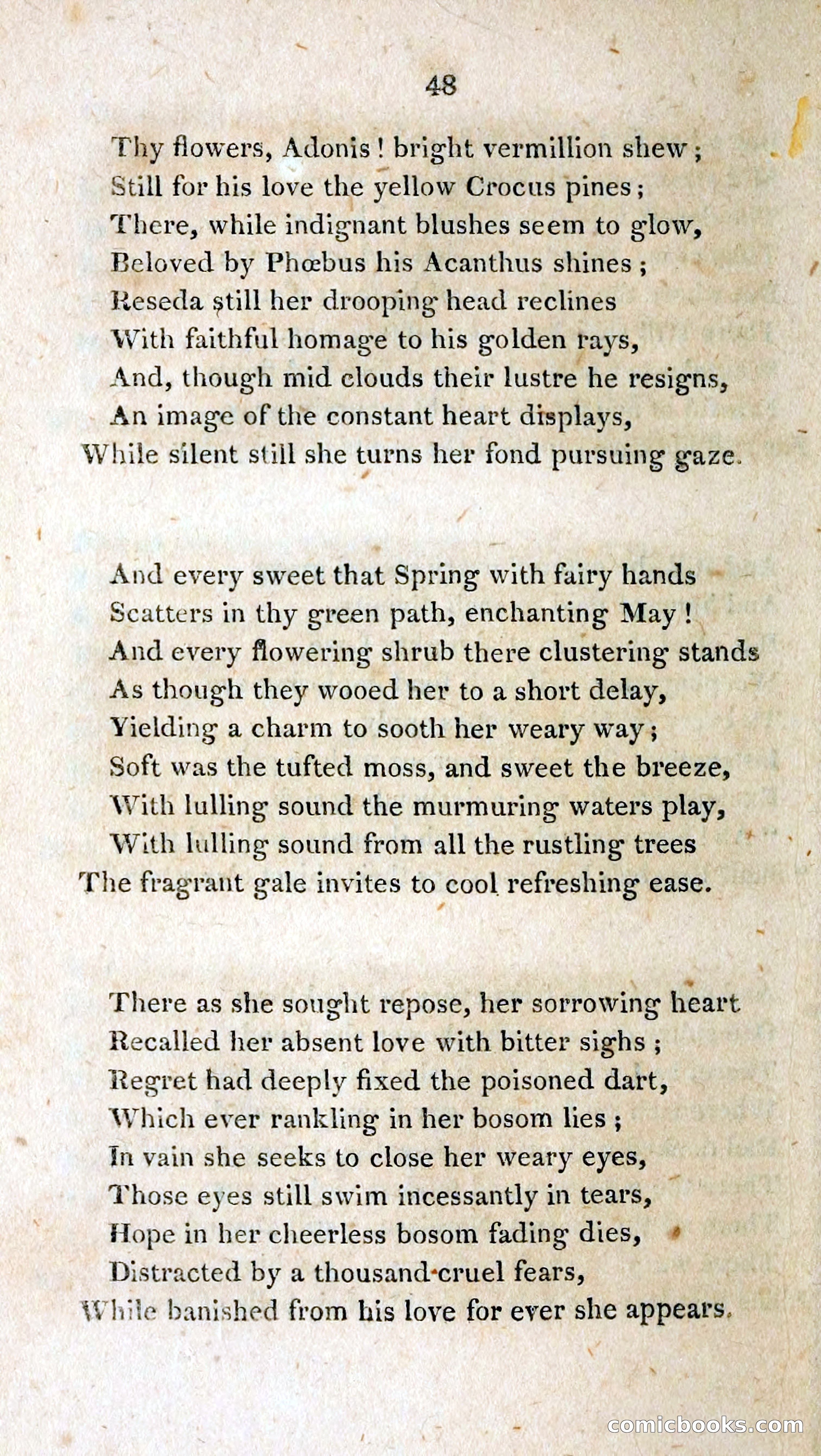
# Page 48: Poetry Excerpt This is a page of running verse (page 48 of a larger work). The text is a romantic poem addressing flowers associated with mythological figures—Adonis, Phoebus, and others—before shifting to describe a sorrowful female character wandering through a spring landscape. She seeks rest but is tormented by memories of an absent lover, her heart "poisoned" by regret, unable to sleep, and crying continuously. The poem concludes with her appearing "banished from his love for ever." The work appears to be sentimental Victorian verse, possibly narrative poetry embedded within a penny dreadful's serialized story.
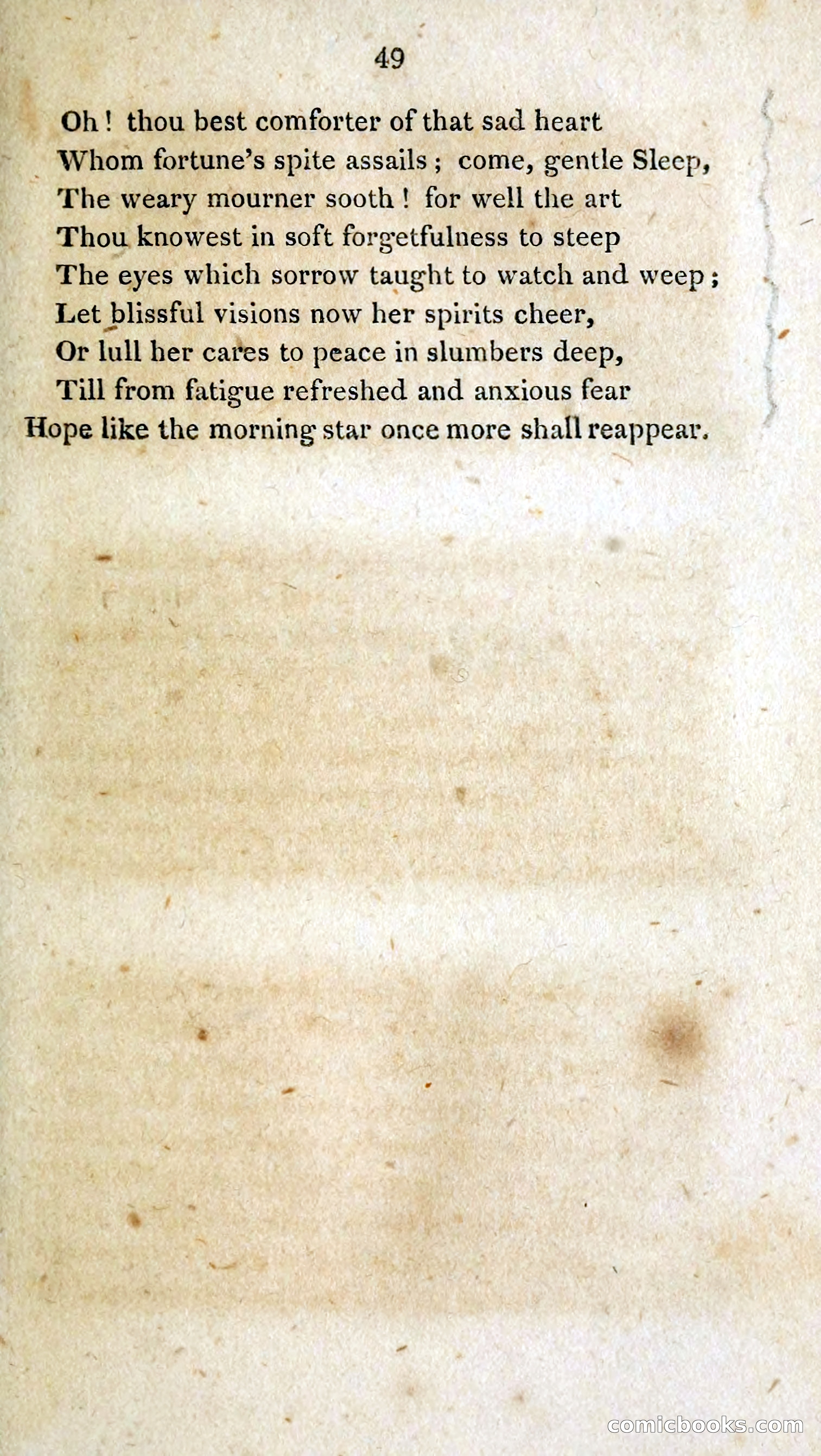
# Page 49: Poetic Verse This is a text page from running prose or poetry, numbered 49. The visible content is a nine-line poem or verse passage addressed to Sleep as a comforter for a sorrowful person. The speaker invokes Sleep to soothe "the weary mourner" and bring forgetfulness, blissful visions, and peace to someone whose eyes have been "taught to watch and weep" by sorrow. The passage concludes with hope that the person will awaken refreshed, with hope returning "like the morning star." The poem employs romantic, melodramatic language typical of Victorian-era sentiment.
This page appears to be running prose text from a Victorian penny dreadful, though the OCR rendering is severely degraded and largely illegible. The original printed text is faint and heavily aged, with numerous stains and discoloration obscuring much of the content. While individual words and fragments are scattered throughout—including what appear to be dialogue markers and narrative passages—the text is too corrupted to reliably determine the specific plot or subject matter of this installment. The page represents typical serial fiction formatting with multiple columns of dense type, characteristic of cheap Victorian sensational literature.
This is a section title page from a Victorian penny dreadful. The page displays "CANTO III." in bold black typeface centered on a worn, aged paper background with visible stains and foxing. The OCR text above the title is largely illegible or corrupted, suggesting degradation of the original print. Below "CANTO III." appears a single letter "F," possibly indicating a printer's mark or section designation. The page serves as a division marker separating narrative sections rather than containing running prose or illustration. The worn appearance is typical of surviving penny dreadful copies, which were cheaply printed and heavily read.
# Description This is an **argument page**—a summary or outline preceding the main narrative. It appears in a work (possibly allegorical) featuring a character named Psyche and her Knight-protector. The text outlines a sequential plot: Psyche's journey under her Champion's protection, her temptation in the "Bower of loose Delight," escape, encounters with personified vices (Vanity, Flattery, Ambition), and her Knight's rescue. The page uses the conventions of Victorian moral allegory, with abstract virtues and vices as characters.
This page presents "Canto III" of a narrative poem, printed on aged paper with visible foxing. The text is a sustained verse meditation on Love personified as a gentle, noble spirit—describing his virtues (tears softer than April showers, innocence supporting his throne) in the opening stanza, then contrasting these qualities against earthly obstacles in the second stanza: vanity, fraud, suspicion, jealousy, passion, ambition, and avarice all work against Love's benevolent reign. The poem appears to be moralizing or allegorical rather than the sensational content typical of penny dreadful serials, though without further context it's unclear whether this constitutes the entire installment or is embedded within a larger narrative.
# Page 54: Narrative Poetry This is a page of running verse (numbered 54), likely from a serialized narrative poem. The text depicts Psyche, a mythological figure, struggling against magical adversaries sent by Inconstancy, then falling asleep in despair. She awakens to discover an armed knight appearing mysteriously beside her; though initially terrified, his courteous manner gradually calms her fear, and her color returns as "pale terror" gives way to composure. The ornate, sentimental language and classical subject matter suggest this penny dreadful adaptation romanticizes familiar mythological material for popular Victorian audiences.
# Page 55: Running Verse Narrative This is a page of running verse from what appears to be a serialized narrative poem (numbered page 55). The text describes a young knight in armor approaching a lonely woman to offer his protection. The woman is uncertain how to respond, torn between suspicion and attraction, as she observes his graceful form and hears his gentle voice beneath his helmet. The verse concludes with detailed description of the knight's appearance—his shining armor, shield bearing a bleeding heart, azure plumes, and a wounded dragon emblem. The romantic, chivalric tone and elaborate descriptive language suggest this is likely a sensation or adventure narrative written in verse form.
This is page 56 of running verse narrative from a Victorian penny dreadful. The text, written in rhyming couplets, describes a young, eternally youthful page-boy named Constance attending a knight, and a character named Psyche observing him with wonder. The passage then shifts to dramatic action: a fierce lion wearing a golden chain suddenly rushes from the forest, and Constance steps forward to confront the beast while Psyche watches in terror. The verse emphasizes the boy's supernatural youth, his loyalty, and his magical blue mantle, before culminating in this moment of danger and heroic intervention.
# Page 57 of a Victorian Penny Dreadful This is a page of running verse poetry (page 57), printed in standard typographic text. The narrative describes a knight encountering a submissive beast, then receiving the homage of a character named Psyche, who mounts his steed. As they travel, Psyche recounts an oracle's decree and her difficult journey through wild lands. The courteous knight responds with eloquent counsel, revealing he is bound by a solemn vow to find "the bower of happiness" before removing his helmet. The verse employs romantic and melodramatic language typical of sensation fiction.
# Page 58: Running Prose from a Romantic Narrative This is a page of running prose—likely from the middle of a serialized story. It contains two distinct quoted passages: first, a man's declaration that he is separated from his love and vows to search for her through any hardship; second, his address to "Psyche," pledging eternal loyalty and protection as her "champion and friend." The page then shifts to narrative prose describing how the two characters proceed together, with Psyche finding hope in his earnest declarations and devoted manner. The tone is romantic melodrama with classical allusions (Venus, Psyche).
# Page 59: Running Prose from a Narrative Poem This is a page of continuous poetic verse (page 59 of an apparently serialized work). The text describes Psyche and a knight traveling at dusk along a river's bank; the knight's mount crosses the river, alarming Psyche until he signals safely from the other side. They are then greeted by a "joyous goodly train" of youths and maidens who escort them across a grand illuminated bridge to an inviting bower described as "the bower of loose Delight"—the language suggesting temptation or moral danger ahead. The narrative appears to draw on the classical myth of Psyche, though the exact title and author are not visible on this page.
# Page 60 of a Victorian Penny Dreadful This is a page of running verse poetry, numbered 60, containing narrative verse apparently based on the classical myth of Psyche. The text describes a woman (referred to as "fair Psyche") crossing a bridge while anxious about a dove she is carrying. She arrives at a grand hall with music and dancing, but remains distressed and unable to enjoy the festivities. The passage concludes with a scene of guests reclining on a couch attended by a young page-boy who steadfastly refuses to participate in their entertainments, remaining loyal to his master. The verse employs a romantic, melodramatic tone typical of Victorian sensational literature.
# Page 61: Running Prose This is a page of running verse (page 61, unnumbered stanza) depicting an elaborate banquet scene. White-robed nymphs attend guests with food and drink while Psyche (whose melting eyes command the strain) is present. A queen enters with attendants and winged boys resembling Cupids, and greets a stranger guest warmly. As she rises to present a sparkling drink, a dove suddenly alarmed knocks the cup from her hands at her feet—the dove knows the drink contains treacherous poison meant to harm Psyche's breast.
# Page 62 of a Victorian Penny Dreadful This page contains running verse narrative prose—poetry printed in a narrative format typical of serialized Victorian sensation fiction. The text depicts an action scene in which a female character named Psyche is attacked by serpents summoned by an unseen antagonist, while her male champion defends her. The passage describes serpents with "forked tongues" and "poisonous fire" emerging from "secret dens," the champion's heroic defense, and ultimately the revelation that their beautiful adversary—described as a "fair and treacherous queen"—has vanished along with her enchantments. The language is melodramatic and gothic in tone, characteristic of penny dreadful adventure narratives.
# Page 63 of a Victorian Penny Dreadful This is a page of running verse poetry, not a title page or illustration. The text describes a dramatic rescue scene: a dove guides the frightened character Psyche toward escape along a dark, overgrown path. A brave knight named Constance rushes through a dangerous field to aid her. He returns on horseback with a lion on a chain, then helps the trembling Psyche onto the steed, which carries her swiftly away from pursuit. The narrative emphasizes Constance's fearlessness, skill, and devotion to providing aid in distress.
This is page 64 of running prose verse from what appears to be a narrative poem. The text describes Psyche's exhausting flight through rough terrain pursued by unknown assailants, her arrival at dawn in a secluded forest dell, and her discovery of a hermit's cottage. A youth urges her to rest, assured she has escaped her pursuers, and the hermit welcomes her to a sheltered bower. The verse employs rhyming couplets and describes a melodramatic scene of a fleeing woman finding refuge in an isolated, rural sanctuary.
# Page Description This is a page of running verse (page 65) from what appears to be a narrative poem. The text describes a character skilled in healing and herbal knowledge who provides comfort and instruction to others, particularly to a figure named Psyche who is recovering her strength. The passage shifts into philosophical reflection on the pleasures of quiet retirement and romantic love, culminating in the declaration "Oh, you have never loved! you know not what is love!" The verse employs rhyming couplets and elevated language typical of Victorian poetry.
# Page 66: Romantic Poetry on Love and Longing This is a text page containing poetry (page 66 of what appears to be a serialized work). The verses explore themes of love, loss, and yearning, contrasting those who lack appreciation for contemplation and the Muse with a lovesick figure who finds solace in memories and hope. The passage references Psyche—a figure from classical mythology—and describes her imaginative journey toward reunion with Love, dwelling on anticipated reunion ("when Love unveiled should to her eyes appear") and intimate moments of reunion. The language is sentimental and melancholic, characteristic of Victorian-era romantic literature, though the specific work is unclear from this page alone.
# Page 67: Running Prose This page contains running verse narrative from what appears to be a longer poem. It describes a knight and his companion Psyche journeying through forests and seeking shelter; the passage then focuses on Psyche rising early one morning and walking alone across a dewy plain while the knight sleeps nearby, protective and watchful. The tone is romantic and melodramatic, with elevated poetic language describing nature and emotional states. The page number and printer's mark ("G2") suggest this is mid-work in a serialized publication.
# Page Description This is running verse text (page 68) from what appears to be a narrative poem. The passage describes two female figures approaching: one, seemingly a queen, rides in a car drawn by panthers, while the other—a nymph in white with a green scarf—sits at her feet singing beautifully. The text focuses on the seated figure's character: though Psyche listens with wonder to the nymph's music, the mistress sits with disapproving demeanor, instead gazing at herself in a mirror. The verse elaborates on the mistress's vanity, describing her ever-changing, ornately decorated robes adorned with treasures, yet notes that her bare arms and bosom shine with "painted pride."
# Page Analysis This is a page of running verse poetry (page 69) from what appears to be a narrative poem retelling the myth of Psyche. The text describes an elaborately dressed female figure (appearing to be a goddess or supernatural being) admiring the mortal Psyche and instructing her attendant Lusinga to invite Psyche to her bower. A character named Constance, apparently protective of Psyche, becomes alarmed at the "Syren's song" and warns of hidden dangers, suggesting this passage depicts a moment of supernatural seduction or peril in the narrative.
# Page 70 of a Victorian Penny Dreadful This is a page of running verse narrative prose, numbered 70, from what appears to be a serialized poetic tale. The text depicts a dramatic scene in which a character named Psyche is warned against trusting a woman associated with Vanity and Ambition. A mysterious knight on a glittering chariot arrives and persuades Psyche to board his vehicle, promising to convey her safely. Though a page urges her to flee, Psyche agrees and directs the knight to a humble cottage where she had spent the night, imagining the knight's joy upon her return and the shame the page will feel.
# Page 71: Running Prose (Verse Narrative) This page contains narrative verse depicting a scene from what appears to be a retelling of the Psyche myth. A female character (Psyche) is trapped in a magical chariot drawn by panthers, unable to escape despite her desperate attempts—she is bound by "silken trammels" and carried away from her guardian. The text describes her despair as a queen describes another character's (apparently her brother's) glorious journey on horseback toward a magnificent mountaintop castle with towers, cliffs, and surrounding landscape. The passage emphasizes themes of betrayal, entrapment, and contrasting fates.
# Page 72 of a Victorian Penny Dreadful This is a page of running verse prose—likely from the narrative heart of a serialized melodrama. The text describes a reluctant woman being brought to an imposing "blazing structure" perched high and precariously. Though unaware of her full danger, she approaches with dread. A haughty hall-master attempts to impress her with his wealth and throne, but her heart remains fixed on an absent "knight." Suddenly a violent storm erupts; lightning strikes the building, and its insecure foundations fail catastrophically, sending the master and his attendants fleeing in panic as his throne overturns. The passage emphasizes Gothic horror, emotional turmoil, and architectural collapse—typical sensational elements of penny dreadful fiction.
# Page 73: Narrative Poetry Passage This is a page of running prose—specifically, verse narrative in heroic couplets and blank verse. The text depicts a dramatic Gothic scene: a character named Psyche attempts escape from a knight who forcibly restrains her, declaring she cannot abandon him. As they struggle, the palace catastrophically collapses around them in an earthquake; the knight, undaunted, maintains his grip on the woman and plunges with her into the flooding waters below. He then emerges from the flood, heroically holding her aloft with one arm while battling the raging waves with the other, sustaining her through the tempest. The passage emphasizes his fearless devotion and superhuman strength amid devastation.
This is a page of running prose poetry (page 74) from a Victorian penny dreadful. The text describes a dramatic maritime rescue scene: a heroic knight pursues a vessel across dangerous waters, while a character named Psyche awakens and spots her "valiant knight" struggling against a lion that attacks him in the flood. The knight releases his grip, seemingly lost, but a character named Constance rescues the drowning Psyche and carries her to shore. The narrative employs elevated poetic language and melodramatic imagery typical of the genre.
This is a page of running verse poetry (numbered 75) from what appears to be a narrative poem. The text describes a knight engaged in combat with a whale in the ocean, followed by his victory and the rejoicing of a woman named Psyche. The passage employs rhyming couplets and elaborate poetic language typical of Victorian verse romance, recounting the knight's struggle through foaming tides, the whale's violent resistance, and his ultimate triumph, after which he claims a starred helm as trophy to present to a woman named Constance while Psyche watches with tears of gratitude.
This page appears to be heavily degraded or damaged, making it nearly illegible. The OCR text is essentially indecipherable—consisting almost entirely of scattered punctuation marks, single letters, and fragments without coherent words or sentences. Based on the image, this looks like a text page from a penny dreadful rather than a title page or illustration, but the deterioration is too severe to reliably identify any actual content, plot, or narrative. The page is too worn to serve the stated purpose of analysis.
# CANTO IV This is a title page or section divider from a Victorian penny dreadful. The page displays only the text "CANTO IV." printed in serif typeface against a heavily aged, stained, and speckled paper background. The rust-colored stains and foxing suggest this is from an original or facsimile reproduction of a nineteenth-century publication. The use of "Canto" indicates this serialized fiction was written in verse form, likely sensational poetry or narrative verse popular during the Victorian penny dreadful era. No other text, illustrations, or advertisements appear on this particular page.
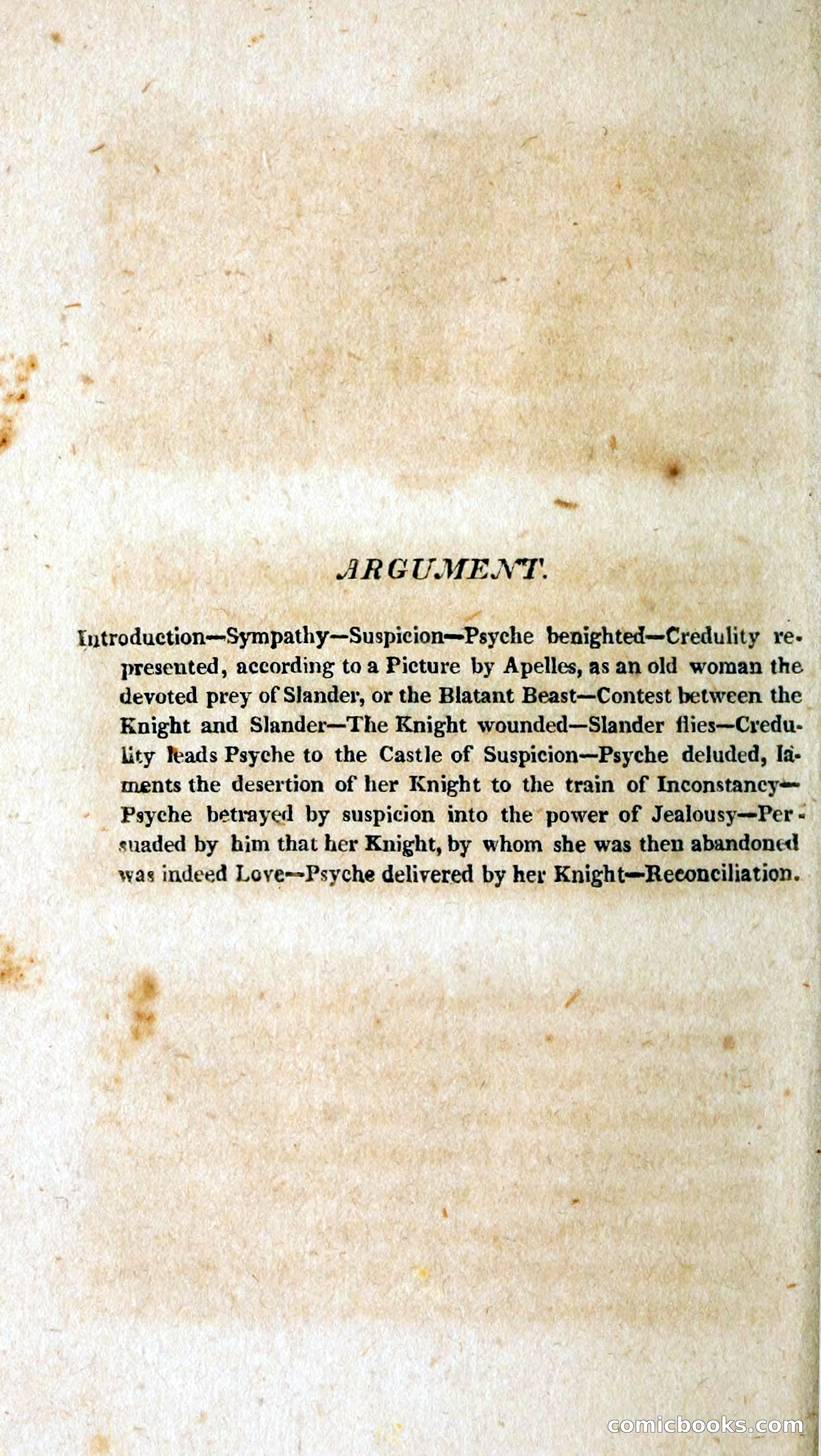
# Analysis This is a plot summary page, titled "ARGUMENT," from what appears to be a Victorian allegorical narrative or serialized story. The text outlines the progression of a tale involving characters named Psyche and a Knight, along with personified abstract forces—Slander, Credulity, Suspicion, Jealousy, and Inconstancy. The summary traces Psyche's journey from introduction through various trials of doubt and betrayal to final reconciliation with her Knight (apparently representing Love). The reference to "a Picture by Apelles" suggests the work draws on classical or artistic sources. This page functions as a chapter or section outline, typical of Victorian serialized fiction that would help readers follow complex allegorical plots across installments.
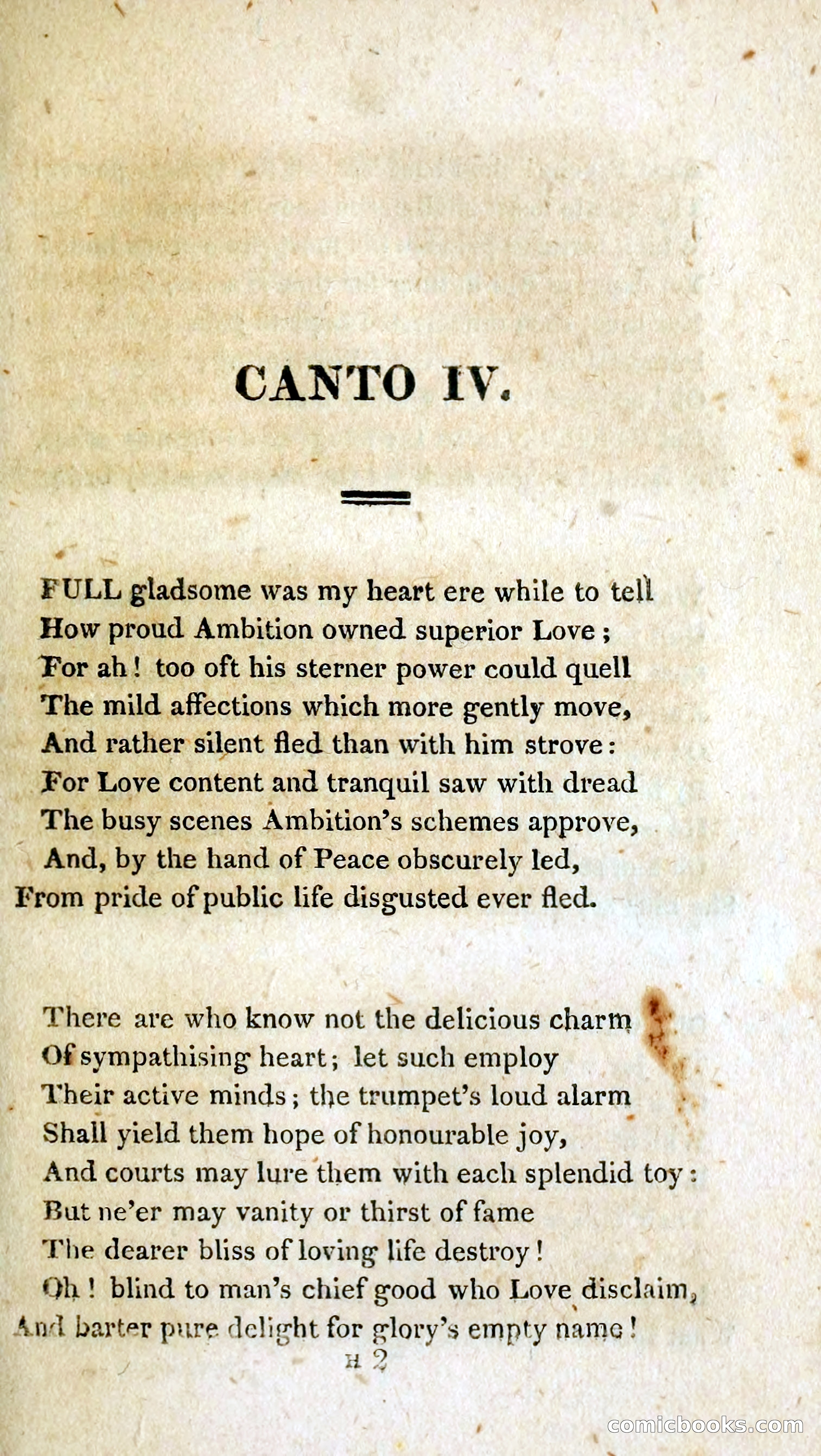
# CANTO IV This page presents running poetic verse—the fourth canto of a longer narrative poem. The text explores the tension between Ambition and Love as competing human motivations. It argues that while some pursue public glory and worldly advancement, true happiness lies in love and domestic contentment rather than vanity and fame. The poem concludes by condemning those who reject love in pursuit of glory's "empty name." The page number "H 2" appears at the bottom, indicating this is part of a bound or serialized work.
# Page 80: Running Poetry This is page 80 of running text—specifically, verse poetry rather than prose. The passage consists of three stanzas in rhyming couplets celebrating a character named Psyche and her relationship with a protective "faithful knight." The text describes how Psyche has escaped a tyrant's power, though dangers remain; she finds safety and comfort in her knight's guidance and protection. The final stanza rhapsodizes about the joy of mutual confidence and trust between two faithful hearts, suggesting that such sympathetic connection allows them to endure fortune's hardships together. The overall tone is romantic and melodramatic, typical of Victorian sentimental verse.
# Page 81 of a Victorian Penny Dreadful This is a text-only page of running poetry, numbered 81. The verse concerns romantic love and trust, opening with the speaker's wish that suspicion never chill their beloved's faith, and expressing preference for "pleasing error" and "blind reliance" over cold prudence. The passage shifts midway to narrative verse describing an evening scene: gathering darkness, wind-nymphs foretelling a coming storm, absent stars and moon, and mysterious sounds and "strange forms" perceived through the gloom. The text appears to be advancing a melodramatic plot involving love, anxiety, and supernatural or ominous atmosphere typical of penny dreadful sensationalism.
# Page Description This is a page of running verse poetry (page 82) from a Victorian penny dreadful. The text describes a heroic knight defending a helpless, misshapen woman from a creature called the Blatant Beast. The woman (apparently named Psyche) is vulnerable and unarmed, while the knight fights the monster with sword and javelin, deliberately avoiding protective armor to prevent accidentally wounding the woman. The verse employs archaic language and heroic couplets typical of sensation fiction melodrama, emphasizing the knight's chivalrous self-sacrifice and the monster's savage ferocity.
# Page 83 of a Victorian Penny Dreadful This is a page of running verse prose, numbered 83, from what appears to be a serialized narrative poem. The text describes a knight who wounds a "roaring beast" in combat but is himself poisoned by the creature's venomous bite, which he endures silently. A hag, grateful for rescue, warns the knight's companion Psyche away from a dangerous road toward a protective grove. Despite his own pain and an intensifying storm, the knight agrees to seek shelter via a different path, but soon becomes separated from Psyche in darkness—leaving her alone with only the garrulous hag for company.
# Page 84: Running Prose This page contains verse narrative in the style of Gothic poetry. A fearful woman, alone in a dark wood during a storm, hears calls to follow a mysterious light, hoping to meet "her wandering knight." The passage then shifts to describe a solitary Gothic castle deep within the forest, where a character named Credulity has long dwelt as mistress—described as meagre, tawny-hued, and living "unsociably...unloved, alone." The text emphasizes atmospheric Gothic terror: storm-roused woods, shapeless forms of terror, ill-omened birds, and meteor's fire.
# Page 85 of a Victorian Penny Dreadful This is a page of running verse prose numbered 85, depicting a Gothic melodramatic scene. The text describes Psyche's arrival at the dark castle of the "gloomy princess" Disfida, complete with fortified gates, surly guards, and iron-barred windows. The princess sits alone in a dimly-lit hall, anxiously listening for distant sounds. When startled by noise, she initially grows suspicious but is reassured by her old slave's voice. She then questions her guests and dispatches scouts through the woods to search for "the knight," while Psyche weeps through the night in anguish.
# Page 86: Running Prose from a Narrative Poem This page contains numbered verse (page 86) depicting a scene of anxious waiting and distressing imagination. A character named Psyche, unable to sleep at midnight, watches from a tower window hoping to hear her lover's voice but hears only a night-bird's cry. The text then addresses the reader directly, asking if they have experienced deferred hope and suspense, before revealing that a character called Disfida is filling Psyche's mind with terrifying false tales—of torrents, ambushed foes, magicians, and enchantments—causing Psyche to imagine her knight betrayed, wounded, and dying. The passage emphasizes emotional torment through Gothic imagery and melodramatic language typical of Victorian sensation fiction.
# Page 87 of Victorian Penny Dreadful This is a page of running verse narrative (poetry) from what appears to be a serialized Gothic or romantic melodrama. The text describes messengers bringing news to a woman (apparently named Visfida) that her knight has abandoned her for another woman. After hearing that he has been "lured by a wanton fair" and now prefers this new lady's love, Visfida stands shocked, then bursts into angry indignation, blaming "that wicked brood" for his betrayal through their "ensnaring arts." The passage combines romantic betrayal with supernatural or Gothic undertones typical of penny dreadful sensationalism.
# Victorian Penny Dreadful Page This is a page of running prose verse (page 88) from what appears to be a serialized narrative poem or dramatic work. The text presents dialogue between two characters: one speaking in quoted lines about troubles caused by "Vile Varia's" followers—theft, destruction of crops and vineyards, seduction of allies—who offers to lead "thee to the glittering sands" to reclaim a "truant knight." The character Psyche responds with firm refusal, declaring she will not attempt to control the knight's conduct but instead trusts a "surer guardian" and proceeds at dawn. The passage ends with Psyche withdrawing to her chamber to grieve privately. The verse employs rhyming couplets in a melodramatic, sentimental style typical of Victorian popular literature.
# Page 39 of Victorian Penny Dreadful This is a page of running verse narrative prose from page 39 of a penny dreadful. The text presents a character (apparently named Psyche, likely referencing the classical myth) in an extended emotional soliloquy. She laments her abandonment by her lover, who has been commanded by Venus to leave her for a worthier mate. Psyche expresses despair, contemplates suicide or permanent isolation, then resolves at dawn to flee her dwelling and seek solitude where grief might end her suffering. The passage is written in formal poetic couplets typical of sensation fiction's theatrical melodrama.
# Page 90: Running Prose Narrative This is a page of running verse narrative from what appears to be a serialized story. The text describes a character named Psyche attempting to escape or journey away against the wishes of a character named Disfida, who sends guards to watch and detain her. Psyche becomes exhausted and collapses, unable to overcome the guards' surveillance, while she descends into terror and despair as day fades. The passage is written in rhyming couplets and employs Gothic melodramatic language typical of Victorian sensation fiction.
# Page 91: Running Prose from a Penny Dreadful This page contains running prose (numbered page 91) from what appears to be a Gothic melodrama. A female character hears mysterious groans emanating from a hidden cave. A guard urges her reluctantly toward the cavern, claiming a magical sage dwelling within can answer her questions about her betrayal by a faithless knight. As they enter the lightless cave—inhabited by screaming owls—the guard reveals a sickly lamp and a sinister "wretched master," described as a "devouring fiend" whose blood-stained hands have lacerated his own flesh. The passage exemplifies penny dreadful sensationalism through Gothic atmosphere, melodramatic mystery, and hints of supernatural or cannibalistic horror.
# Page 92: Running Prose This is a page of running verse narrative from a penny dreadful. It describes a man in deep despair sitting on damp ground, showing physical signs of wasting illness and mental anguish. A treacherous guard then taunts him with news that a woman (apparently his promised bride) has been sent to him, claiming she was lured away by another knight. The guard departs, and the woman attempts to flee, but the villain—described as a "monster" and "sorcerer"—blocks the cavern's exit and uses magic to show her a vision of her knight in a place called "the bower of loose Delight."
# Page Analysis This is a page of running verse poetry (page 93) from a Victorian penny dreadful. The text depicts a dramatic romantic scene in which a woman witnesses her beloved knight—apparently her "own adored Love"—in an intimate embrace with another lady. The verse describes her internal torment as she watches them exchange passionate glances and sighs, unable to look away despite her anguish. The passage concludes by reflecting on how her natural meekness and gentle heart, which have previously softened her sorrows, may help her endure this "bitter bale" and the "fierce agony" of witnessing this betrayal.
# Page 94: Running Prose (Verse) This is a page of narrative poetry from what appears to be a Gothic romance or supernatural tale. The text describes a virtuous character named Psyche who is abandoned and falls victim to a sorcerer called Geloso, who transforms into a serpent to drain her life force. However, her knight rescues her by calling out through the cave; the serpent releases her and, terrified, shrinks into a spider, its web trapping the "vile" sorcerer himself. The passage employs dramatic, melodramatic language typical of penny dreadful sensationalism, emphasizing supernatural horror, peril, and last-minute heroic salvation.
# Page 99 of a Victorian Penny Dreadful This is running prose—specifically verse narrative from page 99 of what appears to be a serialized poetic tale. The text describes a reunion between two lovers: magical spells dissolve as a knight is revealed in a cavern, and Psyche awakens in his arms. Upon revival, she sees him again but remains conflicted—outwardly reserved despite inner joy, tormented by questions about his earlier departure and doubting whether their love was real or enchantment. Though he attempts to comfort her, she stays silent and withdrawn, leaving his efforts to restore her spirits unsuccessful.
# Page 96 of a Victorian Penny Dreadful This is a page of running verse narrative, not a title page or illustration. It depicts a romantic quarrel between a knight and a woman named Psyche. The knight, wounded from rescuing Psyche from "a fell beast," withdraws in silence after she appears coldly indifferent to his sacrifice. A character named Constance intervenes, urging Psyche not to wound her faithful knight's heart. As Psyche realizes her error and wishes to apologize, the knight has already departed—leaving her unable to prevent his flight. The passage emphasizes melodramatic emotional conflict and misunderstanding between the lovers.
# Page 97: Narrative Poetry This is page 97 of running text—specifically narrative verse in rhyming couplets and stanzas. The passage depicts an emotional reconciliation scene where a female character (identified as "Psyche") is reunited with a male character who has been wounded. After their tearful meeting, they escape from "Disfida's groves" into an open landscape. The poem uses an extended botanical metaphor, comparing Psyche's revival to a neglected plant revived by dew, suggesting themes of recovery and renewed hope after suffering.
This is a page of running verse poetry (page 98) from a Victorian penny dreadful. The text depicts a knight and a woman (likely named Psyche) in dialogue after he has rescued her from a demon's cell. The knight recounts how he detected and thwarted the plots of villains named Varia and Disfida, forcing their servants to flee, then tracked the fugitives to a cavern. The passage concludes with the couple walking together toward reunion, while Psyche anticipates being embraced by her beloved, described in romantic, melodramatic language typical of the genre.
This is a title or section-opening page from a Victorian penny dreadful. The page displays "CANTO V." in bold black type centered on the aged, stained paper. The OCR text is largely corrupted and unreadable, consisting mostly of scattered punctuation and fragments that don't form coherent words. Based on the "CANTO" designation, this appears to be marking the beginning of a new section or chapter in a serialized narrative work, likely one written or structured in verse form. The heavy staining and deterioration of the page reflects the cheap paper quality typical of these penny publications.
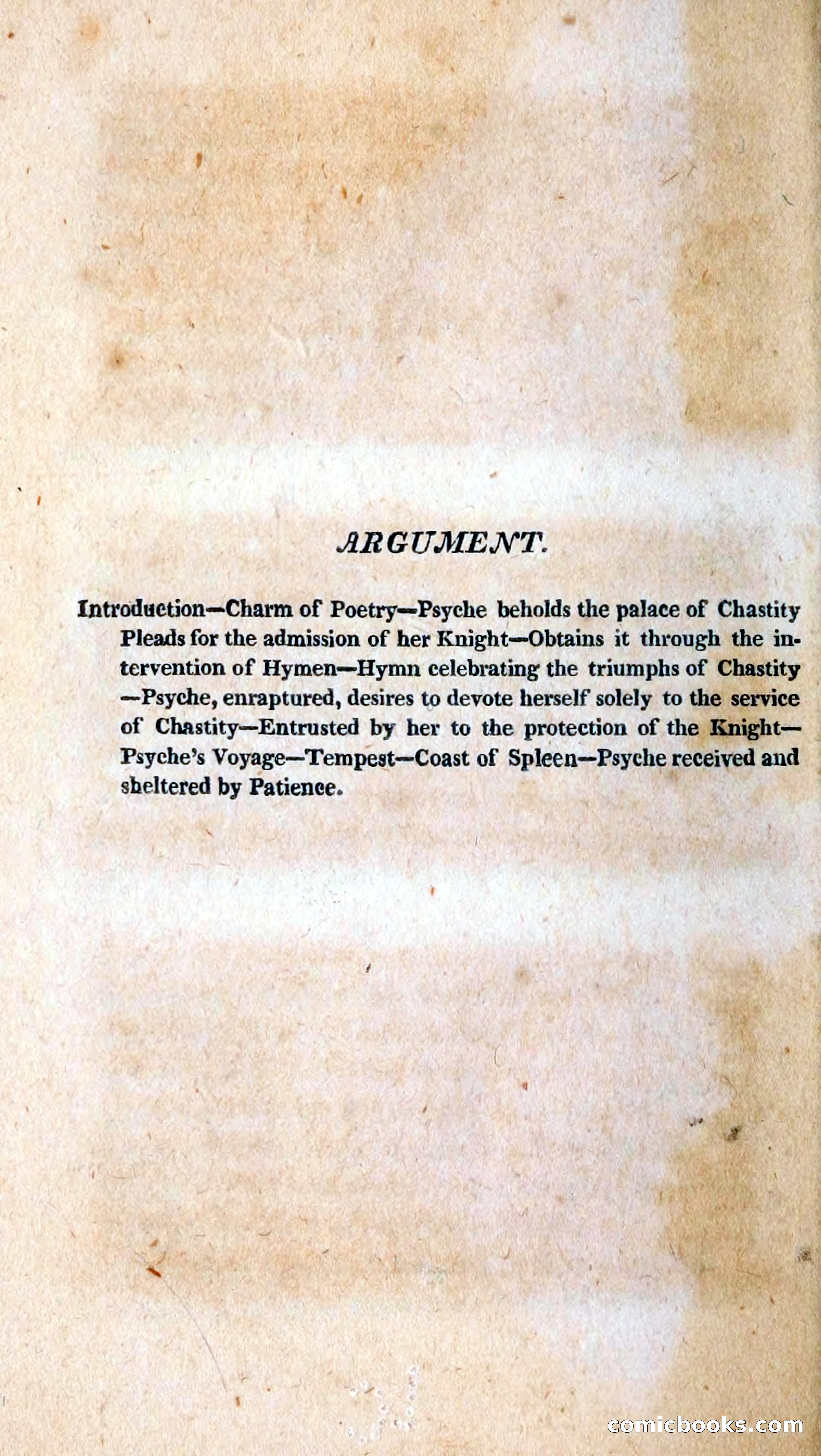
# Analysis This is a contents or argument page from a Victorian penny dreadful. The text presents a plot summary in outline form, describing a narrative involving a character named Psyche who seeks admission to "the palace of Chastity" through a Knight's intervention. The story follows Psyche's devotion to Chastity, her entrustment to the Knight's protection, and her subsequent voyage through trials including a tempest and arrival at a "Coast of Spleen," where she is sheltered by a character called Patience. The page appears to introduce the work's allegorical themes of virtue and moral trial.
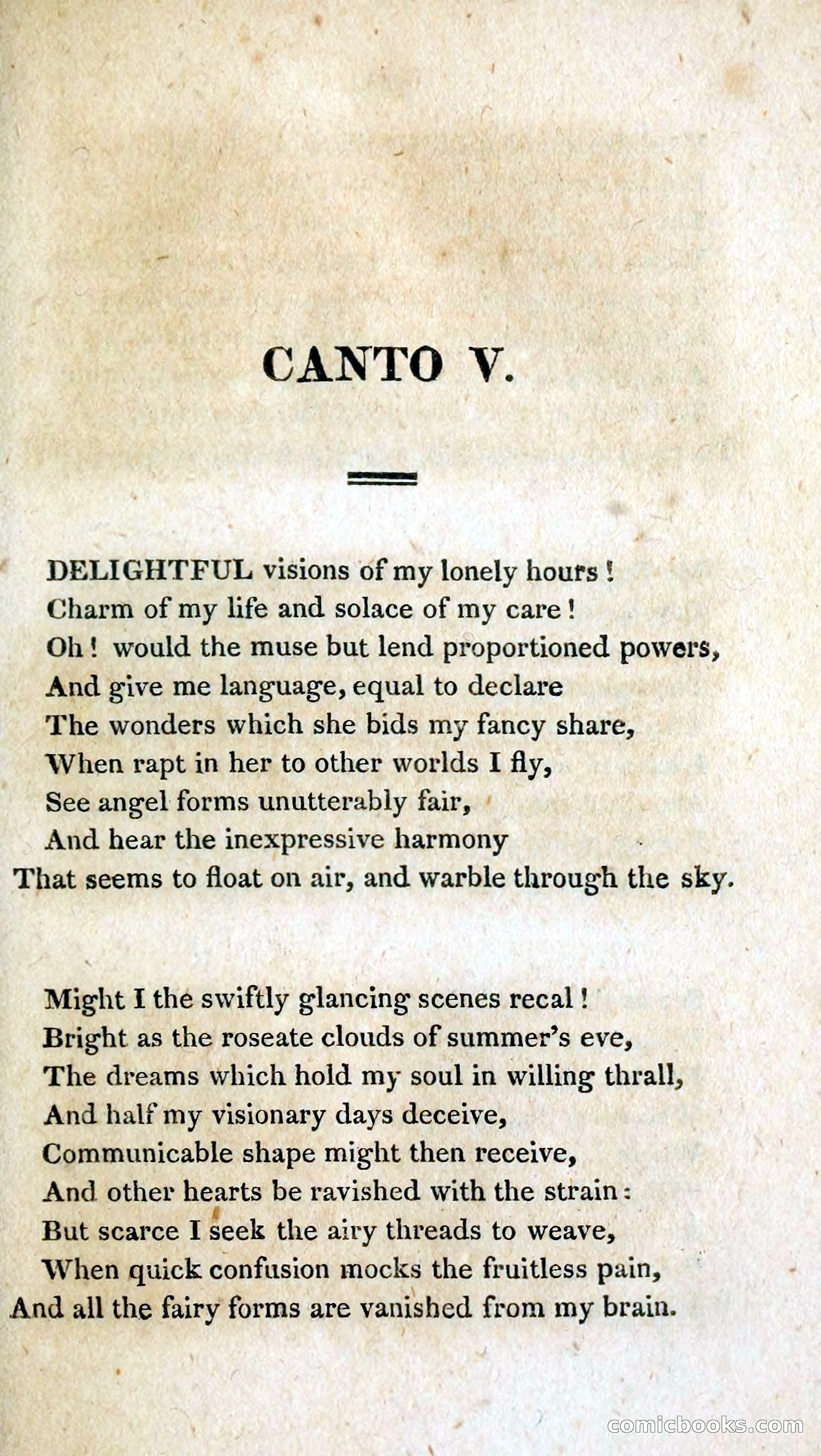
# Page Description This is a running poetry page from what appears to be a narrative poem. The heading "CANTO V." indicates this is the fifth section of a longer work. The text consists of two nine-line stanzas in formal verse that express the speaker's struggle to capture in language the beautiful visions and dreams that visit them in solitude—celestial scenes of angels and harmony that vanish when the speaker attempts to describe them to others. The emotional tone is melancholic, emphasizing the gap between inner inspiration and artistic expression.
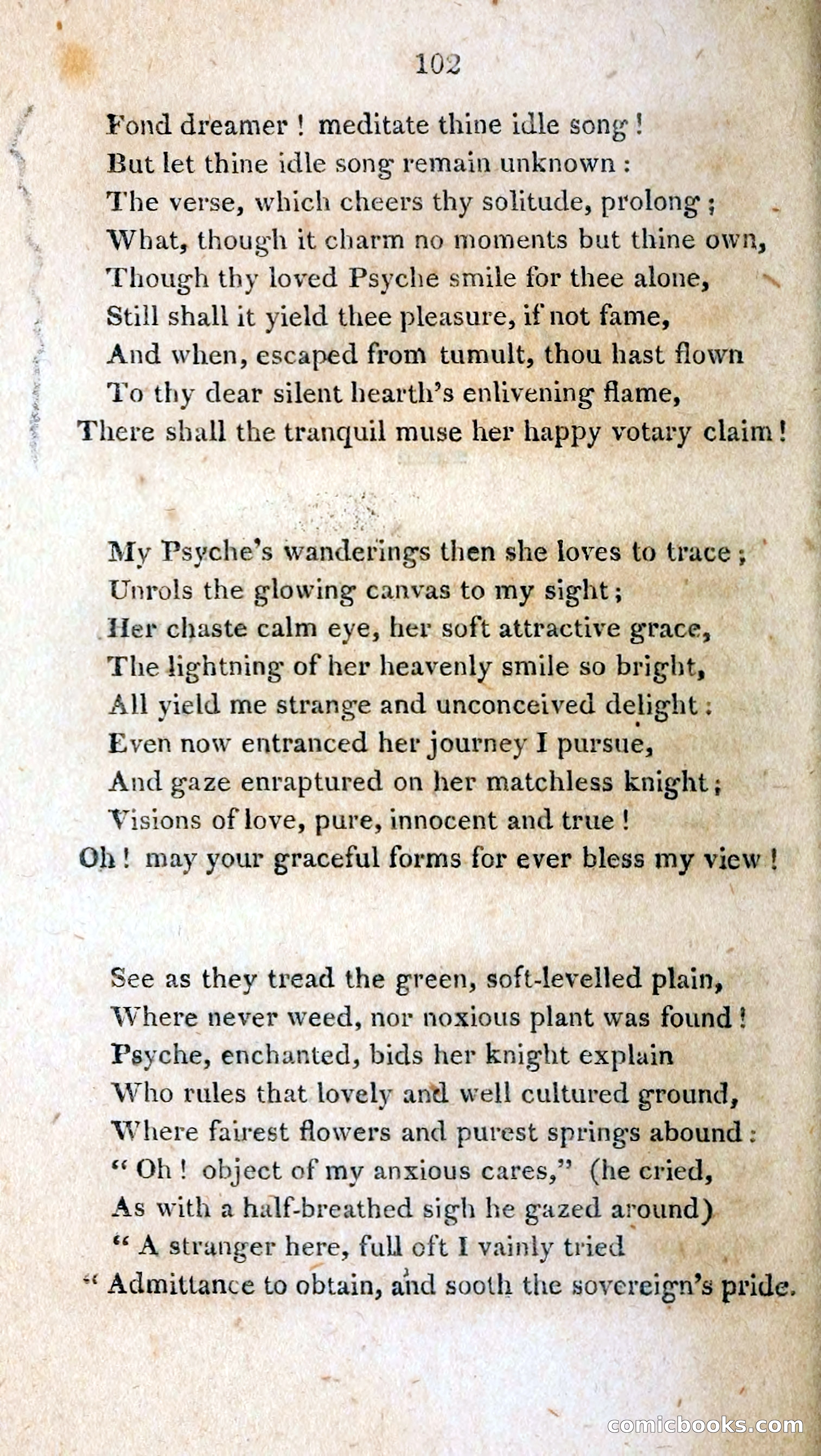
# Page 102: Poetic Narrative Text This is a page of running verse (not a title page or illustration), numbered 102, containing romantic poetry. The text appears to be a lengthy poem addressing a "fond dreamer" about composing idle songs, then shifts to describing the speaker's beloved "Psyche" and her enchanted journey with a knight across a beautiful plain. The passage concludes with the knight lamenting his status as a stranger seeking admittance to some sovereign's domain. The verse employs elevated Romantic language about love, beauty, and devotion, typical of Victorian-era serialized fiction.
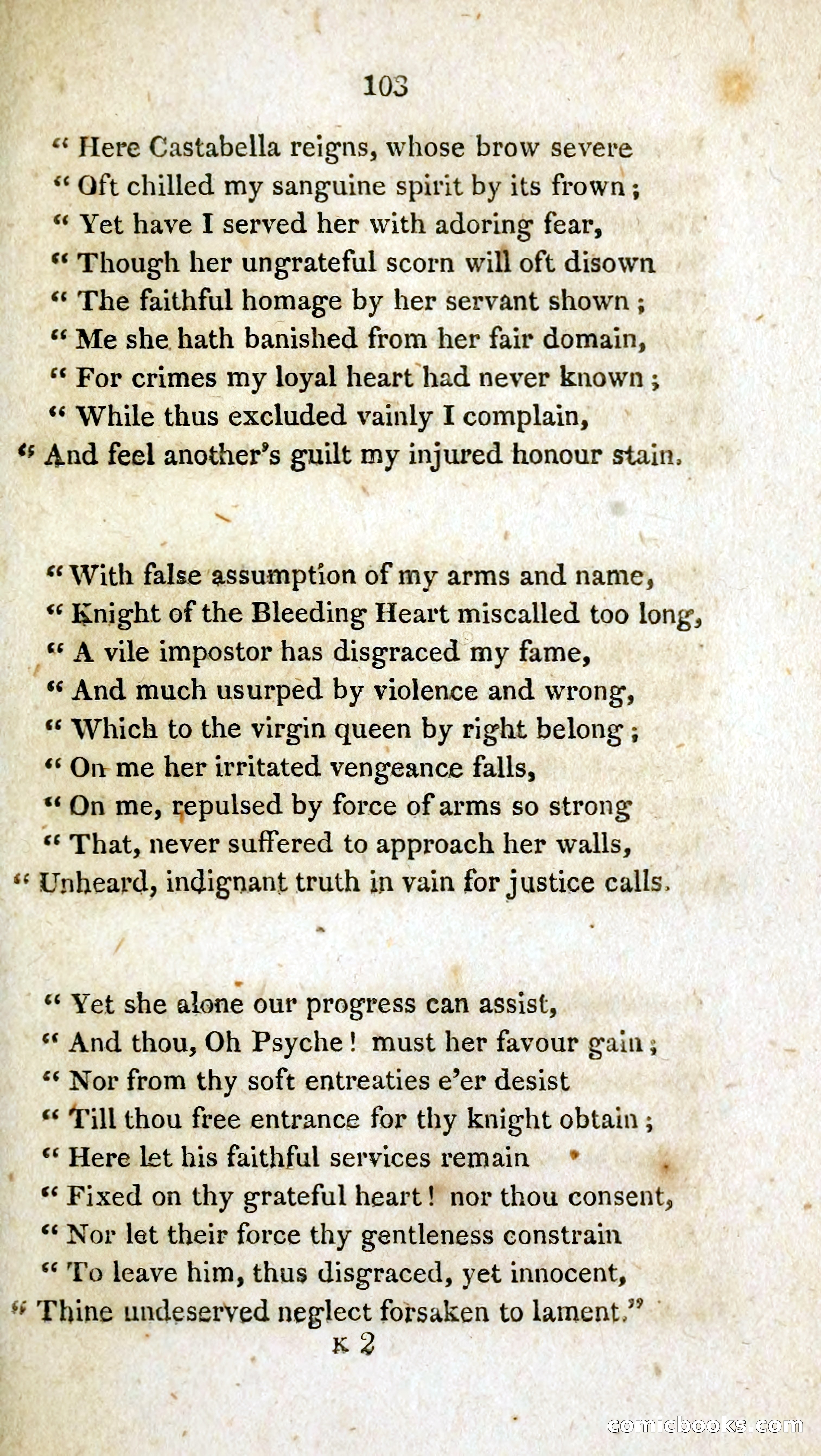
# Page 103: Verse Monologue This is a page of running prose—specifically, dramatic verse organized in stanzas. The speaker, apparently a wronged knight, laments his banishment from Lady Castabella's domain and complains that an impostor has stolen his name and title ("Knight of the Bleeding Heart"), usurping his rightful honors and causing the queen to turn against him unjustly. He then appeals to a character named Psyche to intercede with Castabella on his behalf, begging her to use her influence to secure his vindication and restore his access to the court, emphasizing his faithful service despite his undeserved disgrace.
# Page 104: Running Prose This is page 104 of running verse narrative. The text describes a divine vision of the towers of Castabella appearing before a character's eyes, praised in ornate language as a celestial temple. It then recounts how a dove (apparently a messenger) reaches Castabella's seat while two other figures—Psyche and a knight—are barred from the gates. The dove is warmly received; Castabella is eventually lured from her throne to the gates where Psyche and her companion wait, she blushing and he half-doubtful.
# Page 105: Running Prose This page contains verse narrative (appearing to be from a romantic or fantasy poem). The text depicts a scene where a character named Psyche encounters a lion and "his gallant lord" (a knight). After guards close the portals, Psyche's emotional response—tears, blushes, and sighs—silently supports the knight's cause. The knight then defends himself against charges and false accusations, asserting his innocence and his loyal attachment to "her reign" while refusing contact with "the base impostor." The passage combines courtly romance with melodramatic sentiment typical of Victorian popular literature.
# Victorian Penny Dreadful Page Analysis This is a page of running prose poetry (page 106) from what appears to be a serialized narrative. The text describes a scene at a festive gathering where a master pursues a suit while his page discovers a joyous friend named Hymen. The passage then shifts to depict a queen surrounded by timid virgins receiving a knight, with elaborate descriptions of her divine beauty compared to classical goddesses Diana and Minerva. The language emphasizes her ethereal appearance—her pale cheek, pure complexion, and the blush that occasionally crosses her face. The scene suggests romantic or courtly drama, though the specific plot context remains unclear from this page alone.
# Page 107: Allegorical Verse This is a page of running prose—specifically, poetry. The text presents an allegorical passage describing a female figure (likely representing Virtue or Chastity) who wears a magical white robe and luminous girdle. Fate entrusts two handmaidens, Prudence and Purity, to guard her. The verse details how her glowing cestus (belt) protects her in battle and, when concealed beneath a silken scarf by Modesty during peaceful hours, allows a "blushing maid" to hide her charms. The passage concludes with Courage standing foremost, inspired by Truth and holding a crystal lamp. The allegorical personification of virtues suggests this excerpt appears from a longer didactic or moral narrative poem.
This is a page of running verse poetry (page 108) from what appears to be a longer narrative work. The text consists of three stanzas in heroic couplets celebrating virtues personified as classical goddesses—Temperance, Honour, Pallas, Cynthia, Fauna, and Vesta—who champion female purity and virtue. The final stanza shifts to a darker tone, warning that those who betray such trust face scorn, infamy, and obscurity, though a noble queen will defend the pure and grant them posthumous fame. The style is elevated and allegorical rather than sensational.
# Page 109: Running Verse Text This is a page of running poetry numbered 109, containing what appears to be classical allusions in verse form. The text celebrates virtuous figures from mythology and legend—Bellerophon, Peleus, Hippolytus, and others—praising their resistance to temptation and their faithful devotion. References include figures resisting the advances of goddesses, refusing magical enchantments, and maintaining conjugal fidelity. The passage appears didactic in tone, celebrating chastity and virtue through mythological exemplars. No illustrations or advertisements are visible; the page consists entirely of printed poetic text on aged paper.
This is a page of running prose poetry (page 110) depicting a classical mythological scene. The text narrates the pursuit of the nymph Arethusa by the god Alpheus through woods and plains. Arethusa calls upon the goddess Dictynna for aid; Dictynna conceals her in a cloud, causing Alpheus to lose her. The passage concludes with Arethusa's transformation into a silver stream that retains her name and "virgin fame." The verse employs formal rhyming couplets in a neoclassical style typical of Victorian narrative poetry.
This is a page of running verse text, numbered 111, presenting a narrative poem in heroic couplets. The passage retells the classical myth of Apollo's pursuit of Daphne, emphasizing her virtue in resisting his advances through flight rather than yielding to his eloquence and gifts. The poem then shifts to celebrate how the Muses honor virginity and chastity, referencing the transformation of Syrinx (here called "Syringa") into reeds to escape Pan's pursuit. The text is moralistic, framing female virtue and escape from seduction as worthy of immortal honor.
# Page 112 of a Victorian Penny Dreadful This is a page of running verse poetry (page 112 of a larger work). The text describes a miraculous trial of innocence involving a young woman who must pass through fire and water to prove her virtue. The passage references classical and mythological figures—Clusia, Vesta, Clelia, and Sulpicia—who supposedly survived divine ordeals unharmed, their innocence proven by supernatural protection. The verse celebrates virginal purity and divine intervention, suggesting the narrative involves a melodramatic test scene where an accused woman's chastity will be vindicated through miraculous means, a common plot device in Victorian sensation fiction.
# Page 113: Running Verse Text This is a page of running verse poetry (page 113 of a larger work), printed in standard Victorian typeface on aged paper. The text comprises three stanzas discussing female virtue and chastity, referencing classical figures like Lucretia and Virginia, praising British women's moral character, and depicting a character named Psyche listening to music while aspiring toward spiritual purity and divine joy. The verse celebrates virginity and modest matronhood as virtuous ideals, with Love unable to inspire earthly desires in the spiritually devoted listener.
# Analysis of Page 114 This is a page of running poetry text (no illustrations or advertisements visible). The passage appears to be from a narrative poem featuring characters named Psyche, a Queen, and a Knight. The knight declares he is leaving Psyche because her "false heart" rejects divine love, while the Queen responds by offering Psyche a different destiny—to serve in the "bowers where Love himself commands" and reign secure from blame, ensuring the Queen's fame echoes through sacred groves. The tone is melodramatic and romantic, typical of Victorian sensation fiction, though the mythological references (Psyche, Love/Cupid) suggest this particular work draws on classical rather than purely contemporary material.
# Page 115: Running Prose from a Victorian Poem This is a page of running verse (numbered page 115) from what appears to be a narrative poem. The text depicts a dramatic scene where a speaker (likely a supernatural or allegorical figure) entrusts a young woman named Psyche to a knight's care, instructing him to bear her safely to her lover's arms and providing a magical vessel for their journey. The passage then shifts to describe how "Peace" personified prepares comfortable rest for the travelers, with an attendant named Cheerfulness greeting them the next morning before they pay homage at someone's (Castabella's) feet. The tone is romantic and melodramatic, featuring classical/mythological references.
# Page Analysis This is a running prose page (numbered 116) from what appears to be a narrative poem in a Victorian penny dreadful. The text describes a sea voyage: a character named Psyche departs from shore aboard a vessel with favorable weather and auspicious omens. The passage details the mariners seizing oars, streamers fluttering in the wind, and the ship swiftly departing while Psyche watches the shore recede. It then shifts to her emotional state during the voyage—she is pleased and hopeful, gazing at distant lands and listening to the rhythmic oars, while asking a "knight" companion whether they will reach the promised shore by morning. The verse employs classical references (Boreas, Favonius, Hymen) and romantic sensibility typical of the period.
# Page 117 of a Victorian Penny Dreadful This is a page of running verse prose from the narrative body of the text. It describes a dramatic maritime storm scene: a ship's passengers—particularly a woman named Psyche and her knight—endure a violent tempest at sea. The verse recounts rising winds, threatening waves, lightning, and their desperate efforts to steer the vessel away from a treacherous rocky coast. The passage employs ornate, melodramatic language typical of sensation fiction, emphasizing supernatural terror ("demons of the tempest") and emotional anguish as the couple faces danger.
# Page 118 of a Victorian Penny Dreadful This is a text page of running verse from an illustrated serial story. The passage depicts a knight and his companion Psyche arriving by ship at a dark, ominous shore during a hurricane. The knight addresses Psyche with reassuring words, encouraging her courage as they face threatening "guards" and dangerous conditions. He predicts that the storm will pass and their enemies will be overcome. The narrative combines Gothic elements (a "hateful cave," dark cliffs, melancholy atmosphere) with adventure and heroic resolution typical of penny dreadful sensationalism.
# Page 119: Running Prose This page contains verse narrative (likely from a longer poetic tale). The text describes a knight whose mere presence causes enemy soldiers to lose their will to fight—their weapons fall useless and they flee in terror. The passage then shifts to a storm at sea, where a vessel reaches shelter in a bay. A knight tends to a character named Psyche, who is sheltering in a grotto carved into a bank. A defenseless woman emerges from the cave and courteously invites the knight to share whatever sustenance heaven has provided, hoping to ease his distress during his lonely suffering.
This is a page of running verse poetry (page 120) from a Victorian penny dreadful. The text describes a pale, sorrowful woman living in isolation by the sea—barefoot, enduring harsh weather in a cavern. She waits faithfully for her husband, a sailor lost at sea years before after being separated from her during a storm in early youth. Despite her prolonged suffering and grief, she maintains hope that his ship will return with each tide, and refuses to leave the desolate shore where she dwells.
This is a page of running prose—specifically poetry—from what appears to be a narrative work numbered 121. The verse describes a compassionate female character who shelters shipwrecked sailors in her cave, healing their wounds and offering comfort. The passage then shifts to depict this woman (apparently named or called "she") caring for someone named Psyche during a storm, providing warmth, food, and solace until the weather clears and "pacific sunshine glows." The text emphasizes themes of benevolence and refuge from suffering.
# Victorian Penny Dreadful Page Analysis This appears to be a **running prose page** from a penny dreadful, though the image quality and OCR degradation make the text nearly illegible. The visible content consists of what looks like body text arranged in multiple paragraphs across the page, with scattered stains, foxing, and deterioration typical of aged Victorian printing. The OCR output is too corrupted to reliably discern specific plot details or character names. The page shows no illustrations, title information, or advertising—simply aged, worn printed text from a serialized narrative whose specific subject matter cannot be determined from this reproduction.
This is a title page or section divider from a Victorian penny dreadful. The page displays "CANTO VI." in bold black type centered on an aged, stained cream-colored paper. The OCR'd text above this heading is largely corrupted and illegible, suggesting either poor print quality or damage to the original document. The visible heading indicates this marks the beginning of the sixth canto or section of the serialized work. The paper's foxing and discoloration are consistent with nineteenth-century cheap printing materials.
# Analysis This is a chapter or section argument page—a content summary rather than narrative prose or illustration. The page outlines the plot of what appears to be a allegorical tale centered on the classical figure Psyche. The text summarizes a romantic narrative arc: Psyche faces trials involving love, indifference, and danger; she is rescued by a Knight; returns home to a Temple of Love; reunites with her Lover; and ultimately receives divine apotheosis from Venus in Heaven. The language and mythological subject matter suggest this penny dreadful adapts classical material into Victorian sensation fiction, though the specific work's title or author is not visible on this page.
# Page Analysis This is a text page from a Victorian serialized work presenting **Canto VI**, a lengthy poetic passage in verse form. The poem romanticizes youth and love, contrasting the sweetness of youthful romantic pleasure—hearing "vows of love" in "roseate bowers"—with a deeper, more melancholic understanding of love's power over the soul. The verse suggests that those who experience love's "enchantment" in their sorrowful depths understand something inaccessible to carefree youth. The page contains no illustrations, advertisements, or identifying publication information—only running poetry in formal printed text.
# Page 126: Verse on Love and Consolation This is a text page containing poetry (page 126 of what appears to be a serialized work). The verses use romantic, sentimental language to counsel that Love provides comfort during hardship and distress—comparing it to a mother's breast soothing an infant, and to a protective plant that blooms in summer but persists through winter. The poem employs extended metaphors involving nature (roses, red-breasts, spring) to urge the reader to cherish Love as a treasure and guard it against peevishness, warning that ill-temper can destroy it. The elaborate, moralistic tone is typical of Victorian sentimental literature, though whether this appears in a penny dreadful or higher-class publication remains unclear from the image alone.
This is page 127 of running verse narrative prose. The text is a lengthy poem about love and domestic relationships, using the metaphor of storms and flowers to describe how quarrels and harsh treatment drive away romantic affection. The speaker warns that Love, though it may initially forgive passion's tempests and be soothed by beauty's tears, will ultimately flee if subjected to prolonged discord, reproach, or blame—leaving indifference and disgust in its wake. The page number and printer's mark suggest this is from the middle of a serialized work.
# Page 128 of a Victorian Penny Dreadful This is a page of running poetry text (no illustration or title page). The verse addresses themes of love's suffering and loss, personifying forces like "Indifference" and an unnamed "foe" (possibly Death or Despair) that destroy romantic happiness. The speaker laments how Love cannot escape destruction, how the "gentle heart" watches its joy fade, and counsels a "faithful heart" to endure lost love in silent patience. The ornate, melodramatic language and focus on emotional anguish are typical of penny dreadful sensational literature, though the form here is lyric verse rather than narrative prose.
This is page 129 of running prose poetry from a Victorian narrative work. The text describes a knight's departure by ship, blessed by his hostess Psyche with a protective talisman. The passage depicts an ideal sea voyage: favorable winds fill the sails, sailors shout in joy, and the ship glides smoothly across calm waters under clear skies. The scene emphasizes peaceful conditions—serene seas, brilliant azure sky, and untroubled passage—as mariners rest idle and the pilot neglects his helm. The language is elevated and romantic, using classical allusions (Neptune, Cynthia) typical of Victorian verse fiction.
# Page 130 of a Victorian Penny Dreadful This is a page of running verse narrative, numbered 130, continuing a serialized story. The text describes Psyche and a knight departing by boat from shore. As they travel, Psyche's initial joy fades into languid weariness; the atmosphere grows cold and misty. A character named Hymen, apparently experienced with these waters, awakens in alarm and cries out a warning to the knight about dangerous territory ahead—specifically a place called Petrea ruled by someone named Glacella, whose "chilling voice" he claims to hear, speaking of despair. The passage employs Gothic atmosphere and melodramatic language typical of penny dreadful sensational fiction.
# Page 131 of a Victorian Penny Dreadful This is a page of running verse poetry (numbered 131), not a title page or illustration. The text describes a ship stuck fast in shallow waters; while the pilot and an anxious knight named Constance attempt to free the vessel, a fair lady (apparently named Glacella or guarded by someone named Hymen) falls into an enchanted sleep induced by mist. While her guardian knight remains unaware, treacherous slaves emerge from the darkness and abduct her. The passage combines nautical peril with supernatural kidnapping—typical melodramatic elements of Victorian sensation fiction.
# Page 132: Running Prose from a Narrative Poem This is a numbered page of running verse (page 132) from what appears to be a longer narrative poem. The text describes a traveller dying in Alpine snows, then shifts to a fantastical scene where supernatural beings carry the sleeping figure of "Psyche" to an ice castle ruled by a queen named "Glacella." The passage depicts Psyche's confused awakening in this strange realm and introduces "Proud Selfishness" as Glacella's dark lord and chief supporter. The language and meter suggest romantic or Gothic poetry rather than typical penny dreadful prose fiction.
# Page 133: Running Prose This page contains numbered verse (line 133) from what appears to be a narrative poem. It depicts a mysterious, cloaked figure—described as shapeless, concealed in furs—addressing someone named Psyche. The figure persuades Psyche to accept isolation and abandonment of compassion, promising her peace, independence, and untroubled pleasure in exchange for withdrawing from the suffering of others. The figure withholds a true name (Glacella's) while using a false philosophical title to deceive. The tone is clearly sinister, presenting temptation disguised as benevolence.
This page contains running verse poetry numbered 134. The text depicts elaborate scenes of luxury and revelry—grand halls with gold, feasting, and music—where various vices (Grandeur, Beauty, Luxury, Apathy) are personified. The poem criticizes the heartlessness of this world, praising instead "Affection's voice divine" as humanity's best treasure. It concludes with an exhortation that this voice should comfort the sad and distressed without being suppressed by selfishness. The verse employs extended metaphors comparing emotional neglect to water being repelled from impervious ground.
# Page 135: Narrative Poetry This is a page of running verse—numbered page 135 from what appears to be a longer narrative poem. The text describes a guided tour through a castle where personified vices (Dissipation, Pride, Folly) hold sway. A character named Psyche is led around by a guide who shows her the pleasures available, though her heart remains unmoved, answering only "Love!" to his enticements. The passage concludes with the guide's mocking revelation that even Cupid himself has been conquered and now serves the castle's sovereign. The verse employs allegorical figures common to moral or philosophical literature.
# Page 136 of a Victorian Penny Dreadful This is a page of running verse poetry, numbered 136. The text describes a character named Psyche observing an "idiot child in golden chains"—a figure decorated with gems and led by Fashion—before experiencing a dramatic emotional shift. When crowds suddenly tumble and gates burst open, Psyche's expected "hero" appears in "awful beauty." The passage employs heroic couplets and appears to retell or adapt the classical myth of Psyche and Cupid in sensational, melodramatic language typical of cheap serialized Victorian literature.
# Page 137: Running Prose (Verse) This is a page of narrative poetry from a penny dreadful, numbered 137. The text depicts a dramatic magical battle: a knight with a destructive dart attacks ice-built walls while a Queen with Gorgon-like petrifying powers attempts to stop him. She flees "like a bird" while crowds panic and walls dissolve. The Queen possesses a mysterious shield that transforms things to stone, and she turns this power against the knight, petrifying his form and his followers into marble. The passage emphasizes the supernatural conflict between the two antagonists.
# Analysis This is a page of running verse poetry (page 138), not a title page or illustration. The text appears to be narrative verse recounting mythological events: a magic shield is recovered and hidden in the sea to protect humanity from some threat (possibly linked to a creature called the Hydra). The character Psyche is rescued and escapes by ship with her knight, while the Hymen spirits restore joy to their journey. The passage concludes with Psyche looking back at the desolate coastal landscape where victims of a cruel Queen remain transformed into rocky cliffs—a bleak, barren place devoid of civilization. The verse employs rhyming couplets and formal poetic language typical of Victorian narrative poetry.
# Page 139 of a Victorian Penny Dreadful This is a page of running verse narrative prose. It depicts a female character named Psyche departing from "Glacella's isle" with her knight, her spirits lifting with hope for reunion and success. The text then shifts to describe Psyche's awakening the next morning in a pleasant, aromatic place, and her arrival—apparently by ship with mariners—at a beautiful shore with graceful hills. The passage concludes with Psyche's anxiety upon reaching an "important day," uncertain whether she can obey some unstated "mandate." The narrative emphasizes emotional states (hope, delight, courage failing) and sensory details typical of sentimental Victorian melodrama.
# Page 141: Running Verse Narrative This is a page of running poetic text (page 141 of a larger work) depicting a dramatic moment. The passage describes a character named Psyche surveying a beautiful landscape—temples, orange groves, silvery floods—in a dreamlike state, then kneeling in joy at discovering what she believes are "the unknown bowers of Happiness." However, the scene is interrupted when a character named Constance ascends a steep path to "gain the prize," her star "bright blazing to the sky." The verse employs romantic, melodramatic language typical of Victorian sensation literature, with classical mythology references (Psyche) and themes of searching for happiness and romantic rivalry.
# Victorian Poetry Page on Psyche and Cupid This is a page of running verse (page 142) from what appears to be a narrative poem retelling the classical myth of Psyche and Cupid. The text describes Psyche performing a ritual at an altar with an urn, then being reunited with her lover—identified as a celestial being who removes his helmet to reveal himself. The poetry uses elaborate similes (comparing their union to converging candlelight) and emphatic language about their spiritual and physical union, concluding with an exclamation that such bliss exceeds words.
# Page Description This is a text page (page 143) of running verse poetry, not a title page or illustration. The poem addresses a "fond youth" separated from his beloved by fate and distance, describing his suffering during absence and the anticipated joy of reunion. The language is sentimental and melodramatic—emphasizing pensive hearts, exile, bitter tears, and the beloved woman watching from her window for his return. The romantic, emotional tone and formal verse structure are typical of popular Victorian poetry found in penny serials.
# Page 144: Running Verse on Psyche's Apotheosis This is a page of running prose poetry (numbered 144), appearing to conclude a narrative about the mythological figure Psyche. The visible text describes Psyche being blessed by a heavenly parent (likely Venus or a similar deity), who grants her immortality and eternal union with her lover. The passage emphasizes celestial imagery—divine voices joining in chorus, Graces and Hours attending, fragrant clouds, and doves—as Psyche achieves eternal bliss and deification. The verse celebrates romantic triumph and heavenly reward in ornate, melodramatic language typical of Victorian sentimental literature. No illustrations or advertisements appear on this page.
This page contains running prose—specifically a poem numbered 145. The poem is a melancholic meditation on lost romantic or imaginative pleasures. The speaker bids farewell to "Dreams of Delight," lamenting that while the written page remains, it cannot restore vanished beauty or the smiles of someone referred to as "Psyche." The poem expresses despair that visions have faded and that vivid colours are fleeing from the "fading lines"—suggesting both literal text deterioration and the fading of cherished memories or imaginative experiences.
This page is heavily degraded running prose text from a Victorian penny dreadful, though the OCR rendering is nearly illegible due to the poor condition of the source material. The image shows a densely printed text page with visible foxing, staining, and deterioration typical of aged nineteenth-century paper. While individual words are scattered throughout the OCR output, the corruption is too severe to reliably determine the actual narrative content or plot details. The page appears to be from the body of a serialized story rather than a title page or illustration.
# Page Analysis This is a **notes page** from a Victorian text, providing scholarly annotations and classical references for passages cited throughout the work. The visible text consists of footnotes keyed to three different page numbers, offering historical and mythological context. Page 75 notes that Biscayan sailors pioneered Greenland whale-fishery, citing Goldsmith's *Animated Nature*. Page 103 explains that Fauna (also called Bona Dea) was an ancient figure celebrated for purity and worshipped exclusively by women. Pages 109 entries reference classical mythology—Bellerophon and Peleus—with a Latin passage from Horace's *Ode* (vii, lib. iii), and mention Laodamia as Acastus's mourning daughter. The notes suggest the main text contains classical allusions and historical digressions typical of Victorian literary fiction.
This is a page of running prose—specifically, footnotes or annotations from a Victorian penny dreadful. The text consists of mythological and classical references, each keyed to a page number, explaining allusions in the main narrative. The entries describe various classical female figures (Dyctinna, Syringa, Claudia, Aemilia, Tucia) who underwent miraculous trials to prove their innocence or chastity, drawing on Greek and Roman mythology and legend. The page functions as a scholarly apparatus explaining classical sources rather than as primary narrative text.
# Page Analysis This is a page of running prose from what appears to be a classical reference work or literary compilation, not a penny dreadful as initially suggested. The page contains two numbered entries (149) describing classical female figures: Sulpicia, a Roman lady chosen to dedicate a temple to Venus Verticordia to promote chastity among her countrywomen, and Sinope, a nymph who secured perpetual chastity from Jupiter by cleverly requesting it as her promised reward. The second entry includes a Latin quotation from Valerius Flaccus. The page number references (112, 113) suggest this is an excerpt from a larger compiled work of classical mythology and history.
# Assessment This page is running prose text from a Victorian penny dreadful, though the OCR rendering is severely degraded and largely illegible. The image shows aged, discolored paper with multiple lines of printed text arranged in columns, but the actual words are too blurred, faded, and corrupted in the OCR output to determine any specific plot details or narrative content with confidence. The source attribution "comicbooks.com" at the bottom indicates this is a digitized archive page, but the text quality prevents reliable transcription of what the passage actually discusses.
# Analysis This is a presentation page containing a dedicatory poem written in April 1809. The text indicates this verse was inscribed in a copy of the work "Psyche," which had belonged to C. J. Fox's library. The poem praises an unnamed patriot figure, celebrating his intellectual strength, moral character, and gracious temperament. It emphasizes his commitment to "Truth, sense, and liberty" and his appreciation for constructive criticism. This appears to be a tribute page rather than penny dreadful content—the formal verse and classical reference suggest a more literary, respectable publication context.
# Page Description This is a poetry page from what appears to be a Victorian-era printed text. The poem, titled "Written at Scarborough" and dated August 1799, is a reflective meditation on memory and the passage of time. The speaker, musing alone at home, hears the distant ocean and contemplates how life's sorrows and joys fade like waves erasing traces on the beach, leaving the speaker himself worn and exposed to each new storm. The verse uses maritime imagery to explore themes of impermanence and emotional erosion.
This is a title page from a Victorian penny dreadful. The page displays the single word "SONNETS." centered in bold type against a aged, discolored paper background with visible staining and speckling. The page number "2" appears at the bottom. The OCR'd text is largely corrupted and illegible, suggesting significant degradation of the source material. Beyond the title itself, no other textual content is clearly visible or readable on this page.
This appears to be a text page from a Victorian penny dreadful, though the image quality and OCR rendering make the actual content nearly illegible. The heavily degraded scan shows what was once printed prose, with scattered words and characters visible but largely indecipherable due to age, damage, and poor digitization. No coherent narrative, title, or illustration is discernible from either the image or the OCR text provided. The page appears to be from the interior of a serialized publication, though its specific subject matter cannot be determined from this reproduction.
# Page 155: A Sonnet This is a text page from the body of a Victorian penny dreadful, numbered 155. It contains a single sonnet titled simply "SONNET." The poem describes the fleeting beauty of sunset visions—comparing Phoebus (the sun) departing the earth to the transient nature of human hope and joy. The speaker reflects on how approaching darkness and melancholy resemble a past loss that dimmed their happiness, though memory preserves these faded scenes like moonlight reflecting on dark plains. The sonnet appears to be thematically melancholic, exploring loss, memory, and the passage of time.
# Page Analysis This is a text page (numbered 156) containing a poem titled "Written in Autumn." The verse is a Romantic-era composition addressing the autumn season, expressing the speaker's affection for autumn's melancholy atmosphere—its "pensive air," yellow foliage, and misty light. The poem celebrates the sounds of the woods and their murmuring quality, which evoke thoughts of departed spring and summer while hinting at winter's approach. It concludes with the speaker seeking solace and rest in autumn's embrace during times of emotional distress. The page appears to be from the body of a larger Victorian publication rather than a title or cover page.
This is page 157 of a Victorian penny dreadful, displaying a complete sonnet titled simply "SONNET." The poem addresses a "deluded heart," warning against surrendering to treacherous pleasure and the false promises of Fancy and Hope. The speaker laments past betrayals and disappointment, ultimately confessing that despite Truth's pleas, his soul remains "vanquished" by an unnamed woman's enchanting power. The verse employs melodramatic language typical of Victorian sensation fiction, emphasizing emotional torment and romantic despair.
# Page 158: Poetry Page This is a text page containing a poem titled "Written in the Church-Yard at Malvern." The poem is a melancholic meditation on death and mourning, composed at a graveyard near the Malvern hills. The speaker reflects on the graves, ancient yew trees, and weathered tombstones, expressing grief for a deceased friend and wishing to pay final tribute by weeping at their grave. The verses emphasize themes of loss, resignation, and the vanities of earthly life.
# Page Description This is page 159 from a Victorian publication, containing a single sonnet titled "SONNET." The poem is a meditation on aging and disillusionment, where the speaker laments that youthful fancy and hope are no longer suited to their advancing years. The verse expresses a desire to abandon "gay phantoms" and youthful illusions in favor of wisdom and calm repose. The poem consists of fourteen lines in traditional sonnet form, printed in plain typographic text on aged paper.
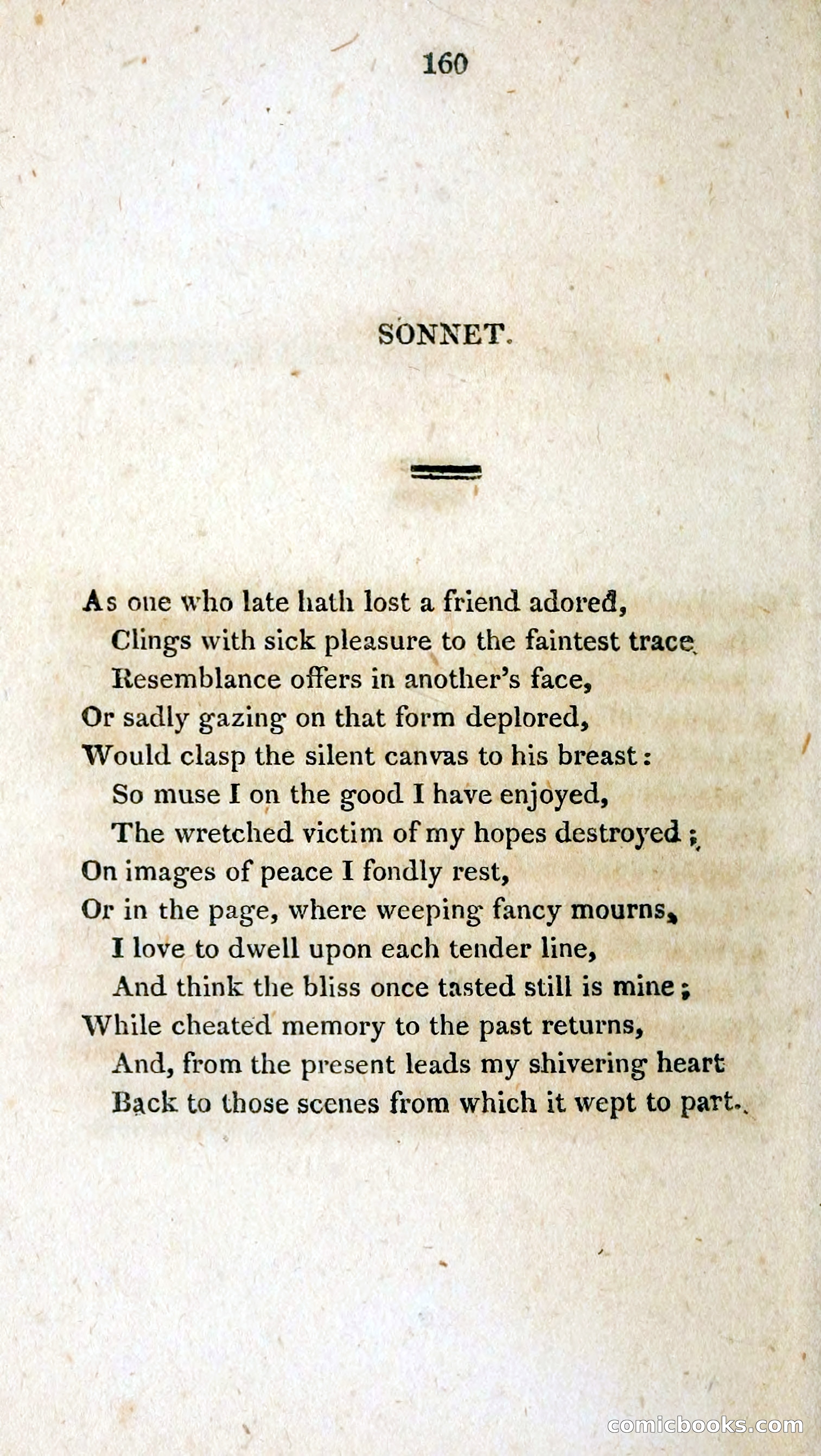
This page presents a sonnet (numbered 160) from what appears to be a Victorian narrative work. The poem explores grief and loss, comparing the speaker's longing for past happiness to someone who cherishes faint reminders of a deceased beloved. The speaker dwells on memories of joy now destroyed, finding solace in remembrance while lamenting separation from those cherished scenes. The formal structure and melancholic tone are typical of sentimental verse appearing in penny dreadfuls, likely interspersed within a larger serialized narrative rather than constituting the main content.
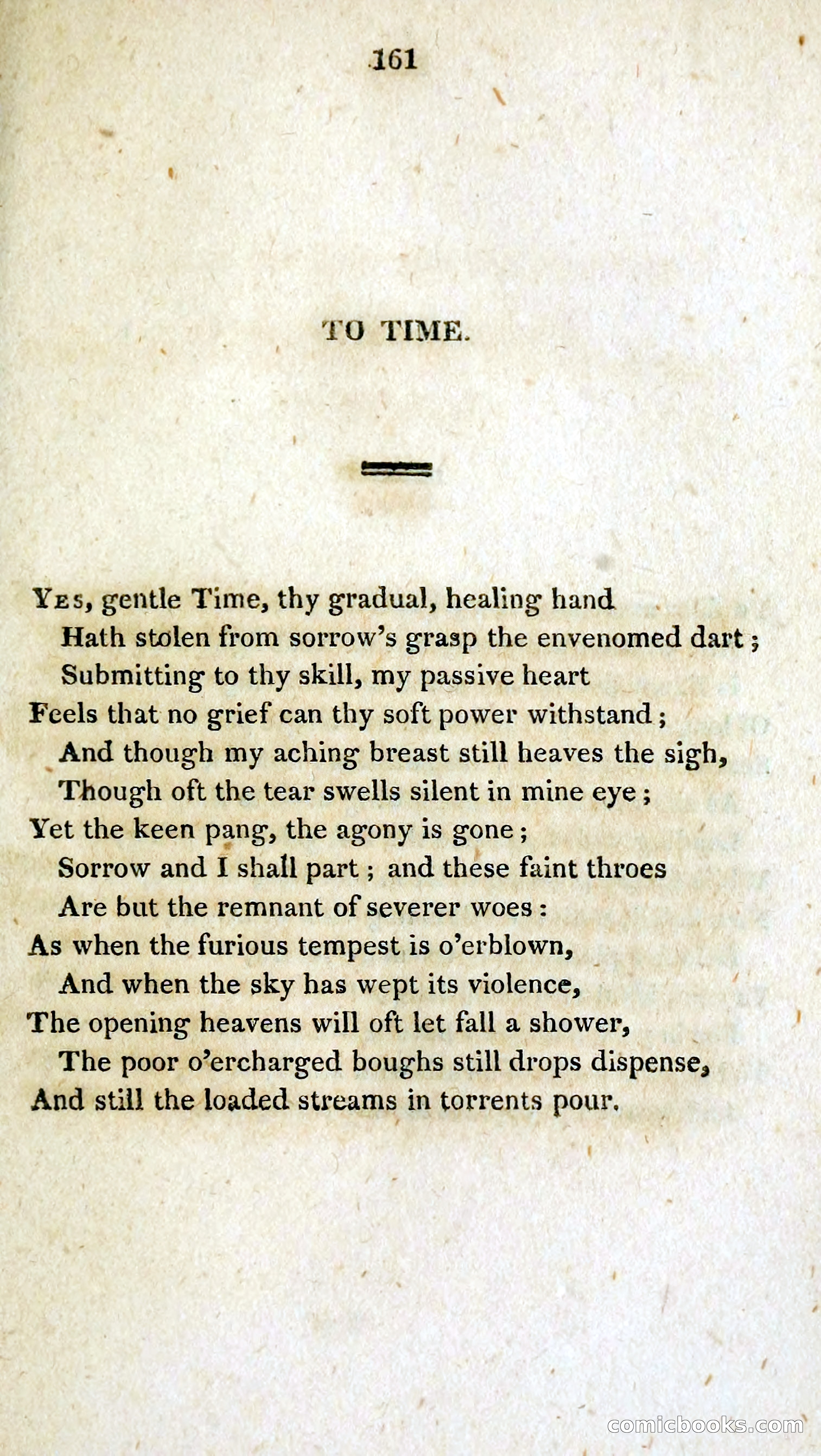
# Page 161: "To Time" — A Poem This is a text page containing a complete poem titled "To Time." The poem is written in verse and addresses Time as a healing force that gradually alleviates human suffering. The speaker describes how Time has removed sorrow's sharp pain, allowing grief to diminish despite lingering sighs and tears. The poem uses an extended metaphor comparing emotional recovery to weather aftermath—just as rain continues after a storm passes and overcharged branches still drip, so too do faint echoes of severe sorrow persist even as acute agony fades. The verse employs formal rhyming couplets characteristic of Victorian poetry.
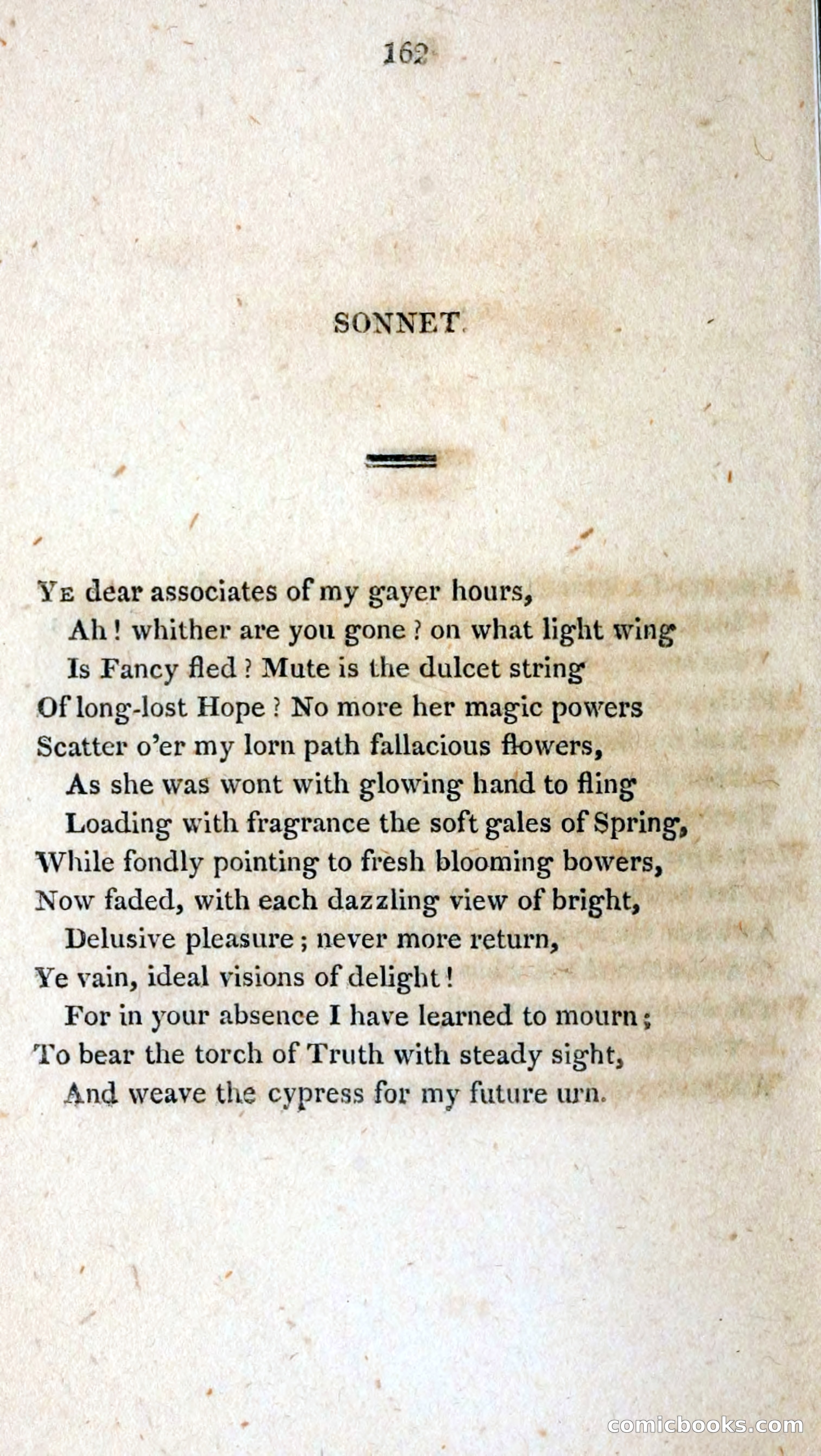
# Page 162: A Sonnet This is a text page from a Victorian penny dreadful containing a complete sonnet titled simply "SONNET." The poem addresses lost companions and pleasures from happier times, lamenting their departure through metaphors of faded Fancy and Hope. The speaker resolves that in the absence of these "vain, ideal visions of delight," they have learned to embrace Truth and mortality, accepting a somber future symbolized by cypress branches for their funeral urn. The poem adopts a melancholic, Gothic tone typical of Victorian sensational literature.
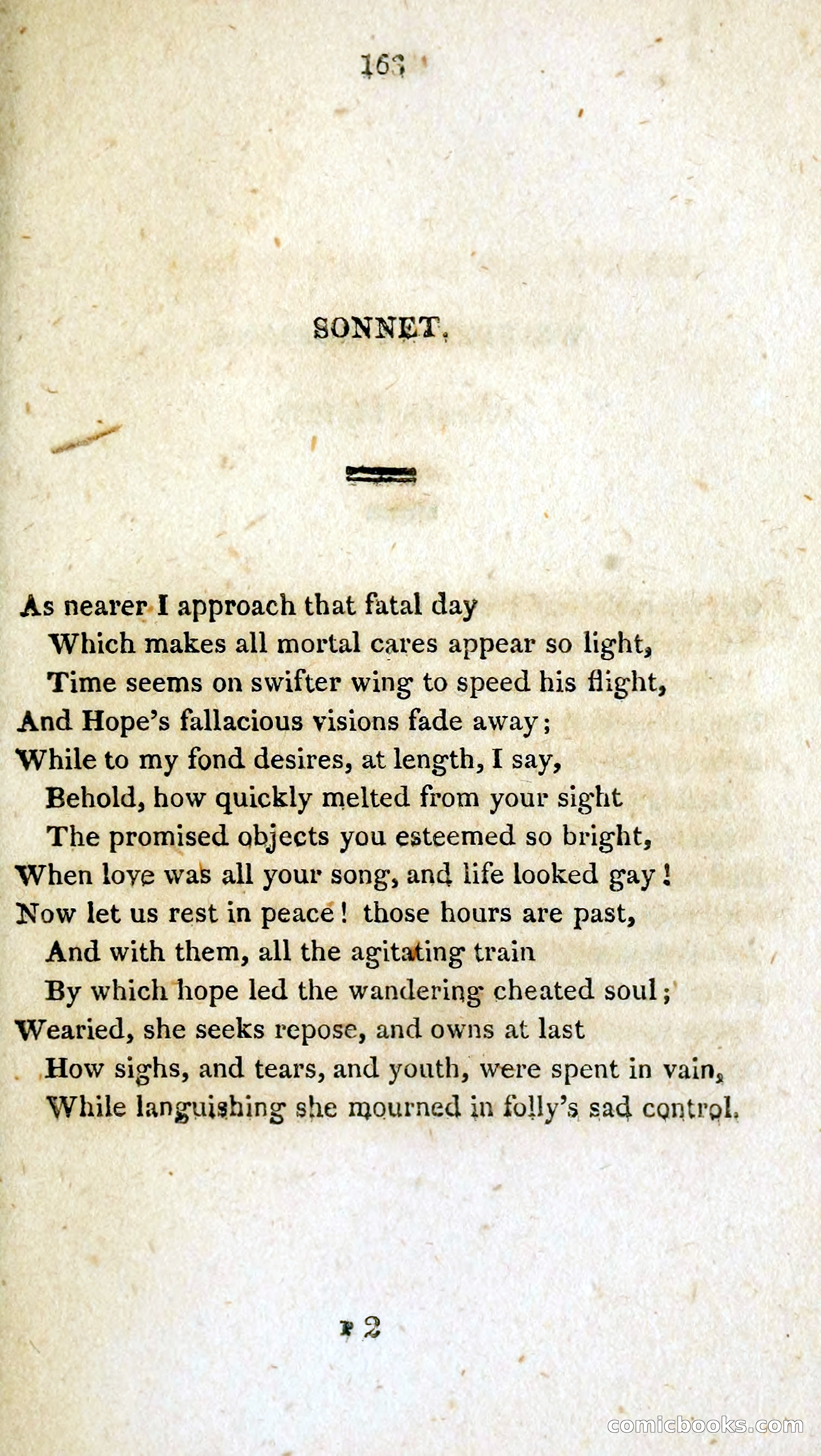
This page contains a complete sonnet titled simply "SONNET," printed as running verse rather than as an illustration or title page. The poem meditates on approaching death, the fading of hopes and youthful promises, and the speaker's eventual acceptance of rest after a life spent in vain pursuit and sorrowful longing. The tone is melancholic and reflective, typical of sentimental Victorian verse.
This is a page of running prose containing a poem dated November 18, 1799, and marked "Written at Rossana." The poem addresses someone who has carelessly plucked the last flower of winter from its humble bank. It laments the destruction of this delicate bloom, which had survived storms, and urges the rash hand to instead cherish what little beauty remains in "faded life"—particularly domestic love and contentment. The verse employs Romantic conventions of nature, loss, and moral reflection typical of late 18th-century sentimental literature.
This is a page of running prose—specifically a poem titled "Written at Rossana" (page 165). The verse addresses a chestnut bower, praising its quiet shade as a refuge from the bustling world of dancing and singing. The speaker blesses the bower's darkness and finds comfort in its shelter, preferring its simple peace to the bright pleasures and dangers of society, concluding that no sudden storms will frighten their calm retreat there. The poem appears to be sentimental, nature-focused verse rather than the sensational content typically associated with penny dreadfuls.
# Page Analysis This is a printed poetry page (page 166) from what appears to be a Victorian-era literary work. The poem, titled "Written at the Eagle's Nest, Killarney, July 26, 1800," is a romantic verse describing a group seeking rest and shade by a lake near an eagle's nest in Ireland. The speaker celebrates the natural beauty of the location—its soft turf, magical sounds, and woodland melodies—declaring these hours among life's brightest moments, ones memory will preserve forever. The poem employs elevated, sentimental language typical of Romantic-era verse rather than the sensational melodrama characteristic of penny dreadfuls.
This is a printed poetry page from a Victorian-era publication. It presents a poem titled "Written at Killarney" and dated July 29, 1800. The verse describes a serene lakeside scene at night, with imagery of moonlight on water, Alpine hills, and dark woods, while addressing someone to rest their oars and listen to music. The speaker expresses hope that sweet sounds will magically preserve the memory of this rapturous moment. The page number 167 appears at the top.
This page contains a poem titled "ON LEAVING KILLARNEY," dated August 5, 1800. The text is a lyrical verse expressing melancholy farewell to the Irish landscape of Killarney—its hills, lakes, and forests—as the speaker departs by boat. The poem laments the loss of natural beauty and sensory pleasures (music, birdsong) experienced there, while hoping the place remains untouched and continues to bring joy to others. It appears to be extracted prose or poetry from a larger work rather than typical penny dreadful sensation fiction.
# Page Analysis This is a poetry page from a Victorian penny dreadful (page 169). The heading "TO DEATH" introduces a dramatic verse addressed directly to Death as a personified force. The poem employs Gothic melodrama typical of the genre, depicting death through vivid imagery—sudden arrows in midnight silence, a suspended javelin over a dying person surrounded by weeping relatives. The speaker agonizes over whether Death will strike swiftly or slowly strip away life's pleasures before claiming the soul, ultimately resigned to accepting death when all loved things are lost. The florid, anguished tone and supernatural personification are characteristic of sensational Victorian literature.
# Page Analysis This is a dedicatory poem page (numbered 170) addressed to "W. P. Esq. Avondale." The text consists entirely of verse—a fourteen-line poem wishing the recipient pleasant summer experiences in their beautiful landscape, while expressing confidence they will ultimately cherish their home and the influence of the Muses more dearly upon returning from observing the wider world. The poem employs romantic, sentimental language typical of Victorian verse, praising the addressee's aesthetic sensibilities and moral character. There are no illustrations, advertisements, or narrative prose on this page.
This is page 171 of running prose—specifically, a poem titled "Addressed to My Brother" dated 1805. The fourteen-line verse expresses profound gratitude from a speaker recovering from serious illness, addressing both his brother and kindly friends who cared for him during his near-fatal sickness. The speaker laments his inability to fully express the deep emotions and grateful feelings that his recovery has awakened.
This is page 172 from a Victorian penny dreadful containing a poem titled "Addressed to My Harp." The page presents running verse in which the speaker addresses their harp as a beloved companion, lamenting that it can no longer provide comfort during times of anxiety and grief. The poem recalls how the harp's music once soothed emotional pain and brought back cherished memories of happy moments shared with friends. The text is formatted as formal poetry with regular stanzas.
# Page 173: Poetic Verse This is a page of running verse text, numbered 173, presenting a sentimental poem about parting from a beloved musical instrument (likely a harp or piano, referred to as "thee" with "strings"). The speaker grieves their forced separation from this "partner of my happiest days," expressing that while they may forget how to play it, memory will preserve the emotional scenes they shared. The poem concludes with the speaker resolving that the instrument's "silver sounds" will haunt their imagination in future melancholy. The typography and aged paper suggest this is from a Victorian-era publication, though whether penny dreadful or more conventional verse collection cannot be determined from this page alone.
# Page Analysis This is a text page from a Victorian serialized work (page 174), presenting a poem titled "MORNING." The page opens with a classical Latin epigraph attributed to Statius, followed by an English poem in four quatrains. The verse addresses the morning personified, depicting a speaker who has endured a sleepless night tormented by anxiety and care—darkened rooms excluded light, and worry prevented sleep. With dawn's arrival, the speaker finds renewed hope and comfort, ultimately rising from bed to greet the new day. The poem employs romantic, sentimental language characteristic of the period.
# Page 175: Poetry This page contains verse numbered 175, presenting a romantic poem in multiple stanzas. The speaker describes emerging from a night of melancholy and fear into daylight, finding solace in nature's beauty—birdsong, fresh air, and morning light. The poem then directly addresses someone who reluctantly rises from bed, reproaching their indifference to the dawn's charms. The speaker concludes by revealing their own intense emotional experience: nature's beauty revives them after enduring "a night of horrors, only less than death," suggesting they have survived some unspecified trauma or ordeal. The verse appears emotionally heightened and melodramatic in tone, consistent with Victorian popular literature.
# Page 176: "The Vartree" This is a text page containing a poem titled "The Vartree." The poem, prefaced by an Italian epigraph from Poliziano, is a descriptive lyric in English verse celebrating a picturesque riverside location. The poem praises the beauty of the Vartree's banks, vegetation, water, and shaded groves across different times of day, employing romantic imagery of dew, flowers, sunlight, and peaceful waters. The work appears to be literary content rather than sensational fiction, though its presence in this penny dreadful suggests it may be padding or an interlude within a larger serialized narrative.
This is a page of running verse poetry, numbered 177, printed on aged paper. The text is a moral exhortation addressed to someone named Mary, urging her to abandon worldly pleasures and the corrupting influence of society's "senseless crowd." The speaker invokes pastoral imagery—water nymphs, flocks beneath lime and beech trees—as a counterpoint to the hollow joys of flattery and pleasure-seeking. The poem warns that the satisfactions of youth and novelty cannot be recaptured in maturity, and counsels Mary to forsake vanity for innocence and peace. The language and themes are characteristic of Victorian didactic verse.
This is a page of running verse poetry, numbered 178, presented on aged paper. The eight-line passage addresses someone who has experienced life's vanities and fashionable pleasures, urging them to abandon such pursuits and instead embrace Wisdom, Science, and Reason as better guides. The tone is moralistic and didactic, characteristic of Victorian moral literature. The verse appears to be part of a longer narrative work rather than a penny dreadful's typical sensational content, suggesting this may be from a more elevated literary publication or a moralizing section within serialized fiction.
# Page 179: Philosophical Verse on Friendship and Love This is a text page (not a title page or illustration) from what appears to be a Victorian-era publication. The page presents a moral epigraph—"A Faithful Friend is the Medicine of Life" (attributed to the Son of Sirach)—followed by an extended poem exploring the mingling of sorrow with pleasure, disappointment with joy, and the corrupting influence of passion on pure affection. The verse employs ornate, sentimental language typical of Victorian sentiment, contrasting Heaven's gift of true friendship with Love's tendency to poison innocent pleasures through desire and anguish.
This page contains running verse (poetry) rather than prose narrative. Numbered 180, it presents a poem about the ideal qualities of friendship, emphasizing sincerity, emotional reciprocity, and loyalty through both joy and sorrow. The speaker rejects false flattery and fair-weather friends, instead valuing those who remain present during grief and maintain honest, unguarded confidence. The final stanza uses mirror imagery to suggest the friend should reflect oneself truthfully without distortion. The archaic language and sentimental subject matter are characteristic of Victorian-era popular literature.
This is a page of running prose—specifically, a four-line poem or verse numbered 181. The text expresses a sentiment about friendship, asking that a friend be a "mirror as true" to reflect one's faults privately rather than exposing them to others. The speaker requests that the friend neither reveal nor dwell upon failings that should remain hidden "from Heaven and from man." The passage appears to be moral or sentimental verse typical of Victorian-era popular literature, though the broader context and source remain unclear from this page alone.
# Page 182: Poetry on Spring (1802) This is a text page from what appears to be a literary collection or miscellany, not a typical penny dreadful. It contains a poem titled "Verses Written at the Commencement of Spring.—1802." The four-stanza poem addresses spring's return, invoking natural images: soft gales and forgotten breath, tender leaves and eglantine, a bright hyacinth, and a blackbird's song. The speaker expresses nostalgia, contrasting spring's renewal with lost joy and hopes "that now are over." The tone is melancholic rather than sensational—reflective rather than lurid. The typography and aged paper suggest an early nineteenth-century publication date.
# Page 183: Victorian Poetic Text This is a page of running verse poetry, numbered 183, likely from the middle of a serialized narrative. The poem addresses a red-breast (robin) and celebrates the arrival of spring, describing nature's renewal through the songs of birds and the "grateful song of gladness." However, the tone shifts to melancholy as the speaker laments the absence of a "blooming Cherub Boy" who once joined in spring celebrations—a child whose "bright" eyes and "laughing" expression embodied innocence and joy, now apparently lost to time and maturity ("sadder years resigned to Reason"). The poem blends Romantic nature imagery with elegiac sentiment over lost childhood innocence.
# Page 184 — Poetry on Death of a Child This is a text page containing a complete poem printed in running verse. The poem is a mourning elegy addressed to a deceased child ("sweetest Babe," "sweet Boy"), describing the loss of the child's physical beauty and presence while offering consolation through Christian belief in heavenly reward. The speaker asserts that tears should fall not for the dead child, now in paradise, but for the living who remain in earthly sorrow. The work appears to be sentimental Victorian verse, likely from a serialized melodramatic tale involving child death—a common penny dreadful theme.
This is a page of running prose containing a four-line poem numbered 185. The verse addresses people who endure sleepless nights, passing many watchful hours while longing for daylight or envying those who sleep soundly. The poem appears to be part of a larger work, presented in a standard Victorian typeface on aged paper with visible foxing and discoloration. No illustration or advertisement is visible. The text suggests this may be from a miscellany, anthology, or narrative work incorporating verse, typical of penny dreadful publications that mixed various literary content.
# Page 186: Memorial Verse This is a running text page containing a commemorative poem titled "To the Memory of Margaret Tighe," dated June 7th, 1804, when she died at age 85. The verse celebrates her virtues—her tenderness, kindness, maternal care, hospitality, and piety—mourning her loss as a beloved parent and friend while asserting her peaceful passing to eternal rest. The poem's final lines shift focus to the living, suggesting the bereaved should mourn their own spiritual impoverishment rather than her blessed fate. This appears to be a sentimental memorial poem typical of Victorian periodical literature.
# Page Analysis This is a text page from a Victorian-era publication containing poetry. The page presents a poem titled "Verses Written in Sickness," dated December 1804. The poem addresses "Domestic Love" as a comforting force, describing it as sweeter than pleasure or passion. The latter stanzas express lamentation for those suffering from pain without sympathy or care—particularly for someone (the speaker) experiencing physical decline and loss of vigor without compassionate support. The page number is 187, with a signature mark "R 2" at the bottom, indicating this is part of a larger bound work.
# Page 188 - Running Prose/Poetry This page contains verse (numbered page 188) depicting contrasting experiences of illness and care. The speaker describes someone who receives loving attention during sleep without awareness of the sacrifices made, then contrasts this with their own suffering—enduring pain and ineffective medicine despite yearning for health. The poem shifts to gratitude, celebrating how a compassionate friend's watchful presence alleviates suffering and renews hope. It concludes with the speaker resolving not to complain about their "mild" lot, given the comfort of such devoted friendship and care. The tone moves from anguished complaint to resigned thankfulness.
This is page 189 of running verse poetry. The text consists of four stanzas in rhyming couplets addressing themes of suffering and love's consolation. The speaker, confined to a "couch of pain" and separated from former pleasures, expresses hope that love and affection will provide comfort through illness or decline. The final stanza appeals to Heaven to preserve these comforts, asking that love might ease the speaker's suffering and "smooth life's downward slope" as age approaches. The tone is sentimental and melodramatic, typical of Victorian popular literature.
# Page 190: Poetry on Pleasure This is a text page from running prose—specifically a poem titled "PLEASURE" (page number 190 visible at top). The verse is a moral warning in dramatic, Victorian language, addressing "Pleasure" as a seductive force that lures the speaker through flattery and false joys, dulling reason and conscience. The poem warns young and innocent readers to avoid Pleasure's snare, cautioning that those enchanted by her "magic charms" ultimately seek "bliss in Dissipation's arms." The tone is melodramatic and moralizing, typical of Victorian penny dreadful content blending sensation with didactic warnings against vice.
# Page 191: Running Verse This is page 191 of running narrative verse (appears to be poetry, likely from a longer work). The numbered page contains heroic couplets describing a ship sailing near Senegal's coast. The text depicts lush tropical scenery—mangrove forests, flowering fields, and wildlife—as heedless sailors approach the shore, seemingly oblivious to danger. The verse emphasizes nature's wild abundance contrasted with human blindness to warnings, suggesting an impending peril awaiting the mariners.
This is a page of running verse poetry numbered 192, printed on aged paper typical of Victorian penny dreadfuls. The eight lines describe a gruesome scene of death by poisoning, with vivid imagery of "deadly vapours," "vegetable poison," and "putrescence" causing victims to waste away and expire. The dramatic language and gothic subject matter—focusing on the slow, terrible decay of the poisoned—is characteristic of the sensational melodrama found in these cheap serialized publications.
# Page 193: Dedicatory Poem This is a text page containing a poem titled "Written for Her Neice S. K." The verse is a sentimental blessing addressed to the author's niece, wishing her well through the seasons of life—spring with beauty and virtue, summer's bloom protected from tempests, autumn's calm with lingering flowers of affection, and winter's days brightened by conscience, peace, love, and divine light. The poem appears to be a gift or dedication rather than narrative fiction, suggesting this penny dreadful publication included miscellaneous literary content alongside its serialized stories.
This is a page of running poetry text, numbered 194, presenting a poem titled "To Fortune" attributed to Metastasio. The poem is a defiant address to Fortune as an "Unstable Goddess," asserting the speaker's refusal to fear or submit to her threats. The speaker claims their soul grows stronger through adversity, comparing themselves to steel that becomes keener when hammered. The verse employs classical poetic language and formal rhyming couplets typical of Victorian-era anthologized poetry.
# Page 195: "The Picture" This is a poetry page from running prose within a Victorian serial. The poem, titled "The Picture" and subtitled "Written for Angela," is a lyrical lament in which the speaker describes gazing at a portrait of a beloved woman. The speaker admires the accurately rendered features—the lip, smile, and eyes—yet complains that the painted image, however skillfully executed, lacks the warmth, tenderness, and magical living presence of the actual person. The poem emphasizes the gap between artistic representation and lived emotion, with the speaker mourning the portrait's cold, "unimpassioned" gaze compared to the beloved's enchanting actual presence.
This is a page of running prose—specifically verse or poetry—numbered 196, appearing mid-narrative in a penny dreadful. The text presents an emotionally intense, melodramatic passage in which a speaker addresses "O image adored," pleading for intimacy and confessing sorrows while acknowledging the beloved's affection lies elsewhere. The language emphasizes romantic desperation and bittersweet longing, typical of Victorian sensation fiction's lurid emotional appeals. The verse form and page number suggest this is extracted from a serialized story rather than a standalone poem.
# Page 197: "The Shawl's Petition to Lady Asgill" This is a page of running verse poetry, not a title page or illustration. The poem is a whimsical petition written from the perspective of a decorative shawl addressing a lady named Asgill. The shawl flatters her beauty, recounts its journey from exotic Kashmir and Tibet to colder climates, and describes how it adorns her shoulders and form, adding charm that "Venus well might own." The verse employs romantic, ornate language typical of Victorian sensibility, though the conceit of an object petitioning its wearer is playful rather than sensational.
# Description This is a page of running poetry text (page 199), not a title page or illustration. It's a dedicatory poem addressed "To Lady Charlemont, In Return for Her Presents of Flowers" dated March 1808. The verse praises a woman named Nina whose graceful hand can magically coax flowers to bloom despite dreary weather and gloomy surroundings. The poem employs romantic, flowery language to describe how Nina's command causes flowers—particularly violets—to unfold their petals, comparing their blue color to her eyes. The page ends mid-poem with a catchword indicating continuation on the next leaf.
# Page 200: Verse/Poetry This is a text page of Victorian verse, numbered 200, containing a poem addressed to "Dear Nina." The poem uses floral imagery (crocuses, flowers) and classical allusion (Narcissus) to praise someone's ability to bring comfort and joy, particularly to the speaker who appears to be imprisoned or confined ("my prison couch"). The verse celebrates how affection and friendship have sustained the speaker through hardship, describing how Nina's kindness has revived hope "in spite of years, and grief, and pain." The language is sentimental and melodramatic, typical of Victorian popular literature.
# Page 201 This is a page of running poetry text from what appears to be a Victorian narrative work. The verse, numbered 201, addresses someone named Nina, invoking tenderness and blessing for "my happy home." The poem employs elaborate Romantic imagery—referencing the painter Rubens, wreathed flowers, cherubs, and ambrosia—to express wishes that love and kindness will protect the speaker's domestic life and create cherished memories. The ornate, sentimental language is typical of Victorian popular verse.
# Page 202: Poetry ("Written at West-Aston") This is a page of verse poetry, dated June 1808, composed at West-Aston. The poem recalls a "dear suffering saint" who planted a myrtle tree on the speaker's birthday as a commemorative gift. The poet reflects on the woman's gentle, selfless nature and her hopes that the plant might one day delight her beloved brother in this pleasant garden setting. The poem concludes melancholically, observing that such tender affections often come to nothing—"when sweet affection thus designs in vain, / And sees the fragile web it smiling spun" break apart. The work appears sentimental and domestic in character rather than sensational.
# Page Description This is a page of running verse poetry (page 203) from what appears to be a Victorian narrative poem. The text employs elaborate metaphorical language mixing themes of death, grief, and loss with botanical imagery. It describes a woman who lost her brother to death and subsequently endured hidden suffering, now resting in peace; it then shifts to describing a withered young tree that, despite care and the arrival of spring, cannot revive. The passage concludes by directly addressing someone named Sydney, suggesting their "assiduous care" may offer hope. The ornate, sentimental tone and melodramatic subject matter are consistent with Victorian popular literature.
# Page Description This is a poetry page (page 202) from what appears to be a collected or serialized work. The poem, titled "Written at West-Aston" and dated June 1808, is sentimental Victorian verse recalling a woman who planted a myrtle tree on the narrator's birthday as a gesture of love. The speaker reflects on her gentle character, her devotion to a beloved brother, and her unfulfilled hopes of walking through the grounds with him, lamenting that "sweet affection thus designs in vain" when her plans fail to materialize.
# Page 203 of Victorian Penny Dreadful This is a page of running verse poetry, numbered 203, appearing mid-narrative in a serialized work. The text is a melancholic meditation on loss and death: it describes a woman who suffered the sudden death of her beloved brother during a moment of happiness, mourned him for years bearing her grief silently, and now both rest in peaceful afterlife awaiting eternal bliss. The poem shifts to extended metaphor, comparing her to a blighted young tree that, despite careful tending by friendship, cannot revive—its withered branches producing no new growth. The passage concludes by addressing someone named Sydney, suggesting their devoted care may yet offer some solace.
# Page 206: Running Prose from a Victorian Penny Dreadful This page contains numbered verse (page 206) presenting melodramatic poetry rather than prose. The passage depicts a soldier encountering a frightened child and woman fleeing down Glenmalure. The child, tears streaming, accuses the soldier of belonging to men who murdered her father. An old man identifies them as "Ellen Byrne" and her orphan boy, then turns away emotionally. The verses emphasize pathos and moral conflict—the soldier's gentle heart contrasted against the child's accusation and the mother's apparent distress—typical of penny dreadful sensationalism mixing military action with domestic tragedy and emotional manipulation.
# Page 207: Running Prose from a Victorian Penny Dreadful This is a page of running verse narrative (page 207) from what appears to be a serialized melodramatic tale. The text depicts a dialogue about an orphan boy named Byrne of Carrickmure, whose father was murdered. A stranger assumes the father was a "deluded rebel youth," but an elderly man (identified as "Ellen's aged sire") passionately denies this, insisting the father did not die in "Tarah's fight" nor shed blood at the Curragh—locations that suggest Irish historical conflict. The verse emphasizes the boy's tragic circumstances and the father's innocence of rebellion.
# Page 208: Running Verse Narrative This is a page of poetic running text (page 208), printed in standard Victorian type. The passage is a dramatic monologue or narrative verse concerning the death of Bryan Byrne and the speaker's son. The speaker laments that despite a cross-sectarian marriage to "Ellen" uniting British and Irish ("Erin's") families in love, party hatred prevented the son's acceptance into a "loyal band." The verse culminates in the tragic revelation that both Bryan Byrne and the speaker's own son were slain, their "life-blood shed in vain" through what the speaker calls "the savage work of death." The reference to "Clough's dark vale" and the historical name Bryan Byrne suggest this likely concerns actual Irish political violence, though the specific event remains unclear from this excerpt alone.
# Page 209: Running Verse This is a page of running poetry (page 209 of a larger work). An aged man, apparently a father grieving over his son Bryan, responds to a youth's questioning about whether Bryan committed any rash or rebellious deed. The father defends Bryan's loyalty and honor, claiming his son bled during "that day of slaughter" where "Justice dropped the sword," and describing how "Fury" waged war against "unarmed Innocence" in a manner unjust. The text appears to be part of a dramatic narrative about loyalty, injustice, and a son's tragic fate.
# Page 210: Running Prose This page contains running verse narrative, likely spoken dialogue from a character recounting tragic events. A sorrowing father describes widespread death and mourning—loyal brothers dying nightly, victims falling each morning. He grieves his own sons' deaths and tells of additional horror: his daughter Ellen's husband's murder, and three young nephews (yeomen) brutally killed by treachery before their mother's eyes. The speaker, their uncle, expresses love mixed with fear for their reckless daring. The verse is typical penny dreadful melodrama, emphasizing crime, murder, family grief, and moral outrage.
# Page 211: Running Prose This page contains running verse narrative (page 211 of a larger work). The text describes Ellen bringing news of some tragedy to the narrator, who then visits a grieving mother. The passage escalates to depict an assembled country roused to violent revenge, with crowds demanding death for those suspected of treachery and "the faith of Rome." The emotional arc moves from personal sorrow to collective calls for vengeance, typical of penny dreadful melodrama. The page ends mid-narrative.
# Page 212: Verse Narrative This is a text page of running poetry in verse form, numbered 212. The passage depicts a dramatic domestic tragedy: a woman named Ellen trembles as men advocate striking at an enemy "even through the breast of innocence." The narrator describes Ellen's distress over her missing infant child and her brother's protective response. When hearing warfare approaching ("the first savage blast"), the brother flees back to what was their "home of peace," now destroyed. The passage concludes with the narrator's anguished wish that he had died beneath his sister's roof rather than witness the family's catastrophic loss.
# Page 213: Running Poetry Text This is a page of running verse from a Victorian penny dreadful, numbered 213. The poetic narrative describes a scene of violence and tragedy: a speaker recalls witnessing horrific bloodshed ("blood-hounds of revenge"), fleeing with a child past destruction ("smoking ruin round"), and returning home to find their cottage in the Glen. The passage culminates in the deaths of characters named Bryan and Ellen, with a surviving infant found clinging to a corpse. The tone is melodramatic horror, emphasizing anguish, death, and domestic tragedy—typical sensational content of penny dreadful serials.
# Page 214 of a Victorian Penny Dreadful This is a text page containing running verse—specifically dramatic poetry or verse narrative, not illustrated content. The passage depicts an intensely melodramatic scene of grief and loss: a narrator witnesses the death of his son from wounds, his wife's collapse and subsequent descent into madness, and the deaths of his children. The surviving speaker, haunted by these horrors, is then called away by an orphaned child described as the "last relic of our hope." The rhetoric emphasizes emotional extremity—despair, convulsion, frenzied eyes, and gushing wounds—typical of Victorian sensation literature's appeal to pathos and sensationalism.
This is a page of running verse poetry, numbered 215, appearing mid-narrative in a penny dreadful. The text presents a dramatic farewell address to a soldier, urging him to remember "the murdered youths of Glenmalure" and to pause before committing acts of vengeance during civil conflict. It invokes specific named figures—Bryan Byrne, Ellen, and her orphan child—apparently victims or casualties central to the story's plot. The passage conveys typical melodramatic themes of the genre: violence, moral exhortation, and emotional appeals to restrain destructive impulses.
This is a text page containing poetry labeled "IMITATED FROM JEREMIAH" (Chapter 31, verse 15). The poem appears to be a Victorian-era verse adaptation of the biblical passage, written in a sentimental, melodramatic style typical of penny dreadful literature. It describes Rachel mourning her children in Ramah's plain, emphasizing themes of grief, desolation, and eventual consolation. The verse uses archaic language ("nigh," "forlorn") and biblical imagery, concluding with reassurance that the "loved, lamented band" will return from "the destroyer's land." There are no illustrations—only the printed text on an aged, cream-colored page.
This is a page of running poetry text, numbered 217, appearing near the end of a work. The six lines present a rhyming couplet passage in elevated language, addressing someone directly ("thee," "thy") with promises of future peace and happiness. The verse celebrates freedom from enemies, rest, hope, freedom from suffering, familial joy, and the blooming of gardens or estates. The language and sentiment are typical of Victorian sentimental or melodramatic verse, though whether this concludes a narrative, serves as moral instruction, or represents something else in the penny dreadful's story cannot be determined from this page alone.
This is a page of running verse poetry, numbered 218, titled "Hagar in the Desert." The poem depicts the biblical story of Hagar and her son Ishmael abandoned in the wilderness, emphasizing their suffering: the child's thirst and death, and the mother's anguish as she witnesses his demise. The verse employs melodramatic language characteristic of Victorian sensational literature, dwelling on despair, "deep despair," and the mother's helpless torment as her child perishes.
This page contains poetry (page 219 of a larger work), printed in standard Victorian typeface. The verse presents an angel's consoling message to a suffering woman—described as "Poor, abandoned soul" and "Mother of a mighty race"—offering divine comfort and salvation. The angel urges her to abandon despair, look toward heavenly visions of fountains and green bowers, and trust in God's care. The tone is melodramatic and sentimental, typical of Victorian penny dreadful moralizing, mixing emotional appeals with religious reassurance about redemption and resting from affliction.
# Page 220: Verse/Poetry This page contains printed verse (page 220) addressing a suffering soul driven from comfort into desolation and despair. The poem progresses from depicting the speaker's hopeless state—mourning over an empty pitcher in a spiritual desert—to offering religious consolation through divine intervention. It concludes with promises of heavenly redemption and eternal joy in a kingdom to come. The text is devotional in tone, emphasizing themes of salvation and divine mercy rather than sensation or melodrama typical of penny dreadfuls.
# Analysis of Page 221 This is a **poetry page** from what appears to be a Victorian-era publication (dated May 1809). The poem, titled "THE LILLY," uses extended metaphor to describe a lily bulb's hidden beauty beneath an ugly, unimpressive exterior. The speaker addresses the withered root, acknowledging its apparent lack of grace while celebrating the precious flower concealed within—one that will bloom when spring arrives. The verse emphasizes patience and faith in nature's transformation, suggesting that inner loveliness may be invisible to the careless eye but will eventually reveal itself. The poem's romantic, sentimental tone is characteristic of early-nineteenth-century popular verse.
# Page 222 of a Victorian Penny Dreadful This is a text page containing poetry (numbered 222), not a title page or illustration. The verse appears to be an allegorical meditation on spring and renewal, personifying abstract concepts like Hope, Ignorance, and Faith. The poem celebrates the emergence of spring flowers from the earth and suggests that Faith should patiently watch over "humble Sorrow" with a hopeful eye. The language is ornate and sentimental, typical of Victorian popular verse, employing floral and natural imagery as metaphors for emotional and spiritual themes.
This is a page of running poetry text, numbered 228 at the top. The four visible lines form a complete stanza in verse, employing an ABAB rhyme scheme. The passage describes enduring hardship—a "long, cold, wintry night" and "degraded doom"—while awaiting divine salvation through "Heaven's reviving light" and an "Eternal Spring" that will dispel gloom. The tone is melancholic yet redemptive, characteristic of Victorian sentimentality. The page appears largely blank below the stanza, suggesting this may be near a chapter or section break in the serialized fiction.
# Analysis This is a **text page** containing a single **sonnet poem**. The poem, titled "Sonnet Written at Woodstock, In the County of Kilkenny, The Seat of William Tighe," is dated June 30, 1809. It addresses a muse, asking her to comfort the speaker during painful hours by recalling the inspiring visions and natural beauty of Woodstock estate that once consoled its master, William Tighe. The poem references specific features of the estate—ivy-covered seats, rose gardens, hills, and a trickling fountain beneath oak trees—as sources of spiritual and artistic solace.
This is a printed poetry page numbered 225, featuring a complete poem titled "On Receiving a Branch of Mezereon Which Flowered at Woodstock," dated December 1809. The poem is a melancholic meditation on receiving early spring flowers during dark times, expressing both hope and despair. The speaker contemplates how the flowers promise brighter May days ahead, yet laments that they will not live to see them, ultimately suggesting death would be preferable to losing beloved friends. The verse employs regular rhyme scheme and reflects Romantic-era sensibility about nature, mortality, and emotional suffering.
# Page 226: Poetry This page contains verse (numbered 226), appearing to be from the middle of a serialized story rather than a title or cover page. The poem expresses intense emotional and spiritual anguish—a speaker struggles with mortality, terror, and the bonds of earthly love while attempting to embrace heavenly transcendence. The verse addresses those who comfort the dying and those loved ones whose presence the speaker will soon lose forever. The tone is melodramatic and Gothic, typical of Victorian sensation fiction, dwelling on death, regret, and the soul's conflicting attachments to earthly versus spiritual realms.
This is a page of verse poetry, numbered 227, appearing in the middle or later section of a serialized work. The poem is a poignant appeal to remember the speaker fondly after death or separation, addressing someone whose kindness is acknowledged despite distance. The speaker—apparently a woman, given the pronoun "her"—asks not to be entirely forgotten, requests that her faults be overlooked, and requests to be spoken of with affection by someone whose thoughts she seeks. The tone is melancholic and elegiac, typical of Victorian sentimental literature. No illustration or title information appears on this page.
This is a concluding page of running prose and poetry. It contains a prose headnote describing the author's death on 24 March 1810 at age thirty-seven after six years of illness, followed by an elegiac poem (signed "W.T.") commemorating her passing. The text frames the poem as the author's final composition, emphasizing her Christian faith and virtuous character as a lasting spiritual guide to mourners. The page number 228 appears at top.
# What This Page Contains This is a notes section from a Victorian literary work, providing editorial annotations keyed to specific page numbers. The notes explain the biographical and historical contexts behind poems or passages—including details about where texts were written (at Waltrim, after a child's death), their origins (some poems from a novel by Mrs. H. Tighe), and personal references (a myrtle plant planted by the author's aunt, destroyed by frost in 1807). The final note indicates that a story about Bryan Byrne, found on page 205, is based on actual events from autumn 1798, though the poem may not record them with complete accuracy.
This is the final page of a penny dreadful narrative, consisting entirely of running prose text. The visible passage describes military retaliation near Wicklow, where approximately twenty persons were reportedly executed by troops in response to loyalist murders, "particularly of the three brothers mentioned in this ballad." A footnote references Page 208, identifying Clough as the location where Colonel Walpole was killed and his detachment defeated by rebels. The page concludes with "THE END," marking the story's completion. The aged, yellowed paper and typography are typical of Victorian-era serialized fiction.
I can see this is a heavily degraded or damaged page from a Victorian-era publication, with a mottled, colorful pattern of pinks, purples, blues, and yellows throughout. The image quality is too poor to read any coherent text reliably. While there appear to be some small dark marks or characters scattered across the page, I cannot make out legible words with confidence. The OCR text provided is blank, which aligns with the illegibility of the image itself. This appears to be either a severely deteriorated page, a printing artifact, or a decorative element rather than a readable text or illustration page. Without legible content, I cannot determine whether this is prose, an advertisement, or another page element from the penny dreadful.

# Assessment This appears to be a **heavily degraded or corrupted scan** of a Victorian penny dreadful page. The OCR'd text is essentially unreadable—consisting almost entirely of random characters, symbols, and formatting artifacts with no coherent words or sentences discernible. The image itself shows a **textured, speckled surface** in tan, beige, and muted colors with no clear visible text, illustrations, or layout features that can be reliably interpreted. It resembles either severe image corruption, a blank page, or heavily aged/damaged source material. **Verdict:** Without legible text or visible content, the actual subject matter of this page cannot be determined from the provided materials.
# Analysis of This Page This appears to be a heavily degraded or damaged page from a penny dreadful publication, likely showing both illustration and text elements. The image quality is extremely poor—dominated by noise, color distortion, and pixelation that obscures most content. A vertical crease or fold runs down the center. While some faint marks and what might be a spiral symbol are visible in the middle section, the text is largely illegible in the image itself. The OCR returned no readable text, suggesting either severe damage to the original page or scanning/digitization issues. Without clearer visibility, it's impossible to determine whether this is prose narrative, an illustration caption, or other page content.

This is a blank or nearly blank page from a Victorian penny dreadful. The page itself contains no visible text or illustrations—just the aged, yellowed paper characteristic of 19th-century cheap print material. The only text visible is a modern conservation label at the bottom, indicating the document was deacidified using the Bookkeeper process with Magnesium Oxide as neutralizing agent in May 2009, applied by Preservation Technologies. The label does not describe the original content of the penny dreadful itself. Without visible text or images on the page proper, its original purpose within the serialized story cannot be determined.
This is a back cover or endpage of a bound volume, showing only a Library of Congress barcode label (0 014 547 330 5) affixed to a dark green cloth binding. The page itself contains no visible text or imagery beyond the institutional label and the website "comicbooks.com" printed in small white text at the bottom right corner. This appears to be archival documentation rather than original Victorian penny dreadful content—the barcode indicates this is a modern catalogued copy held by the Library of Congress. No information about the actual penny dreadful's title, content, or publication details is visible on this page.