
Penny Dreadfuls, 1812 · page 17 of 258
Psyche, and other poems — page 17: what you’re looking at
What you’re looking at
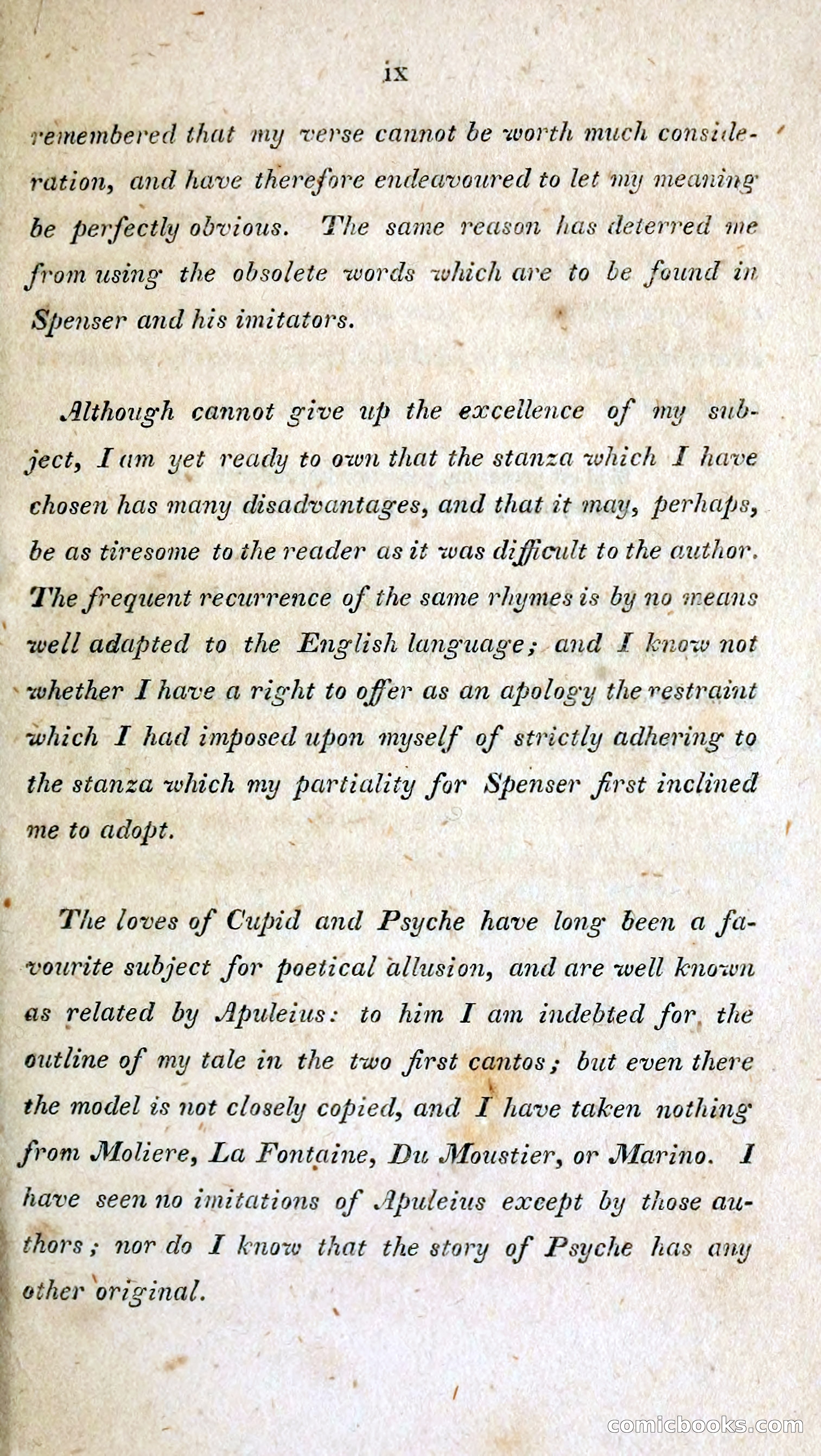
# Analysis of Page ix This is a prefatory page (numbered ix in Roman numerals) containing authorial prose—likely from an introduction or preface rather than the narrative itself. The author discusses compositional choices: explaining the deliberate simplicity of their verse to ensure clarity, avoidance of obsolete Spenserian language, and justification for adopting a particular stanza form despite its disadvantages (recurring rhymes ill-suited to English). The author also acknowledges drawing the outline of their tale about Cupid and Psyche from Apuleius for the first two cantos, while claiming originality beyond that source and independence from French and Italian treatments of the same material.
📄 Transcribed text from this page (OCR, searchable)
Machine-transcribed from the original scan — historical spelling and the odd misread are preserved.
1X — te remembered that my verse cannot be worth much conside- ¢ pation, and have therefore endeavoured to let my meaning be perfectly obvious. Whe same reason has deterred me - from using the obsolete words which are to be found in Spenser and his imitators. 7 Although cannot give up the excellence of my sub- ject, Lum yet ready to own that the stanza which £ have chosen has many disadvantages, and that it may, perhaps, be as tiresome tothe reader as tt was difficult to the author. The frequent recurrence of the same rhymes is by no means well adapted to the English language; and F know not whether I have a right to offer as an apology the restraint which I had imposed upon myself of strictly adhering to the stanza which m y partiality for Spenser first inclined me to adopt. . ~~ The loves of Cupid and Psyche have long been a fa- vourite subject for poetical allusion, and are well known as related by Apuleius: to him I am indebted for, the outline of m y tale in the two first cantos; but even there | the model is not closely copied, and 9 have taken nothing’ _ from Moliere, La Fontaine, Du Moustier, or Marino. £ { have seen no imitations of Apuleius exeept by those au- thors; nor do I know that the story of Psyche has any \ we other original. 2 Connicloookks.comn)