
Penny Dreadfuls, 1812 · page 160 of 258
Psyche, and other poems — page 160: what you’re looking at
What you’re looking at
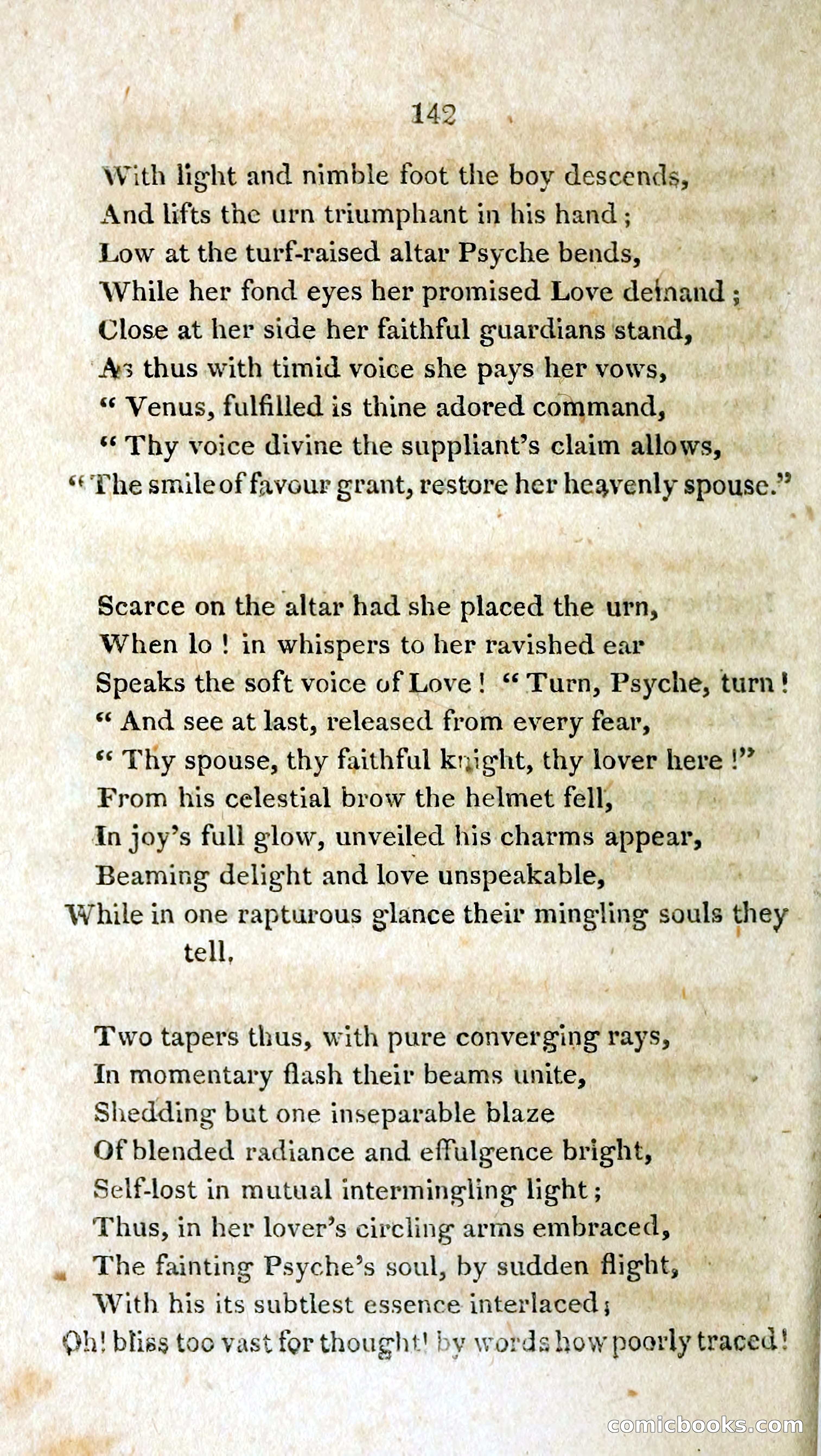
# Victorian Poetry Page on Psyche and Cupid This is a page of running verse (page 142) from what appears to be a narrative poem retelling the classical myth of Psyche and Cupid. The text describes Psyche performing a ritual at an altar with an urn, then being reunited with her lover—identified as a celestial being who removes his helmet to reveal himself. The poetry uses elaborate similes (comparing their union to converging candlelight) and emphatic language about their spiritual and physical union, concluding with an exclamation that such bliss exceeds words.
📄 Transcribed text from this page (OCR, searchable)
Machine-transcribed from the original scan — historical spelling and the odd misread are preserved.
442. 5 With light and nimble foot the boy descends, And lifts the urn triumphant in his hand; Low at the turf-raised altar Psyche bends, While her fond eyes her promised. Love detnand ; Close at her side her faithful guardians stand, Avs thus with timid voice she pays her vows, “ Venus, fulfilled is thine adored command, ‘‘ Thy voice divine the suppliant’s claim allows, ‘The smile of favour grant, restore her heavenly spouse.” on . * Scarce on the altar had she placed the urn, When lo! in whispers to her ravished ear Speaks the soft voice of Love! “* Turn, Psyche, turn! “‘ And see at last, released from every fear, ‘‘ Thy spouse, thy faithful knight, thy lover here !”? From his celestial brow the helmet fell, In joy’s full glow, unveiled his charms appear, Beaming delight and love unspeakable, | ' While in one rapturous glance their ere souls ioe tell, Two tapers thus, with pure converging rays, In momentary flash their beams unite, Shedding but one inseparable blaze : Of blended radiance and effulgence bright, — f Self-lost in mutual intermingling light; 4 Thus, in her lover’s circling arms embraced, a The fainting Psyche’s soul, by sudden flight, With his its subtlest essence interlaced; | Qh! bliss too vast for thought! by words how poorly traced! | >