
Penny Dreadfuls, 1812 · page 166 of 258
Psyche, and other poems — page 166: what you’re looking at
What you’re looking at
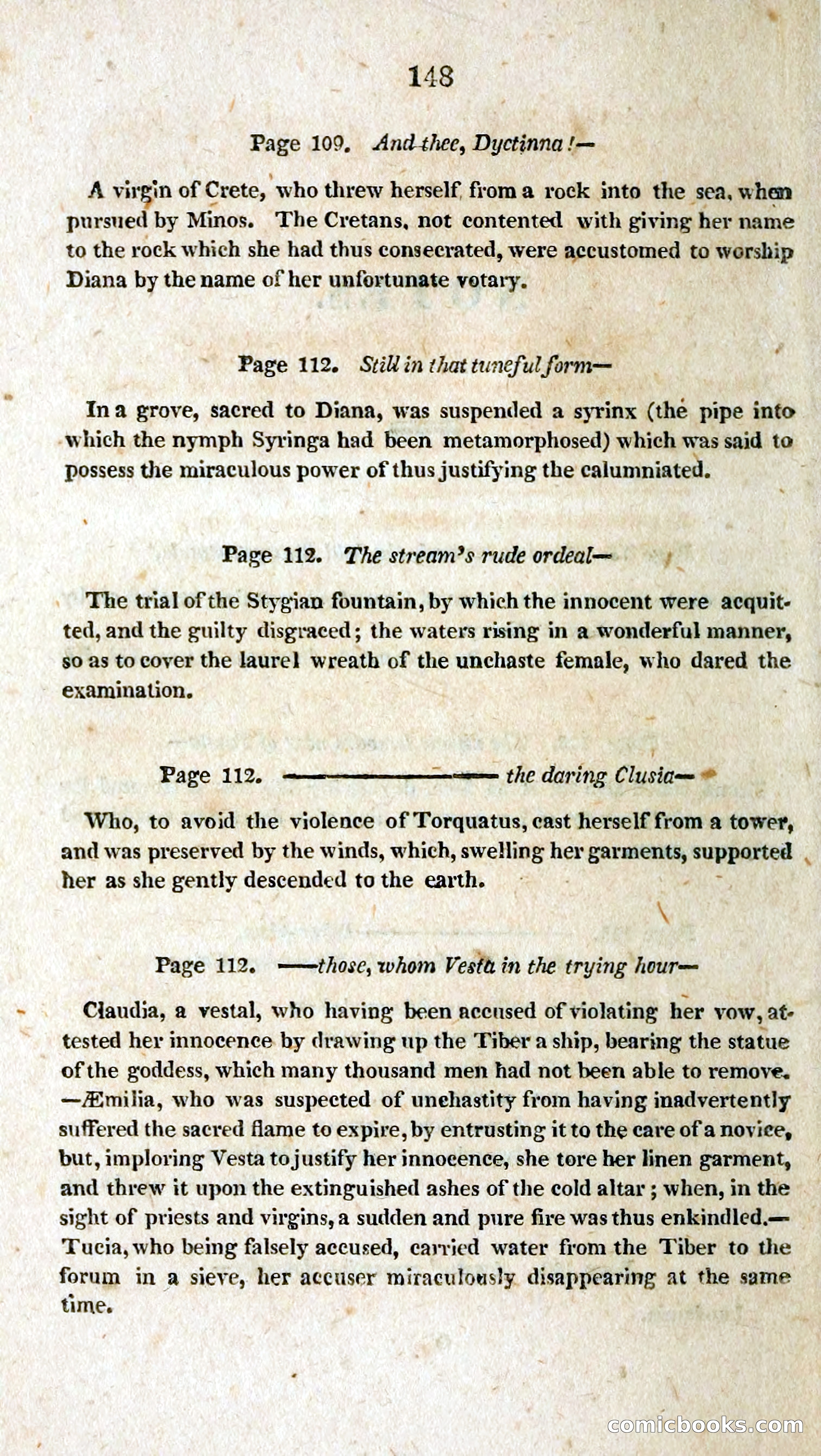
This is a page of running prose—specifically, footnotes or annotations from a Victorian penny dreadful. The text consists of mythological and classical references, each keyed to a page number, explaining allusions in the main narrative. The entries describe various classical female figures (Dyctinna, Syringa, Claudia, Aemilia, Tucia) who underwent miraculous trials to prove their innocence or chastity, drawing on Greek and Roman mythology and legend. The page functions as a scholarly apparatus explaining classical sources rather than as primary narrative text.
📄 Transcribed text from this page (OCR, searchable)
Machine-transcribed from the original scan — historical spelling and the odd misread are preserved.
148 Page 109, And thee, Dyctinna!— A virgin of Crete, who threw herself, froma rock into the sea, when pursued by Minos. The Cretans, not contented with giving her name to the rock which she had thus consecrated, were accustomed to worship Diana by the name of her unfortunate votary. Page 112. Still in that tuneful form— Ina grove, sacred to Diana, was suspended a syrinx (the pipe into ‘which the nymph Syringa had been metamorphosed) which was said to possess the miraculous power of thus justifying the calumniated. . s Page 112. The stream’s rude ordeal + The trial of the Stygian fountain, by which the innocent were acquit- ted, and the guilty disgraced; the waters rising in a wonderful manner, so as to cover the laurel wreath of the unchaste female, who dared the examination. ~ ; Page 112. the daring Clusia @ Who, to avoid the violence of Torquatus, cast herself from a tower, and was preserved by the winds, which, swelling her cma sUypANted ‘ her as she gently descended to the earth. \ Page 112, ——zhose, whom Vest in the trying hour— Ciaudia, a vestal, who having been accused of violating her vow, at- tested her innocence by drawing up the Tiber a ship, bearing the statue of the goddess, which many thousand men had not been able to remove. —Amilia, who was suspected of unehastity from having inadvertently suffered the sacred flame to expire, by entrusting it to the care of a novice, but, imploring Vesta tojustify her innoeence, she tore her inen garment, and threw it upon the extinguished ashes of the cold altar ; when, in the sight of priests and virgins,a sudden and pure fire was thus enkindled.— Tucia, who being falsely accused, carried water from the Tiber to the forum in a sieve, her accuser miraculously disappearing at the same time. Comichbooks;com