
Penny Dreadfuls, 1812 · page 247 of 258
Psyche, and other poems — page 247: what you’re looking at
What you’re looking at
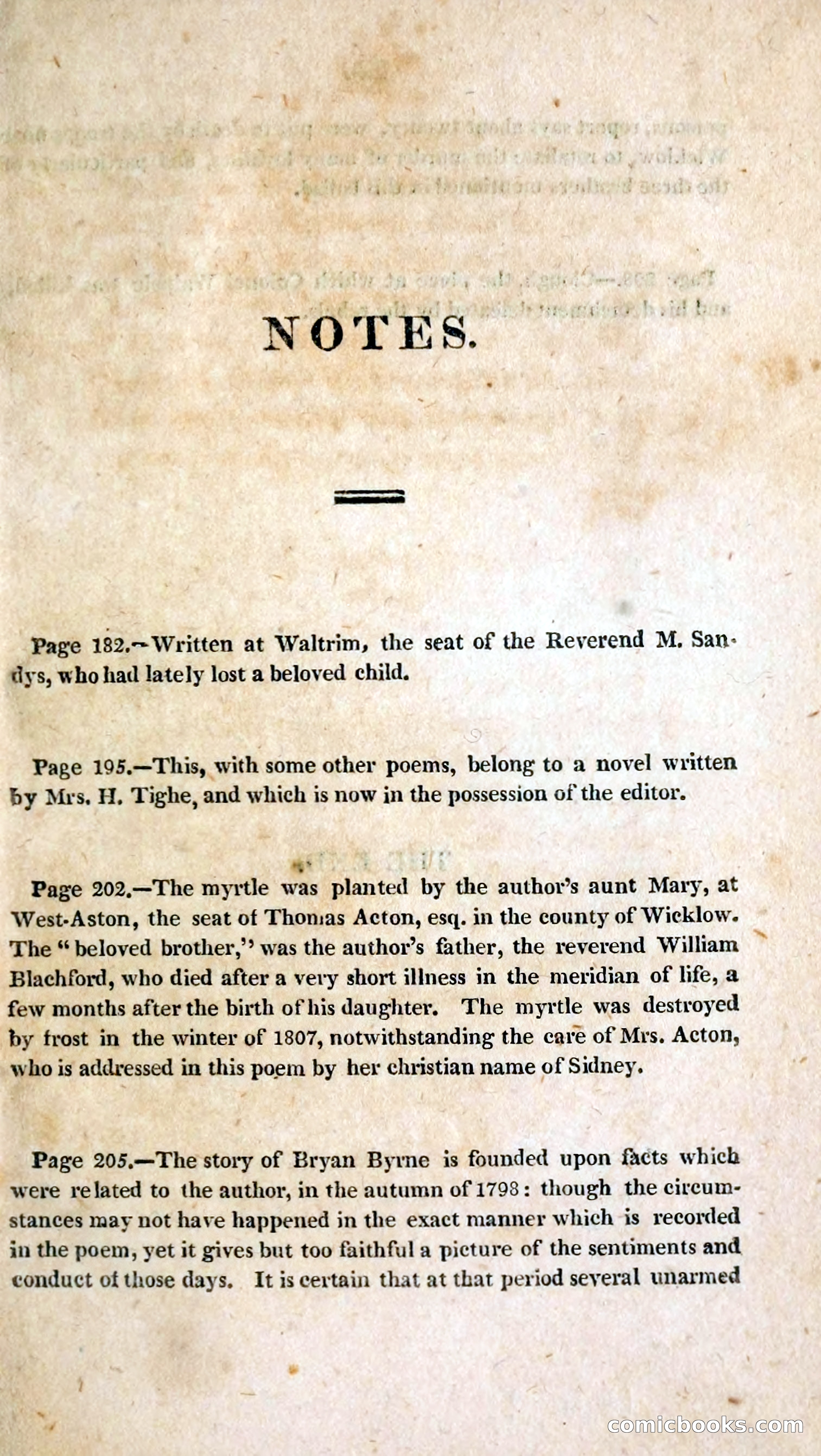
# What This Page Contains This is a notes section from a Victorian literary work, providing editorial annotations keyed to specific page numbers. The notes explain the biographical and historical contexts behind poems or passages—including details about where texts were written (at Waltrim, after a child's death), their origins (some poems from a novel by Mrs. H. Tighe), and personal references (a myrtle plant planted by the author's aunt, destroyed by frost in 1807). The final note indicates that a story about Bryan Byrne, found on page 205, is based on actual events from autumn 1798, though the poem may not record them with complete accuracy.
📄 Transcribed text from this page (OCR, searchable)
Machine-transcribed from the original scan — historical spelling and the odd misread are preserved.
NOTES. | Page 182.~ Written at Waltrim, the seat of the Reverend M. San- dys, who had lately lost a beloved child. Page 195.—This, with some other poems, belong to a novel written by Mrs. H. Tighe, and which is now in the possession of the editor. Page 202.—The myrtle was planted by the author’s aunt Mary, at West-Aston, the seat of Thomas Acton, esq. in the county of Wicklow. The “ beloved brother,’? was the author’s father, the reverend William Blachford, who died after a very short illness in the meridian of life, a few months after the birth of his daughter. The myrtle was destroyed by frost in the winter of 1807, notwithstanding the care of Mrs. Acton, who is addressed in this poem by her christian name of Sidney. Page 205.—The story of Bryan Byrne is founded upon facts which were related to the author, in the autumn of 1798: though the circum- stances may not have happened in the exact manner which is recorded in the poem, yet it gives but too faithful a picture of the sentiments and conduct of those days. It is certain that at that period several unarmed ~ id Comichbooksseom