
A complete issue · 41 pages · 1929
Life — July 5, 1929
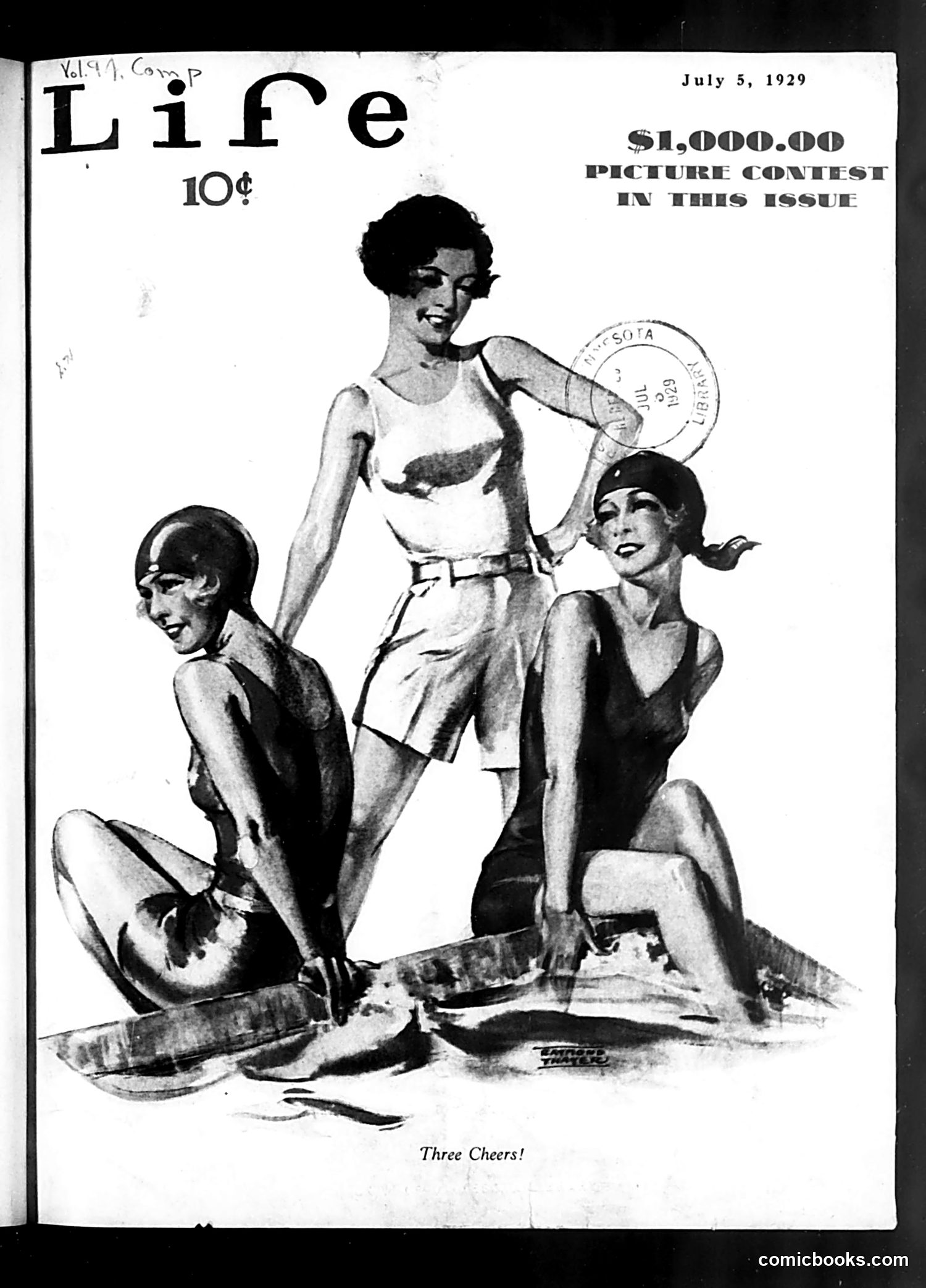
This is a magazine cover illustration titled "Three Cheers!" depicting three women in 1920s bathing attire at what appears to be a beach or swimming venue. The women are shown in athletic, confident poses with swimming equipment visible. The cover promotes a "$1,000.00 Picture Contest" featured in this issue. The illustration likely celebrates the "New Woman" of the 1920s—a figure associated with greater personal freedom, athleticism, and social independence following women's suffrage (1920). The casual beachwear and active poses reflect the era's changing attitudes toward women's bodies and leisure. This represents typical Life magazine satire of the period: gently mocking modern social trends through humorous illustration while simultaneously promoting the publication's contests and content.
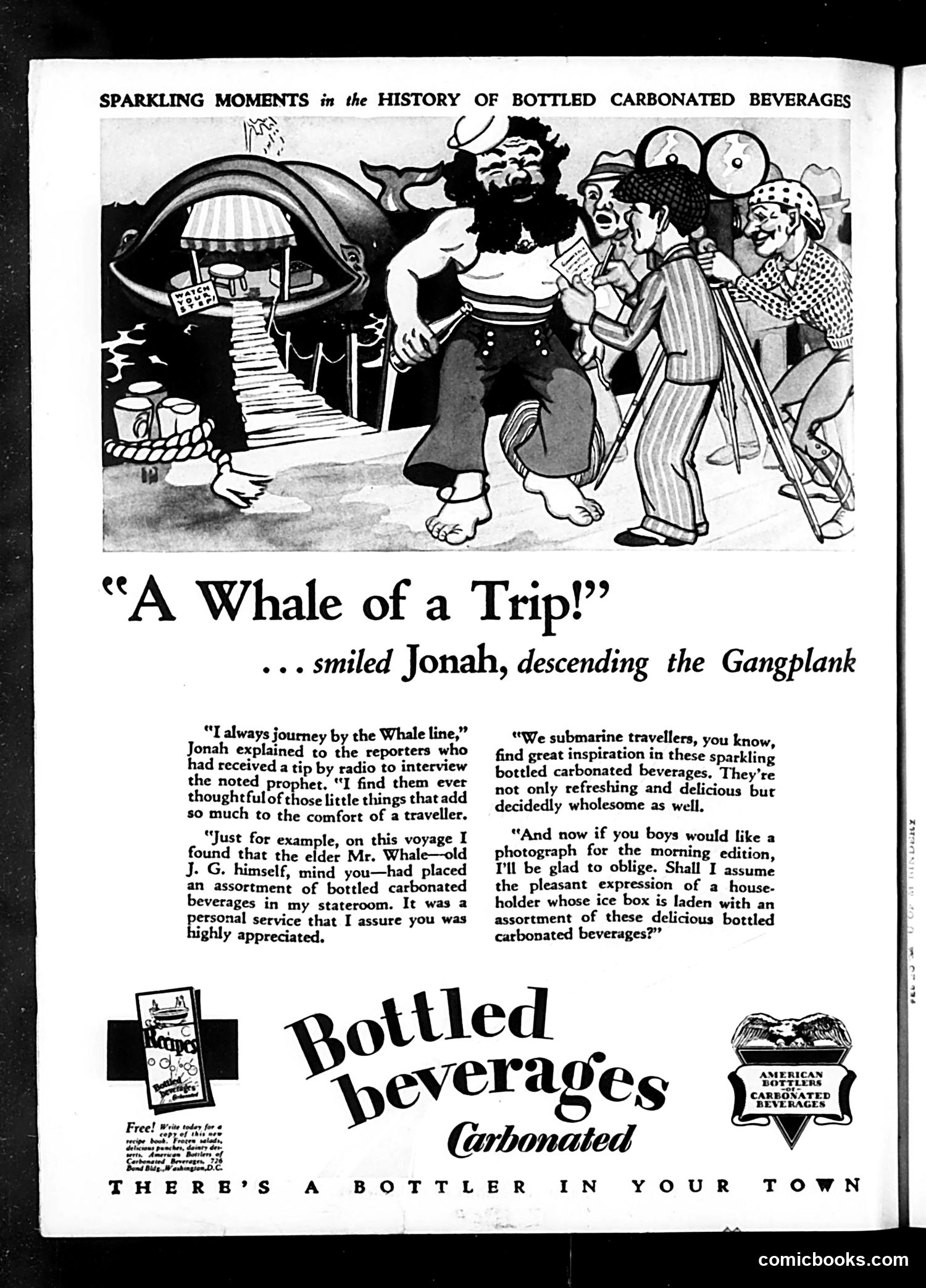
This is primarily a **carbonated beverage advertisement**, not political satire. The cartoon depicts a character named "Jonah" descending a gangplank from what appears to be a submarine or ship. The caption reads "A Whale of a Trip!"—a pun referencing the Biblical Jonah and the whale. The advertisement's narrative presents Jonah as a traveler praising bottled carbonated beverages he discovered aboard, calling them "refreshing and delicious but decidedly wholesome as well." The "whale" pun works on multiple levels: Jonah's famous whale encounter, and "whale of a trip" as slang for an excellent experience. The ad promotes bottled carbonated beverages through humor and creative wordplay, ending with the tagline "THERE'S A BOTTLER IN YOUR TOWN."
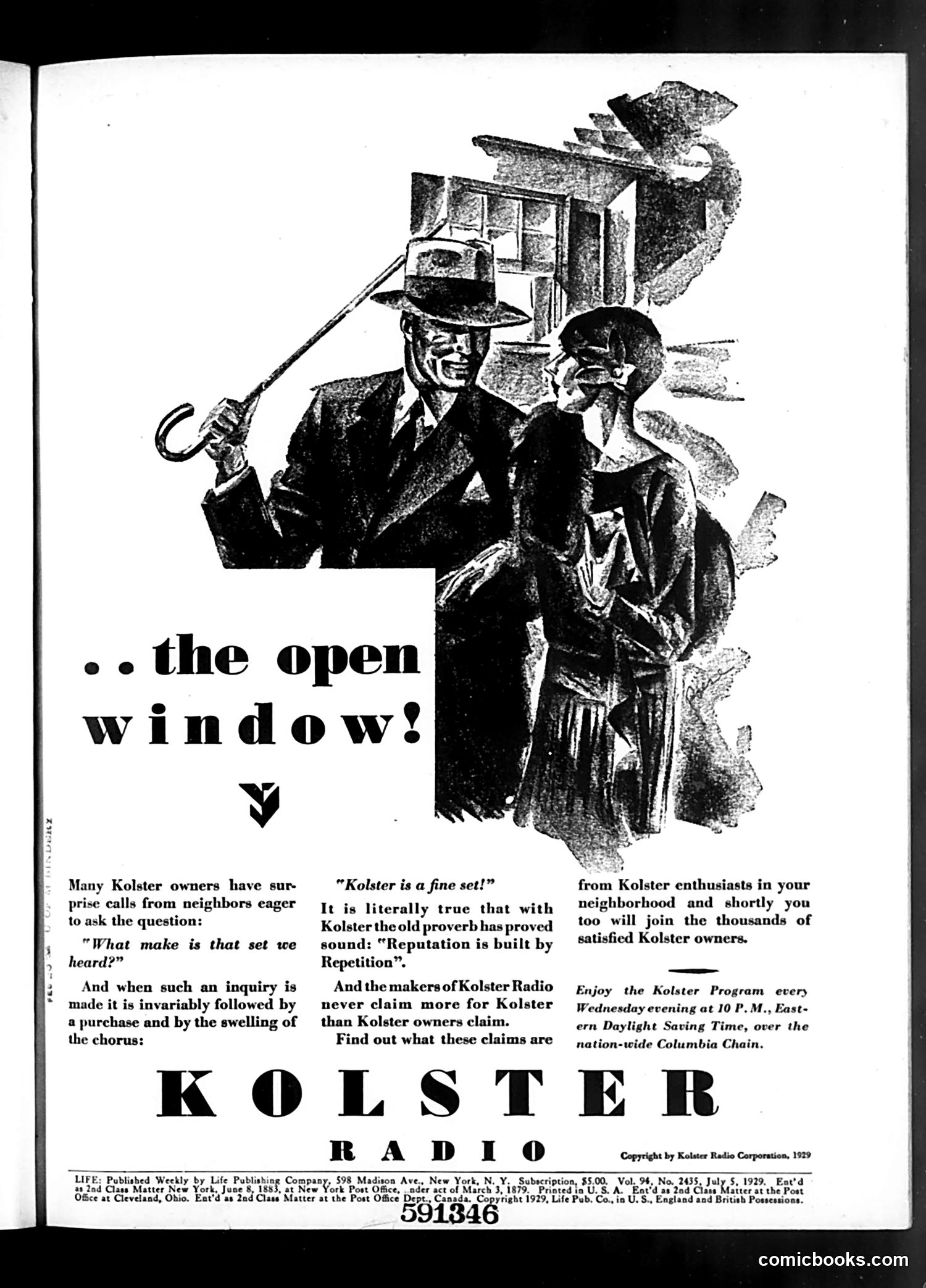
This is a **Kolster Radio advertisement**, not political satire. The illustration shows a well-dressed man with a cane confronting a woman at an open window—a visual pun on the advertiser's product name and the phrase "the open window." The ad plays on the old proverb "Reputation is built by Reputation," claiming Kolster radios are so highly regarded that satisfied owners enthusiastically recommend them to neighbors. The threatening pose of the man appears designed to humorously suggest the aggressive enthusiasm of word-of-mouth marketing. The text promises that listening to the Kolster Program (Wednesday evenings on Columbia Chain) will make readers join "thousands of satisfied Kolster owners." This 1929 advertisement targets radio-set purchasers during the early commercial broadcast era.
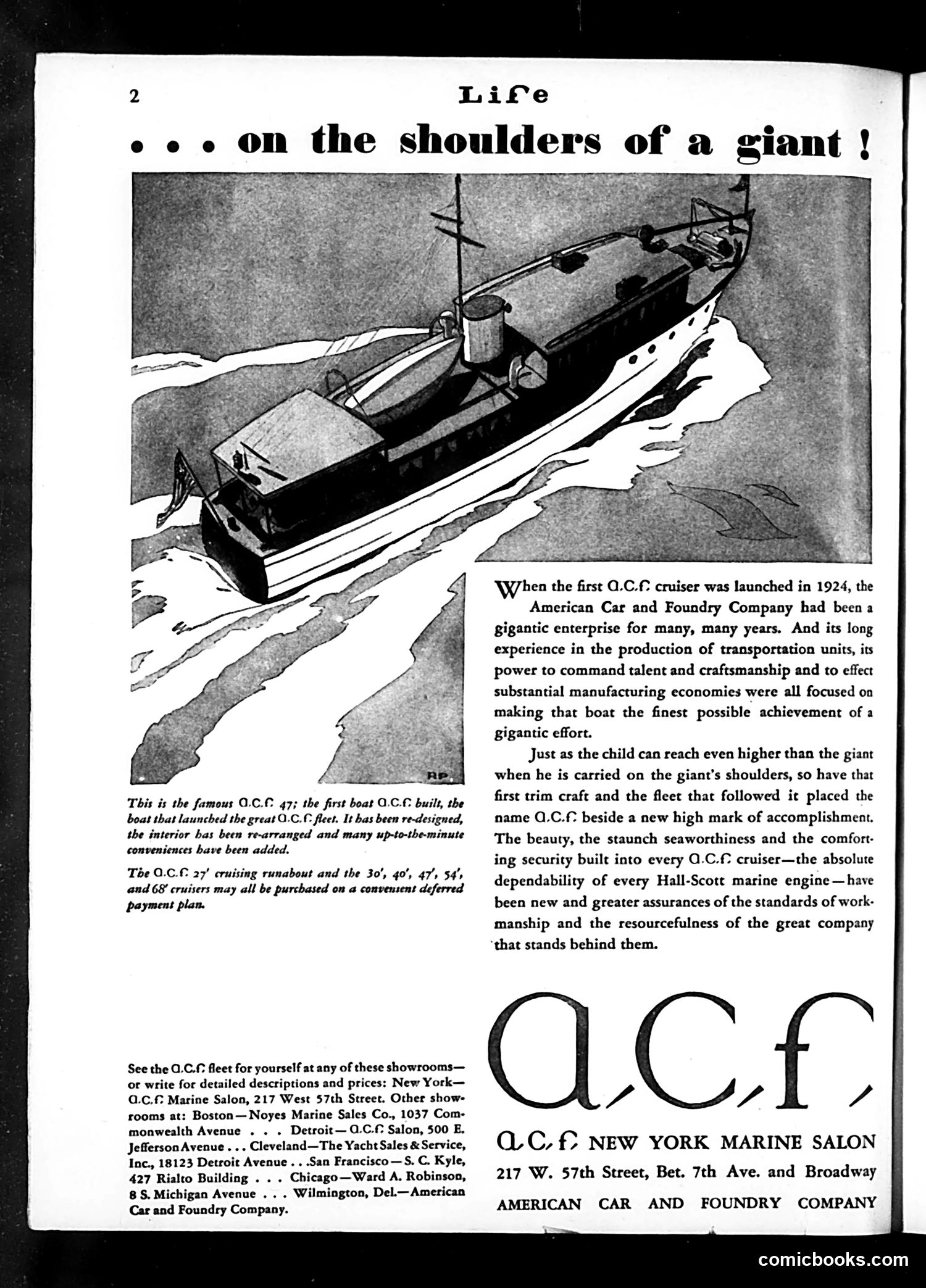
This is **not a political cartoon or satire page** — it's a straightforward advertisement for O.C.F. (Oakes, Cole & Fay) marine cruisers, manufactured by the American Car and Foundry Company. The page features a photograph of the O.C.F. 47 boat and uses the metaphor "on the shoulders of a giant" to describe how smaller O.C.F. craft benefit from the company's extensive experience building transportation units since 1924. The text emphasizes manufacturing quality, craftsmanship, and reliability of Hall-Scott marine engines. The advertisement lists showroom locations in major cities (New York, Boston, Detroit, Cleveland, Chicago, San Francisco, Wilmington). This is a commercial product advertisement, not editorial satire.
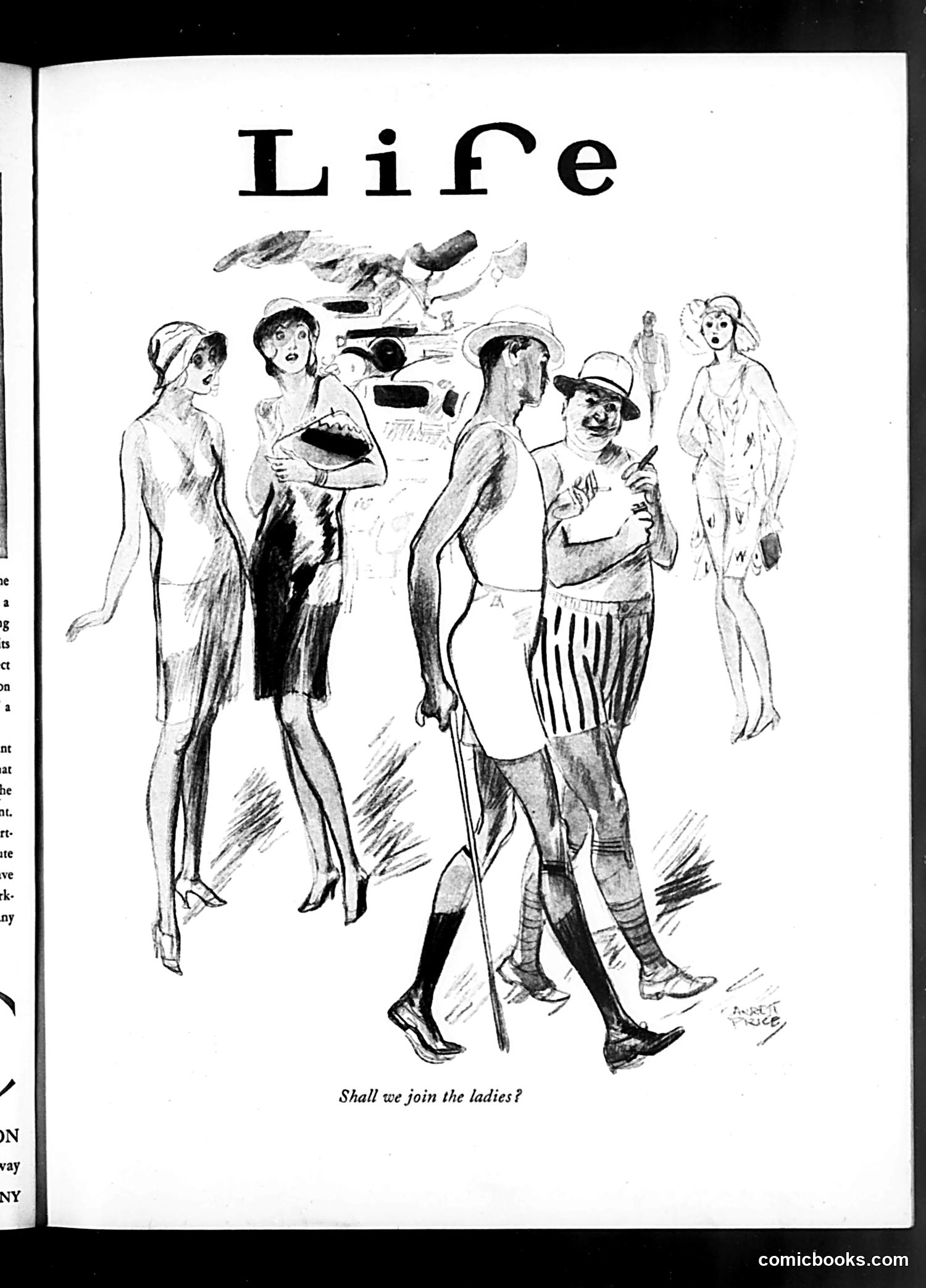
This is a satirical illustration titled "Life" with the caption "Shall we join the ladies?" The sketch depicts five figures in 1920s-style clothing and bathing attire, showing both men and women in casual beach or leisure settings. The cartoon appears to satirize changing social norms of the era—specifically the increasing social mixing and casualness between genders during the Jazz Age. The relaxed, mixed-gender gathering depicted here would have represented modern, somewhat scandalous behavior for the period. The somewhat exaggerated character expressions and poses suggest gentle mockery of these social changes and evolving attitudes toward propriety and gender interaction. Without additional context, the specific satirical target remains unclear, though it likely comments on 1920s social modernization.
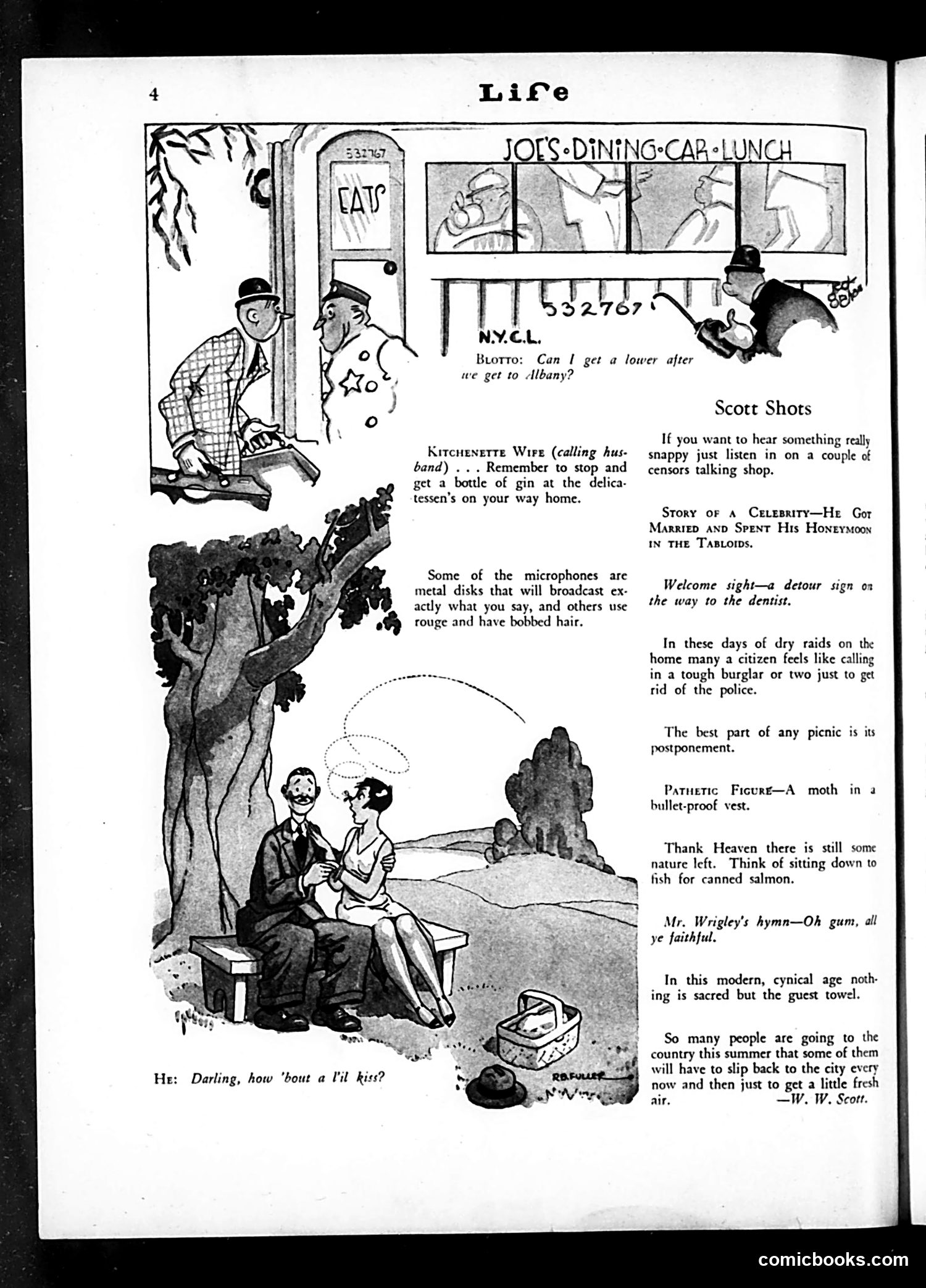
This page contains satirical humor and social commentary typical of Life magazine. The cartoons mock early 1920s American life: **Top cartoon**: Two men in hats at a dining car entrance, with one asking about getting "a lower after we get to Albany?"—likely joking about railroad travel accommodations and sleeping car etiquette. **Bottom cartoon**: A couple on a picnic bench with the man asking "Darling, how 'bout a li'l kiss?"—gentle romantic humor. **Right column**: Brief satirical observations on contemporary life, including references to radio microphones, home security concerns ("dry raids," suggesting Prohibition-era police), and summer vacation behavior. The final attribution to "W. W. Scott" identifies the writer. The humor targets middle-class anxieties and modern conveniences of the period.
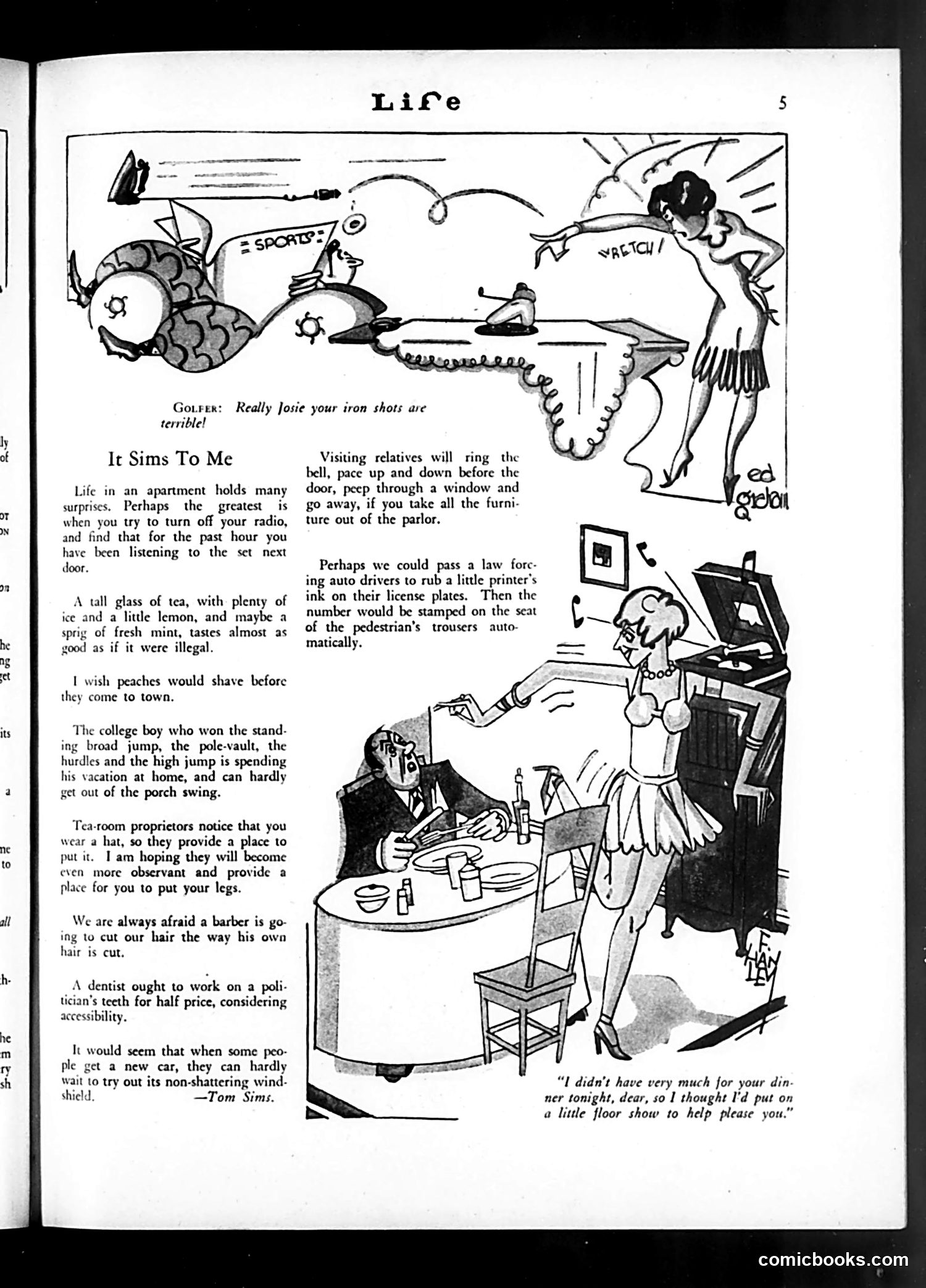
This page contains humorous social commentary typical of early 20th-century Life magazine. The main cartoon depicts a domestic scene where a woman performs a "floor show" for her husband during dinner, apparently to compensate for a meager meal ("I didn't have very much for your dinner tonight, dear, so I thought I'd put on a little floor show to help please you"). The accompanying "It Sims To Me" column offers satirical observations on urban apartment living, including complaints about radios, suggestions for novel laws (like marking auto drivers' license plates with ink), and critiques of various service industries (barbers, dentists, tea-room proprietors). The top cartoon shows "Sports" figures, likely athletic champions of the era. The satire targets everyday inconveniences and social absurdities of the period.
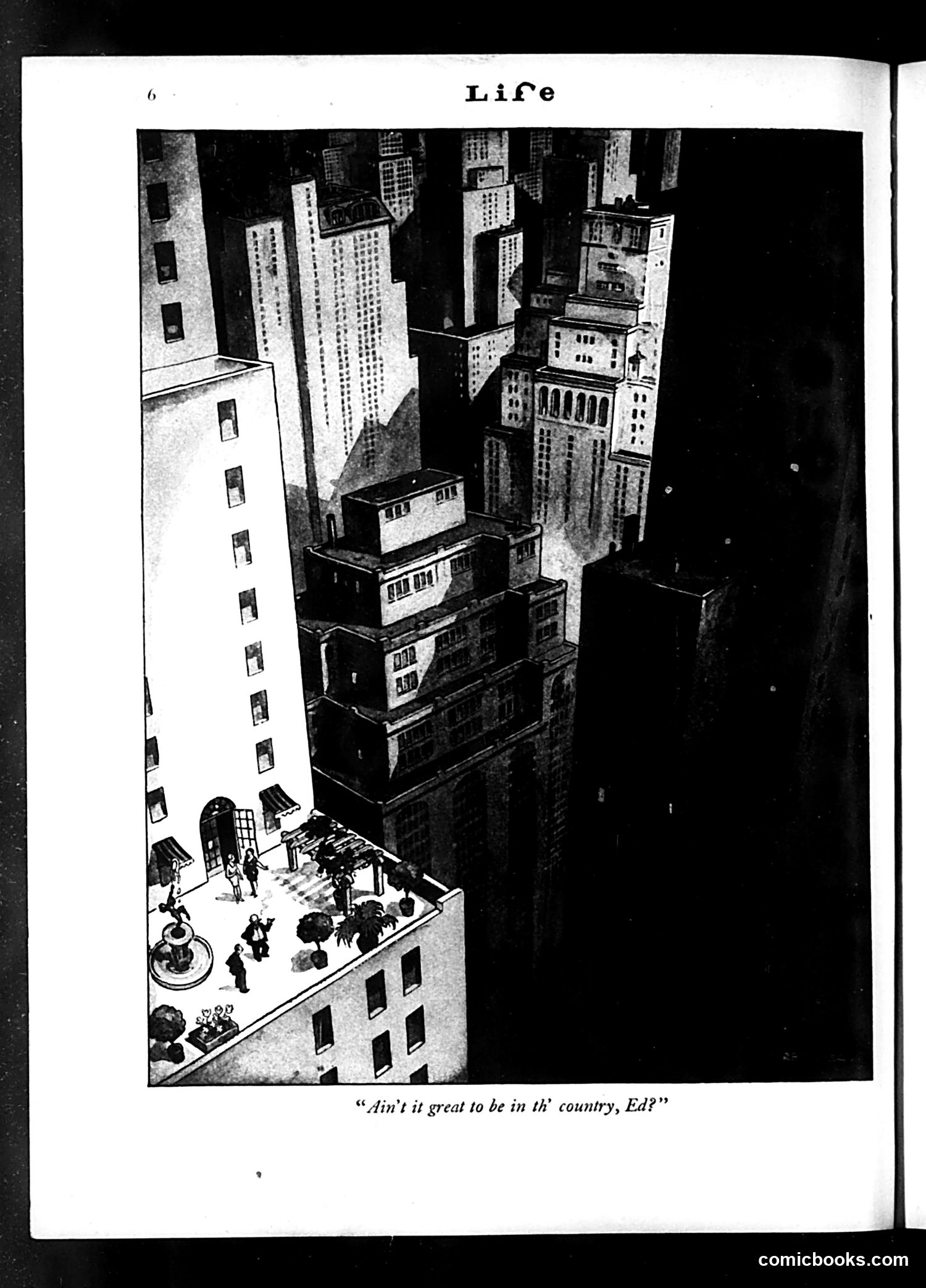
This is a satirical cartoon from *Life* magazine depicting an aerial view of a crowded urban courtyard surrounded by tall buildings. Small figures of people gather in the confined space below. The caption reads: **"Ain't it great to be in th' country, Ed?"** — a sarcastic joke contrasting the speaker's words with the image's reality. The cramped, claustrophobic urban canyon, densely packed with buildings and people, represents the opposite of pastoral country living. The satire mocks either: (1) urban dwellers' ironic denial about cramped city conditions, or (2) the false advertising/romanticization of city life as desirable. The speaker's cheerful claim about being "in the country" when surrounded by concrete and crowds exposes the disconnect between marketing rhetoric and actual urban living conditions.
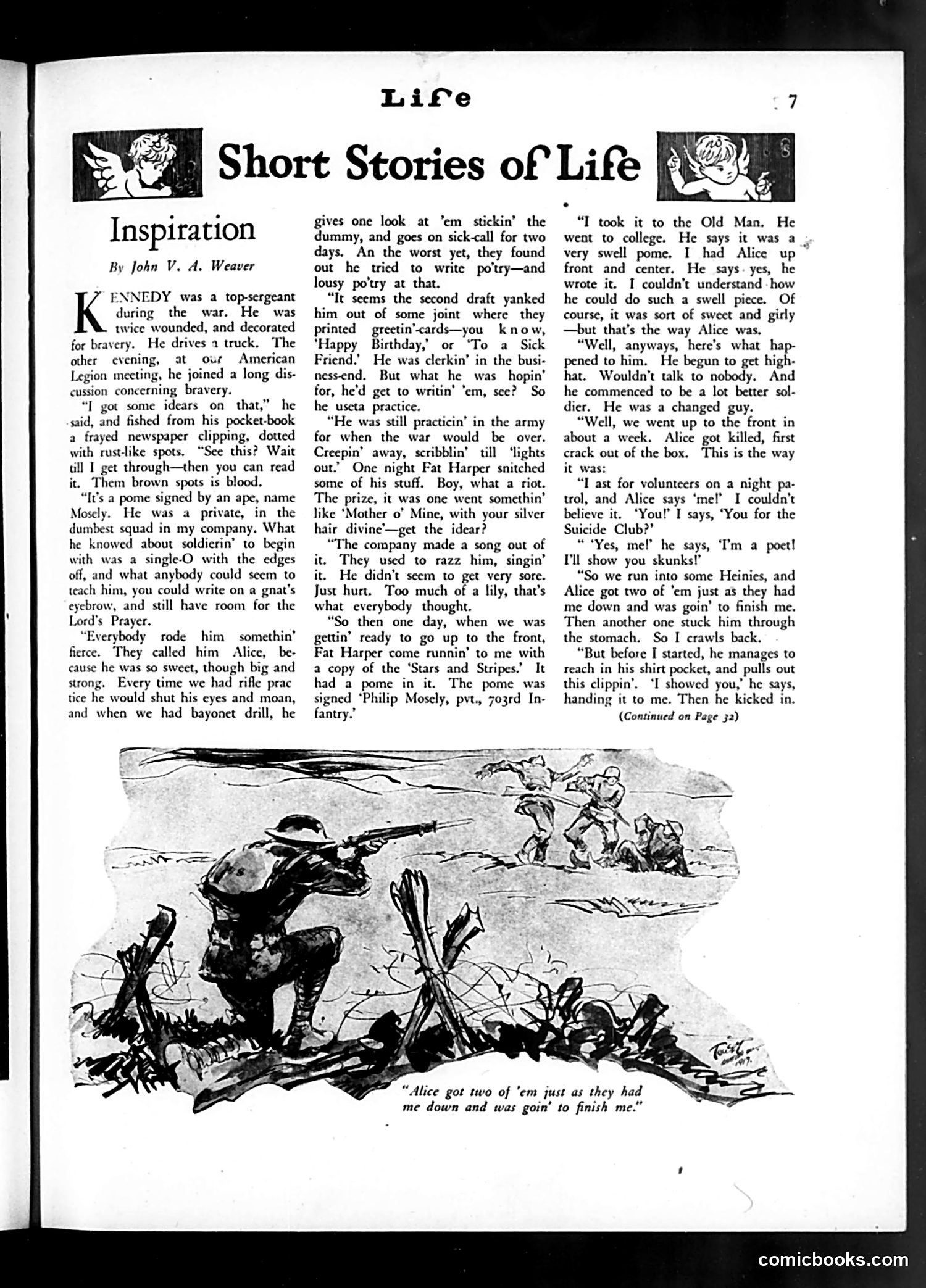
This is a WWI-era short story about Private Kennedy, a decorated but twice-wounded soldier who becomes known as "Alice" for his poetry-writing. The narrative follows how his unit encouraged him to write sentimental verses—initially mocking efforts like "Happy Birthday" and "To a Sick Friend"—which gradually improved. The accompanying illustration depicts trench warfare, showing soldiers in combat. The story's humor derives from the contrast between a tough soldier and his unexpected literary talent, reflecting how WWI transformed American culture and soldiers' experiences. The piece celebrates how even hardened military men could develop artistic sensibilities, a theme common in post-war American literature examining how combat changed individuals.
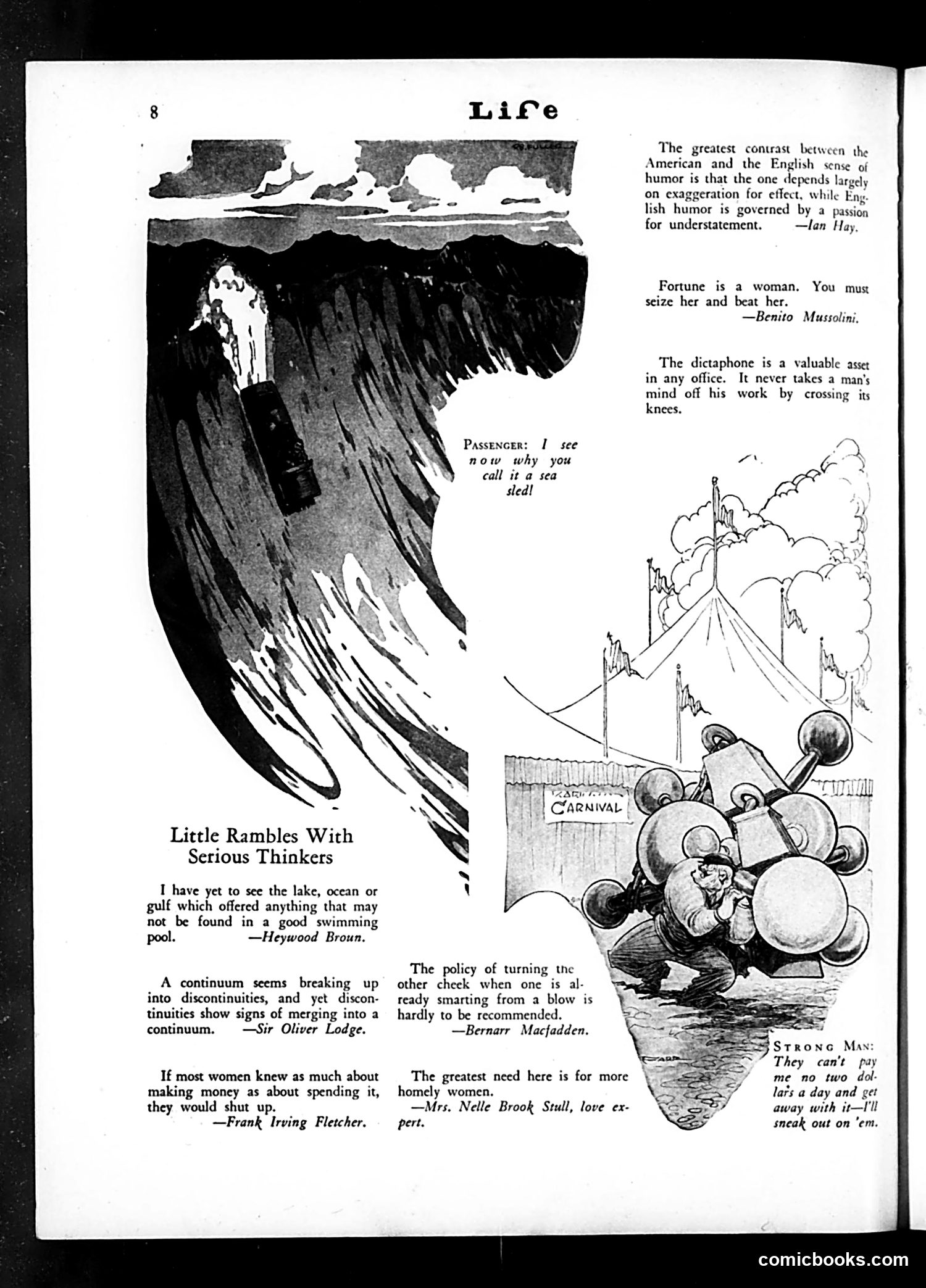
This page collects humorous quotes and two cartoons. The left cartoon, titled "Little Rambles With Serious Thinkers," shows a massive wave threatening a small figure, with a passenger asking why it's called a "sea deal." This appears to be a pun on "sea/C" and possibly "New Deal" economic policies. The right cartoon depicts carnival balloon games, with a caption about a "Strong Man" unable to afford two dollars daily wages—social commentary on economic hardship and carnival games as exploitative entertainment. The scattered quotes mock various targets: American versus English humor styles, dictaphone office use, women's financial management, and the need for "homely women" (unclear meaning without fuller context). The overall tone is satirical commentary on contemporary American society and manners.
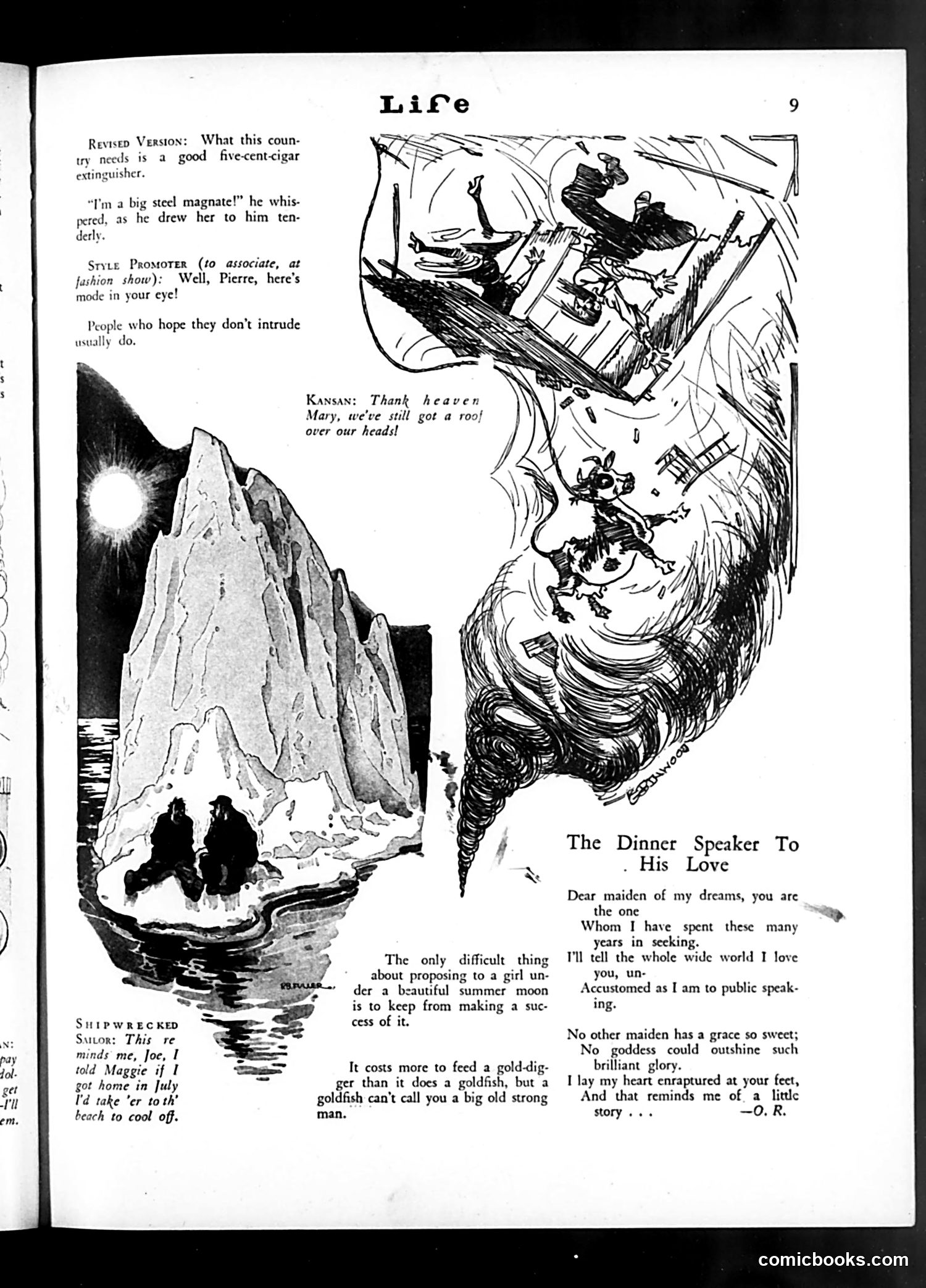
This page contains humor pieces and illustrations typical of early 20th-century satirical magazines. The top section includes brief comedic observations about social behavior ("People who hope they don't intrude usually do") and fashion commentary from a "Style Promoter." The left illustration shows a dramatic scene of two figures in a cave or rocky shelter beneath a bright moon—labeled "SHIPWRECKED"—with dialogue about a sailor telling Maggie about getting home in July. The right side features "The Dinner Speaker To His Love," a romantic poem by O.R. about courting a maiden, accompanied by a chaotic illustration of figures tumbling through space or air, apparently satirizing the awkwardness of formal courtship and public speaking. The humor relies on contrasting romantic sentiment with pratfalls and everyday social awkwardness.
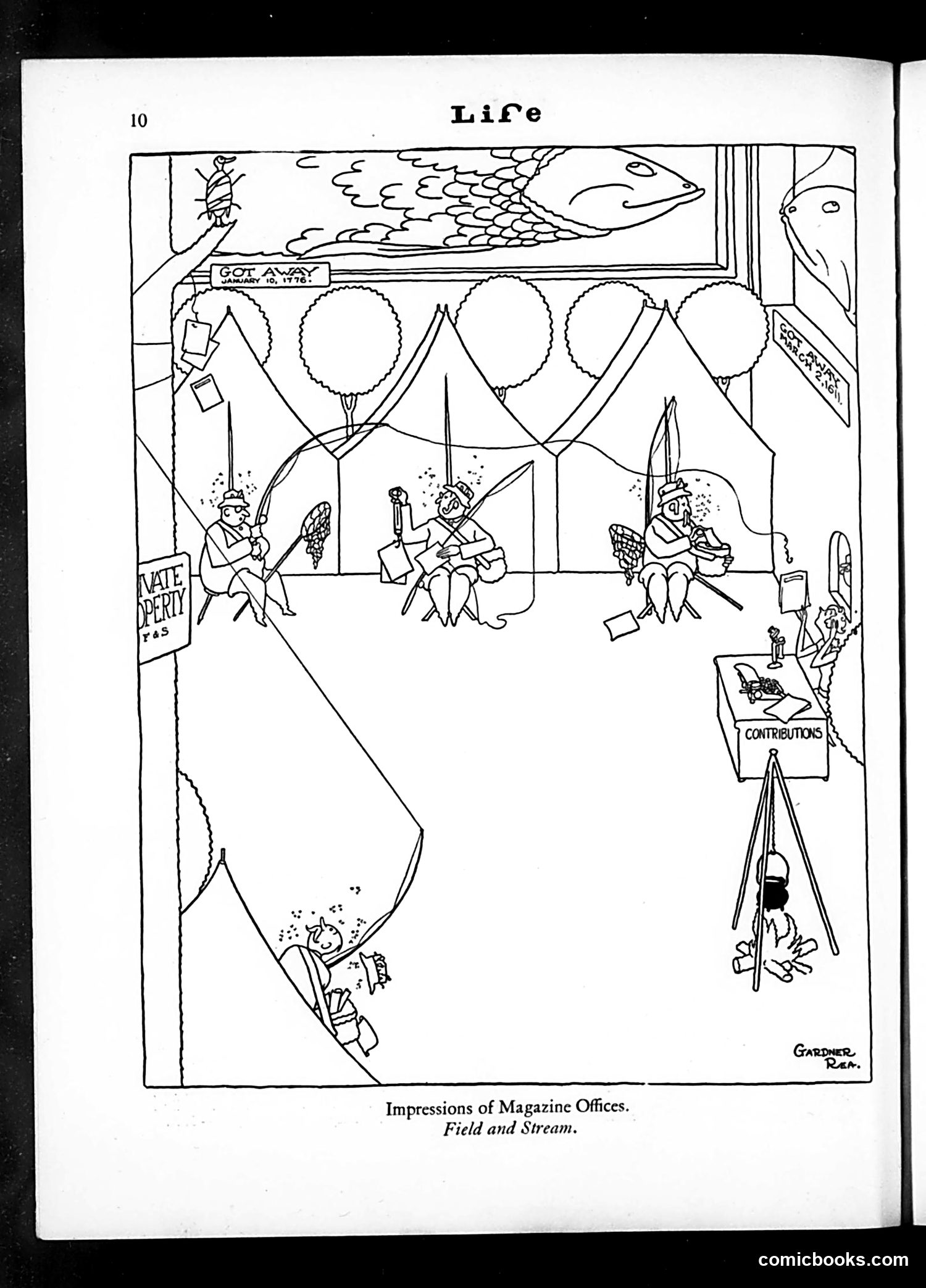
This cartoon satirizes the editorial offices of *Field and Stream* magazine through absurdist humor. The illustration depicts a chaotic indoor scene where multiple figures sit suspended from balloons, fishing with rods into what appears to be an interior space—likely mocking the magazine's outdoors focus by literalizing "fishing" in an office setting. The sign reading "LATE DELIVERY" on the left appears to reference production delays. A "CONTRIBUTIONS" box sits on the right, suggesting submissions. The overall joke seems to be that *Field and Stream* editors are so detached from reality that they've brought their fishing obsessions indoors, creating an absurd workplace environment rather than conducting normal editorial business.
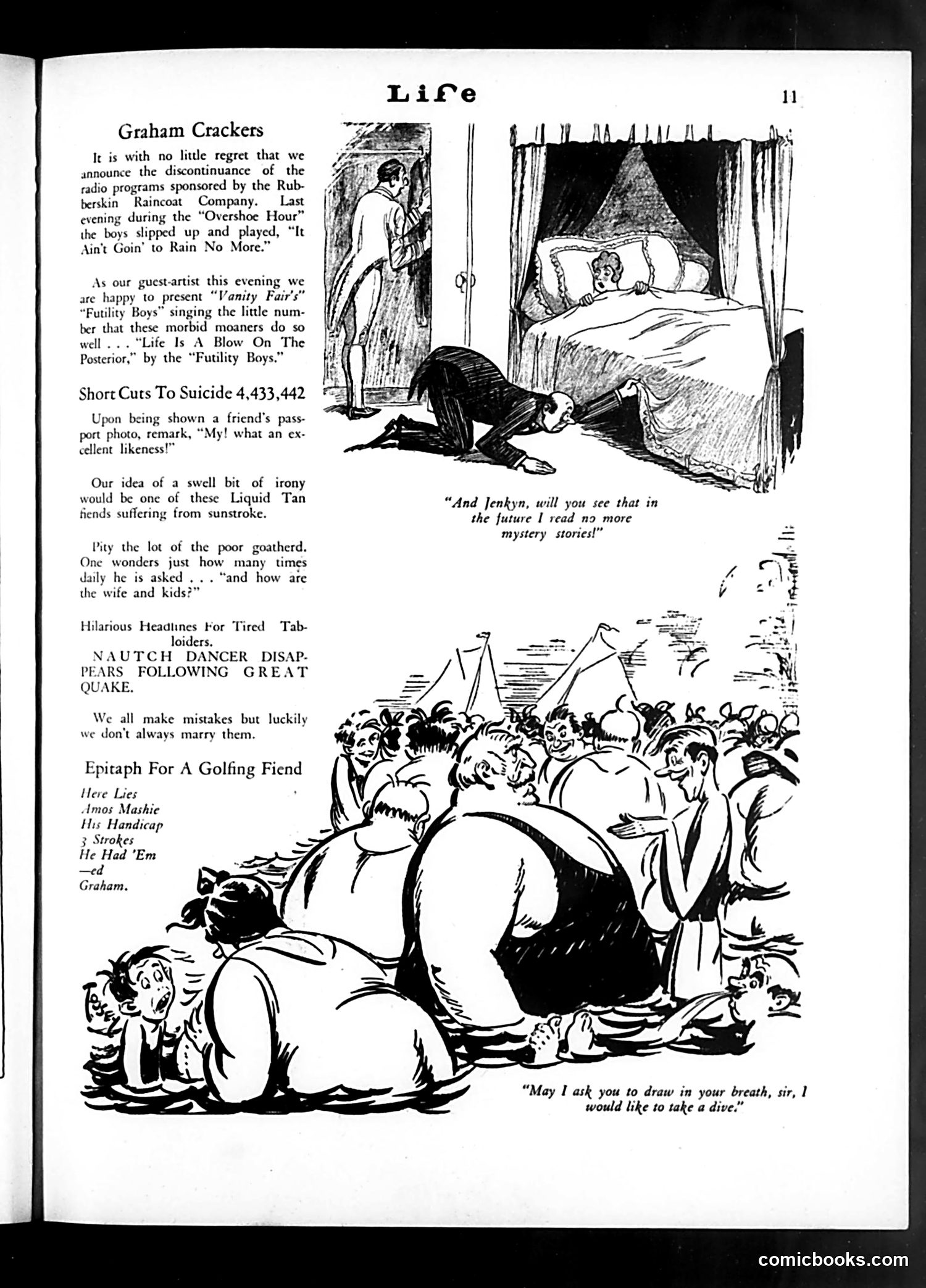
This page contains brief humorous items and two cartoons typical of Life's satirical content. The **top cartoon** depicts a man collapsed on a bedroom floor while a woman in bed asks him to read "mystery stories" in the future instead—a joke about the man fainting from shock at a mystery plot twist. The **bottom cartoon** shows a crowded beach scene where an overweight man is surrounded by onlookers. The caption reads: "May I ask you to draw in your breath, sir, I would like to take a dive."—mocking both the man's large size and the cramped beach conditions of the era. The text sections mock headlines about suicide rates, tanned "Liquid Tan fiends," and include a humorous epitaph for a golfer, reflecting Life's typical blend of dark humor and social commentary.
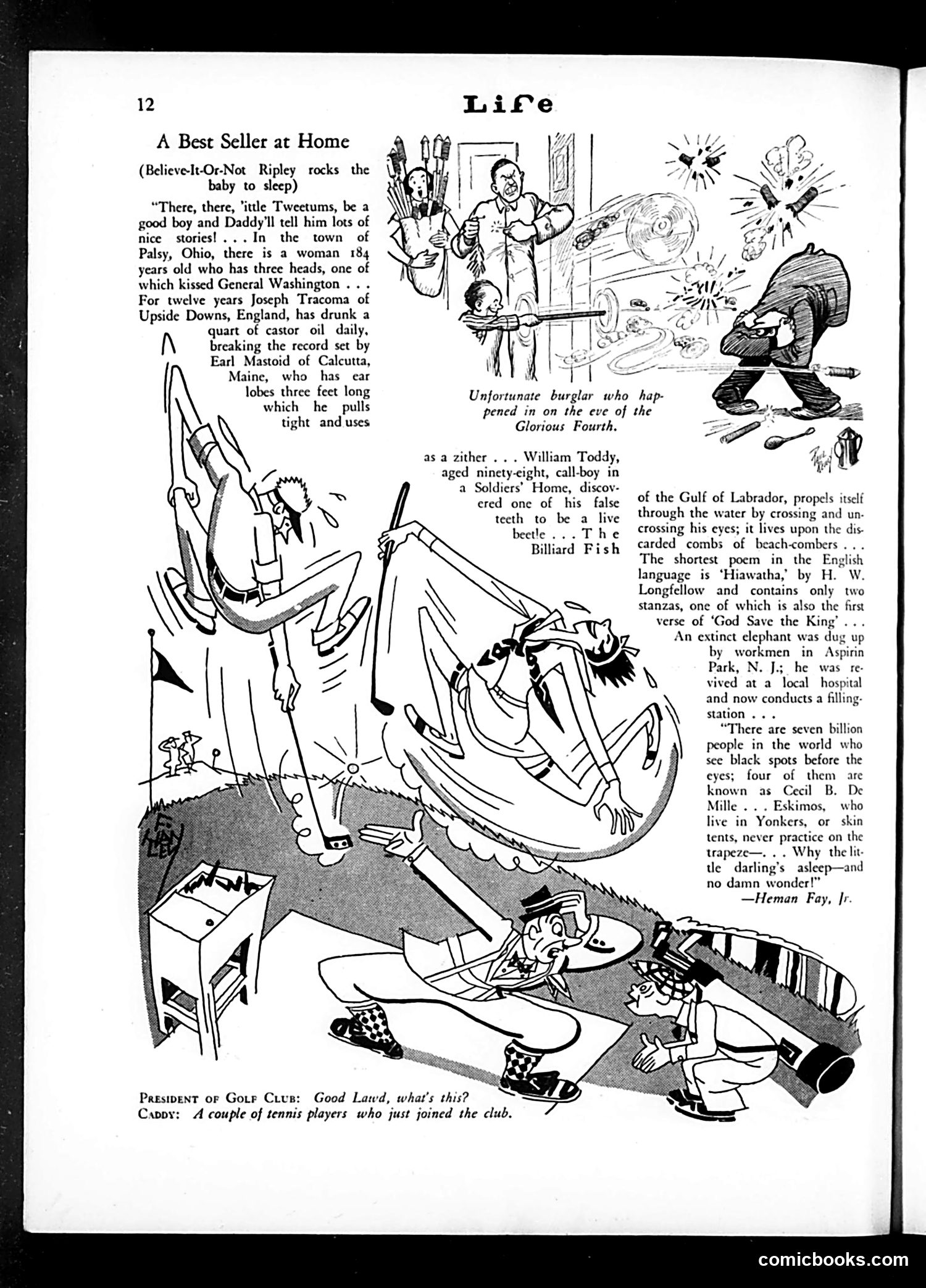
This page contains humorous anecdotes and two cartoon illustrations satirizing early 20th-century American life. The main cartoons depict: 1. **Upper right**: A burglar interrupting a family's Fourth of July celebration, with firecrackers exploding around him—playing on the chaos of holiday fireworks. 2. **Lower section**: A golf club scene where tennis players have apparently joined, creating disorder. The caption jokes: "Good Land, what's this?" / "A couple of tennis players who just joined the club." The anecdotes reference various oddities: a woman who kissed George Washington, record-breaking achievements, and colorful facts (false teeth, billiard fish, shortest English poems, extinct elephants). The humor relies on absurdist observations and visual comedy typical of Life's satirical style during this era.
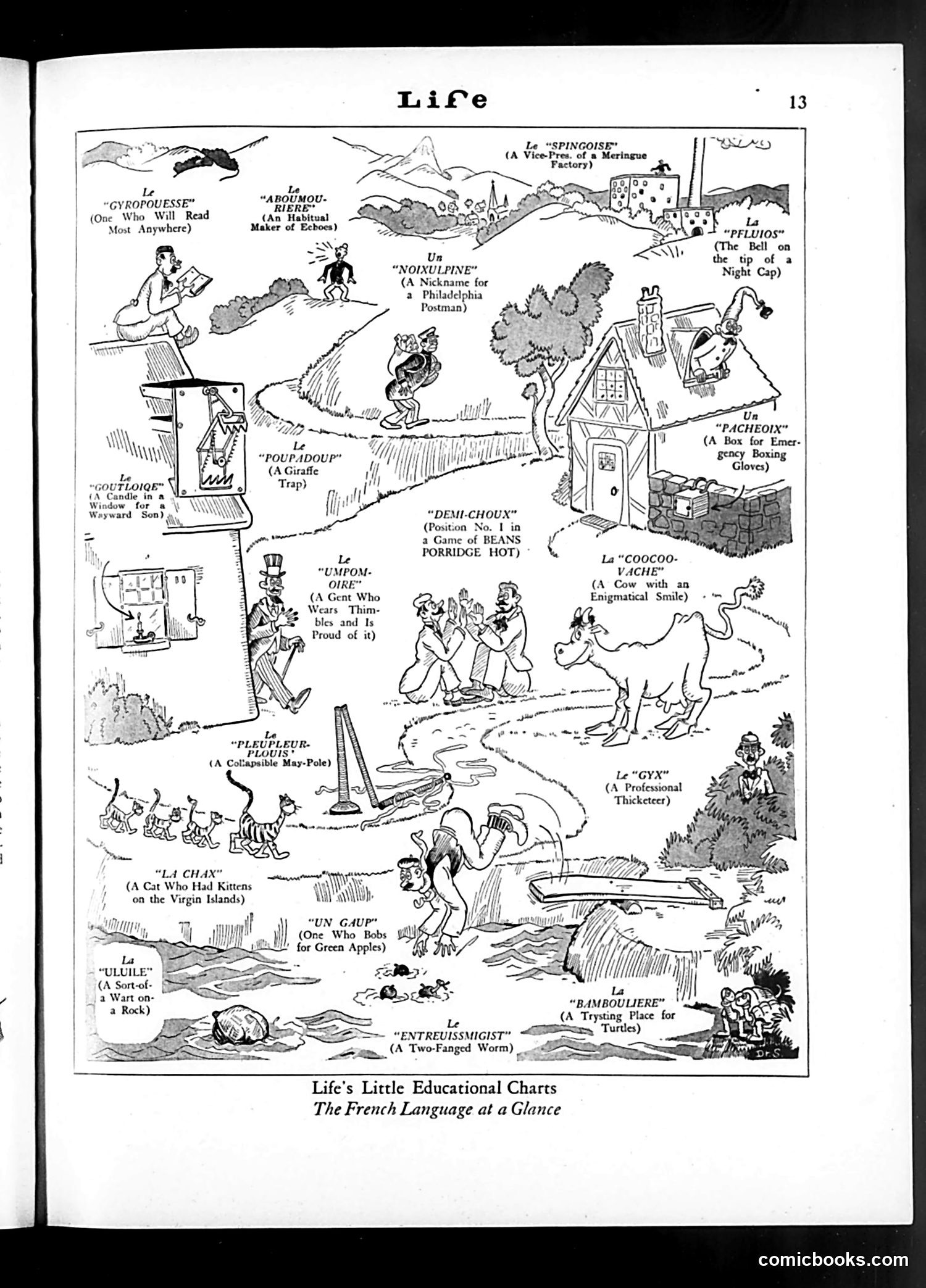
This is an educational chart titled "Life's Little Educational Charts: The French Language at a Glance." It's a humorous guide using absurdist French phrases paired with whimsical illustrations. The page teaches French through puns and wordplay based on French names. Examples include "La Gyrofouesse" (One Who Will Read Most Anywhere), "Le Poupадoul" (A Giraffe Trap), and "Un Noinculpine" (A Philadelphia Postman nickname). The satire mocks both French language instruction methods and stereotypical French culture. Rather than teaching practical vocabulary, it creates nonsensical definitions for made-up or real French words, illustrating them with absurd scenarios—a man in a boat, figures boxing, a camel, and various animals. The humor targets the pretentiousness of language-learning materials while poking fun at French affectation popular in American magazines of this era.
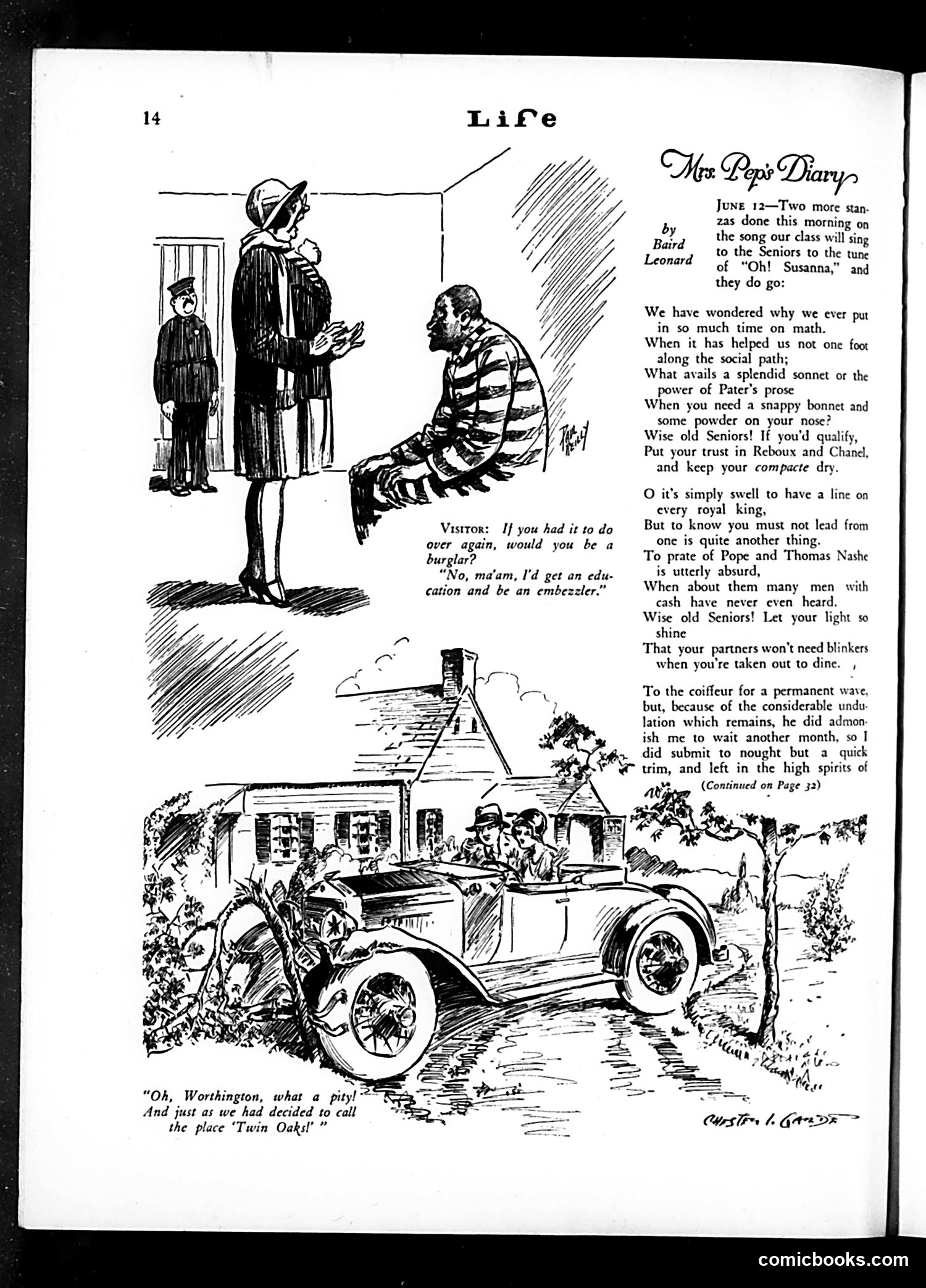
This page contains two distinct pieces: **Top cartoon**: A visitor asks a young woman about becoming a burglar if given another chance. She replies she'd get an education and become an "embezzler" instead. The satire mocks both crime and social pretension—suggesting that white-collar crime (embezzlement) is considered more respectable than common burglary, despite both being criminal. It's commentary on class-based attitudes toward different types of illegal activity. **Bottom section**: "Mrs. Pepsi Diary" (dated June 12) includes poetry mocking seniors and a car illustration labeled "Twin Oaks," satirizing pretentious estate naming among the wealthy. Both pieces target social snobbery and class-consciousness of the era.
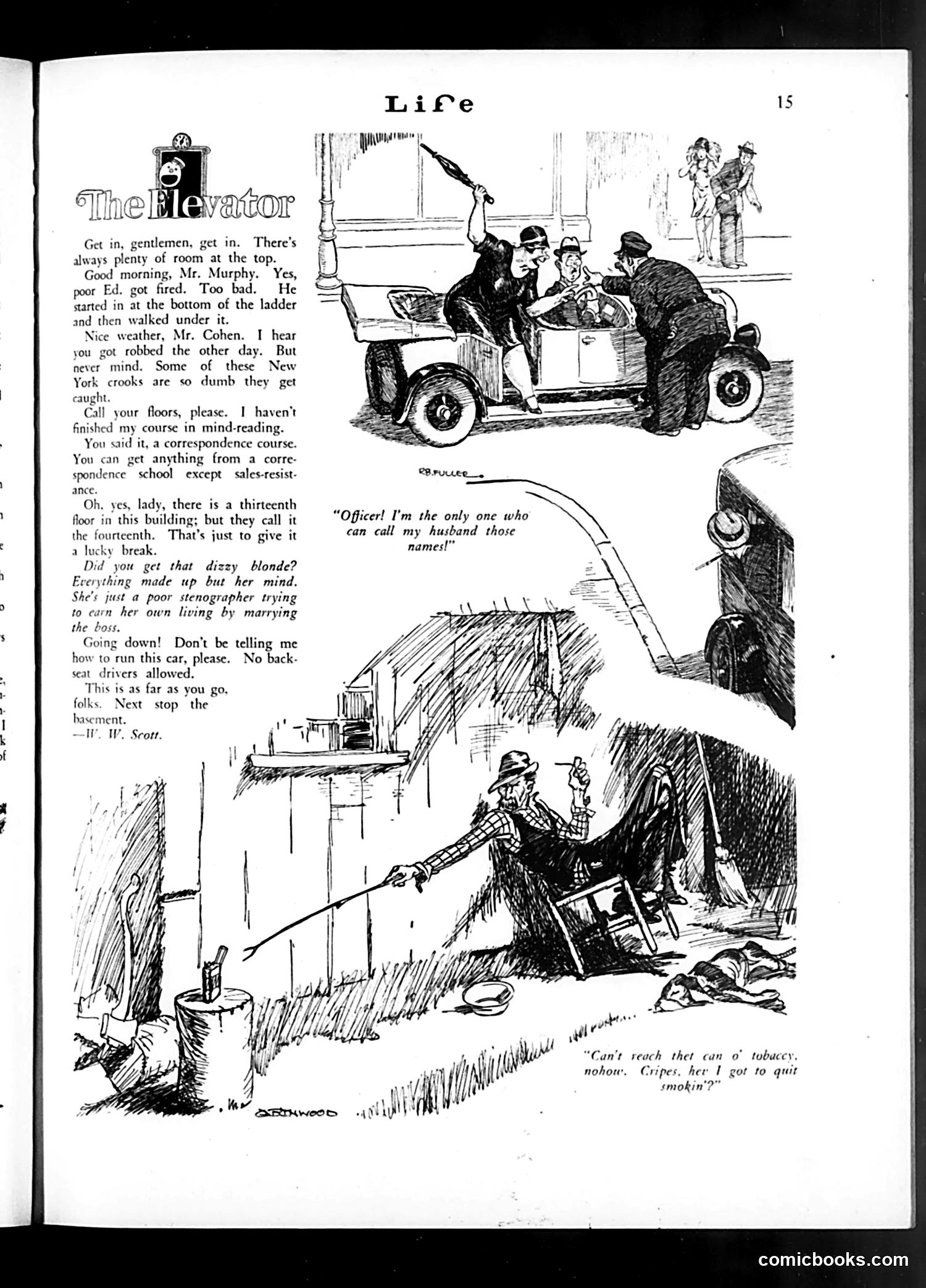
This page contains two separate comic sketches satirizing urban life and workplace dynamics. **Top cartoon**: An elevator operator brags about access to gossip, mentioning a "dizzy blonde" stenographer who married her boss for financial survival rather than love—mocking both the woman's ambition and the boss's poor judgment. **Bottom cartoon**: A hobo attempts to steal tobacco from a sleeping vagrant, but the sleeping man catches him mid-theft with a fishing pole. The humor derives from the unexpected competence of someone appearing helpless, and the absurdity of using a fishing rod to protect one's meager possessions. Both sketches target working-class and impoverished figures common to 1920s-era urban satire, using exaggerated situations to comment on desperation and social pretension.
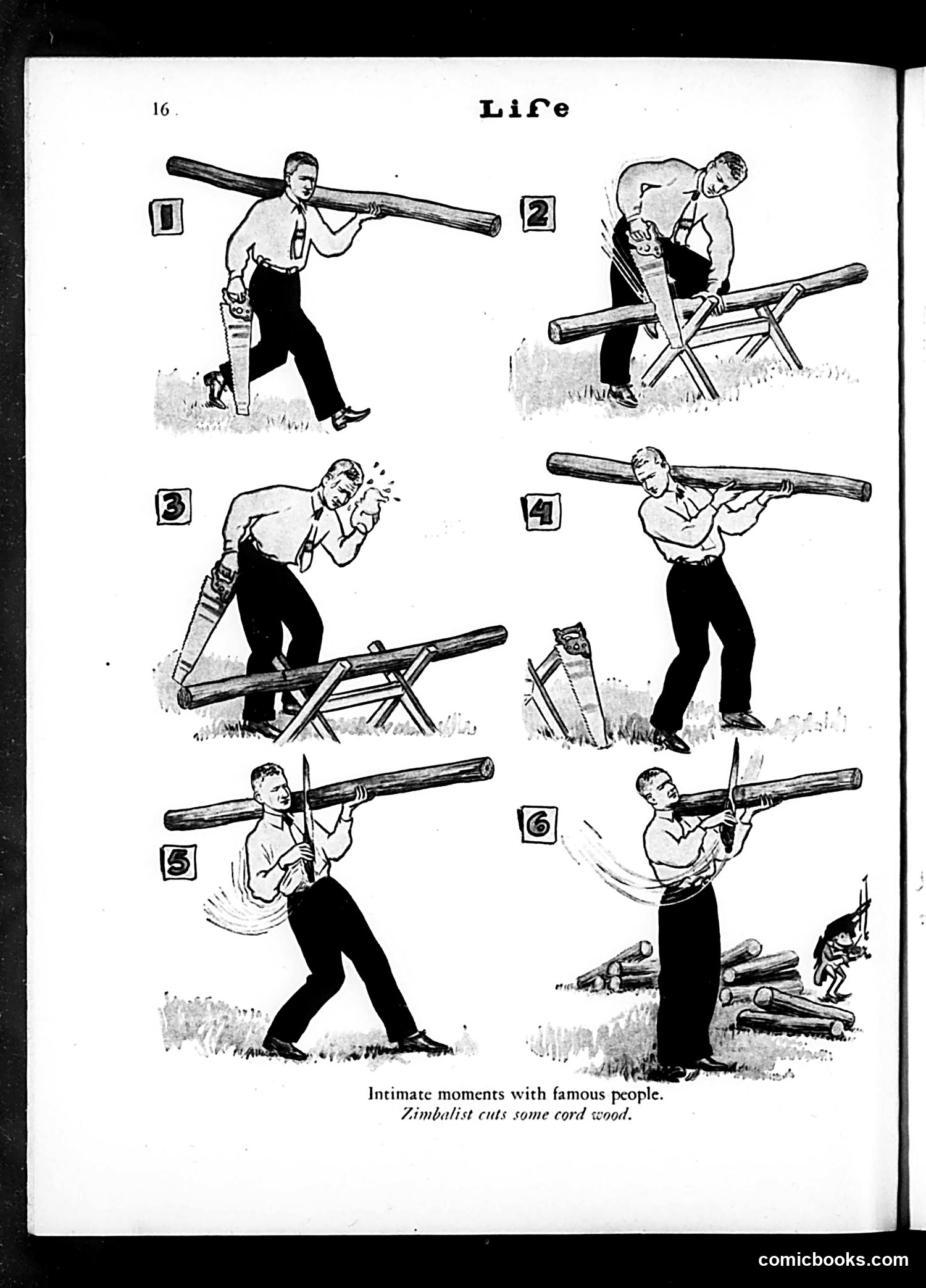
This page from *Life* magazine presents a humorous instructional sequence titled "Intimate moments with famous people," with the caption "Zimbalist cuts some cord wood." The six numbered panels depict a man carrying and manipulating a large log in increasingly exaggerated poses—hoisting it, balancing it, swinging it, and straining with it. The joke appears to satirize **Efrem Zimbalist**, likely the famous violinist of that era, by depicting him doing manual labor (cutting cordwood) rather than performing his refined musical profession. The humor relies on incongruity: a celebrated classical musician shown doing rough physical work, suggesting either that even famous performers engage in ordinary tasks, or mocking pretensions about artists' gentility. Without the magazine's date, the specific satirical intent remains somewhat unclear, but the basic comedic structure—"famous person + undignified activity"—is evident.
This page from *Life* magazine contains two columns of brief humorous anecdotes rather than political cartoons. The header illustration shows a row of stylized figures in hats standing before a house—a decorative motif, not satirical commentary. The "Life at Home" section features jokes about American domestic life: a principal warning against "improper" daughters, donkey serum as a dubious medical remedy, workplace anxiety over divorce laws, and police attempting to reduce police brutality through odd methods. The "Life Abroad" section offers brief comedic observations from international locations—Warsaw, Paris, London, and Rome—presenting foreign customs as amusing curiosities to American readers. The humor relies on contemporary social anxieties (marriage, law, medicine) and gentle cultural stereotyping rather than pointed political satire.
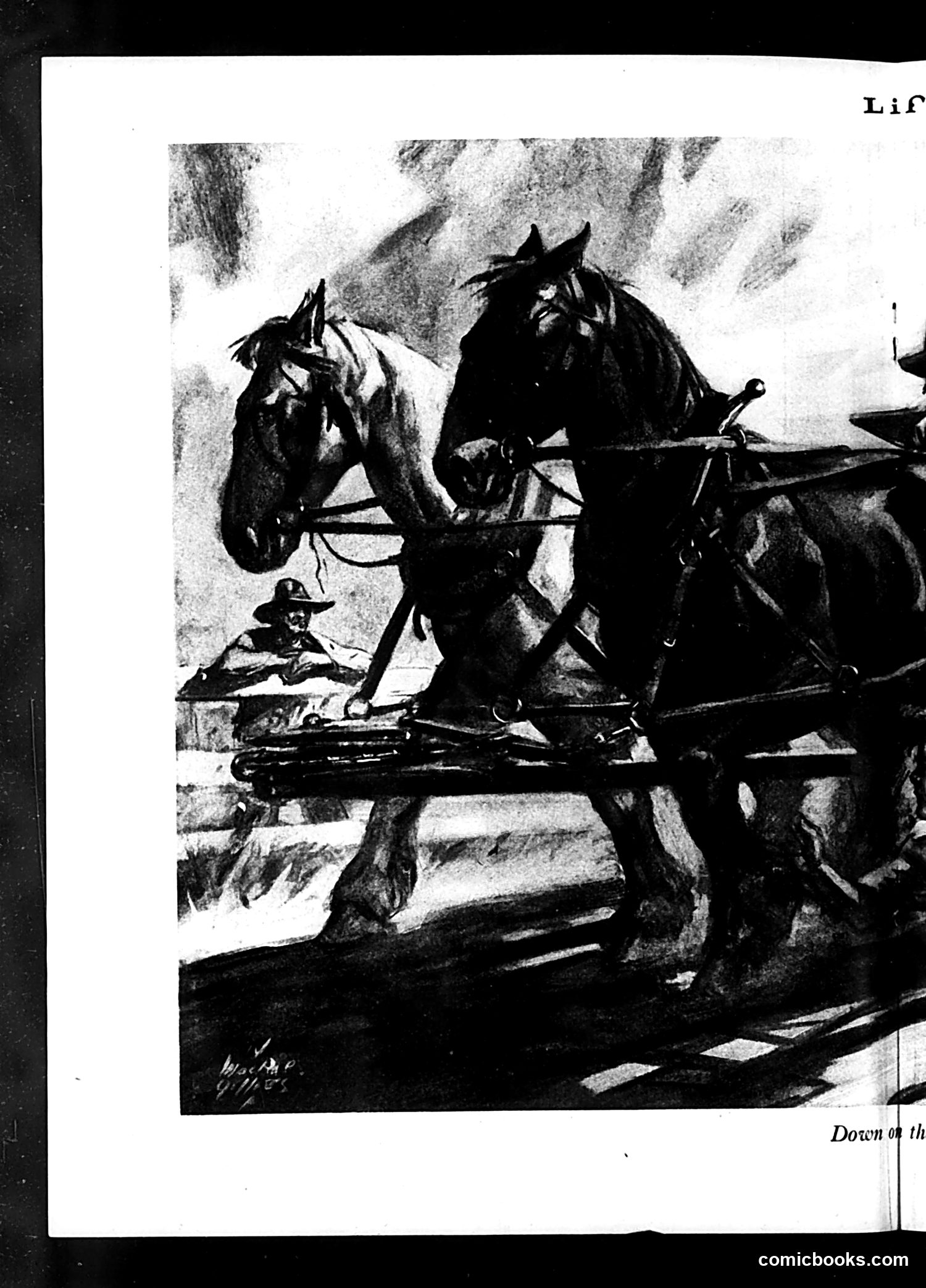
This black and white illustration depicts a team of horses pulling a heavily laden wagon or plow, driven by a small figure in a hat. The image appears to be satirizing labor or agricultural burden—possibly commentary on farmers, workers, or an entire nation bearing an excessive load. The artistic style and composition suggest economic hardship or exploitation. The contrast between the massive horses straining under weight and the small driver emphasizes disproportionate burden. Without visible text identifying specific political figures or dated context, the exact target remains unclear, though this appears to critique labor conditions, taxation, or resource allocation during an economically difficult period in American history.
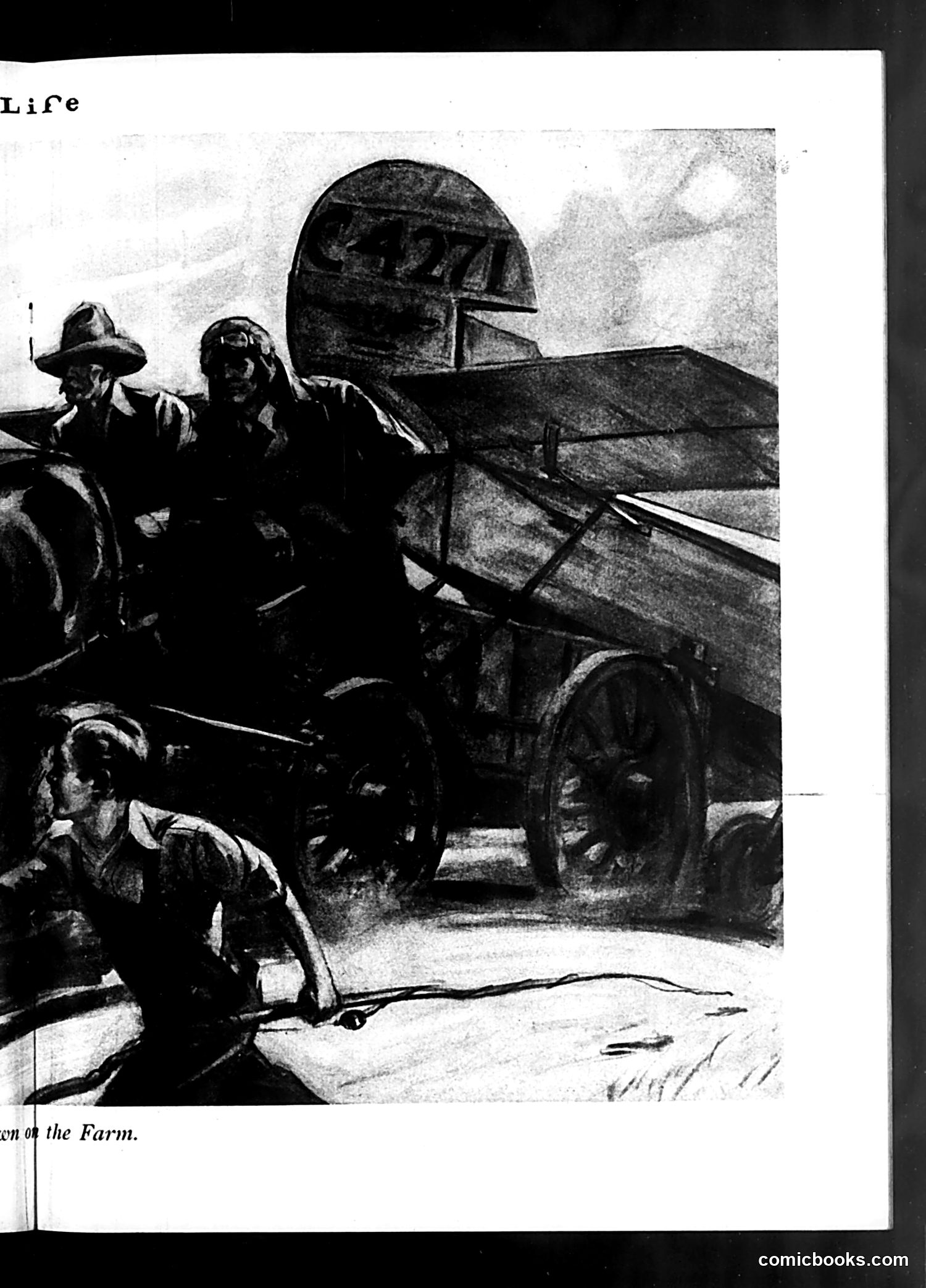
This appears to be a wartime illustration titled "on the Farm," likely from World War I era based on the style and subject matter. The image depicts soldiers in military uniforms and helmets near a large artillery piece or gun mounted on a farm wagon. The composition suggests commentary on militarization of civilian agricultural spaces—the contrast between farming equipment and military hardware. The soldiers' presence on farmland, combined with Life magazine's satirical nature, likely critiques either: the military's requisition of agricultural resources during wartime, the militarization of rural America, or the blending of civilian and military life during the conflict. The page title "Life" at top supports this is from the satirical magazine of that era. Without additional text visible, the precise satirical point remains somewhat unclear.
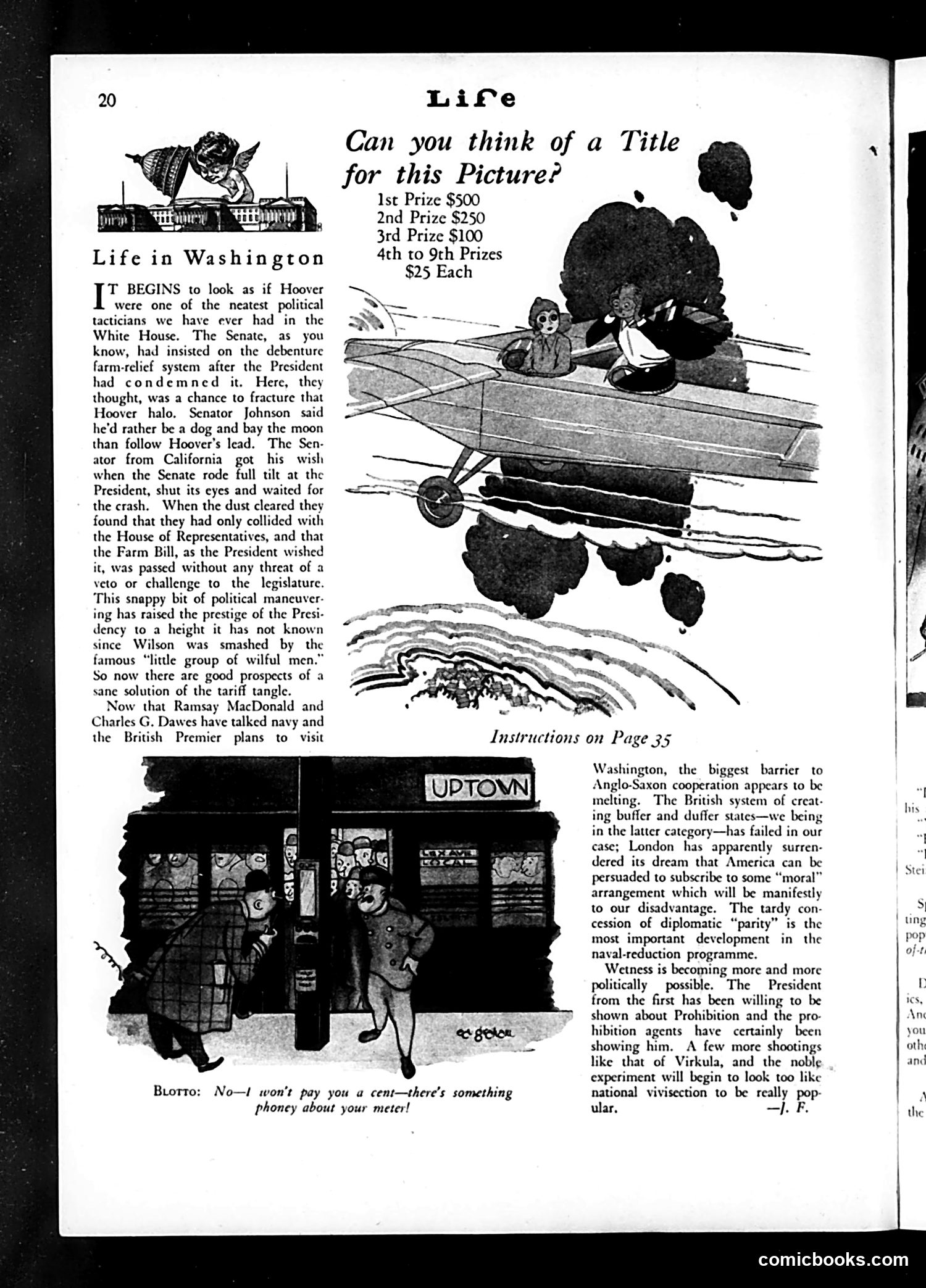
This page satirizes President Hoover's political maneuvering regarding farm relief legislation. The text describes how Senate opponents (led by California Senator Hiram Johnson, who famously opposed Wilson) expected to defeat Hoover by pushing a "debenture farm-relief system" he opposed. However, Hoover outmaneuvered them: the Senate's aggressive push collided with the House instead, and the Farm Bill passed in the form Hoover wanted—without requiring his veto. The separate cartoon at bottom shows a taxi meter dispute, captioned "No—I won't pay you a cent—there's something phoney about your meter!" This likely satirizes Prohibition-era corruption or government dishonesty more broadly. The page also contains a title-suggestion contest for an aerial photograph (showing an airplane and landscape). The political commentary concludes by addressing Anglo-American naval cooperation and Prohibition enforcement—contemporary issues under Hoover's administration.
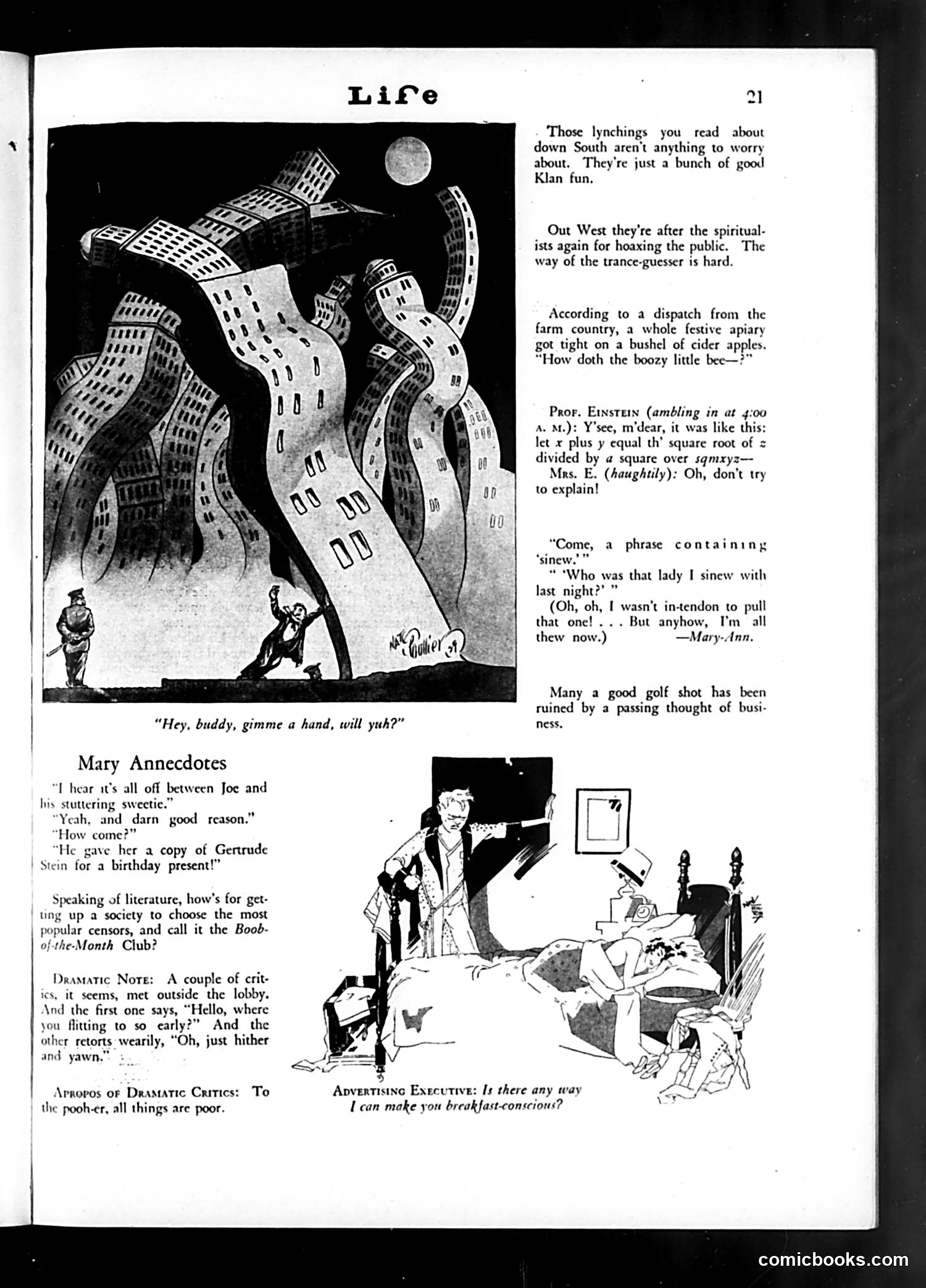
This page combines brief satirical commentary with cartoons mocking contemporary issues: **Main cartoon**: Depicts skyscrapers collapsing/bending unnaturally, with a small figure asking "gimme a hand?" This likely satirizes the 1920s real-estate boom and economic instability—buildings symbolizing financial structures on precarious footing. **Text satire targets**: - **KKK violence**: Opens with dark irony about Southern lynchings as "Klan fun"—mocking indifference to racial terrorism - **Spiritualism fraud**: References con artists ("trance-guessers") exploiting the public - **Einstein**: Mocks his complex theories as incomprehensible, with his wife refusing explanation - **Gertrude Stein**: Jokes that her experimental writing caused a relationship breakup - **Censorship**: Proposes a "Boob-of-the-Month Club" satirizing popular culture gatekeeping The humor targets intellectual pretension, scientific complexity, literary experimentalism, and organized crime—typical 1920s concerns. The tone is lighthearted but addresses serious subjects (racism, fraud) with casual dismissal characteristic of the era.
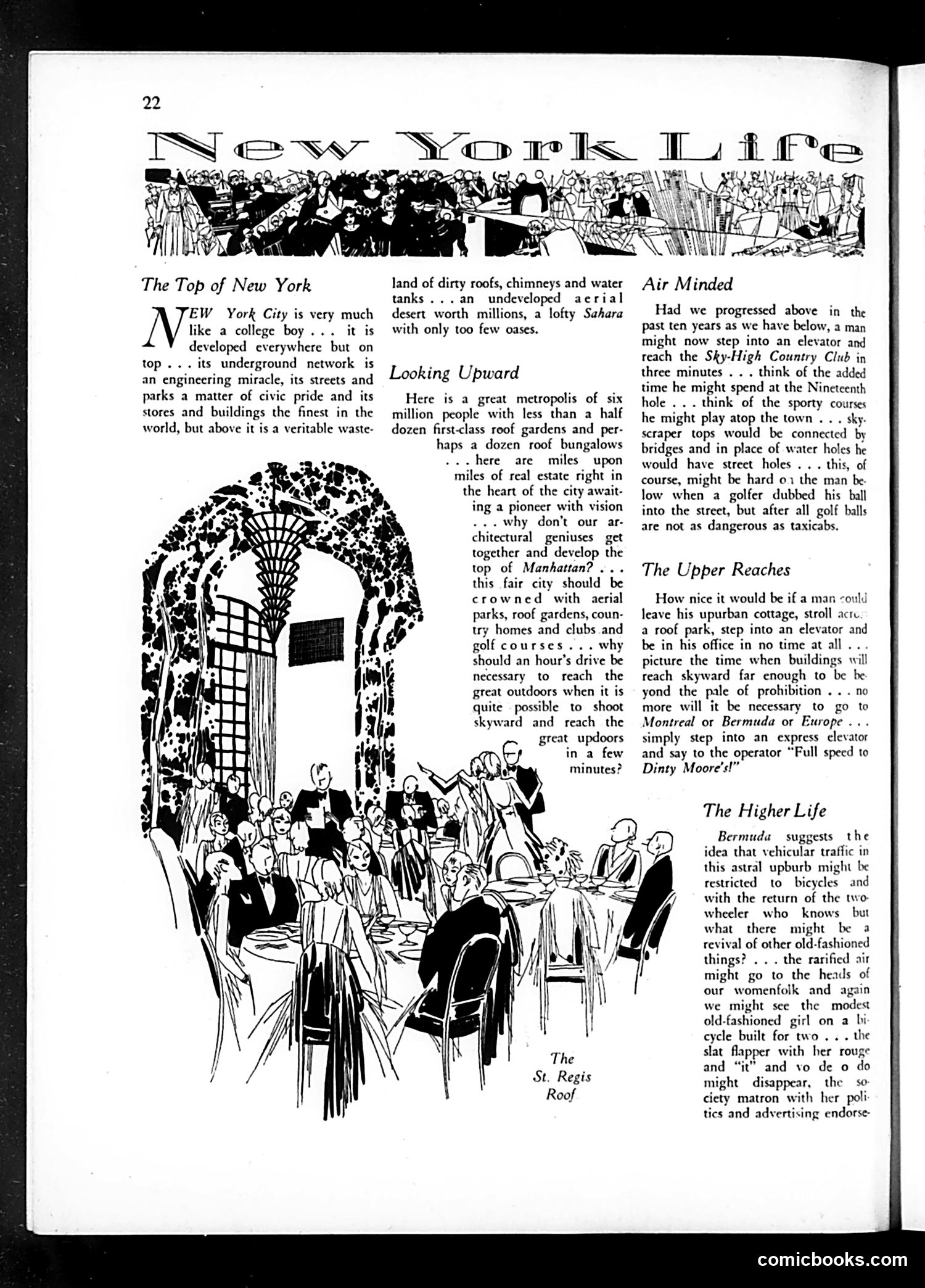
This page satirizes 1920s New York City's underdeveloped rooftops. The central illustration shows an elegant roof garden restaurant (the St. Regis Roof), contrasting with the text's complaint that Manhattan wastes valuable aerial real estate on "dirty roofs, chimneys and water tanks." The satirical sections mock futuristic dreams: "Sky-High Country Club" accessible by elevator, rooftop golf courses (where errant balls won't be "as dangerous as taxicabs"), and aerial neighborhoods replacing suburbs. "Air Minded" jokes about speakeasies at high altitudes during Prohibition. "The Higher Life" humorously suggests rooftop living might revive old-fashioned morality—the "modest old-fashioned girl on a bicycle" replacing the scandalous 1920s "flapper." The satire targets both urban planners (for neglecting rooftops) and contemporary social anxieties about modern manners and Prohibition enforcement. It's lighthearted futurism with Jazz Age social commentary.
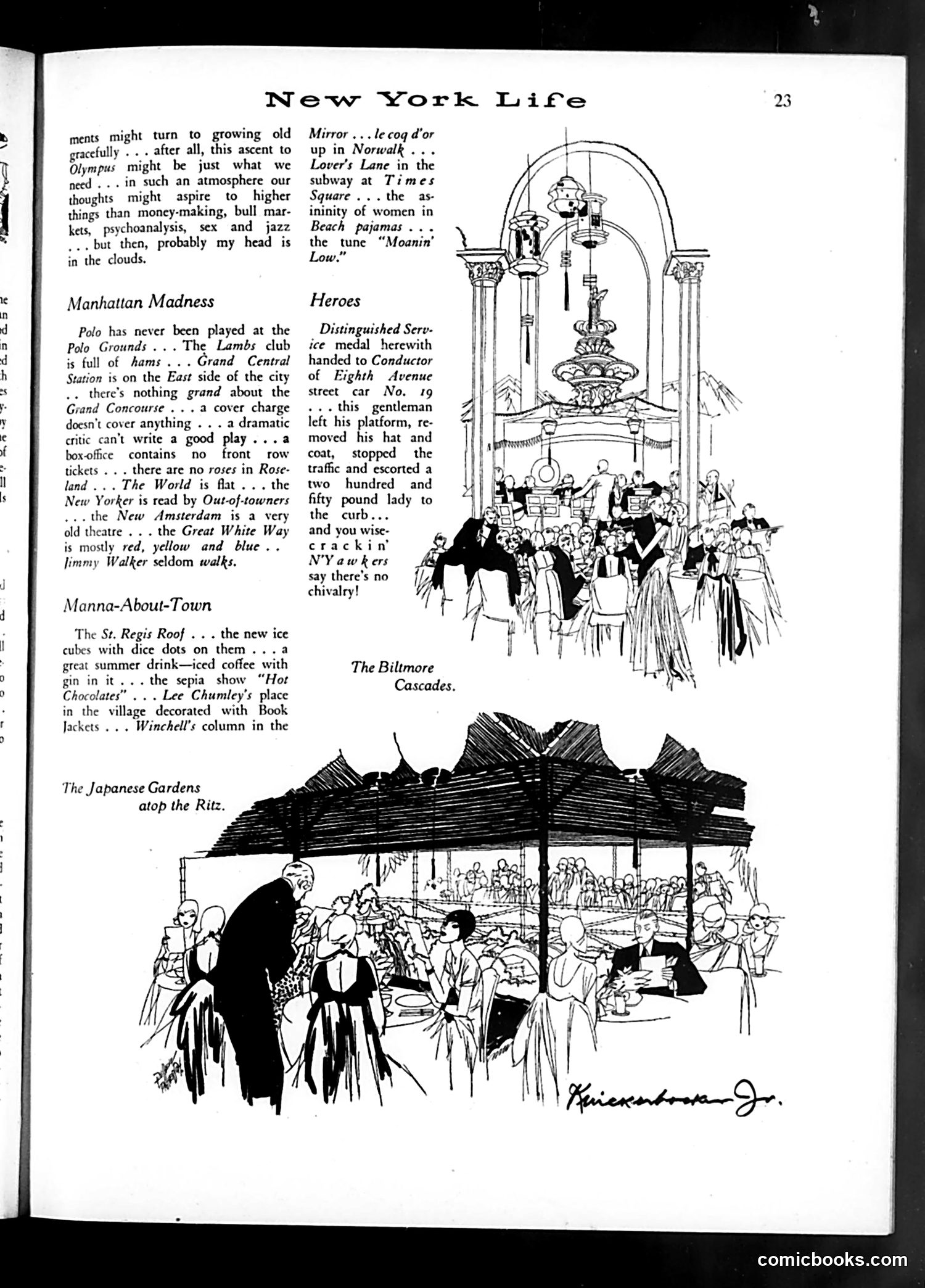
This page from *Life* magazine contains satirical commentary on 1920s New York City life. The top section mocks Manhattan pretensions through ironic observations—venues with grand names lacking grandeur (Grand Central isn't grand, Polo Grounds never hosted polo), and absurd contradictions (Jimmy Walker, likely the city's mayor, "seldom walks"). The two illustrations depict upscale social venues: the upper shows what appears to be *The Biltmore Cascades*, a fancy hotel ballroom or restaurant with formally dressed diners; the lower depicts *The Japanese Gardens atop the Ritz*, another elite gathering spot. The "Heroes" section satirizes New York's supposed lack of chivalry by awarding a medal to a street car conductor for performing basic courtesy—helping a 250-pound woman cross the street. This is presented ironically: the gesture is genuinely kind, but New Yorkers supposedly dismiss such behavior as hopelessly old-fashioned. Overall, the satire targets both New York's false sophistication and its reputation for rudeness.
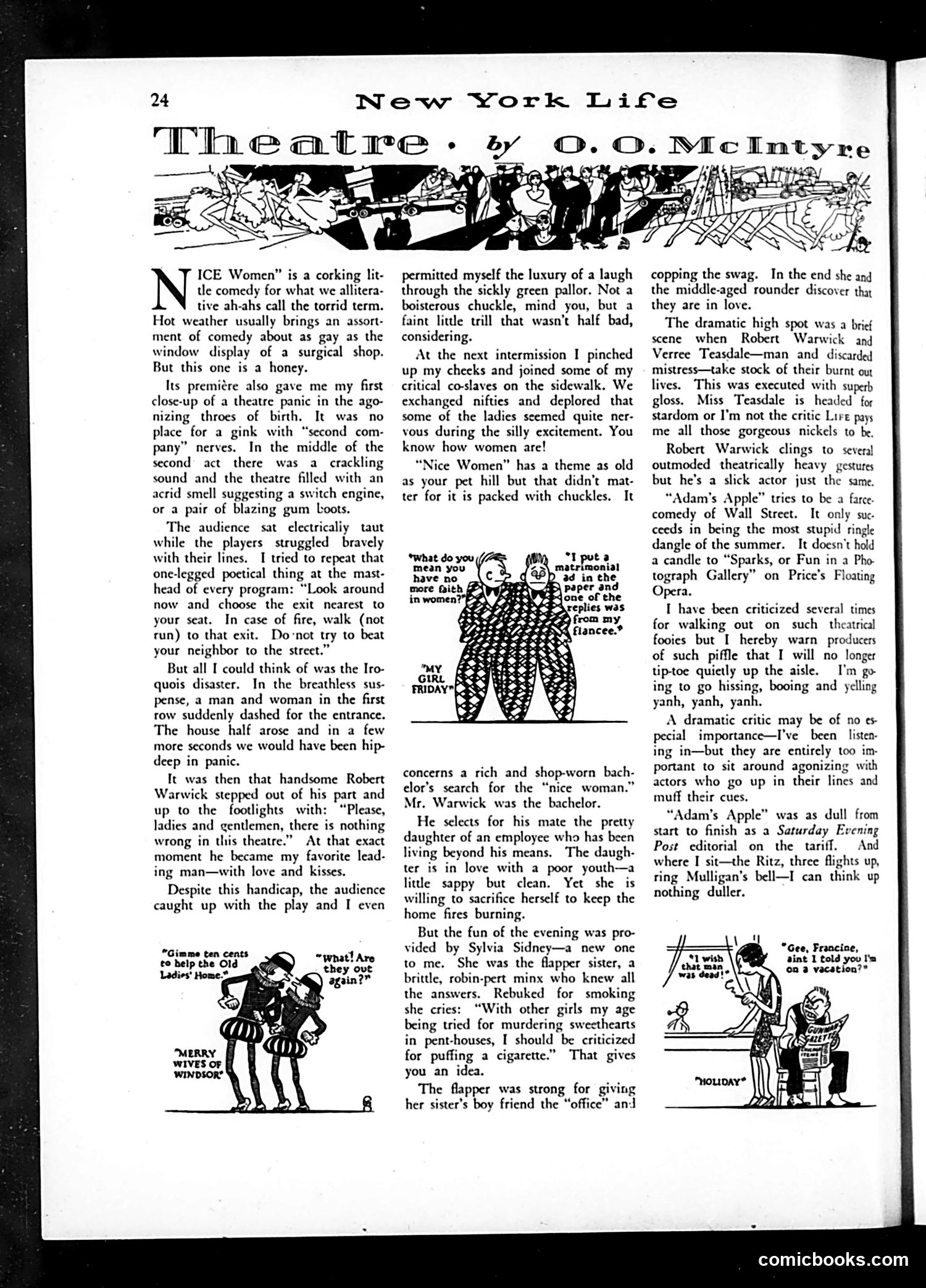
This is O.O. McIntyre's theater column reviewing two Broadway plays. The main review concerns "Nice Women," starring Robert Warwick and featuring newcomer Sylvia Sidney as a flapper character. The satire centers on the flapper archetype—a young woman who smokes, talks back, and makes witty remarks about serious topics (she jokes that murdering sweethearts in "pent-houses" is worse than her cigarette smoking). This represents 1920s anxieties about "modern" women rejecting traditional morality. The column also references a real theatrical emergency—the Iroquois Theatre disaster (a 1903 Chicago fire killing hundreds)—used to humorously illustrate the audience's panic during an unrelated backstage smell. McIntyre praises Warwick's quick thinking in calming panicked patrons. The second play reviewed, "Adam's Apple," is dismissed as worthless. The cartoons appear to illustrate flapper behavior and suburban life, supporting the contemporary anxiety theme about changing social norms.
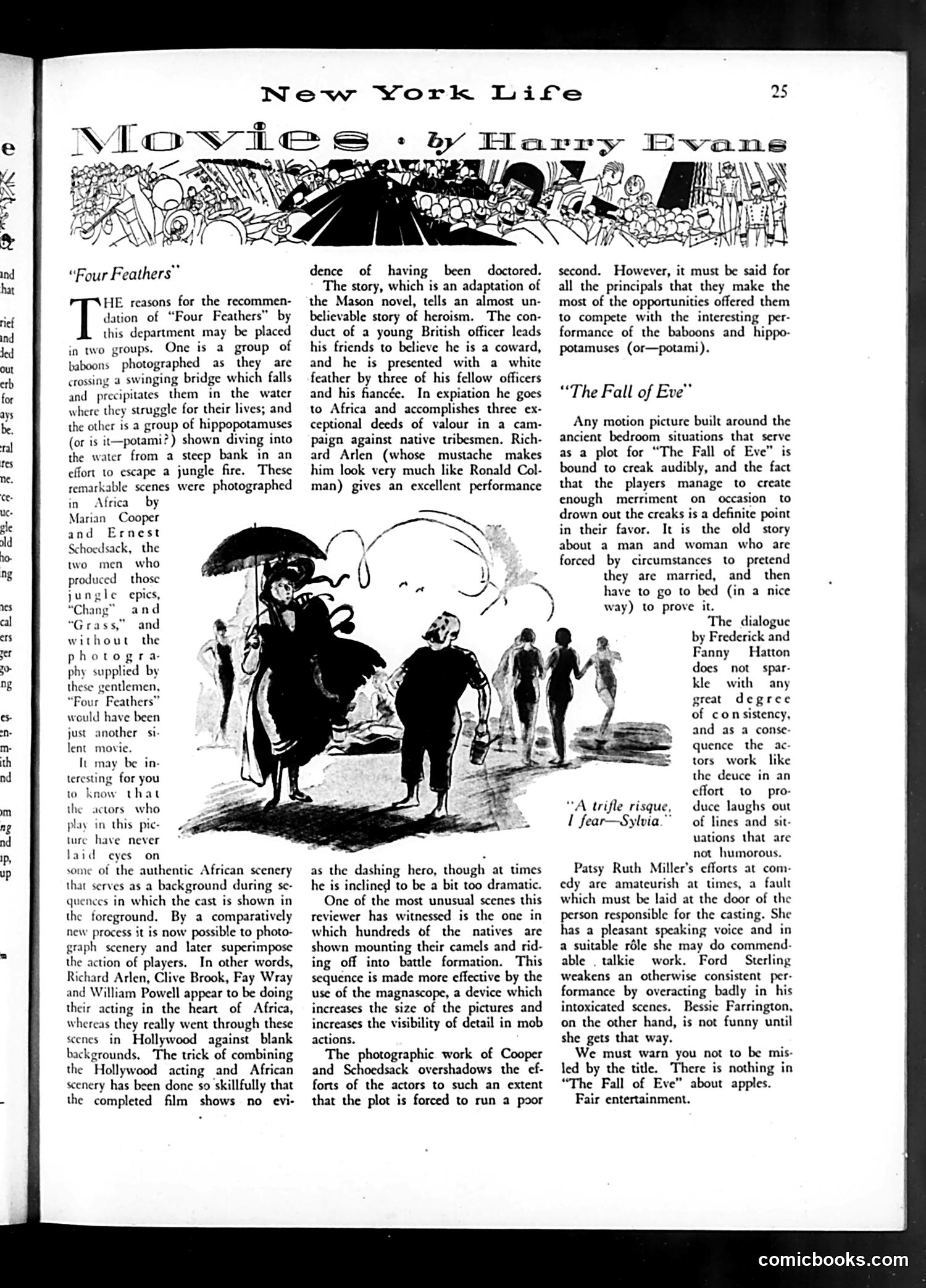
This page contains two film reviews by Harry Evans from an early sound-era *Life* magazine (likely late 1920s). **"Four Feathers"** is praised primarily for its wildlife cinematography—baboons crossing a bridge and hippopotamuses diving—shot in Africa by Cooper and Schoedsack (famous documentary filmmakers). The review notes an early special effects technique where actors performed against blank Hollywood backdrops while African footage was superimposed behind them, creating seamless composite shots. The actual narrative—a British officer proving his courage in Africa after being called a coward—is dismissed as formulaic, overshadowed by the spectacular animal footage and exotic locations. **"The Fall of Eve"** follows a tired comedic premise: a man and woman must pretend marriage and share a bed to prove their relationship. The reviewer criticizes the dialogue as unfunny and notes that actors work hard to extract laughs from weak material. Patsy Ruth Miller's comedic performance is described as "amateurish." Both reviews exemplify early cinema criticism's focus on technical innovation and spectacle over narrative sophistication.
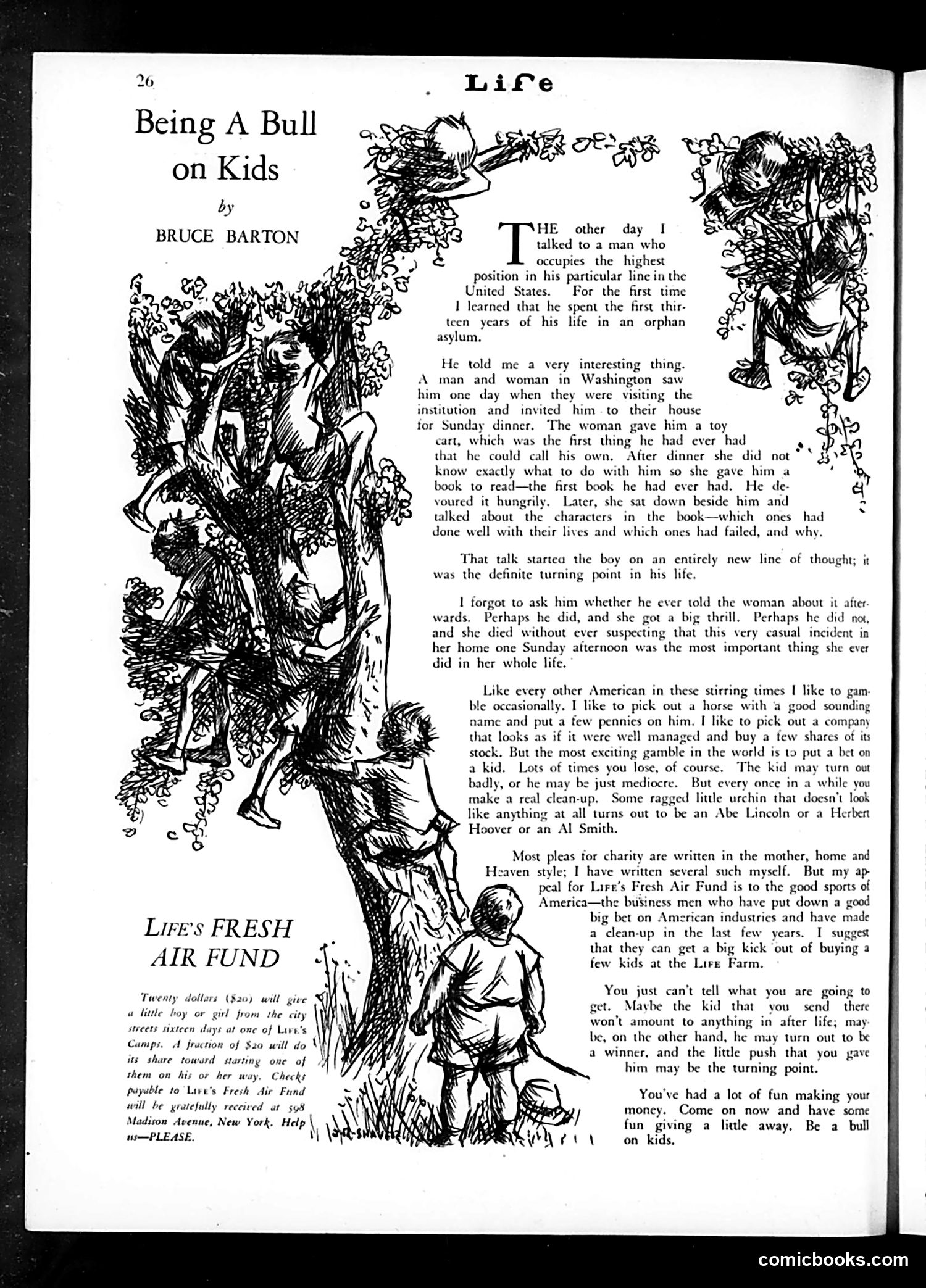
This is an essay arguing for charitable investment in underprivileged children, using financial gambling metaphors. Barton tells of a high-ranking government official who spent his first thirteen years in an orphanage; a Washington couple's casual kindness—giving him a toy cart and his first book, then discussing its characters—became his "turning point." Barton appeals to wealthy businessmen to "gamble" on poor children through Life magazine's Fresh Air Fund, which sends city kids to camps. He frames it as speculation: most investments in children may fail, but occasionally you'll get "an Abe Lincoln or a Herbert Hoover or an Al Smith"—transforming street urchins into successful men. The ad solicits $20 donations (substantial for the era). The satire lies in monetizing charity through masculine business language—children as "bets," success as "clean-ups"—to appeal to competitive businessmen's egos and competitive instincts rather than sentiment.
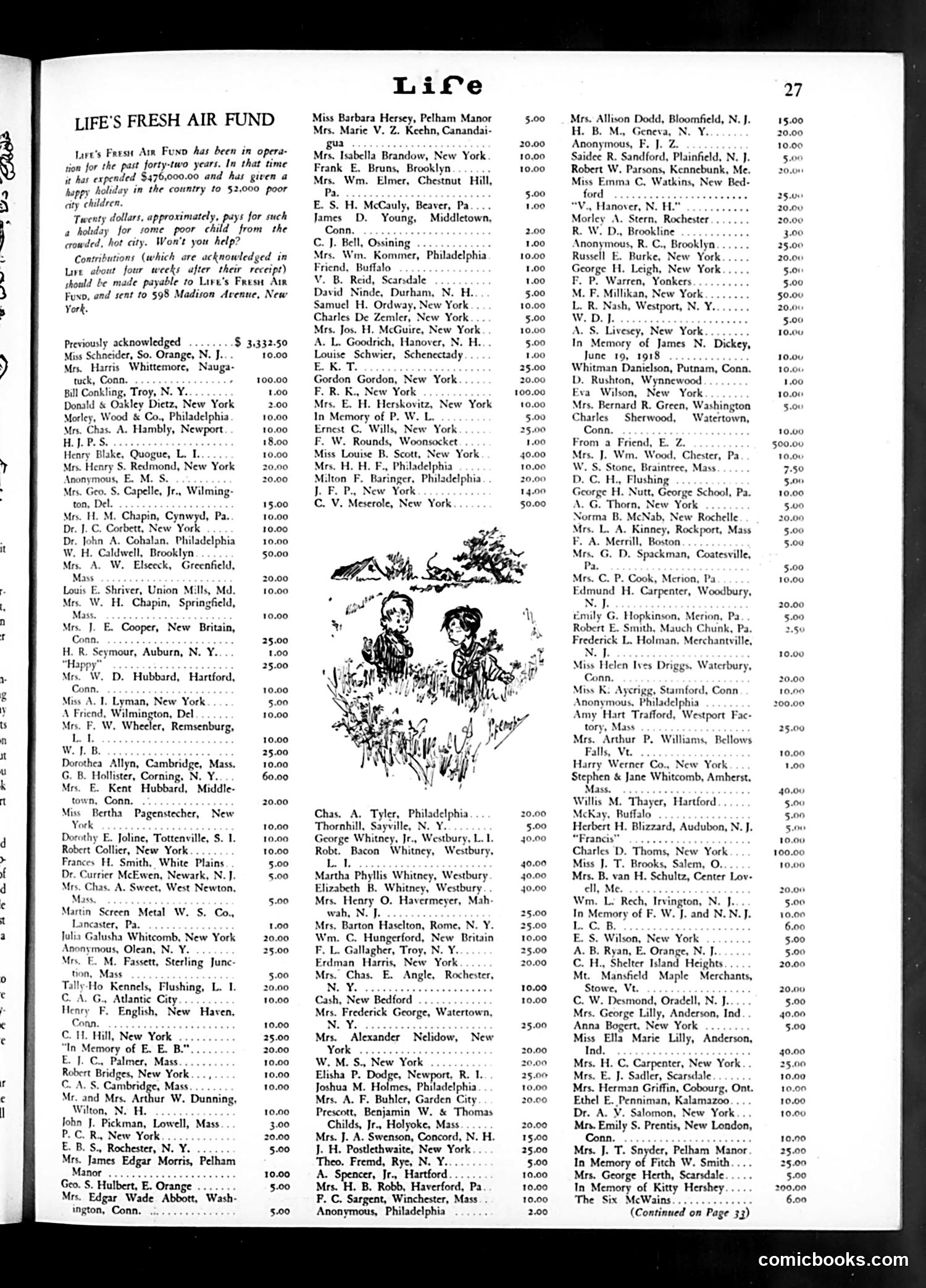
This page is primarily a **donor list** for *Life* magazine's Fresh Air Fund—a real charitable program that sent poor urban children to the countryside for holidays. The small **illustration shows two children**, likely representing the beneficiaries of this fund. The cartoon's implicit message is sentimental: these needy city kids deserve outdoor recreation and respite. The page lists hundreds of donors with contribution amounts (ranging from $1 to $100), creating a record of charitable giving. The context reflects early-20th-century Progressive-era social reform—the belief that urban poverty was a civic problem requiring middle- and upper-class philanthropy. The "fresh air" concept was literal: medical theory held that country air improved children's health. For modern readers, this shows how charitable fundraising once worked: personal, name-based, with public acknowledgment of donors. It's also a time capsule of class consciousness—wealthy Americans publicly supporting charity for "crowded, hot city" children.
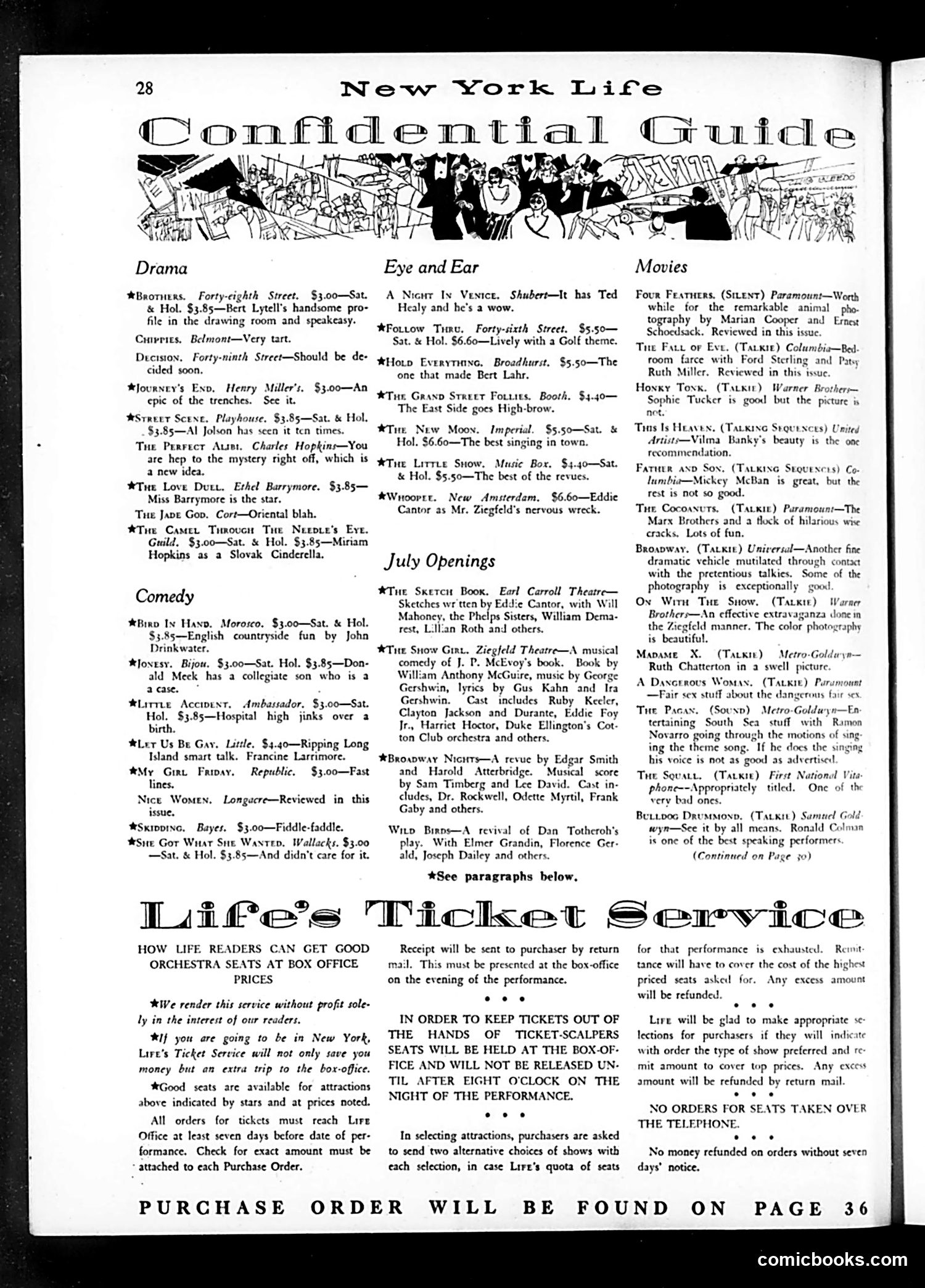
This is a **theater listing and review page** from Life magazine, not primarily a political cartoon page. It contains reviews and advertisements for Broadway plays, comedies, and early "talking" films (marked "Talkie"). The page reflects **1920s entertainment culture**, listing shows with prices and brief critical assessments. Notable references include: - **Eddie Cantor** and **Marx Brothers** (famous comedians of the era) - **Ziegfeld** productions (prestigious musical theater) - **Silent vs. talking films** — a major technological shift occurring then - Working-class entertainment ("East Side goes High-brow") The "Confidential Guide" header suggests Life positioned itself as an arbiter of taste for New York's sophisticated audience. The ticket service section indicates Life profited by brokering theater purchases. This page documents **how Americans entertained themselves during the Jazz Age**, with emphasis on Broadway and early cinema.
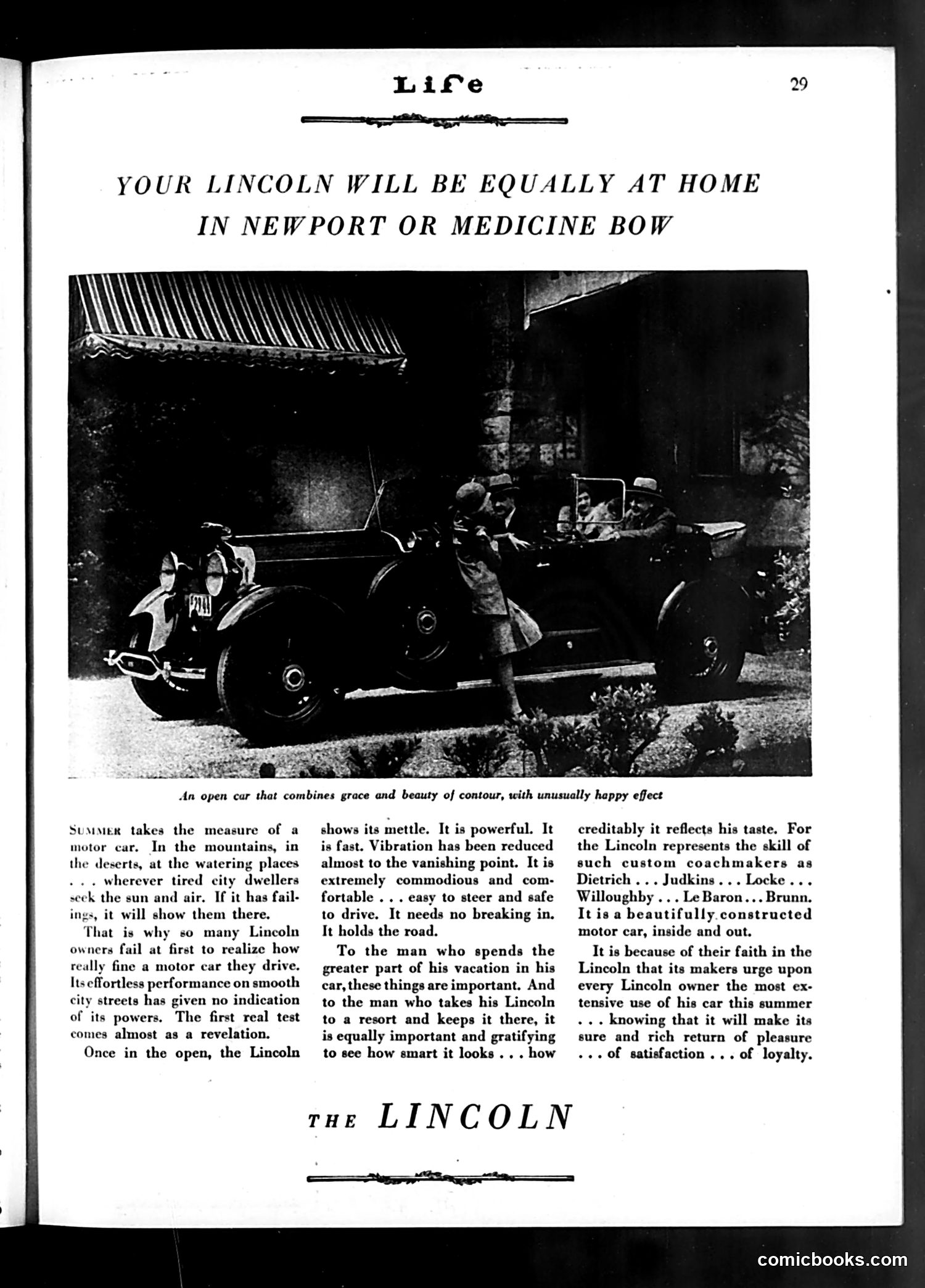
This is **not a cartoon or satire**—it's a straightforward automobile advertisement for the Lincoln motor car, likely from the 1920s-1930s based on the style and vehicle design shown. The ad promotes the Lincoln as equally suitable for wealthy leisure destinations ("Newport," an elite Rhode Island resort) and rugged, remote locations ("Medicine Bow," a Wyoming frontier town). The copy emphasizes the car's performance, comfort, and durability across diverse driving conditions. The advertisement leverages social aspiration by name-checking prestigious custom coachbuilders (Dietrich, Judkins, Locke, Willoughby, Le Baron, Brunn)—implying that owning a Lincoln reflects refined taste and status. The image shows an open touring car with well-dressed passengers, reinforcing the luxury positioning. This represents early automotive marketing targeting the affluent market segment willing to invest in extended summer travel.
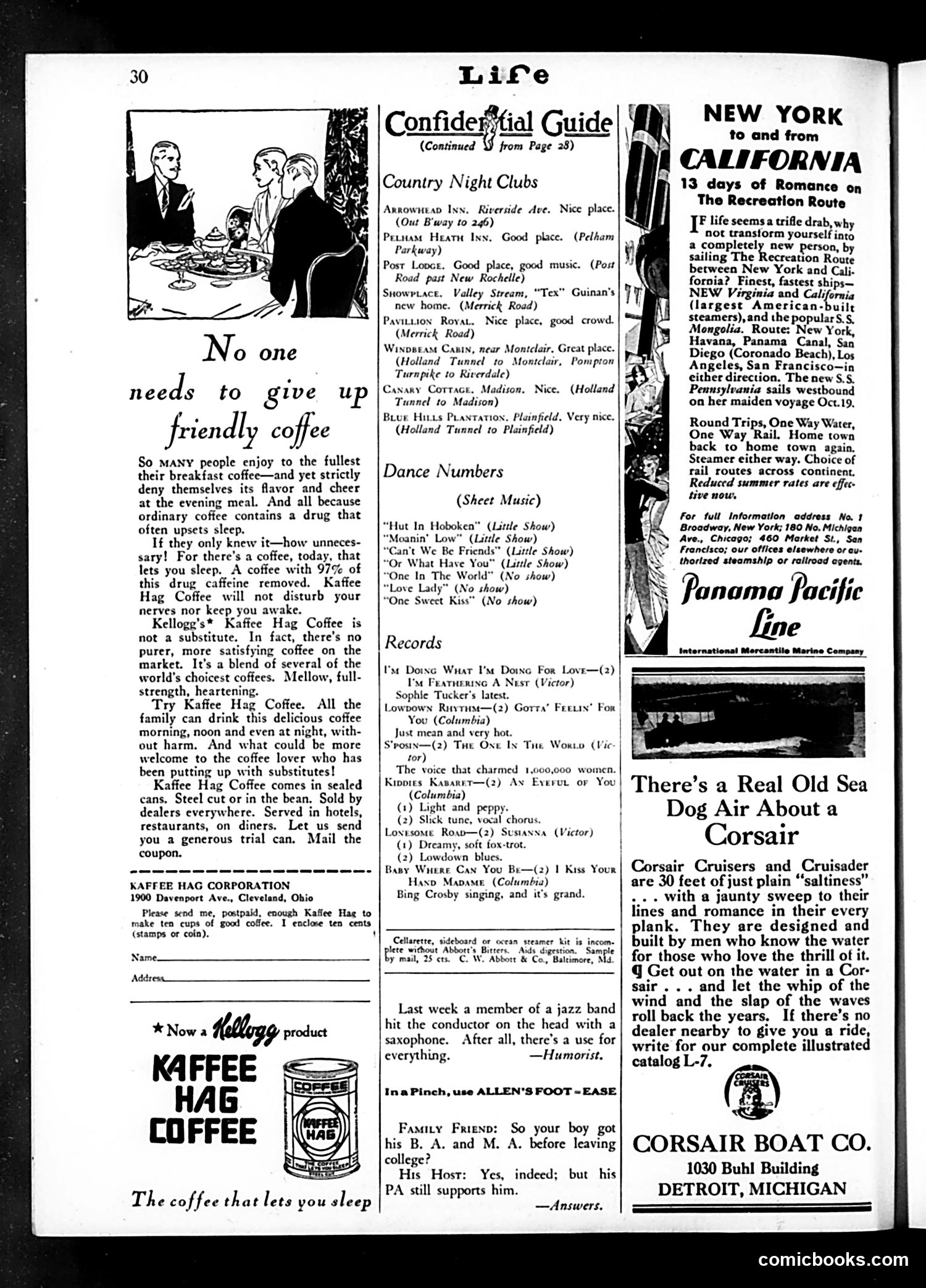
This page is primarily **advertising**, not political satire. The dominant content is a Kaffee Hag Coffee ad addressing a genuine consumer concern of the 1920s-30s era. **The Central Premise:** The ad acknowledges that many people loved coffee but avoided it at dinner because caffeine disrupted sleep—a real social problem. Kaffee Hag marketed itself as a solution: coffee with 97% of caffeine removed, allowing "friendly coffee" at any hour without sacrificing sleep. **The Social Context:** The cartoon illustration shows well-dressed diners socializing over evening coffee, implying that coffee at dinner was desirable for social reasons, not just stimulation. The ad's language ("what could be more welcome to the coffee lover who has been putting up with substitutes") suggests previous decaffeinated options were unsatisfactory. **The Satire Element:** The page's small humor section jokes about a jazz conductor being hit with a saxophone—unrelated to the main content and typical filler humor of the era. The page reflects 1920s-30s consumer culture where decaffeination technology was novel and marketed as enabling social pleasure without health consequences.
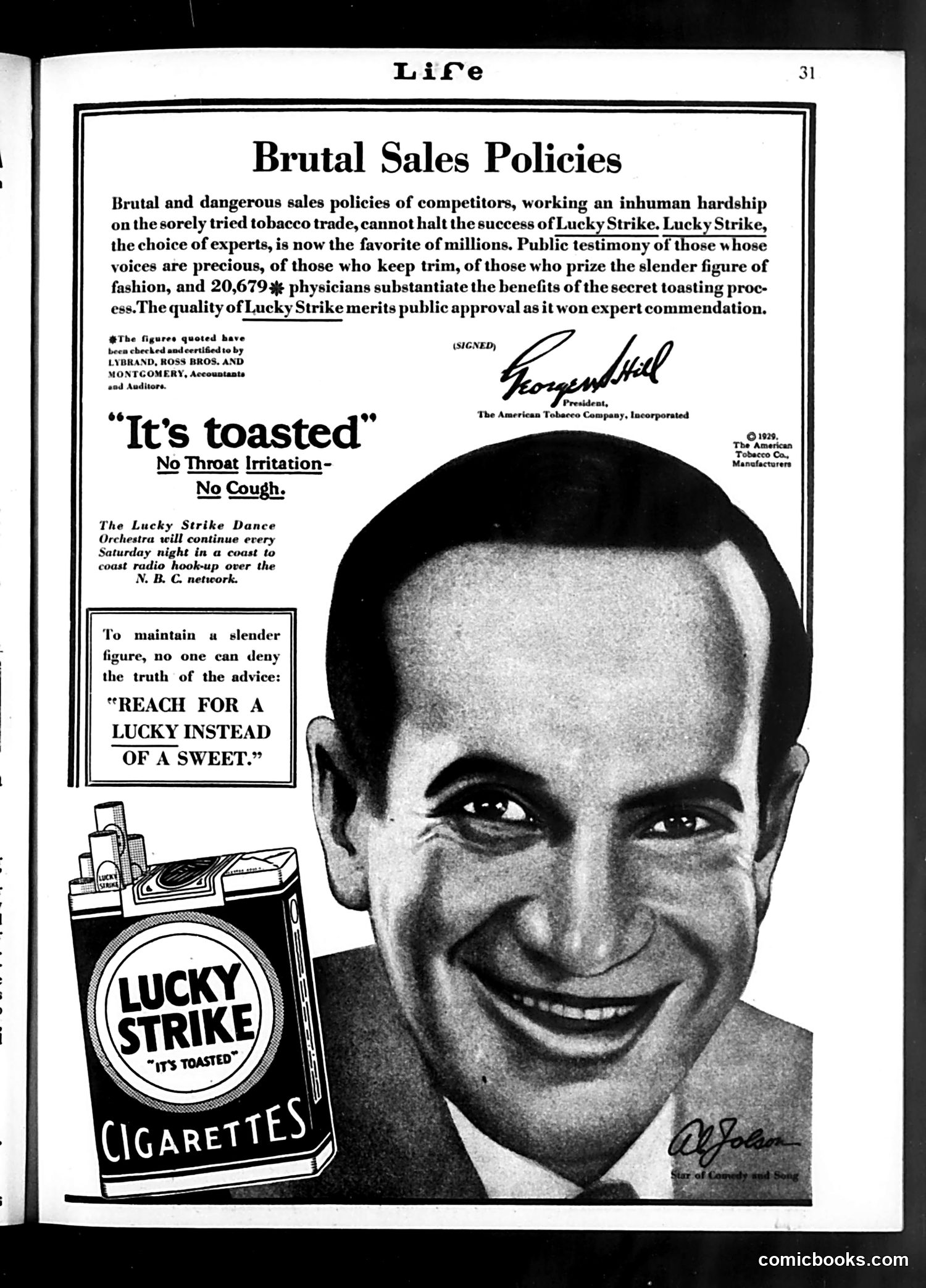
This is a **cigarette advertisement**, not satire—it's a genuine Lucky Strike promotion from Life magazine (circa 1920s-30s). The page promotes Lucky Strike cigarettes by claiming they're the choice of experts and millions. Key marketing claims include: the "secret toasting process" prevents throat irritation and cough, and the cigarettes help maintain a "slender figure" (positioning smoking as a diet aid—a common pitch to women at the time). The authority appeals are notable: it cites 20,679 physicians endorsing the product and references accountants verifying these claims, lending false scientific credibility. A smiling man's portrait endorses the brand. **What modern readers should know:** This represents pre-regulation tobacco advertising when health claims were unsubstantiated and unregulated. The "reach for a Lucky instead of a sweet" slogan explicitly marketed cigarettes as appetite suppressants—a tactic targeting weight-conscious consumers, particularly women. Such advertising is now illegal.
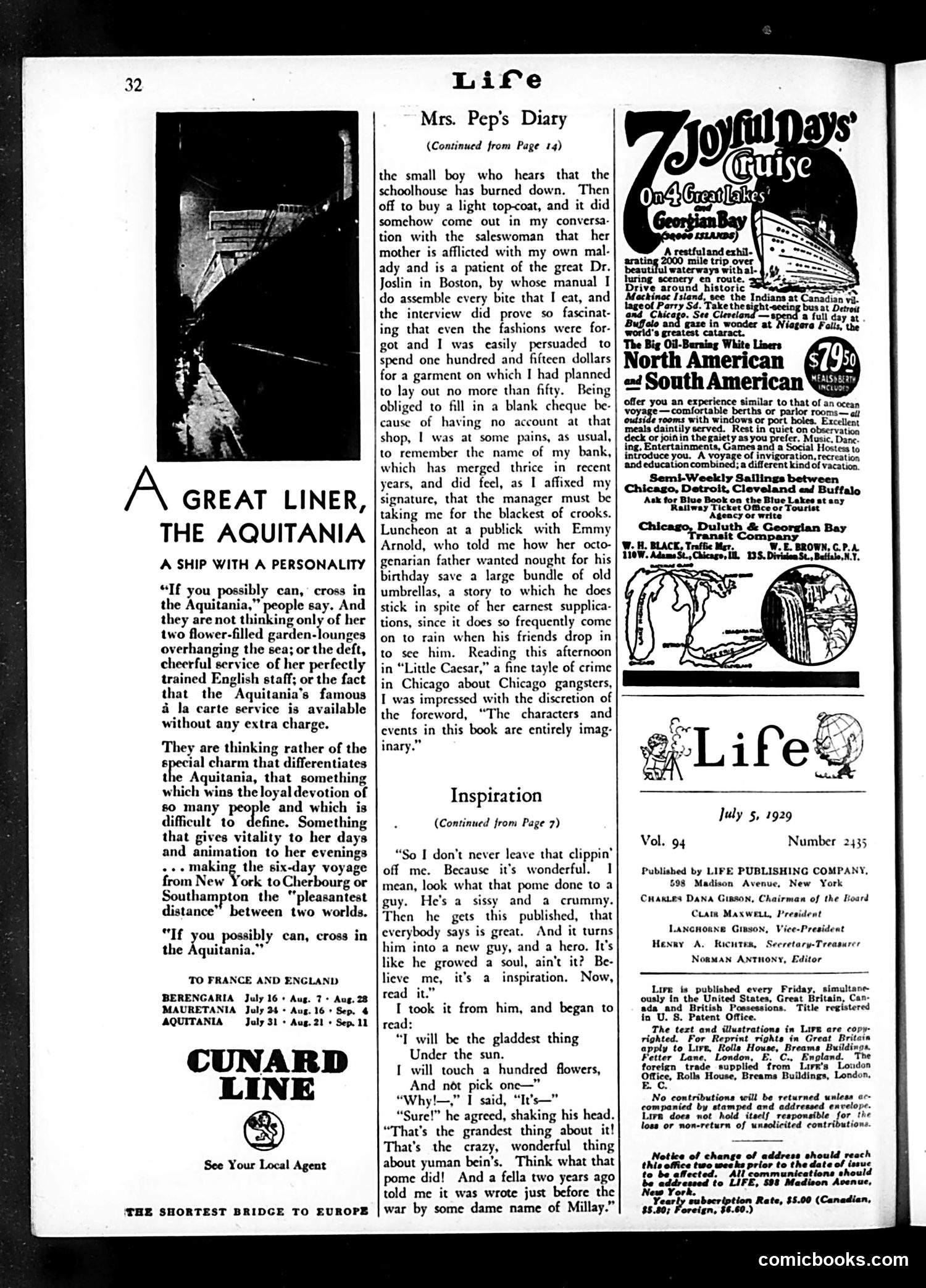
This page is primarily **advertising and magazine content** from July 5, 1929. The main visual element is a **photograph of the RMS Aquitania**, a luxury ocean liner, accompanied by promotional copy emphasizing its comfort and "personality"—a marketing appeal to wealthy travelers considering transatlantic voyages. The Cunard Line advertisement below directs readers to booking agents. The text content includes two separate diary/column pieces: 1. **"Mrs. Pep's Diary"** — a gossipy account of shopping, lunch, and reading "Little Caesar" (a 1929 crime novel about Chicago gangsters). The diarist notes the book's disclaimer that characters are fictional—likely a knowing reference to contemporary anxieties about sensationalist crime literature. 2. **"Inspiration"** — describes someone moved by poetry (apparently by Edna St. Vincent Millay, though unnamed) that transformed a "sissy and crummy" character into a hero, arguing art can change people's souls. The page reflects **1920s leisure culture**: transatlantic travel, consumer spending, gangster fiction, and romantic notions of art's redemptive power. There is no political satire visible here.
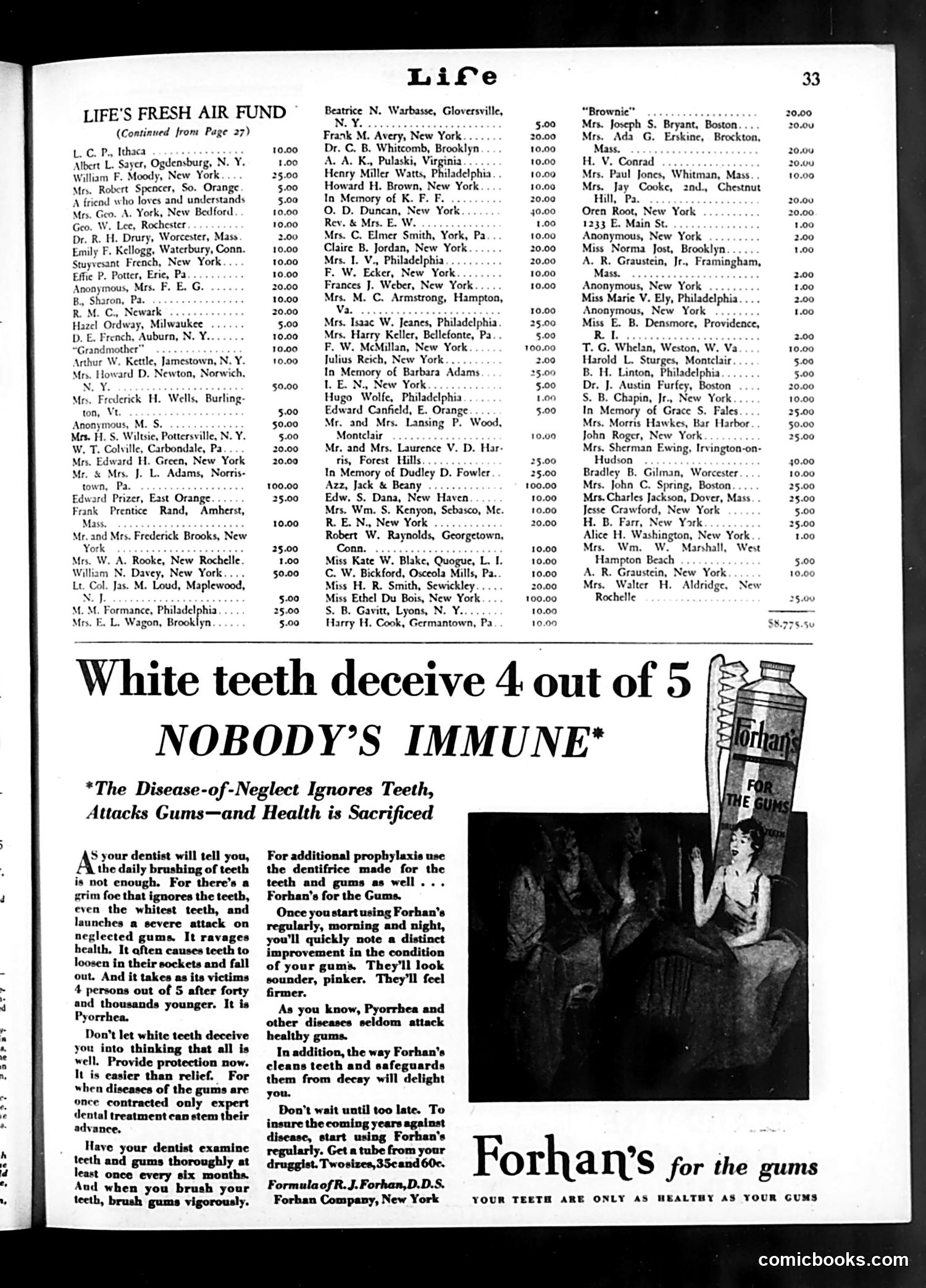
This page is primarily **Life magazine's "Fresh Air Fund"** — a charitable fundraising section listing donors' contributions for what appears to be a children's welfare program. The donations range from $1 to $100. The bottom half contains a **dental advertisement for Forhan's gum treatment**, not political satire. The headline "White teeth deceive 4 out of 5—NOBODY'S IMMUNE" uses alarming rhetoric to sell a product, warning that even clean-looking teeth hide gum disease ("Pyorrhea"). The ad copy employs fear-based marketing common to early-20th-century advertising: it claims only expert dental treatment can prevent tooth loss and emphasizes that brushing alone is insufficient. The product ("Forhan's for the gums") is positioned as necessary preventative medicine. **There is no political cartoon on this page.** It's a charitable donation list followed by period medical advertising using exaggerated health warnings as a sales tactic.
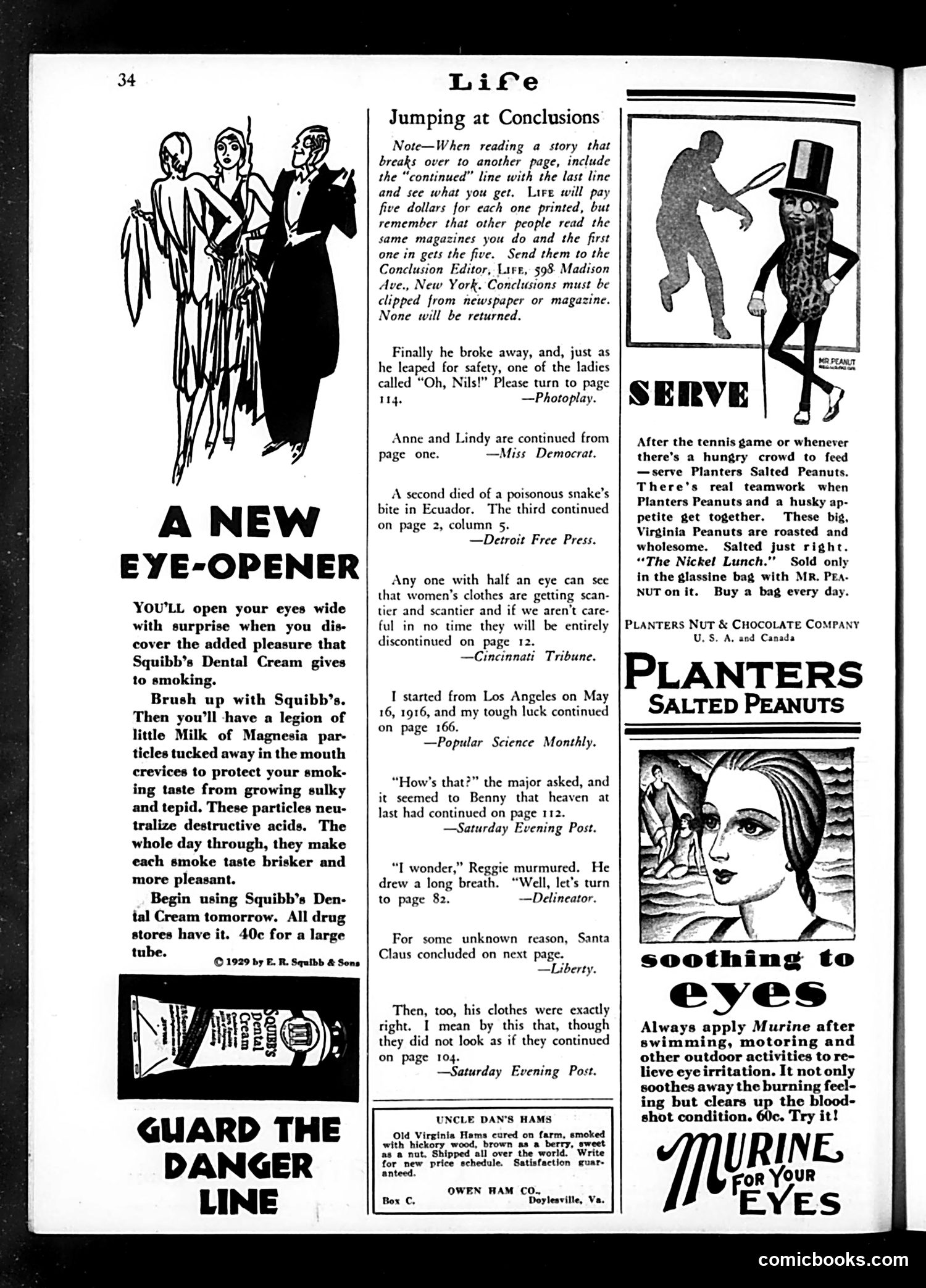
This page's central feature is a humor feature satirizing how magazine stories continue across pages. Life invites readers to submit funny unintended meanings created by reading a story's final line followed immediately by the next page's opening line—without turning the page as instructed. Examples shown include absurd juxtapositions: a dramatic escape ("just as he leaped for safety") followed by "Anne and Lindy are continued from page one," or a poisoned snake bite in Ecuador that "continued on page 2"—implying the deadly bite somehow persisted in an unrelated story. The satire mocks both magazine formatting conventions and readers' potential confusion when stories sprawl across multiple pages. Life offered $5 per published submission, making it a participatory humor feature for 1929 readers. The page is otherwise filled with period advertisements (dental cream, peanuts, ham, eye drops) typical of the era's magazine content.
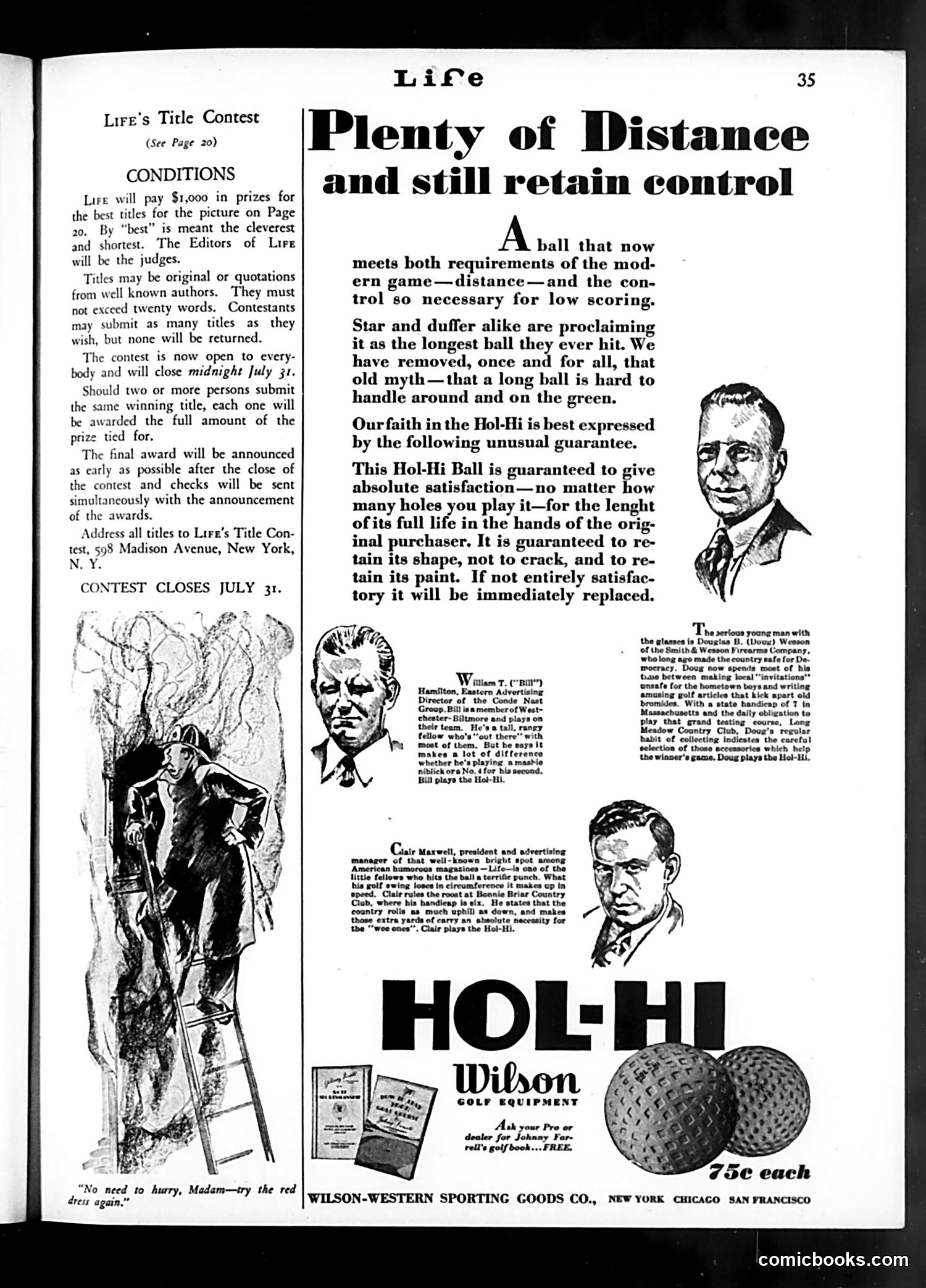
This page contains **primarily advertising** for the Hol-Hi golf ball by Wilson-Western Sporting Goods, mixed with a **Life Magazine title contest announcement**. The left side promotes a contest offering $1,000 for clever, short titles for an image on page 20 (not visible here). Submissions close July 31. The right side is a **golf ball advertisement** featuring testimonials from three named executives: Douglas Wesson (Smith & Wesson Firearms), William "Bill" Hamilton (Conde Nast advertising director), and Clair Maxwell (Life magazine president/advertising manager). Their headshots and brief biographical sketches establish credibility as serious golfers endorsing the product. The advertisement's central claim: the Hol-Hi ball achieves both distance *and* control—solving golf's traditional trade-off. A money-back guarantee emphasizes confidence in the product. The small cartoon on the lower left appears unrelated to the main content—its meaning is unclear without context from page 20.
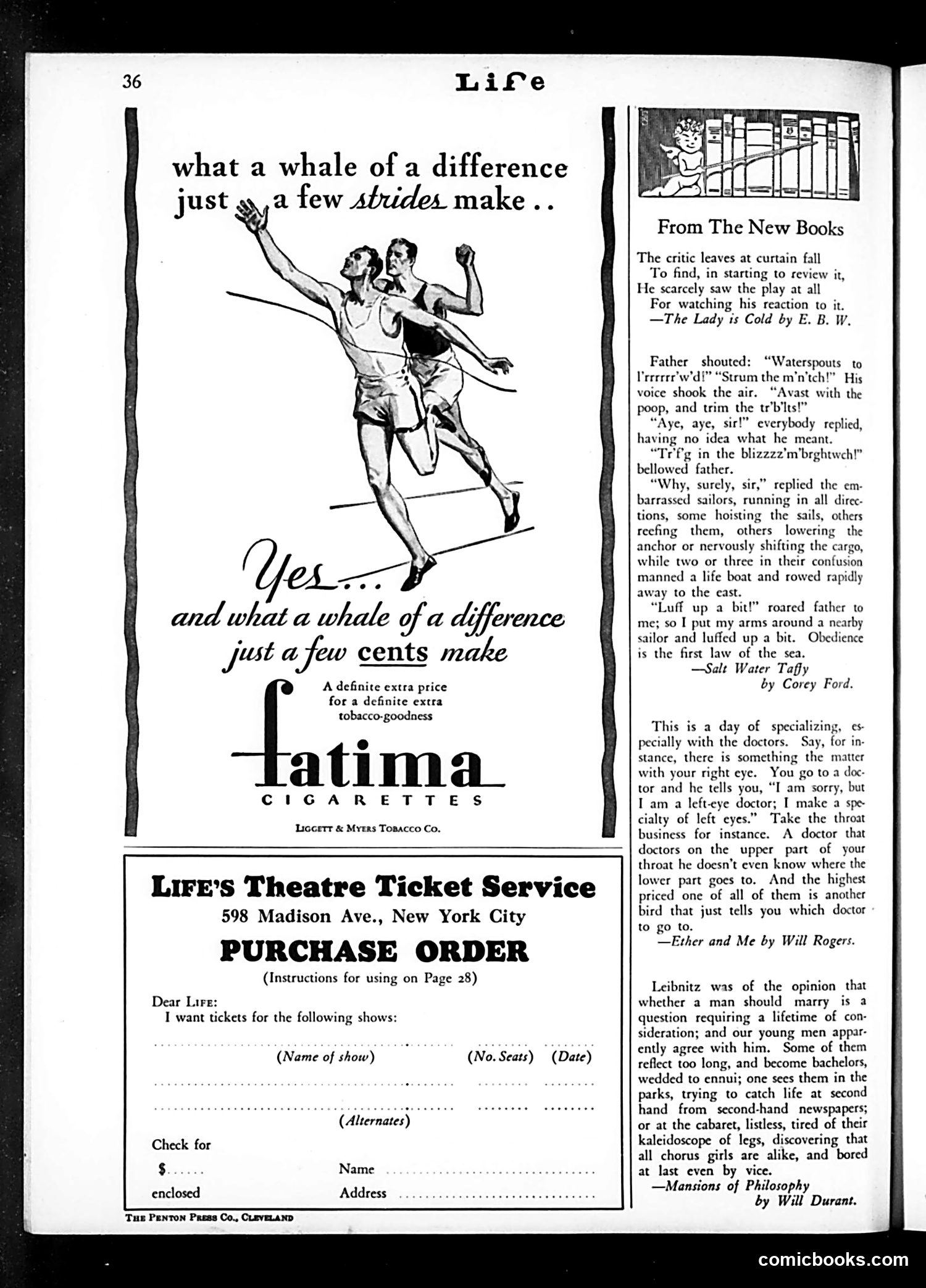
This page is primarily a **cigarette advertisement** for Fatima brand cigarettes, using a pun-based sales pitch common to early 20th-century advertising. The illustration depicts two figures in athletic poses (appearing to be swimmers or divers in motion), used to visualize the ad's wordplay: "what a whale of a difference just a few *strides* make" versus "what a whale of a difference just a few *cents* make." The joke equates small physical movements with the modest price premium—implying that Fatima cigarettes offer superior "tobacco-goodness" for only a few extra cents. The right column contains book reviews and literary excerpts, unrelated to the advertisement. The bottom section is a **theater ticket order form** for Life magazine's subscription service. This reflects 1920s-era advertising strategy: punning wordplay, athletic imagery suggesting vitality, and emphasis on value pricing to justify product quality over cheaper competitors.
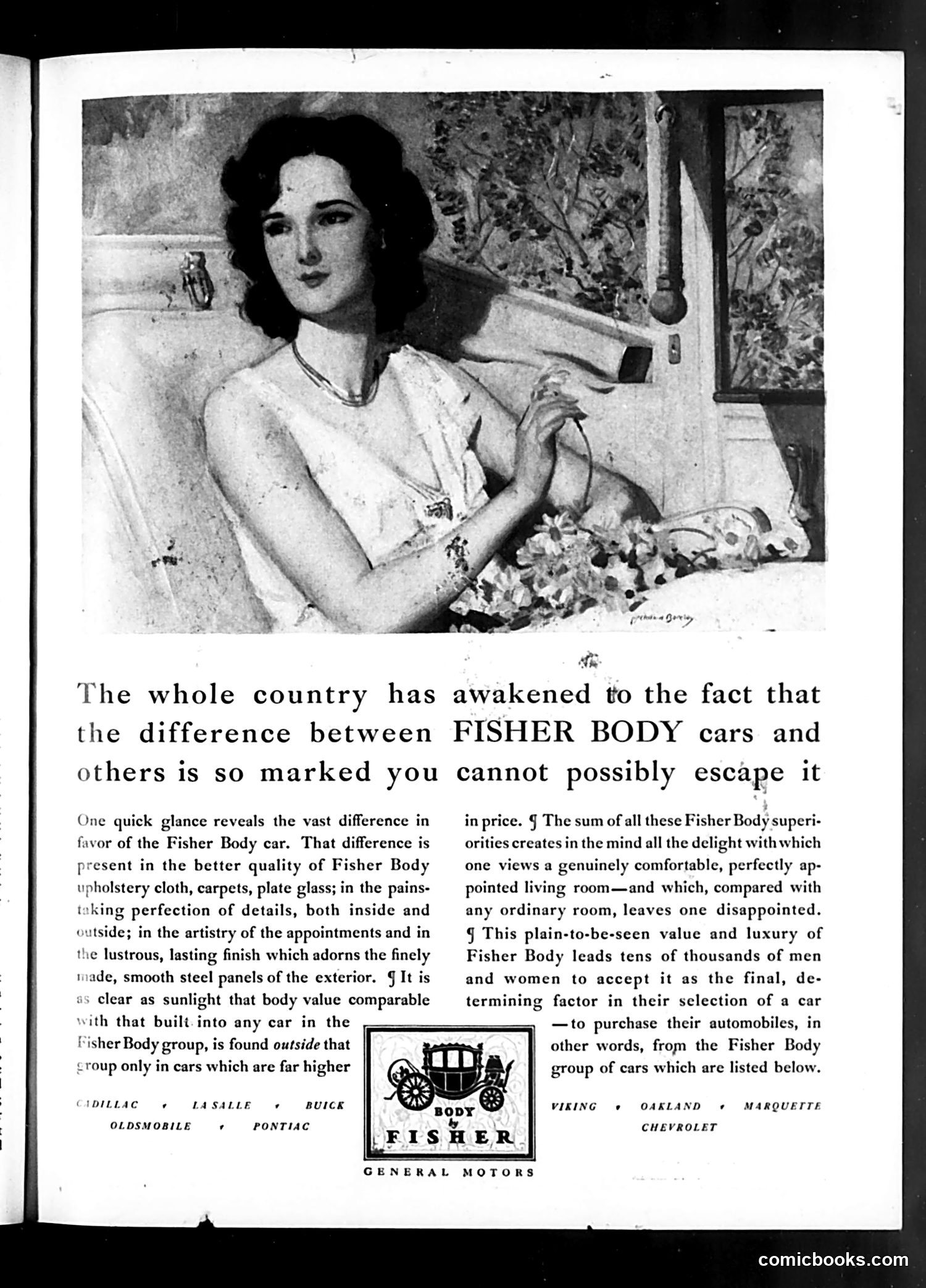
This is **not a political cartoon or satire**—it's a straightforward automobile advertisement for Fisher Body, a General Motors subsidiary that manufactured car bodies. The page features a photograph of a woman arranging flowers, used to associate Fisher Body cars with domestic elegance and comfort. The ad claims Fisher Body vehicles offer superior quality in upholstery, glass, steel panels, and interior appointments compared to competitors—despite comparable pricing. The advertisement lists Fisher Body's affiliated brands (Cadillac, Buick, Oldsmobile, Pontiac, Chevrolet, etc.) and argues that their "value and luxury" makes them the determining factor in car purchases. There is no satire or political messaging here—it's period advertising rhetoric emphasizing craftsmanship and aesthetic refinement as selling points to middle and upper-class consumers.
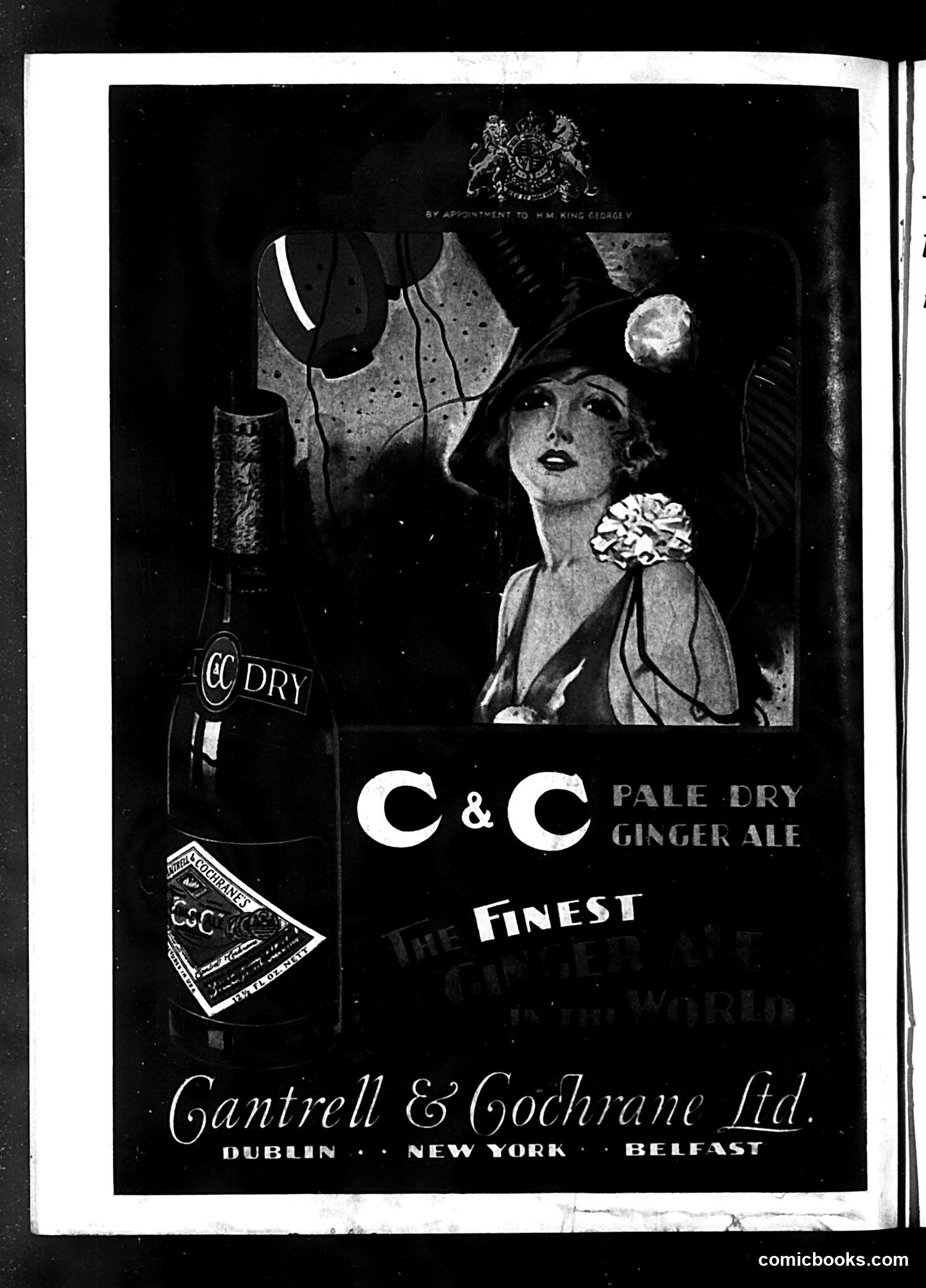
This is a **commercial advertisement**, not political satire or editorial cartoon. It promotes C&C Pale Dry Ginger Ale, manufactured by Cantrell & Cochrane Ltd. (with locations in Dublin, New York, and Belfast). The ad features a glamorous woman in 1920s-30s styling, gazing upward in an aspirational pose. She wears a distinctive ruffled collar and cloche hat, suggesting sophistication and modernity. A bottle of C&C ginger ale appears on the left side. The phrase "The Finest...in the World" claims product superiority. The mention of "By Appointment to H.M. King George V" at the top indicates royal patronage, a marketing strategy to convey prestige and quality to consumers. This reflects period advertising conventions: glamorous imagery, royal endorsement, and aspirational messaging to sell beverages.
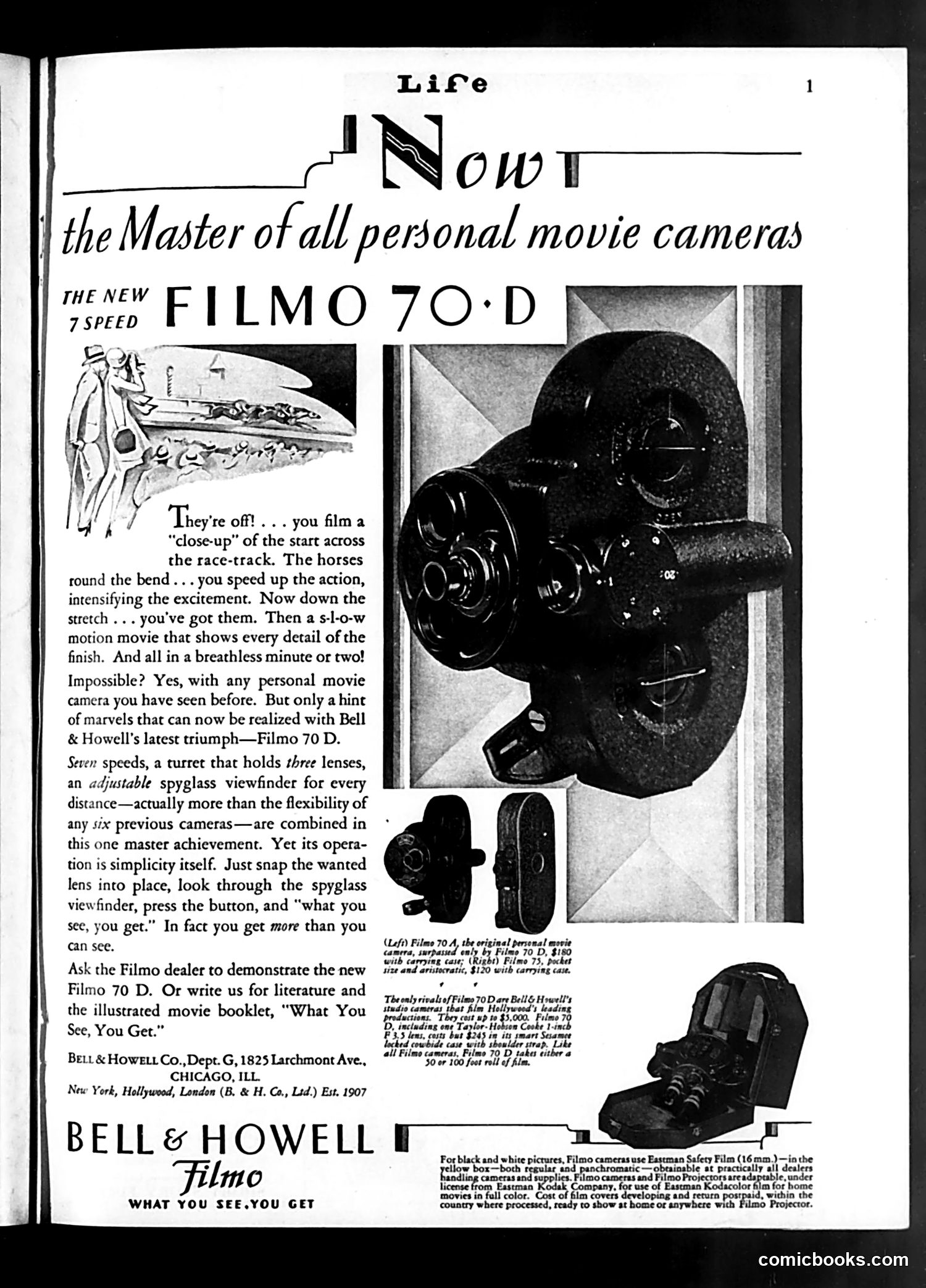
This is a **product advertisement**, not a political cartoon or satire. It promotes Bell & Howell's Filmo 70 D personal movie camera, positioned as "the Master of all personal movie cameras." # The Content The ad describes the camera's innovative features: seven variable speeds, a turret holding three interchangeable lenses, and an adjustable viewfinder. It uses a vivid example—filming a horse race with close-ups, action acceleration, slow-motion finish—to demonstrate the camera's flexibility and capabilities that earlier personal cameras supposedly lacked. The phrase "What You See, You Get" is the marketing slogan emphasizing ease of use: point, focus, shoot. # Context for Modern Readers This targets **amateur filmmakers** during the 1930s era when home movie cameras were becoming accessible consumer products. The detailed technical specs and price ($245) suggest this was marketed to serious hobbyists or semi-professionals, not casual users. The multiple photographs of the camera emphasize its sophisticated design and professional pedigree (Bell & Howell also made Hollywood studio equipment).