
A complete issue · 36 pages · 1929
Life — March 22, 1929
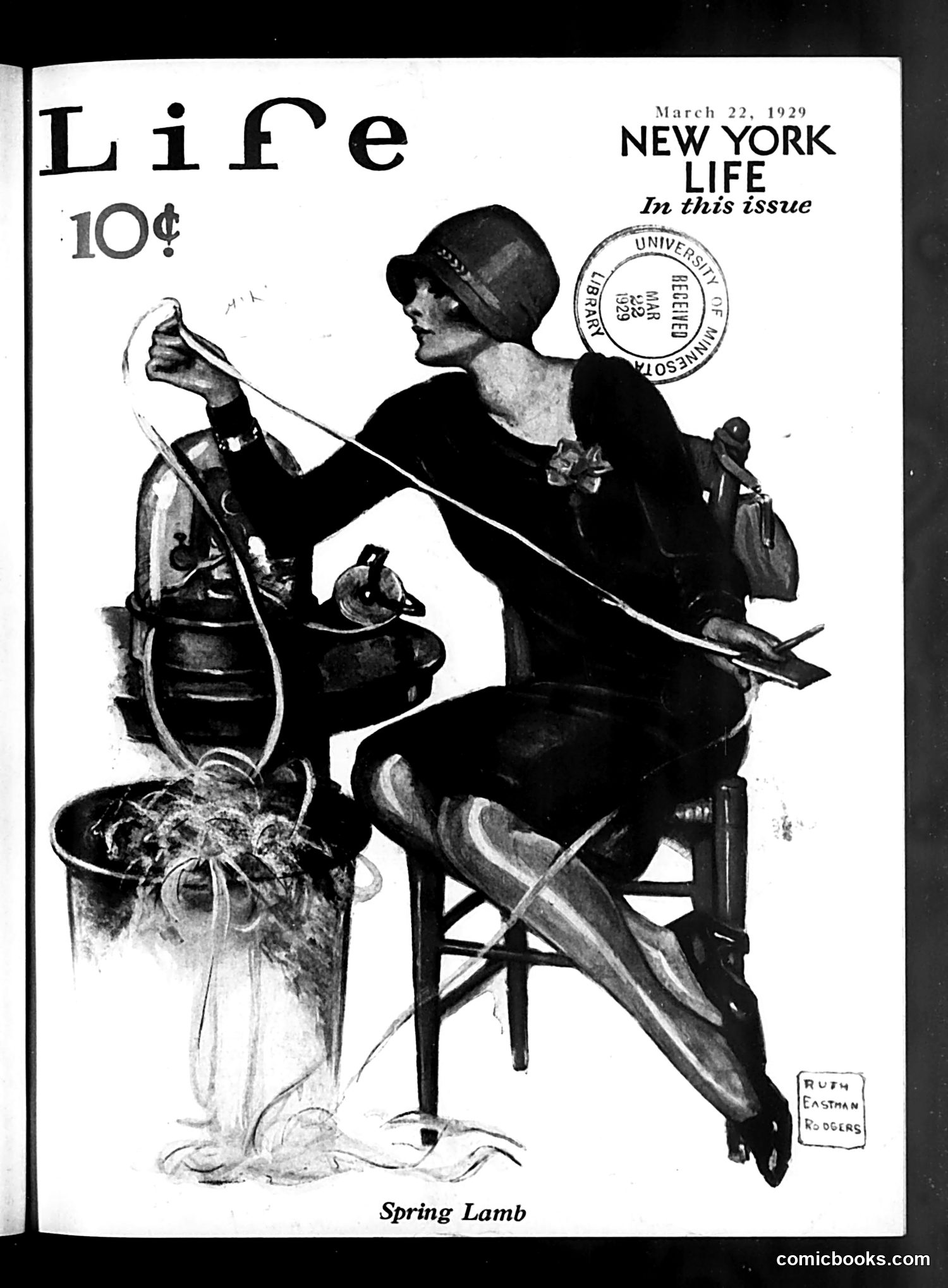
This cover illustration by Ruth Eastman Rodgers depicts a fashionable woman in 1920s attire—cloche hat, short dress, rolled stockings—examining a fresh lamb at market, likely for Easter dinner preparation. The "Spring Lamb" title references both the seasonal availability of young lamb and plays on the woman's youthful, modern appearance. The satire appears to mock the fashionable flapper aesthetic: this stylish woman treats shopping and domestic duties as leisurely entertainment rather than necessity. Her poised, theatrical presentation while selecting meat reflects 1920s consumer culture and the emerging "modern woman" who treated household shopping as social performance rather than practical work.
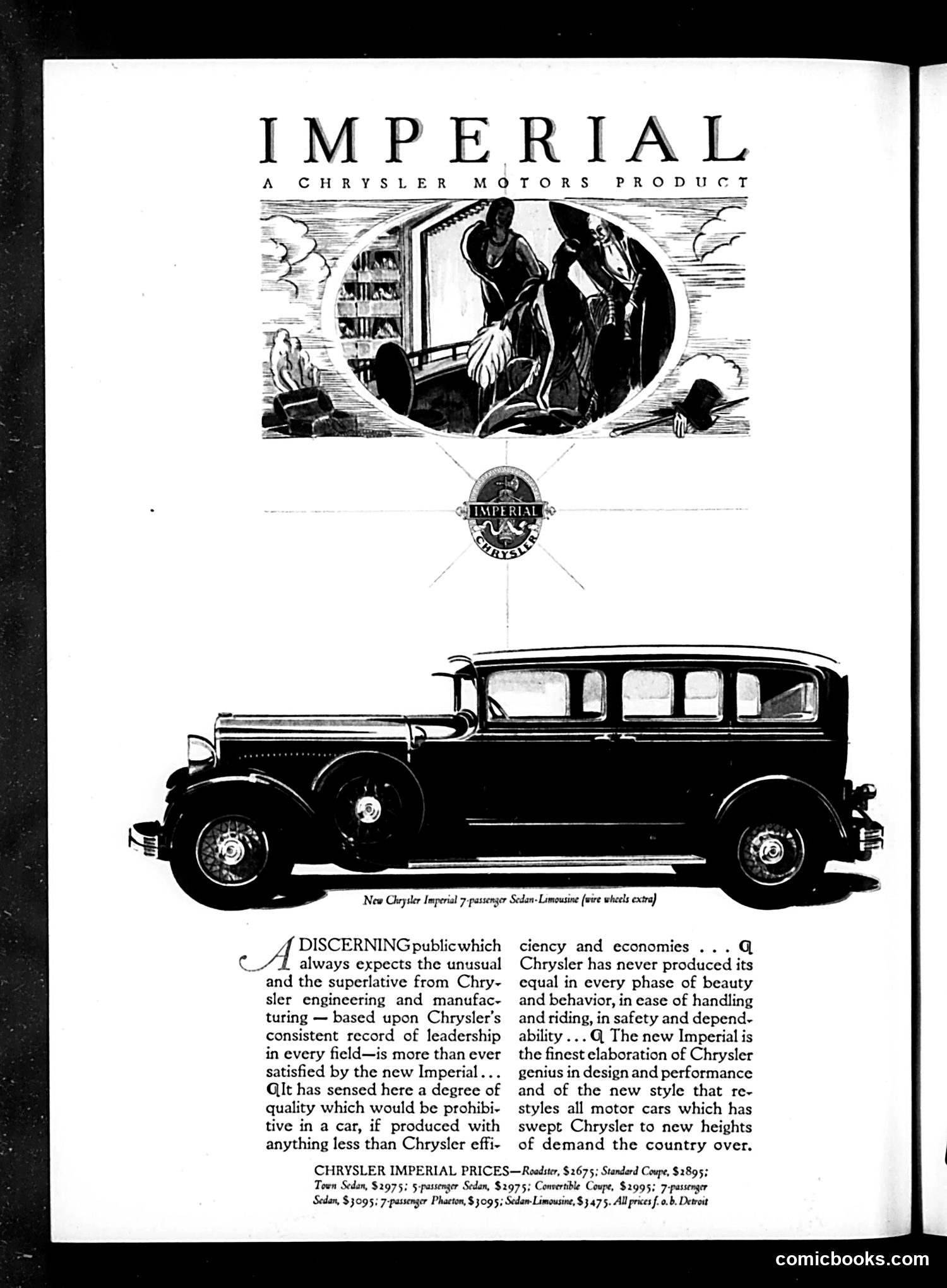
This is **not a satirical cartoon page**, but rather a **Chrysler automobile advertisement** from what appears to be the 1920s-1930s era. The page advertises the "Imperial," a luxury sedan-limousine, presented as a Chrysler Motors product. The top illustration depicts well-dressed passengers in an elegant interior—emphasizing the car's luxury appeal to affluent buyers. The vehicle diagram below shows the 7-passenger sedan configuration. The advertising copy emphasizes Chrysler's engineering reputation, design superiority, and the Imperial's status as the pinnacle of their manufacturing. Pricing information is included at bottom. This represents typical **period automotive marketing** targeting wealthy consumers, not political or social satire. The imagery reflects contemporary aspirational messaging about automobile luxury and technological advancement.
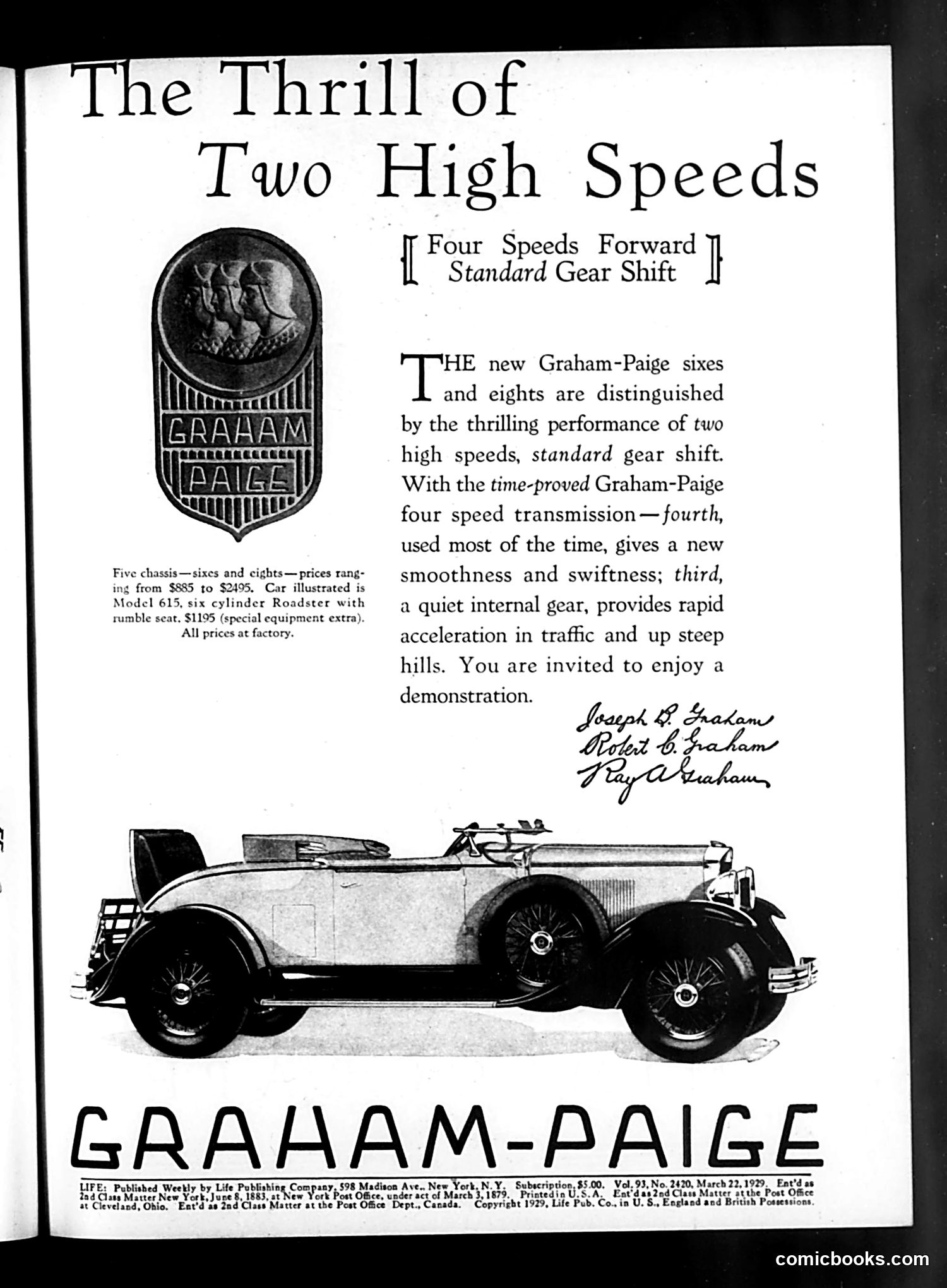
This is **not a cartoon or satire page** — it's a straightforward automobile advertisement for Graham-Paige vehicles, published in *Life* magazine (March 22, 1929, based on the footer). The ad promotes the new Graham-Paige "sixes and eights" models, emphasizing their four-speed transmission with two "high speeds" using a "standard gear shift." Key selling points include smooth performance, rapid acceleration, and hill-climbing ability. The three signatures at bottom appear to be Graham-Paige company principals endorsing the product. Pricing ranged from $885 to $2,495 at factory. This represents how major corporations used *Life*'s pages for upscale automobile marketing during the pre-Depression prosperity era.
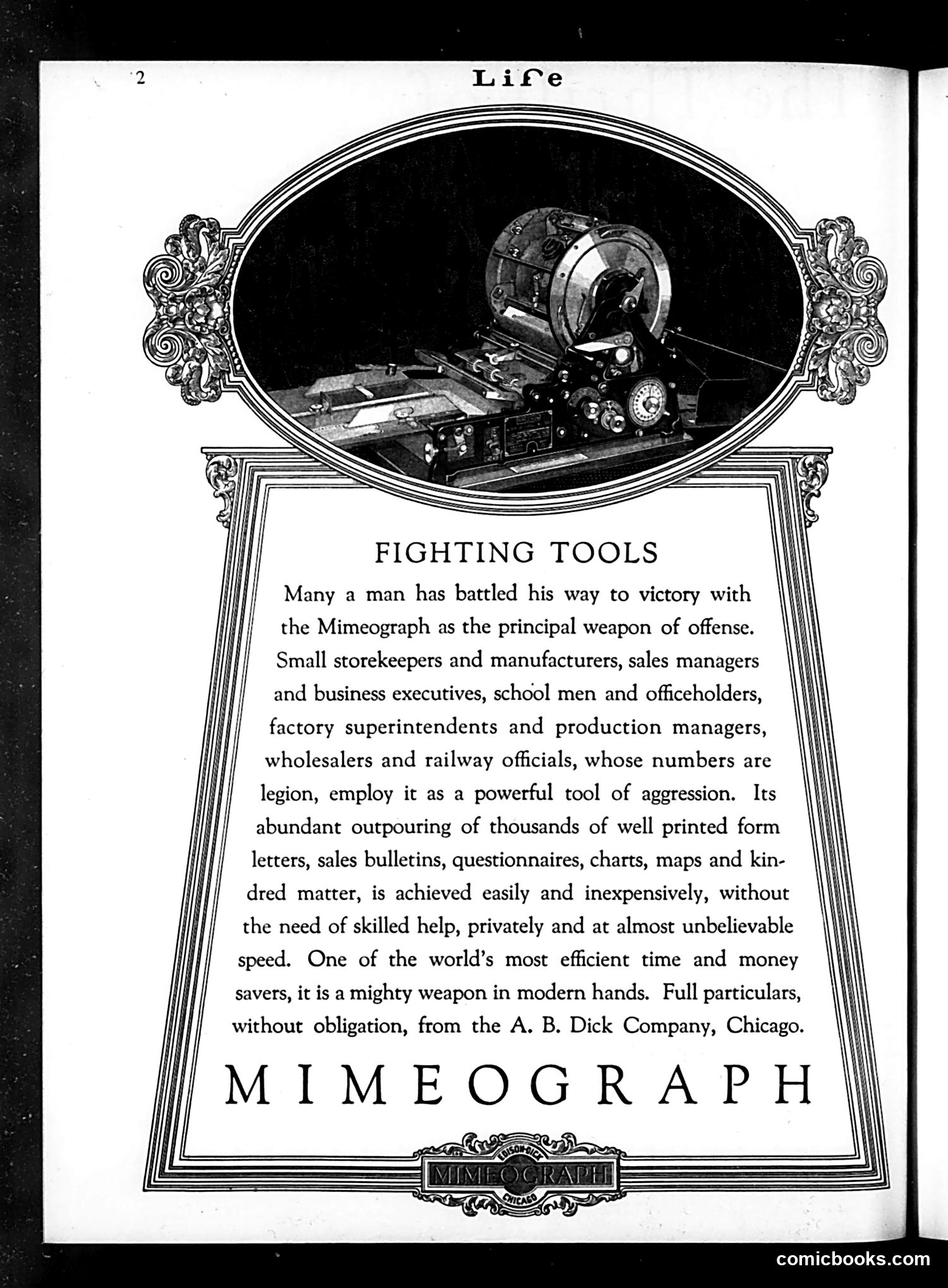
This is an **advertisement, not a political cartoon**. It promotes the Mimeograph machine, manufactured by the A.B. Dick Company of Chicago. The ad uses military metaphor to sell the device to business audiences. It describes the mimeograph as a "weapon of offense" and "fighting tool" for various professionals—storekeepers, managers, factory superintendents, and railway officials. The language frames business competition in wartime terms, comparing commercial document distribution to military conquest. The photograph shows an actual mimeograph machine, the era's primary office duplicating technology. The ad emphasizes speed, low cost, and minimal skill required—key selling points for early 20th-century businesses seeking efficiency. This reflects how rapidly the mimeograph became essential to American commerce.
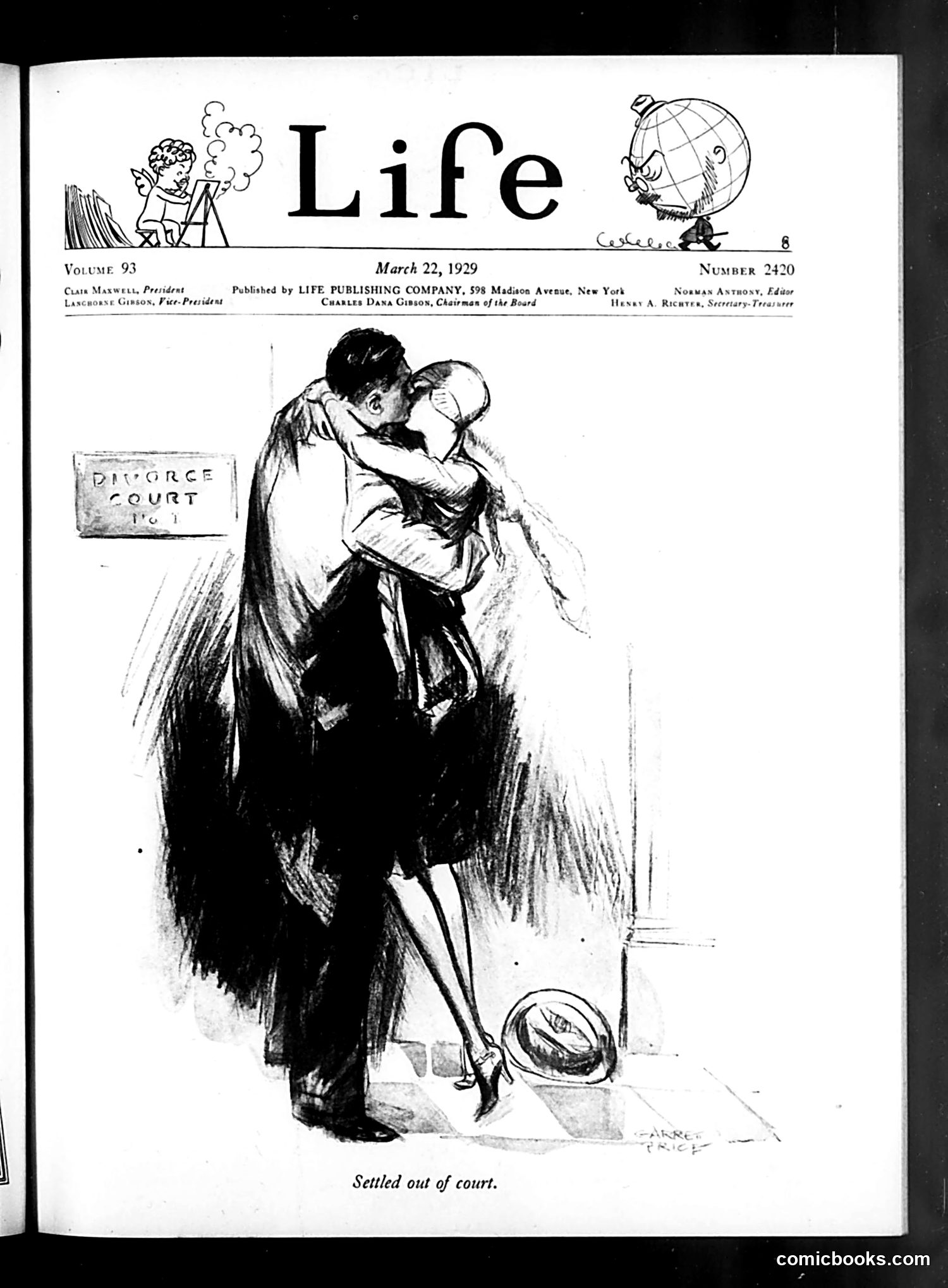
This cover cartoon illustrates a divorce settlement, showing a man and woman embracing outside a "Divorce Court" as a hat lies discarded on the ground—suggesting hasty departure or emotional turbulence. The caption "Settled out of court" is a legal pun: divorce cases could be resolved through settlement agreements rather than full court proceedings. The satire appears to mock the ease and emotional casualness of divorce in 1920s America, particularly among the wealthy classes Life's readership represented. The intimate embrace suggests either reconciliation or relief at avoiding public court proceedings. The cartoon likely critiques both the prevalence of divorce and the tendency to treat serious marital dissolution as a transactional matter rather than a moral issue—reflecting contemporary anxiety about changing social values.
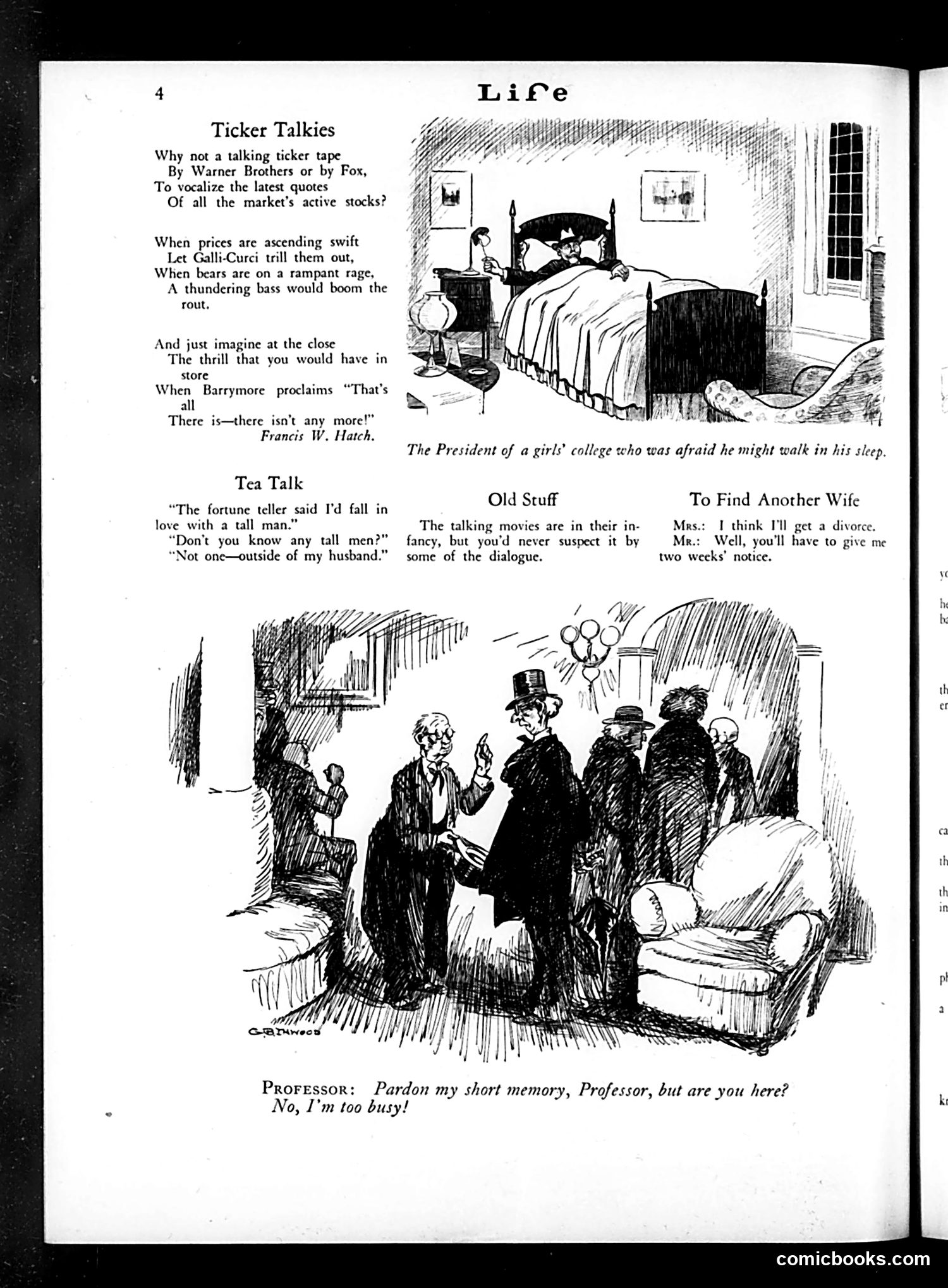
This page contains three separate humorous pieces: **"Ticker Talkies"** satirizes the idea of adding sound to stock ticker machines, suggesting comedians like Galli-Curci and Barrymore could provide entertaining commentary on market movements. **"Tea Talk"** presents a brief joke about a fortune teller and marriage expectations. **"Old Stuff"** critiques talking movies as unoriginal, noting their dialogue lacks novelty. **"To Find Another Wife"** shows a domestic comedy sketch where a husband announces he wants a divorce, and the wife responds by demanding two weeks' notice—treating it as a business arrangement. The bottom cartoon depicts a professor at a social gathering claiming to be "too busy" when asked if he's present, satirizing academic pretension and social awkwardness. The cartoons reflect 1920s entertainment culture and contemporary social commentary.
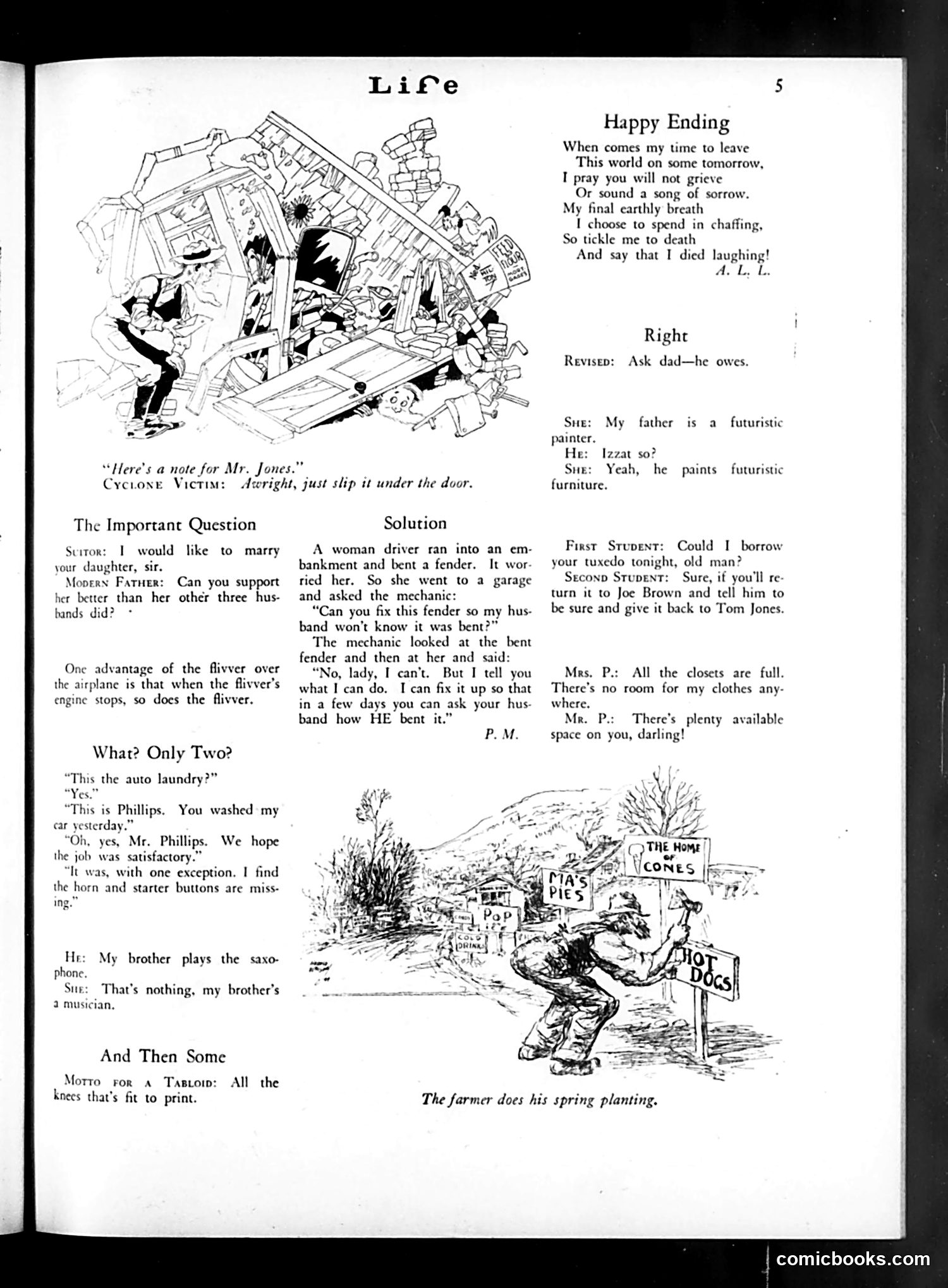
This page contains humor pieces and cartoons satirizing early 20th-century American life. **"The Important Question"** mocks gender roles: a suitor asks a father if he can support a daughter better than her three brothers—implying women's economic dependence and reducing marriage to financial calculation. **"What? Only Two?"** jokes about a car laundry's poor work (missing horn and starter buttons), poking fun at both automotive technology and service quality of the era. **"The farmer does his spring planting"** cartoon shows a farmer operating a plow near roadside vendors (hot dogs, pies, cones), likely satirizing how commercialization and tourism were encroaching on rural America. The pieces collectively ridicule outdated social conventions, technological incompetence, and modernization's disruption of traditional ways.
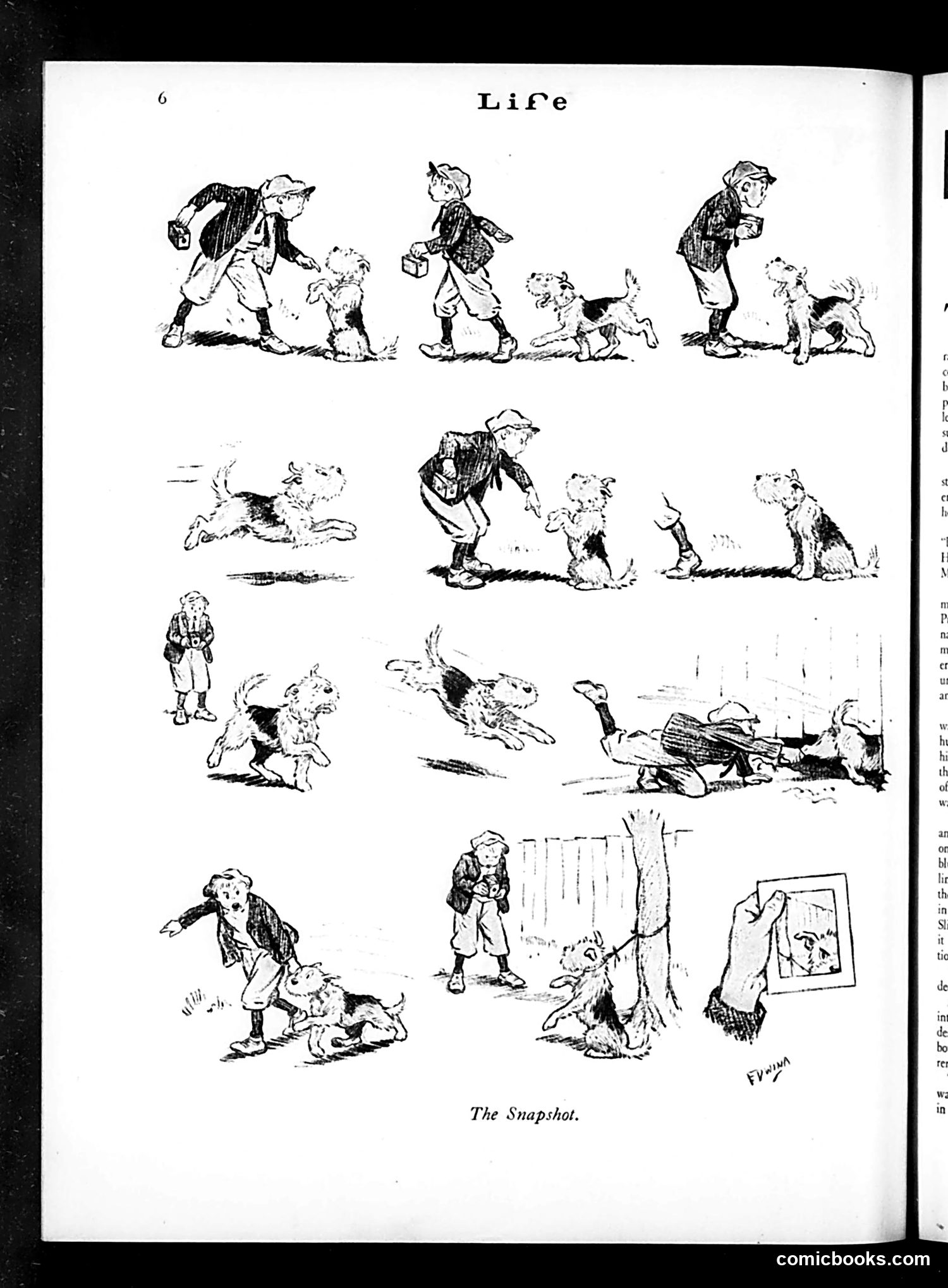
This page titled "The Snapshot" appears to be a series of humorous sketches depicting interactions between men and dogs. The cartoon shows various domestic scenes: men playing with or training dogs, dogs misbehaving or running away, and comedic moments of chaos—including what appears to be a dog knocking over a man or destroying property. The satire likely mocks the unpredictability and mischief of pet ownership, showing idealized expectations (orderly play, obedience) versus messy reality (destruction, disobedience). The final panel showing a framed photograph suggests the cartoon's title joke: people photograph only the pleasant moments while ignoring the actual chaos dogs cause. This reflects early 20th-century middle-class anxieties about maintaining domestic order and respectability.
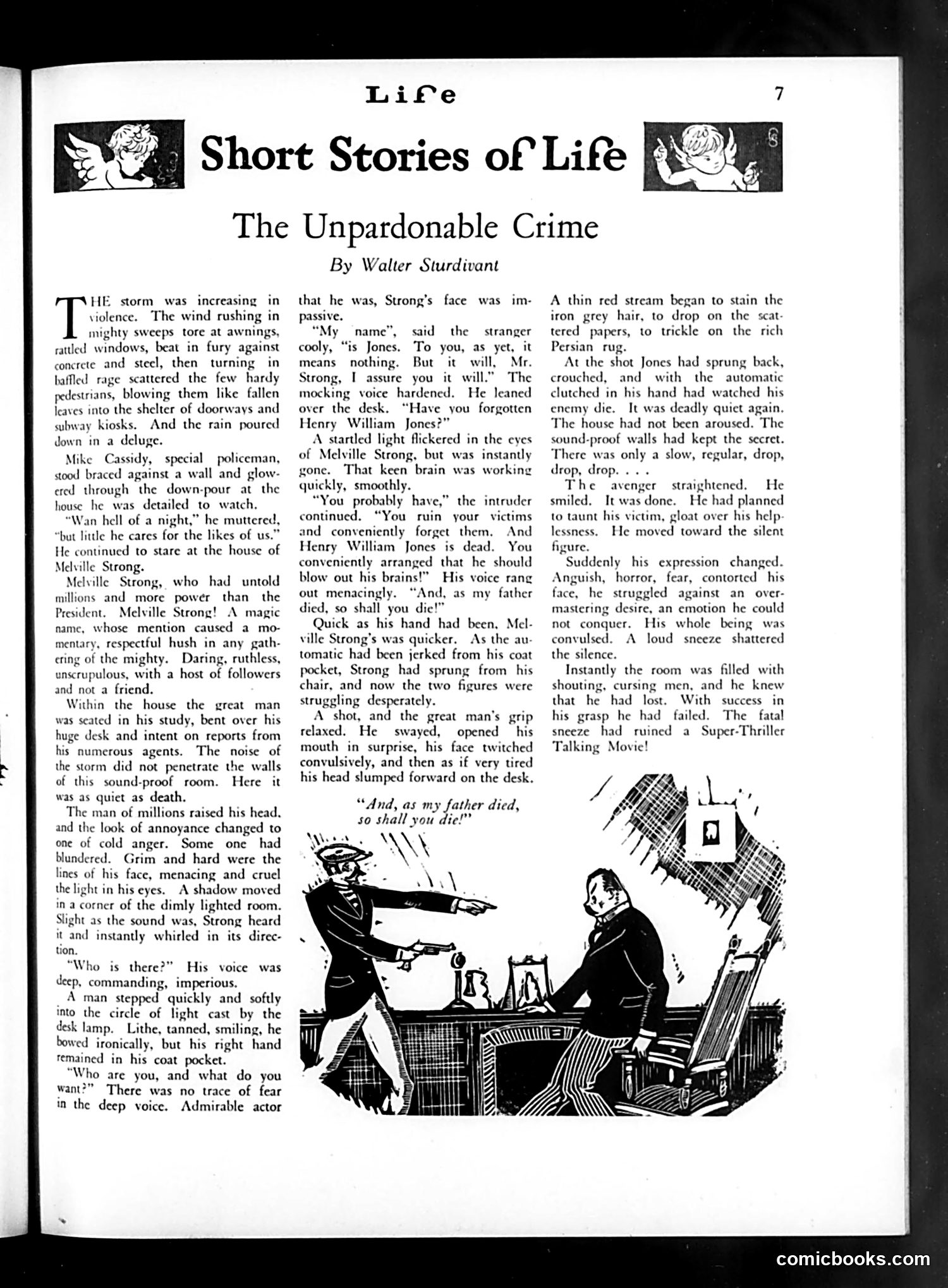
This is a short story, not political satire. The narrative concerns a powerful man named Melville Strong who is confronted in his office by a stranger claiming to be "Jones"—someone Strong apparently wronged years ago. The stranger threatens Strong with death, claiming to be the son of Henry William Jones, whom Strong apparently caused to die. The accompanying illustration shows the dramatic confrontation: Strong at his desk facing an armed intruder. The story explores themes of revenge and conscience rather than contemporary political commentary. The "unpardonable crime" referenced in the title appears to be Strong's past action against Jones, now returning to haunt him through his son's vengeance.
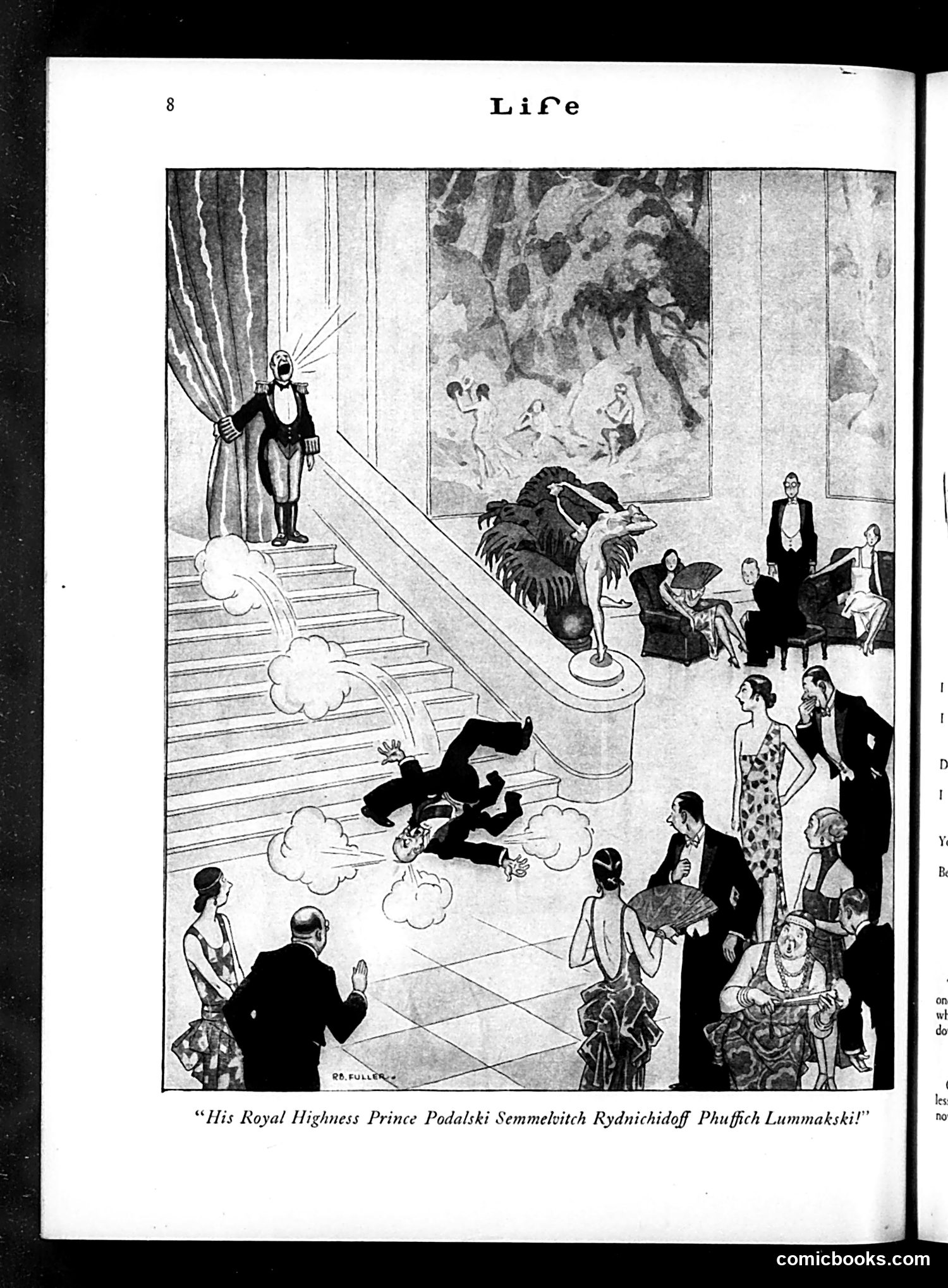
This Life magazine cartoon depicts a humorous scene of chaos at what appears to be a formal aristocratic gathering. The caption references "His Royal Highness Prince Podalski Semmelcitch Rydhichidoff Phuffich Lummnakski!" — clearly a nonsensical, deliberately unpronounceable foreign name meant to satirize the European aristocracy. The joke appears to target the pretensions of titled nobility: an elaborately named "royal" figure descends a grand staircase while chaos erupts below — a man tumbles down clouds of smoke, guests scatter in confusion. This suggests satire of the absurdity of rigid class hierarchies and the ridiculous reverence Americans showed toward European titles and nobility. The cartoon mocks both the pomposity of aristocratic names and society's fawning deference to such figures.
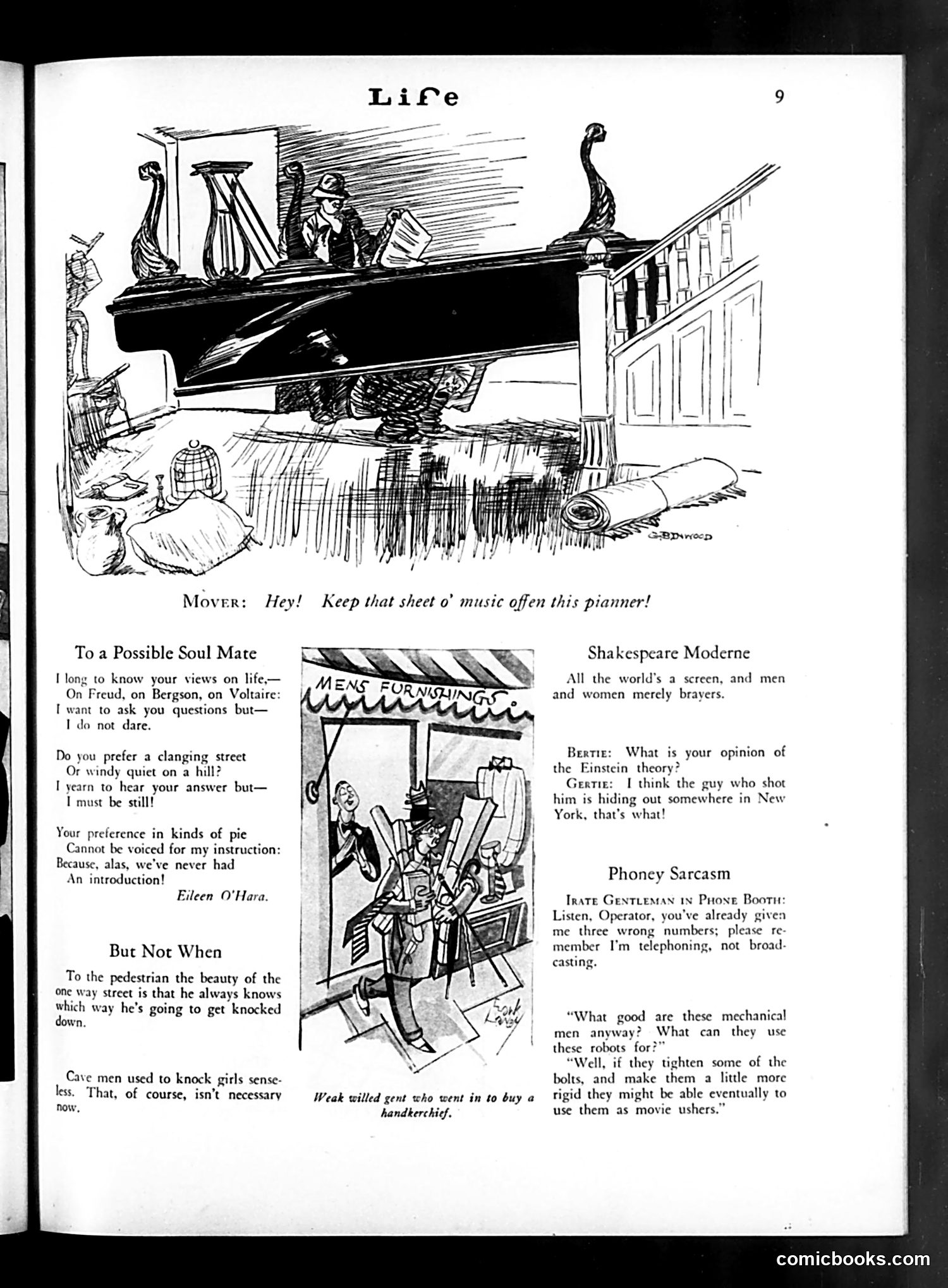
The main cartoon depicts movers struggling to fit a grand piano through a doorway—a common domestic predicament. The mover's exclamation "Hey! Keep that sheet o' music offen this pianner!" is humorous because it treats the piano as if it were fragile food rather than a sturdy instrument. Below are three unrelated satirical pieces: "To a Possible Soul Mate" mocks personal-ad style poetry; "Shakespeare Moderne" contains a casual joke about Einstein hiding in New York; and "Phoney Sarcasm" depicts a frustrated phone-booth user complaining about wrong numbers and mechanical "robots" as movie ushers—likely a jab at early automation anxiety and technology replacing human workers in the 1920s-1930s era.
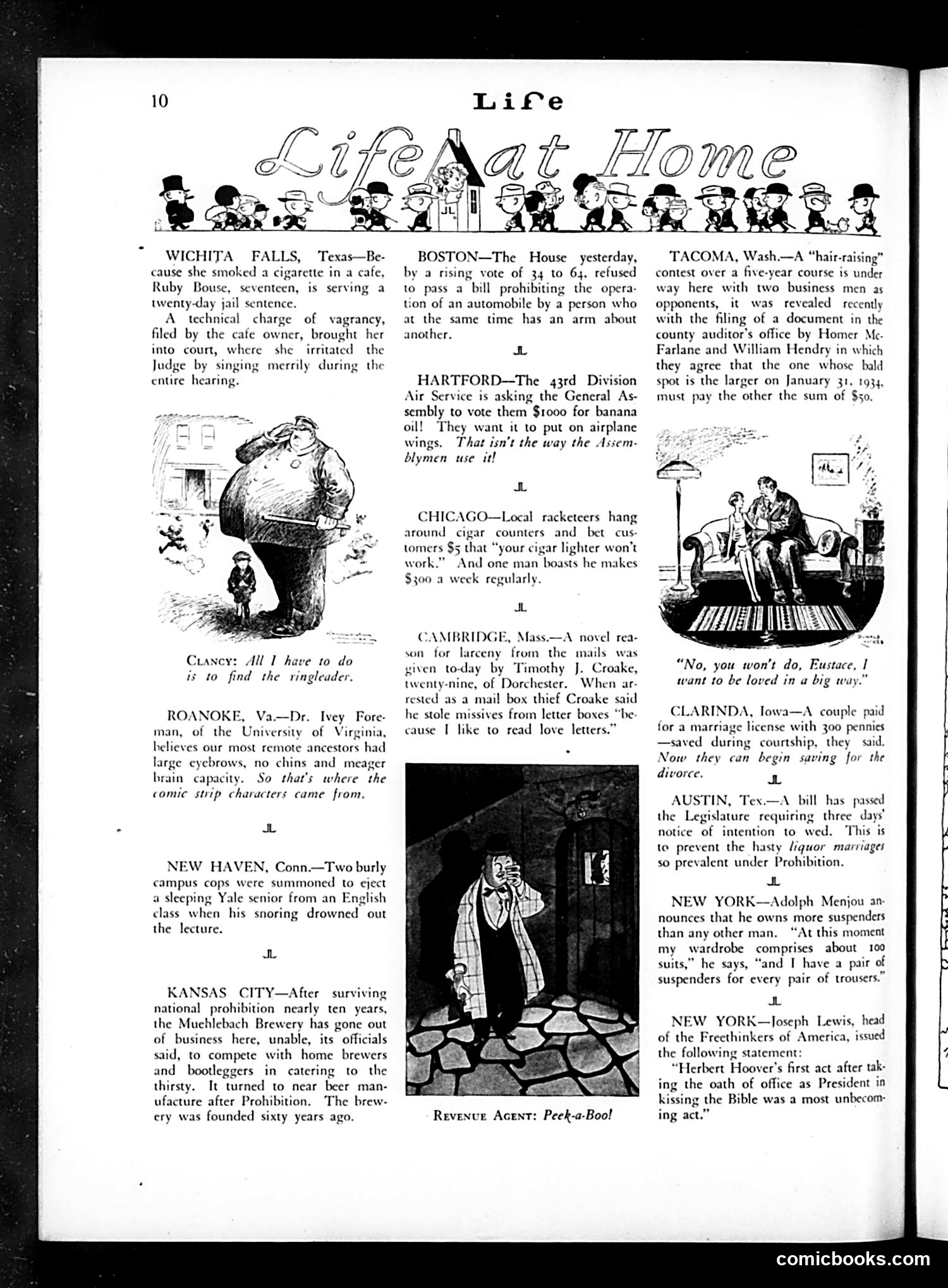
This page collects humorous anecdotes from across America, mostly satirizing **Prohibition** (the nationwide alcohol ban). The main cartoon shows a portly man labeled "Revenue Agent: Peek-a-Boo!" — likely a federal Prohibition enforcer attempting to catch illegal alcohol producers. The joke references the cat-and-mouse game between agents and bootleggers during this period. Other items mock Prohibition's effects: a Kansas City brewery forced underground after nearly ten years, Chicago racketeers running betting schemes around cigar counters as a cover, and a couple in Iowa who saved money by starting divorce proceedings (suggesting Prohibition marriages were hasty or regrettable). The satire targets both Prohibition's ineffectiveness and the creative criminality and social disruption it spawned.
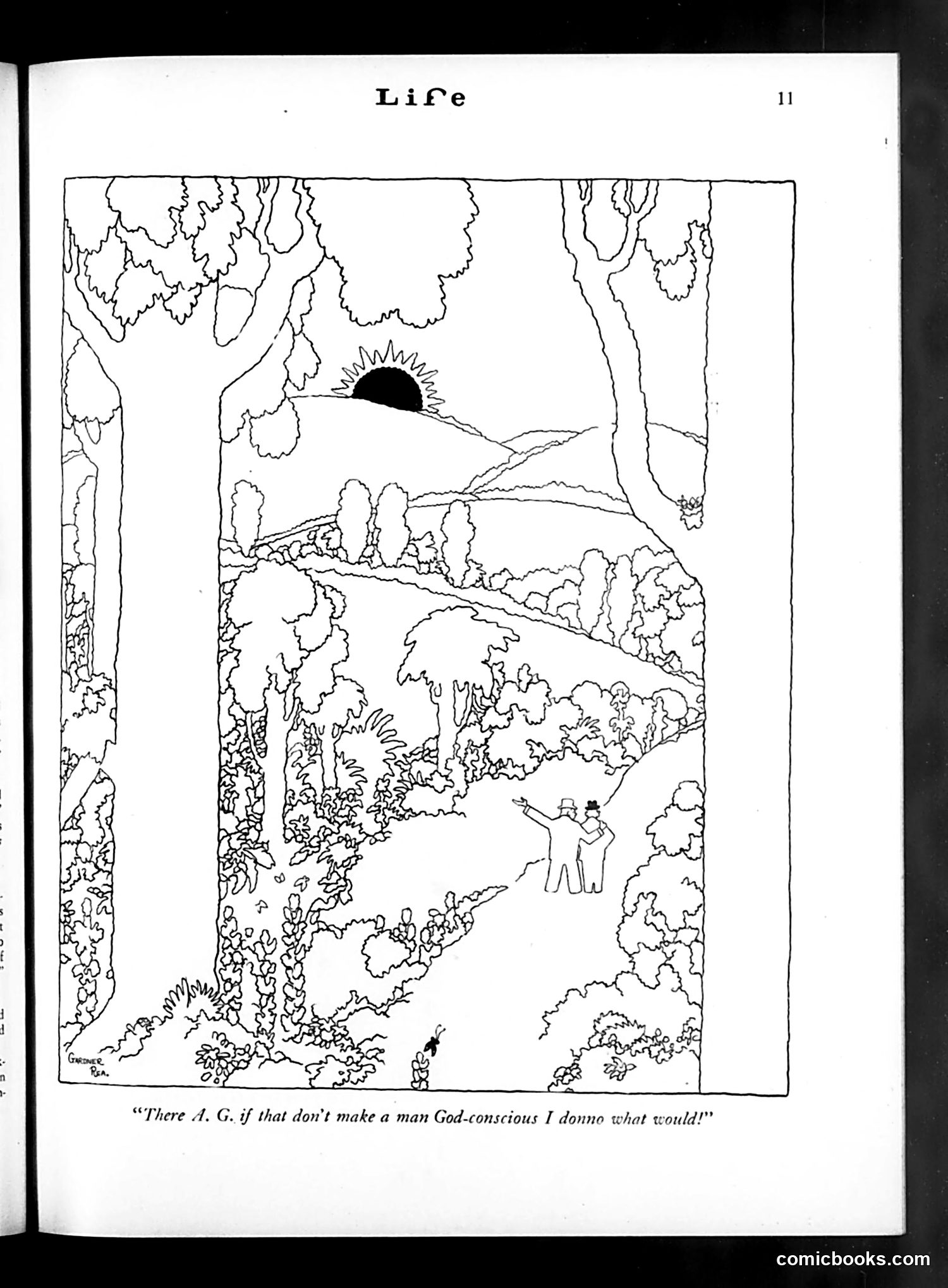
This single-panel cartoon depicts two figures in a vast, scenic landscape of rolling hills, trees, and a sunset. One figure points skyward while speaking to their companion, saying: "There A. G. if that don't make a man God-conscious I donno what would!" The cartoon appears to be a gentle satire about religious awakening or spiritual reflection inspired by natural beauty. The abbreviation "A. G." likely refers to a specific person (possibly someone known to Life's contemporary readers), but without additional context, their identity is unclear. The humor lies in the implication that witnessing sublime natural scenery should inspire spiritual consciousness in anyone. It's a relatively mild commentary on faith and nature's capacity to inspire reverence.
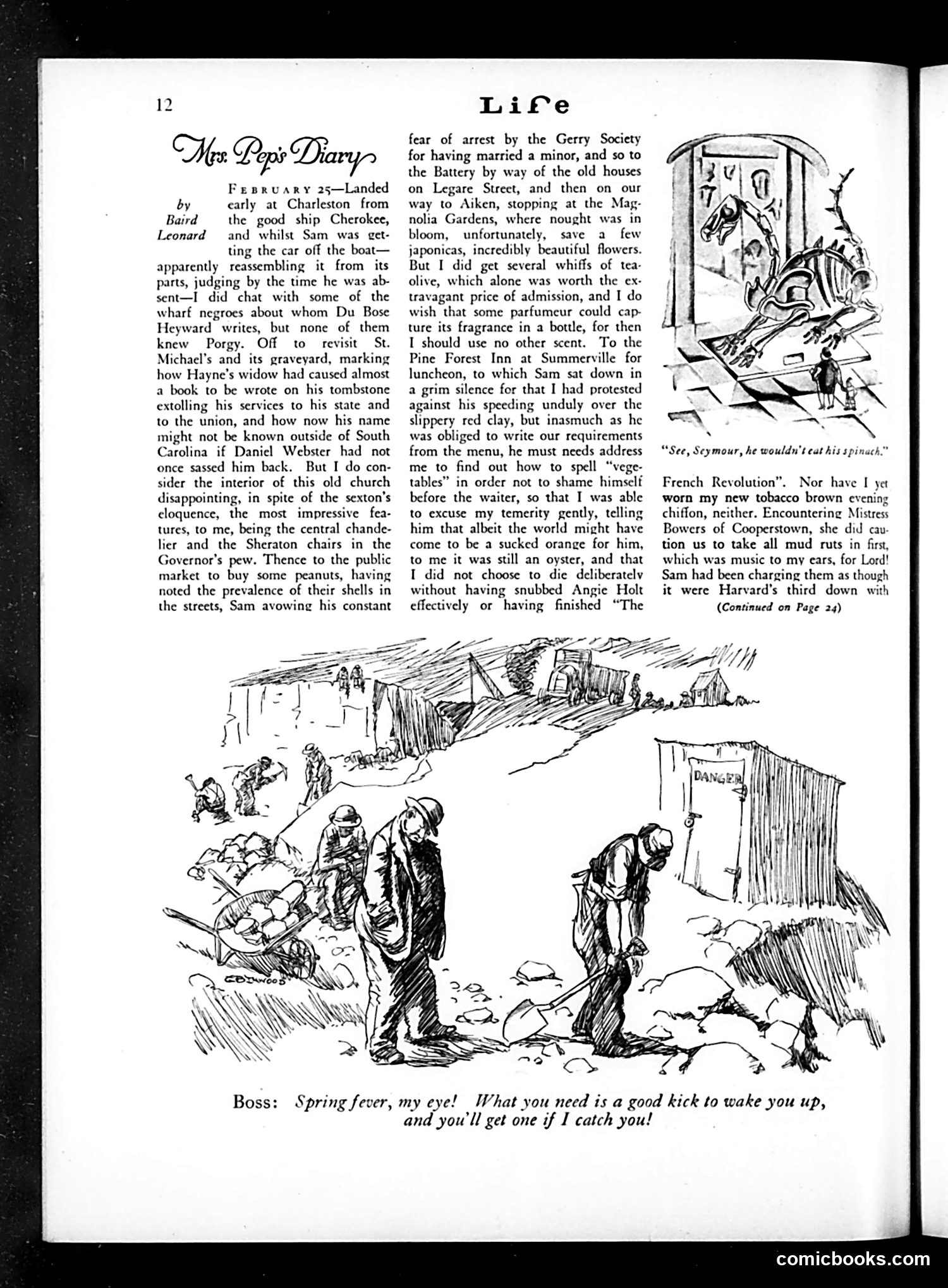
This page contains a diary entry dated February 25 describing a Charleston boat landing and subsequent travels through South Carolina. The narrative includes social observations about local churches, graveyards, and encounters with various characters. The lower illustration depicts a work scene with a boss threatening a lazy worker ("Spring fever, my eye! What you need is a good kick to wake you up"). This is a common early-20th-century workplace humor trope—mocking employees who lose productivity during spring season. The upper illustration shows a domestic scene with the caption "See, Seymour, he wouldn't eat his spinach," depicting parental discipline regarding children's vegetable consumption, a recurring satirical theme about nutrition and child-rearing attitudes of the era.
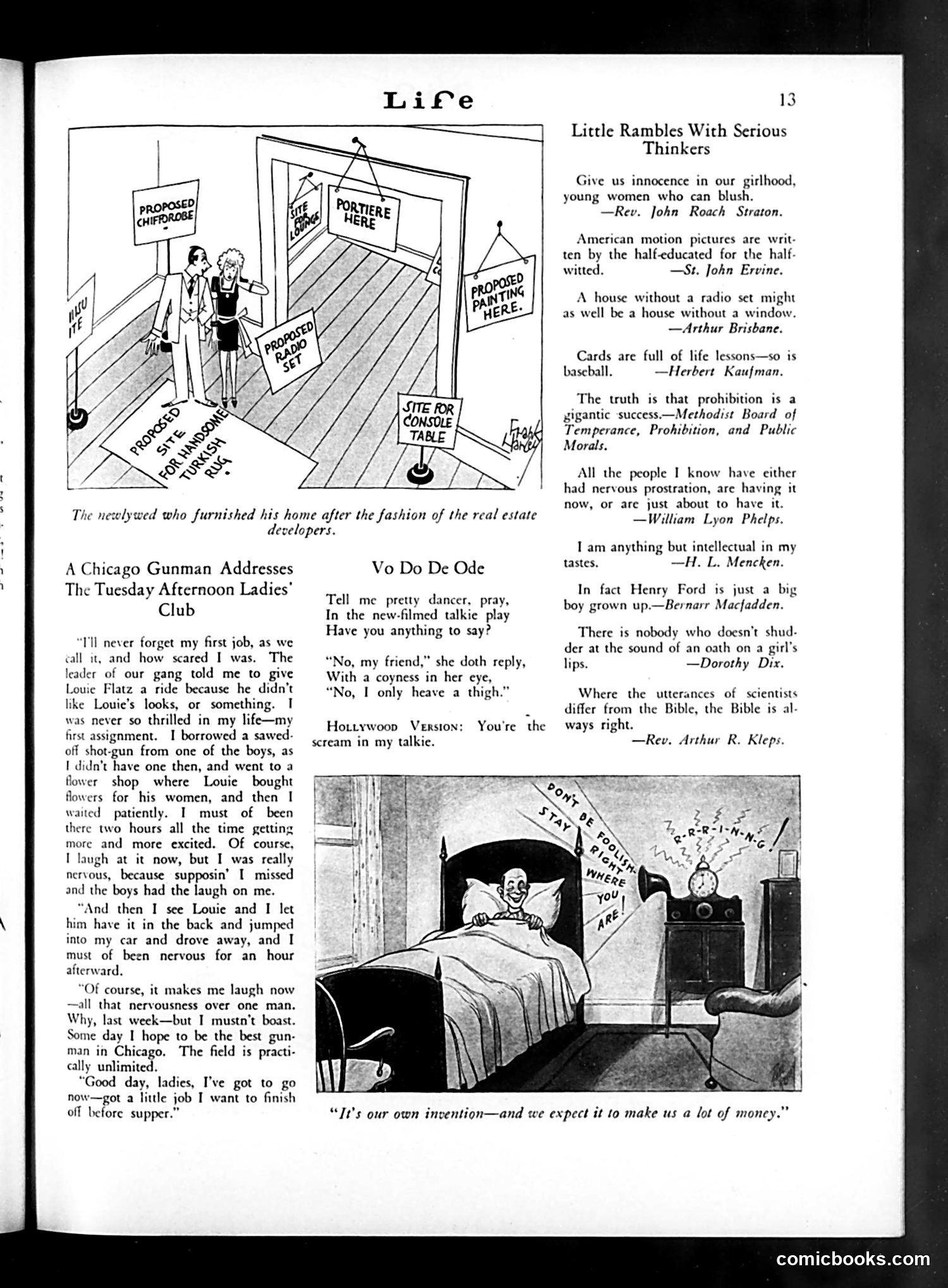
**Top Cartoon:** Satirizes real estate developers' aggressive marketing tactics in what appears to be the 1920s-30s. A couple tours a vacant lot with multiple "proposed" signs for different development schemes (chipboard, painting set, console table, etc.), each claiming prime location. The joke mocks how developers would pitch the same worthless property with invented purposes to different buyers—a commentary on real estate fraud and speculative bubble hype. **Bottom Cartoon:** A person lies in bed with an elaborate contraption overhead labeled "Don't stay/Do stay/Don't stay where you are," suggesting marital discord. The caption reads "It's our own invention—and we expect it to make us a lot of money," satirizing the absurdity of commercializing relationship problems or selling dubious "solutions." Both comics critique consumer culture and commercial exploitation of everyday anxieties.
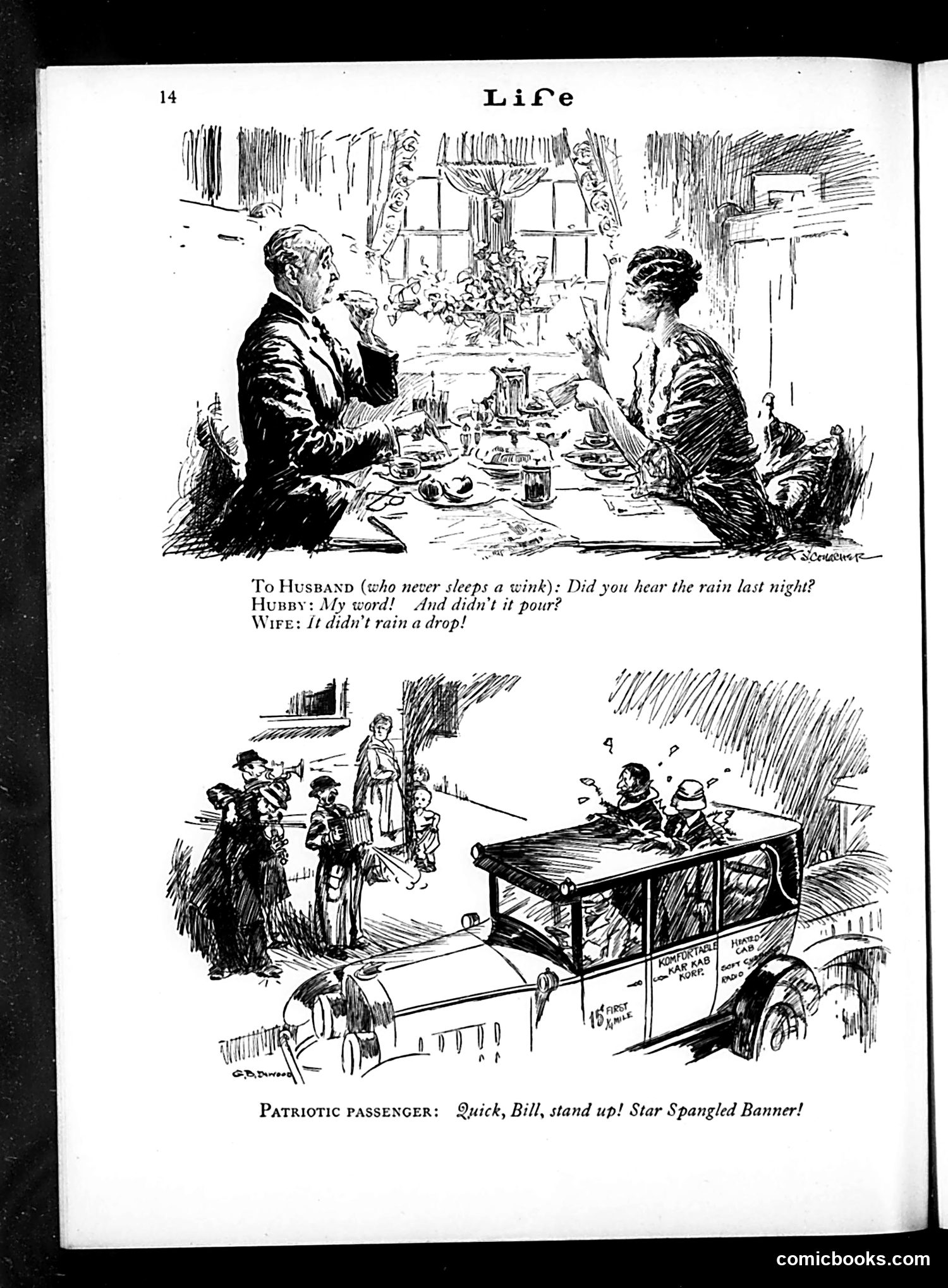
This page contains two satirical cartoons from Life magazine: **Top cartoon:** A husband and wife at dinner. The husband claims he heard rain last night; the wife contradicts him, saying it didn't rain at all. The joke satirizes inattentive husbands—he "never sleeps a wink" yet somehow misses obvious facts about the weather, suggesting either his insomnia makes him unreliable or he's simply oblivious. **Bottom cartoon:** Labeled "Patriotic Passenger," shows people in an open-air vehicle during rain. A passenger urgently tells the driver ("Bill") to stand up and salute the "Star Spangled Banner" (the American flag or national anthem). This mocks exaggerated patriotic fervor—the irony being that standing up in a moving vehicle during a rainstorm is dangerous and ridiculous, yet patriotic duty supposedly demands it. Both cartoons humorously critique social absurdities through domestic and civic scenarios.
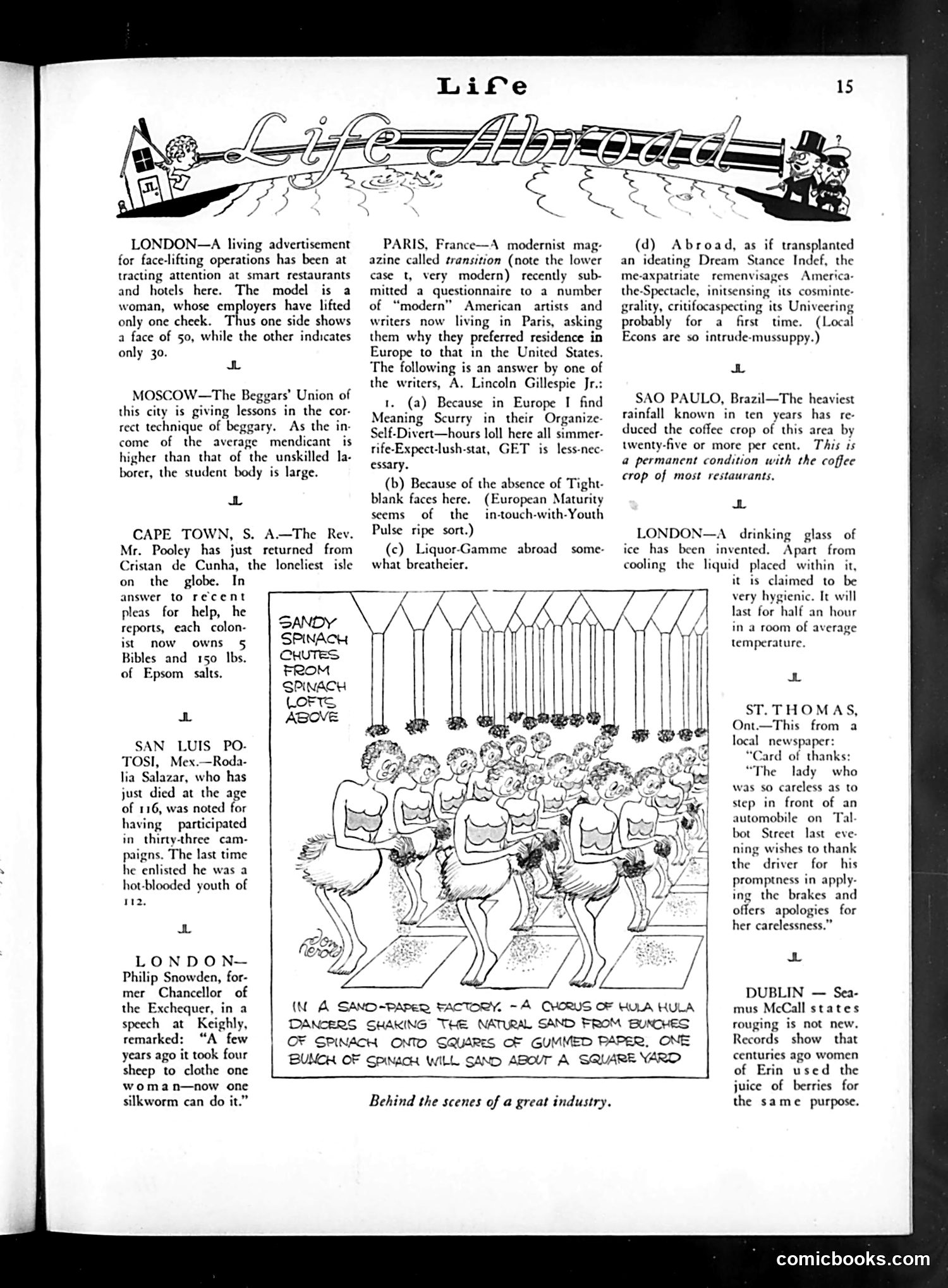
This page contains a satirical cartoon titled "In a Sand-Paper Factory—A Chorus of Hula Hula Dancers Chanting the Natural Sand from Bunches of Spinach Onto Squares of Gummed Paper. One Bunch of Spinach Will Sand About a Square Yard." The cartoon depicts women in a factory setting performing exaggerated hula dancing motions while processing spinach. The satire mocks industrial manufacturing efficiency by absurdly suggesting spinach can be used as sandpaper through rhythmic dancing. This appears to be lampooning both factory labor practices and the fad for Hawaiian culture ("hula hula") that was popular in early 20th-century America. The cartoon uses physical humor and unlikely juxtaposition—combining manufacturing, tropical dance, and vegetable processing—to create comedic commentary on industrial absurdity.
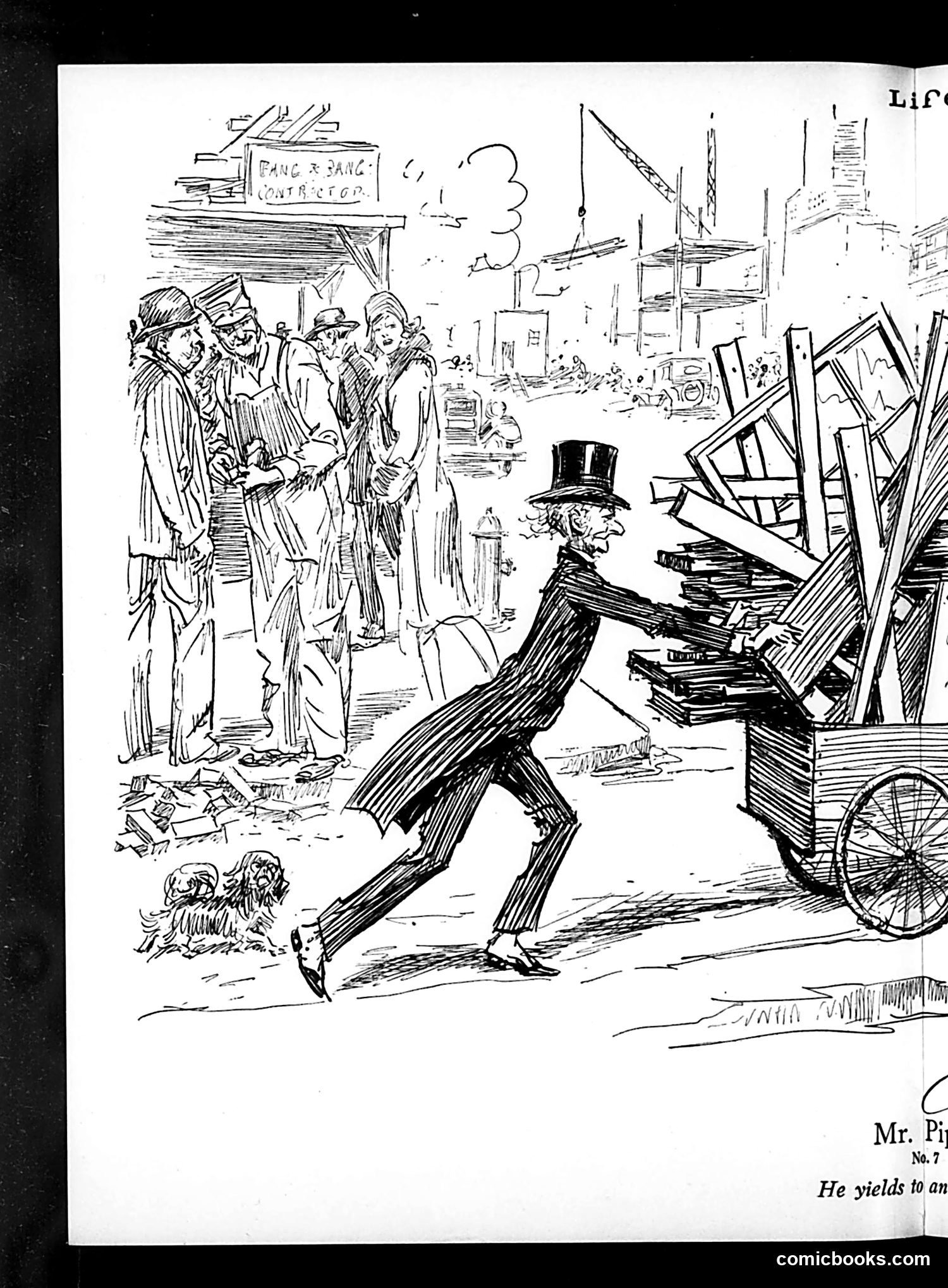
This cartoon depicts a well-dressed gentleman in a top hat actively yielding or stepping aside before a pile of wooden debris and construction materials. The caption reads "He yields to an..." (text cut off). The scene appears to satirize a figure of authority or prominence who is backing down or surrendering position, literally stepping out of the way. A group of working-class men observe from the left, suggesting this may reference labor disputes or class conflict common in early 20th-century American politics. The cartoon's title references "Mr. Pip" (No. 7), suggesting this is part of a series. Without the complete caption, the specific political or social target remains unclear, though the imagery strongly suggests commentary on capitulation or compromise by someone of higher social standing.
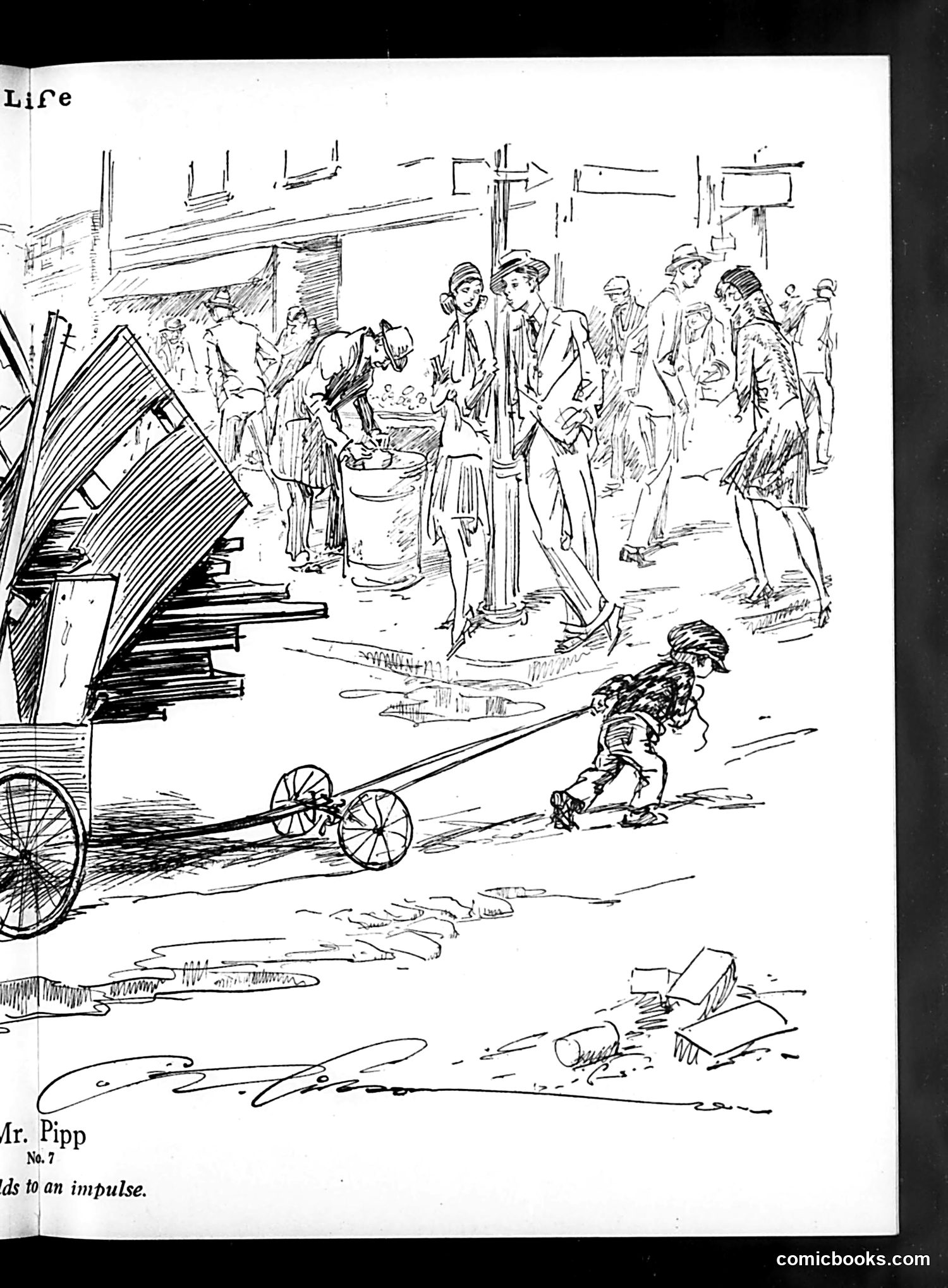
This appears to be a satirical cartoon titled "Mr. Pipp, No. 7" with the caption "...ds to an impulse" (likely "yields to an impulse"). The scene depicts a man in formal attire on a city street, seemingly about to pull or tug on a rope attached to a large wheeled object or cart on the left. A child figure is also visible interacting with the rope. In the background, various onlookers in period dress observe the scene. The humor likely derives from Mr. Pipp acting on an impulsive urge—possibly attempting to move or manipulate the large object—creating a disruptive or embarrassing public scene. This appears part of a recurring character series satirizing the follies of ordinary urban life and the consequences of yielding to spontaneous, ill-advised impulses. The specific social context or Mr. Pipp's character arc remains unclear without additional context.
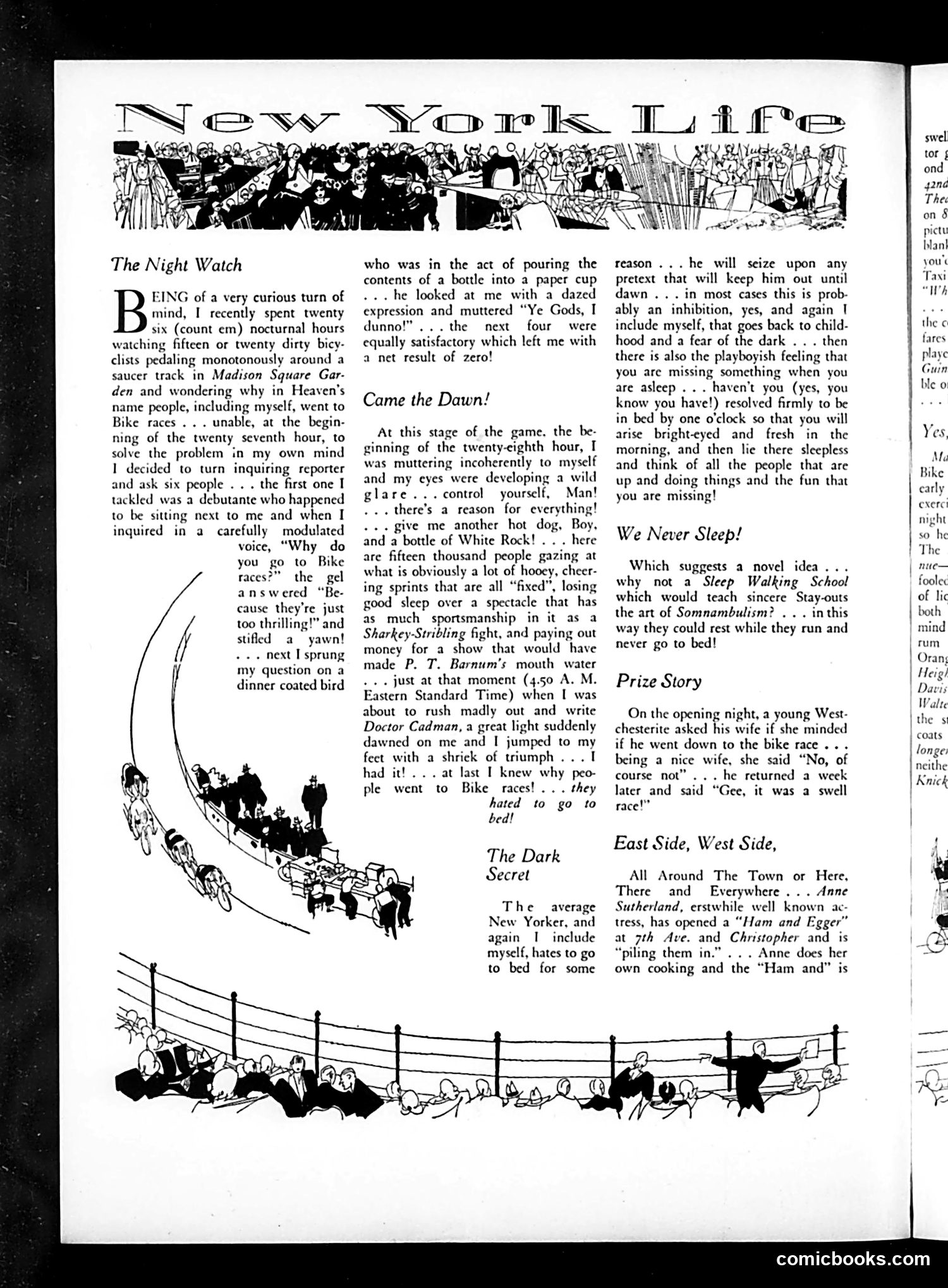
This page from Life magazine features humorous observations about New York nightlife and insomnia. "The Night Watch" describes the author's experience observing Bike races in Madison Square Garden at an unusual hour, culminating in the absurd spectacle of people rushing to bike races at 1:50 A.M. The cartoon illustrates the nocturnal chaos—crowds of people engaged in evening activities when they should be sleeping. Other sections mock New York customs: the inability to sleep, peculiar restaurants opening on the East Side, and a anecdote about a wife refusing her husband's request to attend a bike race. The satire targets urban life's exhausting pace and New Yorkers' resistance to normal sleep schedules, treating insomnia as a defining characteristic of city living.
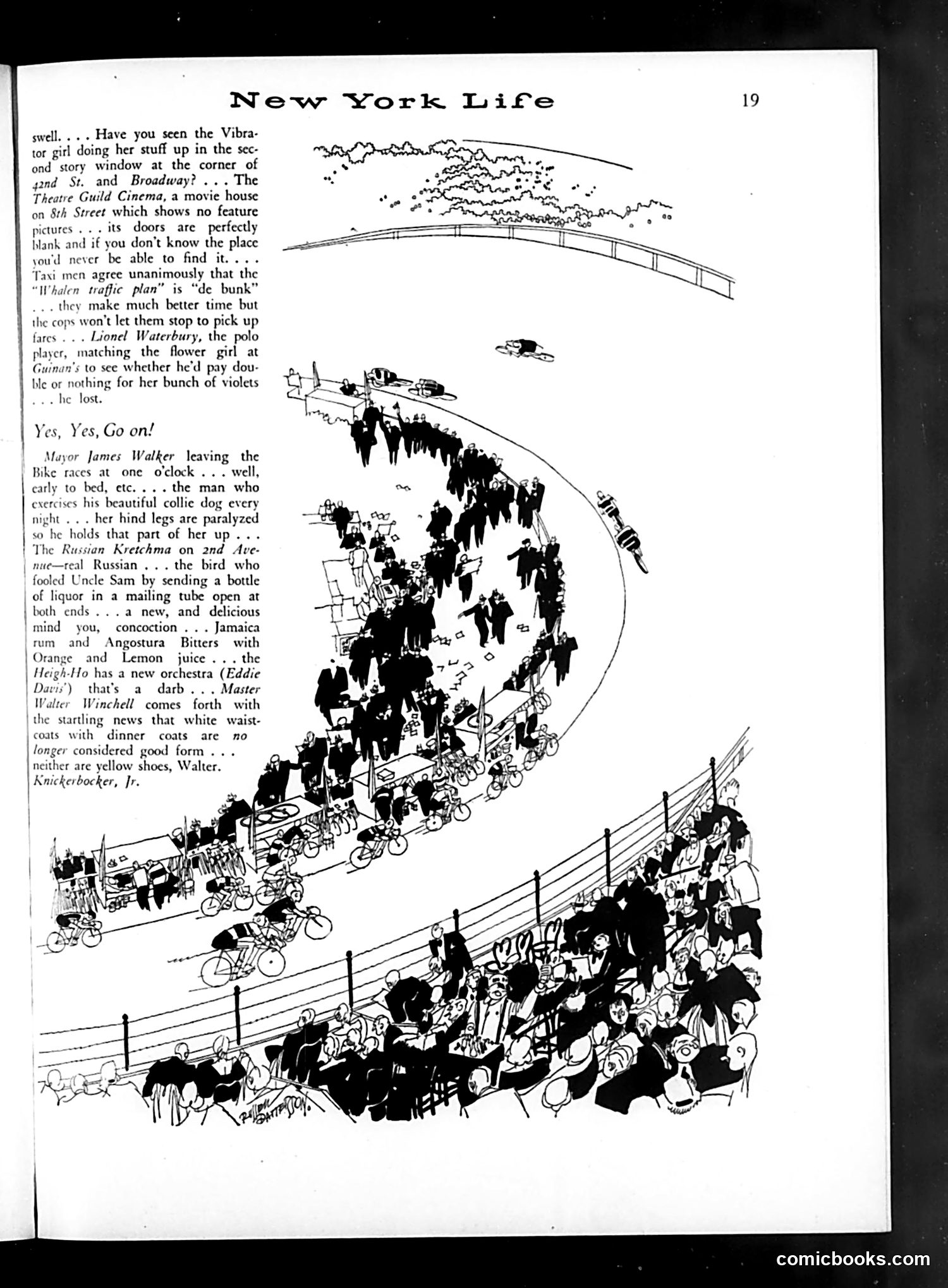
This is a gossip/society column from *Life* magazine's "New York Life" section, accompanied by a satirical illustration of a crowded beach or boardwalk scene. The column consists of brief, snappy observations about 1920s New York City personalities and trends. References include: - Mayor James Walker's social habits - The "Whalen traffic plan" (Police Commissioner Richard Whalen's traffic reforms, dismissed by taxi drivers as ineffective) - A Russian restaurant called the Kretchma - Eddie Darling's orchestra at the Heigh-Ho nightclub - Walter Winchell's fashion commentary about evening wear The illustration depicts a dense, chaotic seaside crowd—suggesting summer leisure culture. The byline "Knickerbocker, Jr." indicates this is society/gossip commentary, likely satirizing the wealthy and fashionable set's activities and pretensions during Prohibition-era New York. The overall tone mocks both the subjects and the vapid nature of society-page reporting itself.
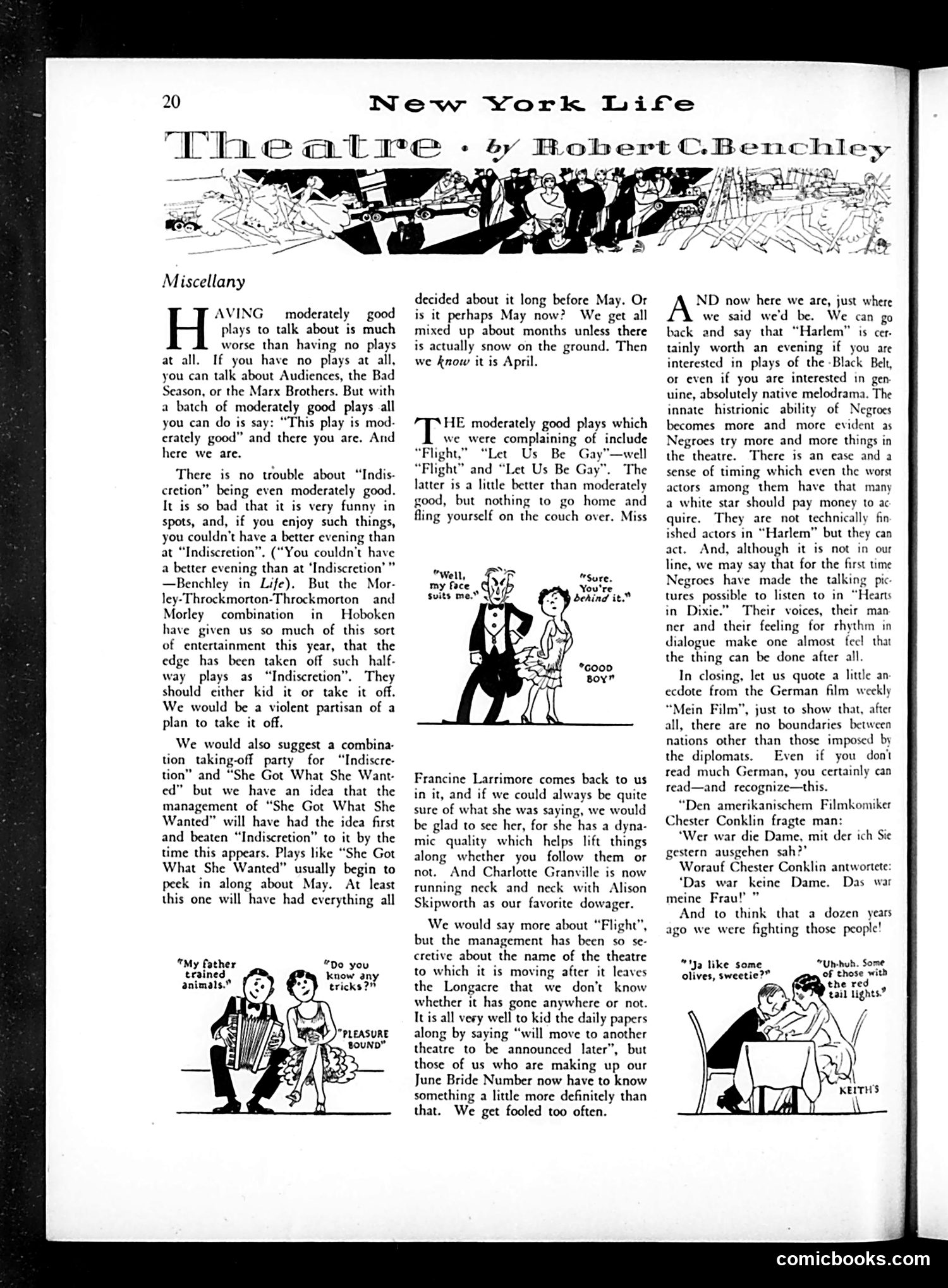
This is Robert C. Benchley's theatrical column reviewing several moderately good Broadway plays. The satirical point: moderately good plays are worse than having nothing to discuss, because you can only repeat "this play is moderately good." Benchley discusses specific productions: "Indiscretion," "She Got What She Wanted," "Flight," and "Let Us Be Gay" (featuring actress Francine Larrimore). He also reviews "Harlem," praising Black performers' natural acting ability and rhythm in dialogue—notably progressive for the era, though still paternalistic in tone. The small cartoons illustrate mundane conversation ("My father trained animals"/"Do you know tricks?") representing the banality of moderate entertainment. Benchley's complaint: theatres moving productions without announcing venues frustrates magazine deadlines. The humor relies on insider theatrical knowledge and Benchley's distinctive, rambling critical voice.
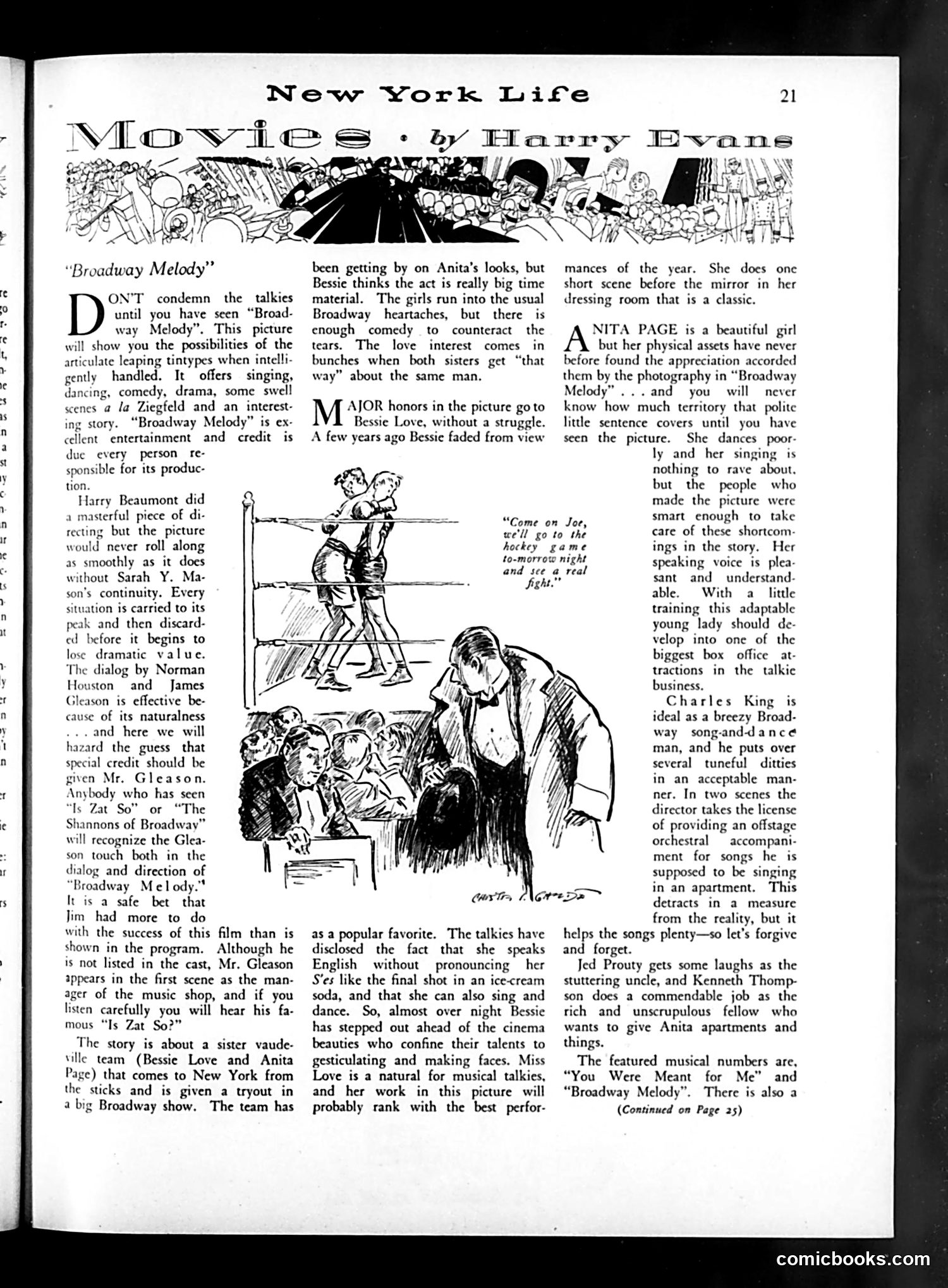
This is a film review by Harry Evans praising MGM's early talkie (talking picture). The review discusses the transition from silent films to sound cinema—a major technological shift occurring around 1928-1929. **Key points:** - The film stars Bessie Love and Anita Page as vaudeville sisters trying to make it on Broadway - Evans praises the screenplay's pacing and dialogue, crediting uncredited writer James Gleason for much of its success - He highlights Bessie Love's unexpected talent for speaking and singing in talkies, contrasting her comeback against Anita Page's limited vocal abilities - The cartoon illustrates a humorous dialogue about going to a hockey game for a "real fight"—likely satirizing the talkie's entertainment value or the contrast between "real" live entertainment and cinema The review reflects early-talkie-era excitement about synchronized sound as a revolutionary technology that transformed cinema and revealed new possibilities in casting and performance.
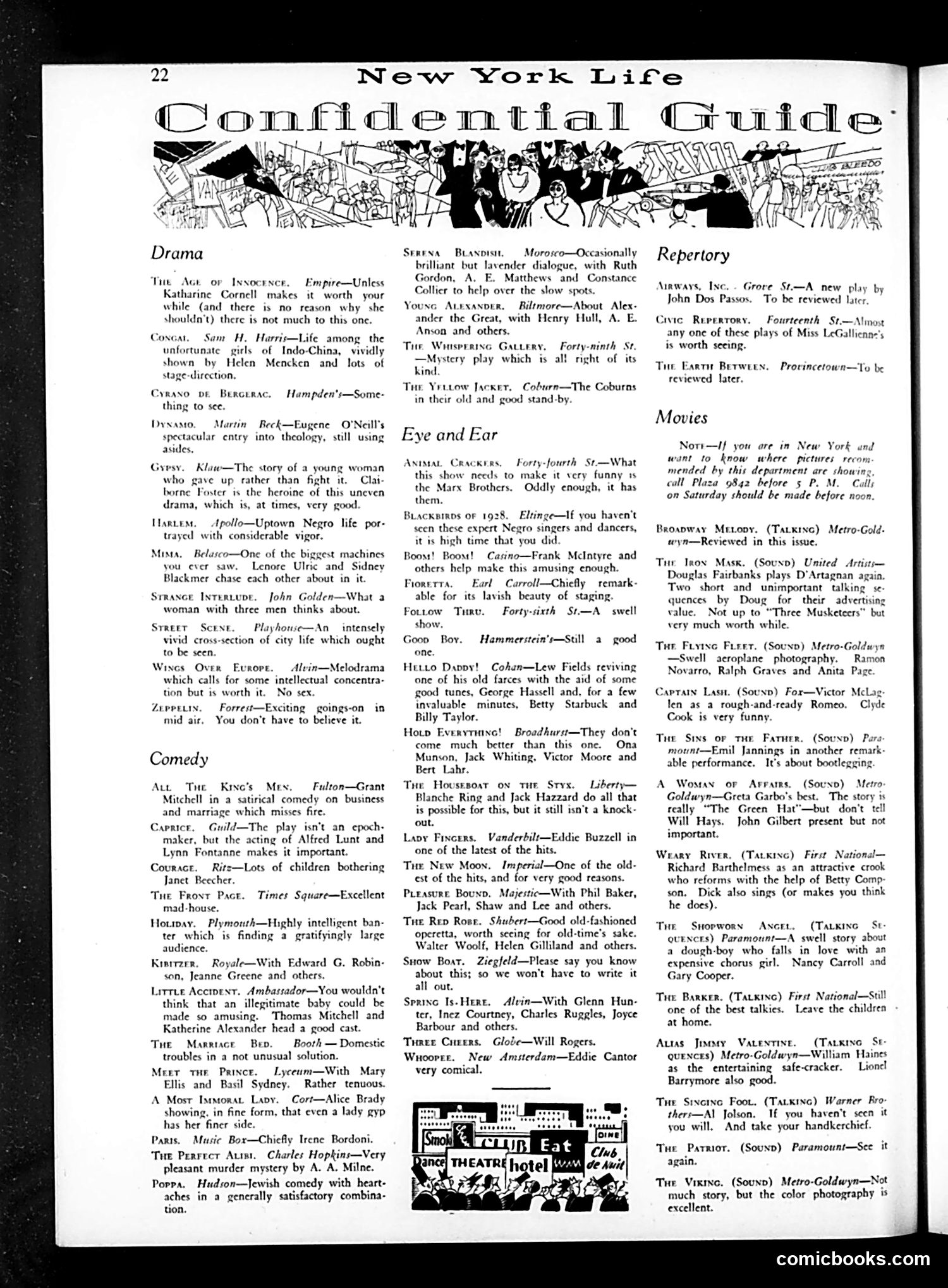
This page is a **theater review guide** for New York productions, not political satire. It's organized by genre (Drama, Comedy, Eye and Ear/Vaudeville, Repertory, Movies) with brief critical assessments of Broadway shows. The reviews are witty, dismissive capsules: "The Act of Innocence...there is not much to this one"; "Little Accident...You wouldn't think that an illegitimate baby could be made so amusing." Notable is the casual racism: "Uptown Negro life portrayed," "expert Negro singers and dancers" at the Blackbirds of 1928. The small illustration at bottom shows a theater marquee advertising various shows. This represents **Life magazine's entertainment coverage** of the late 1920s—snappy, theater-focused criticism aimed at Manhattan sophisticates deciding what to see.
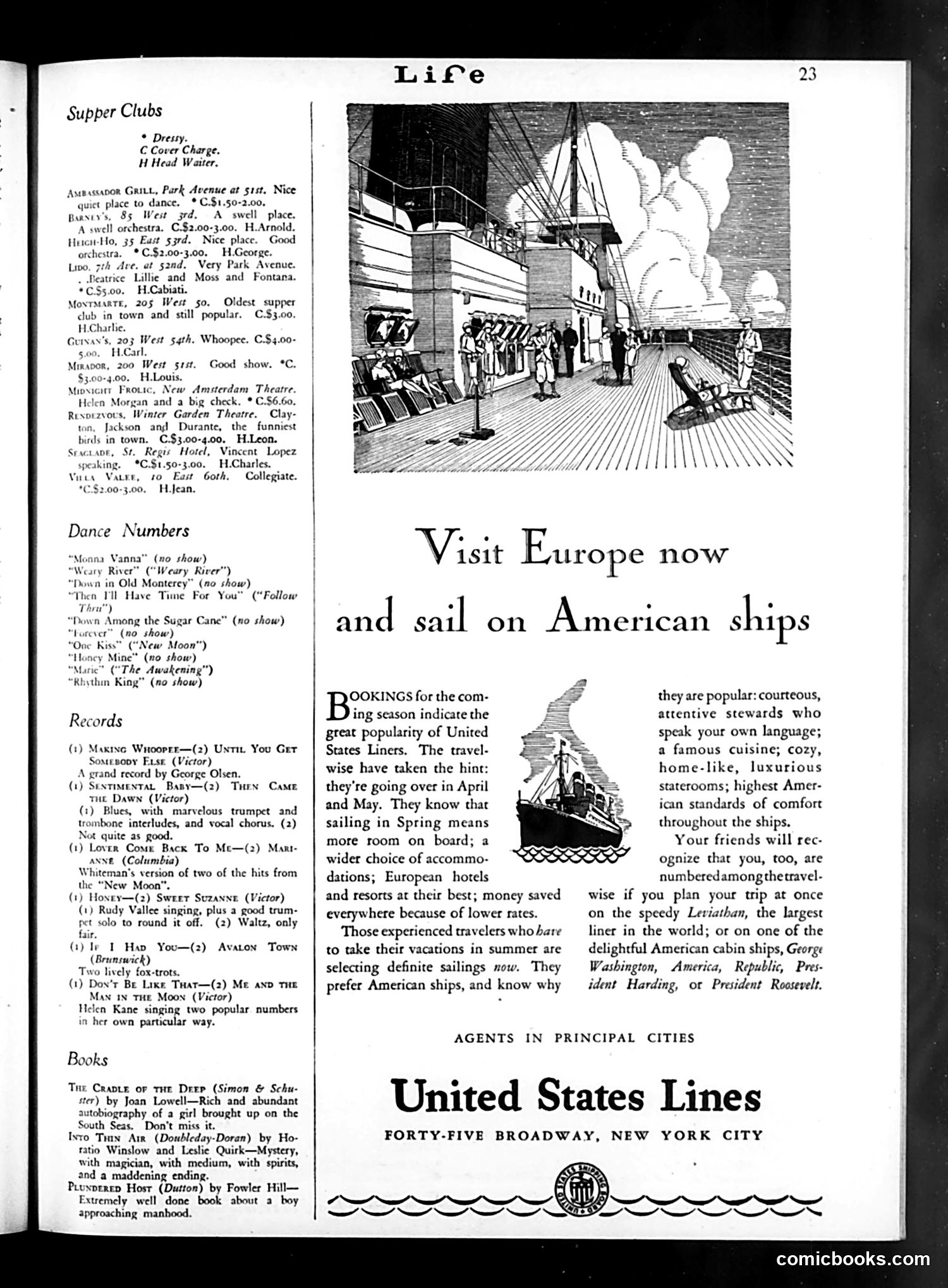
This page is primarily **advertising and entertainment listings** rather than political satire. The left column contains practical guides: supper clubs in New York (with cover charges and orchestra quality noted), popular dance numbers from Broadway shows, phonograph records, and book reviews—typical *Life* magazine consumer content from the late 1920s. The right side features a **major advertisement for United States Lines shipping company**. An illustration shows passengers on a luxury ocean liner's deck. The ad encourages spring travel to Europe aboard American ships, emphasizing comfort, cuisine, and service standards. It specifically promotes large vessels like the *Leviathan* and ships named after U.S. presidents. The only potentially satirical element is subtle: the ad's repeated claim that experienced travelers "prefer American ships" during a period when European liners dominated transatlantic travel—suggesting the advertisement itself was working against market reality.
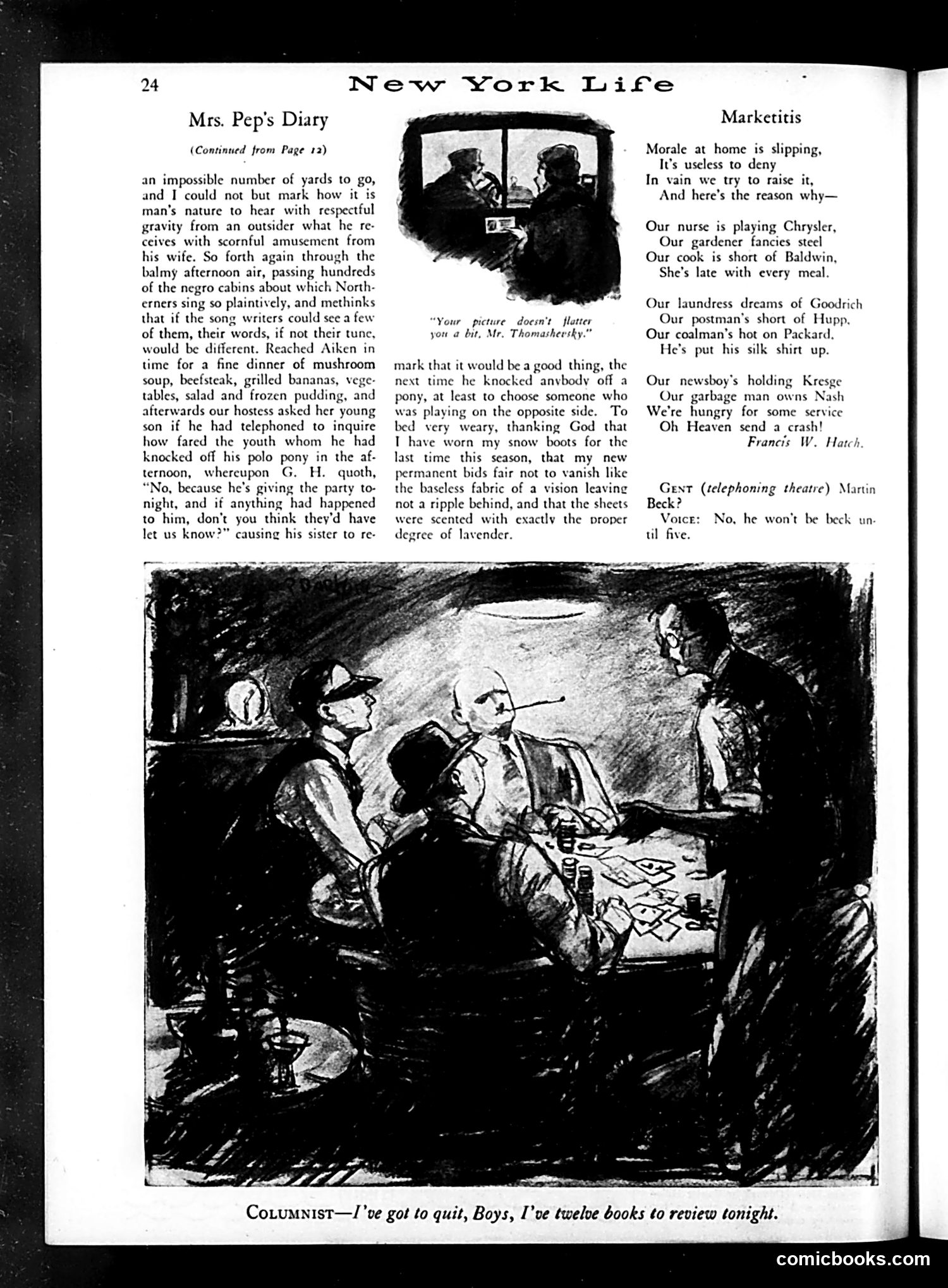
This page contains three satirical pieces from *Life* magazine: **"Mrs. Pep's Diary"** (top left): A humorous travel account depicting a wealthy woman's observations during a Southern trip, with period attitudes toward African Americans evident in the dated language. **"Marketitis"** (right): A poem satirizing the stock market craze of the 1920s. The joke is that household staff—nurse, gardener, cook, laundress, postman, coalman, newsboy, garbage man—are all distracted by stock speculation (holding shares in Chrysler, Baldwin, Goodrich, Packard, Kresge, Nash, and Hupp—actual auto and retail companies). They're neglecting their jobs because they're obsessed with the market. The punchline: "Oh Heaven send a crash!"—meaning a market crash might force them back to work. This reflects widespread anxiety about the speculative fever preceding the 1929 crash. **"Columnist" cartoon** (bottom): A joke about a book reviewer leaving a poker game with twelve books to review that night—implying he won't actually read them.
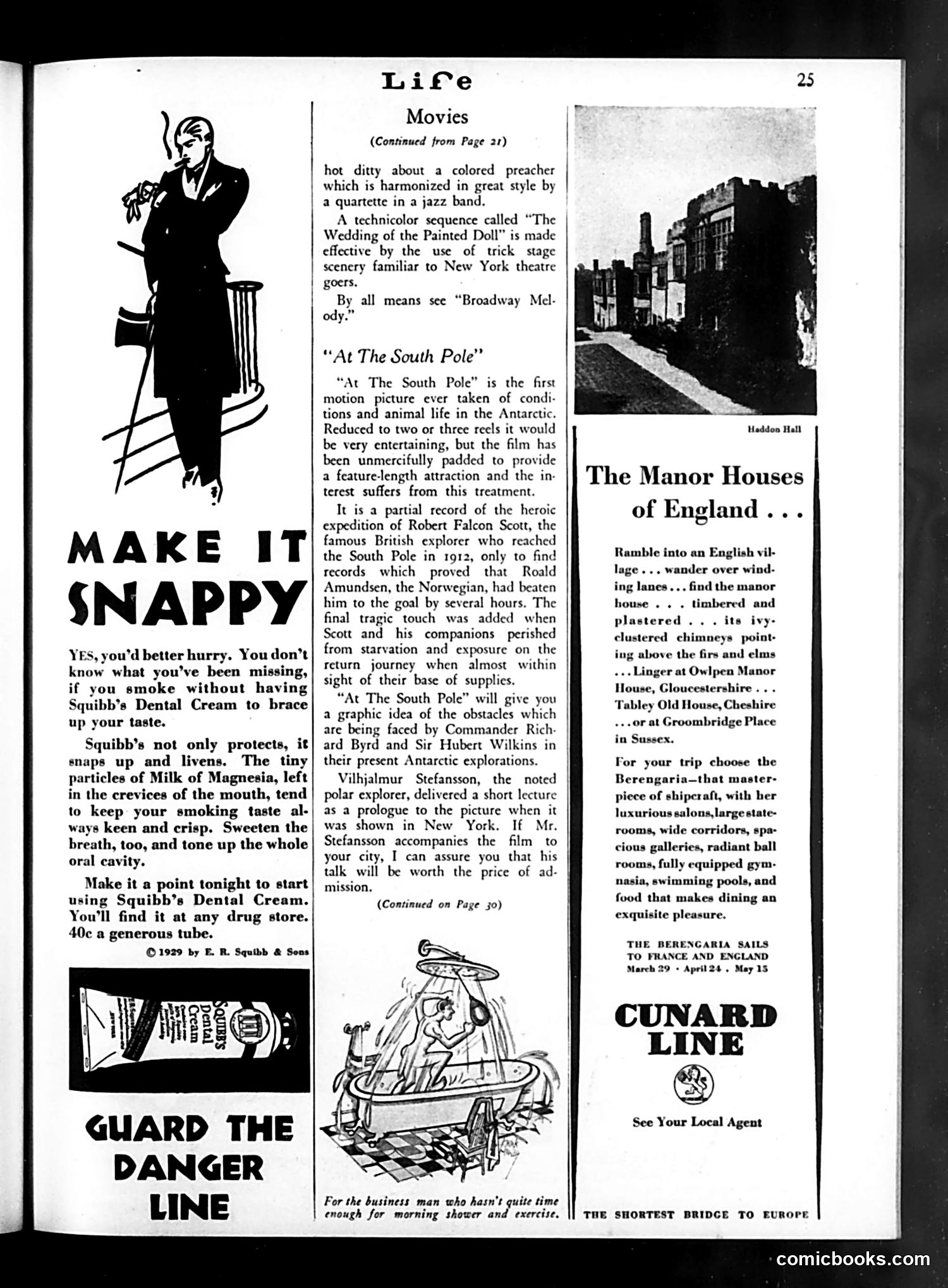
This page is primarily **advertising** rather than political satire. It contains three distinct ads: 1. **Squibb's Dental Cream** ("Make It Snappy"): A 1929 dental hygiene ad targeting smokers, claiming the product's Milk of Magnesia particles keep breath fresh and smoking taste "keen and crisp." The illustration shows a well-dressed man—likely meant to represent a sophisticated businessman or gentleman. 2. **"Guard the Danger Line"**: An incomplete ad below, apparently also dental/hygiene-related. 3. **Cunard Line cruise ship advertisement**: Promoting leisure travel to English manor houses and France. The movie review section discusses films including "At The South Pole," which documents Robert Falcon Scott's Antarctic expedition (1912), noting the tragic historical fact that Norwegian Roald Amundsen reached the pole first. The page reflects 1920s consumer culture and leisure advertising rather than political commentary.
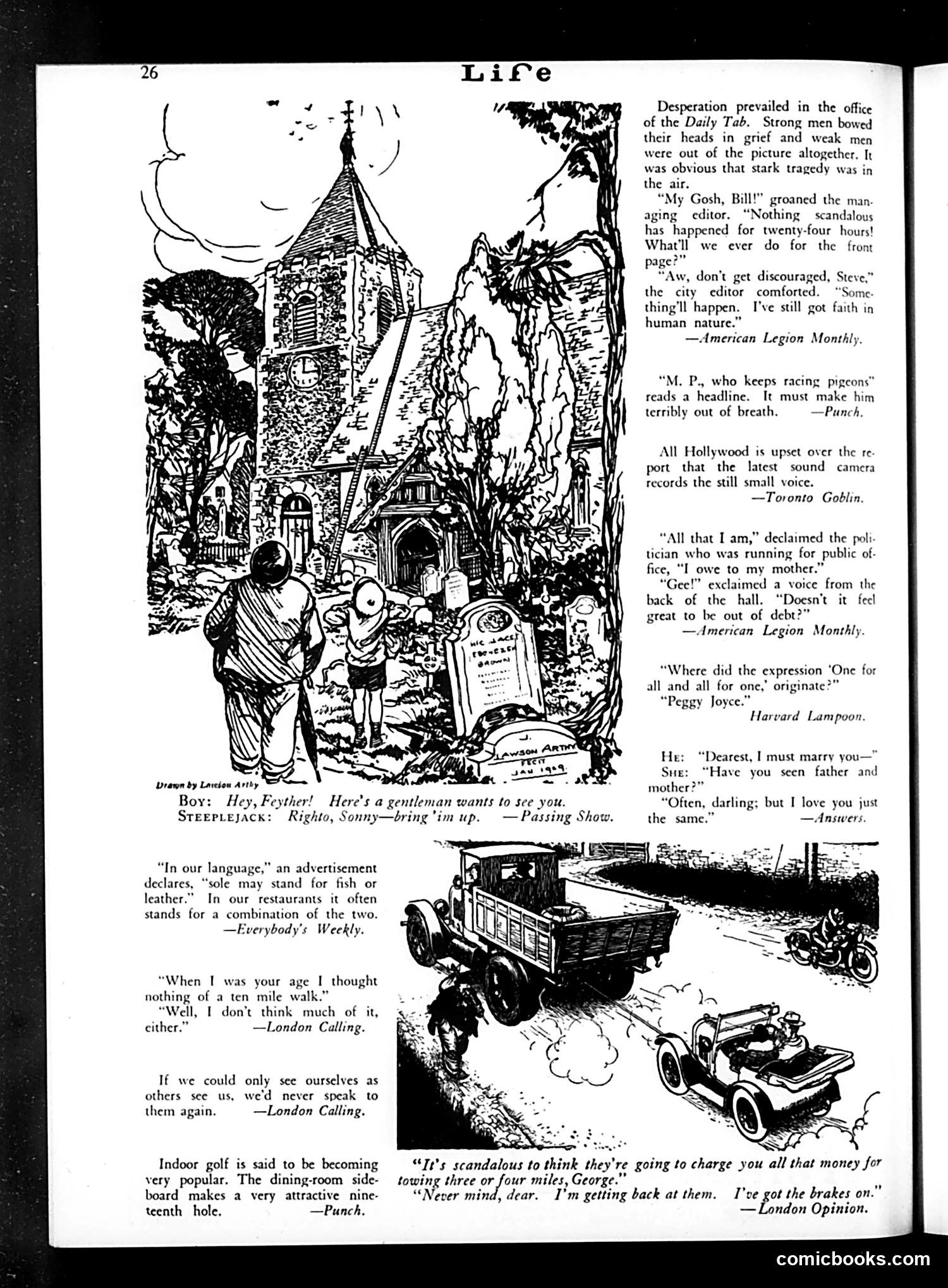
This page from *Life* magazine presents a collection of brief jokes and cartoons sourced from various publications (American Legion Monthly, Punch, Toronto Goblin, etc.). The content satirizes everyday frustrations and social absurdities: **Main cartoon** (top): A newspaper editor despairs that nothing scandalous has occurred in 24 hours, mocking journalism's reliance on sensationalism and tragedy for headlines. **Recurring themes**: - Gender relations and marriage negotiations ("Dearest, I must marry you") - Class and financial anxieties (towing charges, restaurant substitutions) - Generational conflict ("When I was your age...") - Technological changes (Hollywood's new sound cameras) - Modern conveniences backfiring (indoor golf as excuse for poor dining) The humor relies on observational comedy about middle-class life, marital dynamics, and the gap between pretense and reality—typical of 1920s-era satirical magazines targeting educated, urban audiences.
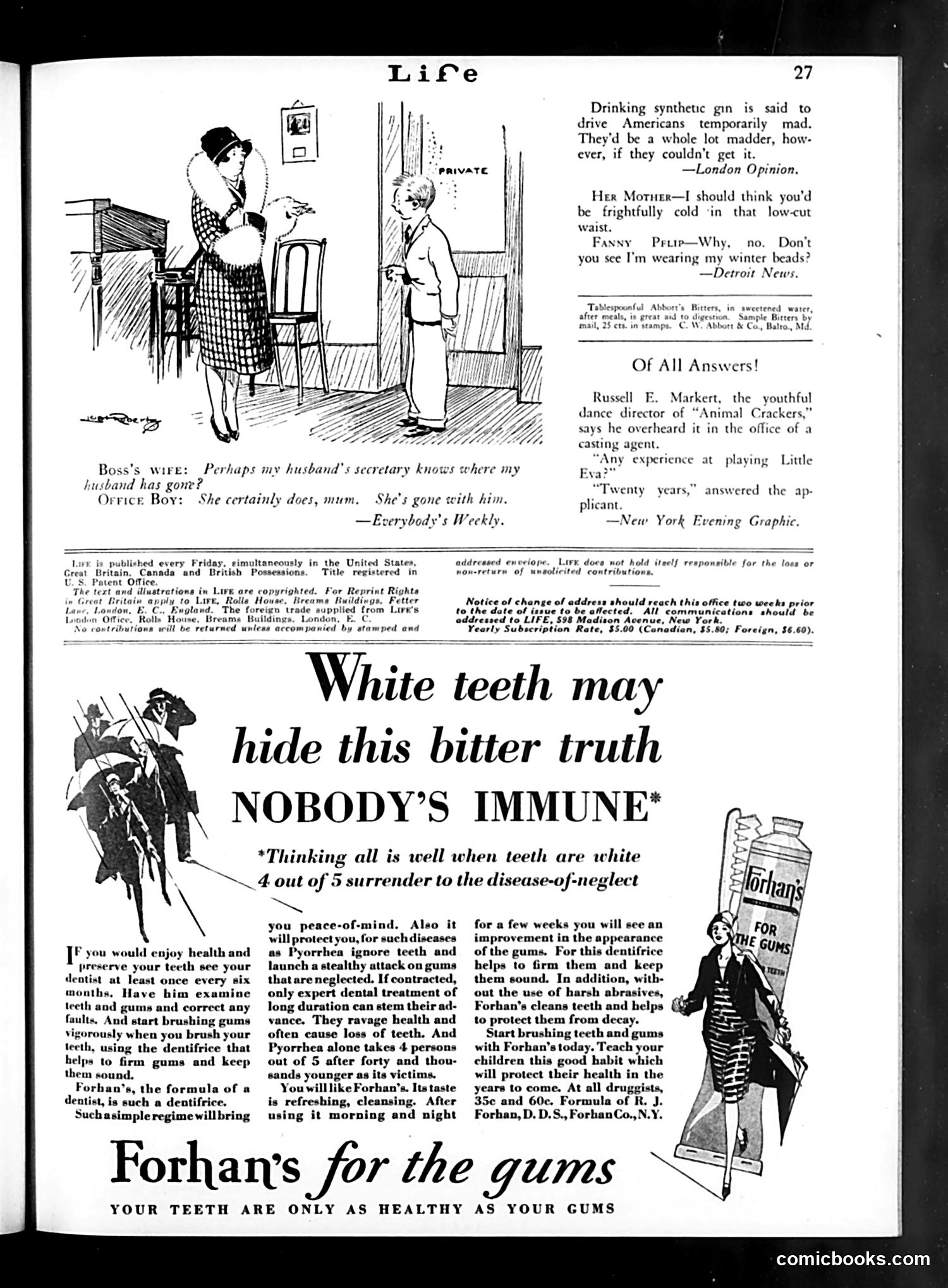
This page contains three distinct humor pieces typical of 1920s-30s Life magazine, plus a toothpaste advertisement. **The cartoons** mock marital infidelity: a boss's wife asks her office boy where her husband went; he replies the secretary "certainly does"—implying the secretary left with the husband. A second joke involves a woman wearing a low-cut dress in winter; she explains she's wearing "winter beads" for warmth, a flirtatious non-answer. **The advertisement** for Forhan's toothpaste uses alarmist health messaging common to the era, claiming "4 out of 5" people over 40 develop pyorrhea (gum disease). It promotes gum brushing as essential preventative care—reflecting early 20th-century anxieties about dental health and modern scientific marketing techniques that exaggerate disease risk to sell products. The humor pages satirize workplace romance and fashion pretense, while the ad exemplifies period advertising's fear-based sales tactics.
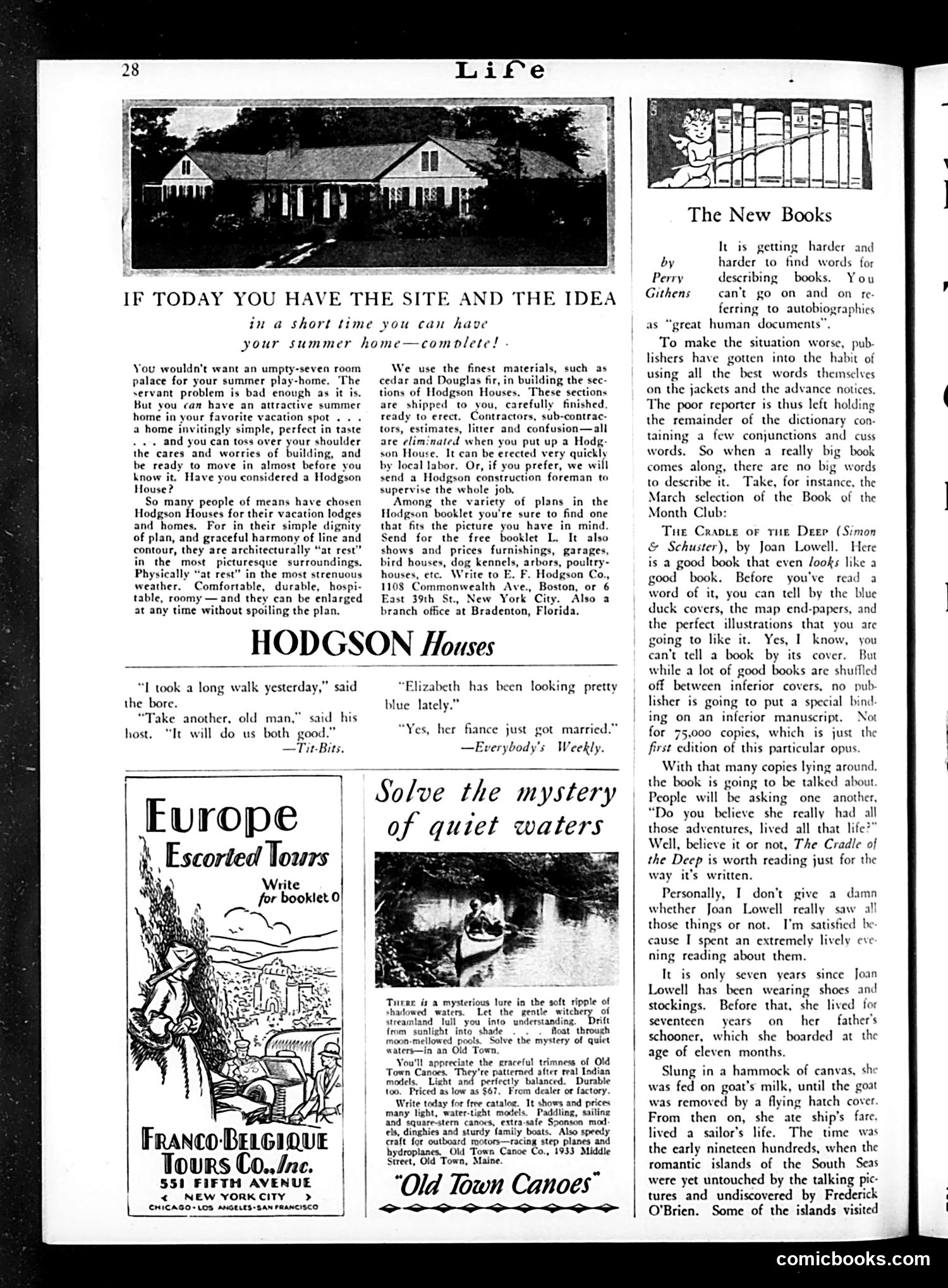
This page is primarily **advertising and light humor**, not political satire. The main elements are: **Advertisements:** - Hodgson Houses (prefabricated vacation homes), Franco-Belgique Tours (European travel), and Old Town Canoes dominate the page - These target affluent readers seeking leisure activities **Humor:** Two brief jokes appear: 1. A "bore" who takes long walks; his host sarcastically suggests another walk 2. A woman looking "blue" because her fiancé married someone else—a play on emotional versus marital disappointment **Book Review:** A column critiques the difficulty of finding fresh descriptive language for books, using *The Cradle of the Deep* by Joan Lowell as an example. The reviewer notes publishers exhaust superlatives on dust jackets, leaving critics without adequate vocabulary. **Context:** This reflects 1920s-30s consumer culture and leisure industry advertising aimed at the middle-to-upper class. The content shows how Life balanced commercial interests with satirical commentary on contemporary life.
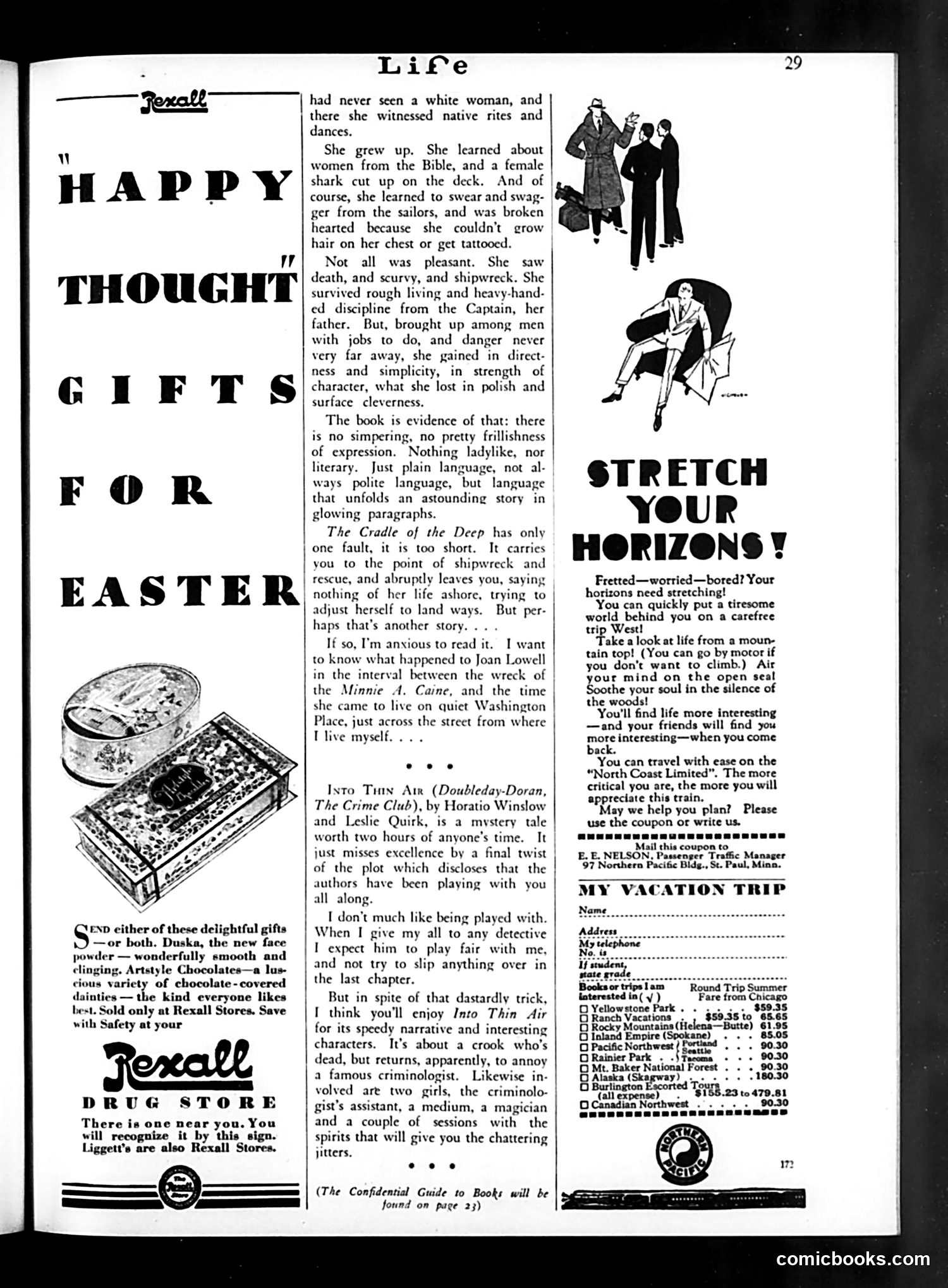
This page mixes book reviews with Easter gift advertising and travel promotion, typical of 1920s Life magazine content. **Book Reviews:** The main text discusses *The Cradle of the Deep*, apparently a memoir by Joan Lowell about growing up aboard her father's ship. The reviewer praises her plain, unsentimental narrative style—notably that she "gained in directness and simplicity" through rough maritime life rather than polish. There's also a brief review of *Into Thin Air*, a mystery novel criticized for playing unfair tricks on readers. **Advertising:** The left sidebar promotes Duska face powder and Artstyle Chocolates as Easter gifts through Rexall drugstores. The right side features a travel advertisement for the "North Coast Limited" train, encouraging readers to "stretch your horizons" by visiting the American West—positioning travel as a cure for boredom and a way to become more interesting to friends. **Visual Elements:** Illustrations show fashionable travelers and gift boxes, typical of period advertising aesthetics.
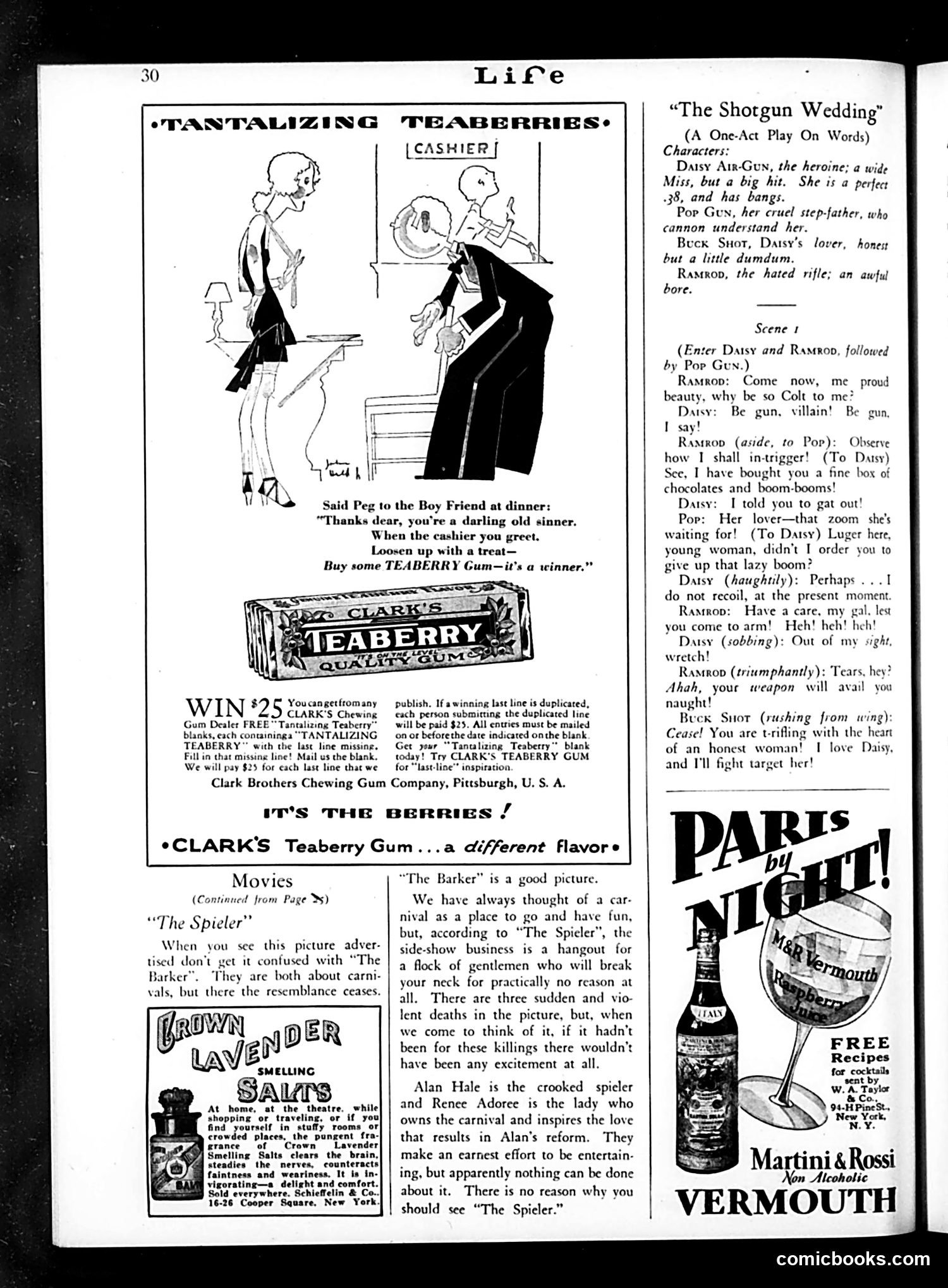
This page features a one-act comedic play that's entirely composed of **gun-related puns and double entendres**. The title plays on "shotgun wedding" (a forced marriage), but the script substitutes firearms terminology for romantic language. Characters include "Daisy Air-Gun" (the heroine), "Pop Gun" (her stepfather), "Buck Shot" (her lover), and "Ramrod" (the antagonist). The dialogue replaces normal words with gun vocabulary: "Be gun," "in-trigger," "gat out," "recoil," "arm," and "target." The satire mocks overwrought melodramatic theater of the era by treating the entire romantic conflict as if conducted through firearm metaphors—transforming a serious "shotgun wedding" scenario into absurdist wordplay. The joke relies on readers recognizing both the clichéd theatrical conventions and appreciating the pun-heavy substitutions that undermine any dramatic tension. This appears designed as light entertainment for *Life* magazine's satirically-minded readers.
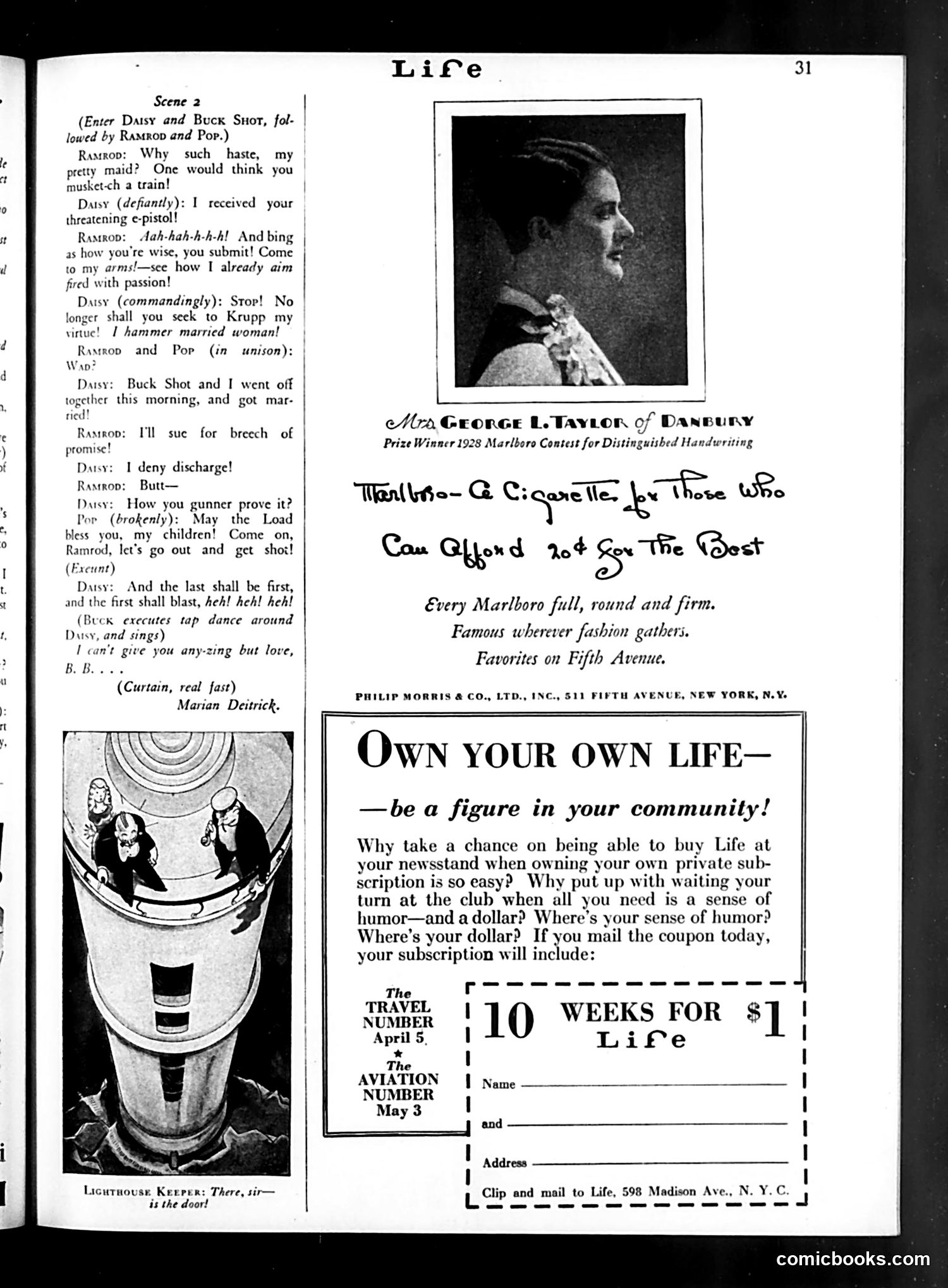
This page contains a theatrical sketch heavy with **gun-related puns** ("e-pistol," "aim fired," "Krupp my virtue," "hammer married woman," "breech of promise," "discharge," "gunner prove it"). The humor relies entirely on weaponry terminology stretched into double meanings for comic effect—a style typical of early 20th-century vaudeville humor. The plot involves a character named Daisy thwarting a seducer (Ramrod) by eloping with "Buck Shot," triggering a cascade of gun-pun dialogue. The sketch appears to be original comedy writing, credited to "Marian Deitrick" (possibly a pseudonym). The page is primarily **advertising**—featuring a Marlboro cigarette ad, a portrait photo of a handwriting contest winner, and a subscription pitch for Life magazine itself ("10 weeks for $1"). The theatrical sketch functions mainly as filler content between advertisements, typical of Life's satirical magazine format of the 1920s-30s.
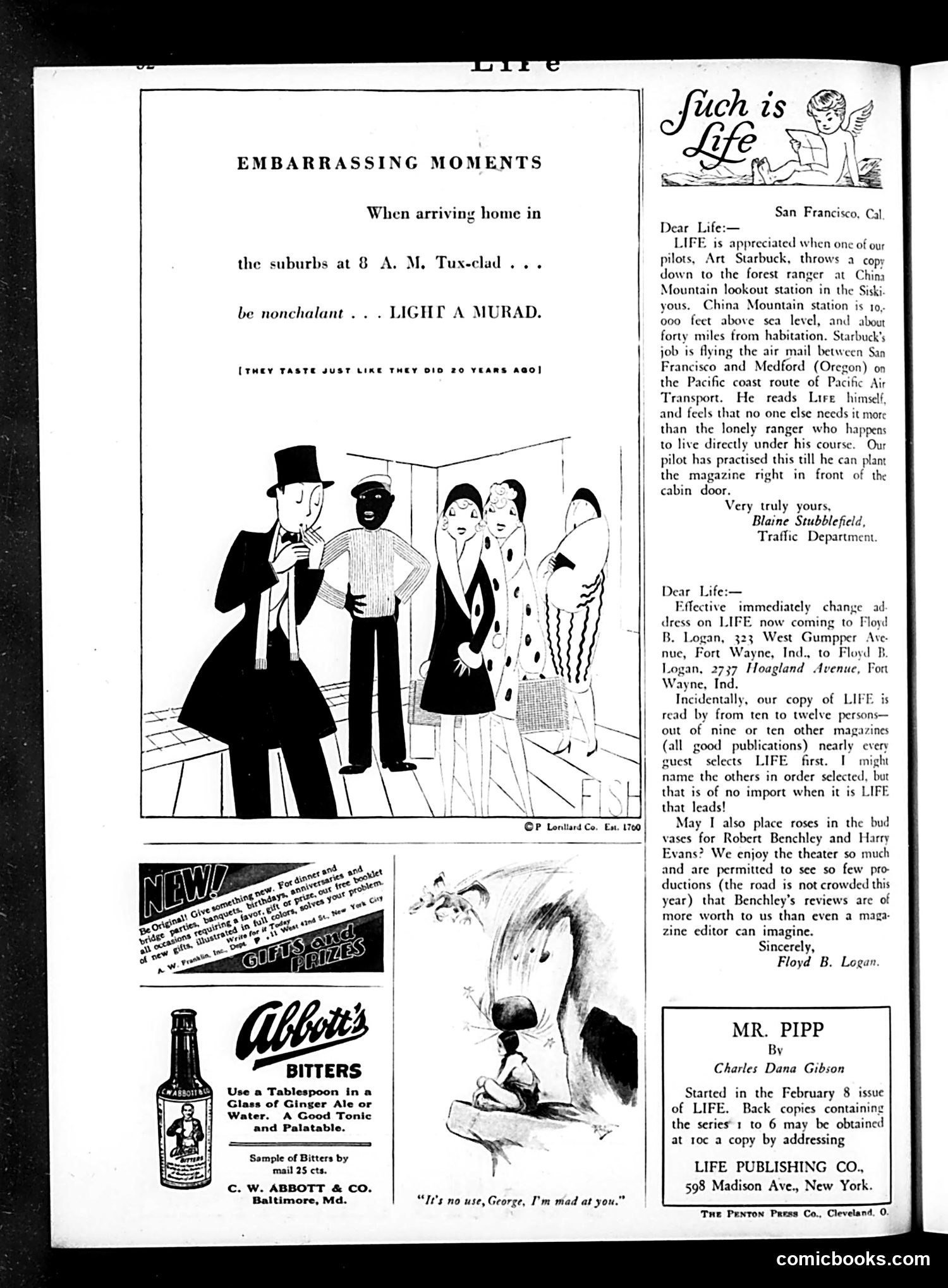
The main cartoon satirizes social awkwardness: a formally dressed man arriving home at 8 A.M. in a tuxedo encounters neighbors, creating embarrassment. The joke's point is captured in the caption: to appear nonchalant, he should "light a Murad" (cigarette). The implication is that smoking provides a convenient social prop to mask discomfort—a casual gesture suggesting he belongs there despite the suspicious timing and formal dress. This reflects early 20th-century attitudes where cigarettes functioned as social lubricants. The phrase "[they] taste just like they did 20 years ago" advertises product consistency. The page also includes reader letters praising *Life* magazine's quality and reach (notably one describing an airmail pilot dropping copies to isolated forest rangers), along with an unrelated Charles Dana Gibson cartoon and Abbott's Bitters advertisement.
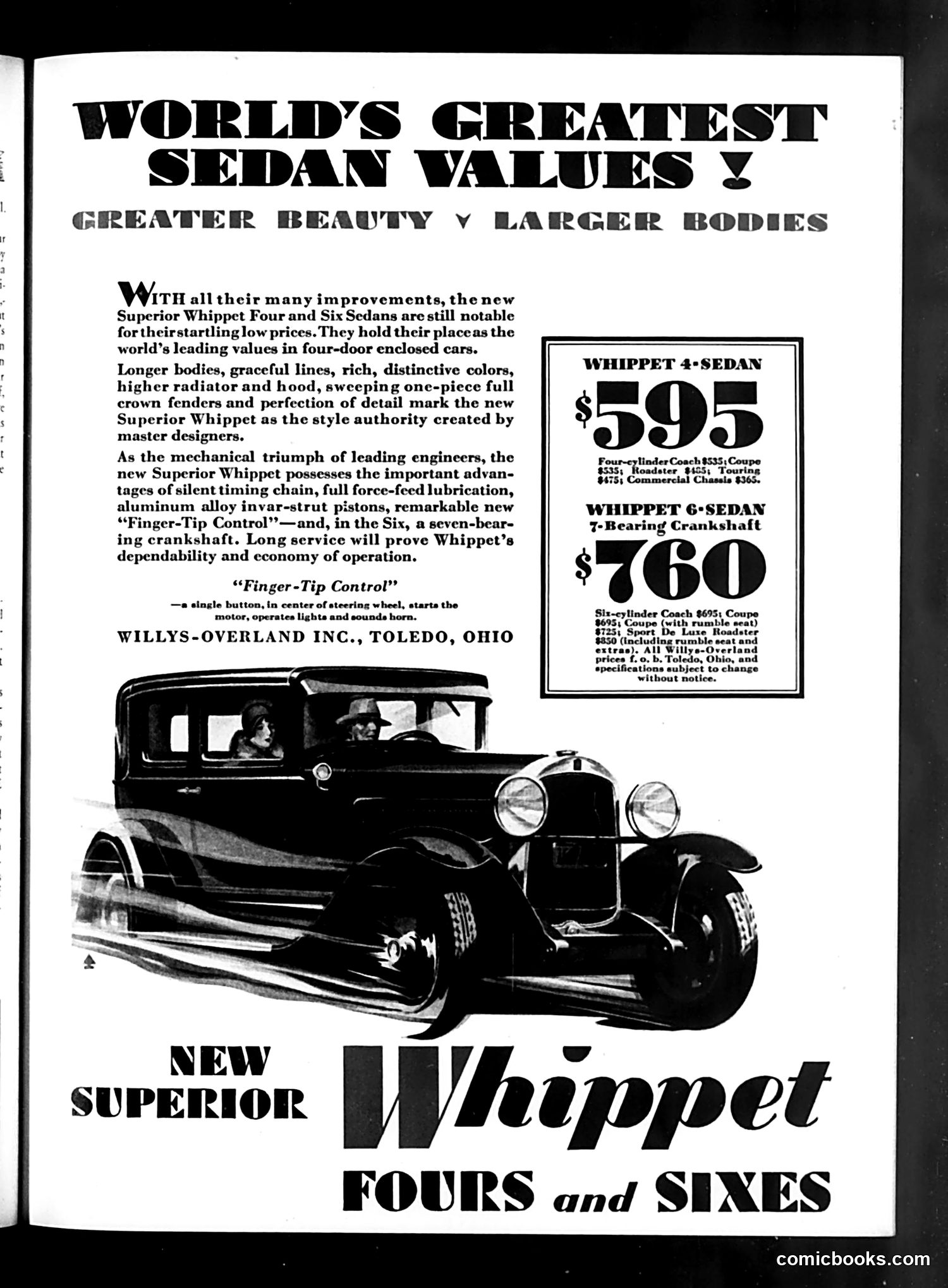
This is **not a cartoon or satire**—it's a straightforward automobile advertisement from the 1920s-early 1930s era. Willys-Overland Inc. promotes their "Superior Whippet" sedans as offering exceptional value. The ad emphasizes two selling points: **affordability** (starting at $595 for the 4-cylinder model) and **modern features** (silent timing chains, aluminum pistons, "Finger-Tip Control" for starting/lights). The vehicle pictured shows typical styling of the era: boxy body, exposed headlights, spoked wheels, and running boards. The ad targets middle-class buyers seeking reliable, stylish cars at competitive prices. The phrase "world's leading values in four-door enclosed cars" reflects a period when enclosed sedans were becoming standard—a shift from open-air vehicles. Nothing in this ad is satirical; it represents authentic 1920s-30s automotive marketing emphasizing both mechanical innovation and affordability.
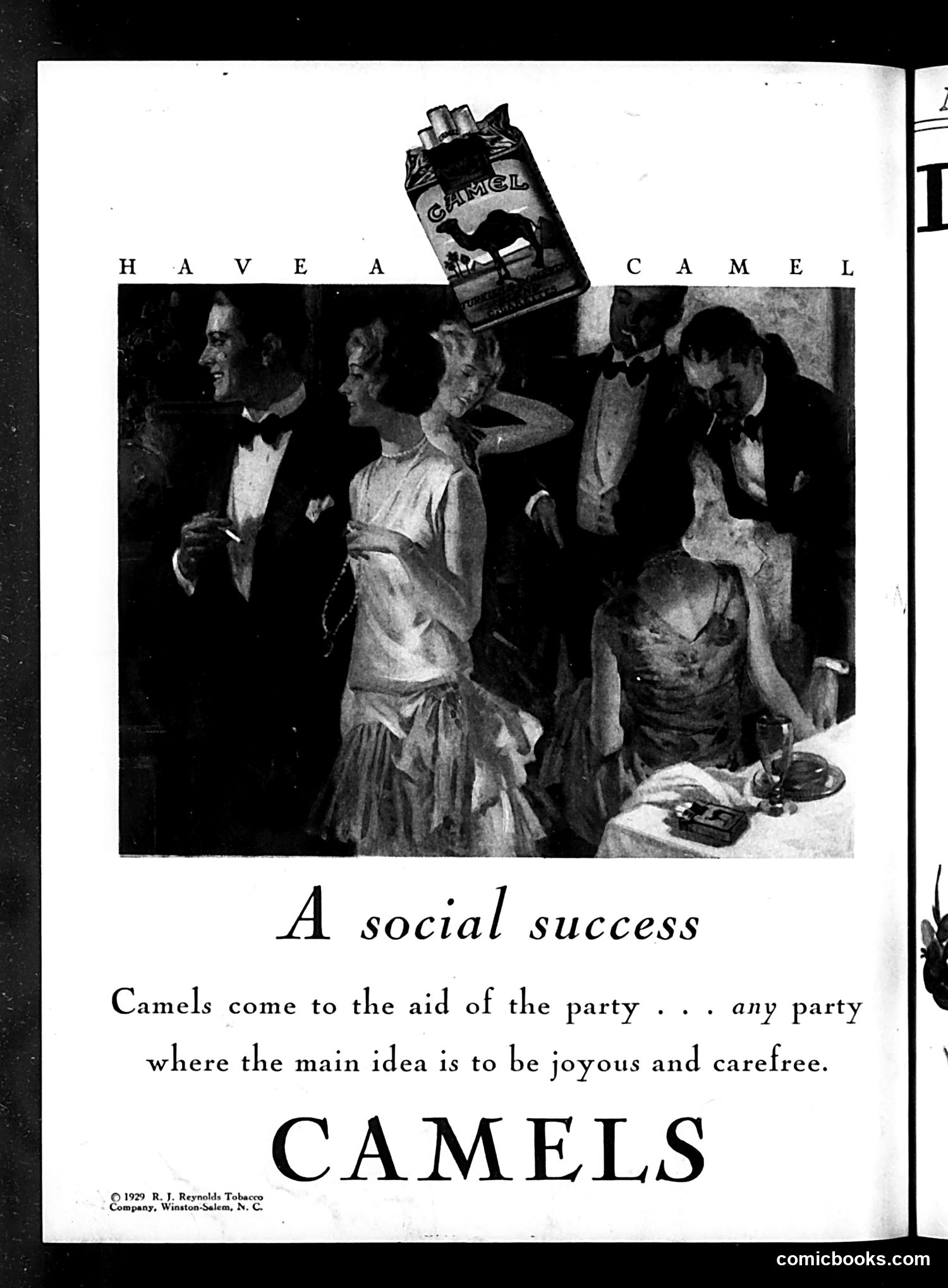
This is a **cigarette advertisement**, not satire or political commentary. The 1929 Camel cigarette ad uses a staged photograph of well-dressed men and women at what appears to be a formal social gathering to promote smoking as essential to party enjoyment. The headline "A social success" pairs with text claiming Camels help any party be "joyous and carefree"—a marketing pitch that associates cigarette smoking with social sophistication and fun. The large Camel pack image above reinforces the brand. For modern readers: this represents pre-regulation tobacco advertising that could directly market cigarettes to general audiences (now prohibited). The ad exemplifies how cigarettes were once sold as lifestyle and social status products rather than as the health hazard they are understood to be today.