
Life, 1929-03-22 · page 23 of 36
Life — March 22, 1929 — page 23: what you’re looking at
What you’re looking at
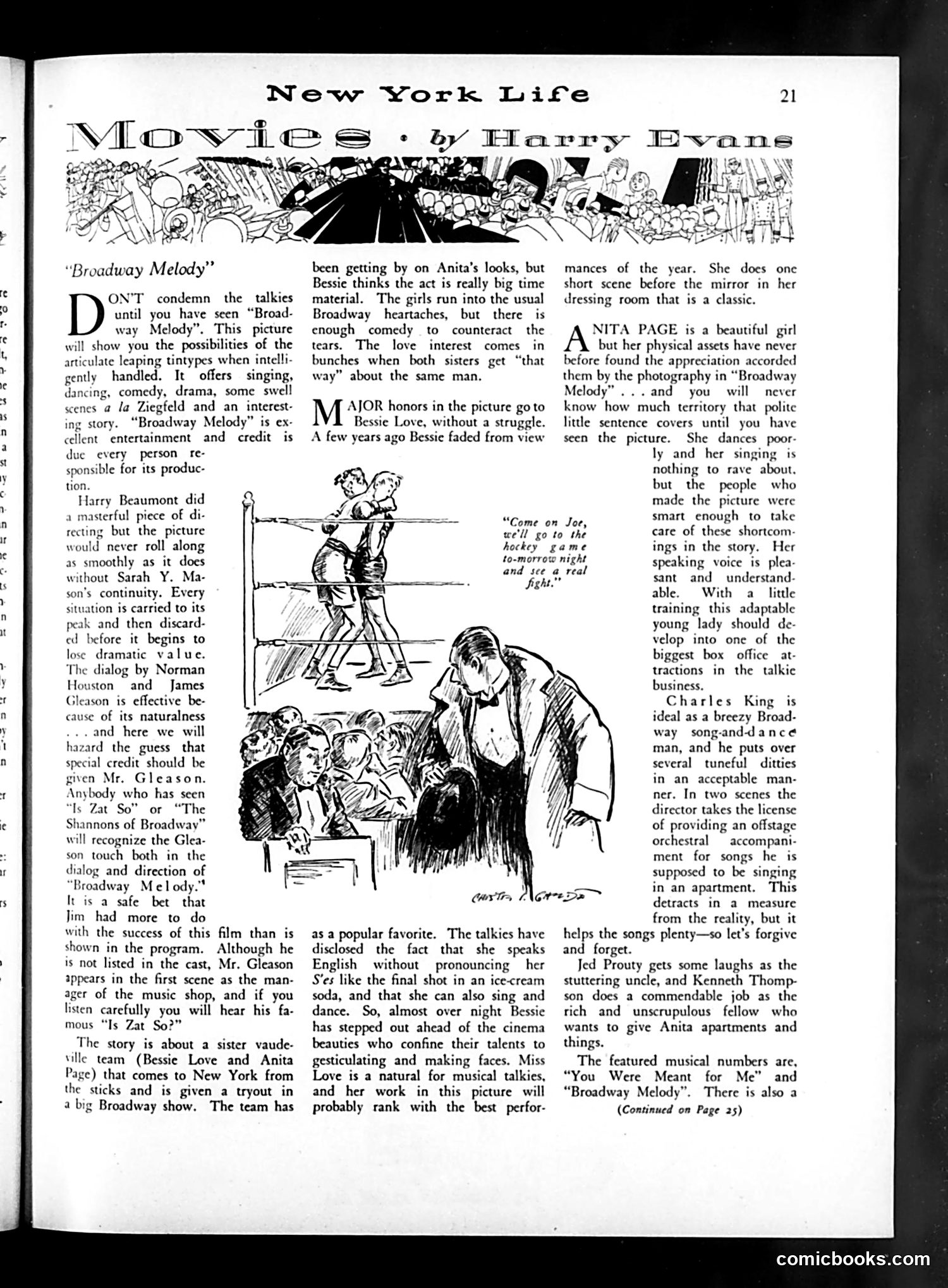
This is a film review by Harry Evans praising MGM's early talkie (talking picture). The review discusses the transition from silent films to sound cinema—a major technological shift occurring around 1928-1929. **Key points:** - The film stars Bessie Love and Anita Page as vaudeville sisters trying to make it on Broadway - Evans praises the screenplay's pacing and dialogue, crediting uncredited writer James Gleason for much of its success - He highlights Bessie Love's unexpected talent for speaking and singing in talkies, contrasting her comeback against Anita Page's limited vocal abilities - The cartoon illustrates a humorous dialogue about going to a hockey game for a "real fight"—likely satirizing the talkie's entertainment value or the contrast between "real" live entertainment and cinema The review reflects early-talkie-era excitement about synchronized sound as a revolutionary technology that transformed cinema and revealed new possibilities in casting and performance.
📄 Transcribed text from this page (OCR, searchable)
Machine-transcribed from the original scan — historical spelling and the odd misread are preserved.
New York Life 21 Mowv ie Ss weet he ie by Tiarry EPwans “Broadway Melody” ON’T condemn the talkies D until you have seen “Broad- way Melody”. This picture will show you the possibilities of the articulate leaping tintypes when intelli- gently handled. It offers singing, dancing, comedy, drama, some swell senes a la Ziegfeld and an interest- ing story. “Broadway Melody” is ex- cellent’ entertainment and credit is due every person re- sponsible for its produc- tion. Harry Beaumont did a masterful piece of di- recting but the picture would never roll along as smoothly as it does without Sarah Y. Ma- son’s continuity. Every situation is carried to its peak and then discard- ed before it begins to lose dramatic value. The dialog by Norman Houston and James Gleason is effective be- cause of its naturalness . and here we will hazard the guess that special credit should be given Mr. Gleason. Anybody who has seen “Is Zat So” or “The Shannons of Broadway” will recognize the Glea- son touch both in the dialog and direction of “Broadway M el ody.”* It is a safe bet that Jim had more to do with the success of this film than is shown in the program. Although he is not listed in the cast, Mr. Gleason appears in the first scene as the man- ager of the music shop, and if you listen carefully you will hear his fa- mous “Is Zat So?” The story is about a sister vaude- ville team (Bessie Love and Anita Page) that comes to New York from the sticks and is given a tryout in a big Broadway show. The team has Nes iP. been getting by on Anita’s looks, but Bessie thinks the act is really big time material. The girls run into the usual Broadway heartaches, but there is enough comedy to counteract the tears. The love interest comes in bunches when both sisters get “that way” about the same man. AJOR honors in the picture go to Bessie Love, without a struggle. A few years ago Bessie faded from view “Come on Joe, we'll go to the hockey game to-morrow night and see @ real fight.” as a popular favorite. The talkies have disclosed the fact that she speaks English without pronouncing her S’es like the final shot in an ice-cream soda, and that she can also sing and dance. So, almost over night Bessie has stepped out ahead of the cinema beauties who confine their talents to gesticulating and making faces. Miss Love is a natural for musical talkies, and her work in this picture will probably rank with the best perfor- mances of the year. She does one short scene before the mirror in her dressing room that is a classic. NITA PAGE is a beautiful girl A but her physical assets have never before found the appreciation accorded them by the photography in “Broadway Melody”... and you will never know how much territory that polite little sentence covers until you have seen the picture. She dances poor- ly and her singing is nothing to rave about, but the people who made the picture were smart enough to take care of these shortcom- ings in the story. Her speaking voice is plea- sant and understand- able. With a little training this adaptable young lady should de- velop into one of the biggest box office at- tractions in the talkie business. Charles King is ideal as a breezy Broad- way song-anddance man, and he puts over several tuneful ditties in an acceptable man- ner. In two scenes the director takes the license of providing an offstage orchestral accompani- ment for songs he is supposed to be singing in an apartment. This detracts in a measure from the reality, but it helps the songs plenty—so let’s forgive and forget. Jed Prouty gets some laughs as the stuttering uncle, and Kenneth Thomp- son does a commendable job as the rich and unscrupulous fellow who wants to give Anita apartments and things. The featured musical numbers are, “You Were Meant for Me” and “Broadway Melody”. There is also a (Continued on Page 25) comicbooks.com