
A complete issue · 44 pages · 1929
Life — March 8, 1929
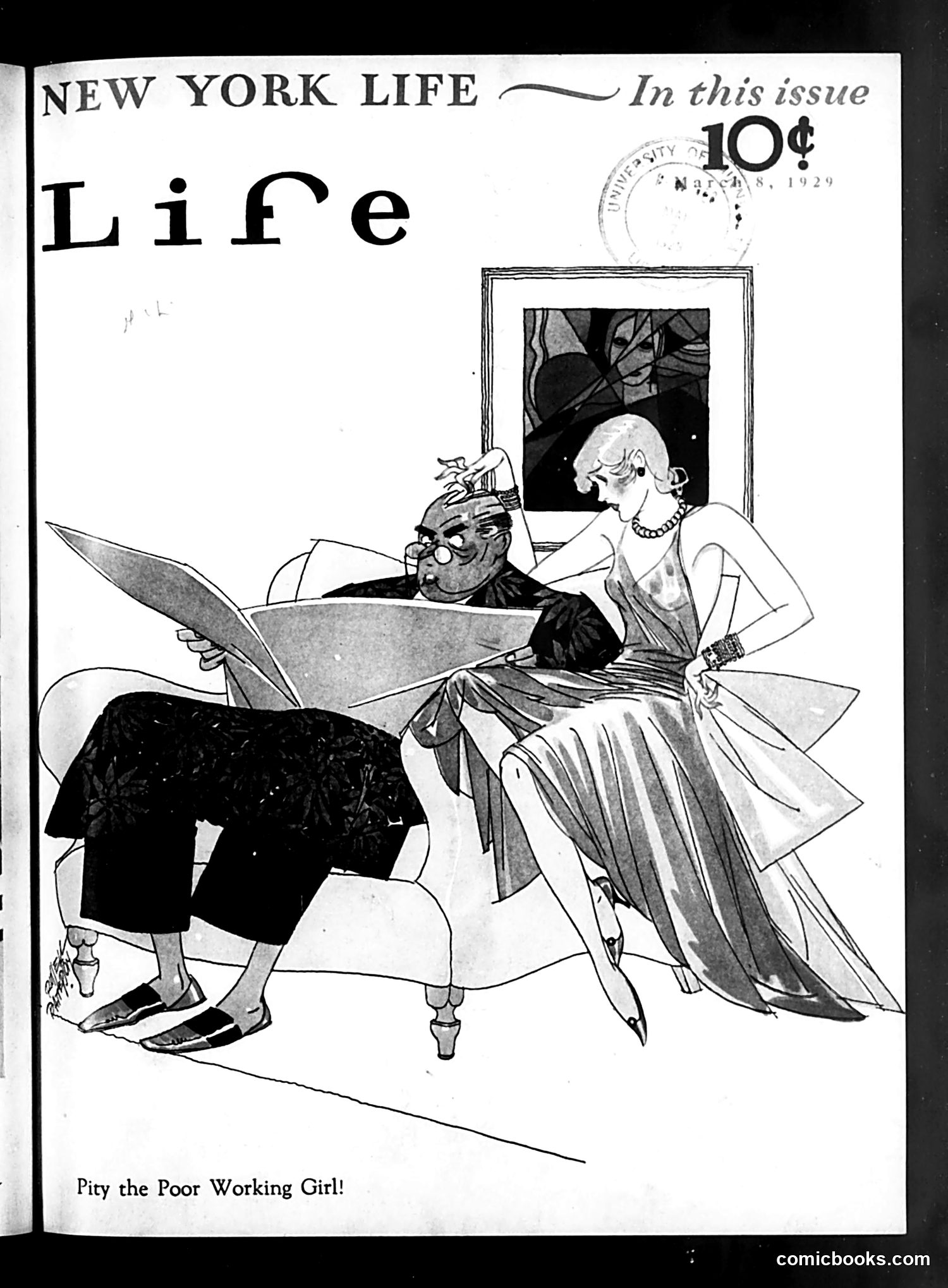
This satirical cover depicts a well-dressed woman showing a newspaper or document to a caricatured man in formal attire. The caption "Pity the Poor Working Girl!" suggests ironic commentary on women's economic status. The cartoon likely critiques the gap between wealthy women's leisure and working women's hardship during the pre-Depression era. The woman's elegant dress and relaxed pose contrast sharply with what appears to be concern about employment matters. The caricatured man's exaggerated features and formal dress suggest he represents either an employer, businessman, or authority figure. The satire operates on multiple levels: mocking sympathy for privileged women while highlighting actual economic struggles faced by working-class women—a pointed commentary on 1920s gender and class divisions.
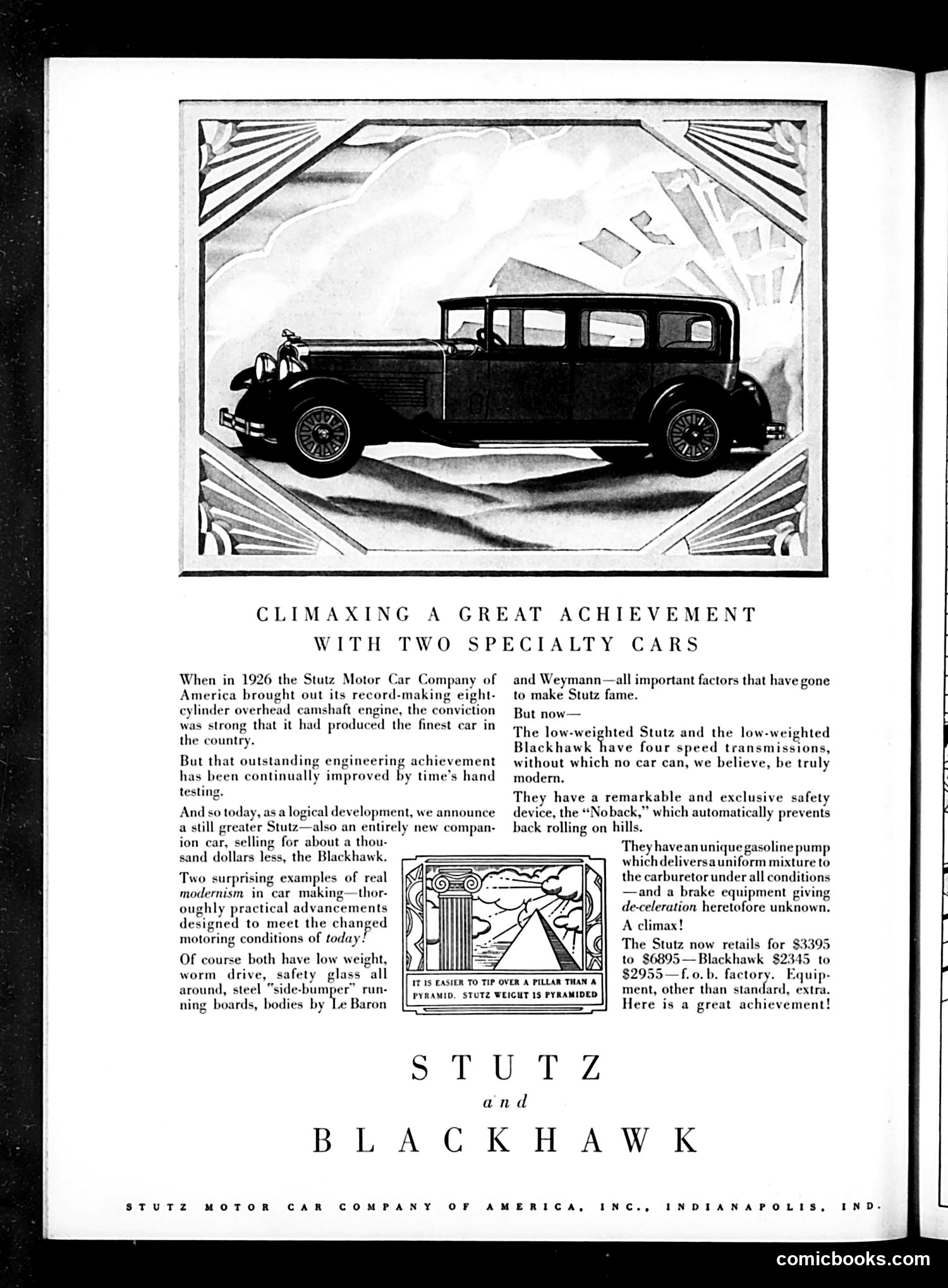
This page is **not satire or political commentary**—it's a straightforward automobile advertisement from the 1920s era. The ad promotes two cars made by Stutz Motor Car Company: the Stutz and the Blackhawk. It emphasizes engineering achievements from 1926, particularly an eight-cylinder overhead camshaft engine. The accompanying illustration shows a sleek sedan in profile against an Art Deco-style background. The text highlights modern features like the "Noback" safety device (prevents rollback on hills), a gasoline pump system, and brake improvements. Pricing ranges from $3,395 to $2,955, positioning these as premium vehicles. The decorative box illustration references pyramid construction ("It is easier to tip over a pyramid..."), likely comparing structural engineering to automotive design. This is purely commercial marketing, not editorial content.
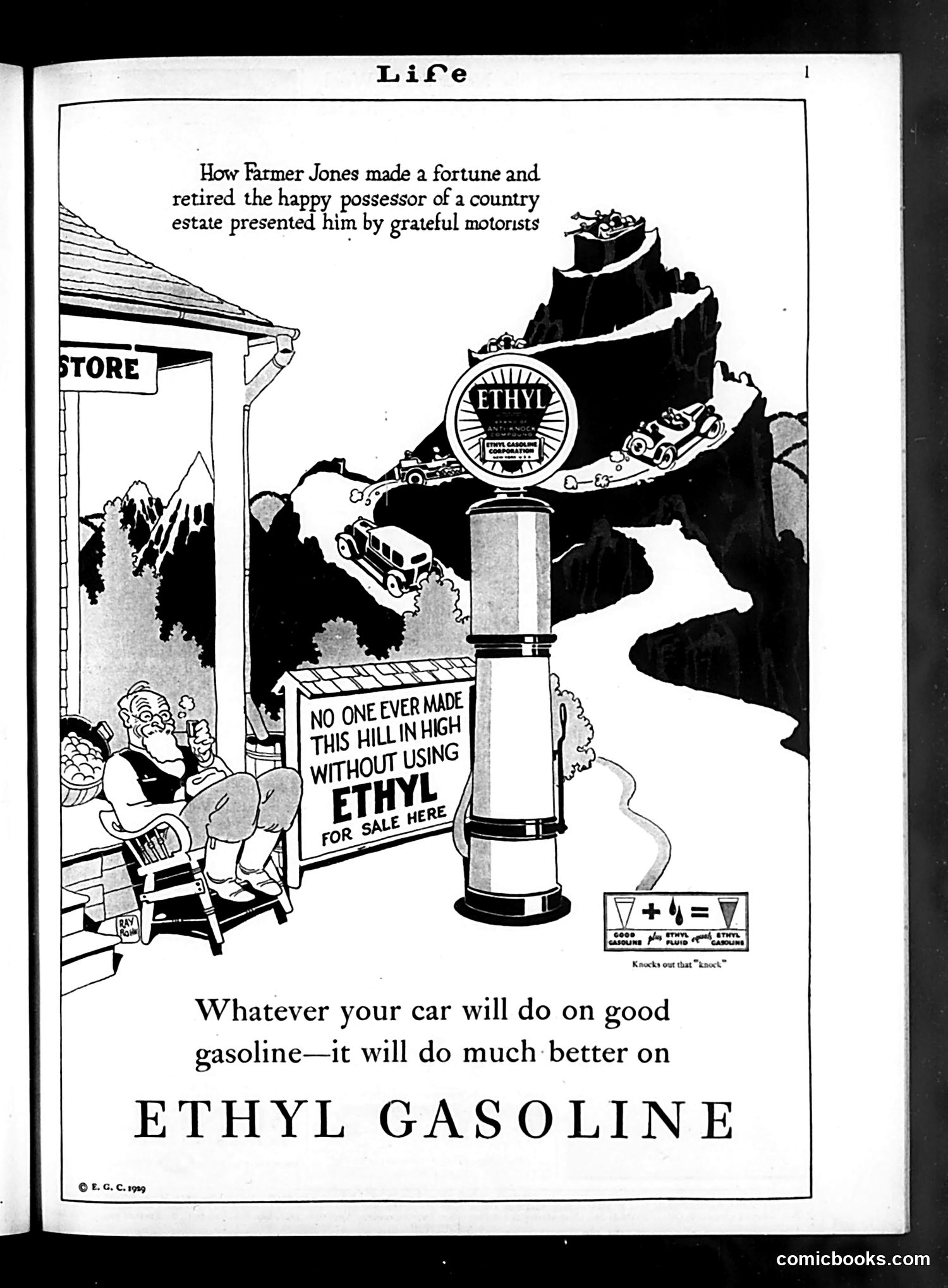
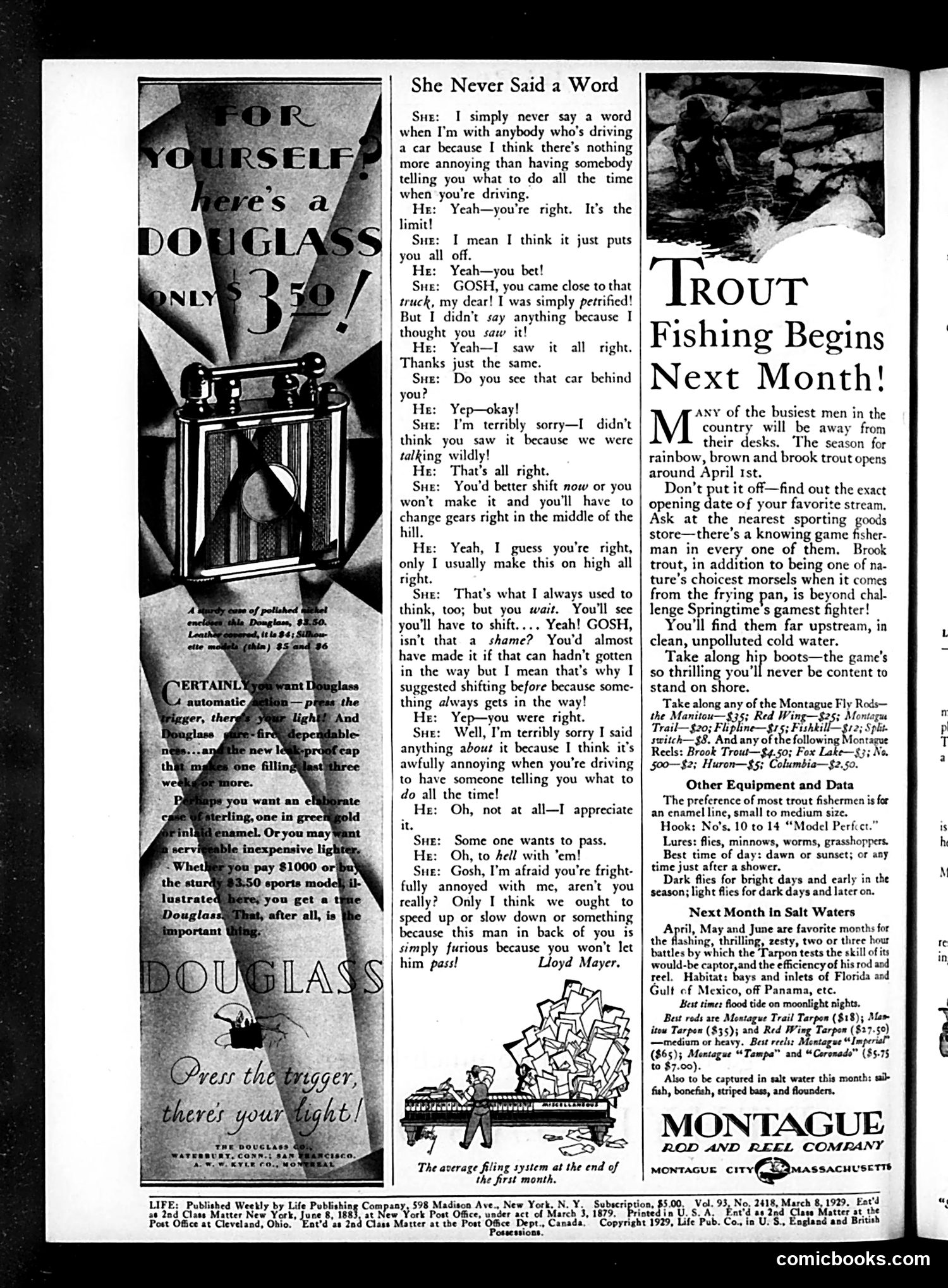
This page contains **three distinct elements**: a Douglas automobile advertisement (left), a satirical dialogue titled "She Never Said a Word" (center), and fishing/sporting goods advertisements (right). The central cartoon depicts a married couple driving. The wife remains silent during a near-accident, resisting her impulse to backseat-drive. The humor targets **gender stereotypes of the 1920s**—specifically the nagging wife trope. The satire mocks both the wife's self-restraint and the husband's obliviousness. The dialogue emphasizes marital tension around automobile safety and domestic control, portraying the wife's silence as either admirable restraint or suppressed frustration—the joke's interpretation depends on one's perspective. This reflects period anxieties about women's roles in modernizing society.
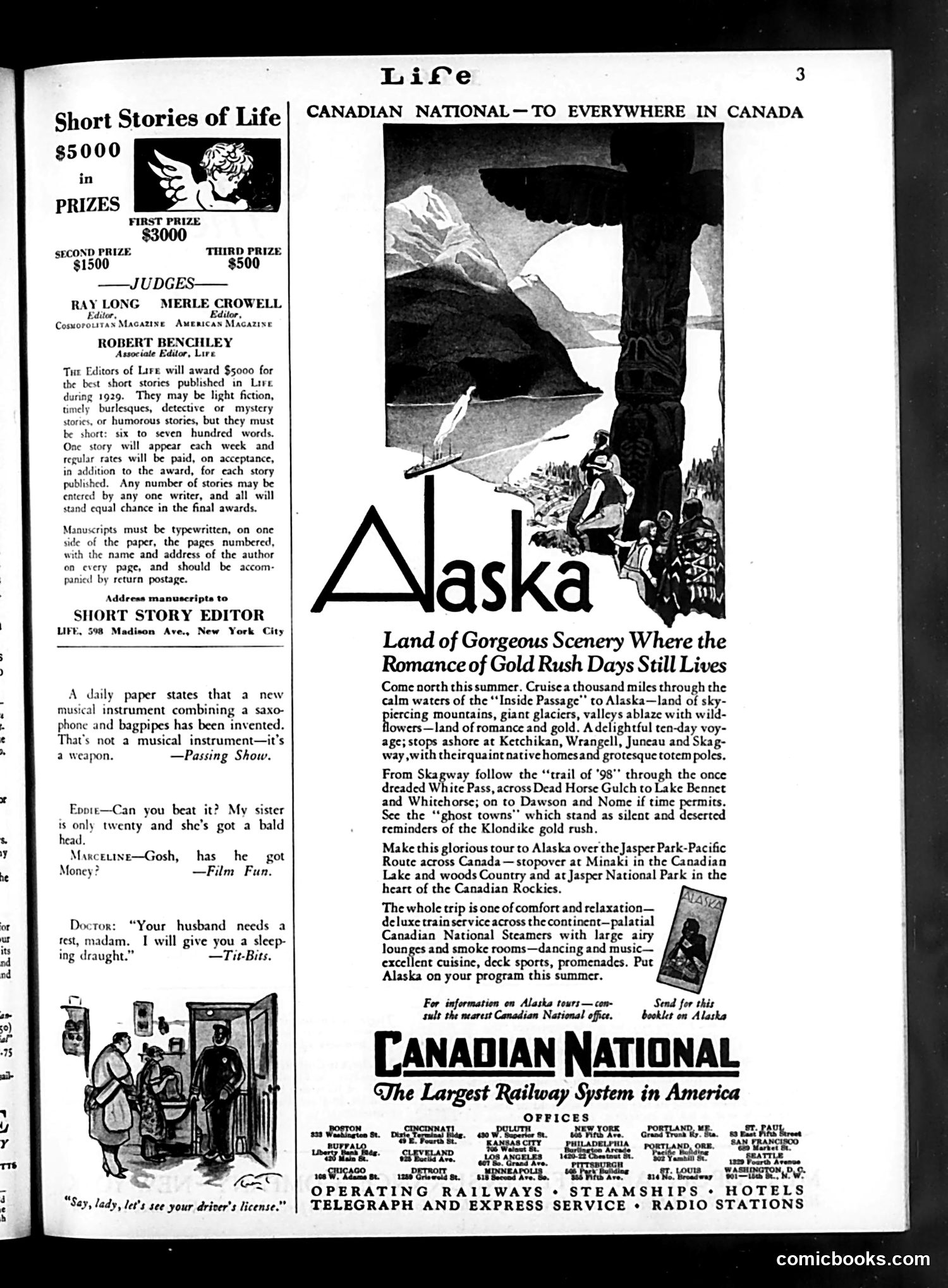
This page is primarily **advertising and contest announcement**, not political satire. The left column announces Life magazine's "$5000 in PRIZES" short story contest, with judges including editor **Ray Long** and **Merle Crowell** (American Magazine editor) and **Robert Benchley** (humorist/associate editor). Below are three brief jokes typical of Life's humor style: - A quip about a new musical instrument - A joke about a bald sibling - A doctor's sleeping-drought pun The main content is a **Canadian National Railway advertisement** promoting Alaska travel, featuring romanticized imagery of mountains, glaciers, and gold rush imagery. The bottom cartoon depicts travelers requesting to see a driver's license—a mundane domestic joke unrelated to the Alaska promotion. This is a commercial magazine page mixing editorial contests with travel advertising and light humor.
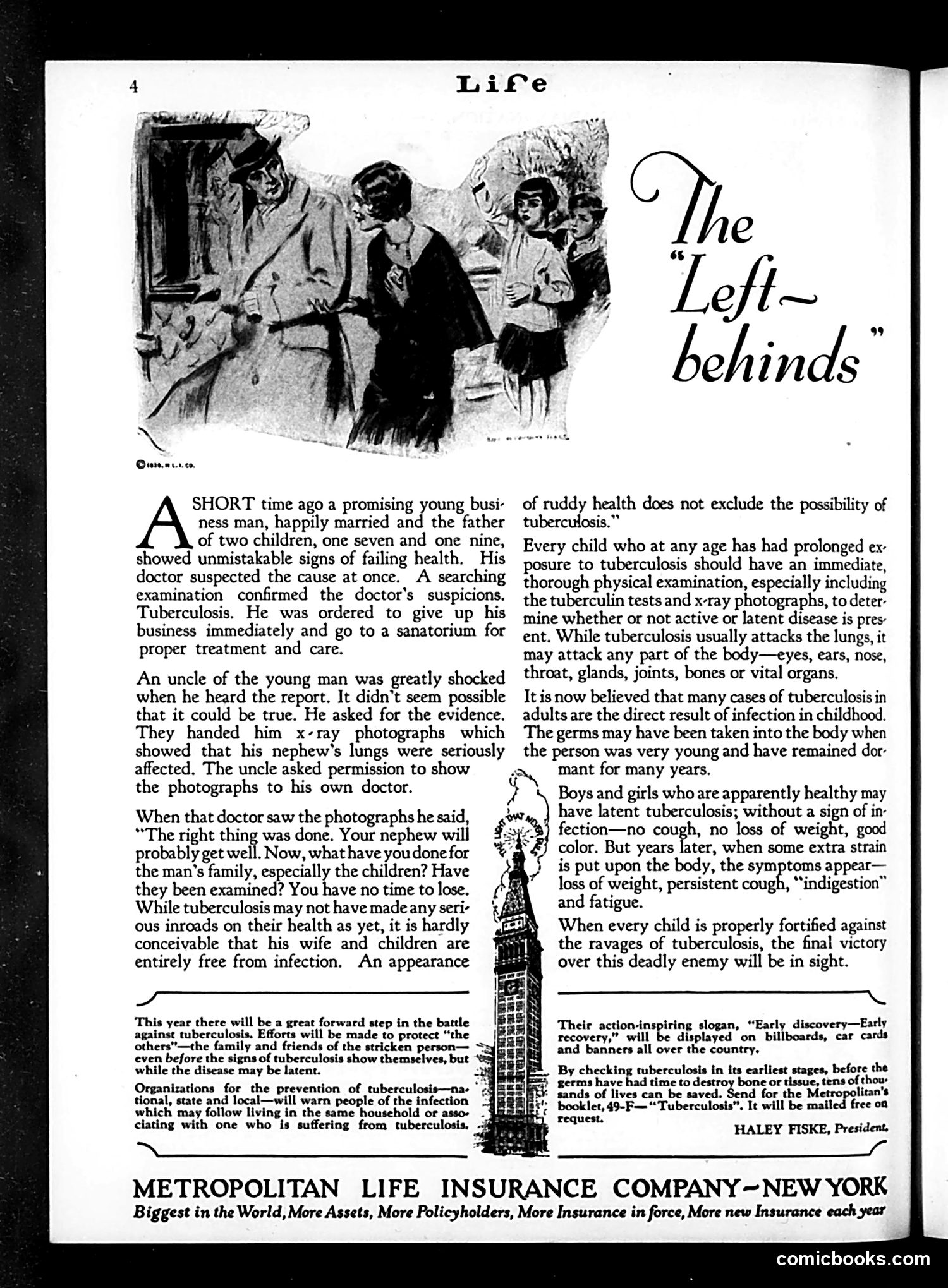
This page is primarily **advertising, not satire**. It's a Metropolitan Life Insurance Company promotional piece disguised as public health journalism. The illustration titled "The 'Left-behinds'" depicts a family scene where a businessman has contracted tuberculosis, leaving behind his wife and children—a scenario insurance would protect against. The accompanying text presents a cautionary case study: a young businessman with tuberculosis must abandon his business for sanatorium treatment, raising concerns about his family's welfare and whether his children have been infected. The "satire" is implicit: the ad uses fear and social anxiety (breadwinner illness, family abandonment, childhood disease) to motivate insurance purchases. The message conflates tuberculosis prevention education with Metropolitan Life's financial products, presenting insurance as part of public health infrastructure.
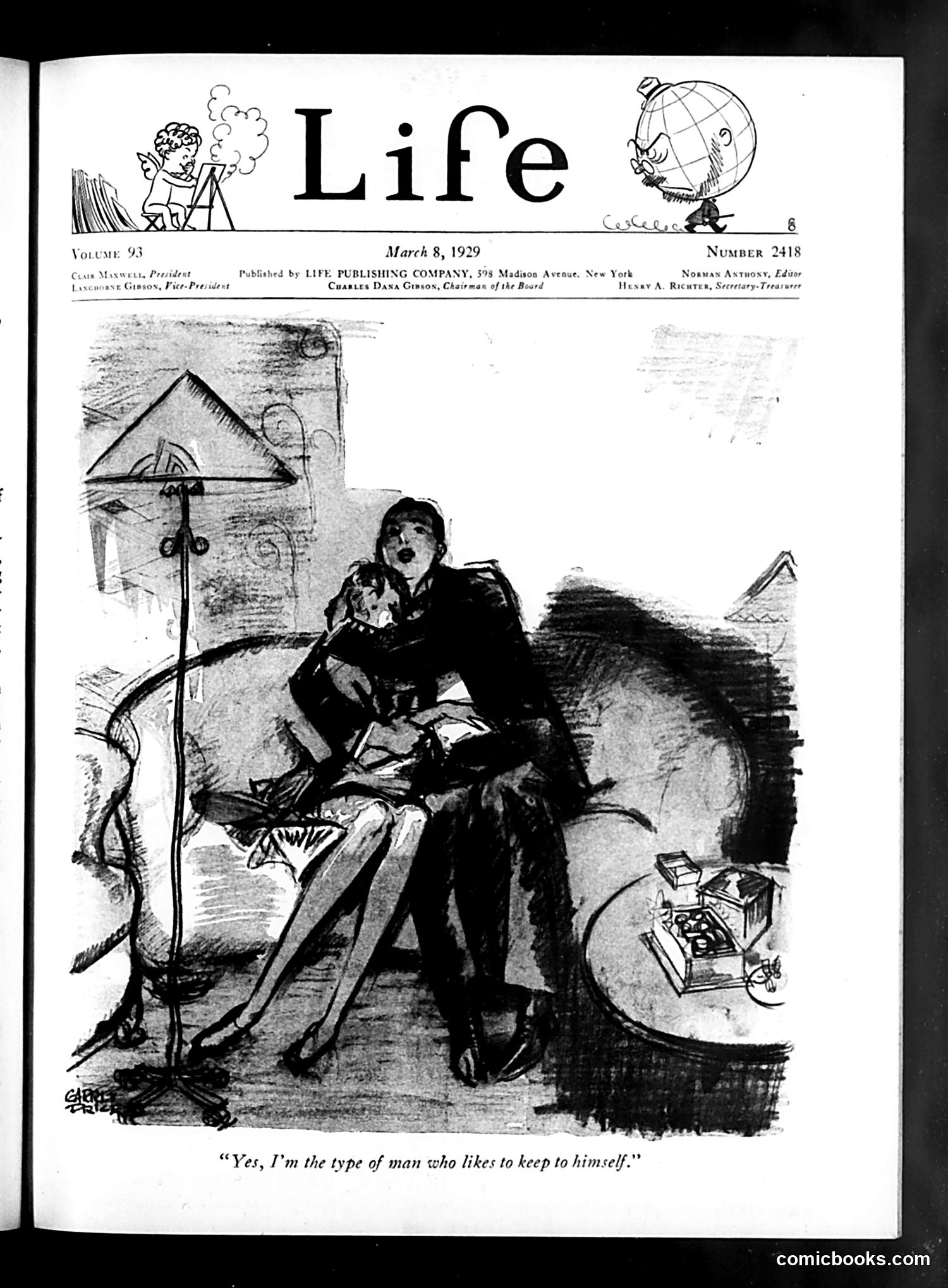
This cartoon satirizes a man's claim about being self-reliant and private ("Yes, I'm the type of man who likes to keep to himself"). The visual irony is stark: he's sitting with a woman on his lap in what appears to be a bedroom or intimate setting, surrounded by domestic furnishings and toys, completely contradicting his stated preference for solitude. The satire mocks masculine pretension—the gap between how men present themselves (as independent loners) versus their actual behavior (seeking companionship and comfort). The artist (signature appears to be present) uses this domestic scene to expose the hypocrisy of the claim, suggesting that most men, despite boasting about self-sufficiency, actually crave intimacy and domestic life.
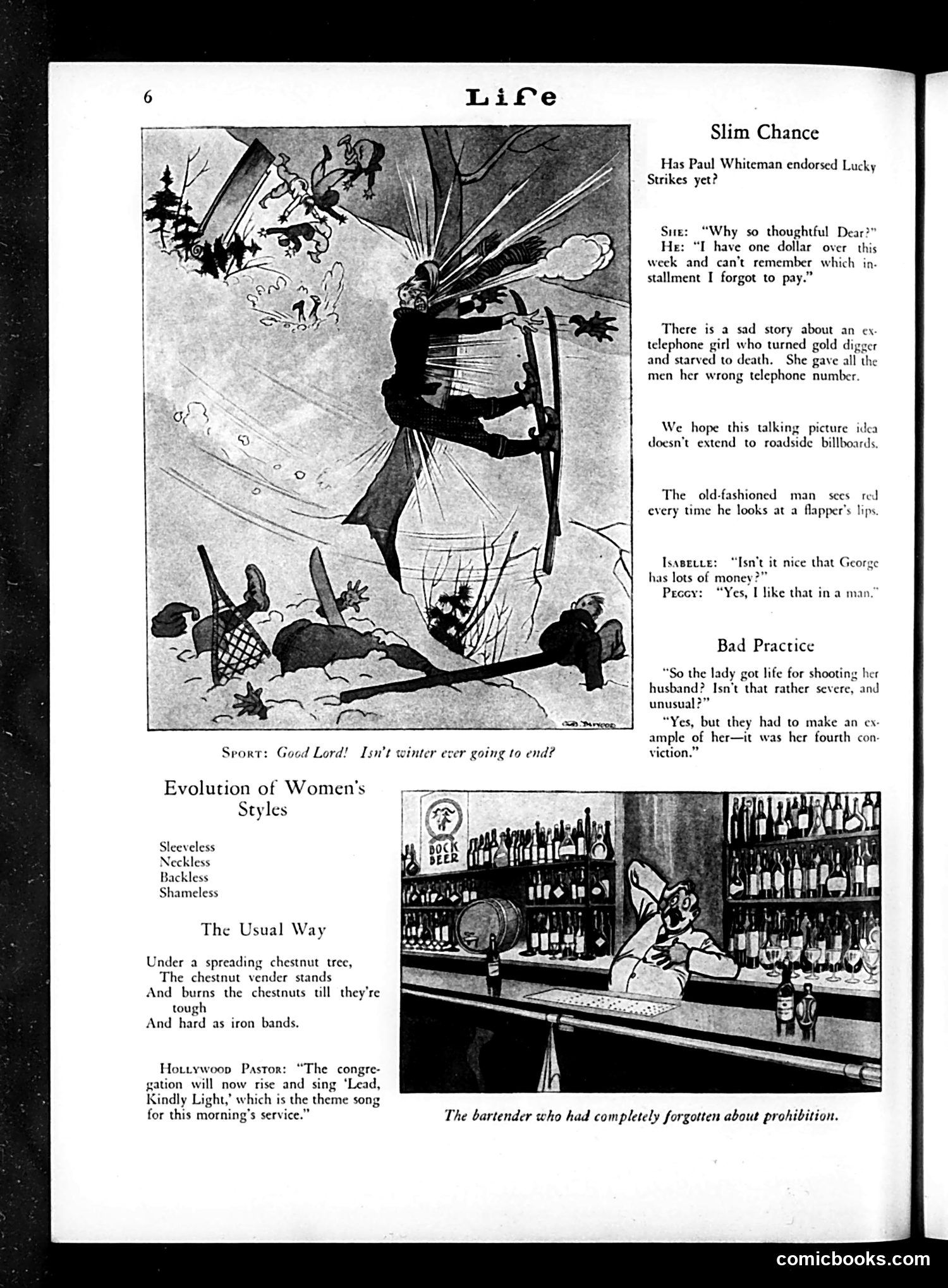
**Main Cartoon (top):** Depicts a woman in winter clothing being blown away by explosive force, surrounded by scattered belongings and small figures. Caption reads "Good Lord! Isn't winter ever going to end?" This appears to be general humor about harsh winter weather rather than political satire. **Right Column ("Slim Chance"):** Brief humorous anecdotes about modern life—a forgetful husband, a telephone operator, and observations about fashion and social behavior. No political content. **Bottom Cartoon:** Shows a bartender serving drinks, captioned "The bartender who had completely forgotten about prohibition." This directly references Prohibition (the alcohol ban), satirizing how widespread illegal drinking was during this period, even among service workers. The page is primarily light social satire rather than political commentary.
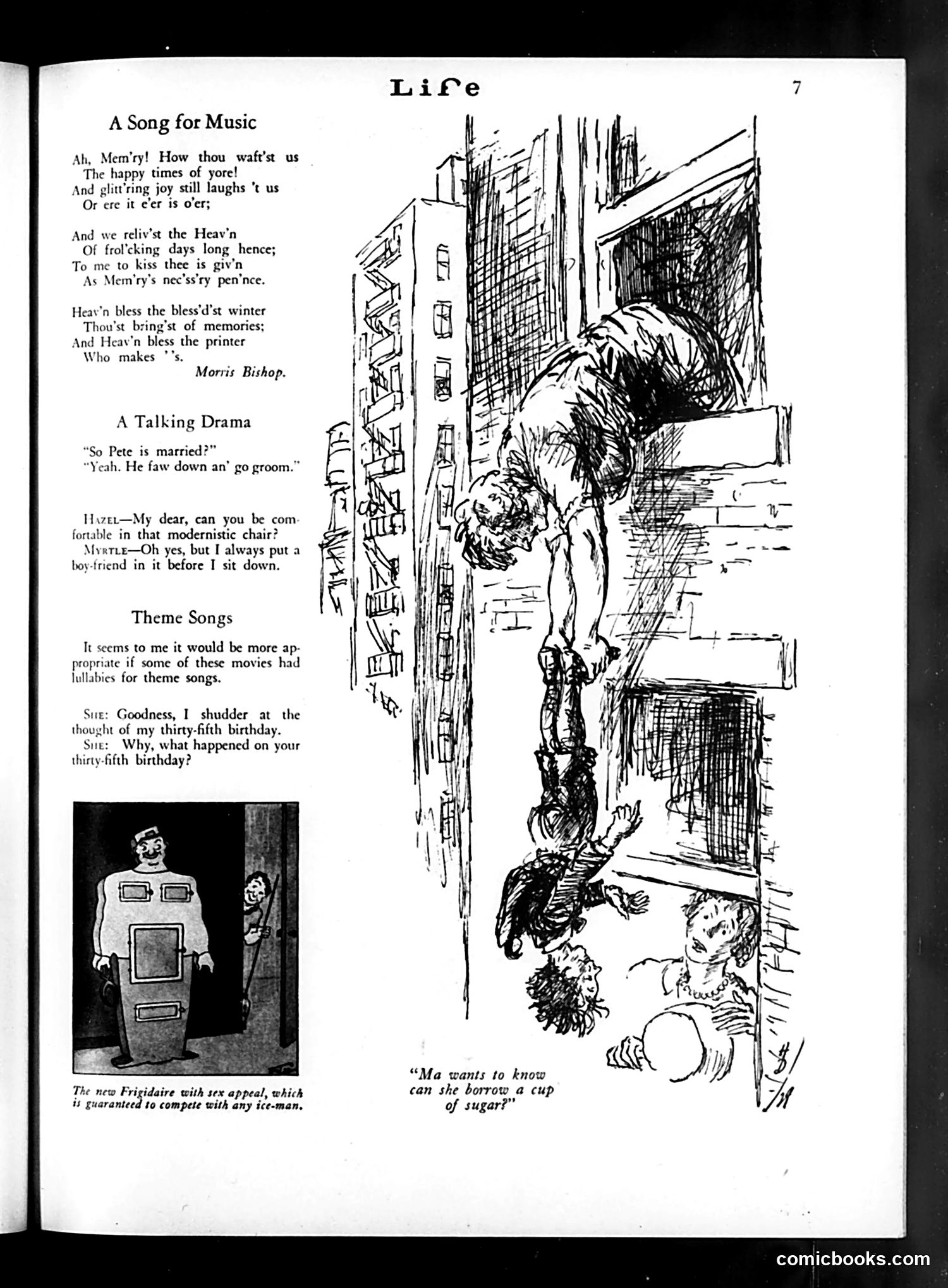
This page contains three separate humor pieces: **"A Song for Music"** - A sentimental poem by Morrit Bishop celebrating music and memory, with no satirical intent. **"A Talking Drama"** - A brief comedic dialogue about a man named Pete getting married, with his friend making a joke about breaking in a "boy-friend" before sitting down—likely implying homosexual innuendo. **"Theme Songs"** - A joke about a woman dreading her thirty-fifth birthday, playing on period anxieties about female aging. **The Frigidaire Advertisement** - Shows a mechanical ice-box costume character, satirizing modern appliances by depicting them as inhuman replacements. **The Cartoon** - A domestic scene showing a woman asking to borrow sugar from a neighbor, a mundane social interaction rendered as comedy, possibly satirizing suburban domesticity or women's domestic roles.
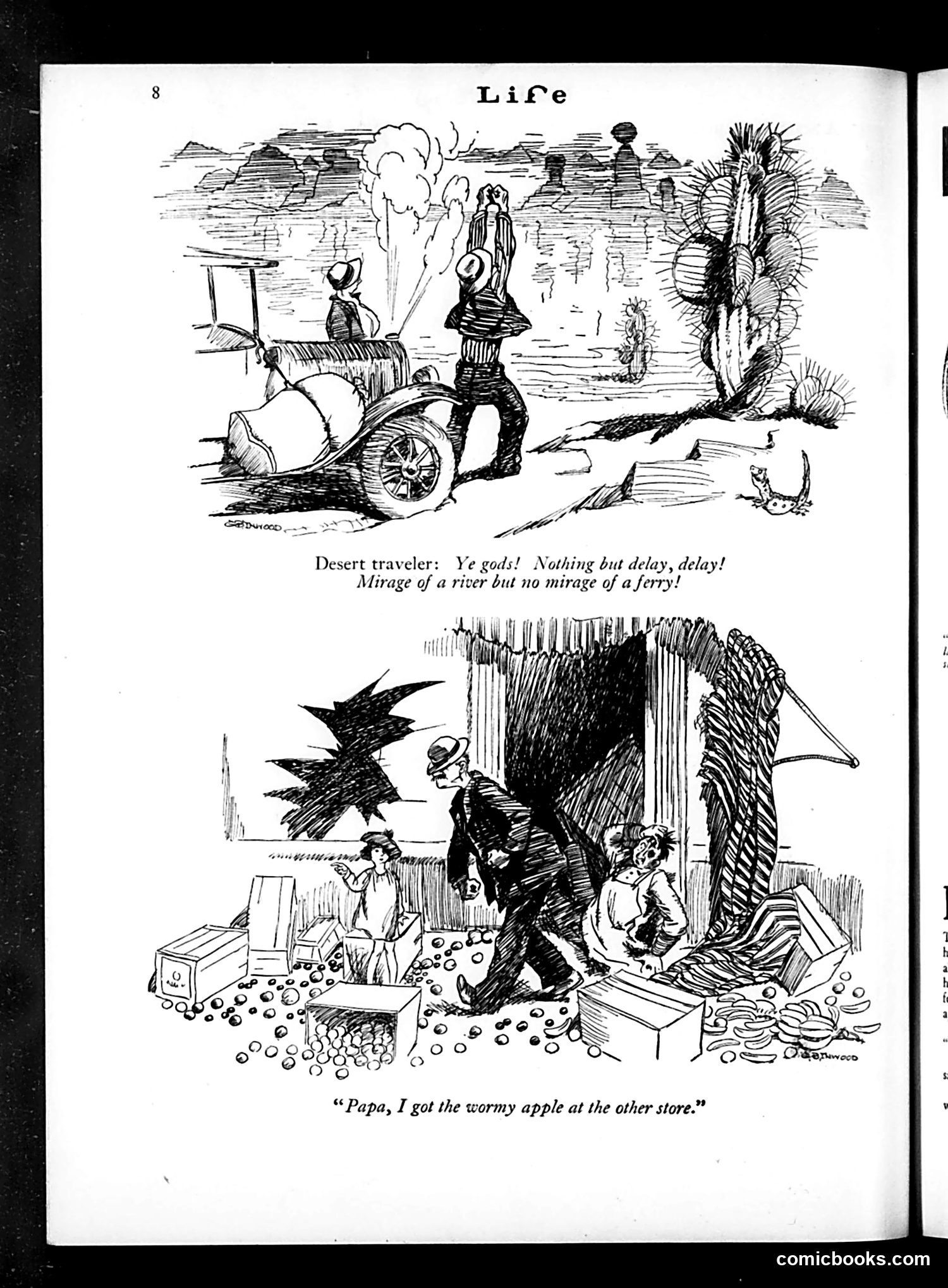
This page contains two unrelated satirical cartoons: **Top cartoon:** A desert traveler complains "Nothing but delay, delay! Mirage of a river but no mirage of a ferry!" The joke targets the frustration of broken promises—the traveler sees illusory water (mirages) yet lacks actual transportation across a real river. This appears to satirize bureaucratic or political delays and unfulfilled expectations. **Bottom cartoon:** A child tells his father "Papa, I got the wormy apple at the other store." The humor is darkly ironic: the child deliberately chose an inferior product, suggesting either poor judgment or mischief. It likely comments on consumer behavior or family dynamics regarding value and quality. Both cartoons use exaggerated situations for humorous social commentary typical of early-to-mid 20th century Life magazine satire.
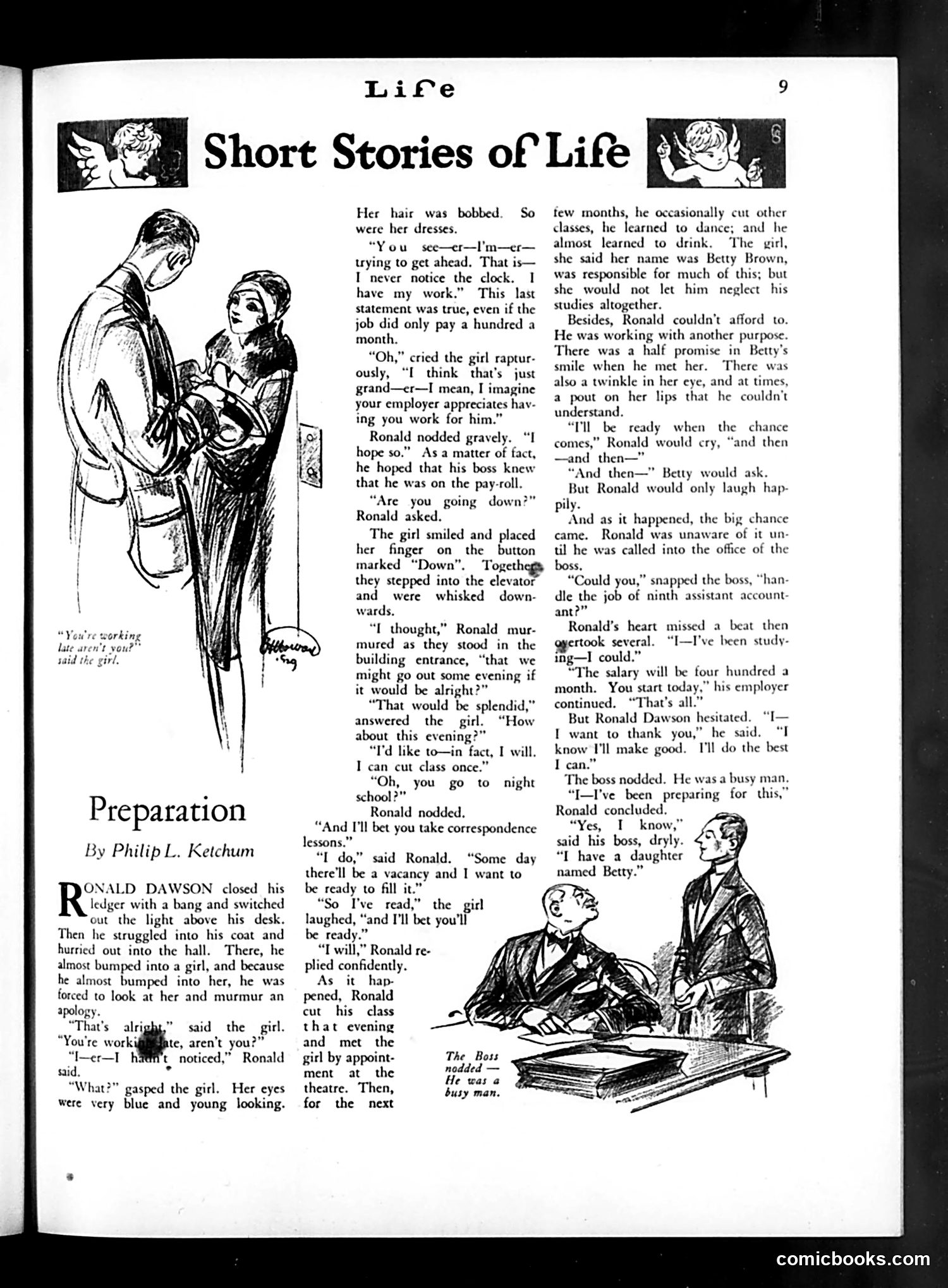
This is a romantic short story, not political satire. The narrative follows Ronald Dawson, a young office worker who leaves work late and encounters an attractive girl in an elevator. She mentions wanting to go out some evening. Ronald becomes determined to advance his career to be worthy of her. When his boss unexpectedly offers him a promotion to ninth assistant accountant—a modest raise to four hundred dollars monthly—Ronald sees it as preparation for courting the girl (Betty Brown, the boss's daughter, though Ronald doesn't initially know this). The story's humor derives from Ronald's earnest self-improvement and the irony that his professional ambition stems from romantic motivation rather than careerism.
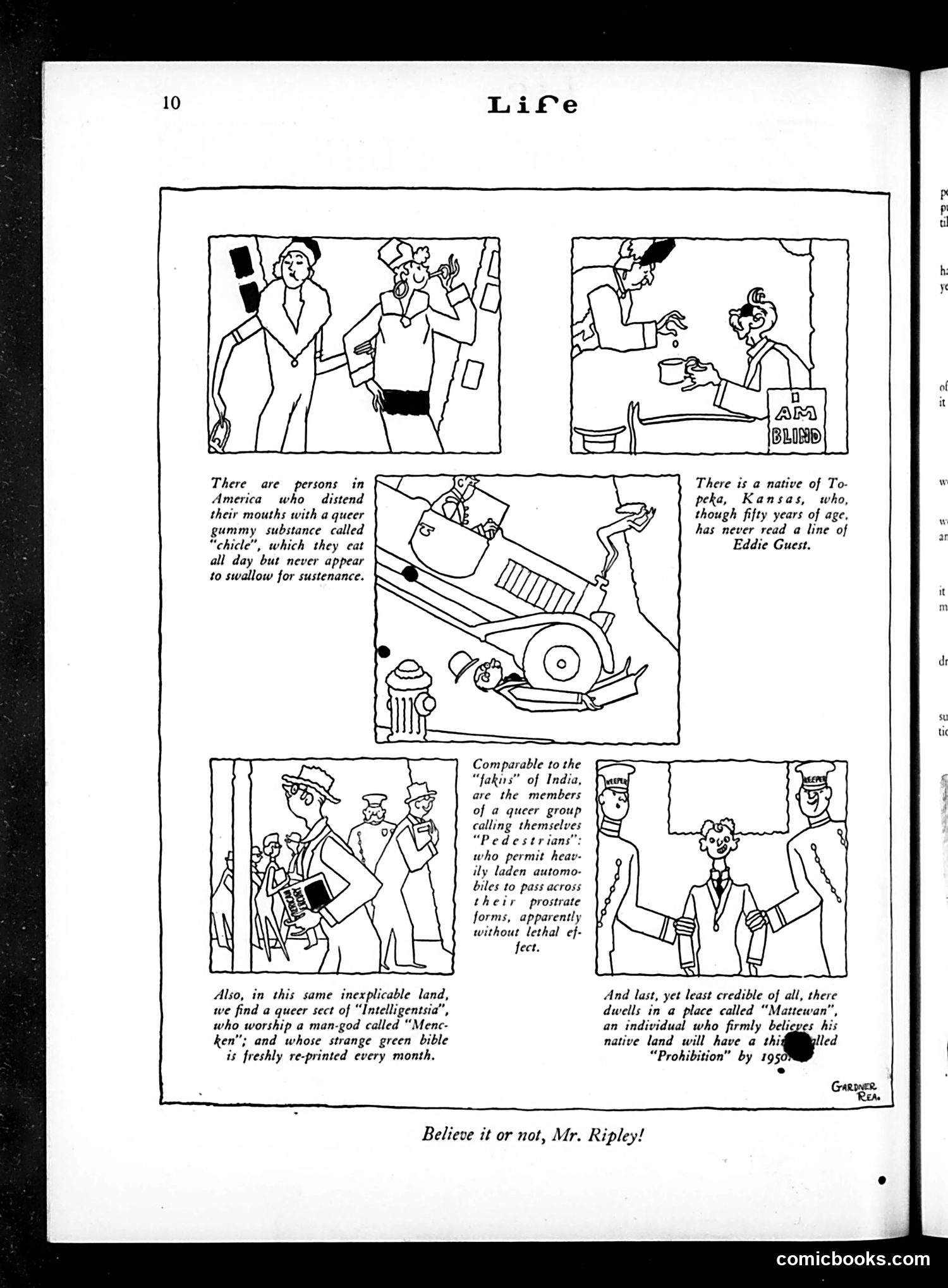
This page satirizes exotic or bizarre cultural practices through cartoon vignettes, presented in the style of Robert Ripley's famous "Believe It or Not!" feature. The cartoons mock what the author presents as absurd customs from unnamed locations: - A group that eats gummy candies but never swallows them - A 50-year-old man who has never read anything - People called "Pedestrians" who somehow drive cars without harm - A religious sect worshipping a man-god named "Mencken" with reprinted green bibles - A place called "Mateewan" with "Prohibition" laws by 1950 The satire targets contemporary American absurdities by presenting them as exotic foreign curiosities, mocking ignorance, religious fervor, traffic safety, and alcohol prohibition—all recognizable to 1920s-30s American audiences.
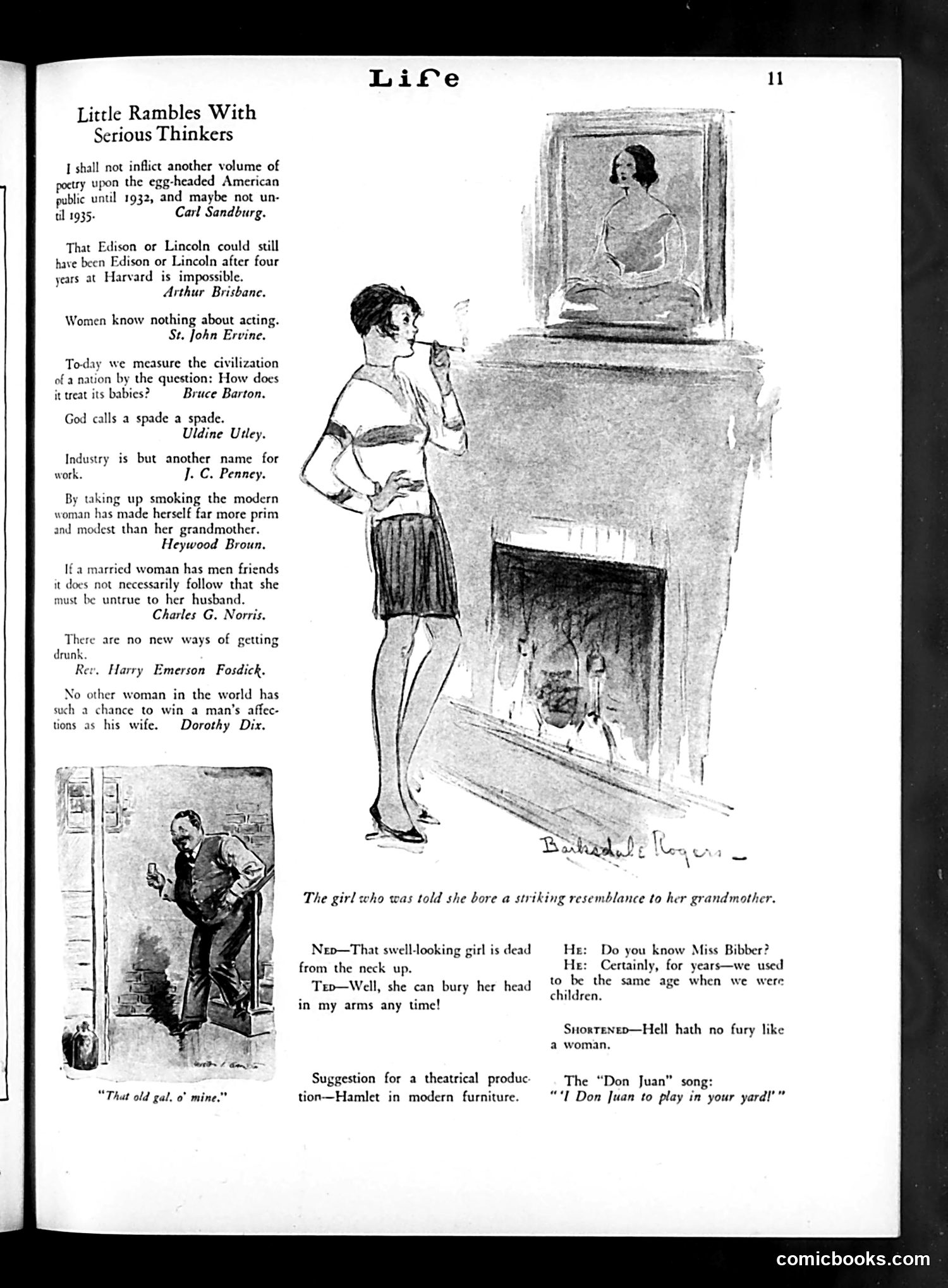
This page contains satirical quotes and two illustrations mocking social attitudes of the era. The main cartoon depicts a woman admiring her own portrait in a mirror while smoking—captioned "The girl who was told she bore a striking resemblance to her grandmother." The joke satirizes vanity and generational beauty standards. The smaller illustration ("That old gal, o' mine") shows a man at a doorway, accompanying a joke about burying a woman's head. The humor relies on misogynistic stereotypes common to the period. The "Little Rambles With Serious Thinkers" section quotes prominent figures (Carl Sandburg, Arthur Brisbane, etc.) offering observations about modern life, civilization, and gender relations—some progressive, others reflecting dated attitudes about women's roles and abilities.
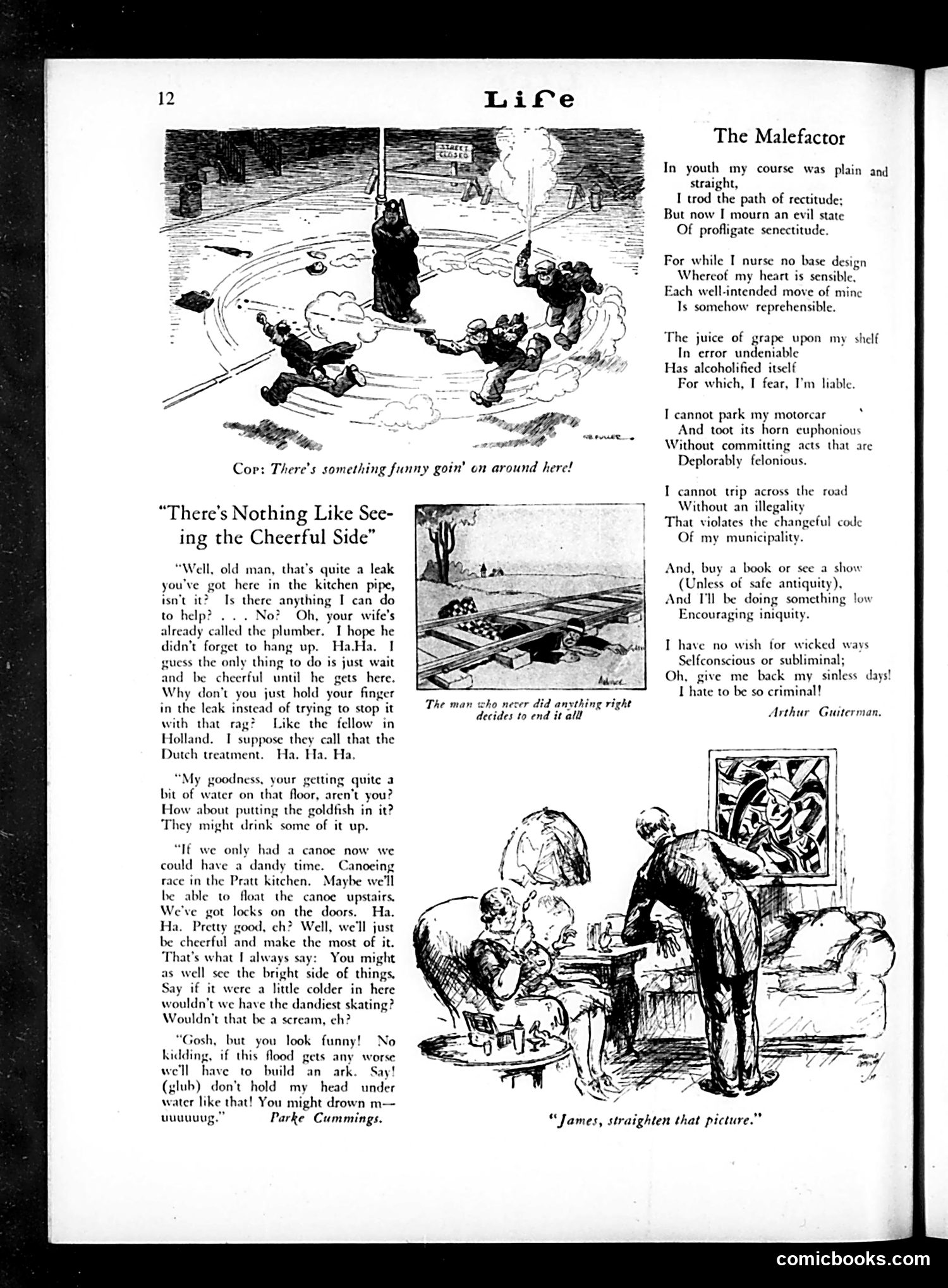
This page contains two distinct pieces: **"There's Nothing Like Seeing the Cheerful Side"** (left): A humorous dialogue between a plumber and homeowner dealing with a kitchen leak. The plumber offers deliberately absurd "solutions" (using a canoe, goldfish, building an ark) rather than actually fixing the problem. The joke satirizes how some service people avoid real work through charm and deflection. **"The Malefactor"** (right): A poem by Arthur Guterman lamenting modern regulations and social constraints. The speaker complains he cannot park, cross streets, buy books, or act freely without violating some code or law—suggesting satirical frustration with increasingly bureaucratic society and loss of personal liberty. Both pieces reflect early-to-mid 20th-century anxieties about modern inconveniences and governmental overreach.
This page contains a collection of humorous short anecdotes from various American towns, presented as a regular "Life at Home" feature. Rather than political cartoons, it consists of satirical news-style vignettes mocking small-town life and human nature. The jokes target: - Small-town eccentricities (a man eating 5 pies daily for 35 years) - Domestic absurdities (a wife shooting her husband, then laughing it off) - Social hypocrisy (teaching children to smoke) - Legal/bureaucratic humor (a burglar leaving an apologetic note) - Human foolishness (dynamite possession by schoolboys) The format presents these as "true" anecdotes, using the incongruity between earnest news-reporting style and ridiculous content for comedic effect. The satire reflects early 20th-century American attitudes toward rural and provincial life as inherently ridiculous.
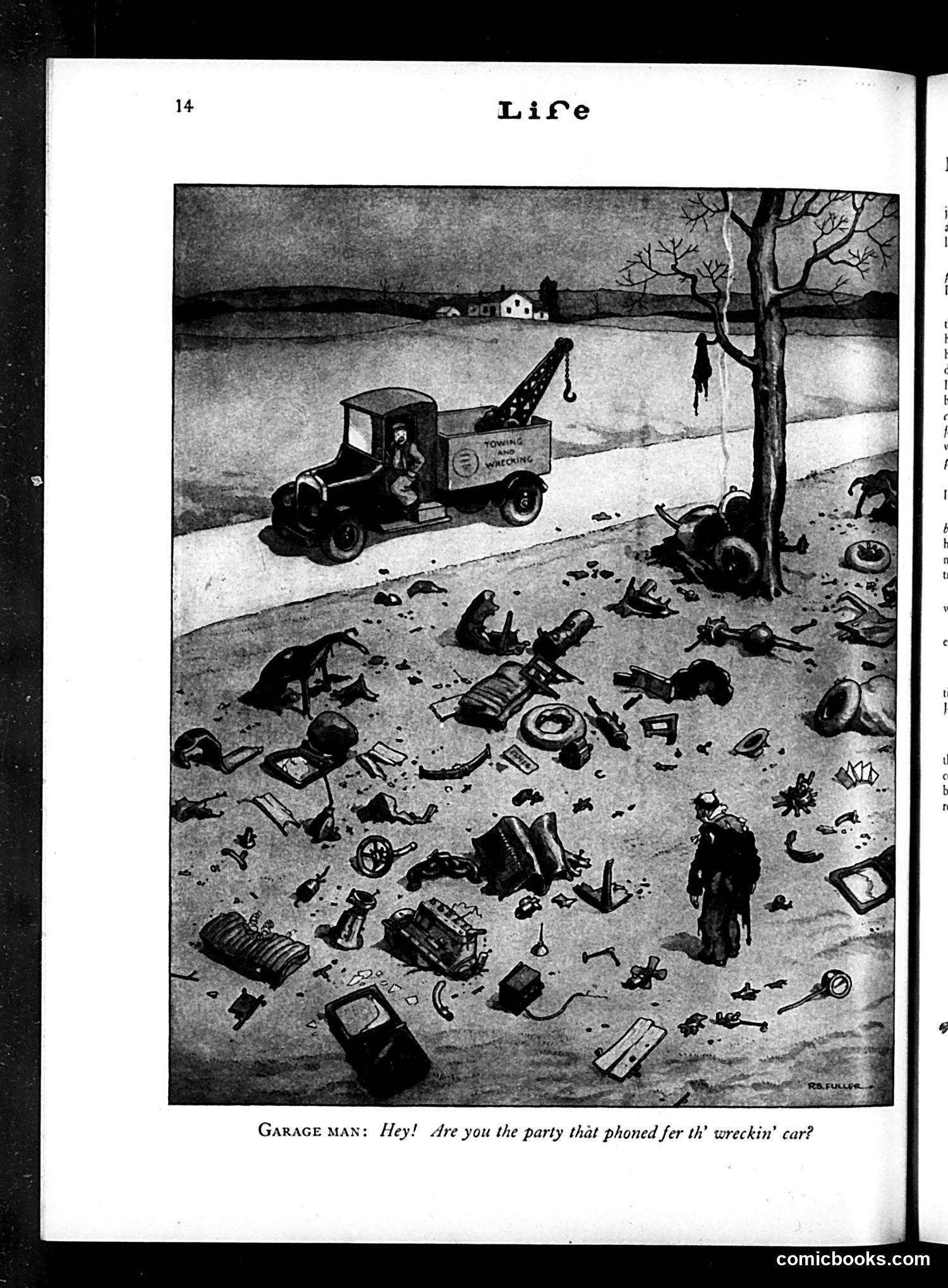
This single-panel cartoon depicts a wrecking truck arriving at a scene of automotive destruction. A garage man addresses the truck operator with the caption: "Hey! Are you the party that phoned fer th' wreckin' car?" The humor is situational irony: the wrecking truck has arrived to collect a damaged vehicle, but the "wreck" shown is actually an enormous pile of car parts, engines, wheels, and mechanical debris scattered across the ground—far exceeding a single broken car. The visual gag suggests either catastrophic over-damage or that multiple vehicles have been destroyed. This likely satirizes careless or negligent auto repair practices of the era, or possibly poor driving/accident conditions. The rural setting (farmhouse visible in background) and dialect ("fer th'") add period-authentic working-class character.
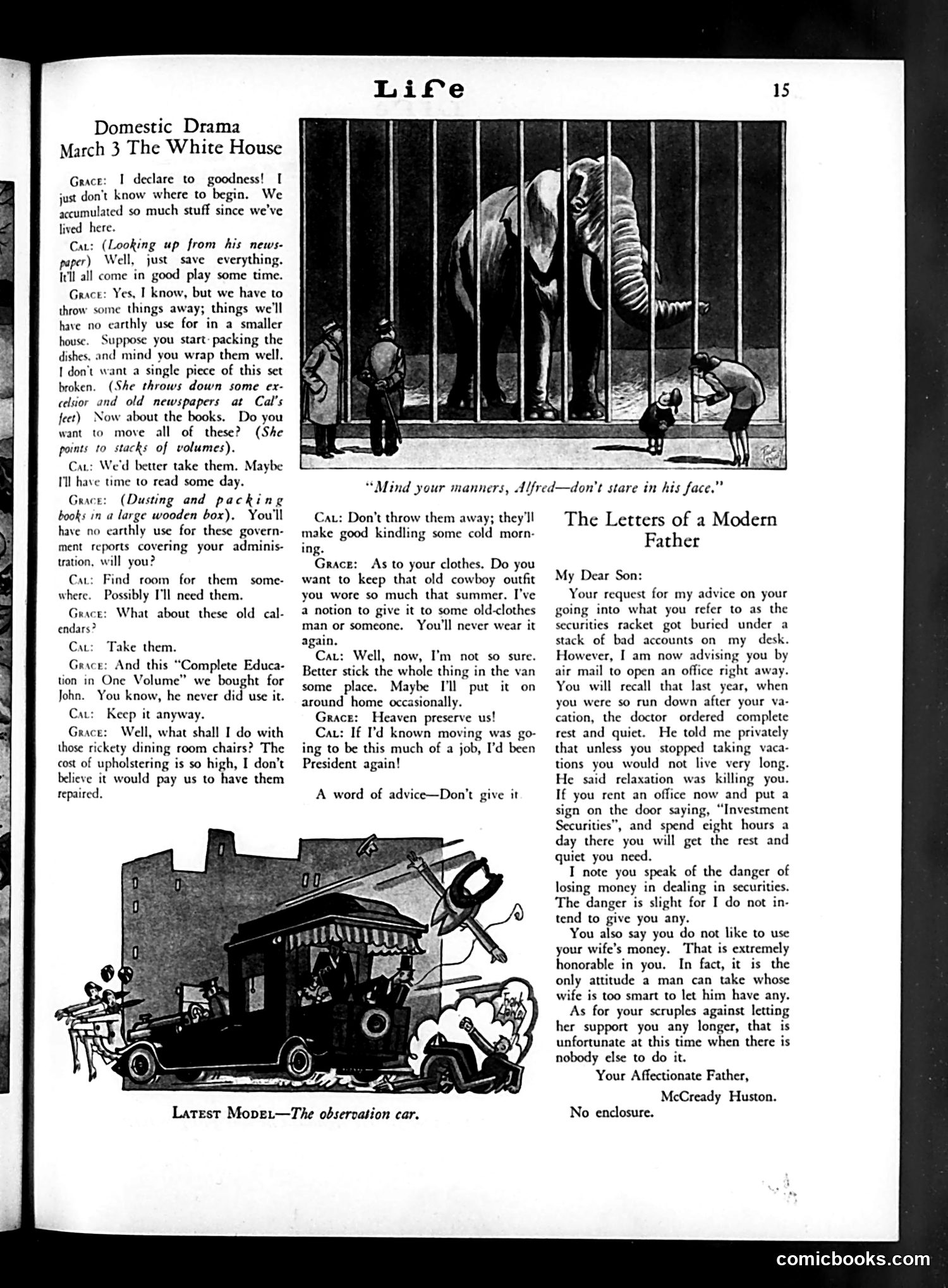
**Top Cartoon ("Mind your manners, Alfred"):** Shows two figures at a zoo viewing elephants behind bars. The caption warns against staring rudely at the animals. This is a straightforward etiquette joke about teaching children proper behavior in public spaces—a common theme in early 20th-century domestic humor. **"Domestic Drama" and "Letters of a Modern Father":** These are comedic domestic sketches typical of Life's satirical content. The drama depicts a couple managing a household move, debating what possessions to keep or discard. The letter section offers humorous paternal advice about finances and marriage, satirizing contemporary middle-class concerns about money management and spousal independence. **Bottom Cartoon ("Latest Model—The observation car"):** Depicts an overcrowded, chaotic automobile, satirizing the rapid proliferation of cars in American society and traffic congestion.
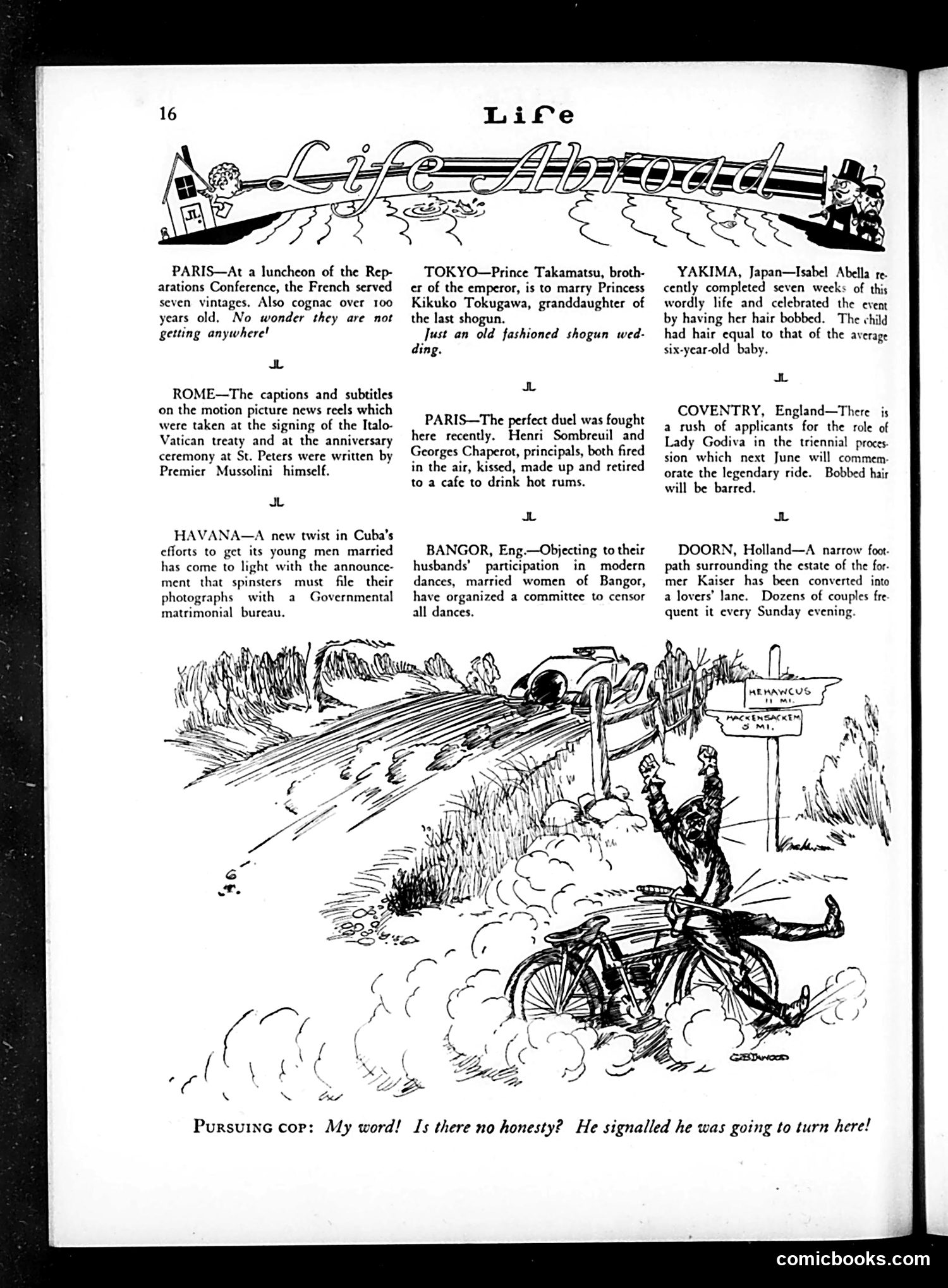
This page from *Life* magazine presents six international news briefs with satirical commentary on customs and current events: **Key items:** - **Paris**: French served 100-year-old cognac at a diplomatic conference—the satire mocks excessive luxury - **Rome**: References the Italo-Vatican treaty signing, with captions written by Mussolini - **Havana**: Mocks Cuba's requirement that photographs with matrimonial bureaus include government approval - **Tokyo**: Reports on a royal marriage and celebrates a child's "modern" bobbed haircut - **Coventry, England**: Notes applicants for a ceremonial role; bobbed hair will be barred (contrasting with the Japan item) - **Bangor, England**: Wives organized a dance-censorship committee - **Doorn, Holland**: A converted lovers' lane now attracts couples on Sundays The bottom cartoon depicts a bicycle accident with a pursuing cop, playing on the "Doorn" item's implications about romance and rule-breaking.
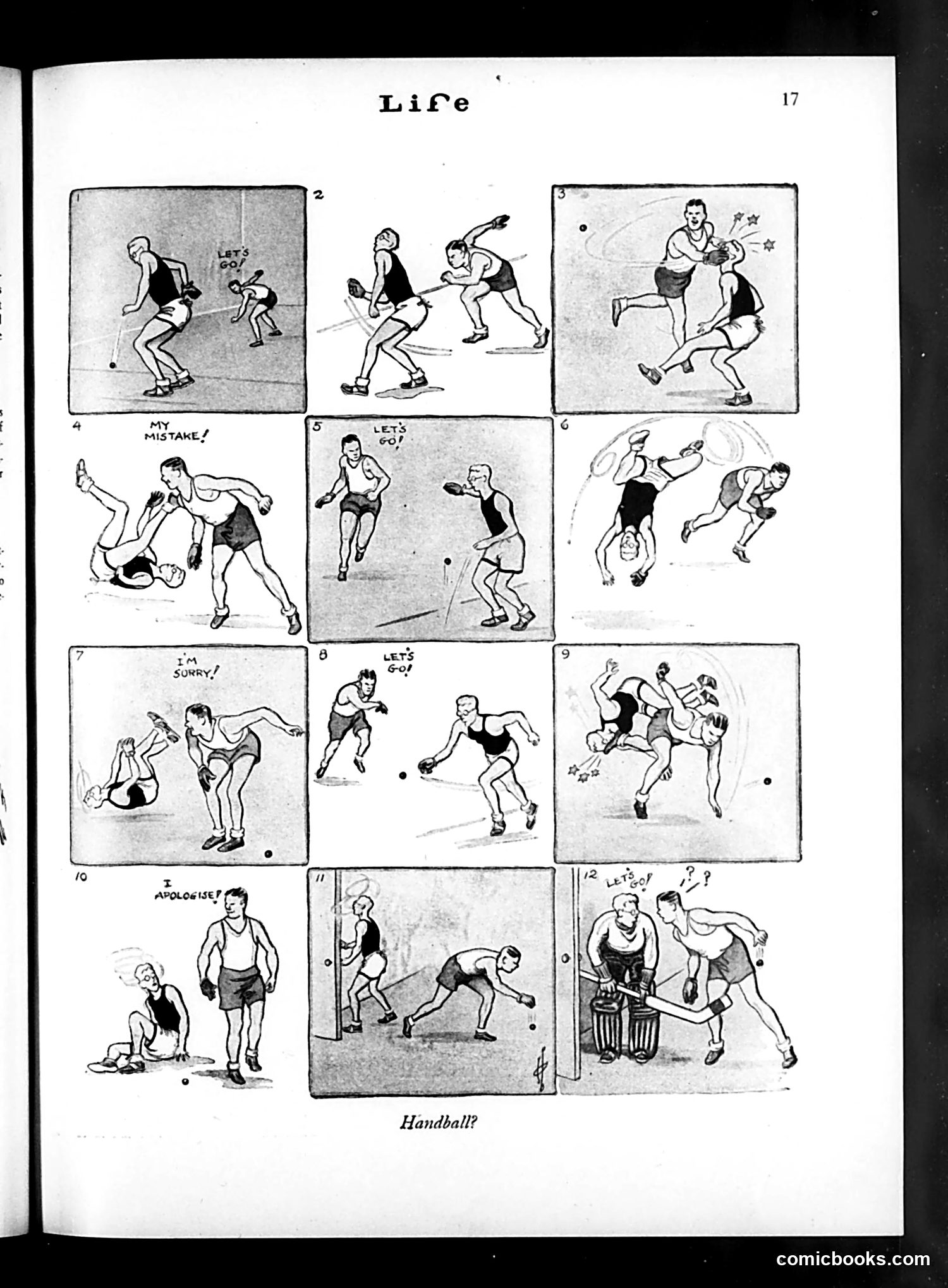
This is a sequential comic strip titled "Handball" depicting a recreational game between two players. The narrative follows a humorous match: Panels 1-3 show the opening plays with dialogue like "Let's go!" establishing the game. Panel 4 ("My mistake!") shows one player making an error. Panels 5-9 continue competitive back-and-forth action with exclamations ("Let's go!"). Panel 10 ("I apologize!") shows a player acknowledging another mistake. Panels 11-12 conclude with dialogue ("Let's?") suggesting ongoing competitive play. The humor appears to derive from the physical comedy of the sport—awkward positions, collisions, and competitive banter between amateur players. This is straightforward sports entertainment rather than political satire, reflecting Life magazine's frequent inclusion of humorous recreational activities aimed at middle-class readers.
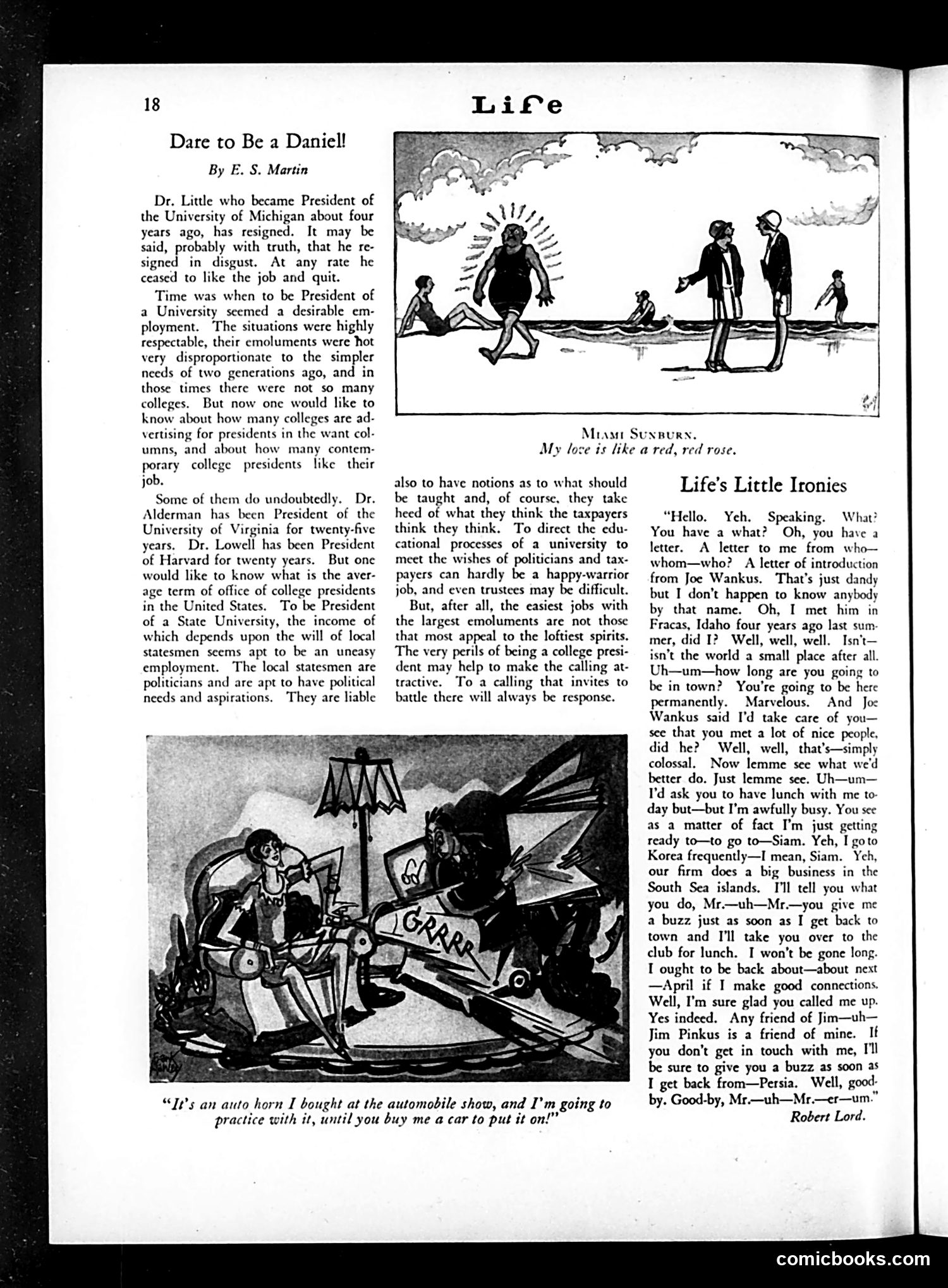
**Main Article: "Dare to Be a Daniel!"** E.S. Martin discusses the declining prestige of university presidencies. He notes that Dr. Little recently resigned from the University of Michigan presidency "in disgust," and observes that college president positions—once desirable—are now frequently advertised in want ads. Martin suggests the job has become unattractive because state university presidents must navigate political pressures from politicians and taxpayers who interfere with educational decisions. He argues that despite these difficulties, the position still attracts some principled leaders willing to fight for institutional integrity. **"Life's Little Ironies"** Robert Lord presents a satirical telephone conversation where someone receives a call from an unknown person bearing a letter of introduction. The recipient fabricates increasingly elaborate excuses to avoid meeting the visitor—claiming business trips to Siam, Korea, and Persia—while offering vague promises to reconnect "next April" or later. The humor lies in the transparent, polite dishonesty of social rejection masquerading as genuine interest. The cartoons illustrate similar themes of social awkwardness and professional frustration common to the era.
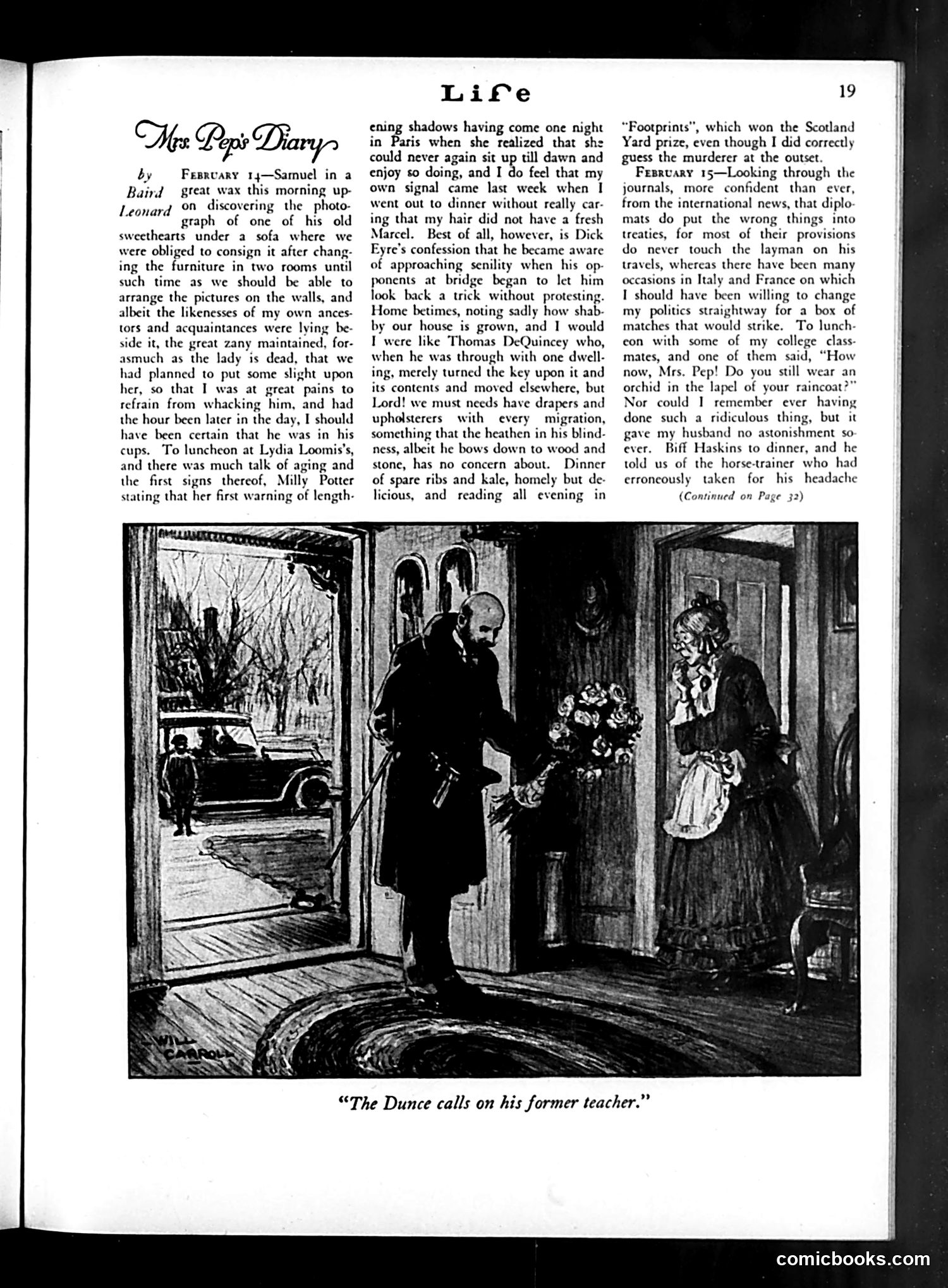
This page presents a satirical diary entry mocking upper-middle-class concerns and vanities. The narrator catalogs trivial worries: discovering an old sweetheart's photograph, anxieties about aging (gray hair, loss of stamina), and complaints about moving furniture and hiring decorators. The accompanying illustration shows a man presenting flowers at a doorway—captioned "The Dunce calls on his former teacher." This appears to illustrate a social visit, likely referencing one of the diary's anecdotes about old acquaintances. The satire targets genteel society's preoccupations: obsessing over physical signs of aging, maintaining appearances, and domestic upheaval. References to bridge games, dinner parties, and reading detective novels ("Footprints") establish the comfortable, leisured world being gently mocked. The overall tone is affectionate mockery of drawing-room concerns rather than sharp political critique.
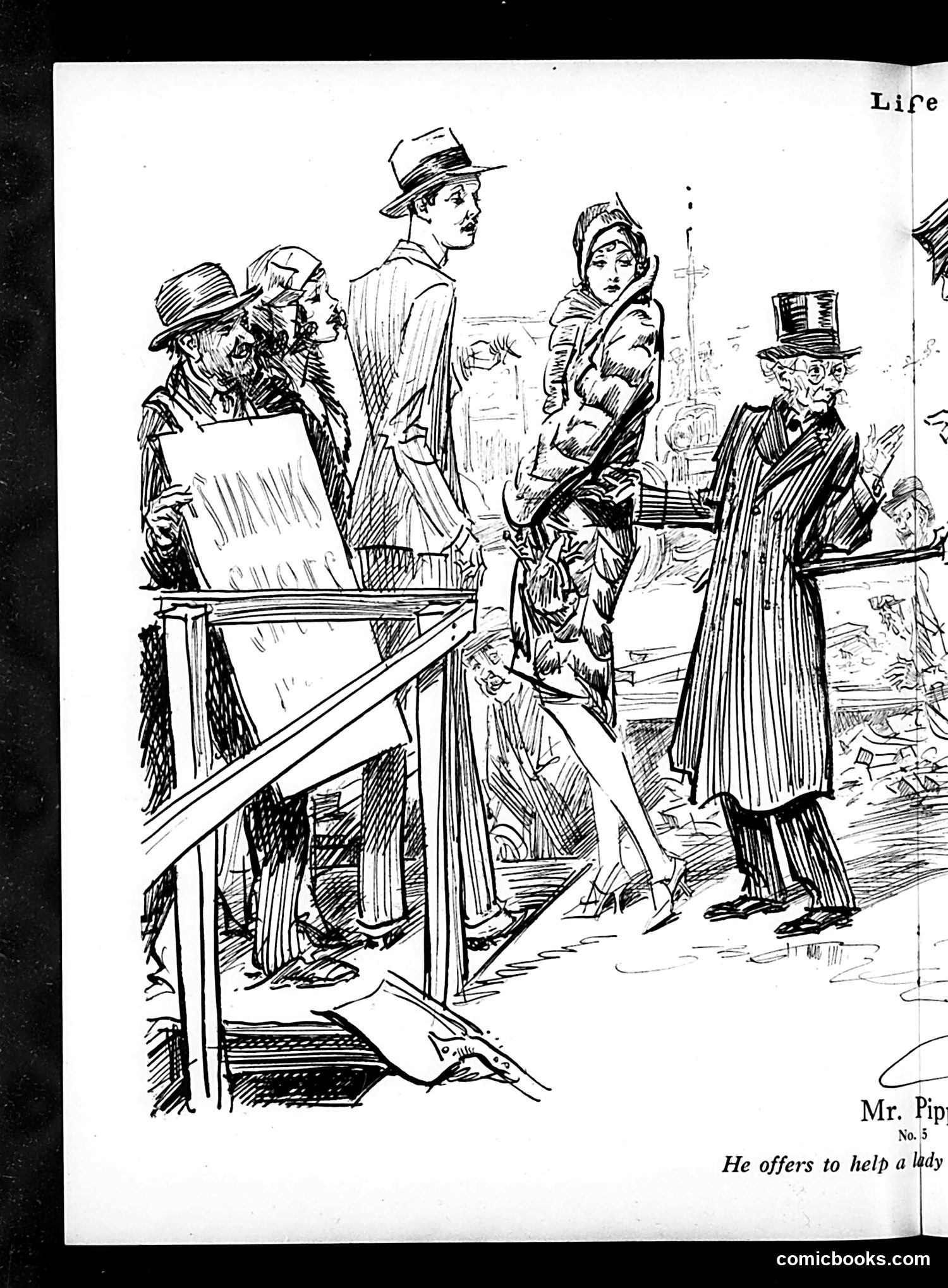
This appears to be a single-panel cartoon from *Life* magazine titled "Mr. Pip" (No. 5), captioned "He offers to help a lady." The scene depicts a well-dressed gentleman in a top hat offering assistance to a woman with luggage or parcels on what appears to be a dock or platform. Several other figures observe the interaction, including a bearded man on the left and other onlookers. The satirical point likely concerns **class dynamics and propriety**—the cartoon appears to mock either excessive chivalry, social pretension, or the gentleman's true motivations in offering help. The careful observation by bystanders suggests the scene's comedic potential lies in what the gentleman's gesture truly represents. Without additional context about "Mr. Pip" as an ongoing character, the specific target of satire remains unclear, though it likely reflects early-20th-century attitudes about manners and social interaction.
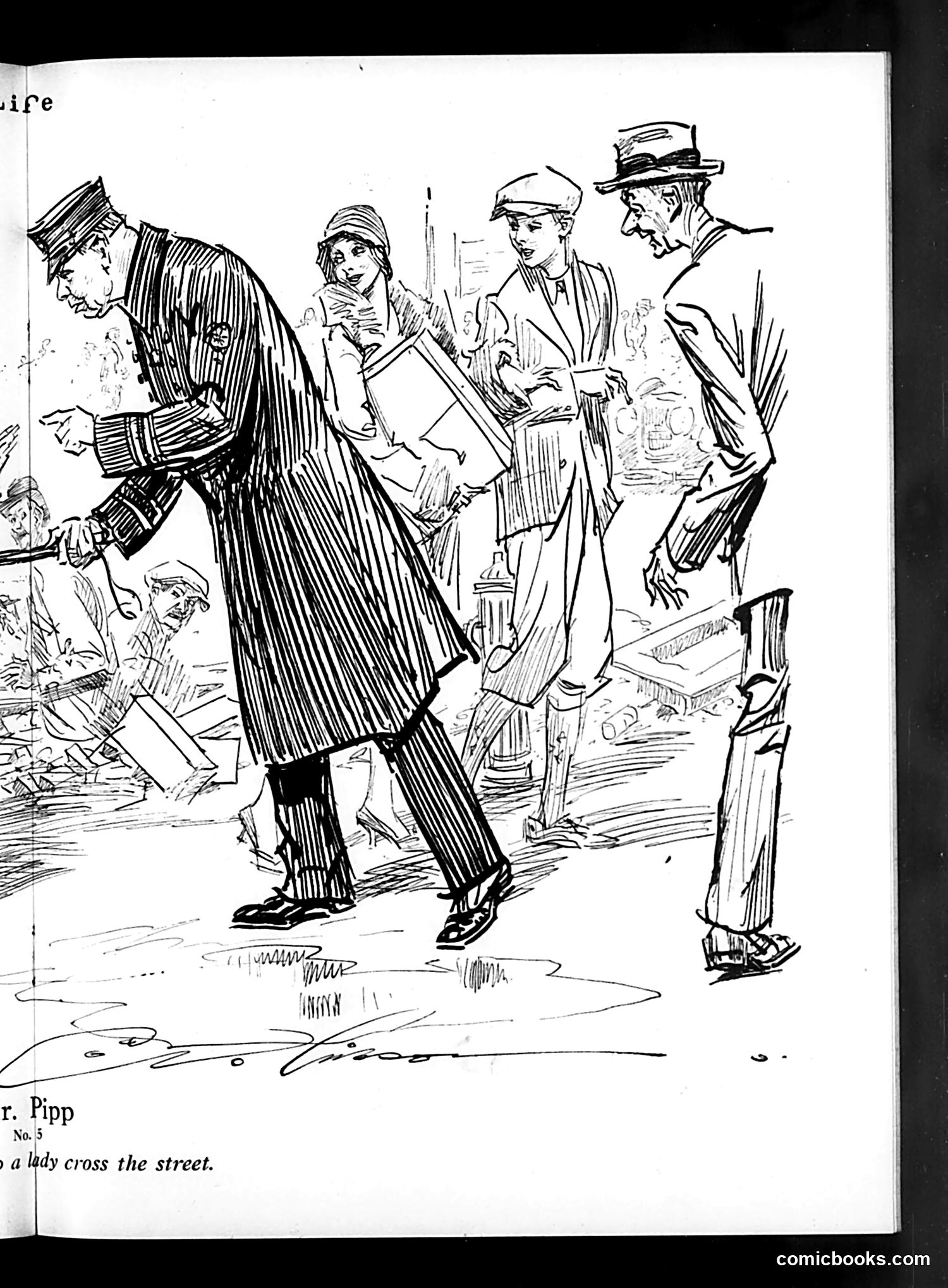
This appears to be a satirical cartoon from *Life* magazine (credited to "r. Pipp," No. 5) depicting street gallantry. The scene shows several working-class or middle-class men in period dress (early 20th century, based on clothing) apparently assisting a woman across the street—a conventional act of chivalry. The satire likely mocks either excessive chivalry or the contrast between gentlemanly pretense and reality. The exaggerated, somewhat awkward postures and expressions suggest the men are either bungling the "assistance" or that the courtesy itself is being treated as performative social theater rather than genuine helpfulness. Without additional caption text, the specific target remains unclear, but the humor appears rooted in class dynamics or changing social courtesies of the era.
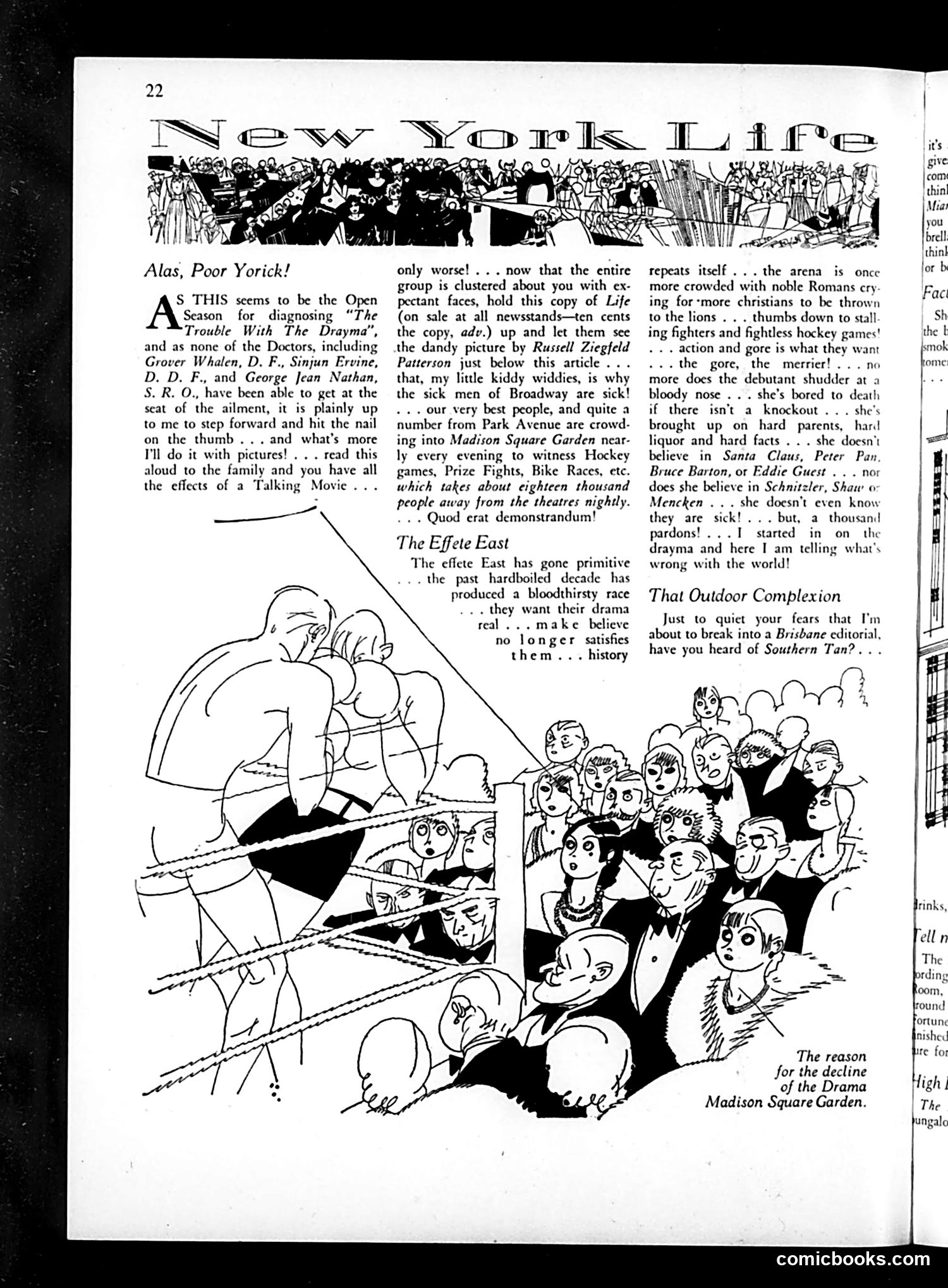
This satirical piece diagnoses why Broadway theater is declining. The author argues that New York's upper classes—"very best people" and "Park Avenue" residents—are abandoning theaters for Madison Square Garden's boxing matches, hockey games, and bicycle races, which draw eighteen thousand spectators nightly. The cartoon depicts aristocratic spectators thronging to violent sporting events rather than theatrical productions. The deeper critique: modern audiences crave raw action and gore over sophisticated drama. The author claims contemporary society has become "primitive" and "bloodthirsty"—comparing it to Romans watching Christians thrown to lions. Young women no longer believe in romantic ideals (Santa Claus, spirituality, or playwrights like Shaw and Mencken); they want authentic brutality instead. The satire mocks both declining theater patronage and the era's apparent moral coarsening among the wealthy elite who prefer spectacle to art.
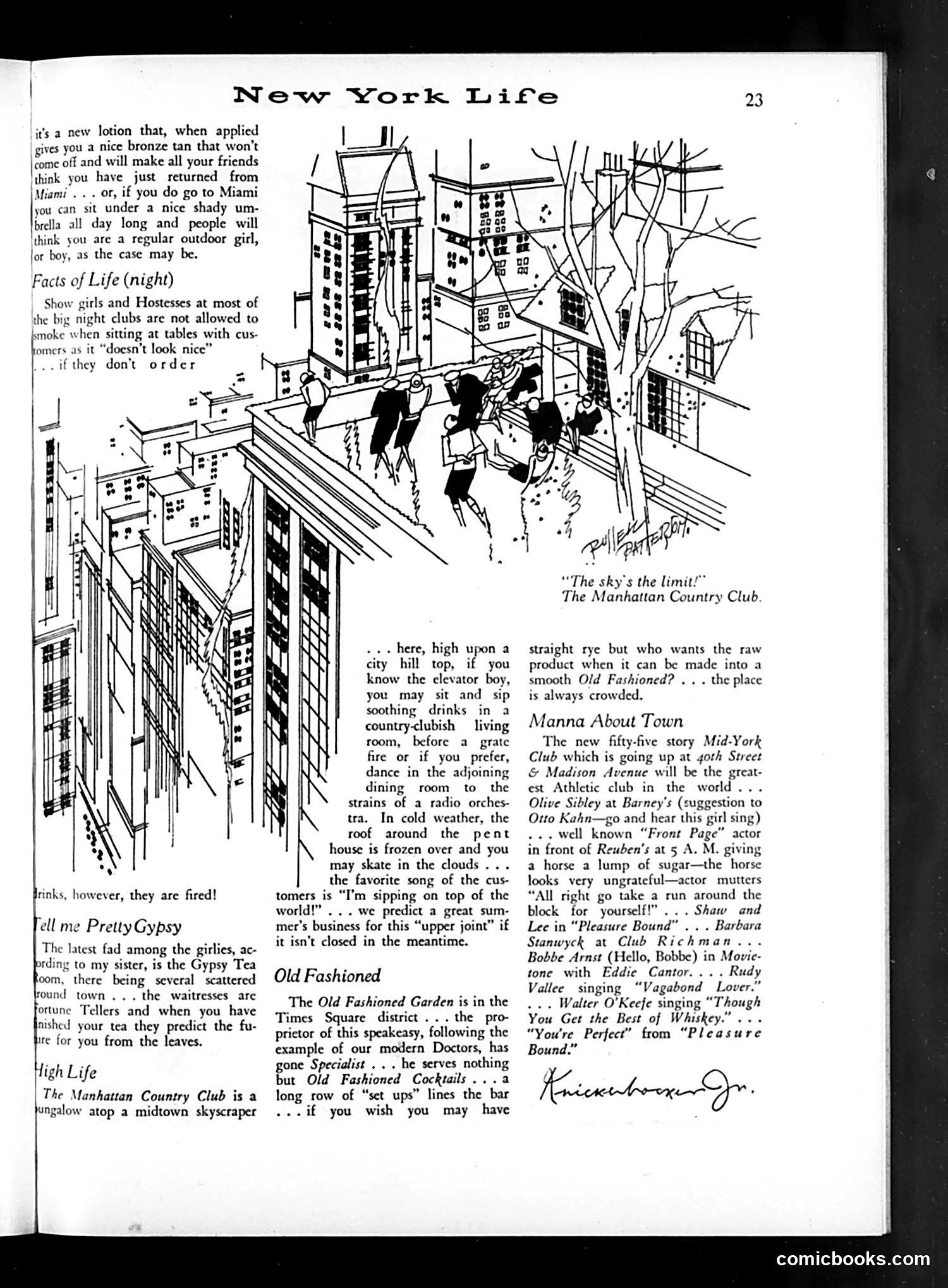
This page from *Life* magazine satirizes 1920s Manhattan nightlife and social pretensions through short humor pieces and a cartoon. The main cartoon depicts people dancing on a rooftop at the **Manhattan Country Club**—a real speakeasy operating illegally on a midtown skyscraper during Prohibition. The caption "The sky's the limit!" is a double meaning: both a boast about the club's exclusivity and a pun on its rooftop location. The text pieces mock various trendy establishments and social customs: fake tanning lotions to simulate Miami vacations, "gypsy tea rooms" with fortune-telling waitresses, and speakeasies like the "Old Fashioned Garden" that disguise raw alcohol as refined cocktails. There's also a jab at show girls being prohibited from smoking (to appear "respectable") while being fired if they don't buy drinks. The overall satire targets wealthy New Yorkers' shallow pursuit of fashionable venues and their creative circumvention of Prohibition laws while maintaining middle-class propriety.
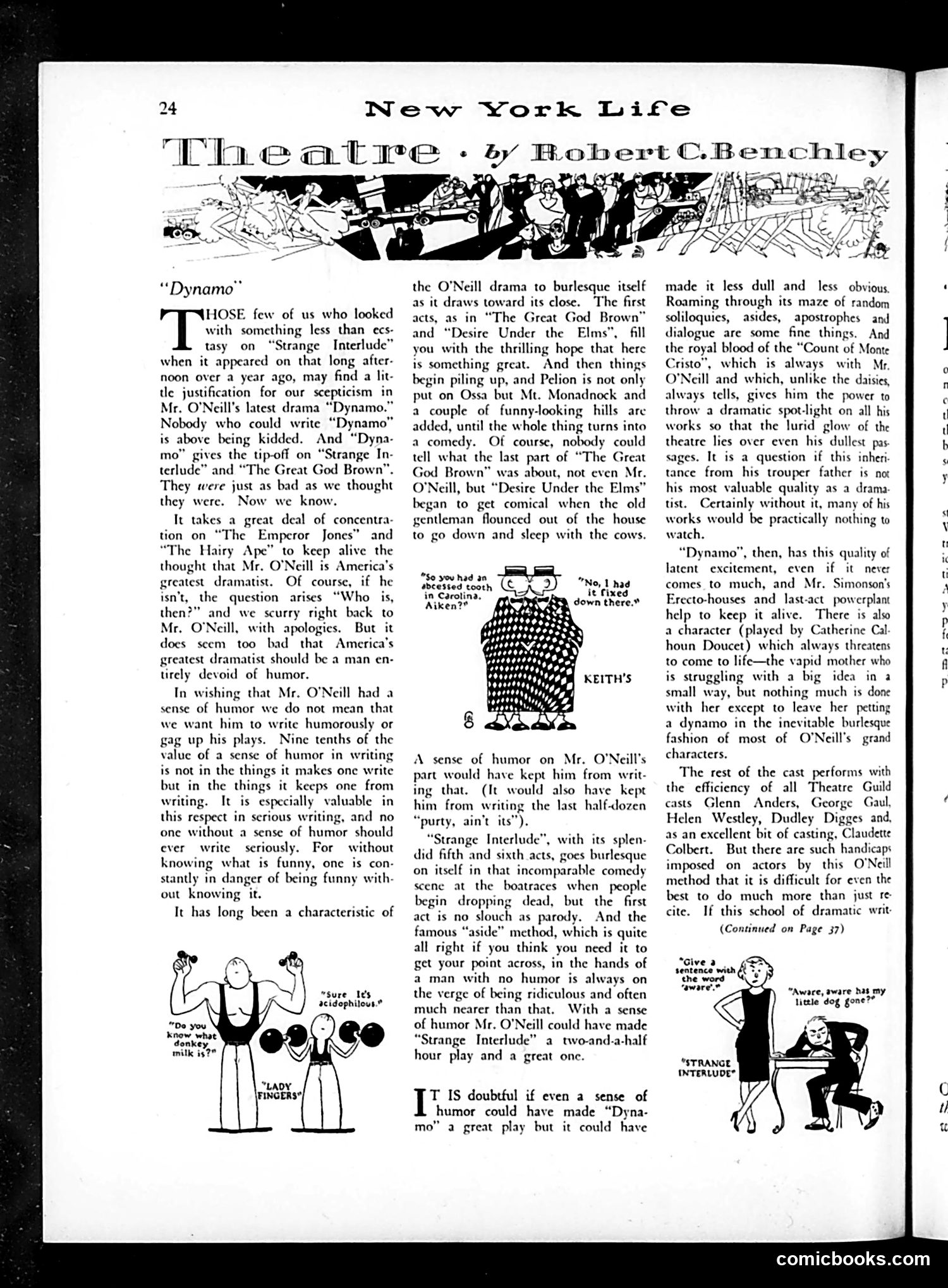
This is a theater criticism column by Robert C. Benchley reviewing Eugene O'Neill's recent plays, particularly "Dynamo." The page contains three small comic illustrations accompanying the text. **The Core Critique:** Benchley argues that O'Neill, America's greatest dramatist, fatally lacks a sense of humor. He's not suggesting O'Neill should write comedies, but rather that humor—understanding what's funny—prevents serious writers from *accidentally* becoming ridiculous. Benchley notes O'Neill's plays consistently descend into unintentional comedy in their final acts (citing "The Great God Brown," "Desire Under the Elms," and "Strange Interlude"), suggesting O'Neill doesn't recognize when his dramatic devices become absurd. **The Cartoons:** Simple line-drawings illustrate O'Neill's theatrical techniques—the "aside" method (characters speaking directly to audiences) and dramatic excess—rendered comically absurd to support Benchley's argument. **Historical Context:** This reflects 1920s-30s debates about modernist theater's legitimacy and O'Neill's reputation during his most experimental, critically divisive period.
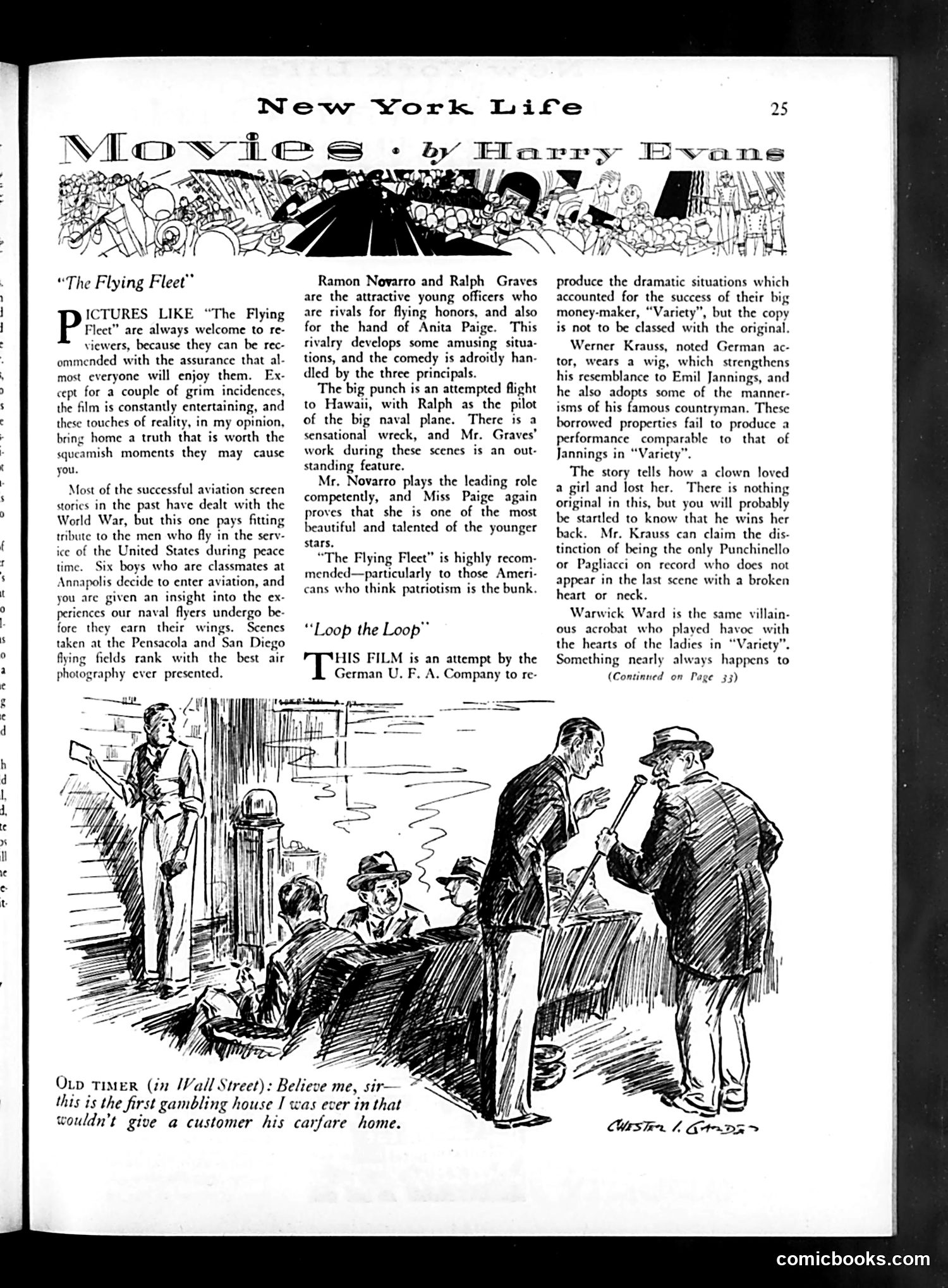
This page reviews two 1920s films. "The Flying Fleet" is a military aviation drama about Navy pilots training at Pensacola and San Diego, featuring romantic rivalry between officers Ramon Novarro and Ralph Graves over actress Anita Paige. The reviewer praises it as patriotic entertainment, notably excluding "grim incidences" that ground the fantasy—a reference to realistic crash scenes. The cartoon below satirizes Wall Street greed during the 1920s stock-market boom. An elderly man in a gambling den (metaphorically comparing stock speculation to gambling) boasts this is the first such establishment that didn't give losing customers carfare home—meaning it was so ruthless it left them completely broke. The joke highlights how stock market gambling impoverished ordinary people, a concern that would prove prescient before the 1929 Crash.
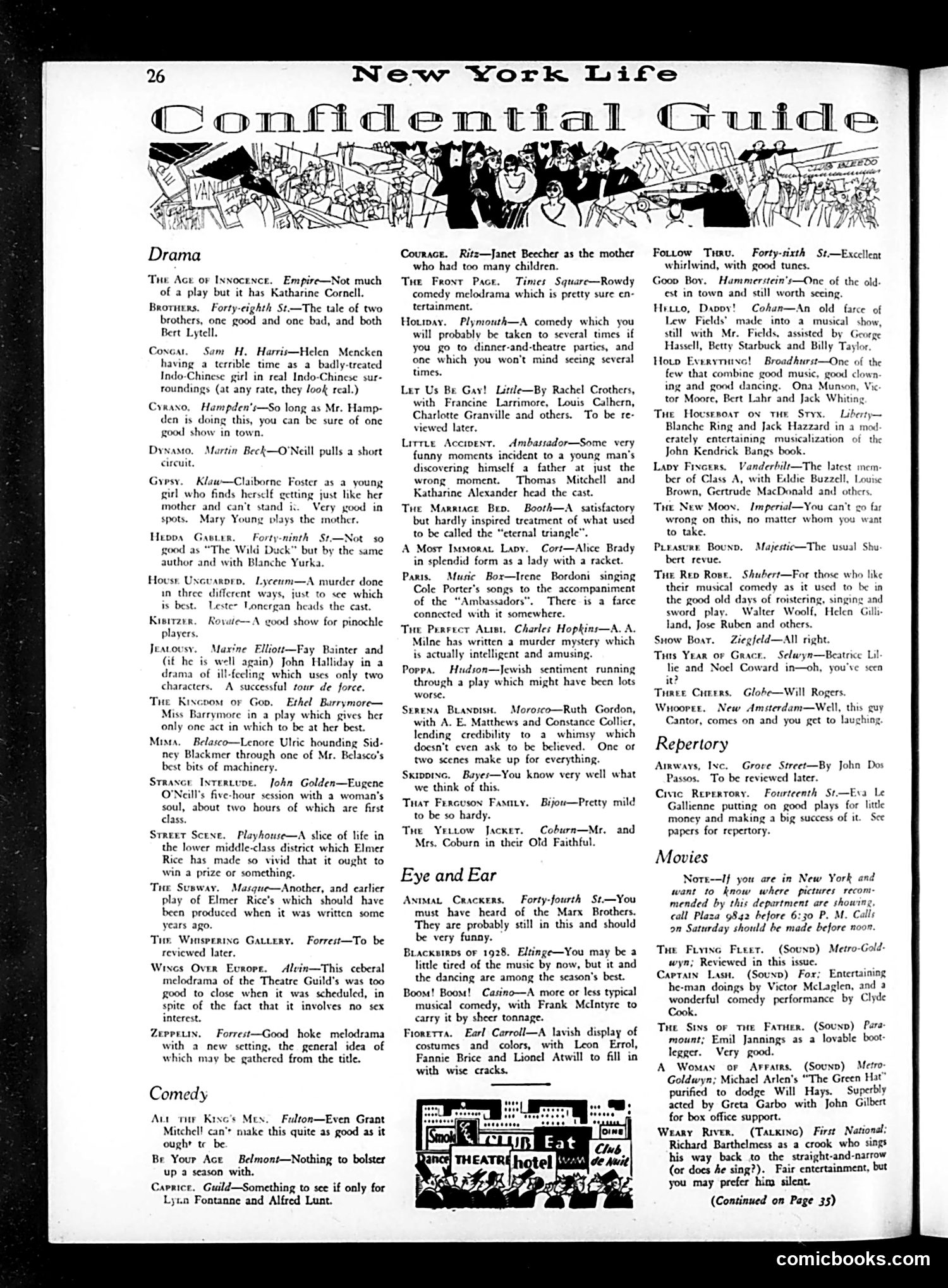
This is a **theater review section**, not a political cartoon page. It's a satirical guide to Broadway shows running in New York, likely from the mid-1920s based on the references (Eugene O'Neill plays, Elmer Rice works, Cole Porter songs). The "satire" is gentle: each show gets a brutally honest one-line summary—often mocking the plot, questioning the quality, or noting what makes it worthwhile. For example, *Kipitzer* is "A good show for pinochle players" (implying you won't miss much if you're distracted), and *By Your Age* gets "Nothing to bolster up a season with." The small illustration at bottom shows a theater marquee, reinforcing the theatrical theme. This reflects 1920s entertainment journalism: witty, dismissive commentary on commercial theater as insider entertainment criticism for a sophisticated urban readership.
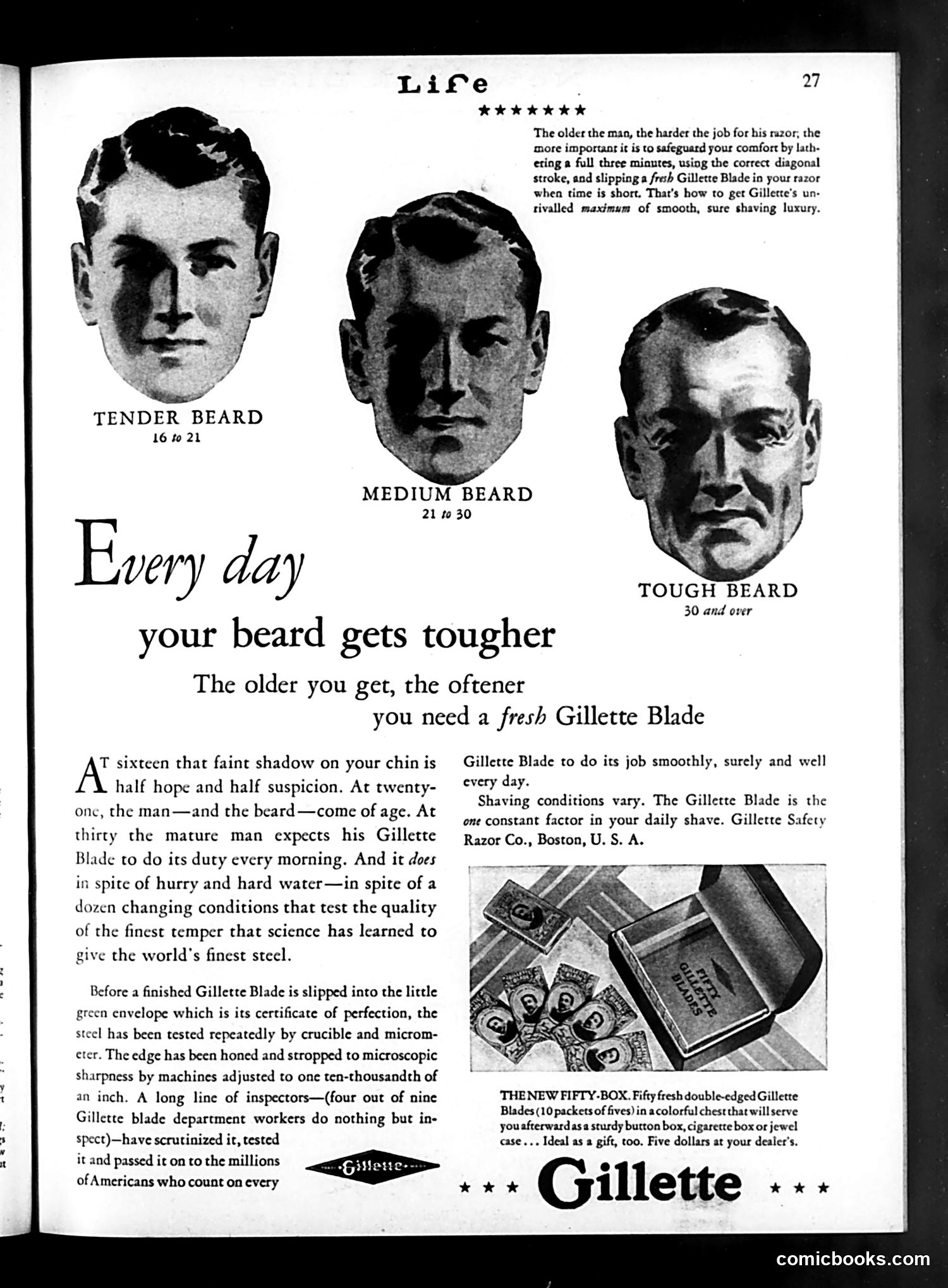
This is primarily a **Gillette razor blade advertisement**, not political satire. The page shows three male portraits labeled by beard growth stage (ages 16-21, 21-30, 30+), illustrating the central sales pitch: "Every day your beard gets tougher / The older you get, the oftener you need a fresh Gillette Blade." The ad uses a pseudo-scientific appeal—detailed descriptions of blade testing, microscopic precision, and quality control—to position Gillette as the reliable choice across all life stages. The humor is gentle and self-aware rather than satirical: the copy acknowledges that shaving conditions vary and that beards genuinely become more difficult to shave with age. The "fifty-box" product at bottom, marketed as serving dual purposes (button/cigarette box afterward), targets gift-giving. This is straightforward mid-century consumer advertising using age progression and masculine appeal rather than political commentary.
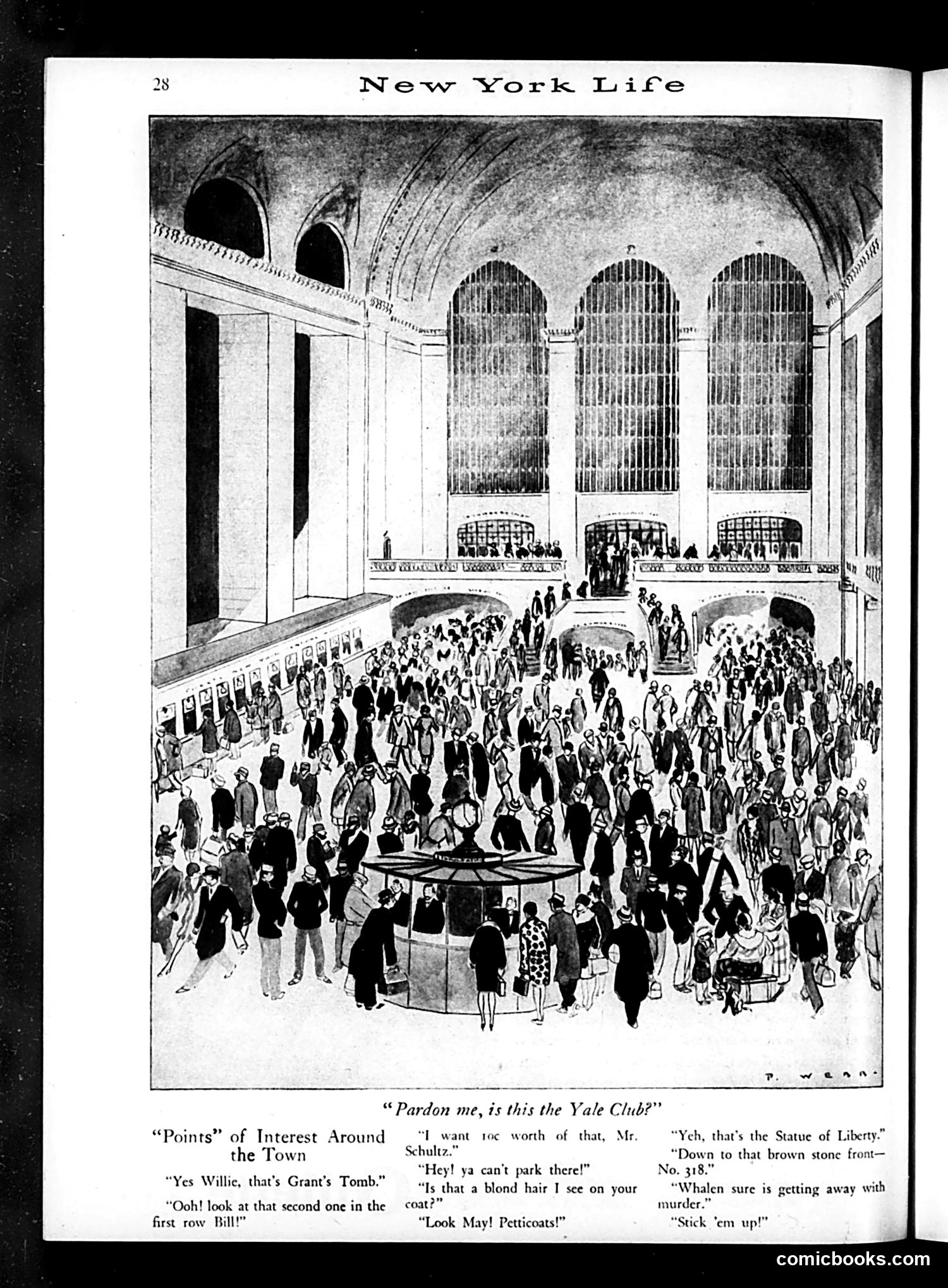
This is a single-panel cartoon satirizing New York City tourism and urban life, circa early 20th century. The scene depicts Grand Central Terminal (identifiable by its distinctive arched windows and crowded interior) packed with tourists and visitors. The humor comes from overlapping tourist conversations revealing stereotypical sightseeing experiences: visitors asking directions to the Yale Club, pointing out Grant's Tomb and the Statue of Liberty, remarking on petticoats and blonde hair, and joking about parking violations and crime ("Whalen sure is getting away with murder"—likely referring to Commissioner Grover Whalen's governance). The cartoon mocks both tourists' naïveté and New Yorkers' cynical indifference to famous landmarks. The phrase "Stick 'em up!" suggests the casual criminality associated with the city in contemporary perception. It's gentle social satire about the contrast between New York's celebrated attractions and its gritty reality.
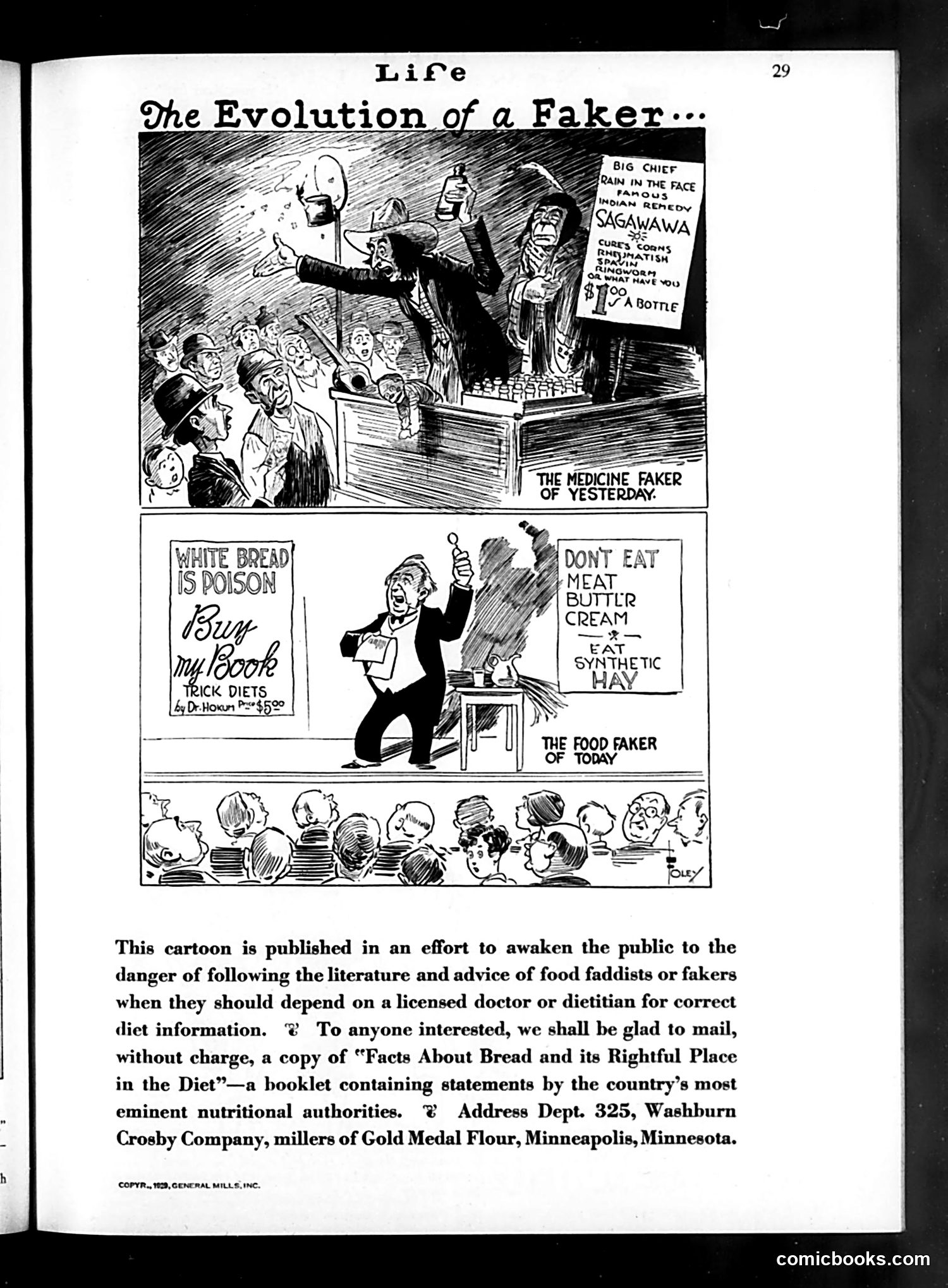
This 1929 satirical cartoon warns against food faddists and quack nutritionists. The top panel shows a medicine faker hawking a fake "Indian remedy" called Sagawawa to a crowd—representing fraudulent patent medicine salesmen of the era. The middle panel depicts the modern evolution: a charlatan now peddles diet books claiming "white bread is poison" and promoting synthetic hay instead of meat and dairy. This represents the emerging trend of pseudoscientific diet advice literature proliferating in the 1920s-30s. The bottom panel shows ordinary people accepting these false claims. The cartoon's message: people should trust licensed doctors and dietitians, not faddish literature. The entire page is essentially an advertisement by Washburn Crosby Company (Gold Medal Flour) promoting bread consumption and offering a legitimizing booklet from "eminent nutritional authorities." It's corporate messaging disguised as public health advocacy.
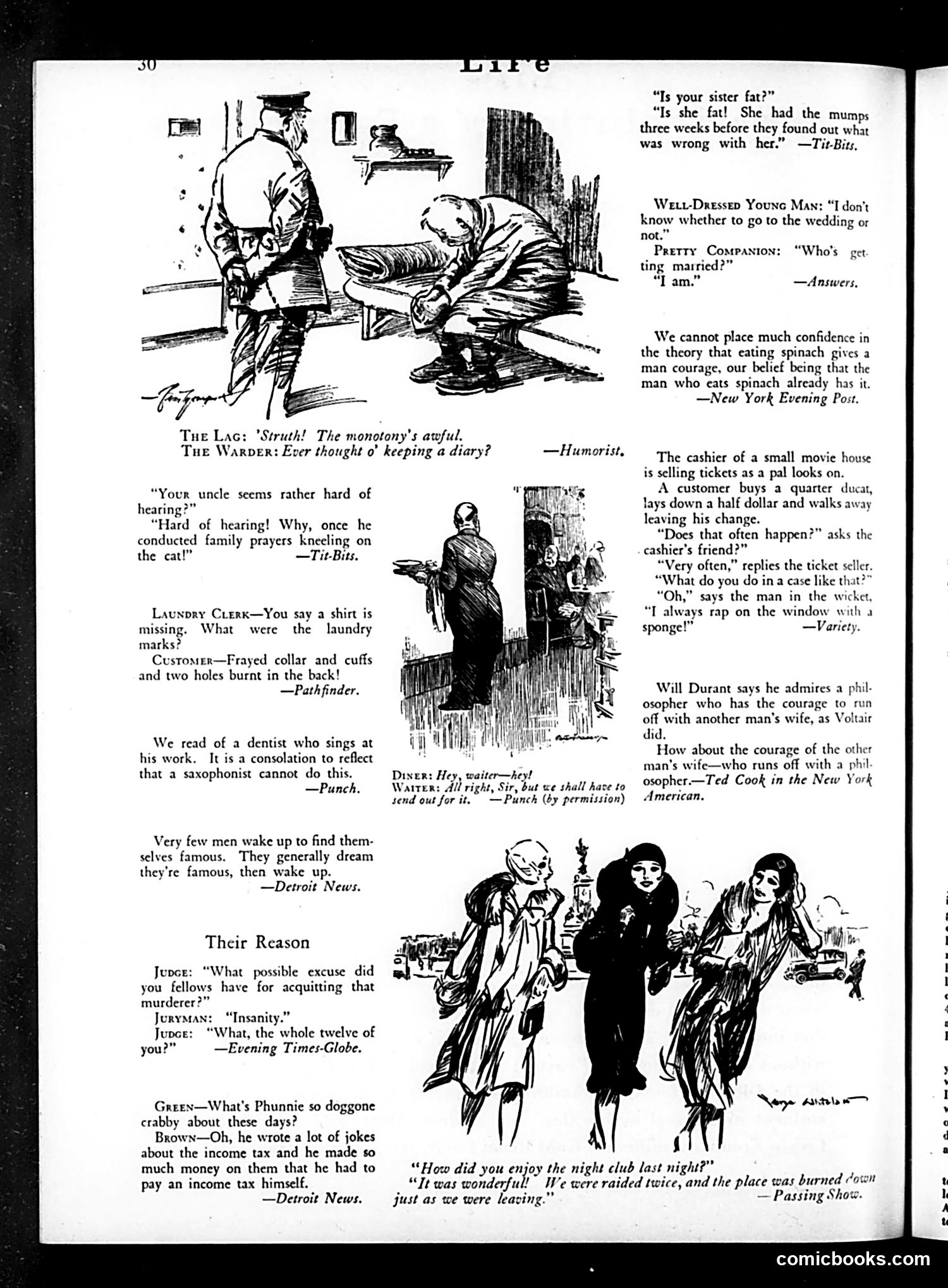
This page from *Life* magazine collects brief jokes and comic observations from various sources, representing early 20th-century American satirical humor. The cartoons and quips target everyday absurdities: **Key humor themes:** - **Domestic mishaps**: A laundry clerk's shirt marked by "frayed collar and cuffs and two holes burnt in the back" satirizes poor laundry service. - **Ironic reversals**: A joke writer making money from income-tax jokes, then owing taxes himself—the humor lies in self-inflicted consequences. - **Social commentary**: The movie-theater cashier who raps a sponge on the window when customers leave without their change suggests petty theft is commonplace enough to warrant a standard (absurd) response. - **Marital skepticism**: Multiple jokes mock marriage and relationships, reflecting period cynicism about romantic commitment. The humor is gentle, observational, and grounded in relatable middle-class experiences rather than political commentary. The *Passing Show* joke about a nightclub being "raided twice, and the place was burned down" references Prohibition-era speakeasies and their dangers.
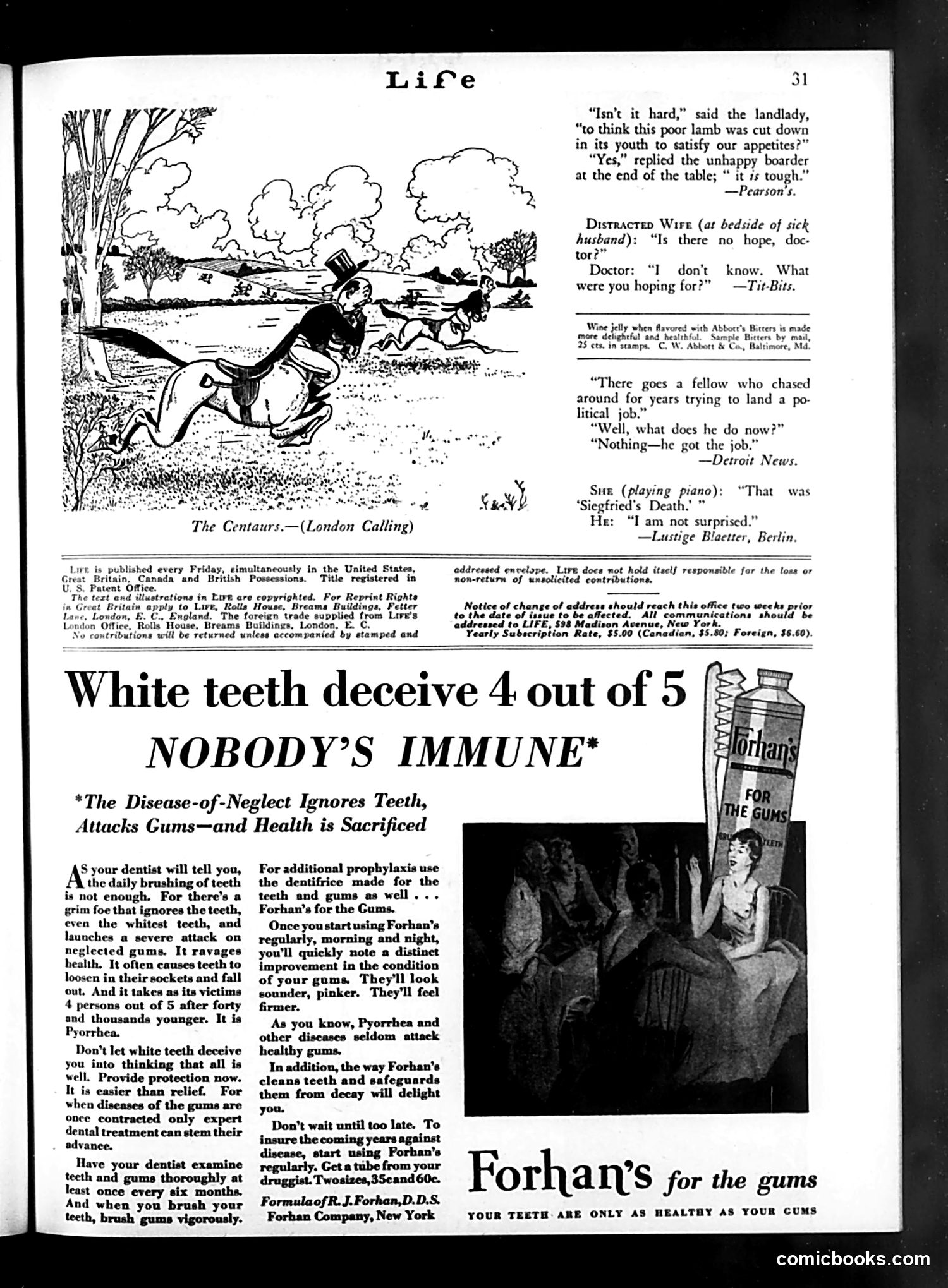
This page features several brief humor pieces typical of *Life*'s satirical style, plus a prominent dental advertisement. **The Cartoon ("The Centaurs"):** A man in formal dress flees on horseback from what appears to be a pastoral landscape. The caption credits it to "London Calling," suggesting British humor. The joke likely plays on the mythological centaur (half-man, half-horse) as visual wordplay. **The Jokes:** Several short, punchy pieces mock everyday situations—a boarder's awkward double-meaning about "tough" lamb, a doctor's unhelpful bedside manner, political job-seekers who accomplish nothing once employed, and a sarcastic response to hearing Wagnerian opera. **The Advertisement:** A full-page Forhan's toothpaste ad warning about pyorrhea (gum disease), claiming 4 of 5 people over 40 suffer from it. The ad emphasizes gum health alongside teeth cleaning—a progressive public health message for the era. The page represents *Life*'s mix of sophisticated satire and commercial content targeting educated, middle-class readers.
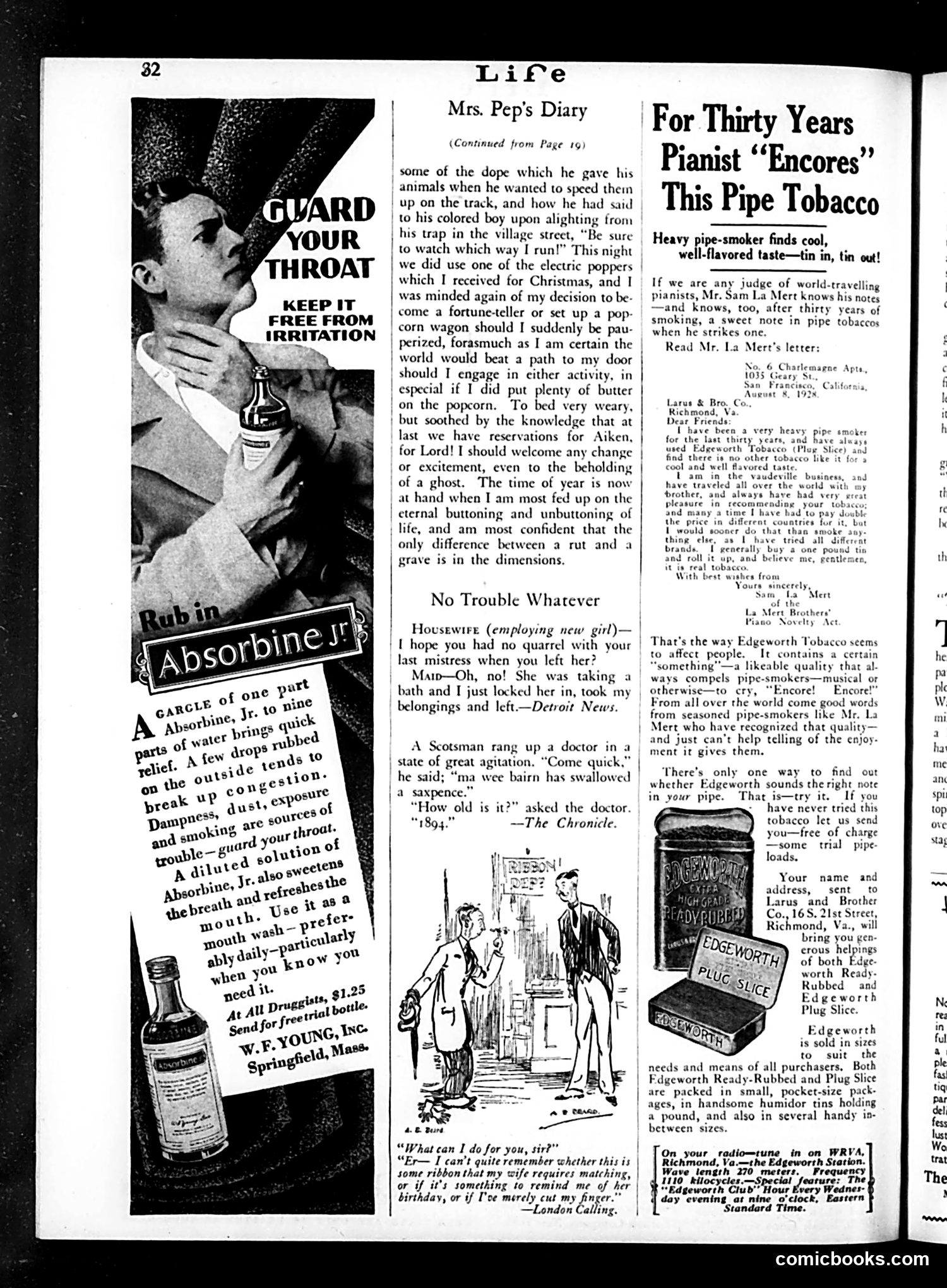
This page combines satirical content with period advertising typical of 1920s magazines. **Left side:** An advertisement for Absorbine Jr., a topical remedy, uses the pitch "Guard Your Throat." The copy emphasizes preventing irritation and congestion through daily use—reflecting early 20th-century patent medicine marketing that made broad health claims. **Center:** Three brief humorous anecdotes mock everyday situations: a housewife's new servant conveniently locks the previous employer in the bath; a Scotsman panics over his baby swallowing a sixpence (dated 1894, suggesting confusion); a man unsure whether a ribbon matches his wife's needs or reminds him of her birthday, or if he's cut his finger—gentle satire on male forgetfulness and domestic befuddlement. **Right side:** Testimonial advertising for Edgeworth pipe tobacco features pianist "Sam La Mert" endorsing the brand's "cool, well-flavored taste" after thirty years of smoking. This celebrity endorsement was standard advertising practice of the era, lending credibility through professional authority. The page prioritizes commercial content over political satire.
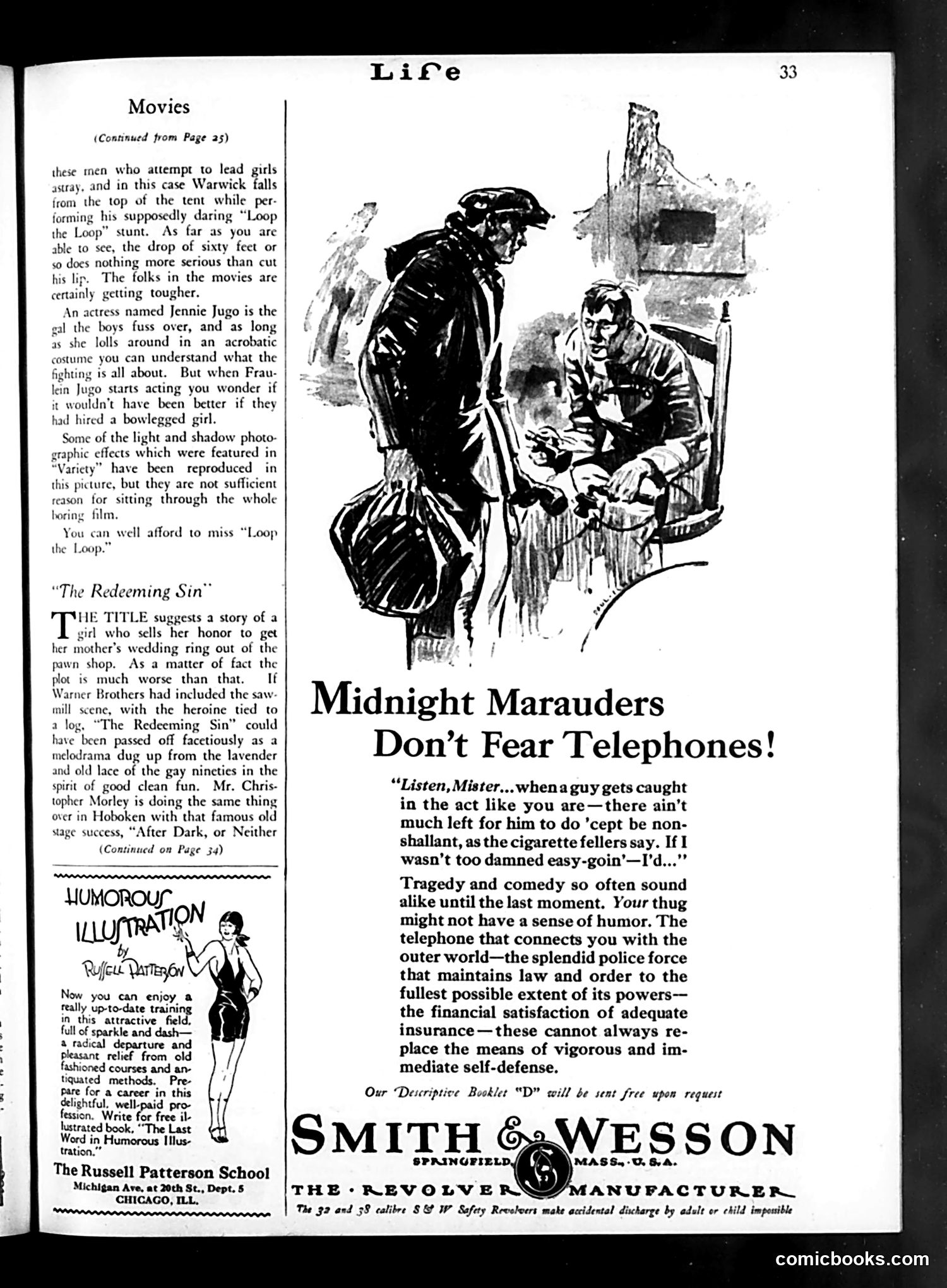
This page contains movie reviews and advertisements, not political cartoons. The movie section critiques two films: "Loop the Loop" (dismissed as boring despite featuring acrobatic stunts and actress Jennie Jugo) and "The Redeeming Sin" (mocked for its melodramatic plot about a girl pawning her honor). The primary illustration shows a scene from "Midnight Marauders Don't Fear Telephones!" — a silent film about a criminal caught in the act. The accompanying text uses this scenario to advertise Smith & Wesson revolvers. The pitch argues that while criminals might use humor as psychological defense, law-abiding citizens should rely on both police protection *and* immediate self-defense via firearms. The advertisement positions gun ownership as practical insurance against crime, reflecting early 20th-century attitudes toward civilian weaponry and personal security.
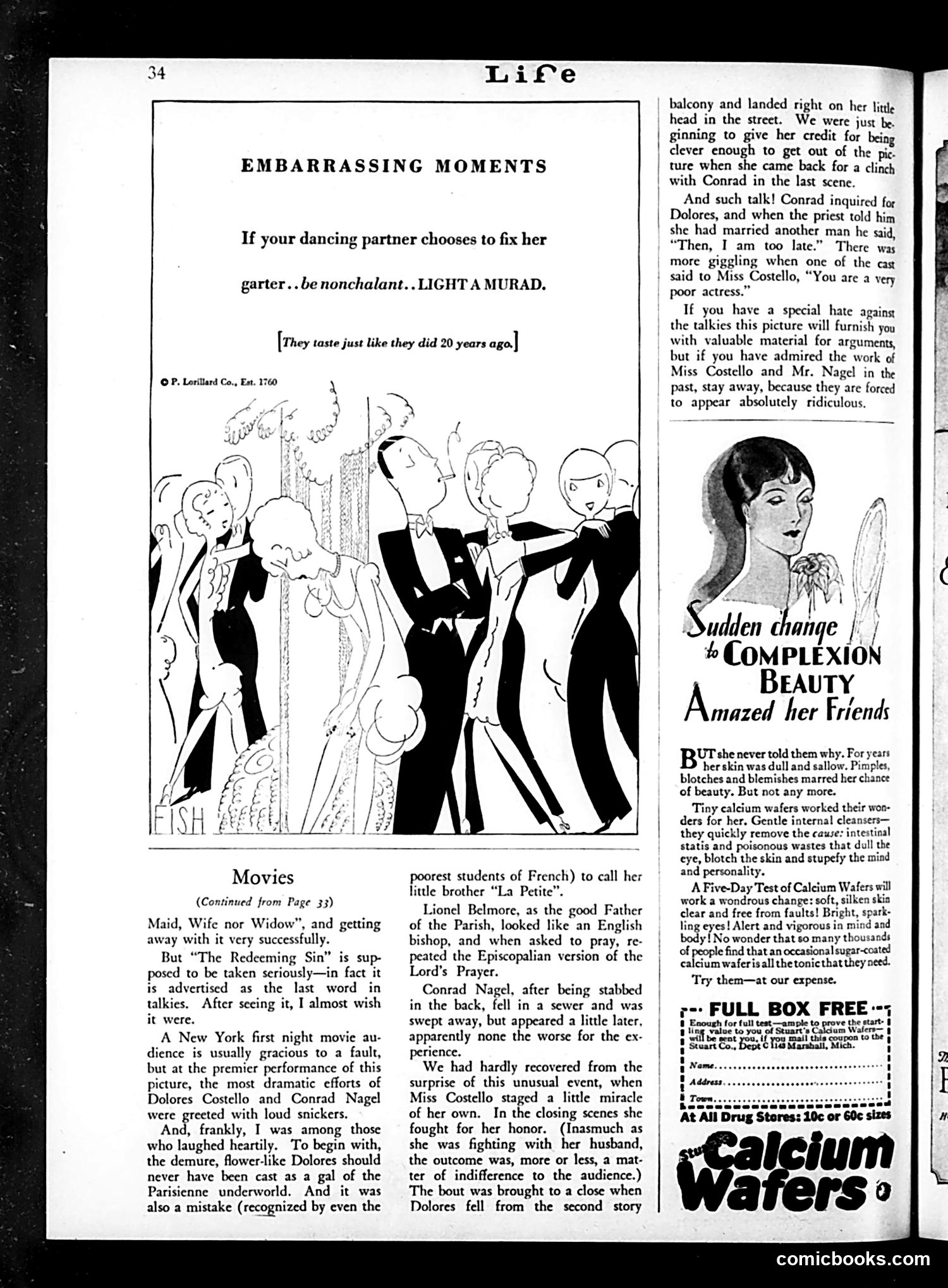
This page contains two distinct elements: **The Cartoon ("Embarrassing Moments"):** A humorous illustration about social awkwardness during dancing, depicting a couple at what appears to be a formal dance where the woman adjusts her garter while dancing. The joke relies on the premise that a gentleman should remain composed ("nonchalant") in such a situation—smoking a Murad cigarette supposedly helps maintain cool detachment. The ad tagline "They taste just like they did 20 years ago" emphasizes product consistency. **The Movie Review:** The critic savagely pans the talkie film "The Redeeming Sin" (starring Dolores Costello and Conrad Nagel), finding it unintentionally hilarious. Key absurdities: Costello miscast as a Parisian underworld character, her brother called "La Petite" (grammatically wrong), an actor playing a priest who looks like an English bishop, and a scene where a man survives being stabbed and swept into a sewer without injury. The review suggests the film's poor quality makes it worthwhile only for those wanting ammunition against talking pictures. Both items satirize early 1920s entertainment and social conventions.
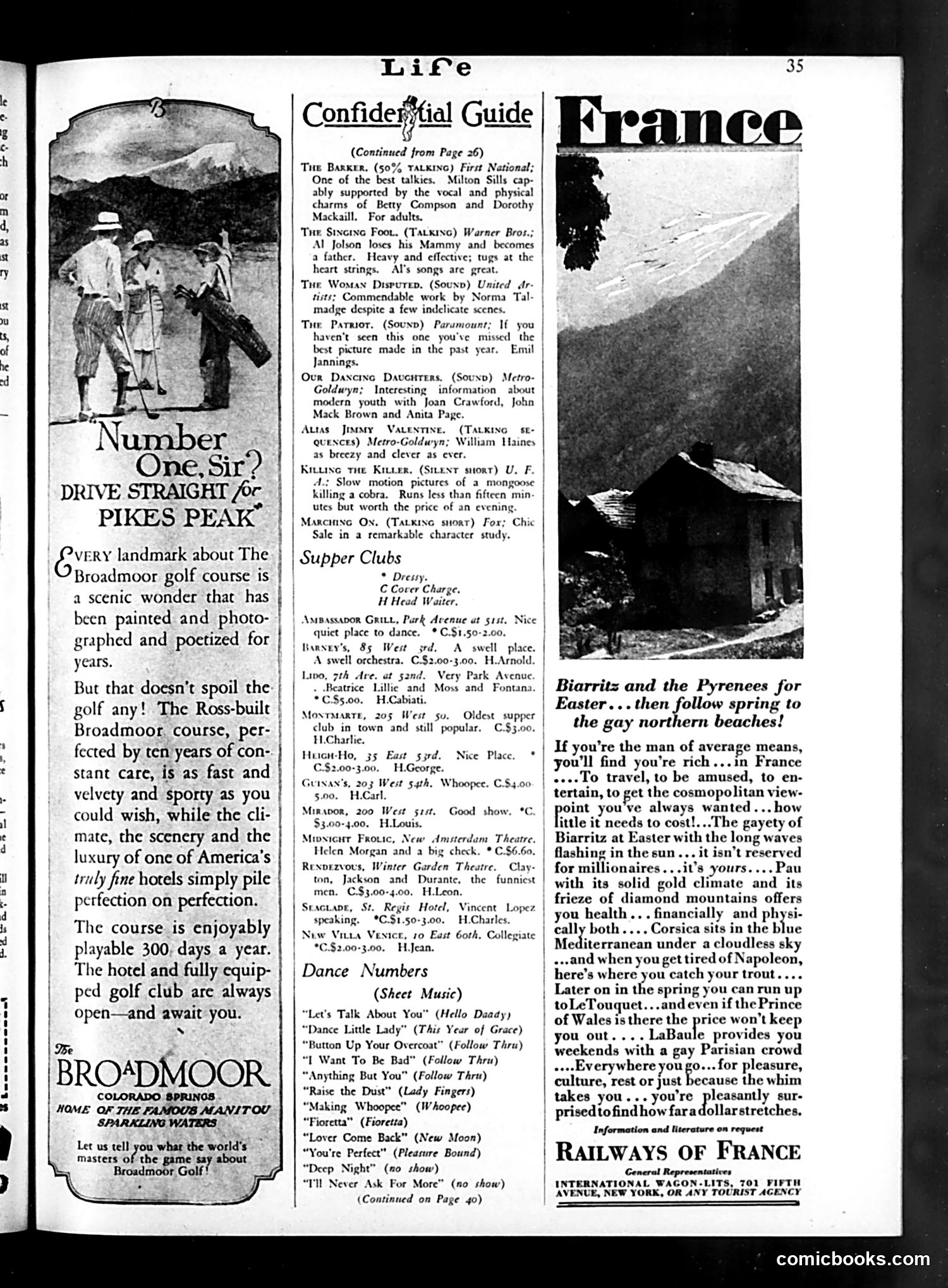
This page is primarily **advertising and entertainment listings**, not political satire. The left side features a **Broadmoor Golf Resort advertisement** showing golfers at a scenic Colorado course. The copy emphasizes luxury ("truly fine hotels simply pile perfection on perfection") and year-round playability—typical 1920s resort marketing targeting affluent Americans. The center and right columns contain entertainment guides: film reviews (noting early "talkies" like Al Jolson's *Singing Fool*), supper club recommendations in New York with pricing, and sheet music listings for popular songs. The right side advertises **French travel** via Railways of France, promoting Biarritz and the Pyrenees as Easter destinations for "the man of average means" who'll "find you're rich...in France"—marketing affordable luxury tourism. **No political content or satire is evident.** This reflects Life's 1920s editorial mix: consumer culture, entertainment, and leisure advertising alongside light social commentary.
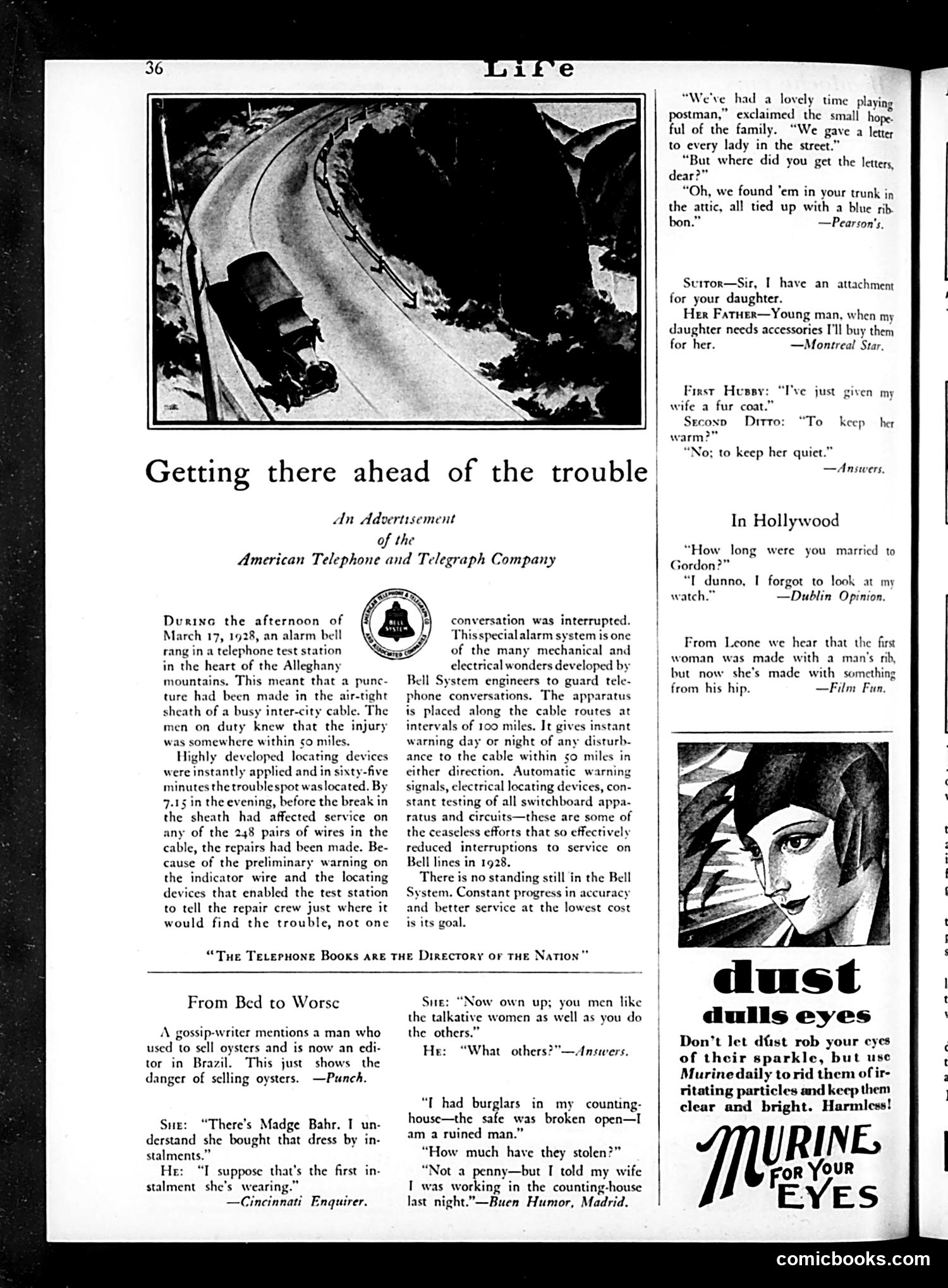
This page combines a substantial **Bell Telephone advertisement** with typical satirical humor content from Life magazine. The main feature is an advertisement celebrating Bell System's mechanical reliability. It describes a March 1928 incident where an underground cable was damaged in the Alleghany Mountains; the new alarm system detected the problem within 65 minutes, allowing repairs before service interruption occurred. The ad emphasizes technological progress and constant monitoring as Bell's competitive advantage—essentially arguing that subscribers benefit from invisible infrastructure management. The remaining content consists of brief joke exchanges typical of Life's humor section. These jokes involve domestic situations (wives, purchases, infidelity), social pretense, and wordplay—common satirical targets. The "Dust Dulls Eyes" advertisement for Murine eye drops appears as a separate small ad. The page reflects 1920s consumer culture celebrating technological modernity while maintaining traditional social comedy about marriage and gender dynamics.
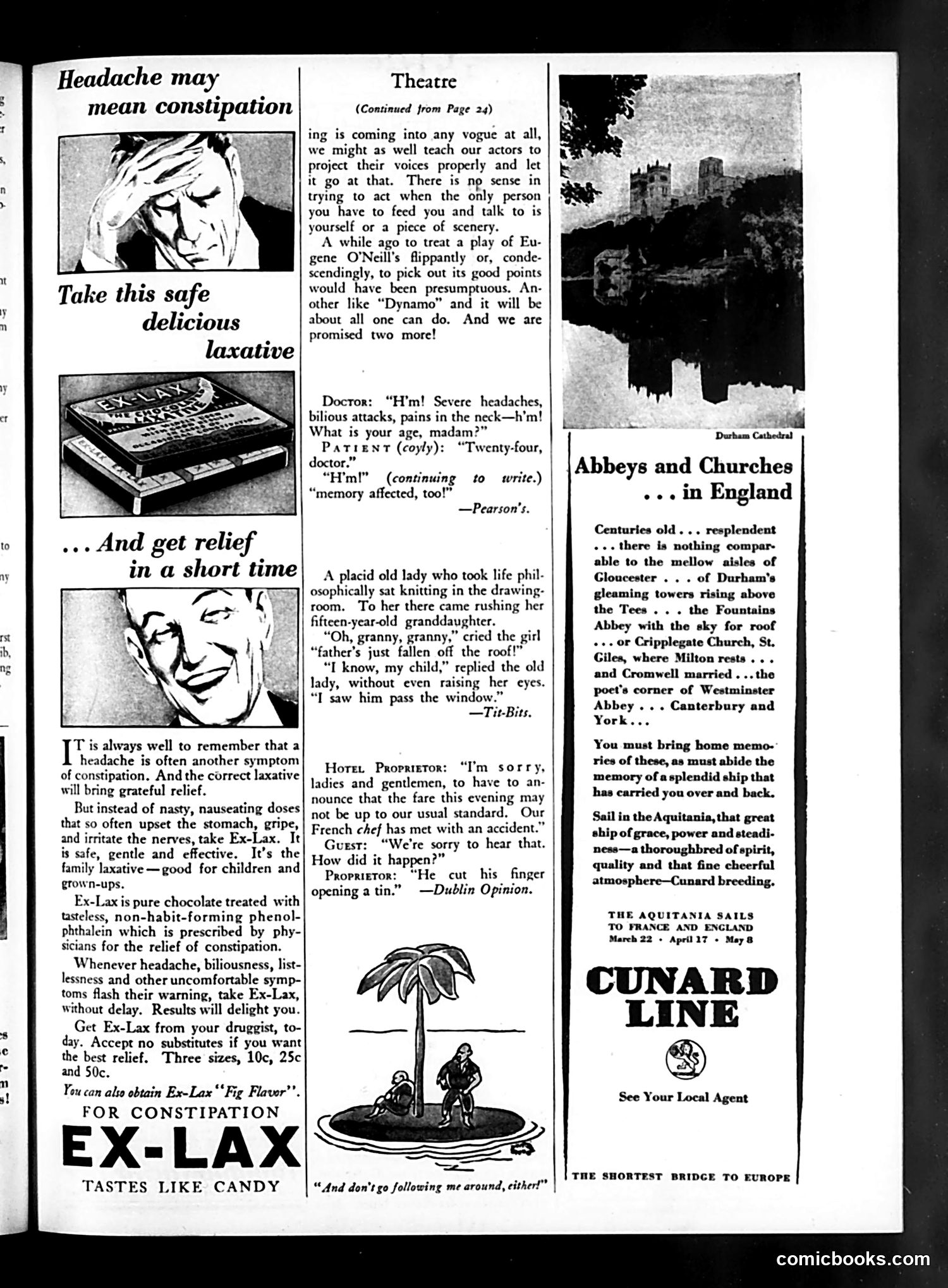
This page contains vintage advertising and humor typical of early 20th-century Life magazine. **Left side:** An Ex-Lax laxative advertisement using the period medical belief that headaches could indicate constipation. It features cartoon illustrations of suffering patients and promotes the chocolate laxative as gentle relief. The ads include small comic anecdotes (from *Pearson's*, *Tit-Bits*, and *Dublin Opinion*) using headaches and digestive complaints as punchlines—humor that reflected common concerns of the era. **Right side:** Tourist advertising for English abbeys and churches (Durham, Canterbury, etc.) paired with a Cunard Line ocean liner ad promoting transatlantic travel to Europe. The cartoon shows two figures on a desert island with the caption "And don't go following me around, either!"—a domestic quarrel joke typical of the period. The page is primarily **commercial content**—advertisements using both earnest health claims and humor to sell products and travel services to affluent readers.
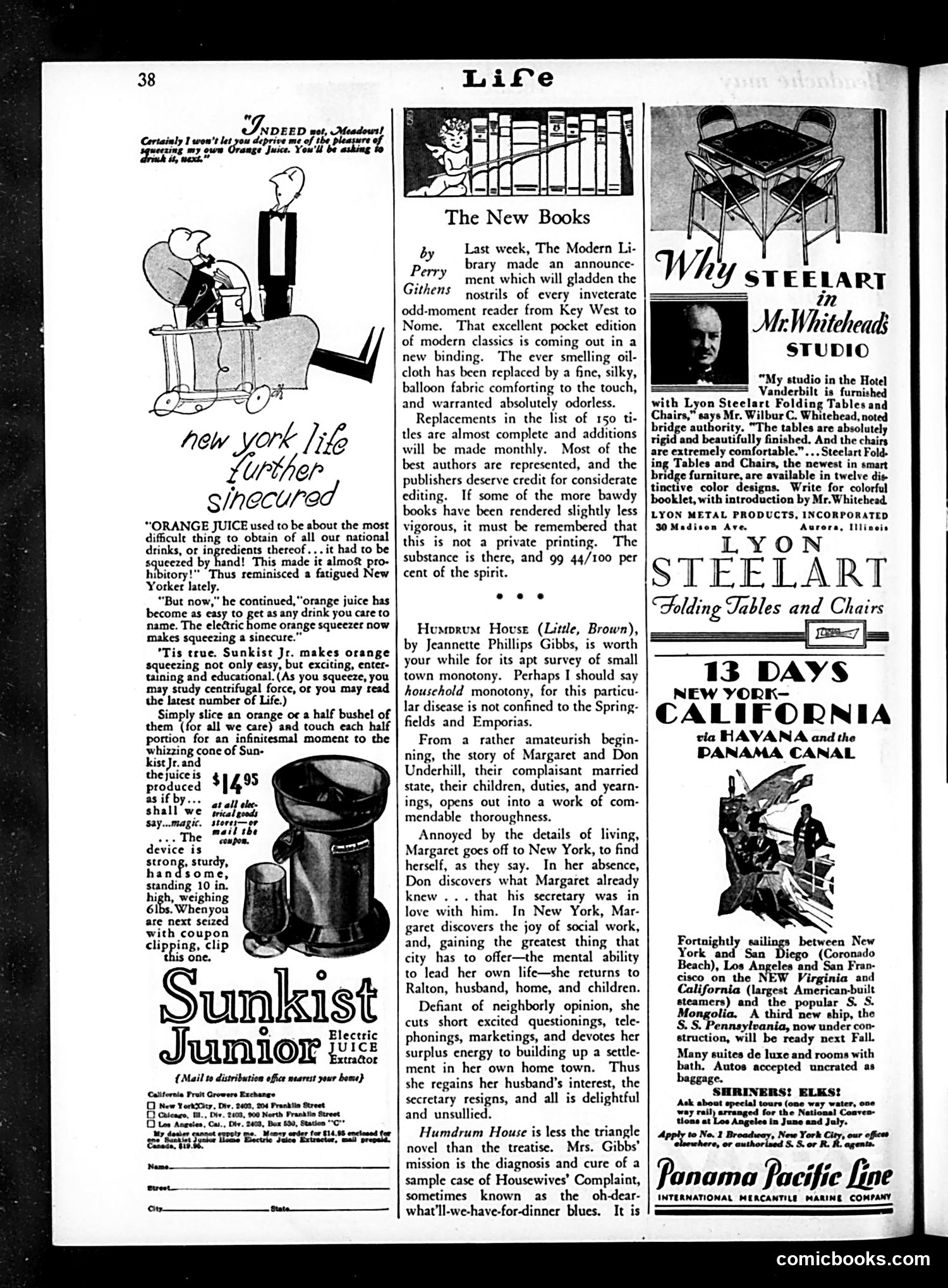
This page primarily contains **advertising and book reviews** rather than political cartoons. The main cartoon (top left) by Perry Githens shows a man in formal attire sitting in an oversized chair, captioned "New York Life Further Sinecured." The satire mocks how modern conveniences have eliminated effort from daily tasks—here, the man's exaggerated posture suggests leisure and ease. The accompanying text discusses the Sunkist Jr. electric orange squeezer, which transformed orange juice from difficult manual labor into effortless convenience. The joke is that modern life has become so streamlined that even the smallest tasks require no exertion. The bulk of the page features advertisements (Sunkist Jr., Lyon Steelart folding furniture, Panama Pacific cruise line) and book reviews of contemporary 1920s fiction, including *Humdrum House* by Jeannette Phillips Gibbs—a domestic novel about suburban marriage and women's social roles. The cartoon's satire targets the American consumer culture and technological optimism of the era, gently mocking how convenience appliances promised to eliminate all effort from modern life.
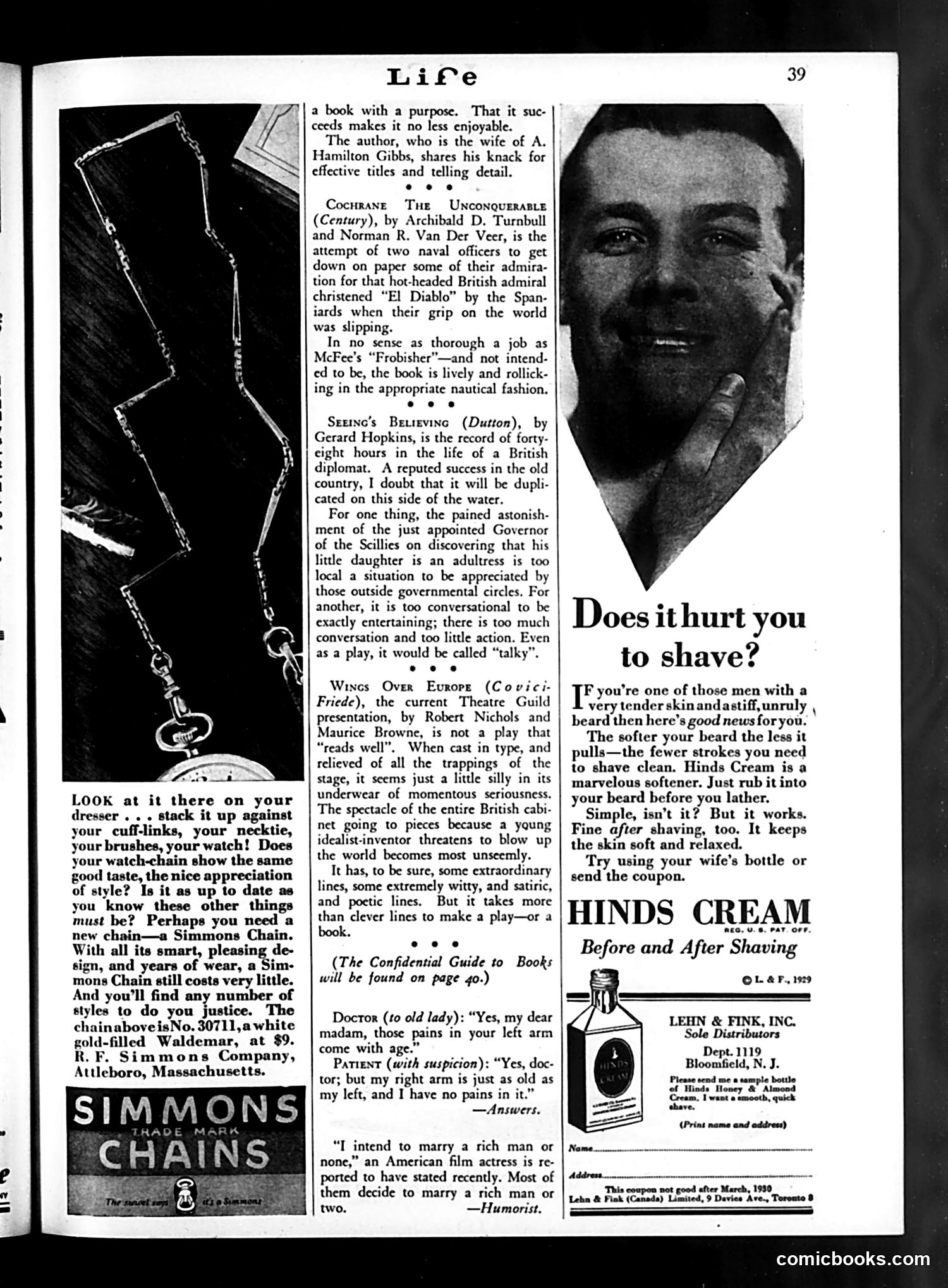
This page combines book reviews with period advertisements. The reviews discuss contemporary 1920s literature: *Cochrane the Unconquerable* (a naval biography), *Seeing's Believing* (a British diplomatic comedy criticized as too "talky"), and *Wings Over Europe* (a Theatre Guild play about a young inventor threatening world destruction—deemed overly serious despite witty lines). The advertisements reflect male grooming concerns of the era. A Simmons Chain advertisement emphasizes tasteful watch-chain design for the well-dressed man. More prominently, Hinds Cream advertises as a beard softener for sensitive-skinned men, solving shaving difficulties. A humor section includes jokes about age-related ailments and a quip about an actress's marriage intentions. The content reflects 1920s consumer culture and literary tastes, with advertising normalized throughout editorial content.
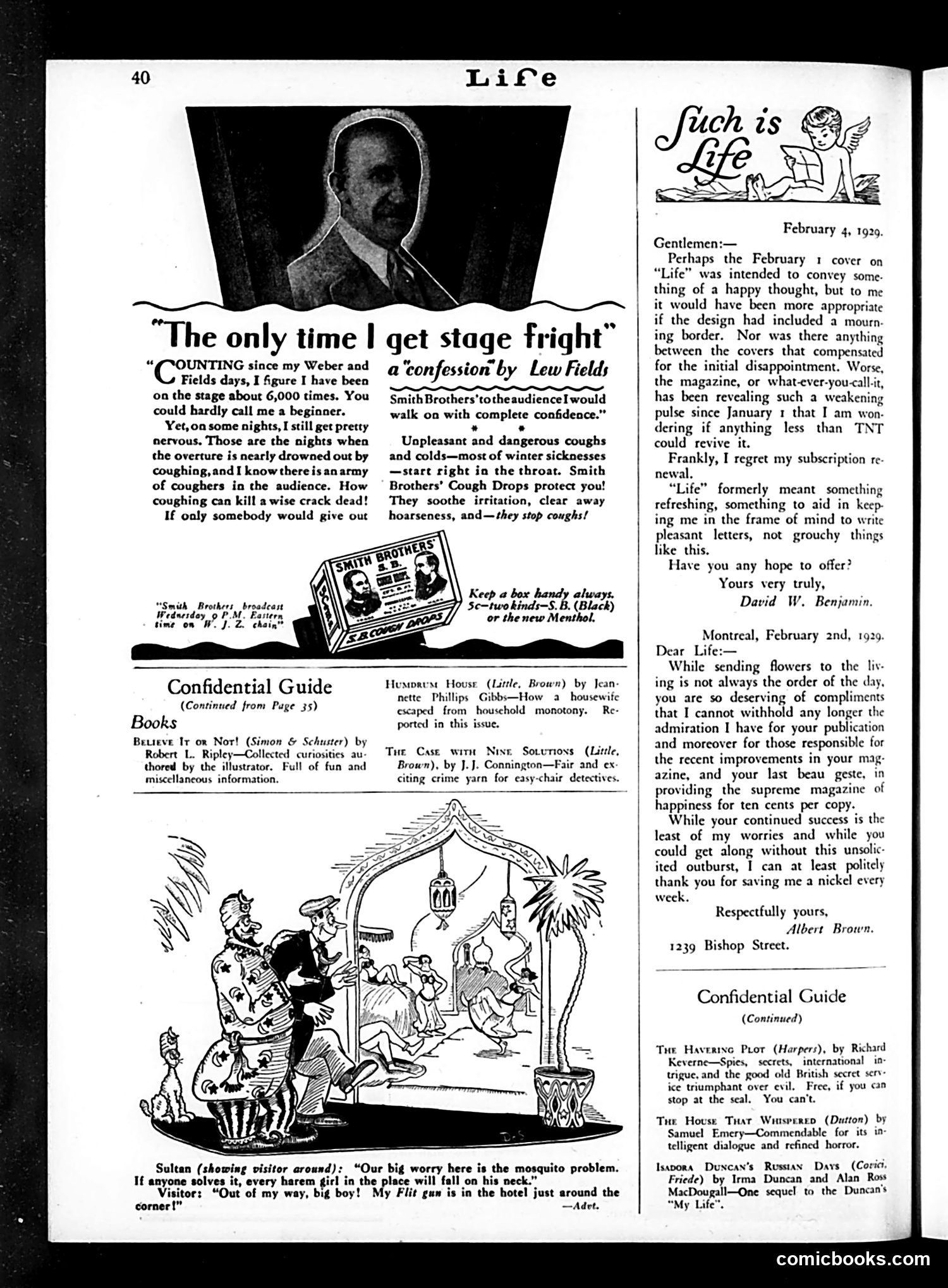
This page combines **advertising content with reader letters and book reviews**. The main feature is a **Lew Fields testimonial advertisement** for Smith Brothers Cough Drops. Fields, a famous vaudeville performer, confesses that stage fright from audience coughing disrupts his act—a humorous endorsement framing the product as essential for theater-goers' consideration of performers. Below is a cartoon joke about a **Sultan's harem** dealing with mosquitoes, playing on orientalist stereotypes common to 1920s humor (the punchline relies on the idea that a mosquito solution would be so valued the harem women would reward the solver). The **reader letters** express opposing views: one subscriber regrets renewing, claiming *Life* has lost vitality since January; another praises recent improvements, calling it excellent value at ten cents. The **"Confidential Guide"** reviews four books, including Ripley's *Believe It or Not!* and detective/adventure fiction—typical 1920s leisure reading recommendations.
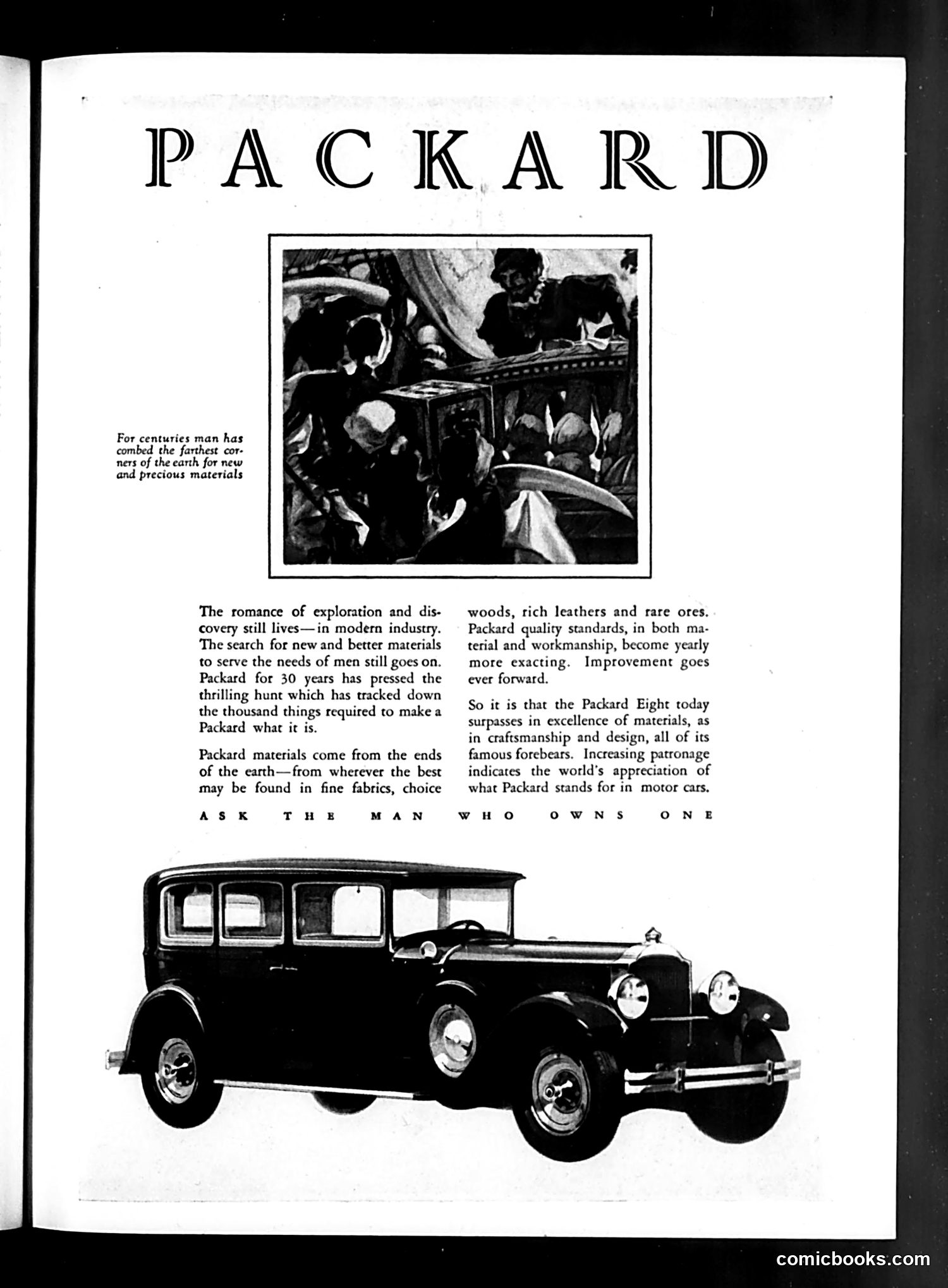
This is primarily a **luxury automobile advertisement**, not political satire. It promotes the Packard Eight motorcar by linking its quality to global exploration and material sourcing. **The Visual Narrative**: The top illustration depicts explorers/adventurers discovering exotic materials worldwide—establishing Packard's claim that their cars use premium materials sourced "from the ends of the earth: fine fabrics, choice woods, rich leathers and rare ores." **The Sales Pitch**: The text romanticizes material acquisition as an ongoing "hunt," positioning Packard's 30-year commitment to sourcing quality as evidence of superiority. The phrase "Ask the man who owns one" was Packard's actual advertising slogan, implying satisfied customers as proof of excellence. **Historical Context**: This appears from the interwar/early Depression era when luxury car marketing emphasized craftsmanship and exclusivity to affluent buyers. The "romance of exploration" reflects period fascination with global discovery and imperial-era resource extraction. **No satire is present**—this is straightforward corporate advertising celebrating conspicuous consumption.
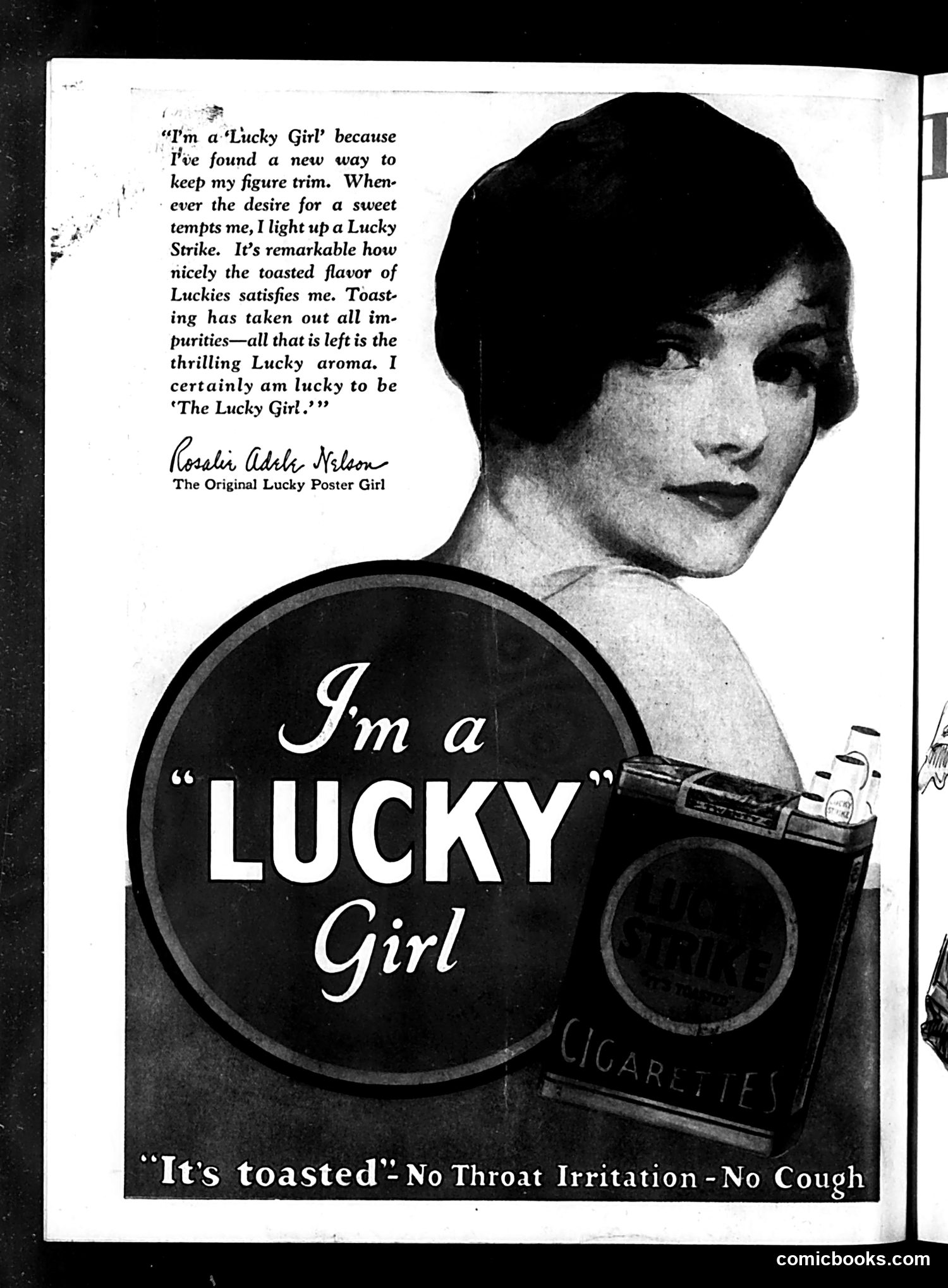
This is a **cigarette advertisement**, not political satire. It features Rosalie Adele Nelson, identified as "The Original Lucky Poster Girl," endorsing Lucky Strike cigarettes. The ad's appeal targets **weight-conscious women** of the era, claiming cigarettes suppress appetite ("light up a Lucky Strike" instead of eating sweets). The "toasted" process is promoted as removing "impurities," addressing contemporary health anxieties about throat irritation and cough. This represents a historical marketing strategy exploiting both vanity and emerging health concerns. The tagline "No Throat Irritation—No Cough" ironically attempts to position cigarettes as safe, a claim now recognized as fraudulent. This reflects pre-regulation tobacco advertising when health claims were unregulated and such endorsements by celebrities were standard practice.